
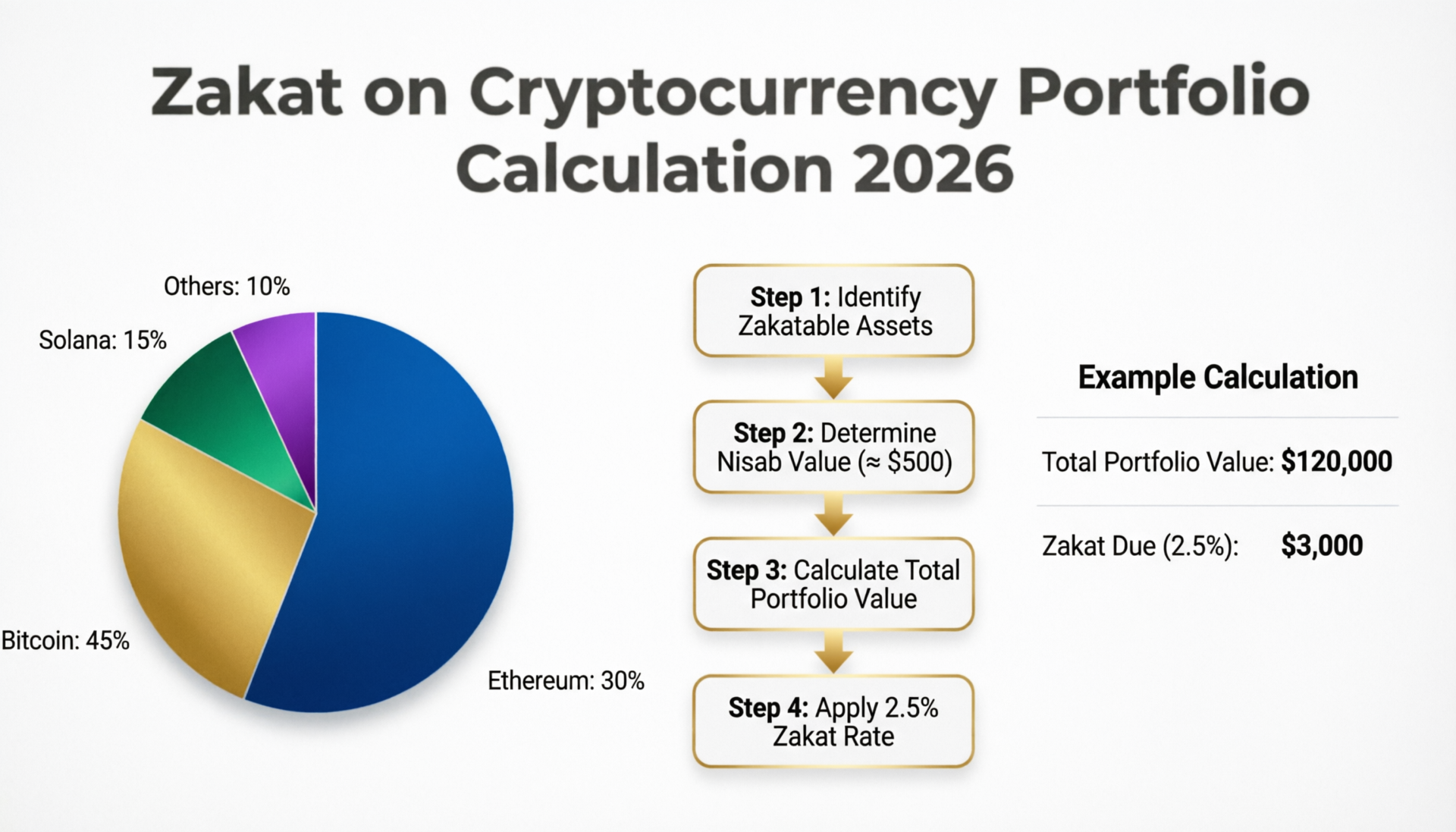

Zakat on Cryptocurrency for UK, US and Europe
Zakat on cryptocurrency is the annual 2.5% charity due on eligible crypto and digital assets once your total zakatable wealth is above the nisab and a lunar year has passed. To work out your zakat, you take the current market value of your halal crypto, add it to your other zakatable assets, check you’re above the gold-based nisab, then give 2.5% of that total to eligible recipients.
Introduction
Zakat on cryptocurrency is the annual 2.5% charity Muslims pay on eligible crypto and digital assets once their total zakatable wealth stays above the nisab for a whole lunar year. In practice, it usually means adding the current value of your Bitcoin, Ethereum and other halal coins to your cash and investments, then giving 2.5% of that total to those entitled to zakat.
This guide pulls together mainstream contemporary views from trusted zakat bodies in the US, UK and Europe, and then translates them into practical, calculator-ready steps for 2026. It’s designed for Muslims holding crypto in places like New York, London, Berlin or anywhere across the EU who just want to know: Do I pay zakat on my crypto and if so, how much and how do I pay it?
What is zakat on cryptocurrency and who has to pay it?
Zakat on cryptocurrency is usually treated as 2.5% of the market value of your zakatable crypto, once your total zakatable wealth (crypto + cash + other qualifying assets) stays above the nisab for a full lunar year. Most contemporary zakat organisations describe eligible crypto as part of “money and trade goods” when it is halal, valuable, and can be exchanged for cash or goods.
Defining zakatable crypto and digital assets
Zakatable wealth is anything that qualifies as māl (wealth) in Shariah, grows or has the potential to grow, and sits in categories like cash, gold/silver or trade inventory. Many scholars now class mainstream cryptocurrencies and payment tokens as zakatable wealth similar to cash or trade goods, because they:
Hold value
Are owned and controlled by you
Can be traded and exchanged
Can be used as a medium of exchange
Bodies like National Zakat Foundation and other councils therefore treat eligible cryptocurrencies as zakatable at their fair market value on your zakat date, especially when you bought them to trade or as a store of value.
The halal/haram status of a coin is a separate fiqh question. If a coin or token is considered impermissible, you should seek specific guidance. But if you choose to treat a coin as halal and it meets the usual zakat conditions, the default assumption in mainstream guidance is that it is zakatable.
Who must pay zakat on cryptocurrency?
You must pay zakat on cryptocurrency if
You are Muslim, sane and legally free.
Your total zakatable wealth (including crypto) is at or above the nisab.
A lunar year (ḥawl) has passed over that wealth.
You don’t have short-term debts that bring you below the nisab.
This applies whether you live in the United States, United Kingdom, Germany, France, the Netherlands or elsewhere in the EU. Local tax rules and how your government treats crypto for tax purposes are different issues; the religious zakat criteria are broadly the same.
Typical profile examples
Long-term HODLer with Bitcoin and Ether sitting in cold storage
Active day trader flipping altcoins every week
Tech worker in Birmingham paid partly in tokens
Remote developer in Europe paid in USDT every month
If their combined zakatable assets (crypto + cash + other qualifying assets) exceed the nisab and stay there for a lunar year, they each owe 2.5% in zakat.
Key zakat triggers for crypto holders
A simple rule of thumb used by organisations like Zakat Foundation of America.
If your total crypto + cash + other zakatable assets ≥ nisab for a lunar year, you owe 2.5% zakat.
Common “yes, you probably owe zakat” scenarios.
Your long-term Bitcoin and Ether stack has grown and sits well above nisab.
You’re an active trader with a portfolio that regularly stays above nisab even when markets dip.
You’re a tech worker in Berlin or Amsterdam partially paid in USDT, with savings and ETFs on top.
You hold stablecoins as a cash parking spot for long periods.
If you’re above the nisab for cryptocurrency zakat once everything is added together, treat your crypto as part of your zakatable wealth.
How to calculate zakat on crypto step by step
Most scholars and fatwa bodies advise calculating 2.5% of the current market value of your zakatable crypto on your chosen zakat date, added to your other zakatable assets. You don’t pay 2.5% on each trade; you pay once a year on the total you hold on that date.
Quick formula and nisab thresholds
A widely used “fast answer” formula is
The nisab is the minimum wealth threshold. Most contemporary fiqh councils use the gold standard: the value of approximately 85g of gold on your zakat date.
Because gold prices move daily and FX rates differ, nisab in.
US dollars changes with global gold prices and USD rates
Pound sterling changes with gold and GBP strength
Euro changes with gold and EUR rates
For example, some German zakat calculators in recent years have set nisab in the region of €12,000 based on 85g of gold. Actual figures move with the market, so this is only a rough illustration; always check a live source.
To keep your zakat accurate, always check a live zakat calculator (e.g. Islamic Relief UK or Islamic Relief Deutschland) or ask a local scholar before finalising your amount.
Step-by-step: calculating zakat on your portfolio
If you’re asking “how to calculate zakat on cryptocurrency in USA step by step” or “how to calculate zakat on crypto UK with HMRC tax already paid”, the core method is the same:
Pick your zakat date
Choose a fixed Hijri date or a fixed Gregorian date each year and stick to it.
Pull current prices for each coin/token
Check reputable market data for Bitcoin, Ether, stablecoins and any other halal tokens you hold.
Convert everything to your base currency
For example, convert BTC, ETH and USDT into USD, GBP or EUR as applicable.
Add other zakatable assets
Include cash, gold/silver, business cash, certain shares and trading stock in the same currency.
Subtract immediate debts
Deduct short-term obligations due within the next 12 months, like an upcoming tax bill or overdue invoices.
Check if you’re above nisab
Compare the net total to the latest nisab in your currency.
Apply 2.5%
Multiply the final figure by 2.5% (0.025) to get the zakat due.
This method works even if you
Use multiple wallets and exchanges (just sum all balances)
Hold coins in hardware wallets (include them at market value)
Use DeFi protocols (include principal and any realised rewards that now belong to you)have small “dust” balances (you can round; scholars usually don’t require tiny fractions to be perfect)
Worked examples: Bitcoin, Ethereum and mixed portfolios
These examples are illustrative only; always check current prices and nisab for your real calculation.
Example 1 Single-coin Bitcoin holder (US)
You live in the US and HODL 0.5 BTC in self-custody.
On your zakat date, 1 BTC ≈ $60,000, so your BTC is worth $30,000.
You also have $5,000 in a cash savings account.
No short-term debts.
Zakatable wealth = $30,000 + $5,000 = $35,000
Assume the nisab that day is roughly $6,000 (check live)
You’re above nisab, so:
Zakat = $35,000 × 0.025 = $875
Example 2 – BTC + ETH + stablecoins (UK)
You live in the UK.
0.1 BTC at £40,000 = £4,000
2 ETH at £2,000 = £4,000
3,000 USDT ≈ £2,400 equivalent
Cash in bank: £600
Credit card bill due next month: £1,000
Total crypto = £4,000 + £4,000 + £2,400 = £10,400
Add cash = £10,400 + £600 = £11,000
Subtract short-term debt = £11,000 − £1,000 = £10,000
If gold-based nisab is, say, £3,000 that day, you’re above it.
Zakat = £10,000 × 0.025 = £250
Example 3 German/EU tech worker, mixed assets
You’re a Muslim engineer in Germany with:
Crypto portfolio: €6,000
Euro savings: €4,000
Share portfolio (treated like tradeable investments): €5,000
Short-term debts due within a year: €2,000
Total zakatable assets = €6,000 + €4,000 + €5,000 = €15,000
After debts = €15,000 − €2,000 = €13,000
If nisab is around €12,000 that day, you’re above it, so:
Zakat = €13,000 × 0.025 = €325
This illustrates the similarity between zakat on crypto and zakat on shares: both can be treated as zakatable at market value if you hold them to trade or as liquid investments.
If you’re searching in German “wie berechne ich zakat auf Kryptowährung in Deutschland Beispiel”, this third example is roughly what scholars and German zakat calculators have in mind.
What kinds of crypto and digital assets are zakatable?
In most mainstream views, payment tokens, currencies and investment-style crypto are treated as fully zakatable at their market value if they’re halal and you hold them as wealth or trade inventory. That includes trading coins, long-term HODL stacks and many stablecoins.
Trading coins vs long-term HODL vs stablecoins
For coins like Bitcoin, Ether and major altcoins:
If you buy them to resell or actively trade, they’re treated like trade goods and fully zakatable at market value.
If you buy them as a store of value, most councils still treat them like cash, so also fully zakatable.
This is where “zakat on long-term HODL vs trading coins” is mostly a question of intention classification, not whether zakat applies at all. In practice, both usually end up zakatable at 2.5% of their value on your zakat date.
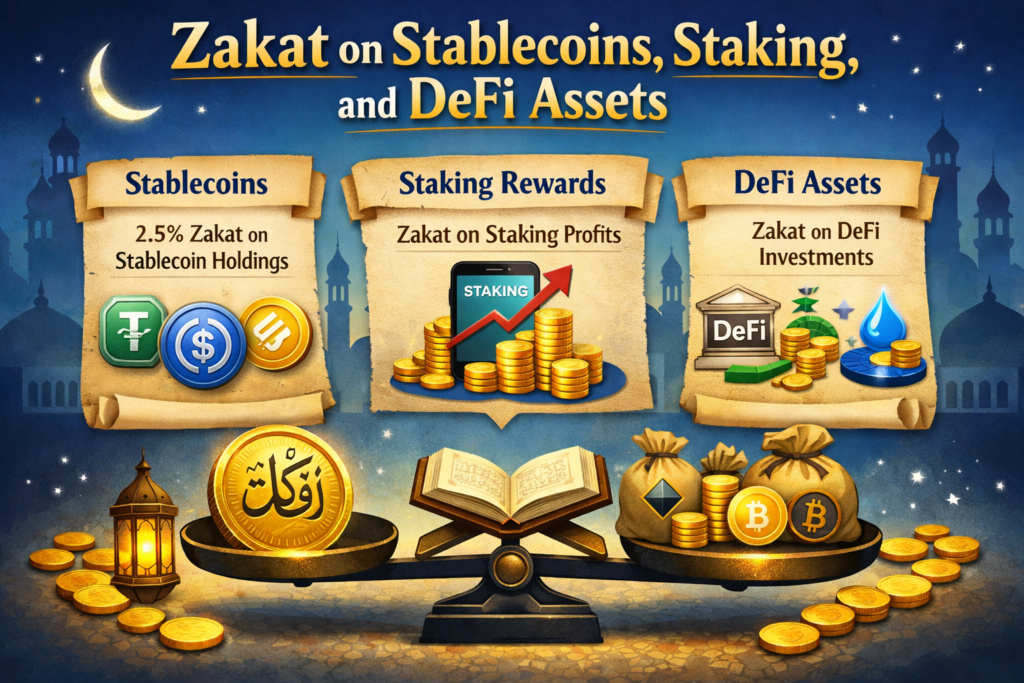
For stablecoins and tokenised cash balances.
If a stablecoin is properly backed and used like cash (e.g. USDT, USDC), you treat it like zakat on cash.
Zakat on stablecoins and tokenized gold or fiat balances therefore follows the same rules as the underlying cash or metal.
Staking, DeFi and yield-farming rewards
With staking and DeFi, scholars often separate.
Principal the value of coins you stake or lend (typically zakatable at full value if the coin itself is zakatable).
Rewards staking income, yield-farming rewards or airdrops, usually treated like investment profit and added to zakatable wealth once they’re received and in your control.
Practical tips for zakat on volatile assets and crypto trading:
Include the full principal you’ve deployed in liquidity pools or lending protocols, valued in your base currency on zakat day.
Add any realised rewards sitting in your wallet; unrealised, unclaimable rewards can often be left until they vest or are claimable.
Complex DeFi structures or leveraged positions are best discussed with a qualified scholar familiar with on-chain finance.
Digital assets beyond coins.
Beyond simple coins, “zakat on digital assets” depends strongly on what the token represents:
Tokenised gold/silver usually zakatable just like the underlying metal if you have real ownership.
Security tokens often treated like shares; if they represent productive assets or business equity, zakat may apply on their market value or underlying zakatable assets.
NFTs as collectibles if bought just as art/collectibles, they’re often non-zakatable unless held explicitly for trade; if you flip NFTs regularly, scholars may treat them as trade inventory.
Accountants and Islamic finance professionals in Europe should generally categorise each digital asset by function (cash-like, commodity-like, equity-like, or pure collectible) and then apply the corresponding classical zakat rules.
Why many scholars treat crypto as zakatable wealth
Many scholars treat cryptocurrency as zakatable wealth because it behaves very similarly to cash and trade goods: it’s ownable, tradable, and widely accepted as a store of value. Classical zakat categories like gold, silver, cash and trade goods are therefore extended to include crypto that serves similar economic functions.
Key fiqh principles behind zakat on crypto
The main Shariah concepts used to justify zakat on crypto include:
Māl something that can be possessed, stored and benefited from
Thamaniyyah its ability to act as a medium of exchange or store of value
ʿUrūd al-tijārah trade inventory held for resale
Papers like “Crypto Assets: Zakat of the Digital World” from Shariah advisory bodies argue that many cryptocurrencies clearly meet these conditions, especially when used as money or investment assets.
Snapshot of contemporary fatwas in the US, UK and Europe
A number of English and German language fatwas now state that:
Crypto with clear monetary or investment use is zakatable above nisab.
You value it at the fair market price on your zakat date.
You aggregate it with your other zakatable assets, not as a separate category.
Guidance from organisations like IslamicFinanceGuru, NZF, Zakat.org and GlobalSadaqah all broadly align on this, even if the fine print differs. They encourage Muslims to follow a recognised scholar or council and then apply one consistent method each year.
Handling disagreement & personal conscience
There is still genuine disagreement around:
Coins with unclear backing or governance
Highly speculative memecoins
Complex DeFi governance tokens
Pseudo-lottery or gambling-style crypto products
A pragmatic “safer option” mindset used by many Muslims is:
If you wouldn’t be comfortable defending a coin as halal, avoid holding it altogether.
If you do hold it as halal and it functions as wealth, assume it’s zakatable unless a trustworthy scholar explicitly says otherwise.
Zakat is a duty between you and Allah; following a sound scholarly opinion and then being consistent in how you apply it across your portfolio is more important than chasing micro-optimised rulings.
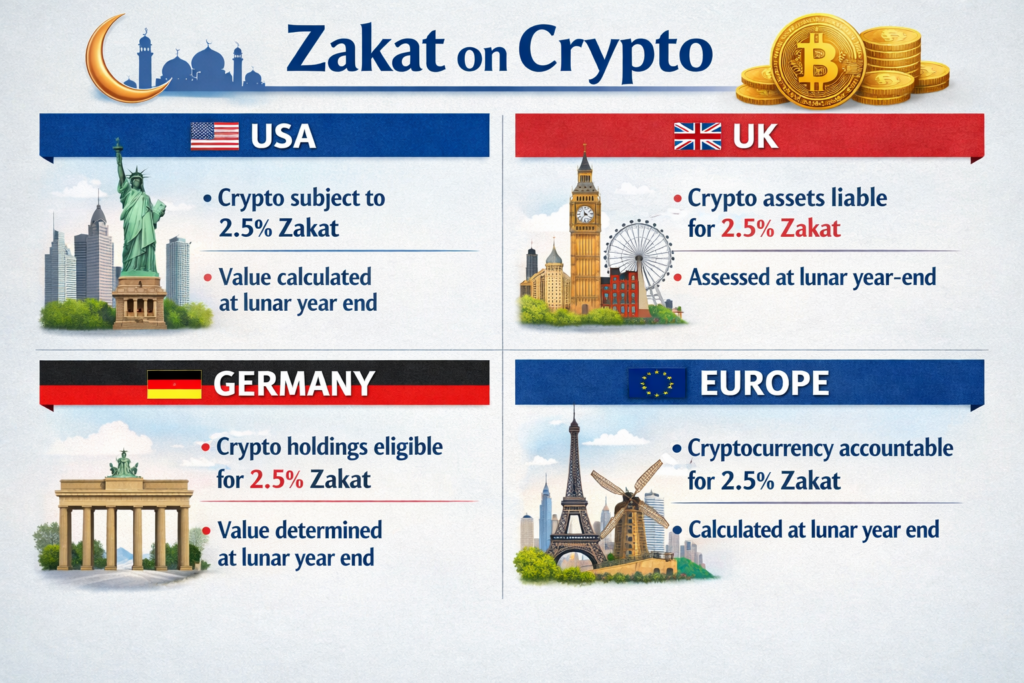
Regional guidance zakat on crypto in the US, UK, Germany and wider Europe
While the zakat rules are similar everywhere, local tax, reporting and regulation differ. Think of tax as a state obligation and zakat as a religious obligation; paying one doesn’t automatically fulfil the other.
United States IRS taxes vs religious zakat rules
The Internal Revenue Service treats crypto as property for tax, tracking capital gains and income events. Paying those taxes does not replace zakat; you still calculate zakat on cryptocurrency based on your total holdings above nisab on your zakat date.
Practical points for American Muslims
Whether your coins sit on Coinbase or Binance, or in self-custodial wallets, you look at the total current value, not just realised gains.
You may deduct upcoming short-term tax bills as debts, but you still owe zakat if your net wealth sits above nisab.
Many US-based zakat guides, including content from Zakat.org, now include dedicated sections on “zakat on cryptocurrency and digital wealth.” (Zakat Foundation of America)
United Kingdom HMRC, local rulings and zakat platforms
In the UK, HM Revenue & Customs also treats crypto as an asset for tax. British zakat bodies like Islamic Relief UK and NZF, however, typically treat eligible crypto as zakatable wealth at 2.5% of market value once your combined wealth exceeds nisab.
A common British pattern.
A professional in London combines bank savings, ISAs, pensions that contain liquid assets, and crypto holdings.
They use a UK zakat calculator to add everything together in GBP and then pay 2.5% above the nisab.
Many UK tools now hook into Open Banking APIs to pull bank figures automatically, and some are starting to support crypto portfolio integrations as well.
Germany & continental Europe tools, language and regulation
In Germany and the wider EU, language and regulation add extra layers.
German-language zakat calculators (for example from Islamic Relief Deutschland) now include fields for crypto and show nisab in euros based on 85g of gold. (Islamic Relief Deutschland)
Many local crypto platforms are supervised by BaFin or passported EU regulators, which can be a useful trust signal but is separate from religious rulings.
European Muslims in cities like Berlin, Paris and Rotterdam increasingly expect calculators and FAQs that work in both English and their local language. Tools like QuantumCalcs, a European zakat calculator brand that explicitly supports crypto and detailed FAQs, aim to answer exactly these “US/UK/EU-ready” questions for digital assets.
How to pay your zakat on crypto safely online
Once you know your zakat amount, the next step is how to pay it in a safe, compliant, user-friendly way. This is where the journey shifts from pure fiqh into UX, security and data protection.
Paying in fiat vs paying directly in crypto
You generally have two options.
Sell a portion of your crypto and donate in local currency (USD, GBP, EUR)
Simple for recipients, especially traditional charities.
May trigger taxable events, so coordinate with your accountant.
Donate directly in crypto (e.g. BTC, ETH, stablecoins)
Some charities like Smile Givers International and others accept direct crypto donations.
On-chain transparency can increase trust; recipients can see funds arrive in real time.
In the US, UK, Germany and the wider EU, many donors now mix both approaches: they pay most zakat in local currency but add a small, recurring crypto donation from their HODL stack.
For charities or fintechs building such flows, guides from Mak It Solutions on topics like multi-cloud cost optimisation and cloud repatriation for US & Europe help keep infrastructure efficient while honouring data-residency and performance requirements. (Mak it Solutions)
What to look for in a secure zakat platform
When you pick a platform or design your own, look for:
Clear zakat policy and named scholar or Shariah board oversight
Secure payment processing aligned with standards overseen by the PCI Security Standards Council and SOC 2-style controls from bodies like the AICPA.
GDPR/DSGVO-compliant data handling for EU users, and UK-GDPR alignment in the UK
Transparent handling of wallet addresses, transaction IDs and on-chain confirmations
For teams building AI-assisted zakat tools or support flows, Mak It’s work on AI agents for businesses and automated ticket resolution shows how to layer secure, policy-aware assistants on top of calculators and donor dashboards. (Mak it Solutions)
From portfolio snapshot to confirmed donation
A simple, user-friendly journey many charities now follow (and that you can adopt or design into a product) is:
Gather balances – crypto wallets, exchanges, bank accounts, gold, eligible investments.
Run them through a zakat calculator (including crypto)
Confirm the amount and intention: zakat vs sadaqah.
Choose beneficiaries or charity e.g. refugees, education, healthcare (note that zakat goes to eligible people/causes, not state systems like the National Health Service).
Pay via card, bank or crypto and receive a receipt/confirmation.
If you’re building such a flow, Mak It’s analytics content for example on BI vs analytics vs reporting and data analytics for decision-makers can help you design dashboards that show zakat volumes, payment methods and regional patterns without exposing sensitive personal data. (Mak it Solutions)
Common questions about zakat on cryptocurrency
Many FAQs around zakat on cryptocurrency boil down to edge cases: unrealised gains, airdrops, forks and missed years. Here’s how mainstream guidance typically approaches them.
Do I pay zakat on unrealised gains, airdrops and forks?
Unrealised gains
If your crypto’s price rises, you don’t pay zakat on the “gain” separately; you pay on the total current value of your holdings. That automatically captures unrealised gains.
Airdrops and forks
Once new coins from an airdrop or hard fork are in your control and you treat them as halal, they become part of your zakatable wealth like any other coin. (GlobalSadaqah.com Blog)
What if my crypto is very volatile around my zakat date?
Most zakat bodies recommend using a single snapshot of fair market value on your zakat date rather than averaging the whole year. That keeps things simple and matches classical practice for gold and trade goods: you value them on the day zakat is due.
If you’re nervous about volatility, you can choose a zakat date, take prices at a consistent time (for example, in the evening local time) and apply that figure every year. Over multiple years, market swings usually average out.
How do I fix missed zakat on crypto from previous years?
If you realise you’ve never paid zakat on crypto for past years:
Estimate past balances as best you can from exchange history, wallet logs or tax reports.
For each year, work out whether you were above nisab and roughly how much.
Calculate an approximate 2.5% per year on those balances.
Treat the total as a debt you owe to Allah and pay it as soon as you reasonably can.
For complex cases (e.g. very active trading or lost records), seek help from a scholar or an Islamic accountant even a reasonably cautious estimate is far better than ignoring the issue.
To support such remediation work digitally, you can host calculators in compliant regions of Amazon Web Services, Microsoft Azure or Google Cloud, and reuse patterns from Mak It’s sovereign cloud and data residency guidance, adapted for US/EU regulatory contexts. (Mak it Solutions)

Key Takeaways
Zakat on cryptocurrency is typically 2.5% of the current value of your zakatable crypto plus other zakatable assets once you’re above the gold-based nisab for a lunar year.
Most mainstream scholars treat Bitcoin, Ether, stablecoins and similar assets as zakatable wealth, whether traded actively or held long term, as long as they are halal and genuinely owned.
A practical method for mixed portfolios (trading, HODL, staking, NFTs) is to convert everything into one currency, deduct short-term debts, then apply 2.5%.
Tax rules from bodies like the IRS, HMRC and BaFin are separate from religious zakat rules; paying capital gains tax does not remove your zakat obligation.
For online payment, you can donate in fiat or directly in crypto, but you should pick platforms with strong security (PCI DSS / SOC 2-style controls), GDPR-compliant data handling and clear Shariah oversight.
If you’ve missed zakat on cryptocurrency in previous years, estimate, calculate and pay what you reasonably can, then adopt a clear, repeatable process going forward.
If you’re a charity, fintech or Islamic finance team serving Muslims in the US, UK, Germany or wider Europe, now is the right time to make your zakat and crypto journey clear, auditable and user-friendly. The combination of fast-growing global crypto ownership now widely estimated in the hundreds of millions of users worldwide and tightening data-protection rules means you need both solid fiqh and strong engineering.
Mak It Solutions can help you design and implement secure zakat calculators, AI-assisted FAQs and donation flows that span web, mobile and cloud from architecture choices to analytics and ongoing optimisation. If you’d like to scope a crypto-aware zakat calculator or upgrade an existing platform, reach out to Mak It Solutions to discuss a focused, region-specific implementation plan.( Click Here’s )
FAQs
Q : Can I choose the gold or silver nisab when working out zakat on my crypto?
A : Most contemporary scholars recommend using the gold nisab for modern cash and crypto, because it better reflects the wealth level at which zakat becomes due in today’s economies. Silver nisab is significantly lower and would make many lower-income Muslims technically liable; some people still choose it as a more cautious option, but you should stick with one approach consistently and ideally follow your local scholar or council’s guidance.
Q : Is it better to pay my crypto zakat monthly in instalments or once a year on one date?
A : Classically, zakat is calculated on a single annual date, based on what you own then, but you’re allowed to pre-pay during the year. Many Muslims calculate their annual zakat on one date and then either pay it all at once or split the amount into monthly or quarterly instalments for cash-flow reasons. Just be sure you’ve fully paid at least the annual amount due by your zakat anniversary each year.
Q : How do I handle zakat on crypto that I keep together with my spouse or family members in a shared wallet?
A : For a shared wallet, you first need to agree who owns what percentage of the balance for example, 60% you, 40% your spouse. Each person then adds their share of the crypto to their own zakat calculation, along with their separate savings and debts. Zakat is a personal obligation, so even if the coins sit in one wallet, you still calculate and pay individually based on your ownership share and nisab status.
Q : What should I do if I have never paid zakat on my cryptocurrency for several past years?
A : If you’ve missed zakat on crypto, don’t panic, but do take it seriously. Use exchange history, wallet records and tax reports to estimate what your zakatable balances looked like each year, then calculate an approximate 2.5% for each year you were above nisab. Add it up and treat the total as overdue zakat, paying it as soon as you reasonably can; if necessary, you can spread payment over time while keeping a clear record of how much remains.
Q : Does zakat apply differently to crypto held in UK ISAs, US retirement accounts or European investment platforms?
A : The packaging (ISA, 401(k), broker account, app-based platform) doesn’t change the underlying zakat rule. If the assets inside are zakatable (e.g. cash, tradeable shares, crypto), and you have actual or eventual access to them, scholars will often consider them when calculating zakat, even if the tax treatment is more favourable. Some retirement accounts are locked until a certain age; in those cases, many scholars either treat them differently or wait until access is possible, so it’s wise to check local guidance for your specific product.