
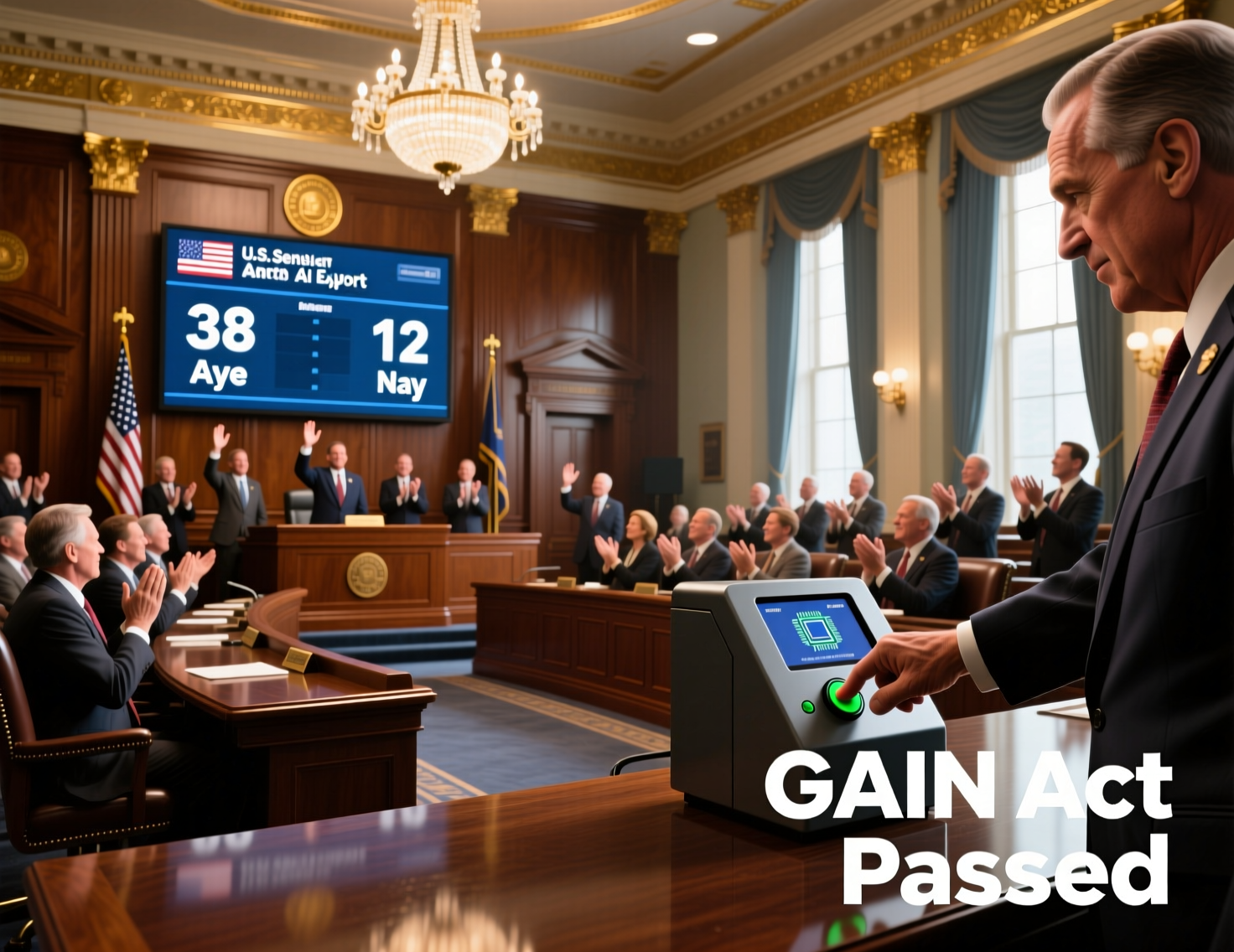

US Senate passes GAIN Act, prioritizing domestic AI and HPC chip sales
WASHINGTON, Oct. 11, 2025 The U.S. Senate has passed the GAIN Act as part of its version of the National Defense Authorization Act (NDAA) for fiscal year 2026. The measure aims to prioritize domestic access to advanced AI and high-performance chips, mandating that chipmakers serve U.S. customers before fulfilling overseas orders.
The legislation also broadens export licensing requirements for advanced processors, tightening controls on technology transfers amid rising global competition. The amendment still needs approval from the House of Representatives and the President’s signature before becoming law, but its passage in the Senate marks a significant step toward reshaping U.S. semiconductor and AI policy.
What the Senate measure does
The Guaranteeing Access and Innovation for National Artificial Intelligence Act of 2026 (GAIN Act) would instruct sellers of advanced AI/HPC chips to prioritize U.S. orders before exporting. It also empowers Congress to block licenses for top-tier AI processors and requires licenses for products containing an “advanced integrated circuit,” potentially widening the scope of U.S. export controls across AI supply chains.
Industry advocates say the shift responds to persistent chip shortages. In late 2024, Nvidia’s Blackwell line was reportedly “booked out” for about 12 months, highlighting tight supply that disadvantaged smaller domestic buyers.
What “US Senate passes GAIN Act” means in practice
Passage in the Senate does not make it law. As an NDAA amendment, the GAIN Act’s fate now hinges on House–Senate negotiations and final approval. Provisions could change or be dropped during conference.
If enacted, chip vendors seeking export licenses would need to show all U.S. orders are fulfilled first. Congress could deny licenses for the highest-performance accelerators, tightening existing controls aimed at advanced compute destined for sensitive markets.

Downstream effects on crypto mining
Export frictions may ripple into crypto mining, where operators source ASICs/GPUs via global supply chains. Added licensing steps and “U.S.-first” allocation could lengthen delivery timelines and raise dollar costs for rigs, especially amid renewed U.S.–China trade frictions and tariff risk that already weigh on hardware prices and miner profitability.
Market and policy backdrop
The Senate’s move coincides with escalating trade tensions. On Oct. 10, 2025, the White House signaled steep new tariffs on Chinese goods, citing Beijing’s expanded rare-earth export controls materials crucial for magnets, chips, and defense systems. China accounts for over 90% of processed rare earths and magnets, amplifying supply concerns for U.S. tech and defense.
How the GAIN Act fits into NDAA process
As of today, the GAIN Act sits inside the Senate’s NDAA text. The House must pass its own bill, then a conference committee reconciles differences before a final vote. Only then would the package proceed to the president. Stakeholders should track conference language closely for definitions of “advanced integrated circuit,” license thresholds, timelines, and enforcement.
Who is affected
Chipmakers & OEMs
Must prioritize U.S. orders and comply with expanded license requirements.Cloud & AI buyers (U.S.)
Could see improved access/allocation if domestic priority is enforced.Overseas buyers
May face longer lead times or denials for top-end accelerators.Crypto miners
Potentially higher rig costs and slower deliveries amid licensing and tariff overhangs.
Industry reaction to “US Senate passes GAIN Act”
Policy advocates who backed the provision point to long-running backlogs as justification for a U.S.-first approach. References to 12-month Blackwell sellouts have circulated since late 2024, underscoring domestic scarcity during AI build-outs. Companies are expected to lobby conference negotiators on definitions and carve-outs to preserve overseas revenue while meeting U.S. demand. Americans for Responsible Innovation+2Yahoo Finance+2
Context & Analysis
The Senate’s approach marries industrial policy with national security. A U.S.-first allocation could ease domestic shortages but risks revenue displacement for chipmakers and frictions with allies reliant on U.S. silicon. The interaction with parallel tariff measures and China’s rare-earth controls elevates uncertainty for capex-heavy sectors (cloud, AI, mining). Outcomes will depend on final NDAA language, license scope, and how strictly “advanced integrated circuit” is interpreted by regulators.

Conclusion
The Senate’s approval of the GAIN Act amendment signals a major shift toward prioritizing U.S. access to advanced AI and high-performance computing (HPC) chips. The move could reshape global chip supply chains by directing manufacturers to serve domestic buyers first.
The amendment’s final form will be decided in the upcoming House conference. Companies involved in advanced computing or dependent on imported hardware should prepare for potential impacts, including stricter export licenses, extended delivery timelines, and possible cost volatility linked to tariffs. Proactive scenario planning will be essential as U.S. tech policy continues to tighten around critical technologies.
FAQs
Q : Did the Senate make the GAIN Act law?
A : No. It passed as an NDAA amendment in the Senate; the House and president must still approve.
Q : What does the GAIN Act require?
A : Prioritize U.S. orders for advanced AI/HPC chips and expand export licensing, with potential denials for top-end processors.
Q : Who benefits most if it passes?
A : U.S.-based AI buyers may gain earlier access; overseas buyers could face longer waits.
Q : How could this affect crypto miners?
A : More licensing and trade frictions can raise rig costs and delay deliveries, pressuring margins.
Q : Why is demand so tight for AI chips?
A : Nvidia’s Blackwell GPUs were widely reported as sold out for ~12 months in late 2024, signaling persistent backlogs.
Q : Does the GAIN Act ban exports to allies?
A : Not a ban; it prioritizes U.S. fulfillment and adds licensing/denial authority for the highest-end parts. Details depend on final NDAA language.
Q : Is the tariff environment related?
A : Yes new U.S. China tariff threats and China’s rare-earth controls form the policy backdrop and may compound supply risks.
Facts
Event
Senate passage of GAIN Act amendment prioritizing domestic AI/HPC chip salesDate/Time
2025-10-11T00:00:00+05:00Entities
United States Senate; National Defense Authorization Act (FY2026); GAIN AI Act; Nvidia (NVDA); U.S. House of Representatives; U.S. Department of CommerceFigures
Blackwell GPUs “booked out ~12 months” (late 2024 reports); China >90% share of processed rare earths/magnets (context). Data Center Dynamics+1Quotes
“Everything’s sold out.” summary of Nvidia commentary on Blackwell demand (late 2024 reporting). Barron’sSources
Nextgov (GAIN AI Act in NDAA), ARI policy brief (advocacy perspective), Reuters (tariff/rare earths context)