
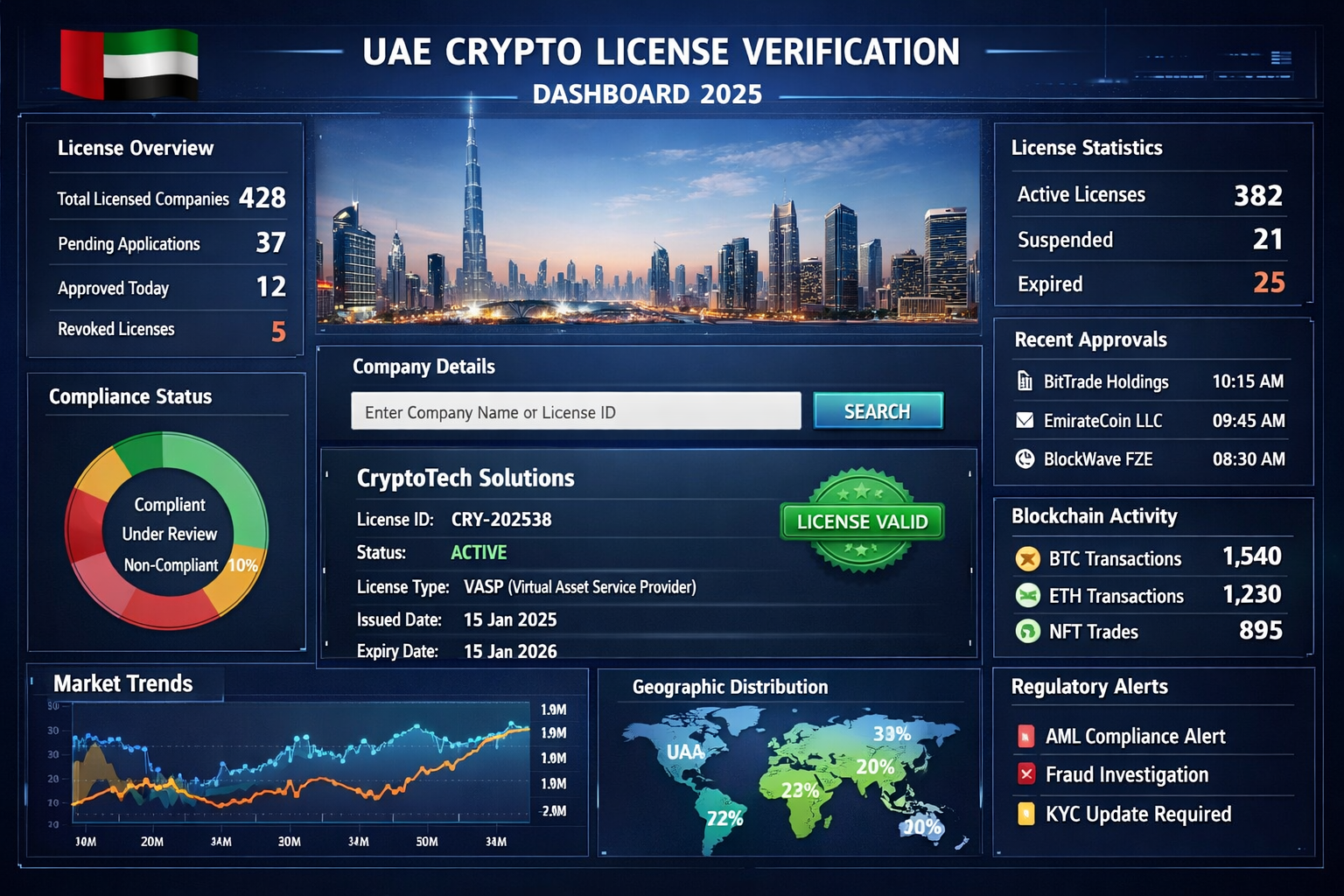

UAE Crypto License Verification: Step-by-Step Guide
To run UAE crypto license verification properly, use the official public registers of Dubai’s Virtual Assets Regulatory Authority (VARA), Abu Dhabi Global Market’s Financial Services Regulatory Authority (ADGM FSRA) and the UAE Securities and Commodities Authority (SCA). Search using the platform’s exact legal name, then confirm that the license status is active, the authorised virtual asset activities match what the platform actually offers (spot, derivatives, custody, staking) and that the same entity appears in UAE trade license databases before you send any funds.
Introduction
If you’re a US, UK or EU investor looking at a Dubai or Abu Dhabi crypto platform, UAE crypto license verification is now a basic control, not a “nice-to-have”. The UAE has moved from a “grey area” reputation to one of the world’s most active virtual-asset hubs, with Dubai and Abu Dhabi competing to attract institutional capital under clear rulebooks. By the end of 2025, analysts estimate the UAE will have approved more than 70 licensed virtual-asset service providers (VASPs) and attracted over $25 billion in related investments.
At the same time, global crypto adoption keeps rising: estimates suggest over 560–650 million people worldwide now own crypto, with UAE adoption among the highest globally. That mix of growth and regulation is appealing for New York hedge funds, London wealth managers and Frankfurt banks but it also attracts lightly licensed or outright unlicensed actors.
This guide explains how to verify a UAE crypto license online, using official VARA, ADGM FSRA and SCA registers, UAE trade licence portals and practical checklists for US, UK and EU teams. It’s general information, not legal advice but it gives compliance officers, risk managers and founders a concrete, repeatable starting point.
Why UAE crypto license verification matters in 2025
From 2025 onward, using a UAE platform without checking its license is increasingly hard to justify from a governance or audit perspective. Regulators in the UAE, US, UK and EU now expect that any institution onboarding a virtual asset service provider can show that the firm is properly authorised and monitored for AML/CFT risks.
A UAE trade licence alone does not mean a firm is allowed to run an exchange, custody client assets or promote complex token products to your clients. The question for your investment or risk committee is no longer “Is Dubai or Abu Dhabi safe?” but “Is this specific VASP demonstrably licensed for what it’s doing?”
From Dubai and Abu Dhabi to New York, London, Berlin
For US teams in New York or Austin, UAE platforms often sit in the “interesting but foreign” bucket. Yet some Dubai and Abu Dhabi VASPs are now courting SEC-registered funds, FinCEN-registered MSBs and banks with US clients. London wealth managers are under UK FCA pressure to treat high-risk crypto promotions and counterparties with extra care. German and wider EU firms must align with BaFin expectations and the EU’s Markets in Crypto-Assets (MiCA) regime, which fully applies from late 2024.
The good news: UAE regulators know they are being compared to the FCA, SEC/CFTC and BaFin. Dubai’s VARA and Abu Dhabi’s ADGM FSRA publish public registers that look familiar to US and European compliance teams firm name, license status, authorised activities, client classes and sometimes key individuals.
For a Frankfurt bank, a UAE VASP entry that clearly sets out permissions under a recognised rulebook is much closer to MiCA or BaFin-style authorisation than to a generic offshore registration.
Licensed VASP vs. generic trade licence.
A licensed Virtual Asset Service Provider (VASP) in the UAE is authorised under virtual-asset specific rules, covering capital, governance, AML/CFT, the Travel Rule, technology risk and consumer protection. Generic commercial or free-zone licences (e.g. “IT services”, “general trading”) do not confer those permissions.
In practical terms
Regulatory oversight
VARA and ADGM FSRA supervise licensed VASPs; trade-licenced entities without VASP authorisation may have minimal financial supervision.
Permitted activities
A VASP license will specify whether the firm can run an exchange, custody assets, offer brokerage or deal in derivatives.
Client protections
Rulebooks cover segregation of client assets, disclosures, conflicts of interest and complaint handling; a generic trade licence does not.
AML/CFT expectations
VASPs must apply UAE AML laws, FATF standards and the Travel Rule, and are subject to inspections and potential sanctions.
If a platform pushes high-leverage trading or “staking” but its only documentation is a Dubai or Ras Al Khaimah trade licence, treat that as a major warning sign not a box ticked.
How Cabinet Resolution 111/2022 reshaped UAE virtual asset regulation
Cabinet Resolution No. 111 of 2022 created a federal framework for virtual assets and their service providers across the UAE. It clarifies that virtual asset activities require authorisation and must comply with UAE AML/CFT legislation, and it connects federal rules with emirate-level regimes like VARA (Dubai) and ADGM FSRA (Abu Dhabi)
For foreign investors, the key implications are.
The UAE now has a coherent, multi-layered regime rather than ad-hoc guidance.
Federal rules sit on top of VARA, ADGM and SCA frameworks you need to understand which regulator is responsible for a given VASP.
Scams claiming to be “approved by the UAE government” but with no entry on any official VASP register are easier to dismiss quickly.
Key UAE regulators and official crypto license registers
The official registers you should use to verify a UAE crypto license are: VARA’s public register (Dubai), ADGM FSRA’s public register (Abu Dhabi), and the SCA’s list of virtual asset service providers for the wider UAE. Each shows whether a firm is licensed, what activities it can perform and often where it is incorporated.
Dubai VARA public register: licensed and in-principle VASPs
Dubai’s Virtual Assets Regulatory Authority (VARA) is responsible for virtual assets across most of Dubai (excluding the DIFC financial free zone, which uses the DFSA). VARA maintains a public register of VASPs that are fully licensed or hold In-Principle Approval (IPA)
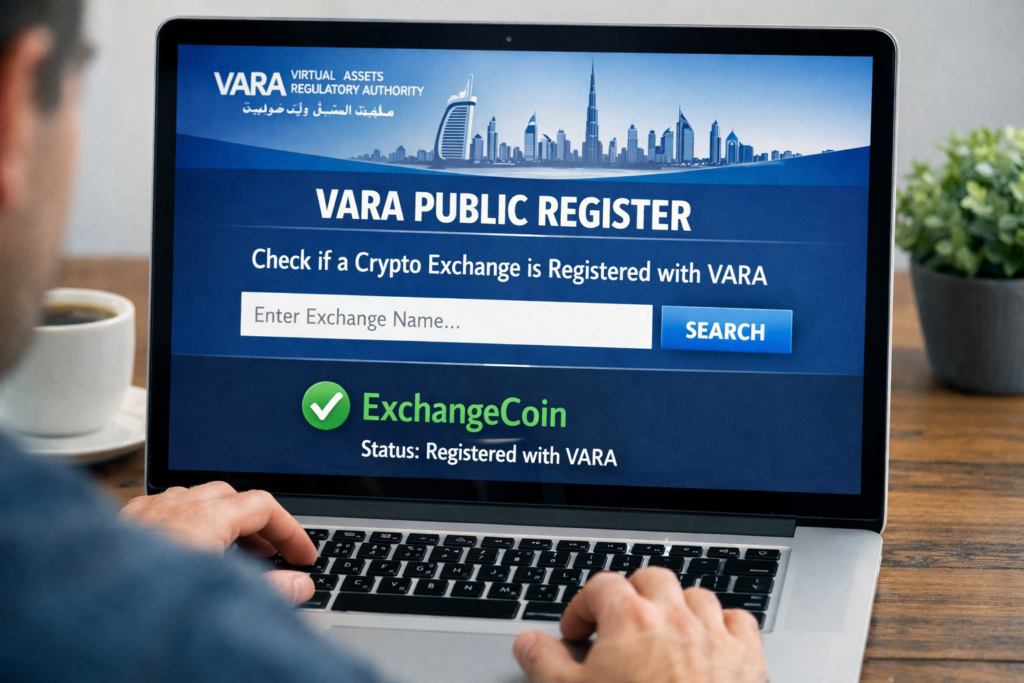
On the VARA public register you’ll typically see:
Legal entity name and sometimes brand name
Status e.g. “In-Principle Approval” vs fully licensed
Activities authorised exchange, broker-dealer, custodian, lending, etc.
Location and license number
For US or UK teams, treat an IPA as a conditional status: it confirms engagement with VARA but not yet full operating permission. We’ll unpack that later in the Dubai-specific section.
ADGM FSRA public registers for virtual asset firms in Abu Dhabi
Abu Dhabi Global Market’s Financial Services Regulatory Authority (FSRA) oversees digital assets under a detailed regime that treats many virtual asset activities as regulated financial services. ADGM’s public register lets you search by firm name and see permissions, including whether the firm can operate a multilateral trading facility (MTF), offer custody or provide dealing services in “Accepted Virtual Assets”.
For MiCA-regulated EU firms or FCA-regulated UK managers, ADGM permissions often feel closest to “traditional” capital-markets licences: they are framed in familiar regulatory language, and the underlying FSRA guidance on digital assets is public.
SCA and other UAE authorities: CBUAE, DIFC/DFSA and free zones
The Securities and Commodities Authority (SCA) regulates securities and certain crypto-asset activities at the federal level and publishes an open-data list of VASPs.
Beyond VARA, ADGM and SCA, you’ll also encounter
CBUAE the Central Bank of the UAE, relevant where virtual assets interact with payments and stored value.
DIFC/DFSA Dubai International Financial Centre and its regulator, the DFSA, which has its own crypto-token regime separate from VARA.
Various free-zone authorities (DMCC, RAKEZ, etc.) that issue trade licences but do not themselves grant VASP permissions.
Your verification process must map the platform to the correct regulator: a DIFC-based firm, for example, should appear on the DFSA register, not on VARA’s.
How to verify a UAE crypto license step by step
You can verify a UAE crypto license in four main steps: collect the platform’s legal and licensing details, search the VARA, ADGM FSRA and SCA public registers, cross-check the UAE trade licence, and ensure authorised activities match what’s on offer (spot, derivatives, custody, staking, etc.)
Collect the platform’s legal name, entity and license claims
Before you touch a register, capture
Brand name and website
Claimed legal entity name (e.g. “XYZ Digital Assets FZE”)
Jurisdiction and zone (Dubai mainland, DMCC, DIFC, ADGM…)
Any license numbers or references VARA licence ID, FSRA FRN, SCA reference, etc.
Marketing claims “regulated by VARA”, “licensed in ADGM”, “SCA-approved”
Ask the platform to send this in writing ideally in a PDF deck or due-diligence pack. Screenshot or save any license badges in the footer. Store all of this in your internal KYC/KYB tooling or BI environment; if you already use dashboards or custom data workflows (for example, similar to how your team might centralise data in a business intelligence stack), treat VASP checks the same way.
Search VARA, ADGM FSRA and SCA VASP registers
Next, go to each official register in turn
VARA Public Register search by exact legal name and by brand name. Check status (IPA vs fully licensed), authorised business lines and any notes.
ADGM FSRA Public Register search by firm name. Confirm if the firm is authorised for “Dealing in Investments as Principal/Agent”, “Operating a Multilateral Trading Facility”, or “Providing Custody” in relation to virtual assets.
SCA VASP List review entries for entities outside VARA/ADGM or for activities falling squarely under SCA’s remit.
When you don’t find a match:
Check alternative spellings (LLC vs. L.L.C., FZE vs. FZ-LLC)
Confirm with the platform whether the license sits under a different group entity.
Treat persistent absence across all registers as a red flag for anything beyond very limited engagement.
Cross-check the UAE trade licence via economic department portals
License verification isn’t complete until you confirm the trade licence and corporate identity via UAE government sources.
Use:
The UAE Verify platform and emirate-level economic department portals (e.g. Dubai Economy, Abu Dhabi DED) to confirm trade licence numbers and statuses.
Free-zone registries such as DMCC, DIFC and ADGM to make sure the entity name, number and activity lines match what the VASP claims.
You’re checking for
The same legal name across VASP register and trade licence
The same free-zone or mainland jurisdiction
No obvious mismatch between stated business activities and what the platform is doing (e.g. a licence for “IT consultancy” but marketing itself as a retail derivatives exchange)
Confirm authorised activities match what the platform offers
Finally, compare the authorised activities with the actual product set:
Exchange vs. OTC dealing
Spot vs. derivatives
Custody vs. self-hosted wallets
Staking, yield products or lending
If a Dubai platform advertises high-leverage perpetual futures to London or New York clients, but its VARA entry only mentions “broker-dealer services in virtual assets” with restrictions, you have a mismatch. If an ADGM firm only has permission to serve professional clients, but your German retail bank wants to onboard it for mass-market clients, that’s another gap.
Document those mismatches in a short internal memo or in whatever tooling you already use to manage AI and digital-risk governance (for example, an AI governance operating model playbook can be adapted for VASP governance too)
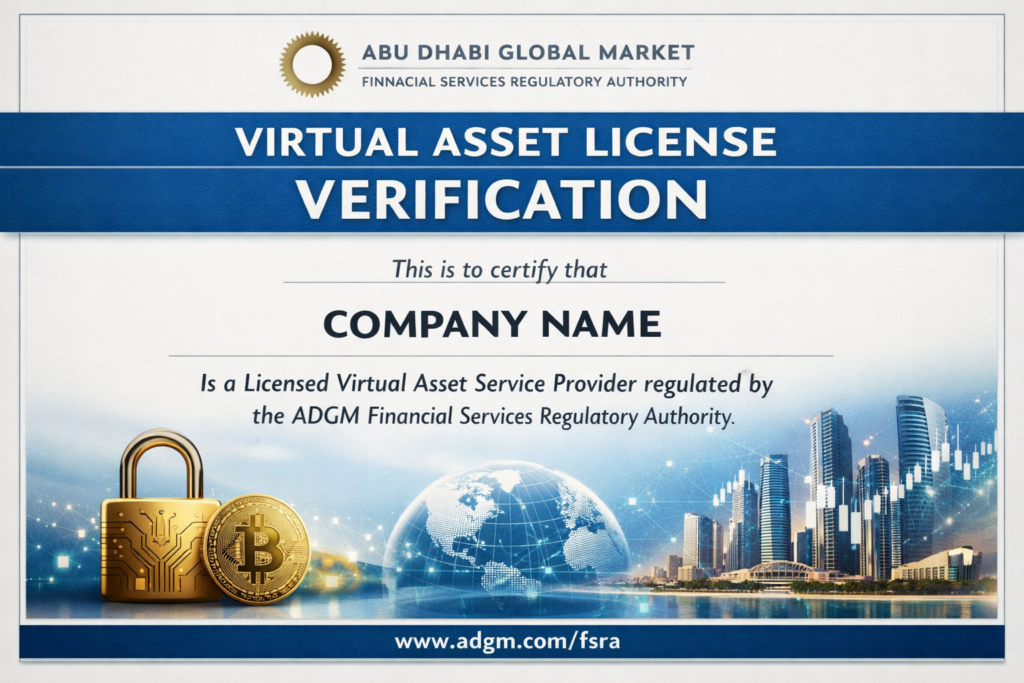
Dubai focus verifying a VARA-regulated crypto exchange
To verify a Dubai exchange, you’ll typically use the VARA public register plus Dubai trade-licence infrastructure and, where relevant, free-zone portals like DMCC or DIFC. The aim is to confirm that the brand you see in New York, London or Berlin matches a VARA-authorised VASP entity and that the status is appropriate for the services being offered.
Understanding In-Principle Approval (IPA) vs. full VASP license
VARA distinguishes between.
In-Principle Approval (IPA) conditional approval; the firm still has to meet operational, technical and local-substance requirements before it can go fully live.
Full license the firm has met VARA’s conditions and can operate within its authorised scope.
For compliance teams
Treat IPA status as similar to “authorised in principle” in other jurisdictions: you may allow limited engagement (e.g. exploring partnerships, sandbox testing) but not full onboarding for retail or institutional flows.
For retail-facing activity into London, Manchester, New York or Berlin, you generally want a full VASP license, not just IPA, unless you’re in a controlled pilot.
Using the VARA public register to check major exchanges
When checking a well-known brand (e.g. a top-tier exchange often mentioned in Dubai media), resist the urge to trust marketing. Instead.
Search the VARA register by legal entity and cross-reference against the brand.
Confirm whether the entity is fully licensed or only at IPA stage.
Review the services authorised: are they limited to professional clients? Do they cover derivatives or only spot/custody?
Compare those permissions with what the exchange offers to your region (US, UK, EU) on its website.
If there’s a mismatch between marketing (“fully regulated in Dubai”) and what VARA shows, escalate internally. It may be a simple lag in communications—or a sign the firm is overstating its status.
Red flags: VARA warnings, enforcement actions and unlicensed VASPs list
VARA also publishes warnings and enforcement actions, including a list of unlicensed VASPs targeting Dubai.
Treat the following as immediate show-stoppers for your committee:
The entity appears on VARA’s unlicensed VASP list.
There is a public warning about the platform or its principals.
There is evidence of operating reserved activities (e.g. exchange, custody) without VARA approval.
At that point, the question isn’t “how do we get comfortable?” but “why are we still entertaining this counterparty at all?”
Abu Dhabi focus checking an ADGM crypto license
For Abu Dhabi, your anchor is the ADGM FSRA digital assets framework plus the FSRA public register. FSRA treats many virtual asset activities as regulated financial services and has published substantial guidance on how firms must manage market integrity, custody, disclosures and technology risk.
Overview of the ADGM digital assets and VASP framework
ADGM’s framework defines “Accepted Virtual Assets”, sets conditions for operating trading venues and custody, and aligns VASPs with broader AML/CFT and prudential requirements. It also plugs into UAE Cabinet Resolution 111/2022 for federal consistency.
For EU and UK readers, FSRA rulebooks often feel more like traditional capital-markets regulation than “crypto-only” regimes: think detailed market-abuse rules, disclosure expectations and governance requirements.
How to use the FSRA public register to confirm permissions
On the FSRA public register.
Search by the legal name of the Abu Dhabi entity.
Confirm the status (authorised vs in-principle)
Look at permitted activities and whether they reference virtual assets.
Check client classification retail, professional, counterparties.
Note any conditions or restrictions in the license text.
If a platform is pitching your London wealth desk as a retail platform, but FSRA permissions limit it to professional clients only, that’s a direct compliance gap.
Comparing ADGM authorisations with EU MiCA and UK FCA expectations
MiCA now provides a harmonised EU framework for crypto-asset service providers, with strong emphasis on consumer protection and market integrity. The UK FCA likewise expects stringent governance, financial crime controls and clearly disclosed risk profiles.
When comparing ADGM to these regimes
Look for scope equivalence are core activities aligned (exchange, custody, advisory)
Assess AML/CFT controls Travel Rule implementation, sanctions screening, PEP management.
Consider governance board oversight, risk/compliance functions, independent audit.
You’re not doing a formal equivalence assessment, but you want enough comfort to explain to BaFin, FCA or SEC staff why this particular ADGM VASP meets your internal thresholds.
Compliance, AML/KYC and documentation for foreign investors
Global regulators increasingly expect documented VASP due diligence, not just a quick website check. For US SEC/FinCEN-regulated funds, UK FCA firms and BaFin-supervised banks, UAE counterparties must fit into existing AML/KYC, Travel Rule and operational-risk frameworks.
Why US SEC/FinCEN, UK FCA and BaFin expect documented VASP checks
Several trends make documentation non-negotiable.
FATF Travel Rule
Pushes VASPs and financial institutions to know who they’re dealing with for virtual asset transfers.
SEC/FINRA expectations
US securities regulators increasingly scrutinise how firms vet crypto trading venues and custodians.
FCA and BaFin enforcement
UK and German regulators already sanction weak AML controls for non-crypto activities crypto is under even closer attention.
In practice, your investment or treasury committee minutes should show that you used official UAE registers and applied the same discipline you would for a new broker, custodian or cloud vendor.
Practical AML/KYB checklist for onboarding a UAE VASP
Build a concise AML/KYB checklist that includes:
Official register checks (VARA, ADGM FSRA, SCA, DFSA where applicable)
Trade licence verification via UAE Verify, DED or free-zone portals.
Beneficial ownership screening for shareholders and directors
Sanctions and PEP screening using your existing tools
Review of crime, fraud and enforcement hits in global databases
Confirmation of Travel Rule compliance and on-chain monitoring tools
Many of the workflows you already use for AI risk, cloud vendors or data platforms (for example, the kind of human-in-the-loop AI workflows and FinOps for AI cost governance you may be building) can be repurposed for VASP onboarding just swap GPU spend metrics for license and risk metrics.
How to evidence UAE crypto license verification for audits
To be audit-ready.
Save PDF exports or screenshots of VARA, ADGM FSRA, SCA and DFSA entries.
Store trade licence PDFs, plus UAE Verify confirmations where available.
Maintain a short internal memo summarising findings, mismatches and mitigations.
Record decision points in your risk or investment committee minutes.
Keep a simple re-verification schedule (e.g. annually, or on any material change)
If your organisation already consolidates AI, cloud and vendor metrics into dashboards (e.g. using BI tooling and custom web apps similar to those described in Mak It Solutions’ web development work for KSA & UAE), consider adding a “VASP register status” widget to the same place your senior team already looks.
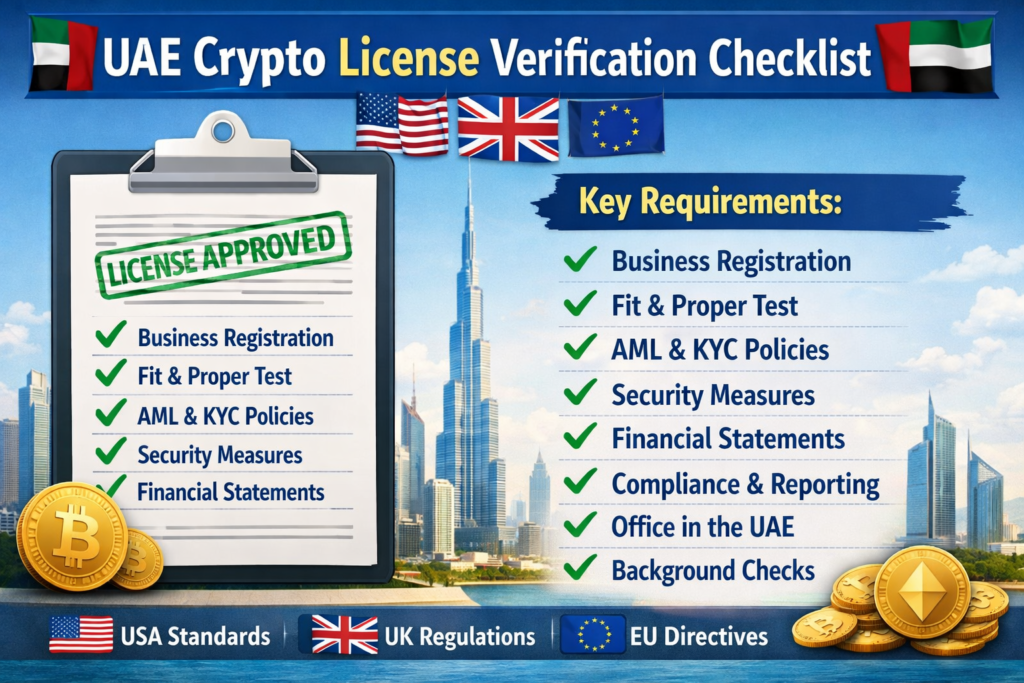
UAE vs US/UK/EU: how crypto licenses compare
UAE crypto licenses aren’t identical to MiCA or UK/US regimes, but they increasingly rhyme. By late 2024, MiCA became fully applicable in the EU, creating a harmonised framework for crypto-asset service providers, while the FCA and US agencies keep layering expectations onto existing rules.
UAE VARA/ADGM vs EU MiCA for exchanges and custodians
For German and EU firms
Scope
MiCA covers crypto-asset service providers (CASPs) across the EU; VARA/ADGM cover virtual assets in their respective zones.
Consumer protection
MiCA is explicit on disclosure and white-paper standards; VARA and ADGM incorporate similar protections through rulebooks and guidance.
Passporting vs single hub
MiCA supports EU-wide passporting, while UAE licences do not automatically allow outreach into the EU.
Your policy might treat VARA/ADGM as “strong third-country regimes” but still require local MiCA compliance for active marketing into Berlin, Frankfurt or other EU markets.
How UK FCA registration and US state/SEC/CFTC regimes differ from UAE
For UK and US investors.
UK FCA focuses on AML registration for cryptoasset businesses, plus strong rules on promotions and consumer harm.
US regimes patchwork of state MSB licences, SEC/CFTC oversight for securities/derivatives, and FinCEN for AML.
UAE more centralised virtual-asset regimes, but with federal (Cabinet Resolution 111/2022) and emirate-level layering.
In other words: an exchange fully compliant with VARA may still need state, SEC/CFTC and FCA authorisations or to limit services to reach clients in New York or London.
Building a cross-border policy.
Your cross-border framework could.
Whitelist UAE platforms that
Hold full VARA/ADGM/DFSA licences matching your use case, and
Have proven AML controls, audited financials and strong governance.
Restrict platforms with IPA-only status, unclear group structures or narrow permissions.
Prohibit platforms with no VASP license, only trade licences, or with any regulatory warnings or enforcement actions.
Document that policy once, then apply it consistently to every UAE VASP, just as you do for cloud regions, AI providers or cross-border data flows.
Common red flags and scams in UAE crypto offers
The biggest risk isn’t that UAE regulation is weak it’s that you mistake generic Gulf marketing for genuine authorisation.
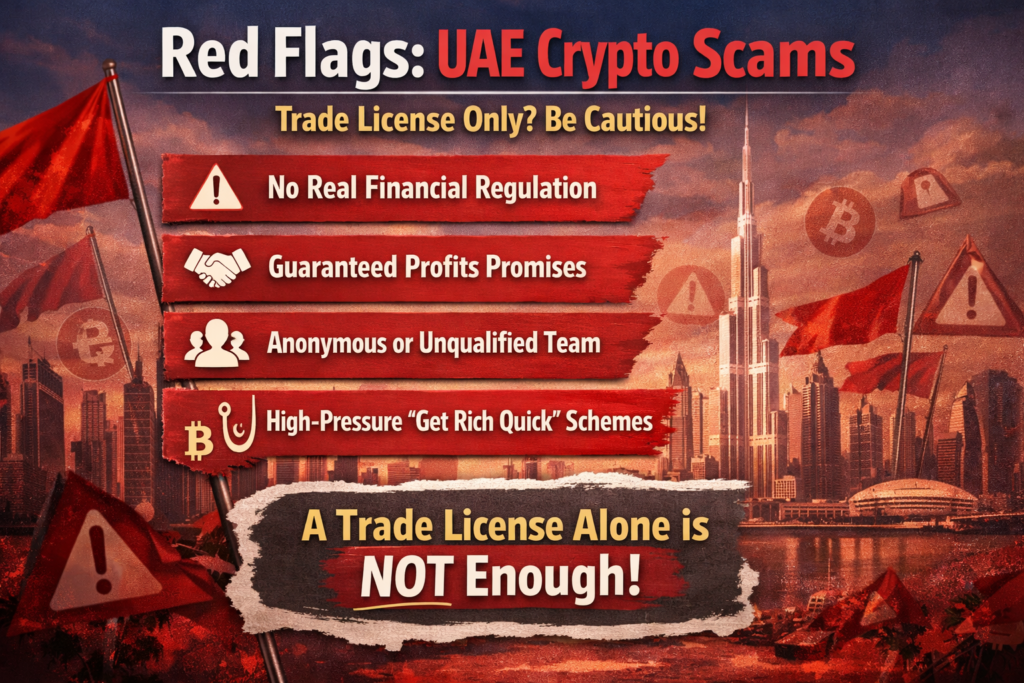
Only a commercial/trade licence but no VARA, ADGM or SCA authorisation
A surprisingly common pattern.
Website footer shows a Dubai or Sharjah trade licence, sometimes from a general free zone.
Homepage headline claims “regulated in Dubai” but never names VARA, DFSA or SCA.
No entry on any official VASP register.
Under Cabinet Resolution 111/2022, virtual asset activities require proper authorisation; a trade licence alone is not enough.
For a New York fund, London family office or Munich bank, that should be a simple rule: no VASP authorisation, no onboarding.
Misused logos, fake “letters of approval” and offshore entities
Other red flags
VARA or ADGM logos on the website with no corresponding public-register entry.
“Letters of approval” on non-official letterhead or with inconsistent formatting.
A legal entity actually incorporated in another jurisdiction (e.g. BVI, Seychelles) while marketing prominently as “Dubai-based” or “Abu Dhabi-regulated”.
Always go back to official websites (vara.ae, adgm.com, sca.gov.ae, dfsa.ae) rather than trusting any document hosted on the platform’s own domain.
When to escalate to internal compliance or walk away entirely
Escalate internally when.
The platform provides partial information or refuses to clarify its legal structure.
You find mismatches between claimed permissions and register entries.
The group structure involves complex chains of offshore SPVs with no obvious commercial rationale.
Walk away when
The entity appears on an unlicensed VASP or warning list.
It is clearly performing regulated activities with zero VASP authorisation.
Senior management respond aggressively or evasively when asked basic questions.
Putting it into practice
Once you’ve internalised the registers and red flags, you need short, geo-specific checklists your teams can actually use.
Quick-reference checklist for US investors and compliance teams
For SEC-registered funds, FinCEN MSBs and US banks.
Confirm VARA/ADGM/SCA/DFSA authorisation and activities.
Map the VASP to your US regulatory perimeter (securities, derivatives, MSB)
Check whether the VASP offers services to US persons and what geo-blocks are in place.
Align Travel Rule, SAR and sanctions workflows with your existing US AML programme.
Ensure contractual terms address US law, dispute resolution and data-sharing.
Checklist for UK FCA-regulated firms and London wealth managers
For UK firms in London, Manchester or Edinburgh.
Confirm whether the VASP is targeting UK retail clients if so, examine promotions carefully.
Assess whether the VASP understands and respects FCA financial promotion rules.
Ensure permissions (e.g. in VARA or ADGM) match your intended client base (retail vs professional).
Map operational controls against your firm’s CASS/client-asset expectations, even if the assets are not UK-regulated in the strict sense.
Capture everything in your firm’s cryptoasset risk assessment and ICAAP/ICARA documentation where relevant.
Checklist for German/EU MiCA-regulated firms and banks
For Frankfurt, Berlin and wider EU teams.
Confirm whether the VASP has EU presence or is serving the EU purely cross-border.
Assess how UAE licences compare to MiCA CASP permissions for the relevant activities.
Evaluate GDPR/DSGVO implications where is customer data stored and processed?
Consider whether the VASP’s custody and market-abuse controls meet internal BaFin-aligned standards.
Decide whether to treat the platform as strategic (whitelisted with limits), opportunistic (case-by-case) or out of scope.
You can run these checklists inside existing digital-governance workflows; for example, combining AI-risk, cloud and VASP governance into the same dashboards and operating model that your CIO already uses.
Summary: minimum verification steps before sending funds
Before any wire, on-chain transfer or client exposure to a UAE platform, your minimum controls should be:
Check official VASP registers VARA, ADGM FSRA, SCA and, where applicable, DFSA.
Verify trade licences UAE Verify, DED and free-zone portals.
Match activities ensure authorised services and client types align with real-world offerings.
Screen governance and enforcement look for warnings, sanctions and adverse media.
Document everything screenshots, memos, committee minutes and re-verification schedules.
If any of those steps fails, you either adjust scope (e.g. no retail) or you walk away.
When to engage specialist UAE licensing or regtech support
For complex, multi-jurisdictional structures say a Berlin neobank partnering with a Dubai VASP while also building AI-driven trading tools you’ll likely need both local legal counsel and technical partners to operationalise all this in your systems.
A digital partner like Mak It Solutions can’t replace UAE legal advice, but can help your US, UK and EU teams:
Build internal portals to track VASP licences alongside AI and cloud risks.
Integrate register lookups and documentation into your existing data and BI stack.
Design compliant onboarding journeys for clients in New York, London, Frankfurt and Dubai.
Key Takeaways
Always use official registers (VARA, ADGM FSRA, SCA and, where relevant, DFSA) to verify UAE VASP licences marketing claims and generic trade licences are not enough.
Cabinet Resolution 111/2022 and emirate-level regimes have turned the UAE into a structured virtual-asset hub, but scams still exploit regulatory logos and Gulf branding.
Match permissions to reality by comparing authorised activities and client classes with what the platform actually offers (spot, derivatives, custody, staking, retail vs professional).
Align with US, UK and EU expectations by documenting checks, aligning AML/KYC and Travel Rule controls, and maintaining a clear whitelist/restrict/prohibit policy for UAE VASPs.
Leverage your existing digital governance stack BI, AI governance, cloud monitoring to track VASP licence status and evidence compliance for audits and regulators.
If you’re staring at a promising Dubai or Abu Dhabi crypto opportunity and wondering how to make it audit-proof, you don’t need another spreadsheet you need a structured verification workflow. Mak It Solutions helps US, UK, German and wider EU teams design data-driven governance around complex digital ecosystems, from AI pipelines to regulated platforms.
Talk to Mak It Solutions about turning your UAE VASP checks into a repeatable process integrated into your existing web, data and analytics stack so your next investment committee in New York, London or Berlin can say “yes” with real confidence. Visit the Mak It Solutions contact page to start the conversation.
FAQs
Q : Is crypto fully regulated in Dubai and Abu Dhabi, or only certain activities?
A : Crypto is partially but increasingly comprehensively regulated in both Dubai and Abu Dhabi. In Dubai, VARA oversees virtual asset service providers for most of the emirate, while the DFSA supervises certain crypto-token activities in the DIFC. In Abu Dhabi, ADGM’s FSRA regulates virtual asset activities within its financial free zone. At federal level, Cabinet Resolution 111/2022 and SCA rules cover virtual assets and VASPs more broadly. Some activities, like purely decentralised use of self-hosted wallets, may sit outside direct licensing, but anything that looks like an exchange, brokerage, custody or centralised platform will likely need authorisation.
Q : Do I need a UAE crypto license check if my fund is already FCA- or SEC-regulated?
A : Yes. Being FCA- or SEC-regulated governs your conduct; it doesn’t validate your counterparties by default. Regulators increasingly expect that supervised firms apply proportionate due diligence to overseas VASPs, including checking official UAE registers, verifying trade licences and assessing AML/CFT controls. If you can’t show how you vetted a Dubai or Abu Dhabi platform, you may face questions during exams or thematic reviews, especially if clients suffer losses or there is a sanctions/AML event.
Q : How often should compliance teams re-verify a UAE VASP license and permissions?
A : As a baseline, many institutions re-verify key counterparties at least annually, with more frequent checks (e.g. quarterly) for high-risk or high-volume VASPs. You should also trigger ad-hoc reviews when there is a major product change (e.g. launch of derivatives), a move into new client segments (retail vs professional), a material enforcement action or significant media coverage. Automating calendar reminders or building simple dashboards around register status is a practical way to show regulators that VASP oversight is ongoing rather than one-off.
Q : Can EU MiCA-regulated firms rely on VARA or ADGM authorisations for cross-border services?
A : MiCA doesn’t grant automatic equivalence to third-country regimes, so VARA or ADGM licences do not replace MiCA compliance for services offered into the EU. However, they can still be extremely helpful: they provide evidence that the UAE VASP operates under a serious regulatory framework, which can influence your internal risk classification and comfort level. For cross-border activity into Frankfurt, Berlin or other EU markets, you still need to consider local MiCA rules, passporting, marketing restrictions and data-protection obligations alongside whatever the VASP holds in Dubai or Abu Dhabi.
Q : What documentation should I keep from VARA, ADGM and SCA registers to satisfy AML/KYC audits?
A : Keep a clear pack that includes: dated screenshots or PDFs of the VASP’s entries on the VARA public register, ADGM FSRA public register and SCA VASP list; copies of relevant trade licences; any official letters from regulators you relied upon; and a short internal memo summarising your assessment and decision. Attach these to your client onboarding files, vendor management system or risk register so they’re easy to surface during audits. Pair that with a simple policy stating how often you re-check registers and what events trigger an earlier review, so auditors can see process as well as artefacts.