
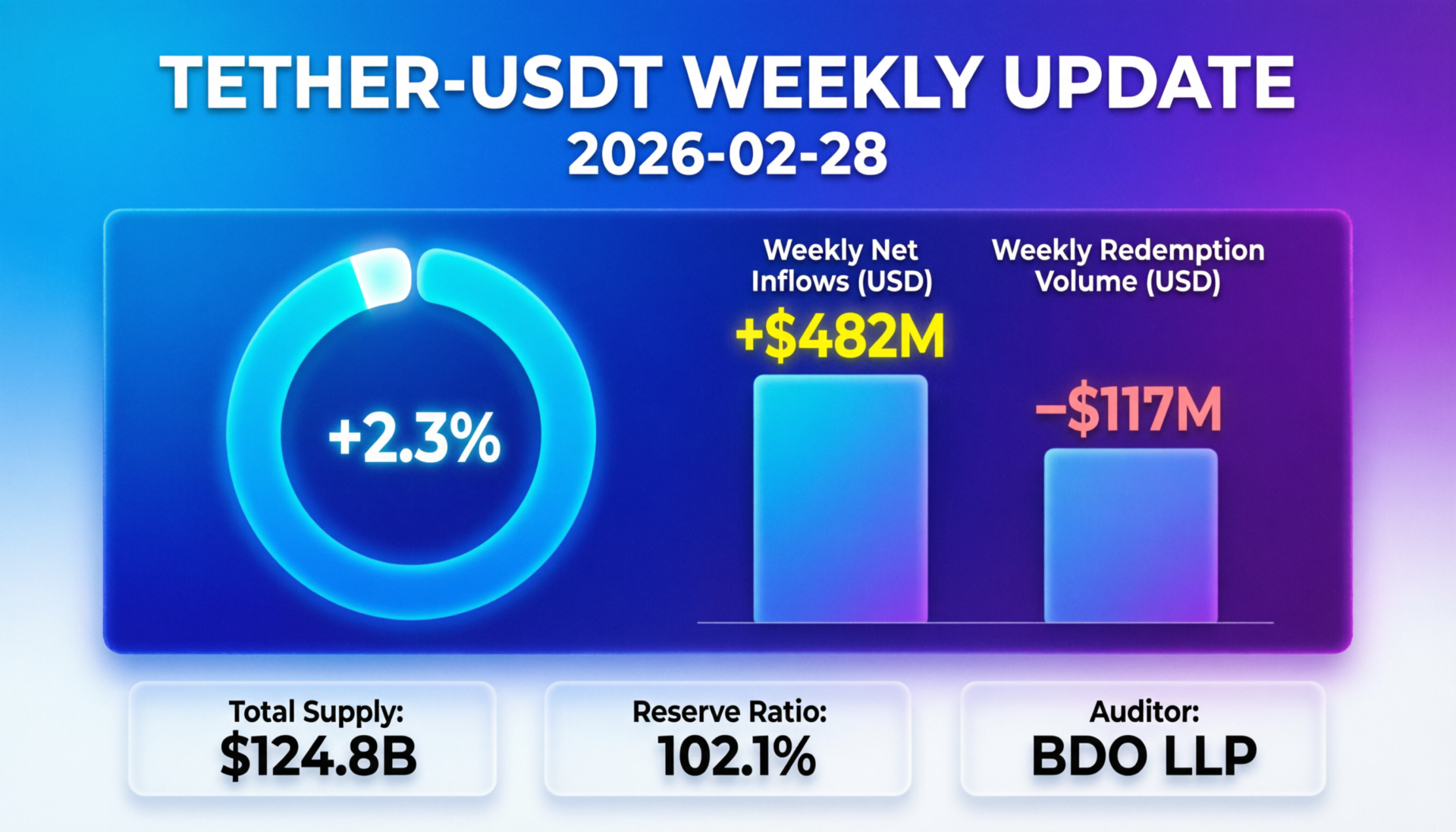

Tether (USDT) Weekly Update Peg Holds Near $1 Amid Regulatory Heat (Feb 28, 2026)
This week’s Tether (USDT) weekly update shows the leading stablecoin trading tightly around $1, with roughly +0.03% movement over the last 7 days and an estimated range near $0.999–$1.002 on major exchanges. Liquidity remains deep, with daily volume above $80B and market cap around $183.6B. The main narrative is regulatory and compliance pressure: Tether has frozen about $4.2B in USDT linked to illicit activity and faces growing scrutiny under new U.S. stablecoin rules. For now, key levels to watch are the $0.995 support zone on the downside and $1.005 on the upside for any signs of meaningful peg stress or premium.
Key Data Snapshot
Data as of: Feb 28, 2026, 11:10 UTC
Current price: ≈ $1.00
24h change: about -0.02%
7d change: about +0.03%
Approx. 7d high / low (estimate): $1.002 – $0.999 (based on major exchange ranges; exact 7-day extremes vary by venue)
Market cap: ≈ $183.6B
24h volume: ≈ $80–86B across major exchanges
Circulating supply: ≈ 183.6B USDT
Main data sources: CoinMarketCap, CoinGecko, Binance, major exchanges.
This Week in USDT Quick Summary
This Tether (USDT) weekly update finds the market’s dominant stablecoin doing exactly what it’s meant to do: trade very close to $1 with minimal price drift, even as headlines around regulation and illicit finance heat up. Price action stayed almost perfectly flat, but the policy and risk backdrop around USDT shifted in meaningful ways.
On one side, USDT’s market cap is still enormous at roughly $183.6B, keeping it firmly in the #3 spot in the crypto market. On the other, regulators and law-enforcement agencies are paying closer attention than ever, and Tether has publicly highlighted aggressive action against suspicious wallets alongside new compliance expectations under recent U.S. stablecoin laws.
USDT Price Action & Key Levels
Weekly Performance
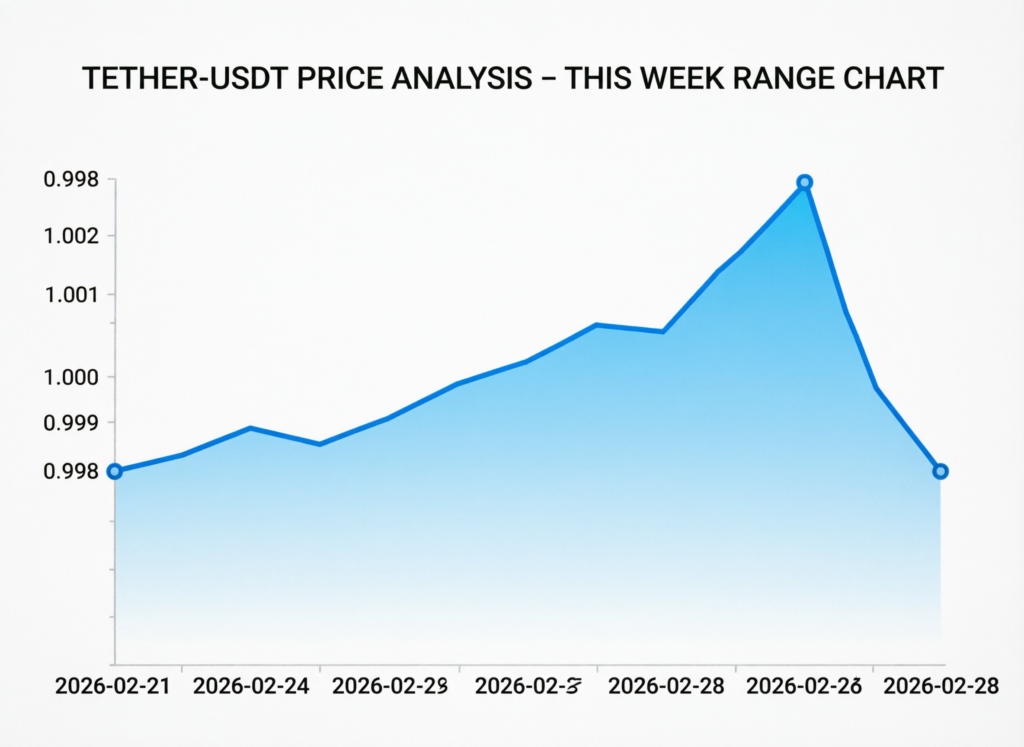
Over the last 7 days, USDT traded in a tight band around $1, with a 7-day percentage change of roughly +0.03% on big venues such as Binance and CoinMarketCap.
Daily ranges were tiny: in the last 24 hours, USDT saw lows near $0.9996 and highs around $1.0010, a typical micro-deviation for a large fiat-backed stablecoin.
Extrapolating across the week, the estimated 7-day range on major centralized exchanges remained roughly $0.999–$1.002. Different trading venues can print slightly different wicks, but the big picture is clear: the peg held, and deviations stayed within a narrow, sub-0.3% band.
Short-Term Technical View
For a stablecoin, “technical analysis” is mostly about monitoring peg stress and liquidity:
Trend
Flat to slightly positive, consistent with a dollar-pegged asset.
Key support
The psychological and structural line is around $0.995; sustained trading below this level would signal unusual peg pressure.
Key resistance
Any move above $1.005 tends to be short-lived and arbitraged away as traders sell USDT at a premium for other assets.
Volatility
Extremely low compared with volatile majors like BTC or ETH; most traders use USDT as dry powder or a settlement currency, not a speculative asset.
News & Narratives That Moved USDT This Week
This week, narratives and headlines framed USDT’s role in the market more than price itself:
$4.2B in USDT frozen over crime links
Tether said it has frozen about $4.2B worth of USDT tied to illicit activity, with $3.5B of that since 2023, and assisted the U.S. Department of Justice in freezing $61M linked to “pig-butchering” scams.
Why it matters:
It shows USDT can be frozen at the issuer level and highlights how tightly real-world law enforcement is now integrated with stablecoins.
Record profits and huge reserves –
Tether’s latest Q4 2025 attestation, prepared by BDO, reported more than $10B in 2025 profits, excess reserves of $6.3B, and enormous exposure to U.S. Treasuries.
Why it matters:
Strong profitability and large reserves support the peg, but also raise questions about concentration and systemic importance.
User and supply growth remains massive
Recent reports show USDT adding tens of millions of users in Q4, reaching over 500M estimated users globally and driving supply well above $180B in circulation.
Market cap dips slightly in February
At the margin, USDT’s market cap slipped by around 0.8% in February after a strong Q4 supply expansion, signaling a small cooling in demand or rotation into alternatives.
Critical op-eds on systemic risk
Recent commentary from outlets like Reuters Breakingviews and Spanish business media has framed Tether as a “fragile foundation” for crypto given its limited equity cushion and growing exposure to riskier assets like bitcoin and gold.
On-Chain, Derivatives & Sentiment
While USDT doesn’t have the same “price chart” dynamics as volatile coins, several structural signals remain important:
Supply and market share
USDT’s circulating supply around 183–184B keeps it the largest stablecoin by far, representing the majority share of the stablecoin market.
Trading volume
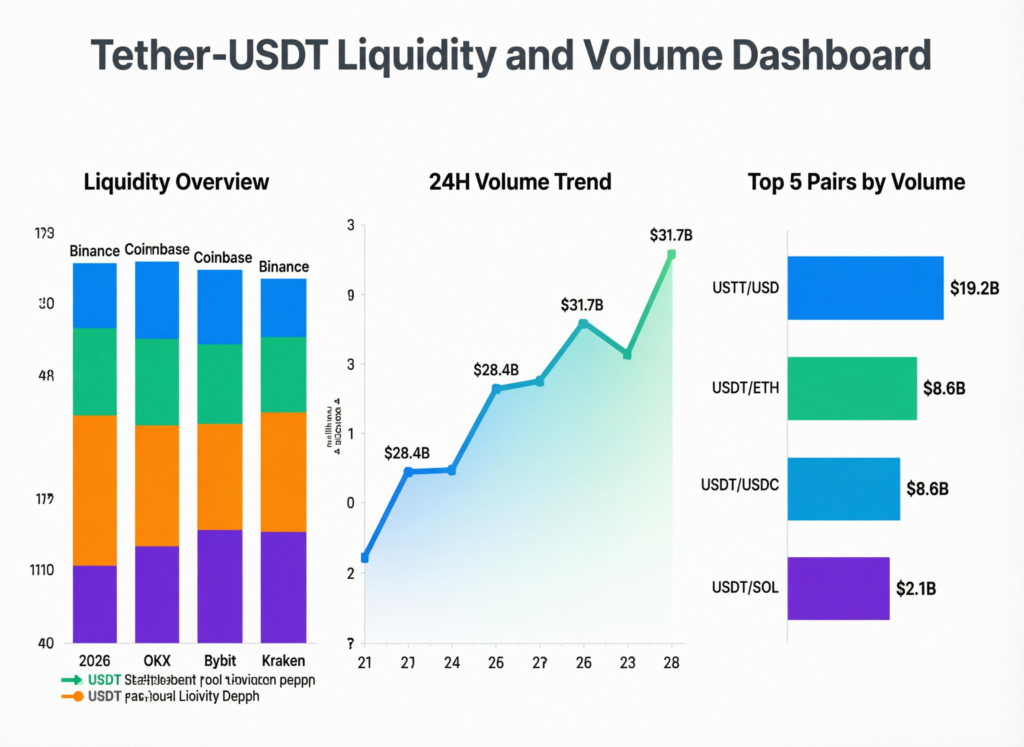
With daily volumes above $80B, USDT remains the key liquidity rail across centralized exchanges, often accounting for a large fraction of total crypto spot volume.
Regulatory perception
Stablecoins like USDT and USDC are central to discussions around the U.S. GENIUS Act, which sets rules for payment stablecoin issuers, especially foreign ones operating in the U.S. market.
Overall sentiment is mixed: markets still trust USDT enough to use it as default collateral and quote currency, but watchdogs, analysts and some institutions continue to flag concentration and transparency risks.
USDT vs Bitcoin & the Wider Crypto Market
Relative to volatile majors
Price stability
While Bitcoin and other top coins saw multi-percent swings over the week, USDT barely moved around $1, as designed.
Market cap ranking
USDT sits at #3 by market cap, behind BTC and ETH, and slightly ahead of other large caps like BNB and XRP.
Use case
Unlike BTC or ETH, USDT’s value proposition is transactional and defensive: a dollar-denominated parking spot, a bridge between exchanges, and a liquidity buffer during crypto sell-offs.
So while traders may focus on BTC charts for directional bets, USDT remains the plumbing of the system: when volatility spikes, USDT volumes typically climb as participants rotate in and out of risk assets.
What This Means for Traders & Long-Term Holders
For active traders.
Treat USDT as short-term cash inside the crypto system—use it for hedging, parking profits, and moving between exchanges.
Watch for persistent deviations below $0.995 or above $1.005, which can signal stress, exchange issues, or temporary liquidity imbalances.
Keep an eye on regulatory headlines and any new restrictions that could affect access to USDT in your region. (brookings.edu)
Track USDT’s market cap trend; sharp inflows or outflows can hint at broader market risk-on or risk-off shifts.
For longer-term holders and users
The central thesis for holding USDT is stability and liquidity, not capital appreciation.
Consider the trade-off between USDT’s deep liquidity and issuer / regulatory risk, especially in light of asset-backing debates and law-enforcement freezes.
Diversifying across multiple stablecoins or blending with traditional cash/bank options may reduce single-issuer risk.
Monitor Tether’s attestations, reserve composition and equity cushion to gauge resilience during market shocks. (tether.io)
Risks, Scenarios
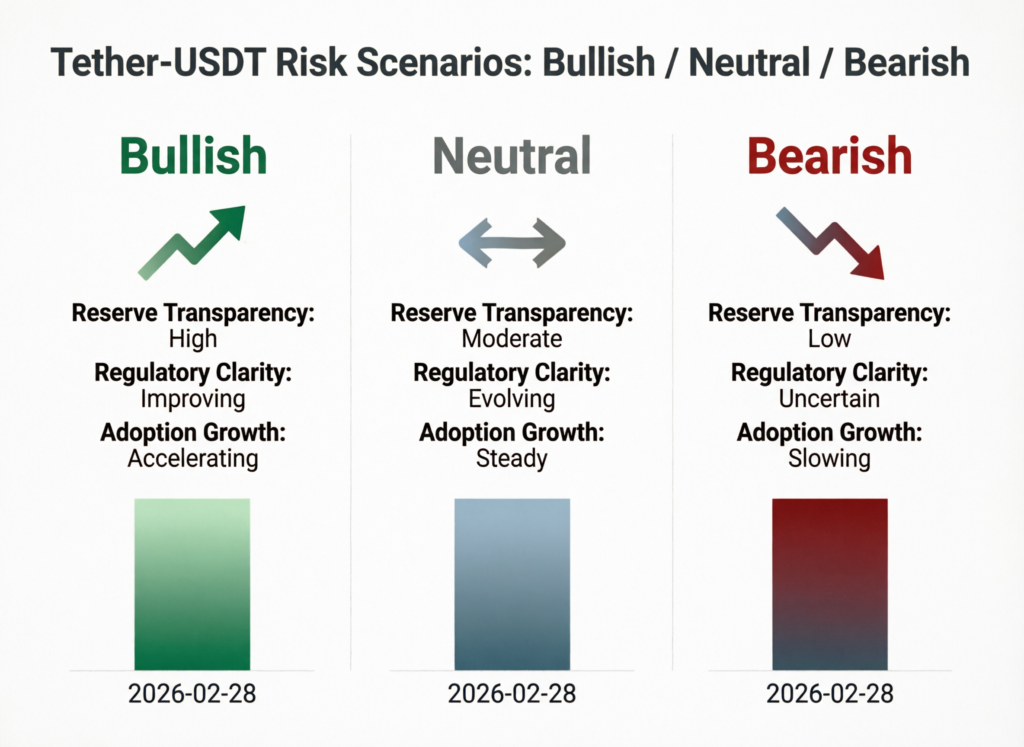
Bullish / constructive scenario
USDT maintains its peg, regulators finalize clear but workable rules, and Tether continues to demonstrate strong reserves and profits. In this case, USDT stays the default stablecoin for global crypto trading and DeFi.
Neutral scenario
USDT remains dominant but faces growing competition from regulated stablecoins and CBDC-like products. Some flows diversify, but USDT continues to trade near $1 with minor periodic de-pegs that get quickly arbitraged.
Bearish / stress scenario
A combination of regulatory shocks, reserve-asset volatility, or transparency failures could trigger a crisis of confidence, leading to redemptions, secondary-market discounts, and contagion across exchanges and DeFi that rely heavily on USDT.
Wrap It Up
This week’s Tether (USDT) weekly update ends on a familiar note: the peg is intact, liquidity is deep, and USDT remains the main settlement rail of the crypto market despite louder regulatory noise. Price barely budged from $1, even as headlines focused on frozen funds, reserve disclosures, and systemic-risk debates around stablecoins.
Looking ahead, the real story for traders and long-term users is not whether USDT can move a fraction of a cent, but how Tether navigates growing policy pressure while maintaining market confidence. Keeping an eye on attestations, reserve composition, and new rules around global stablecoin issuers will be just as important as monitoring the $0.995–$1.005 band. This is not financial advice; always do your own research
FAQs
Q : Why did Tether (USDT) barely move in price this week?
A : USDT is designed to track the U.S. dollar, so its price typically stays very close to $1. Over the last 7 days, it moved only about +0.03%, trading roughly between $0.999 and $1.002 on major exchanges well within its usual stablecoin band.
Q : What are the key levels to watch for USDT right now?
A : For most traders, the main levels are around $0.995 on the downside and $1.005 on the upside. Sustained trading below $0.995 can indicate peg stress, while moves above $1.005 often signal short-term liquidity imbalances or exchange-specific issues that arbitrage tends to correct quickly.
Q : How serious is the news that Tether froze $4.2B in USDT?
A : Tether’s disclosure that it has frozen about $4.2B of USDT linked to illicit activity mostly since 2023 highlights that USDT is centrally controlled and can be frozen at the issuer’s discretion when requested by law enforcement. For some users this is a positive compliance signal; for others it raises concerns about censorship and counterparty risk.
Q : Are regulators putting new pressure on Tether and USDT?
A : Yes. Recent U.S. stablecoin legislation like the GENIUS Act and new guidance from the Office of the Comptroller of the Currency increase expectations for how payment stablecoin issuers, including foreign ones serving U.S. users, operate and manage reserves. This doesn’t automatically threaten the peg, but it does shape Tether’s business model and compliance obligations.
Q : Is holding USDT “safe” for the long term?
A : USDT aims to provide a stable, liquid dollar proxy inside crypto markets, but it still carries issuer, regulatory and reserve-management risks that traditional bank deposits or government bills may not. Long-term users should monitor Tether’s attestations, regulatory developments and diversification options, and consider speaking with a licensed financial professional about how (or if) USDT fits into their overall strategy.