

Solana Weekly Update (Dec 27, 2025): SOL Holds $120 Support as ETFs and On-Chain Activity Stay Strong
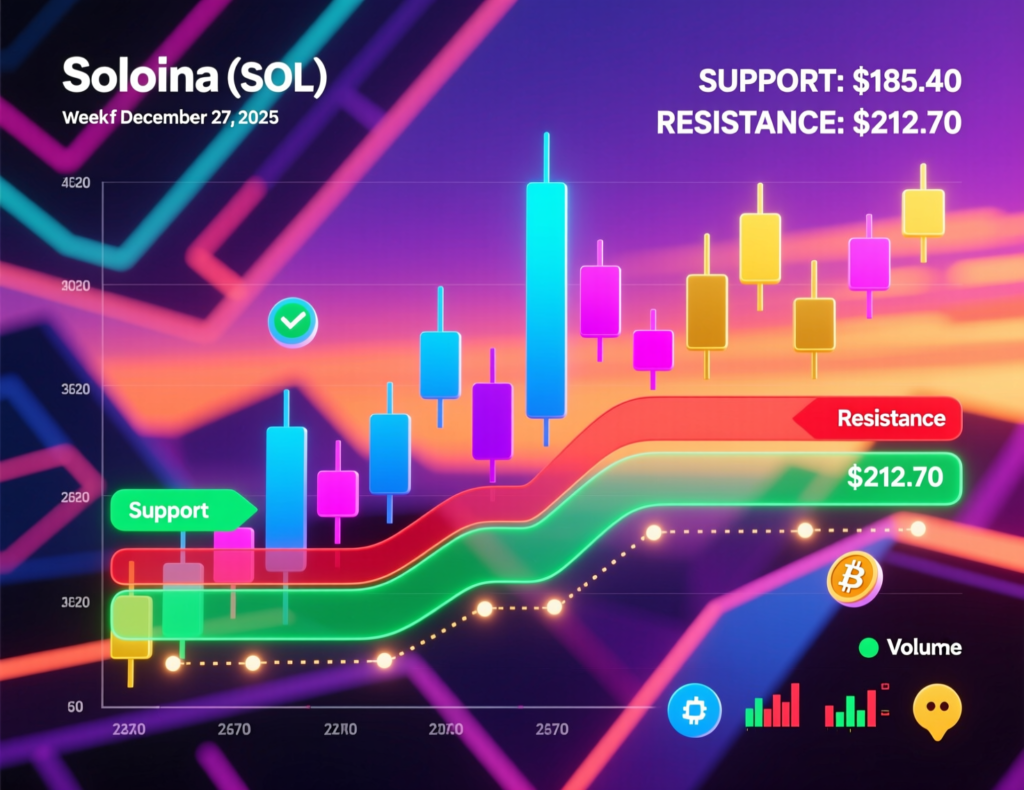
This week’s Solana (SOL) weekly update shows SOL trading around $123, down roughly 2–3% over the last 7 days, with a weekly range of about $116.9–$128.9. According to Kraken and Binance data, Solana’s 7-day high is near $128.9 and the low around $116.9, leaving $118–$120 as the key short-term support zone and $130–$135 as nearby resistance.
Despite softer price action and a bearish moving-average structure flagged by recent technical reports, ETF inflows and on-chain activity still point to an active Solana ecosystem rather than a market that’s switching off.
Key Data Snapshot
Data as of: Dec 27, 2025, 14:11 UTC
Current price: ≈ $122.95 per SOL
24h change: ≈ -1.4%
7d change: ≈ -2.3%
7d high / low: $128.91 – $116.87
Market cap: ≈ $69.1–69.2B
24h volume: ≈ $2.5–2.8B
Main sources
CoinMarketCap, CoinGecko, Binance, Kraken, MetaMask, Investing.com, DeFiLlama, CoinDesk, Binance Square.
Note
Market data moves quickly. All levels above are approximate and reflect conditions at the time of writing, not real-time quotes.
This Week in Solana Quick Summary
This week was more about holding support than breaking out. SOL spent most of the last 7 days drifting lower, trading in a band roughly between $116.9 and $128.9 and ending the week with a net move of around -2–3%.
All of this played out against a softer wider crypto market, with Bitcoin hovering in the mid-$80Ks and posting a small negative 7-day performance – a “risk-off but not capitulation” backdrop.At the same time, Solana spot ETFs continued to see net inflows and on-chain usage stayed elevated, framing this pullback more as consolidation after a strong year than a structural breakdown.
Solana Price Action & Key Levels
Weekly performance
Data from major exchanges shows SOL trading near $123 at the time of writing, with a 7-day high around $128.91 and a 7-day low close to $116.87. Over the week, that works out to a low single-digit percentage decline, in line with the slightly negative 7-day change reported by Binance, MEXC, and Investing.com.
On a longer horizon, SOL still sits well above its 52-week low near $95, but far below the all-time high in the $294–$295 area recorded in January 2025, according to multiple data providers.
Short-term technical view
A recent TradersUnion update flags SOL as trading below its 20-, 50- and 200-day moving averages, which keeps the short-term technical picture on the bearish side. Coinpedia’s analysis this week again highlights the $118–$120 zone as an important support band, with scope for a corrective bounce but no confirmed bullish reversal yet.
From that backdrop, a few widely watched levels emerge (not trade signals, just reference points)
Support
First support: $120
Next support: $118–$116 (recent weekly low area)
Resistance.
Initial resistance: $130–$135, roughly where recent local highs and short-term moving averages cluster.
Volatility this week has been moderate. Intraday ranges were mostly a few dollars wide, hinting at controlled selling rather than panic.
News & Narratives That Moved Solana This Week
Spot ETF inflows continue
Binance Square reports that Solana spot ETFs saw about $33.6M in net inflows over a recent week, with NAV approaching $1B and no net outflows across listed products.That continues to support the institutional demand narrative even as price consolidates.
Technical caution in the short term
TradersUnion notes SOL is still trading below key moving averages, framing the current phase as a weak near-term technical setup within a broader, higher-timeframe uptrend that remains intact. (Traders Union) Coinpedia likewise focuses on the battle around the $118–$120 support band. (Coinpedia Fintech News)
2025 recap: Solana as an institutional & DeFi hub
Recap pieces from Yahoo Finance and Tekedia describe 2025 as the year Solana combined fast retail flows with meaningful institutional capital, leading many chains on metrics like DEX volume and TVL.
Adoption & real-world usage
Analysis from Deriv and other commentators highlights Solana’s growing real-world payment and DeFi footprint, while pointing out that liquidity and stablecoin-market-cap dynamics remain important risks to watch.
On-Chain, Derivatives & Sentiment
DeFiLlama data shows Solana’s stablecoin market cap around $15.3B, up slightly (about 0.5%) over 7 days, with DEX volume near $21.6B for the week, down modestly versus the prior period.
Perpetuals volume over the last 7 days is estimated around $5.6B, down more sharply, suggesting that leverage and speculative trading cooled faster than spot activity.
On the raw activity side, Solana is still posting ~1.9M active addresses and over 50M transactions in 24 hours, underlining that network usage remains heavy even during choppy price action.
Research notes from AInvest and others continue to frame Solana as one of the most active L1s by throughput and user engagement, with more institutional custodians and partners integrating into the ecosystem through 2025.
Solana vs Bitcoin & the Wider Crypto Market
Bitcoin is trading around the mid-$80K region with a roughly flat to slightly negative 7-day performance, depending on the data source. In that context, Solana’s ~-2–3% weekly dip means SOL slightly underperformed BTC, but not in an extreme way.
Against the broader altcoin complex, Solana’s move looks like standard consolidation after a strong multi-month run, not an idiosyncratic blow-up. From a narrative standpoint, SOL still screens as one of the top large-cap “growth L1s” when you look at on-chain metrics and institutional interest.
What This Means for Traders & Long-Term Holders
Reminder
The points below are for general information, not trading or investment advice.
For short-term traders (not advice)
Watch the $118–$120 zone
It’s the key battle line highlighted in several analyses. A clean loss of that area could open the door toward the low-$110s or even the $100 $105 region, where prior demand showed up.
Initial resistance sits around $130–$135.
Any sharp bounce into that band may meet supply from trapped longs and short-term profit-takers.
On-chain data suggests activity remains strong while perps volume cooled, which often lines up with a less crowded derivatives market.
ETF flows and macro context (especially Bitcoin’s direction) remain important, even for SOL-only strategies.
For long-term holders
The core Solana thesis high throughput, low fees, and an increasingly institutionalised ecosystem still looks intact in multiple 2025 recap pieces.
Solana’s DEX and DeFi footprint continues to be a major differentiator, with extended periods of leading DEX volume across chains.
Key areas to watch heading into 2026 include: regulation (especially around ETFs and staking), performance upgrades, NFT/consumer adoption, and liquidity in both stablecoins and derivatives.
From a risk perspective, Solana remains a high-beta large-cap historically more volatile than BTC and often ETH as well so position sizing and time horizon are crucial.
Risks, Scenarios.
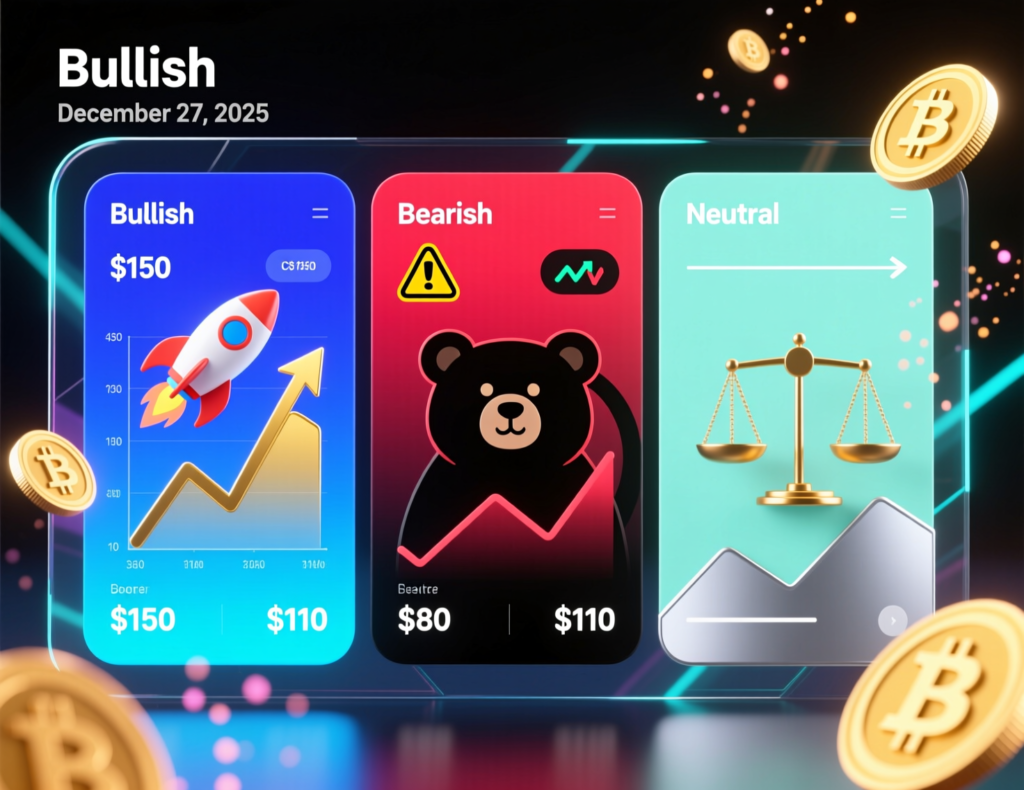
No single outcome is locked in, but the current setup for Solana can roughly be framed in three scenarios:
Bullish scenario
SOL holds above $118–$120, ETF inflows stay positive, Bitcoin stabilises, and on-chain metrics remain strong. In that case, a gradual grind back toward the $135–$150 area over time wouldn’t be surprising – but it’s never guaranteed.
Neutral scenario
SOL continues to range roughly between $115 and $135, with choppy trading, rotation into and out of other L1s, and sector-specific narratives (meme coins, RWAs, etc.) moving attention around.
Bearish scenario
A decisive break below ~$115 on strong volume, combined with macro or regulatory shocks, could drag price toward the $100 and then $95 regions, closer to the 52-week low.
Bottom Lines
This Solana weekly update shows a market that is pausing, not collapsing. SOL is holding the $118–$120 support zone while ETFs, on-chain activity, and DeFi usage stay active in the background. In other words, price is cooling off but the underlying network remains busy, with institutions and retail users still transacting, trading, and building.
For traders and long-term holders, that mix calls for patience, risk management, and clear time frames rather than chasing every move. As always, treat this Solana analysis as one data point among many, do your own research, and invest only what you can afford to lose.
FAQs
Q : Why did Solana (SOL) dip this week?
A : Solana’s price drifted lower by around 2–3% over the last 7 days, broadly matching a mildly risk-off tone across the crypto market. Bitcoin has been slightly negative week-on-week, and technical analysts point to SOL trading below key moving averages, which tends to dampen short-term momentum.
Q : What are the key Solana price levels to watch right now?
A : The $118–$120 zone is the main support band highlighted in several market commentaries, while the recent weekly low near $116.9 is the next downside reference. On the upside, $130–$135 is the first meaningful resistance cluster, roughly in line with short-term moving averages and recent local highs.
Q : How is Solana performing compared to Bitcoin and the wider market this week?
A : Over the last 7 days, Solana has slipped by a bit more than Bitcoin, which is roughly flat to mildly negative on the week, so SOL underperformed BTC by a small margin. Still, the move looks like normal consolidation after a strong multi-month run, not a Solana-specific breakdown, with on-chain activity remaining strong.
Q : Is Solana’s on-chain activity still strong despite the price pullback?
A : Yes. DeFiLlama data shows billions of dollars in weekly DEX volume, a stablecoin market cap above $15B, and roughly 1.9M active addresses with over 50M daily transactions, all suggesting that network usage remains heavy. While perps volume is down week-on-week, that mostly reflects reduced leverage rather than users abandoning the chain.
Q : Is Solana a “safe” coin to hold going into 2026?
A : Solana is a large-cap but high-beta asset – it has strong adoption metrics and growing institutional interest, but it is typically more volatile than Bitcoin and often more sensitive to market swings. ETF flows and on-chain data are positives, yet regulatory shifts, liquidity conditions, and competition from other L1s remain key risks. Investors should size positions carefully and match them to their risk tolerance and time horizon