


SEC vs CFTC Roles: Crypto, Swaps, and Compliance
If you are comparing SEC vs CFTC roles, the core difference is simple: the SEC mainly oversees securities and investor protection, while the CFTC mainly oversees commodities derivatives such as futures and swaps. For fintechs, crypto firms, brokers, exchanges, and cross-border platforms, that distinction affects registration, disclosures, reporting, and enforcement exposure almost immediately.
In practice, the answer is not always about the label on the product. It usually comes down to what the asset is, how it is offered, and what the platform actually does. That is why firms serving U.S. users from New York, London, Berlin, Dublin, or Frankfurt need a sharper view of where SEC oversight ends, where CFTC oversight begins, and where both may apply.
The issue is hardly theoretical. Global OTC derivatives notional outstanding reached about $846 trillion by June 2025. The SEC also reported 583 enforcement actions and $8.2 billion in remedies for fiscal 2024. For compliance teams, those numbers are a reminder that getting jurisdiction wrong can become expensive very quickly.
SEC vs CFTC Roles Explained in Plain English
At a high level, the difference between the SEC and the CFTC is easy to remember. The SEC is more closely tied to securities markets, issuers, broker-dealers, and investor protection. The CFTC is more closely tied to commodities derivatives markets, including futures and swaps.
What the SEC regulates
The SEC sits closest to.
Securities offerings
Public-company disclosure
Securities trading venues
Broker-dealers
Investment intermediaries
Investor protection rules
If your business issues a token that looks like an investment contract, operates brokerage-like workflows, or markets a product tied to ownership or profit expectations, the SEC is often the first regulator to assess.
What the CFTC regulates
The CFTC’s core lane is different. It focuses on.
Commodities derivatives
Futures markets
Swaps
Options on futures
Market conduct
Anti-fraud and anti-manipulation oversight in certain areas
Even when spot commodity markets are not licensed like securities markets, the CFTC can still play an important enforcement role, especially where leveraged products, derivatives, or manipulative conduct are involved.
The easiest way to remember SEC vs CFTC roles
A useful shortcut is this.
Ownership and investment claims usually point toward the SEC
Contracts based on price movement or future delivery usually point toward the CFTC
It is only a starting point, but it works well as a first screening tool for legal, product, and compliance teams.
Jurisdiction Boundaries Between the SEC and CFTC
This is where things get more nuanced. Modern financial products often combine features of securities, commodities, and derivatives. That is why the SEC and CFTC can overlap, especially when one platform offers multiple services under one roof.
Securities vs commodities
Traditional shares, bonds, and many capital-raising instruments usually fall into securities territory. Commodities and commodity interests typically sit on the CFTC side, particularly once futures or swaps are involved.
The challenge is in the grey area. Structure matters. Marketing matters. Rights attached to the product matter. Economic reality matters more than branding.

Security-based swaps, mixed swaps, and security futures
Some products sit clearly with one regulator. Others do not.
Here is the basic split.
| Product Type | Primary Regulator |
|---|---|
| Securities | SEC |
| Futures | CFTC |
| Swaps | CFTC |
| Security-based swaps | SEC |
| Mixed swaps | Shared / coordinated oversight |
| Security futures | Split or coordinated oversight |
This is why product design cannot be separated from legal analysis. A small structural change can move a product into a completely different regulatory bucket.
When oversight overlaps
Overlap tends to appear when a firm combines functions such as.
Issuance
Brokerage
Custody
Spot execution
Margin features
Derivatives trading
A single platform might face SEC scrutiny for securities activity and CFTC scrutiny for swaps or commodity derivatives. That becomes even more likely when U.S. persons or U.S. market infrastructure are involved.
SEC vs CFTC Roles in Crypto Regulation
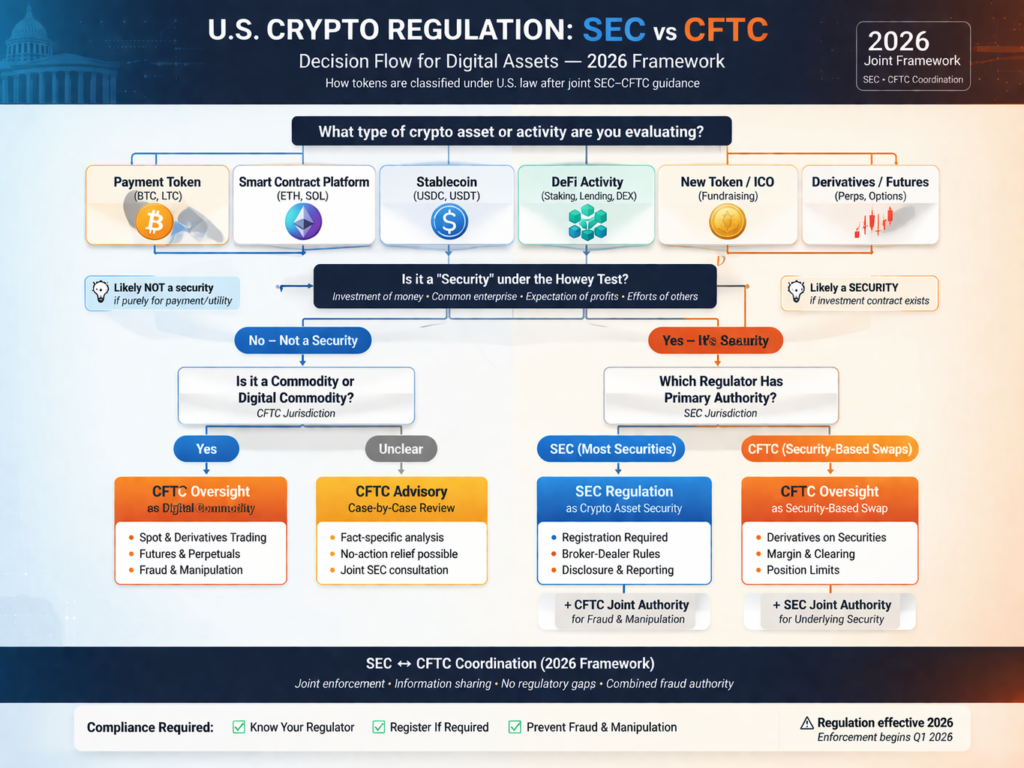
In crypto, SEC vs CFTC roles depend less on broad labels and more on classification plus activity. Asking whether something is “crypto” is too vague to be useful. The better question is: What rights does the asset give, how is it marketed, and what functions does the platform provide?
When a digital asset may be treated as a security or a commodity
A digital asset may raise SEC issues if it is sold or promoted like an investment contract. A crypto product may raise CFTC issues when it involves commodities derivatives, swaps, futures, or certain forms of market conduct.
That means the analysis often turns on.
Token structure
Marketing language
Revenue or profit expectations
Custody setup
Spot versus derivatives activity
Access for U.S. persons
For crypto firms, this is where many mistakes begin. Teams focus on the asset name and ignore the surrounding product design.
What the 2026 SEC/CFTC coordination means for crypto firms
The 2026 coordination between the SEC and CFTC matters because it signals a more practical, product-by-product approach. For crypto exchanges, token issuers, custodians, and derivatives venues, that means fewer simplistic assumptions and more attention to actual business activity.
A London fintech serving U.S. traders, a New York tokenization startup, or a Berlin platform offering derivative-style exposure cannot rely on one-regulator thinking anymore. In practice, many crypto businesses need parallel SEC and CFTC analysis from the start.
How crypto firms should assess exposure
A useful internal checklist starts with four questions.
What is the asset?
How is it marketed?
What does the platform actually do?
Are U.S. persons or U.S. markets involved?
That framework is usually more valuable than any broad “crypto compliance” label. It also helps uncover hidden exposure from staking programs, token-linked returns, margin products, and swap-like structures.
What SEC vs CFTC Roles Mean for Compliance Teams
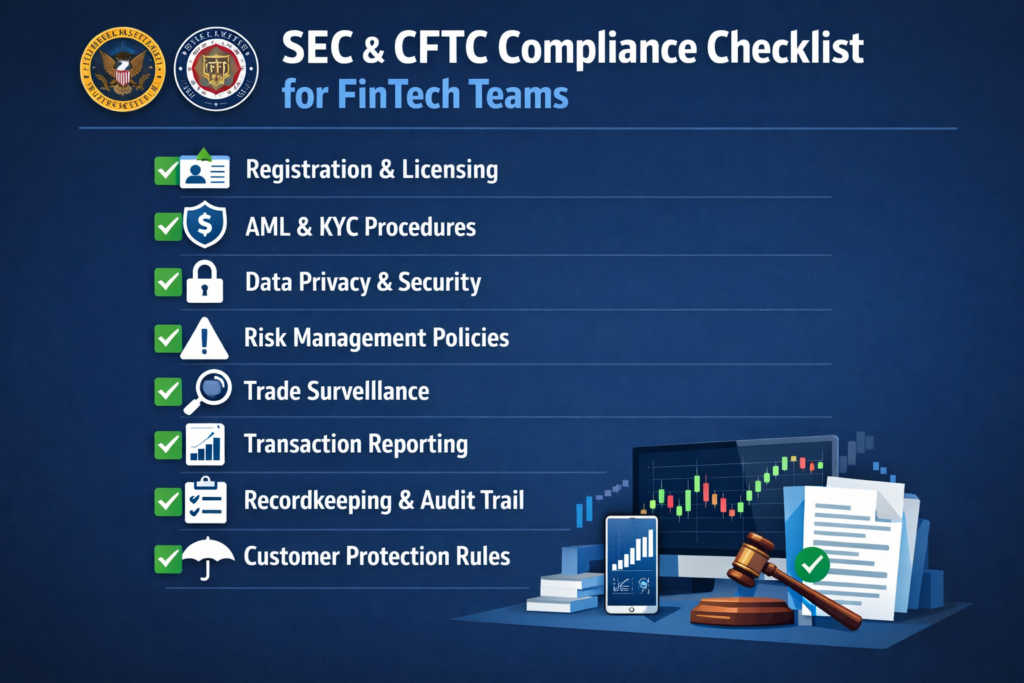
For compliance teams, this is not just a jurisdiction debate. It affects actual operational duties, including.
Registration
Exams
Disclosures
Trade reporting
Surveillance
Recordkeeping
Escalation procedures
One company can trigger both SEC and CFTC obligations depending on how its products and services are structured.
SEC registration vs CFTC registration
On the SEC side, firms often begin with broker-dealer analysis and related registration requirements. On the CFTC side, the analysis may turn toward categories such as.
Futures commission merchant
Swap dealer
Introducing broker
Other derivatives-related statuses
Dual-registration questions appear quickly when a business mixes securities workflows with derivatives activity.
Enforcement, disclosures, and reporting obligations
The SEC’s 2024 enforcement results show how expensive control failures can become. Registration alone is not enough. Firms also need to think about:
Supervisory procedures
Communications retention
Trade and transaction reporting
Disclosure controls
Internal escalation
Issue management across product and engineering teams
That matters in Austin and San Francisco, but it matters just as much in London, Frankfurt, and Dublin when U.S. touchpoints exist.
Dual supervision adds complexity
Where both regulators may apply, the operational burden increases. Firms often need:
A regulator-by-product matrix
Governance for product changes
Clear escalation triggers
Cross-functional review between legal, compliance, and engineering
From a business point of view, it is far easier to build those controls before launch than to retrofit them after a regulator raises questions.
Cross-Border Impact for UK, Germany, and EU Firms
Many firms outside the U.S. assume local authorisation solves the problem. It does not. UK and EU businesses can still create SEC or CFTC exposure if they touch U.S. persons, U.S. liquidity, U.S. marketing channels, or U.S.-linked instruments.
Why UK firms still need SEC and CFTC awareness
For UK firms, FCA requirements and UK-GDPR remain central local obligations. But cross-border servicing can still create U.S. regulatory risk. A London or Manchester firm onboarding U.S. users or targeting U.S. markets may need SEC or CFTC analysis regardless of where its main office sits.
How German and EU firms should view U.S. exposure
For firms in Germany and across the EU, MiCA is important, but it does not settle U.S. jurisdiction questions. A Berlin, Frankfurt, Amsterdam, Dublin, or Luxembourg team may still need separate U.S. analysis for token classification, market access, and cross-border conduct.
MiCA, DORA, GDPR, and UK-GDPR overlays
This is where things become more operational. EU and UK firms may need to consider several layers at once.
U.S. financial regulation
GDPR or UK-GDPR transfer requirements
MiCA authorisation questions
DORA resilience and ICT governance obligations
DORA has applied since 17 January 2025, while MiCA entered into application from 30 December 2024 for the main regime. For firms serving both European and U.S. markets, compliance design has to be coordinated rather than handled in silos.

How to Determine Whether SEC or CFTC Rules Apply to Your Business
If you want to assess SEC vs CFTC roles for your business, start with four practical filters.
Asset type
Identify whether the product involves:
A security
A commodity interest
A future
A swap
A security-based swap
Transaction type
Look at how the transaction works in reality. Is it spot trading, brokerage, custody, settlement, margin, clearing, or derivatives activity? The commercial flow matters as much as the legal label.
Service model
Map every function your platform performs, including.
Issuance
Brokerage
Custody
Spot trading
Clearing
Settlement
Margin
Derivatives
A function-by-function map usually reveals more risk than a brand description ever will.
U.S. nexus
Check whether U.S. persons, U.S. marketing, U.S. counterparties, or U.S. market infrastructure are involved. A company based in Dublin or Amsterdam can still create U.S. risk through customer acquisition and onboarding alone.
When to involve legal counsel
Counsel should be involved before launch when a feature touches.
Token issuance
Revenue rights
Leveraged products
Swaps or futures
U.S. customer acquisition
Hybrid products with overlapping traits
It is usually cheaper to adjust a flow diagram than to unwind a registration or enforcement issue later.
Common Mistakes Firms Make When Comparing SEC and CFTC Roles
Assuming all crypto falls under one regulator
That shortcut is usually wrong. Crypto oversight depends on classification and activity, not on the word “crypto.”
Ignoring derivatives risk
Many firms analyse the token and forget the contract wrapper. In practice, swaps, leverage, or derivative-style exposure can create the more serious regulatory issue.
Treating U.S. exposure as irrelevant
Local authorisation in the UK or EU does not automatically remove U.S. risk. Cross-border product access, marketing, and customer location can all matter.
Concluding Remarks
Understanding SEC vs CFTC roles is not about memorising two agency descriptions. It is about knowing how asset classification, platform activity, and U.S. market exposure work together. For fintech, crypto, and cross-border firms, that distinction can shape registration strategy, product design, compliance cost, and enforcement risk.
If your business touches securities, commodities, swaps, or crypto, treat jurisdiction as a product-design issue early. It is not legal advice, and firms should always do their own analysis with qualified counsel. But the earlier you map SEC vs CFTC roles correctly, the easier it becomes to launch with fewer surprises.( Click Here’s )
Key Takeaways
The SEC usually governs securities, issuers, and broker-dealers
The CFTC usually governs commodity derivatives such as futures and swaps
Crypto analysis should begin with classification plus platform activity
Overlap becomes more likely when a platform combines issuance, custody, brokerage, spot services, and derivatives
UK, German, and EU firms can still trigger U.S. regulatory exposure
MiCA, DORA, GDPR, and UK-GDPR should be assessed alongside U.S. perimeter analysis
FAQs
Q : Does the SEC or CFTC regulate spot crypto trading?
A : It depends on the asset and the conduct. The CFTC has authority in certain areas involving fraud and manipulation in spot digital commodity markets, while the SEC may still apply if the asset or arrangement falls within federal securities laws. Spot activity is not a blanket exemption.
Q : Can one company fall under both SEC and CFTC supervision?
A : Yes. That is common when a platform mixes securities-related activity with swaps, futures, or other derivatives functions. It is especially relevant for firms offering brokerage, token issuance, custody, and derivatives under one business model.
Q : Do UK firms need to care about SEC and CFTC rules if they serve U.S. clients?
A : Yes. A UK firm can still create U.S. regulatory exposure by onboarding U.S. users, marketing into the U.S., or offering products linked to U.S. markets. UK compliance and U.S. perimeter analysis often need to be handled together.
Q : What is the difference between a security-based swap and a regular swap?
A : A security-based swap is generally tied to a single security, loan, or narrow-based securities index and usually falls under the SEC framework. A regular swap typically falls under the CFTC’s swaps framework. Mixed products can make the analysis more complicated.
Q : How can EU firms reduce SEC/CFTC risk before entering the U.S. market?
A : Start with a product-by-product review. Map the asset type, contract type, platform function, customer segment, and marketing route involving U.S. persons. Then align that analysis with MiCA, DORA, GDPR, and vendor-risk controls before launch.