


Rain vs Binance: Best Crypto Exchange for Middle East
For most everyday GCC residents who mainly want a simple, regulated crypto on/off-ramp connected to local banks, Rain is usually the more straightforward choice. Binance better suits active traders who need a wide range of coins, derivatives and liquidity, but its regulation and bank support vary by country, so you must check local rules before using it.
Introduction
Crypto adoption in Bahrain, the UAE, Saudi Arabia and across the wider Middle East has accelerated fast, helped by investor-friendly hubs like Dubai and Abu Dhabi and steadily tightening regulation. The UAE was even named a top-five global crypto hub for investors in a 2025 wealth report, which shows how mainstream the region has become.At the same time, exchanges like Rain and Binance are competing to be the go-to platforms for GCC residents and expats from the US, UK, Germany and wider EU.
This guide compares Rain vs Binance so you can match the right platform to your location, bank setup, religious or compliance preferences, and risk profile. In simple terms: Rain focuses on being a regulated, Sharia-reviewed on/off-ramp for Middle East users, while Binance focuses on global trading features and deep liquidity. We’ll walk through safety, regulation, Sharia considerations, fees, funding rails, UX and who each platform is best for in 2026 and beyond.
Not financial or legal advice
This article is informational only. Crypto is high-risk, and regulation changes quickly always double-check each platform’s official documentation and get professional advice where needed.
Rain vs Binance at a Glance
For crypto traders in the Middle East, the main difference between Rain and Binance is focus. Rain optimises for regulated, local-currency on/off-ramps in the GCC, while Binance optimises for global coin coverage, derivatives and trading tools.
Key facts about Rain for Middle East traders
Rain is a Bahrain-based crypto exchange that became the first licensed crypto-asset service provider under the Central Bank of Bahrain (CBB) back in 2019. It now operates through entities in Bahrain, the UAE (Rain Trading Limited under ADGM’s FSRA) and Turkey, with a strong focus on GCC and wider MENA users.
Rain primarily targets residents in countries like Bahrain, Kuwait, Saudi Arabia, Oman and the UAE, with support for multiple local fiats plus USD. Typical users are people in Manama, Riyadh or Dubai who want.
A simple mobile app
Local bank transfers in AED, SAR, BHD and friends
A limited but mainstream selection of coins (for example BTC, ETH and a few others)
Sharia-reviewed infrastructure and clear regulation
Rain’s value proposition is less “trade every altcoin” and more “buy and sell major coins safely with local rails and banking relationships.”
Key facts about Binance in the region
Binance is one of the world’s largest crypto exchanges, with a huge asset list, advanced spot and margin trading, derivatives, options and a full suite of Earn products.
Its footprint in the region is mixed.
In Dubai, Binance FZE holds a Virtual Asset Service Provider (VASP) licence from VARA to offer broker-dealer, exchange and certain derivatives services, initially focused on institutional and qualified investors and now expanding.
In Abu Dhabi, Binance recently secured a global licence under the ADGM FSRA framework, signalling a push toward more comprehensive regulation.
In Europe, Binance operates under evolving rules, including the EU’s MiCA framework and country-level scrutiny (for example withdrawing its licence application with BaFin in Germany).
In the UK, the FCA has issued consumer warnings about Binance Markets Limited not being allowed to conduct regulated activities locally.
Because of this patchwork, the Binance experience in London or Berlin can look very different from using Binance as a Dubai-based trader.
who is each platform best for?
For a quick mental model.
Rain is best for GCC residents who prioritise:
Local-bank deposits and withdrawals in AED, SAR, BHD, KWD, OMR and USD
CBB and ADGM oversight, plus Sharia review
Simple, spot-only buying for long-term holding
Binance is best for traders who want.
A very wide coin list (altcoins, DeFi tokens, more stablecoins)
Advanced trading tools, leverage and derivatives (where allowed)
Global liquidity and tight order-book spreads
What is the difference between Rain and Binance for Middle East traders?
Rain focuses on providing regulated, Sharia-reviewed fiat on/off-ramps via local GCC banks, while Binance focuses on global trading features, derivatives and deep liquidity, with more complex and varied regulation by country.
Safety, Regulation & Sharia Compliance
Regulation is not just a checkbox; it directly affects whether your bank in Dubai or Riyadh can safely send funds, and what happens if something goes wrong.
How Rain is regulated in Bahrain and the wider GCC
Rain Management W.L.L. in Bahrain holds a crypto-asset service provider licence from the Central Bank of Bahrain, making it the first fully licensed crypto exchange in the Middle East.
Rain also operates Rain Trading Limited in the UAE, which has Financial Services Permission from ADGM’s Financial Services Regulatory Authority (FSRA) in Abu Dhabi. That licence lets it provide regulated virtual asset services to UAE clients under a clear framework.
Why does this matter compared with using an unlicensed offshore platform?
Your local bank is more likely to support transfers to a CBB- or ADGM-regulated exchange without flagging them as suspicious.
You benefit from a defined regime around custody, capital requirements and complaints handling, similar to other licensed financial institutions.
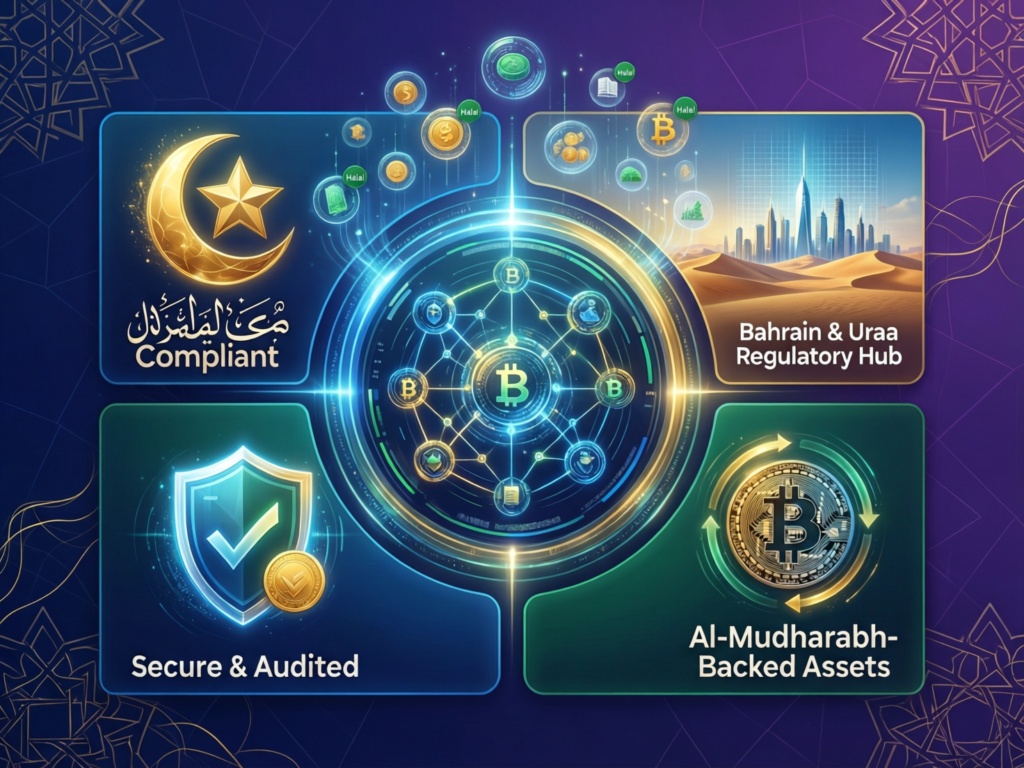
For Sharia-conscious investors in Saudi Arabia or Kuwait, Rain’s Sharia review, conducted under CBB oversight, adds an extra trust layer.
Binance regulation in UK, EU and Middle East
Binance’s regulatory story is much more global – and more complex:
UK
The FCA has warned that Binance Markets Limited may not conduct regulated activities in the UK, so UK users typically use the global platform under strict risk warnings.
EU/Germany
Binance withdrew its application for a BaFin licence in 2023 and now operates without a local German licence, while the EU’s MiCA regime (phased in from 2024) sets new expectations for all crypto-asset service providers.
UAE
Binance FZE holds VARA licences in Dubai and has ADGM approval in Abu Dhabi, which together create a more regulated experience for UAE-based users than in many other markets.
Why is regulation in Bahrain and the wider GCC important when choosing between Rain and Binance?
Regulation in Bahrain, Dubai and Abu Dhabi defines how safely your bank can connect to an exchange, what consumer protections you have, and how stable your fiat on/off-ramps are over time. A CBB or ADGM/VARA licence generally means clearer rules on custody, capital and disclosures than unregulated offshore platforms.
Sharia-compliant and ethical trading considerations
Rain emphasises a Sharia-reviewed model: it entered Bahrain’s regulatory sandbox and later obtained Sharia certification via a CBB-licensed advisory firm when graduating to full licence.That usually means.
No interest-bearing lending (riba)
Care around excessive uncertainty (gharar)
A clear custody structure for client assets
By contrast, Binance offers margin, leveraged futures and complex yield products. Many Islamic finance scholars are cautious about these, especially where speculation dominates genuine economic use.
Practical guidance
Treat exchanges as infrastructure, not religious authorities.
If Sharia compliance is a priority, check platforms like Rain, CoinMENA or bank-backed solutions that explicitly mention Sharia review.
Always confirm your personal situation with a trusted local scholar or advisor.
Fees, Spreads & Hidden Costs
Fees and spreads can easily cost more than you expect, especially when moving money between GCC, US, UK and EU banks.
Trading, deposit and withdrawal fees on Rain
Rain uses a relatively simple percentage-based fee model for spot trades, with occasional zero-fee campaigns on specific pairs. Exact numbers change, so always check Rain’s latest fee page.
Key cost drivers for GCC users include
Deposit method
Local rails like Fawri/Fawri+ in Bahrain or domestic AED transfers are usually cheaper than card deposits.
Withdrawal route
Bank withdrawals in BHD, AED or SAR may have flat fees or FX margins when converted to USD.
Spread vs headline fee
If you only trade small tickets (say AED 2,000 once a month), the spread between buy/sell price can matter more than the visible trading fee.
Binance spot, P2P and funding fees for Middle East users
On Binance, the basic building blocks are.
Tiered maker/taker fees for spot trades, which can fall with higher volumes or if you pay in BNB.
Additional costs for margin and futures (funding rates, borrowing fees, liquidation risk).
Card deposits, P2P transfers and third-party gateways, each with their own FX and spread realities.
For many UAE or Saudi users, the lowest-cost route is often:
Move local currency via P2P trades or a local on-ramp.
Trade on Binance’s global order books.
Then either hold in self-custody or send back to a regulated local exchange like Rain or CoinMENA for off-ramp.
But P2P comes with counterparty risk and FX variability, so it’s not “free money”.
Real-world cost examples in AED, SAR, BHD, USD, GBP, EUR
Here are simplified, illustrative scenarios (you must re-check live fee schedules before acting)
GCC retail user, AED 2,000 to buy BTC
With Rain, you might wire AED from a Dubai bank to Rain’s AED account, pay a modest deposit fee (or none), then a simple spot fee plus spread.
With Binance, you could use a card (faster but higher fee), P2P in AED (spread risk), or an international transfer in USD/EUR, then convert to BTC.

UK expat in Dubai sending GBP
Option A: Send GBP to a UK on-ramp like Coinbase or Kraken, buy USDT, then transfer to Rain or Binance.
Option B: Use a multi-currency fintech and SEPA/SWIFT into Rain or Binance, comparing FX spreads and bank handling fees.
German/EU user sending EUR via SEPA, later off-ramping to GCC
It may be cheaper to use a MiCA-aligned EU exchange, then move BTC/USDT to a GCC platform like Rain or CoinMENA for eventual AED/SAR withdrawals, instead of wiring fiat directly cross-border.
What fees do Rain and Binance charge for deposits and withdrawals to Middle Eastern banks?
Rain usually charges straightforward trading and bank transfer fees, often with local rails (like Fawri or domestic AED transfers) that reduce costs for GCC users, while Binance relies more on cards, P2P and international transfers with variable FX spreads. Exact fees change frequently, so always compare each platform’s current fee schedule and your bank’s charges before moving money.
Funding, Currencies & Local Payment Methods
On/off-ramps are where many Middle East traders either fall in love with a platform or give up.
Local bank transfers and fiat ramps on Rain
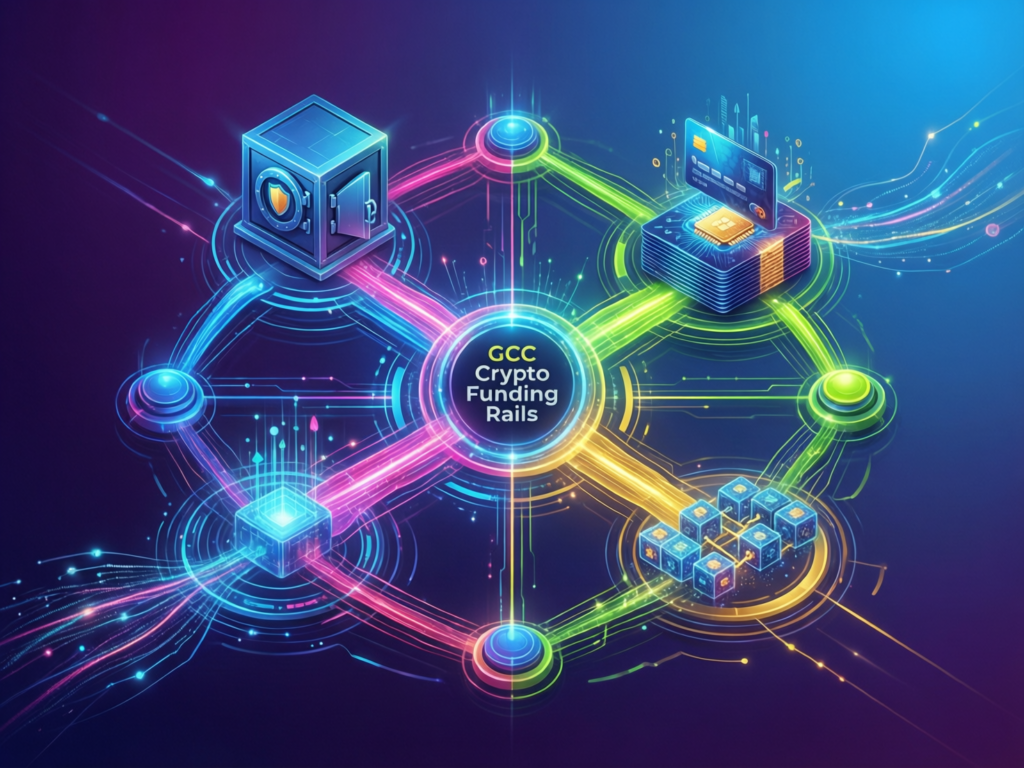
Rain supports key regional fiats including BHD, KWD, SAR, OMR, AED and USD, with dedicated bank details and instructions for each.
In practice, users in.
Bahrain and Kuwait can often use Fawri/Fawri+ or local transfers with fast settlement.
Saudi Arabia, UAE, Oman and Jordan usually rely on standard domestic wires that clear in one to two business days.
Egypt and wider MENA may face a bit more FX friction but still benefit from Rain’s regional focus and local-bank relationships.
Limits and timelines depend on your KYC level and bank; high-value corporate transfers will naturally be slower and more scrutinised.
Using Binance with local banks, P2P and cards in the Middle East
Binance gives you more options but also more moving parts.
UAE, Saudi or Egyptian residents often use P2P to convert AED, SAR or EGP into USDT, then trade on Binance’s main markets.
Local banks may suddenly tighten or loosen support for card or bank transfers to global crypto exchanges as their compliance policies evolve.
P2P safety requires discipline: always stay on-platform for communication, use KYC-verified traders, and understand how Binance’s dispute process works.
Guidance for US, UK, German and wider EU residents funding accounts
US citizens in Dubai or Riyadh should be extra careful: use US-compliant platforms where possible, keep an eye on OFAC/sanctions risks, and talk to a tax advisor about FBAR/FATCA implications.
UK residents sending GBP to GCC exchanges must consider both FCA guidance and UK-GDPR obligations if they’re handling customer funds or building their own crypto apps.
German/EU residents benefit from SEPA transfers and MiCA clarity, but still need to check data-protection (DSGVO), BaFin expectations and FX spreads when interacting with GCC-based services.
How do Rain and Binance compare for UAE, Bahrain and Saudi users in terms of supported fiat currencies and payment methods?
Rain offers native support for major GCC currencies and local bank rails, making deposits and withdrawals in AED, SAR and BHD relatively straightforward, while Binance offers more global options (cards, P2P, international wires) that can work for GCC users but are more dependent on each bank’s current risk appetite and local regulation.
Features, UX & Supported Countries
Once your money is on the platform, features and user experience become the main differentiator.
Simple investing vs pro trading.
Rain is built for simple, spot-only investing with a curated coin list centred on major assets like BTC and ETH.
For a first-time investor in Manama or Dubai, the app flow is intentionally basic:
Deposit local currency
Choose a major coin
Buy and hold in a custodial wallet
This makes Rain suitable for.
Long-term “buy and hold” investors in Bahrain, UAE or Saudi
Users who care more about regulatory comfort than endless altcoins
Busy professionals who don’t want to manage order types, funding rates or complex UIs
Active day traders in New York, London or Berlin will likely find Rain too limited as a primary trading venue.
Advanced trading, derivatives and earn products on Binance
Binance, on the other hand, offers.
Spot markets across hundreds of coins
Margin, futures and options on major pairs
Structured Earn products, staking, launchpools and more (varying by jurisdiction)
That power comes with real risk.
Leverage can amplify both gains and losses.
Liquidations can happen very quickly in volatile markets.
Tax reporting for derivatives and yield products can get complicated for US, UK and German users.
If you don’t fully understand the product especially futures, options or leveraged tokens – it’s a strong signal to keep your setup simpler.
Country and residency restrictions (USA, UK, Germany, GCC)
Eligibility is a moving target.
Binance sometimes offers different products (or separate entities like Binance.US) depending on your residency and local rules.
Rain focuses on GCC and MENA countries, publishing a clear supported-country list centred on Bahrain, Kuwait, Saudi Arabia, Oman, UAE and select neighbours.
In all cases, you should.
Check each platform’s “Supported countries” page for your passport and residency.
Confirm which products (spot, futures, Earn) are available in your jurisdiction.
Understand local regulation: FCA in the UK, BaFin in Germany, CBB in Bahrain, VARA and ADGM in the UAE.
When Rain Is Better vs When Binance Is Better
Here’s where we pull everything together into a decision framework for Rain vs Binance.
Choose Rain if…
You might lean toward Rain if.
You live in Bahrain, Saudi, UAE, Kuwait, Oman, Qatar, Jordan or Egypt and want straightforward local-bank transfers.
You value oversight from the Central Bank of Bahrain and ADGM/FSRA, plus the comfort of a Sharia-reviewed business model.
You mainly buy large-cap assets like BTC and ETH and don’t need obscure altcoins or high-leverage products.
This profile fits many salaried professionals and business owners across Riyadh, Jeddah, Dubai and Doha who simply want a reliable, regulated on-ramp.
Choose Binance if…
You might lean toward Binance if.
You want a very wide asset list and deep liquidity for both majors and altcoins.
You actively trade, use advanced order types and may want access to derivatives (subject to local rules).
You’re comfortable with more complex, evolving regulation and are willing to do your own due diligence for each jurisdiction you interact with.
Frequent traders in London, Berlin or Dubai who already understand futures, options and cross-exchange arbitrage will often find Binance more aligned with their style as long as they stay on top of regulatory changes.
Can you use both together? (bridging strategies and risks)
Yes many GCC users combine both platforms.
Use Rain as a regulated fiat on/off-ramp, connecting safely to banks in Bahrain, UAE or Saudi.
Move crypto (often BTC, ETH or stablecoins) to Binance when you specifically need deeper liquidity or pairs Rain doesn’t offer.
When you’re done, withdraw back to Rain and then to your local bank.
But this hybrid strategy adds.
Network fees (gas, withdrawal fees)
Bridge and counterparty risk during transfers
Extra complexity in your tax and compliance reporting
How can Middle East residents decide whether Rain or Binance is safer for their crypto funds?
Safety depends on your priorities: check each platform’s licences (CBB, ADGM, VARA, FCA, BaFin, etc.), supported countries, custody arrangements and incident history, then compare how easily your local bank can send and receive funds. Many GCC users keep the majority of their fiat and major coins on a regulated local platform like Rain and only move trading capital to Binance, splitting their exposure according to their own risk tolerance.
Best Crypto Exchange for the Middle East in 2026
Some forecasts suggest the Middle East’s crypto market could exceed USD 110 billion by 2026, reflecting strong adoption and regulatory momentum. With Dubai and Abu Dhabi now recognised among the world’s leading crypto hubs, local regulation matters as much as global brand names.
Shortlist of regulated Middle East exchanges
If you’re based in the GCC, your shortlist should include.
Rain
CBB-licensed in Bahrain and ADGM-authorised in the UAE, with Sharia review and strong local-bank rails.
CoinMENA
Licensed by the Central Bank of Bahrain and VARA in Dubai, also positioned as Sharia-compliant.
BitOasis
Long-standing regional player, now holding a full VASP licence from VARA and licensed by the CBB.
Bank-backed platforms
Some banks and fintechs in Bahrain, the UAE and Saudi now offer crypto or tokenised products under banking regulation.
Binance then sits alongside these as a global platform with specific licences in Dubai and Abu Dhabi, giving more features but also more complexity.
For deeper context on Sharia-compliant digital finance, Mak It Solutions also breaks down how GCC banks are digitising Islamic products and compliance in their own Sharia-compliant digital banking in the GCC guide.
Step-by-step checklist to choose your exchange
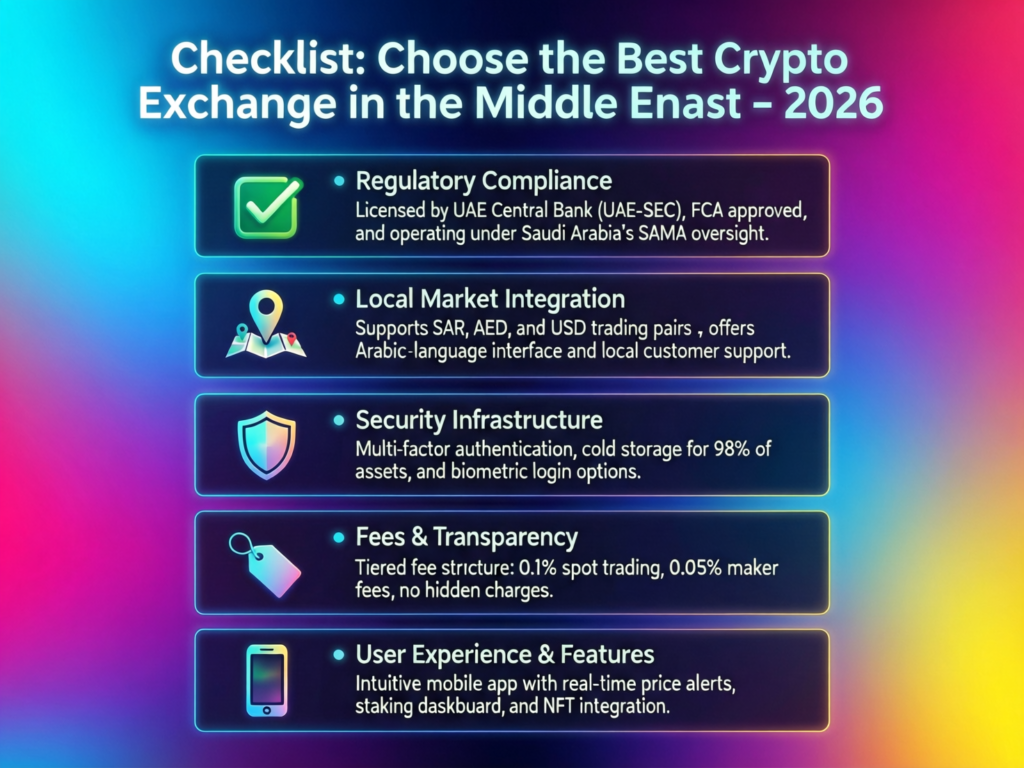
Here’s a simple, regulator-friendly process you can follow:
Confirm your residency and read local rules
Check whether you’re primarily under CBB (Bahrain), VARA or ADGM/FSRA (UAE), SAMA (Saudi), FCA (UK), BaFin (Germany) or MiCA in the wider EU.
Compare fees for your main fiat
List your likely deposit/withdrawal sizes in AED, SAR, BHD, USD, GBP or EUR, then compare exchange fee pages plus your bank’s FX and transfer charges.
Check supported coins and features you actually need
If you mainly buy BTC and ETH for long-term holding, Rain or another regulated GCC exchange may be enough. If you genuinely need derivatives or altcoins, you may consider Binance or another global exchange but only within your risk tolerance.
Run a small test transfer
Start with a small, non-emotional amount from your local bank to your chosen exchange (and back again) to confirm timelines, fees and compliance friction before scaling up.
Mak It Solutions regularly helps fintechs and crypto-adjacent platforms in New York, London, Berlin and the GCC design compliant UX and data flows for these journeys, from mobile apps to analytics dashboards.
Final verdict and soft
There is no one-size-fits-all “winner” in Rain vs Binance only a best fit for your situation:
For most GCC residents who just want a safe, regulated place to move money between local banks and major coins, Rain (or another locally licensed exchange like CoinMENA or BitOasis) is often the default starting point.
For active traders and Web3 professionals, a regulated local exchange plus a carefully managed Binance account (or other global platform) can make sense, as long as you understand the legal, tax and custody implications in each country you touch.
Whichever route you choose, it’s wise to open and verify at least one locally regulated Middle East exchange account before relying on global offshore platforms. Then build your own “playbook” for small test transfers, diversification across venues and cold-storage where appropriate.
Key Takeaways
Rain vs Binance is really regulation vs feature depth
Rain optimises for CBB/ADGM-regulated on/off-ramps in GCC currencies, while Binance optimises for global markets, derivatives and liquidity.
Local rules matter
UK FCA warnings, BaFin licensing decisions and the EU’s MiCA framework all affect what EU/UK traders can legally do with Binance, while CBB and VARA/ADGM define safe rails for GCC users.
Fees hide in FX and spreads
Small GCC users may find Rain’s simpler fee model plus local rails cheaper overall, while high-volume traders might benefit from Binance’s lower trading tiers despite more complex funding routes.
Sharia and ethics are differentiators
Rain, CoinMENA and some bank-backed platforms explicitly highlight Sharia review, while Binance’s high-risk products require careful personal judgement and advice.
Hybrid strategies can work, but add risk
Using Rain as a regulated fiat hub and Binance for specific trades is common, but introduces extra network, counterparty and compliance risks that must be actively managed.
Professional support helps
For startups building their own crypto or fintech products for the US, UK, Germany and GCC, working with experienced engineering partners on UX, security and compliance-aware data architecture can prevent expensive mistakes.
If you’re planning a new crypto, Web3 or digital-banking product for users in the GCC, US, UK or EU, Mak It Solutions can help you design and build it with regulation, analytics and UX in mind from day one. Our teams have already delivered secure mobile apps, multi-region data architectures and SEO-ready content for finance and fintech clients worldwide. Explore our Search Engine Optimization and mobile app development services, then reach out to scope a practical roadmap for your next exchange comparison tool, on-ramp app or analytics dashboard.( Click Here’s )
FAQs
Q : Is Rain available and fully legal for residents in UAE, Saudi Arabia and Qatar?
A : Rain is licensed by the Central Bank of Bahrain and authorised under ADGM’s FSRA in Abu Dhabi, and it openly markets services to residents in Bahrain, Kuwait, Saudi Arabia, Oman and the UAE. However, “fully legal” always depends on your country’s current rules and your personal situation. Before signing up from Saudi Arabia, Qatar or any other jurisdiction, you should review Rain’s supported-countries page and check with your local regulator or bank if you have doubts.
Q : Can I use Binance and then withdraw to Rain or another Middle East exchange safely?
A : Many users move funds from Binance to a regulated GCC exchange like Rain, CoinMENA or BitOasis via BTC, ETH or stablecoins, then off-ramp to their local bank.Technically this is straightforward, but you must consider network fees, withdrawal limits, potential delays and your reporting obligations in the US, UK, Germany or your home country. Always start with a small test transfer and keep clear records for tax and compliance.
Q : Which exchange is better for UK and EU expats living in Dubai or Bahrain?
A : For everyday salary money and long-term holdings, UK and EU expats in Dubai or Bahrain often prefer a locally regulated exchange like Rain, CoinMENA or BitOasis because their banks see them as lower-risk counterparties under CBB, VARA or ADGM frameworks.Binance can be added on top for more advanced trading, but you should always consider FCA, BaFin and MiCA guidance and how your home country treats offshore platforms and derivatives.
Q : How do bank transfer times and limits compare between Rain and Binance for GCC users?
A : On Rain, local transfers like Fawri/Fawri+ or domestic AED/SAR wires typically settle within one to two business days, sometimes faster, and limits are linked to your KYC level and local regulations. On Binance, transfer times and limits depend more on your chosen route P2P, card, third-party gateways or international SWIFT/SEPA and on how your bank treats transfers to global crypto exchanges. In practice, Rain often feels more predictable for GCC users, while Binance can be faster or slower depending on the specific funding method.
Q : What is the safest way to move funds from a US or UK bank to a Middle East crypto exchange?
A : From a risk-management perspective, the safest route is usually to move fiat via regulated, well-documented channels: for example, US or UK bank → regulated US/UK exchange or multi-currency fintech → on-chain transfer of BTC/ETH/USDT → regulated GCC exchange like Rain, CoinMENA or BitOasis → local bank.([FCA][8]) Avoid informal P2P deals across borders, keep your transaction sizes proportionate to your income and always maintain records for the IRS, HMRC or your local tax authority.