

P2P Crypto Trading in the Middle East: Safe & Fast
P2P crypto trading in the Middle East is when you buy and sell Bitcoin, USDT and other coins directly with other users, while a platform escrow holds the crypto until AED, SAR or other local payments clear. For US, UK and European users, the safest approach is to stick to regulated or well-established platforms, follow local virtual-asset rules, and keep clear records of every P2P trade so you can satisfy both tax and AML requirements.
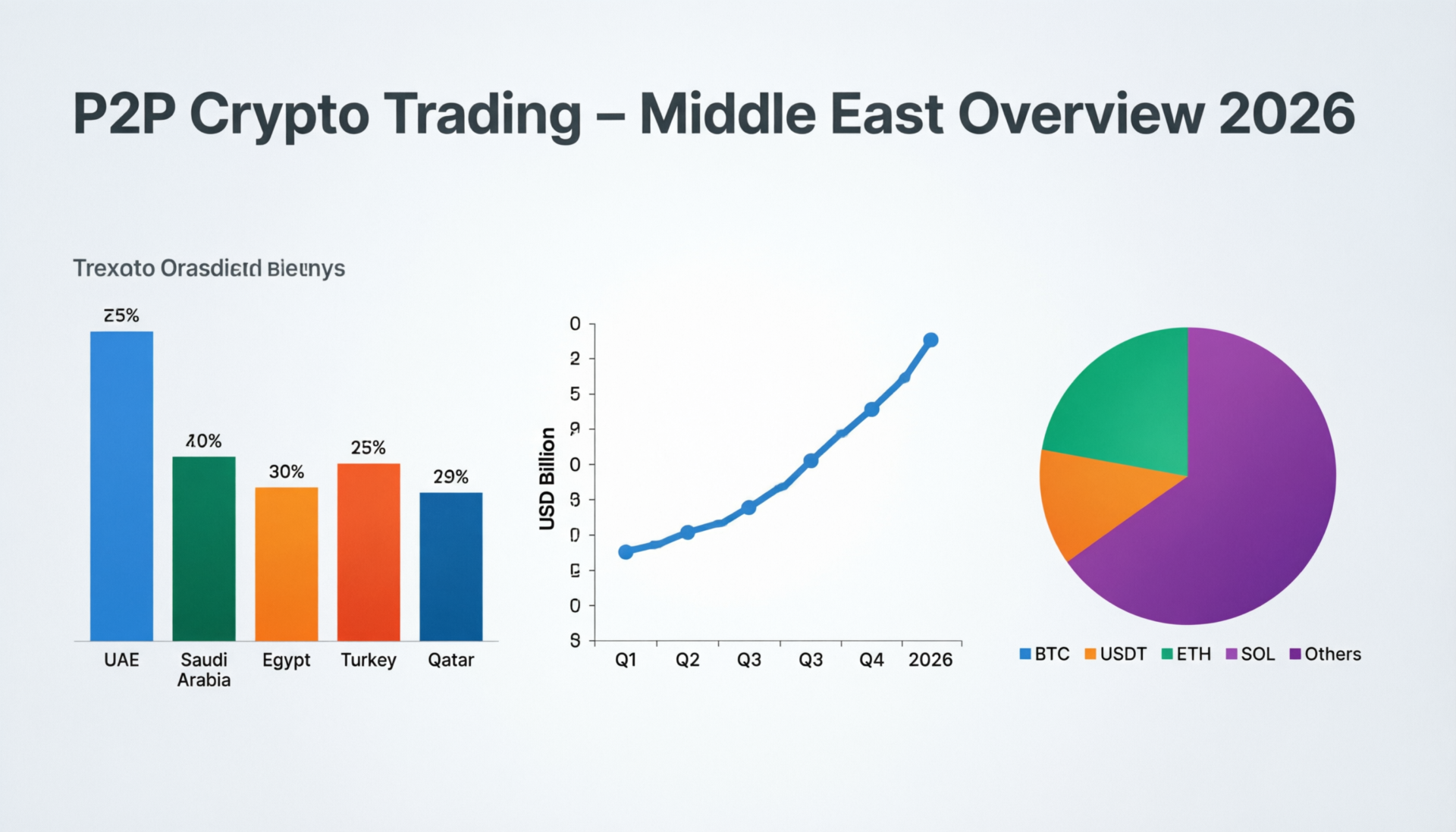
P2P crypto trading in the Middle East has grown fast because it solves real-world problems: strict banking rules, high remittance costs for millions of expats, and rising interest in Bitcoin and stablecoins as alternative stores of value. The region now ranks among the world’s more active crypto markets, with MENA handling well over $300 billion in crypto volume in the latest Chainalysis reports.
If you’re in New York, London, Berlin or elsewhere in the EU, you may be looking for faster, reasonably priced ways to send money into Dubai or Riyadh, pay suppliers in Qatar, or back projects in the region. P2P orderbooks and escrow marketplaces make this possible even when traditional rails like SWIFT are slow, expensive or inconsistent.
In this 2026 guide to P2P crypto trading in the Middle East, we’ll unpack how peer-to-peer Bitcoin trading in GCC countries actually works, where it’s broadly tolerated vs restricted, which platforms expats typically use, and how to connect US/UK/EU bank rails to AED and SAR P2P markets without ignoring tax or AML rules.
What Is P2P Crypto Trading in the Middle East?
P2P crypto trading in the Middle East lets buyers and sellers match directly on a marketplace while the platform holds the crypto in escrow until local fiat (AED, SAR, EGP and others) has been paid and confirmed. Instead of wiring money to a centralized exchange, you usually pay another human via local bank transfer, fintech wallet or cash deposit, and receive Bitcoin, USDT or other assets after both sides confirm.
This human-to-human plus escrow model is especially useful where banks are cautious about crypto, or where people lack easy access to international accounts.
How P2P Escrow Works With AED, SAR and Other Local Currencies
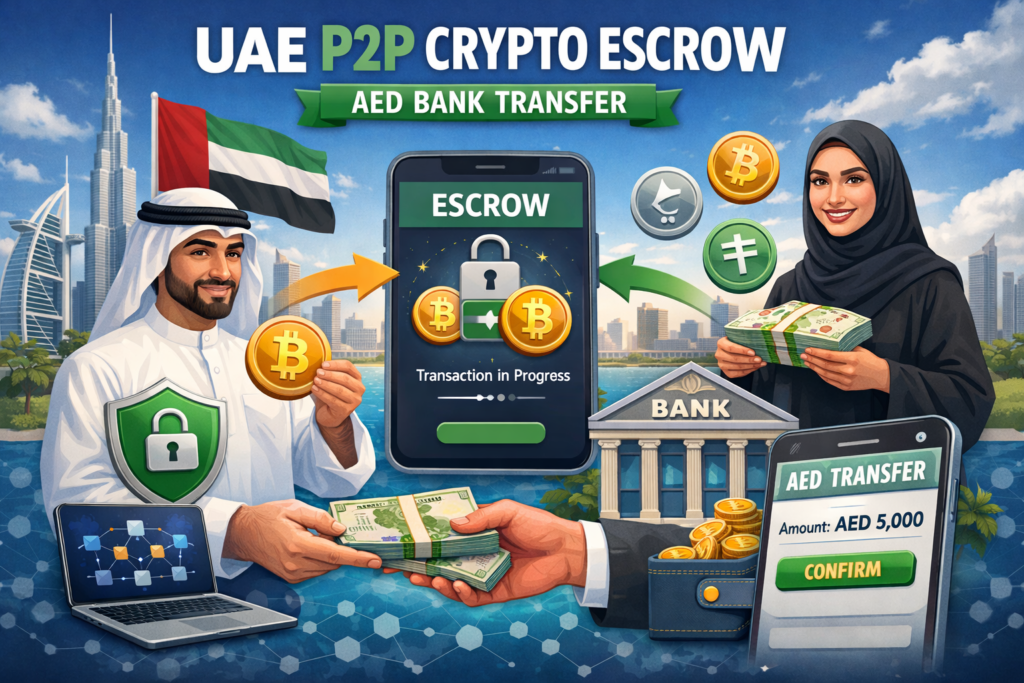
On a typical AED and SAR crypto escrow marketplace, the flow is straightforward.
Post or accept an offer
Choose “Buy USDT in AED” or “Sell BTC for SAR” and pick a counterparty with good ratings.
Crypto locked in escrow
The seller’s crypto moves into the platform’s escrow wallet.
Send local payment
The buyer pays using a local method (bank transfer, instant payment app, sometimes cash in a controlled setting).
Release crypto
Once the seller confirms payment received, the platform releases the crypto from escrow.
Around the GCC and Levant you’ll typically see:
Local bank transfers (e.g. Emirates NBD in Dubai, Al Rajhi in Saudi, QNB in Doha)
Mobile wallets and fintech apps such as stc pay, mada-linked wallets, UAE fintech apps, or Apple Pay / Google Pay in supported markets.
Cash deposits or in-person settlement in some communities higher risk and generally best avoided unless you’re very experienced.
Escrow and structured dispute resolution matter more in emerging markets because chargebacks, fake payment proofs and off-platform pressure are real risks. A good platform will freeze trades while support reviews evidence, keeping funds locked until a decision is made.
Centralized vs P2P Crypto Exchanges for GCC Users
Centralized spot exchanges match buyers and sellers through an order book and hold both fiat and crypto on your behalf. P2P marketplaces, by contrast, only hold the crypto in escrow while the fiat leg happens directly between users.
Pros of P2P for GCC users.
Wider range of local fiat options (AED, SAR, EGP, QAR, KWD, BHD, OMR)
Sometimes better net rates than retail card or instant-buy spreads
Flexible min/max limits for retail and OTC-style deals
Useful where banks are restrictive or card acceptance is patchy
Cons.
You assume counterparty risk if you ignore ratings or go off-platform
Settlement can be slower than a direct card buy
You must do more due diligence and record-keeping yourself
In practice, many expats mix both: centralized exchanges like Coinbase or Crypto.com for compliant on/off-ramp in the US or EU, then P2P orderbooks on platforms like Binance, Bybit or OKX for local AED/SAR legs (subject to each platform’s geo-restrictions).
Key Benefits for Expats and Cross-Border Users From USA, UK and Europe
For expats and cross-border users, P2P’s biggest advantages are cost, flexibility and coverage. P2P can undercut SWIFT wires and traditional remittance providers by reducing FX spreads and banking intermediaries, especially on routes like London → Dubai or Frankfurt → Riyadh.
A typical flow might be
US/UK/EU side
EUR or GBP from a German SEPA account or a UK bank/fintech into a compliant exchange, then converted into USDT.
Middle East side
Use P2P to sell that USDT into AED, SAR or EGP, paying family or suppliers on local rails.
Used correctly, P2P becomes a flexible fiat on-ramp for UAE and Saudi buyers and a fast remittance path for relatives.
Is P2P Crypto Trading Legal and Safe in the Middle East?
P2P trading is generally allowed or tolerated when done through compliant platforms that apply KYC/AML, but rules differ sharply by country and can change quickly. In some markets (like parts of the UAE) licensed virtual-asset service providers (VASPs) operate openly, while in others (like Egypt) unlicensed crypto activities are effectively prohibited.
Using a reputable exchange with clear licensing, and checking current local guidance, is essential before you trade.
Country Snapshot: UAE, Saudi Arabia, Egypt and Wider GCC Rules
United Arab Emirates
Dubai has a dedicated Virtual Assets Regulatory Authority (VARA) overseeing virtual-asset services, with rulebooks covering exchanges, brokers and marketing. Abu Dhabi’s ADGM and the federal Securities and Commodities Authority (SCA) also license crypto businesses. Platforms like CoinMENA and others operate with approvals from VARA, ADGM or the Central Bank of Bahrain for neighboring markets.
Saudi Arabia
Saudi Arabia has historically taken a cautious approach and has warned about crypto risks, but now explores blockchain and CBDCs under SAMA and CMA supervision. Cryptocurrencies aren’t formally recognized as legal tender and retail trading remains high risk from a regulatory perspective, even as the policy stance slowly evolves.
Egypt and some wider markets
The Central Bank of Egypt has repeatedly warned against dealing in cryptocurrencies and national law prohibits issuing, promoting or trading crypto without CBE approval. In practice that means most retail P2P trading is not compliant and can be risky.
In all these countries, even when P2P isn’t explicitly banned, banks may still restrict crypto-linked transfers, especially if references or patterns look suspicious. Always check the latest local guidance and consider getting legal or tax advice if you run serious volume.
KYC, AML and Data Compliance for US/UK/EU and Middle East Users
Reputable platforms with P2P orderbooks will almost always require:
KYC/ID verification (passport, residency, sometimes proof of address)
Ongoing AML monitoring on P2P activity, especially larger or repeated trades
Source-of-funds checks for higher tiers or corporate accounts
For US, UK and EU residents, this sits on top of familiar frameworks:
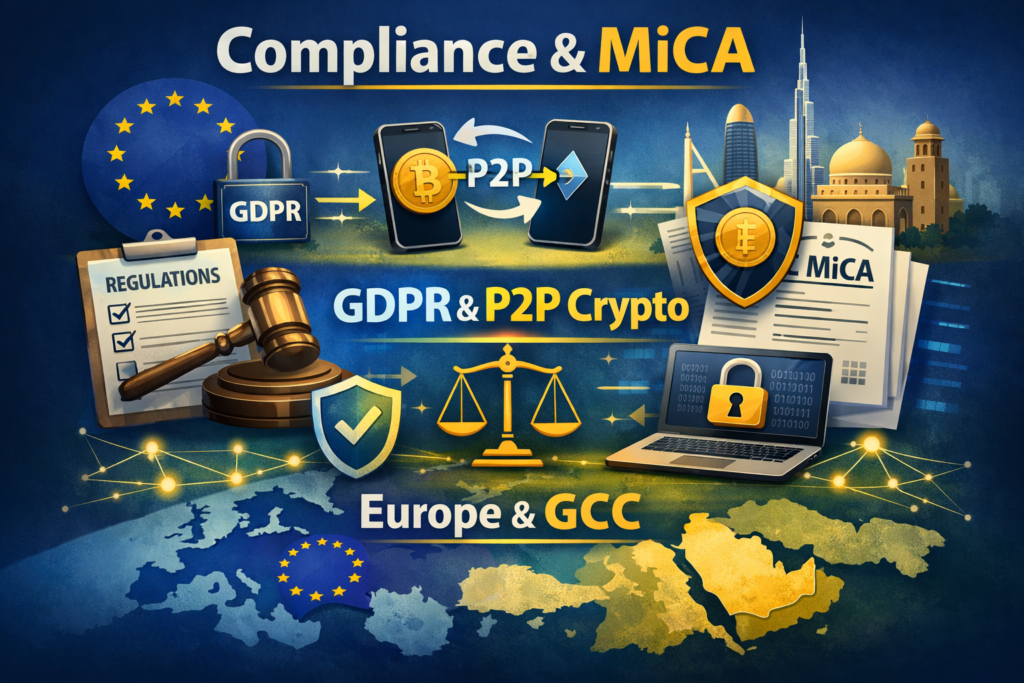
GDPR / DSGVO and UK-GDPR for how your personal data is processed
MiCA in the EU, which sets common rules for crypto-asset issuers and service providers, including disclosures and prudential standards
National AML rules, FATF guidance and, in the UK, Financial Conduct Authority (FCA) oversight of cryptoasset promotions and firms.
Good KYC and record-keeping are not just “for the regulator”; they also help you prove legitimate activity to banks and tax authorities if questions arise.
Nothing in this guide is financial, legal or tax advice; always do your own research and talk to qualified professionals in your jurisdiction.
Common P2P Crypto Risks and Scams in the Region
The same P2P mechanics that help genuine users also attract scammers. Typical issues include:
Fake payment proofs (edited screenshots, reversed transfers)
Chargebacks on card or wallet methods that allow disputes
Pressure to move to WhatsApp or Telegram and complete trades off-platform
Identity fraud using stolen KYC documents
Red flags
Pricing that’s far better than market
New accounts with no trade history or poor completion rates
Counterparties pushing you to release crypto before you see cleared funds
A basic safety checklist
Trade only with users who have strong ratings and a long track record
Keep all communication in platform chat for dispute evidence
Never release crypto before your bank shows cleared, irreversible funds
Avoid meeting strangers with large amounts of cash unless you know exactly how to manage the risk (and local law allows it)
Best P2P Crypto Exchanges for Middle East Users
The best P2P crypto platforms for Middle East users combine strong regulation, reliable escrow, AED/SAR/EGP support and clear fee structures, and are still accessible to US/UK/EU residents where local rules allow.
This section is not a ranking or endorsement of specific platforms, but a framework you can use to evaluate them.
What to Look For in a P2P Platform Serving the Middle East
Key criteria for a compliant exchange for Middle East residents:
Licensing or registration
VARA, ADGM or SCA in the UAE
Central Bank of Bahrain or other GCC regulators where relevant.
EU MiCA, FCA or BaFin permissions where you’re based
Escrow & disputes
Crypto held in on-chain or auditable escrow
Clear dispute SLAs and multilingual support
Fiat coverage
Local currencies: AED, SAR, EGP, QAR, KWD, BHD, OMR
Global currencies: USD, EUR, GBP for your “from” side
Transparent fees
P2P escrow fees, maker/taker spreads, FX margins
Deposit/withdrawal costs and any hidden “convenience” markups
UX & language
Full Arabic and English support
Robust mobile apps for Dubai, Riyadh, Cairo and beyond
24/7 support, ideally with regional hubs
If you’re building your own AED and SAR crypto escrow marketplace as a fintech, it’s also worth thinking about cloud hosting in GCC data centers and compliance-ready architectures areas where partners like Mak It Solutions already work with regional SaaS teams on cloud, security and data analytics.
Global P2P Marketplaces Accessible to Middle East Traders
Global exchanges such as Binance, Bybit, OKX, KuCoin and Crypto.com either operate dedicated P2P desks or offer OTC-style matching with local payment methods. The exact feature set and availability will differ for:
Residents of the Middle East (depending on local licenses and geo-blocking)
US persons, who often face tighter restrictions and may need to use US-specific platforms
UK and EU users, who sit under MiCA and FCA/BaFin regimes
Generally
Advanced traders may prefer platforms with rich charts, APIs and bulk limits.
Beginners usually benefit from simpler P2P interfaces with filters like “Only verified merchants”, capped limits and strong support.
Always check each platform’s current terms and regulatory disclosures for your country before relying on them.
Regional Middle East Exchanges With P2P or Localized Fiat On-Ramps
Regional exchanges such as Rain, BitOasis, CoinMENA and Fasset focus on GCC and wider MENA, often with.
Direct AED, SAR, BHD, KWD and EGP deposits via local bank transfers or cards
Simple buy/sell flows rather than complex order books
Support centers based in Bahrain, UAE or Saudi Arabia.
Pros vs global giants:
Better local banking connectivity and faster fiat settlements
Region-aware compliance aligned with VARA, ADGM and Central Bank of Bahrain rules
Arabic-first UX and GCC-time-zone support
Cons
Sometimes fewer crypto pairs and advanced features
Limited P2P depth in smaller markets compared with global orderbooks
Many expats use a hybrid model: local MENA exchanges for straightforward AED/SAR on-ramps, and global P2P platforms when they need more exotic pairs or specific payment methods.
How to Buy Crypto P2P in the UAE (Dubai, Abu Dhabi) Step by Step
To buy crypto P2P in the UAE, you typically open an account with a compliant exchange, complete KYC, choose a P2P offer in AED, pay via a local method, then wait for escrow to release the crypto. The exact flow is similar across Dubai, Abu Dhabi and other emirates, with local payment methods and different licensing zones (VARA, ADGM, SCA)
Step-by-Step: Your First P2P Bitcoin or USDT Purchase in the UAE
Here’s a generic, platform-agnostic walkthrough.
Create and verify your account
Sign up on a licensed/global platform that supports AED.
Complete KYC with passport/ID and (if asked) Emirates ID or residence visa.
Enable security features
Turn on 2FA (app-based where possible), anti-phishing phrases and withdrawal whitelists.
Use a strong, unique password and avoid shared devices.
Fund your account (if required)
Some platforms let you buy P2P without prior funding; others require a small balance or fee wallet.
Funding options may include local AED transfer, international card, or crypto deposited from your own wallet.
Filter for the right P2P offer
Choose asset (e.g. USDT), currency (AED) and side (Buy).
Filter by payment method (e.g. local bank), price close to market, and seller rating/completion rate.
Place the order and pay
Enter the AED amount and lock the trade; the seller’s crypto moves to escrow.
Pay using the exact bank details shown; add any agreed reference and keep screenshots.
Confirm and receive your crypto
Mark “I’ve paid” inside the platform and wait for the seller to confirm.
Once released, your Bitcoin or USDT shows in your funding or P2P wallet; you can then move it to a personal wallet.
Using Dubai and Abu Dhabi Payment Methods Safely
In the UAE you’ll mostly use.
Local AED bank transfers to accounts in Dubai or Abu Dhabi
Instant payment apps or approved fintech wallets
Occasionally cash trades in controlled settings (e.g. business-grade OTC desks)
To reduce bank flags
Keep reasonable transaction sizes for your profile
Use neutral but accurate references (avoid “crypto” in descriptions unless your bank explicitly allows it)
Avoid bouncing money rapidly between many accounts
Foreign residents should make sure their residency documents and address are updated, especially when using both international and local accounts.
Tax and Reporting Considerations for US/UK/EU Residents in the UAE
The UAE itself is relatively low-tax compared with many Western jurisdictions, but if you’re a US citizen or still tax-resident in the UK or Germany, you may have home-country obligations such as.
Reporting capital gains on crypto disposals
Declaring foreign accounts and offshore asset holdings
Documenting P2P activity used for remittances or business payments
Keeping clean records (P2P logs, wallet histories, bank statements) makes life much easier when accountants or tax authorities ask questions. For complex situations dual residency, business use, larger volumes speak to a professional who understands both GCC rules and regimes like the IRS, HMRC or German tax offices.
P2P Bitcoin and USDT Trading in Saudi Arabia, Egypt and Wider GCC
In Saudi Arabia, Egypt and other GCC states, many users rely on P2P markets because direct bank rails to crypto exchanges are limited, inconsistent or unavailable. In some countries the legal status is cautious or restrictive, so you must weigh the regulatory environment before trading.
P2P USDT and Bitcoin in Saudi Arabia
Demand in Saudi Arabia is driven by retail investors, remittances and hedging against currency moves, especially among expats sending SAR equivalents abroad. At the same time, Saudi authorities have historically warned about crypto risks and are focusing more on CBDCs and tokenised assets than unregulated retail trading.
Practical considerations
Popular rails: local bank transfers, fintech wallets and, informally, cash meet-ups
Constraints: sudden bank policy changes, transaction ceilings, requests for extra documentation
Best practice: keep evidence for every trade, use only well-rated counterparties, and be very cautious about volumes relative to your income
Buying Crypto P2P in Egypt, Qatar, Kuwait and Bahrain
These markets look very different
Egypt
CBE warnings and legal provisions mean unlicensed crypto trading is effectively illegal. That pushes some activity into informal OTC groups, which come with high legal and scam risk.
Qatar & Kuwait
Conservative banking and licensing, with a focus on regulated financial institutions and national priorities.
Bahrain
More open to regulated exchanges, exemplified by Central Bank of Bahrain-licensed platforms like CoinMENA, which serve as on-ramps for BHD, AED and others.
Workarounds people talk about foreign accounts, mobile wallets, informal cash agents may expose you to AML issues or outright illegality. In riskier markets, the safest option may simply be not to trade P2P at all, or to operate only via clearly licensed, on-shore providers if and when they exist.
Using P2P for Remittances and Family Support Across the Middle East
A common pattern for remittances:
A worker in London or Berlin converts part of their salary to USDT or another stablecoin on a regulated EU exchange.
They send that crypto to a wallet controlled by a trusted relative, or to their own account on a P2P platform serving the target country.

They sell via P2P for AED, SAR or EGP and pay school fees or household costs locally.
Compared with traditional remittance.
Fees and FX spreads can be lower, especially for mid-size transfers.
Speed can be minutes instead of days.
To keep things safe and family-friendly:
Avoid complex multi-hop setups your relatives don’t understand.
Use simple, repeatable flows and clear explanations.
Make sure at least one person in the chain understands the local legal position.
How US, UK and European Users Can Use P2P to Send Money or Invest in the Middle East
Users in the USA, UK and Europe can typically use P2P by converting their local currency into crypto on compliant exchanges, then selling that crypto via P2P into Middle East currencies while respecting home-country tax, reporting and AML rules.
Connecting US, UK and EU Bank Rails to P2P Markets
Typical routes
United States
US bank or fintech (e.g. ACH) → a US-compliant exchange → convert USD to USDT or BTC → send to a P2P-enabled platform that supports AED/SAR pairs.
United Kingdom
High-street bank, challenger bank or Revolut/Monzo → FCA-regulated exchange → convert to crypto → P2P or regional exchange serving Dubai, Riyadh or Doha.
European Union / Germany
SEPA transfer from a bank in Frankfurt or Berlin → MiCA-aligned exchange → crypto → P2P into AED/SAR
Conservative banks may question large or frequent transfers to exchanges. Keeping investment and payment flows separate (e.g. one account for investing, one for family remittances) often makes the pattern easier to explain.
Compliance and Tax for American, British and German Residents Using P2P
For residents of jurisdictions like
USA the IRS expects you to track capital gains/losses in USD terms for each disposal, including P2P trades.
UK HMRC treats many crypto disposals as Capital Gains Tax events, and some frequent trading as income.
Germany private crypto gains may be taxable depending on holding periods and thresholds.
Add on.
Potential AML monitoring flags when sending value cross-border to Middle East relatives or suppliers
New EU rules like DAC8 and MiCA that expand reporting obligations on crypto platforms
Given the complexity, especially if you’re wiring large sums into projects in Riyadh or Dubai, it’s wise to work with a tax adviser who understands both your home regime and GCC structures.
P2P for Business: Paying Suppliers and Funding Projects in the GCC
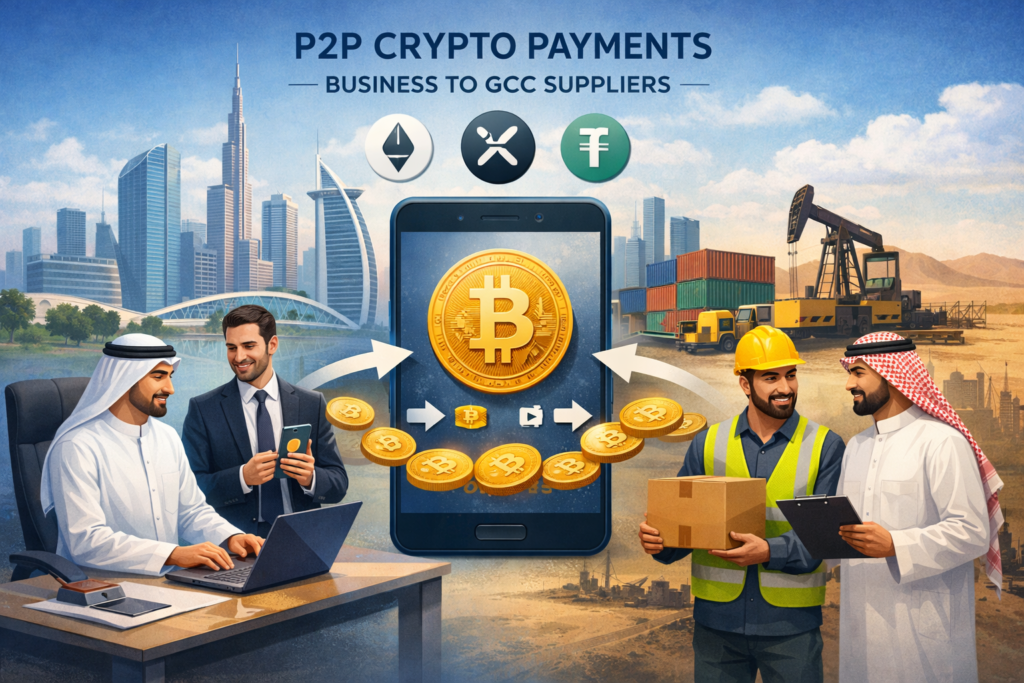
For SMEs and startups, P2P can be attractive when:
Paying smaller suppliers in Dubai, Abu Dhabi, Doha or Istanbul
Funding projects in the region when banks are slow or conservative
Managing FX risk with stablecoins as a short-term bridge
But there are serious caveats.
You’ll need clear contracts explaining whether invoices are in fiat or crypto, and how conversions are calculated.
Your accountants must be comfortable booking P2P flows and valuing positions.
Banks and auditors may want proof you used reputable platforms, not anonymous informal groups.
Mak It Solutions already works with GCC and European firms on cloud, data and governance, so if you’re building a crypto-adjacent product, you can tap similar expertise for logging, audit trails and secure architectures that make your P2P flows easier to defend.
Checklist and Best Practices Before Your First P2P Trade
Before your first P2P crypto trade in the Middle East, secure your account, understand platform rules, verify your counterparty and start with a small test amount. Treat it like any other high-risk financial tool: useful when used carefully, dangerous when rushed.
Security Checklist: Accounts, Wallets and Devices
Turn on 2FA (app or hardware key), not just SMS.
Set anti-phishing codes and withdrawal whitelists where supported.
Keep a separate “P2P hot wallet” for trading; store long-term holdings in cold or hardware wallets.
Keep your trading device patched and malware-free; avoid public Wi-Fi where possible.
Deal Checklist: Offers, Prices and Seller Reputation
Before clicking “Buy”
Compare the offer’s rate with a reputable spot price huge gaps are suspicious.
Check the trader’s completion rate, number of trades and feedback comments.
Read the offer terms carefully: payment window, bank type, references.
Start with a small test trade and scale up only after a smooth experience.
When to Avoid P2P and Use a Regulated Spot Exchange Instead
P2P is not always the right tool. Consider using a regulated spot exchange instead when
You’re moving very large amounts and don’t want human counterparty risk.
Your bank or local law makes P2P particularly sensitive or unclear.
You need institutional-grade processes, such as for listed companies or regulated funds.
Chasing the very best headline rate is rarely worth it if it means breaching local rules or accepting unnecessary fraud risk.
Key Takeaways
Regulation is fragmented: the UAE is building structured regimes (VARA, ADGM, SCA), while countries like Egypt remain highly restrictive and Saudi Arabia is cautiously evolving.
P2P crypto trading in the Middle East solves real problems for expats and SMEs—faster remittances, flexible on-ramps to AED and SAR, and better FX in some cases—but adds counterparty and scam risk.
Compliance doesn’t disappear in P2P flows: KYC/AML, GDPR/UK-GDPR and MiCA still matter for US/UK/EU users routing value into GCC markets.
Safe execution beats clever routing: use escrow, verified traders, platform chat and small test trades before scaling.
Businesses need documentation: contracts, accounting policies and audit trails are crucial when paying suppliers or investing via crypto. Mak It Solutions can help design cloud and data architectures that support this.
If you’re a fintech, exchange, remittance startup or Web3 project planning P2P crypto trading in the Middle East, you don’t just need code you need regulation-aware architecture, secure cloud and robust analytics.
Mak It Solutions works with teams across the USA, UK, Germany, the EU and the GCC on cloud platforms, data pipelines and compliance-friendly digital products. Share your P2P or virtual-assets roadmap, and we can help you design a secure, scalable stack for UAE, Saudi and wider MENA markets.( Click Here’s )
FAQs
Q : Can I use P2P crypto trading in the Middle East without a local bank account?
A : Sometimes, but it’s limiting. Most serious P2P trades in AED, SAR or EGP still rely on local bank transfers or approved wallets, so having at least one local account in Dubai, Riyadh or Cairo gives you better rates and more counterparties. Some platforms support international cards or third-party wallets, but these can be expensive, subject to chargebacks, or restricted by local rules. Always check the platform’s permitted payment methods for your target country.
Q : How does Islamic finance affect whether P2P crypto trading is considered halal or haram?
A : Islamic scholars disagree on crypto: some argue Bitcoin and major stablecoins function as digital assets or currencies that can be halal under certain conditions, while others see speculation and uncertainty (gharar) as problematic. For P2P, leveraged trading and gambling-like behaviour are more likely to be viewed as haram than simple spot conversion for payments or savings. If sharia compliance matters to you, look for local fatwas, sharia boards in your jurisdiction and potentially sharia-compliant digital banking guidance rather than relying on generic internet opinions.
Q : What limits do banks in the Middle East usually place on incoming P2P crypto-related transfers?
A : Banks in GCC countries rarely publish “P2P limits” explicitly, but they do monitor unusual transaction patterns. You may see extra checks on frequent small transfers from many counterparties, or large single transfers from crypto-linked platforms. Some banks quietly block or question transfers whose references explicitly mention crypto. Keeping volumes reasonable, maintaining documentation and being ready to explain the legitimate purpose of transfers is crucial.
Q : Is it better to use stablecoins or Bitcoin for cross-border P2P transfers into the Middle East?
A : For most remittances and supplier payments, stablecoins like USDT or USDC are more practical than Bitcoin because they reduce price volatility between sending and receiving. Bitcoin can make sense if both sides are comfortable holding BTC and price swings, or if you’re making a one-off investment with a longer time horizon. In tightly regulated markets, you must also consider whether local rules or bank policies treat stablecoins differently from other cryptoassets.
Q : How can small businesses in Europe document P2P crypto payments to suppliers in the GCC for accounting and tax purposes?
A : European SMEs should treat P2P payments like any other cross-border transaction: keep signed contracts or invoices, capture screenshots and transaction hashes for each trade, and reconcile fiat values at the time of each payment. Accounting teams may book crypto first as a financial asset, then recognize gains/losses when it is sold P2P into AED or SAR. Working with an accountant who understands MiCA, DAC8 and local tax rules will help ensure your documentation would satisfy auditors or tax authorities.