
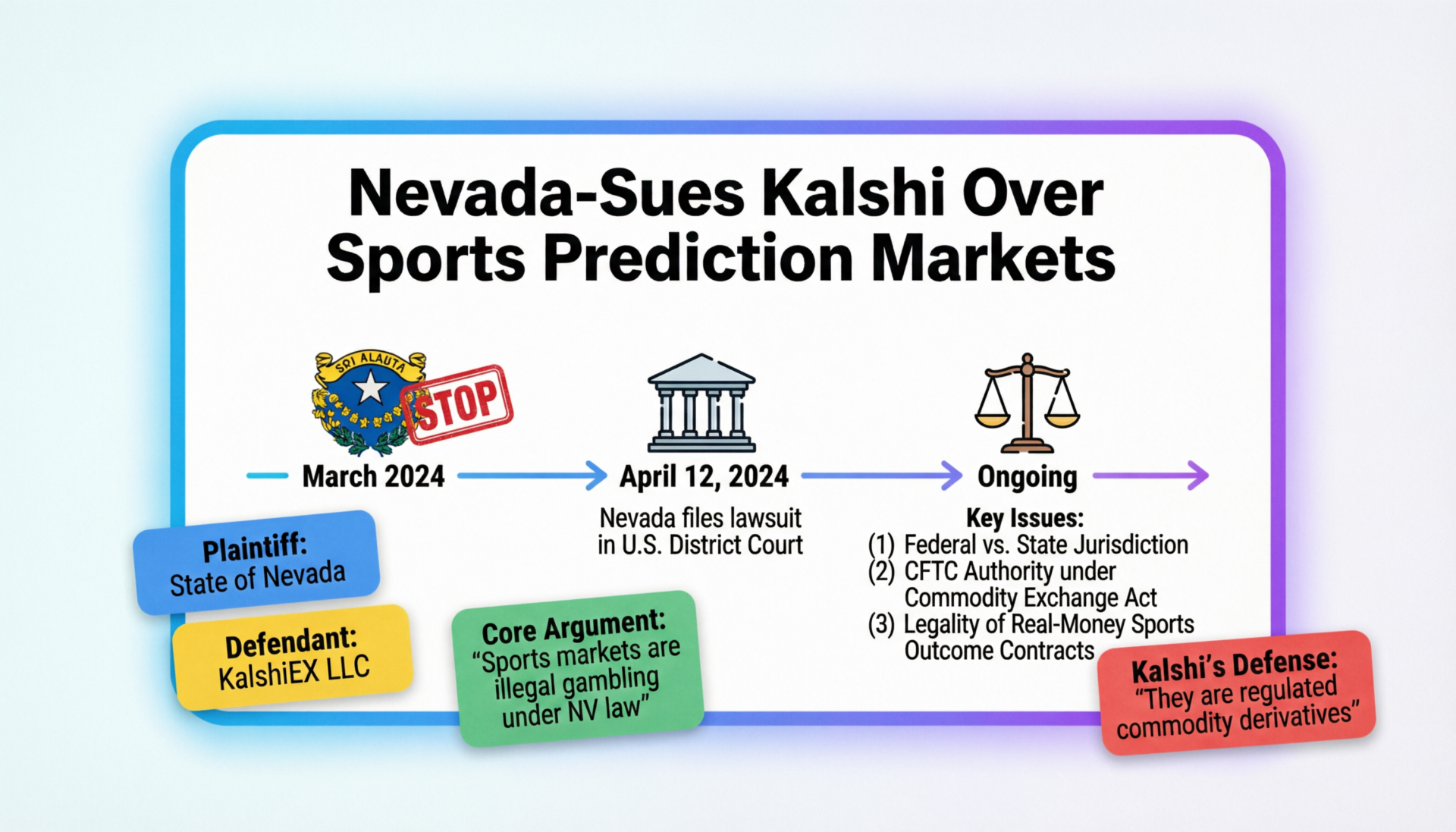

Nevada Gaming Control Board sues Kalshi, seeks to block sports event contracts
Nevada regulators have filed a lawsuit aimed at stopping Kalshi from offering sports-related event contracts in the state, escalating a jurisdictional fight over whether these products are federally regulated derivatives or unlicensed sports wagering under Nevada law. In the latest turn, Nevada sues Kalshi over sports prediction markets after a federal appeals court declined to pause developments that allowed Nevada to move forward with enforcement.
Nevada sues Kalshi over sports prediction markets: what Nevada is asking the court to do
The Nevada Gaming Control Board filed suit on Feb. 17, 2026, seeking to block Kalshi from offering event contracts that allow residents to take positions on sports outcomes (including football and basketball, according to Reuters)
Nevada argues that offering certain sports event contracts constitutes wagering activity under Nevada law and therefore requires state licensure and compliance with state gaming safeguards such as age limits and integrity protections (e.g., restrictions related to insider participation and match-fixing).
The Ninth Circuit ruling that opened the door to Nevada’s enforcement case
Reuters reported that Kalshi had sought for months to prevent Nevada from filing its case, but the U.S. Court of Appeals for the Ninth Circuit on Tuesday declined to put on hold a judge’s November order dissolving an injunction that had previously prevented Nevada authorities from pursuing an enforcement action.
Earlier in the dispute, a federal district court had granted Kalshi a preliminary injunction in April 2025, enjoining Nevada regulators from enforcing certain state laws against Kalshi for offering event-based contracts on a CFTC-designated market.
Why Kalshi says federal law controls the case
How Nevada sues Kalshi over sports prediction markets could hinge on “exclusive” CFTC jurisdiction
Kalshi’s central position is that its event contracts are regulated under federal commodities law (as swaps/derivatives on a CFTC-regulated designated contract market), and that states cannot re-label that activity as illegal gambling to block it. Reuters reported that Kalshi moved to transfer Nevada’s lawsuit to federal court, saying the case turns on whether it is subject to the CFTC’s exclusive jurisdiction.
Separately, the Associated Press reported that CFTC Chair Michael Selig has framed state efforts as undermining the agency’s “exclusive jurisdiction,” and said the CFTC would not “sit idly by” while states seek statewide prohibitions on these products.
Context and analysis
The Nevada case fits a broader national clash between state gaming regulators and rapidly growing prediction markets. AP reported that sports activity represents a large share of trading volume for major prediction market platforms, intensifying state concerns that these products resemble sportsbook wagering more than traditional hedging instruments.
Reuters also noted similar litigation in Massachusetts, where a judge issued an injunction on Feb. 5, 2026, but a state appeals court justice put it on hold while Kalshi appeals.
Concluding Remarks
Nevada’s lawsuit puts immediate pressure on Kalshi’s ability to offer sports event contracts in one of the most heavily regulated U.S. gaming jurisdictions, while Kalshi’s federal-court bid tees up a preemption fight over whether the CFTC’s authority displaces state gambling enforcement. The next milestones will likely include the removal fight (state vs. federal venue) and any court decisions on temporary restraining relief or injunction requests.
FAQs
Q : What did Nevada file against Kalshi?
A : Nevada gaming regulators filed a lawsuit seeking to block Kalshi from offering sports-related event contracts to residents of Nevada, arguing the products amount to illegal sports betting under state law.
Q : Why does Kalshi want the case in federal court?
A : Kalshi argues the dispute turns on federal commodities law, not state gaming law. It says the Commodity Futures Trading Commission (CFTC) has exclusive jurisdiction over the contracts because Kalshi operates a CFTC-designated market, so the case should be heard in federal court.
Q : What did the Ninth Circuit do this week?
A : The Ninth Circuit Court of Appeals declined to pause a judge’s November order that dissolved an injunction which had previously prevented Nevada from moving forward with an enforcement action.
Q : What is the CFTC’s position on prediction markets?
A : According to AP, CFTC Chair Michael Selig said the agency will defend its authority and criticized state efforts that, in his view, undermine the CFTC’s “exclusive jurisdiction” over federally regulated derivatives.
Q : Does “Nevada sues Kalshi over sports prediction markets” mean Kalshi must stop immediately?
A : No, not automatically. Nevada is seeking court relief (including temporary restraining relief). Whether Kalshi must halt offerings depends on what the court orders and whether the case remains in state court or is moved to federal court.
Q : How does this relate to earlier court orders in Nevada?
A : In April 2025, a federal judge granted Kalshi a preliminary injunction that barred Nevada regulators from enforcing certain state laws against Kalshi concerning event-based contracts traded on a CFTC-designated market.
Q : Are other states taking similar action?
A : Yes. Reuters reported litigation in Massachusetts and noted multiple state-level disputes nationwide over whether these contracts are illegal gambling or federally regulated derivatives.
Facts
Event
Nevada Gaming Control Board lawsuit seeks to block Kalshi sports event contracts in NevadaDate/Time
2026-02-17T00:00:00+05:00 (filing date reported as Tuesday; see source for precise court timestamp)Entities
Nevada Gaming Control Board (NGCB); Kalshi; U.S. Court of Appeals for the Ninth Circuit; Commodity Futures Trading Commission (CFTC); Michael SeligFigures
AP reported Kalshi saw “more than $1 billion” in volume trade on the Super Bowl; AP also reported roughly 90% of Kalshi trading volume tied to sports.Quotes
“The CFTC will no longer sit idly by…” Michael Selig (as quoted by AP from his WSJ opinion piece)
Sources
Reuters (Feb. 18, 2026); AP News (updated Feb. 2026); Justia docket order (Apr. 9, 2025)