


Move for Dubai crypto tax: US, UK, EU guide
Introduction
Dubai crypto tax is still a magnet for US, UK and EU nomads in 2026. The short version: the UAE doesn’t tax personal income or capital gains, so most personal crypto gains are at 0% locally. The long version: you can still be taxed by the IRS, HMRC, German Finanzamt or other home authorities unless you properly break tax residence there, become UAE tax resident and time your disposals carefully.
Important.
This article is general information only, not tax or legal advice. Crypto and tax rules change quickly always check live rules and speak with qualified advisers in the UAE and your home country before acting.
If you’re a crypto-heavy founder in New York, a DeFi engineer in London or a long-term HODLer in Berlin, it’s hard to ignore the phrase “Dubai crypto tax”. On paper, the promise is simple: move to the UAE, pay 0% local tax on personal crypto gains, and build from a global hub that runs on sunshine and stablecoins.
Reality is more nuanced. The UAE really does have 0% personal income tax today, but it also now has a federal corporate tax, is signing up to the Crypto-Asset Reporting Framework (CARF) and participates in global information exchange. For US, UK, German and wider EU nomads, whether Dubai is “tax free” depends less on slogans and more on residence tests, timing, structure and documentation.
In 2026, Dubai (and the wider UAE) still has no personal income or capital gains tax, so most crypto gains realised by individuals as personal investments are taxed at 0% locally. However, US, UK, German and other EU investors can still be taxed by their home country unless they genuinely break tax residence there, become UAE tax resident and structure their move and crypto disposals carefully.
Put simply: Dubai crypto tax is 0% for many nomads only once your old country stops treating you as resident and the UAE becomes your main taxing jurisdiction.
Dubai crypto tax in 2026: the 0% promise, explained
For individuals genuinely living in Dubai in 2026, crypto gains on personal investments are currently not taxed by the UAE there is still no personal income or capital gains tax. By contrast, the US taxes citizens on worldwide income, the UK taxes residents on worldwide gains, and Germany often taxes short-term crypto trades while offering exemptions after a one-year holding period. That’s why so many high-value crypto holders and founders from the US, UK, Germany and wider EU have moved their “centre of life” to Dubai.
The catch.
your home country’s rules usually follow you until you properly break tax residence there, and global reporting (CARF/CRS/FATCA) is closing the old “offshore” loopholes.
Is crypto taxed in Dubai at all?
For individuals, the UAE currently has 0% personal income and capital gains tax, so most personal crypto gains are not taxed in Dubai, while corporate profits may face 9% UAE corporate tax above the AED 375,000 threshold.
The UAE’s Federal Tax Authority is clear: natural persons are only pulled into corporate tax if they are running a business or business activity in the UAE with annual turnover over AED 1 million. Personal investment income including gains on selling investments for your own account that are not run under a commercial licence is out of scope for corporate tax.That’s where “UAE 0% income tax on crypto” comes from for many nomads.
So if you’re simply buying and selling Bitcoin, Ethereum or altcoins in your own name, with no licence and no clients, Dubai currently doesn’t tax those gains locally. Your home country might.
What counts as “personal” vs “business” crypto activity?
In UAE practice, the line between personal investment and business activity is about intent, licence and scale, not just how often you trade.
Personal crypto
Trading or investing your own portfolio.
No external investors or clients.
No commercial licence and not marketed as a business.
Looks like investment income; under current FTA guidance, this is generally “personal investment income” and outside corporate tax for natural persons.
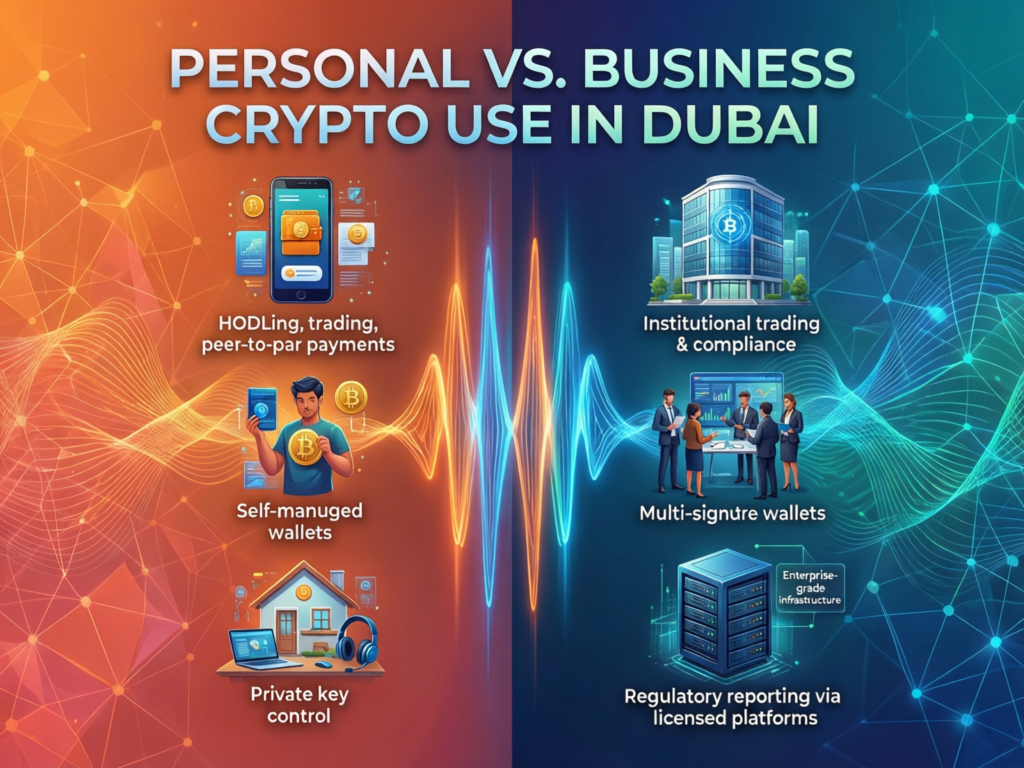
Business crypto
Running a trading desk for others, taking performance fees.
Operating an exchange, broker, fund, market-maker or DeFi/SaaS platform.
Needing a licence in DMCC, ADGM, DIFC or from VARA (for virtual asset businesses).
Profits may fall under 9% corporate tax above AED 375,000, with extra rules for large multinationals under a 15% minimum tax.
If you’re running an algo fund for friends, a yield platform or a tokenised SaaS product, you’re already closer to “business” than “just trading”. That’s usually when Dubai founders start combining a free-zone entity with specialist advisory on licences, substance and banking.
Dubai crypto tax vs US, UK, Germany & wider EU
For AEO.
The key difference is that Dubai doesn’t tax personal crypto income at all, while the US, UK, Germany and many EU states tax residents on worldwide crypto gains, often with detailed reporting.
United States (IRS)
US citizens and green-card holders are taxed on worldwide income even when living in Dubai. Crypto is usually treated as property; disposals go on Form 8949 / Schedule D and offshore accounts can trigger FBAR/FATCA reporting.
United Kingdom (HMRC)
UK-resident individuals are within Capital Gains Tax (CGT) on crypto; HMRC treats most exchange tokens as assets similar to shares. Recent UK guidance and CARF-style rules mean UK-linked accounts on exchanges in London, Frankfurt or elsewhere in the EU are increasingly reported automatically.
Germany
Private crypto trades are generally tax-free if you hold the asset for more than one year, but gains on disposals within 12 months are taxable at your personal income tax rate. For significant shareholdings (typically ≥1%), moving abroad can trigger exit tax (Wegzugsbesteuerung) on unrealised gains even if you move to Dubai.
Other high-tax EU countries
France, Spain, Italy, Sweden and others often tax residents on worldwide crypto gains with varying rates and holding rules.
Dubai is a legal low-tax alternative, not a secrecy haven. The UAE signs double-tax agreements with many countries, participates in OECD initiatives and is committing to CARF.
When is Dubai crypto tax truly “tax free” for individuals?
Dubai is genuinely tax free for many individual crypto investors when three things line up:
You are UAE-tax resident.
Your crypto activity is treated as personal investment, not a business.
Your home country no longer taxes you as resident on those gains.
When that triangle doesn’t close, “0%” on YouTube thumbnails quickly becomes double-tax risk in real life.
Tax-free on Bitcoin, Ethereum and altcoins.
In Dubai, most individual gains on buying/selling crypto for your own account are not taxed, provided you are not treated as running a business. That means many common nomad profiles can get close to true 0% local tax.
Long-term HODLer
A London engineer who moves to Dubai on a free-zone visa, breaks UK residence under the Statutory Residence Test, then sells BTC and ETH held for years: no UAE tax, and—once non-resident no UK CGT on post-departure gains, subject to anti-avoidance rules and timing.
Active trader
A Berlin-based trader who becomes UAE-resident can trade spot and derivatives in their own name with no UAE tax, provided it’s clearly personal trading rather than a licensed business.
NFT investor or DeFi user
Buying and selling NFTs, using liquidity pools or lending protocols for your own portfolio is still generally personal investment in Dubai; the home-country treatment (especially the US and UK) is usually the bigger issue.
Globally, an estimated 650–660 million people owned crypto by the end of 2024, and the UAE has some of the highest adoption rates, making this type of planning increasingly mainstream.
Staking, mining, yield and DeFi income.
Staking rewards, mining and DeFi yield start to look more like recurring income or business activity, especially when:
You operate mining rigs or validators as a service.
You pool capital from others and take a performance fee or spread.
You market your yield product as a platform or app.
Under the UAE’s corporate tax bulletin for natural persons, personal investment income is out of scope, but income from a Business or Business Activity over AED 1 million in turnover is subject to corporate tax, with 0% up to AED 375,000 of profits and 9% above that. If your staking, mining or DeFi activity looks like a business especially with clients, a licence or marketing it’s time for professional advice.
Big picture: staking a personal ETH bag on your own validator is a different risk profile from running a yield platform with thousands of users.
Corporate tax, VAT and fees that still matter
Even if your personal wallet is tax-free locally, UAE-based crypto founders still face:
9% UAE corporate tax on most mainland and non-qualifying free-zone business profits above AED 375,000.
Top-up tax (15%) for large multinationals above the OECD global minimum threshold.
Potential 5% VAT on certain services, plus registration and compliance.
Legal, audit, licensing, and ongoing advisory fees, especially for VARA-regulated businesses.
Global firms like PwC and EY regularly remind clients that jurisdiction arbitrage is now as much about substance, governance and reporting as headline rates and that absolutely applies to Dubai’s crypto sector.
Becoming a UAE tax resident as a digital nomad
For AEO.
Most digital nomads minimise crypto tax by (1) breaking tax residence in their home country, (2) becoming UAE-tax resident through days and ties, and (3) timing major disposals when only the UAE has the main taxing right. The exact steps differ for US citizens, UK residents and Germans, but the logic is the same.
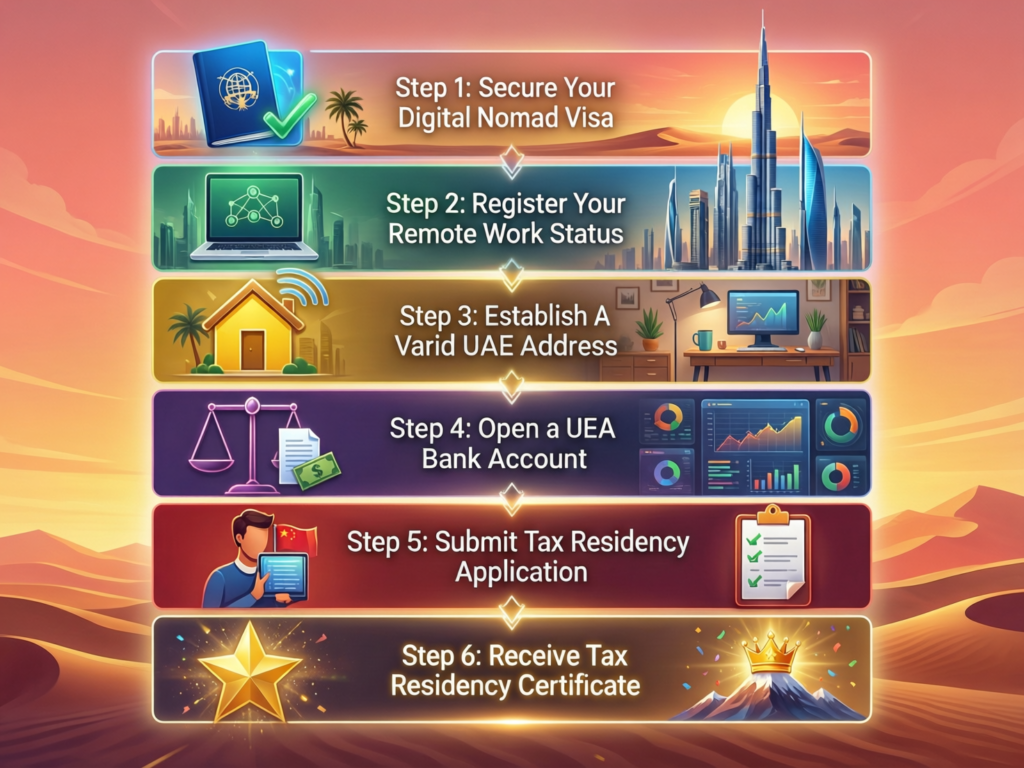
Days in Dubai, “centre of life” and the Tax Residency Certificate
Many digital nomads aim for at least 183 days in the UAE plus clear economic and social ties to support a UAE Tax Residency Certificate, but exact rules depend on their home country.
Common ingredients.
Days – 90- and 183-day thresholds
Are widely used in tax law; spending more than half the year in Dubai and less in any other country is a strong starting point.
Centre of vital interests
Home, family, where your company is managed, where you spend weekends. Moving spouse and kids from Manchester or Munich to Dubai, enrolling children in school, and renting a long-term apartment all help.
Tax Residency Certificate (TRC)
Issued by the UAE for people who can show sufficient presence and ties, often needed to support double-tax claims with treaty countries.
From there, you combine UAE residence with non-residence in your old country under its own tests (Statutory Residence Test for the UK, day-count and ties tests in Germany, etc.).
US citizens: Dubai crypto tax vs IRS worldwide taxation
US citizens and green-card holders do not escape US tax simply by moving to Dubai. The IRS taxes their worldwide income, including crypto gains, wherever they live.
Dubai can still help US nomads.
0% local tax No extra UAE layer on top of US tax.
Foreign Earned Income Exclusion (FEIE) and Foreign Tax Credit (FTC) Useful mainly for active income, not capital gains
Entity planning Using UAE entities for trading, SaaS or DeFi may help with offshore crypto tax planning, CFC rules and treaty access, but this is advanced territory and needs specialist US counsel.
For a New York founder who spends more time with engineers in Dubai and Austin than in the US, the priority is often minimising double taxation and avoiding penalties, not hitting a mythical 0%.
UK and German investors.
For UK and German nomads, the relocation mechanics are different and in some ways trickier.
UK investors
The Statutory Residence Test (SRT) decides if you’re UK-resident, based on days in the UK plus ties like accommodation, work and family.
Once non-resident, most post-departure crypto gains fall outside UK CGT (subject to anti-avoidance and temporary non-residence rules)
The UK–UAE double tax treaty helps avoid double taxation on many income types but doesn’t override the UK’s residence test or stop the UK taxing UK-source income.
German investors
Germany’s one-year rule can make long-term crypto holdings tax-free if sold after 12 months, even before moving.
But Germany’s exit tax (Wegzugsbesteuerung) can apply to significant shareholdings (≥1%) when moving abroad; the UAE–Germany treaty has expired, so there’s no DTT relief.
Wider EU (France, Spain, Italy, Sweden)
These countries often tax residents heavily on worldwide gains and may have wealth or solidarity taxes. Many nomads from Lisbon, Paris or Stockholm now compare Portugal or Cyprus with Dubai as alternative hubs.
In all cases, timing matters: often you’ll want a year where you’re non-resident in the old country and UAE-resident before major disposals.
Global reporting, CARF and avoiding double taxation
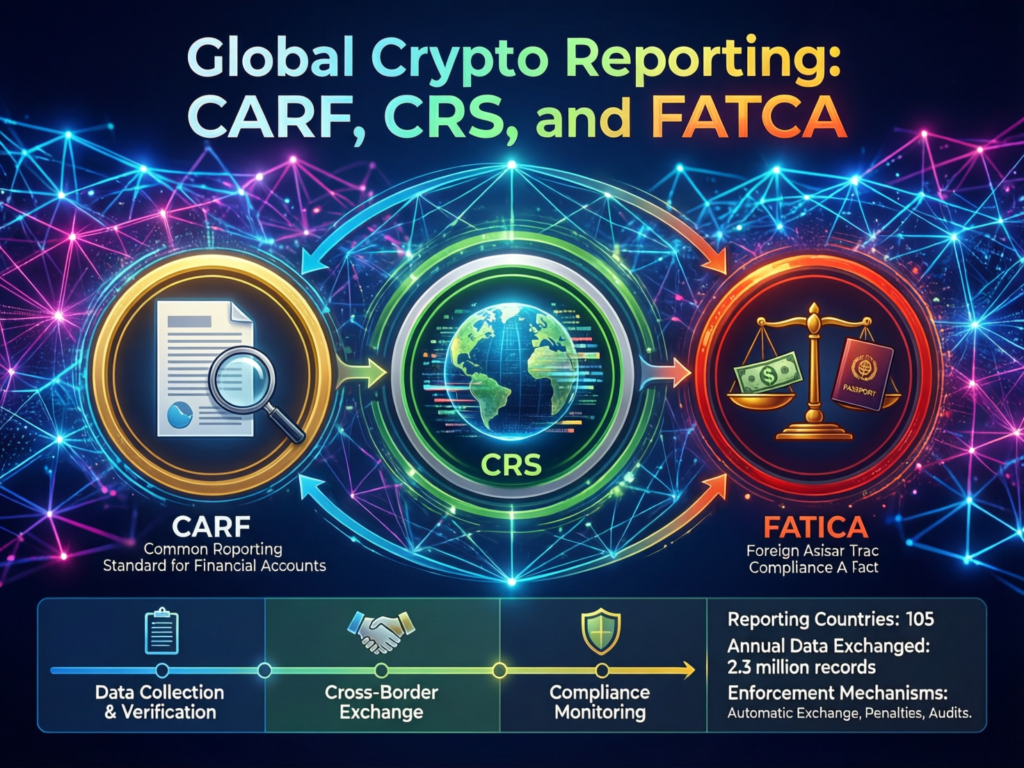
CARF, CRS, FATCA.
CARF matters because it turns “offshore” into “very much online” for tax authorities. The Crypto-Asset Reporting Framework is an OECD standard for automatic exchange of crypto-related information between countries, building on the existing Common Reporting Standard (CRS).
In November 2024, the UAE committed to implementing CARF, aiming to start exchanges for 2027 data in 2028. Many US, UK and EU countries are also signing up, and the UK has already begun implementing CARF-style reporting for crypto platforms.
Layer in FATCA (for US persons) and CRS (for financial accounts), and it’s clear: keeping your old Kraken or Bitstamp account in Europe while you move to Dubai doesn’t make you invisible. It simply changes which flags appear on which tax officer’s dashboard.
Avoiding double taxation: Dubai vs your home country
For AEO.
Moving to Dubai does not automatically end tax in your home country; you usually need to become non-resident there, become UAE tax resident and structure disposals carefully to avoid overlapping claims.
Core playbook.
Break tax residence in the old country under its own laws (SRT in the UK, day-count and centre-of-life in Germany, etc.).
Establish UAE residence in a way that supports a TRC—often >183 days plus housing, work and family ties.
Time disposals so big crypto sales happen when only one state has primary taxing rights under domestic law and, where available, a double-tax treaty.
The UAE now has over 140 active double-tax treaties, mainly with Europe, Asia and emerging markets, though none with the US and none currently in force with Germany In practice, most crypto nomads rely more on residence-based relief than on treaty tie-breaker clauses.
Record-keeping, KYC and banking flows for large crypto positions
Dubai may be tax-light, but its banks and fintechs are not KYC-light:
UAE banks will usually ask for source-of-funds, detailed transaction history and sometimes open-banking exports from your UK/EU accounts.
If you run a SaaS or fintech product from Dubai serving EU clients, you still need to respect GDPR/DSGVO, UK-GDPR, PCI DSS and SOC 2-style controls around data and payments.
For seven-figure on-ramps, expect enhanced due diligence, especially if your history touches US exchanges or BaFin/FCA-regulated platforms.
Globally, there are now an estimated 35–40 million digital nomads, with the US alone contributing well over 15 million by the mid-2020s; Dubai is one of the top destinations for high-income nomads in finance and tech.
Dubai works best when your compliance stack keeps pace with your tax planning.
Visas and residence options for crypto nomads in Dubai
Remote work, freelance and free zone visas for solo traders
For many solo traders and builders, the entry routes are.
Remote work / virtual work visas.
For employees of foreign companies who want to live in Dubai but remain employed in London, New York or Berlin.
Free zone visas.
Via entities in DMCC, DIFC, ADGM or other zones; common for consultants, developers and solo traders who invoice clients.
Mainland options.
For those building local operations, especially if they want to hire UAE staff or contract with government-linked entities.
Each route ties into substance: having a real office, clients and presence makes it easier to argue you’re truly UAE-based when a UK or German auditor looks at your LinkedIn and flight history.
Golden Visa and long-term residence for high-net-worth crypto investors
At higher portfolio levels high six figures and above, often with real estate nomads begin to look at the 10-year Golden Visa:
Real-estate-backed Golden Visas allow you to lock in long-term residence by holding qualifying property.
Investors can also qualify via business or public investments, often routed through free-zone structures that hold operating companies or funds.
Crypto-derived wealth usually needs to be on-ramped into fiat, seasoned in bank accounts and then used to buy property; expect conservative underwriting and tight AML.
For US, UK and German HNWs used to intricate rules from the SEC, FCA or BaFin, Dubai’s Golden Visa will feel familiar: lots of paperwork, but predictable once you know the steps.
Family, dependants and lifestyle logistics
If you’re moving a family from Manchester, New York or Munich, you’re not just optimising tax you’re reinventing your life.
Schools
Dubai has a dense ecosystem of UK (A-Level), IB and US-curriculum schools; fees can rival or exceed private schools in London or Zurich.
Healthcare
Instead of the NHS, you use private insurers and hospital networks; care quality is high but pay-as-you-go.
Cost of living
Rent can be lower than central London or Manhattan but higher than Lisbon or Berlin, depending on neighbourhood and lifestyle.
For many, the trade-off is worth it: a tax-efficient hub in the Gulf time zone, with direct flights to London, Frankfurt, New York and Singapore and a huge crypto / web3 community.
Notably, around 88–89% of UAE residents are expatriates, so day-to-day life in Dubai feels very international.
Holding crypto personally vs via a Dubai company
When a personal-only setup is enough
For many nomads, a personal-only setup is perfectly adequate.
You’re a solo investor with a moderate portfolio, no outside capital and no paid clients.
You mainly trade or invest your own funds, occasionally consulting remotely for companies in London, Austin or Berlin.
You don’t need to raise equity, hire staff or obtain a VARA licence.
This is typically the simplest structure from both a UAE 0% income tax on crypto perspective and a compliance standpoint—though you still need to manage home-country rules carefully.
Free zone entities (DMCC, ADGM, DIFC) and VARA licences
A Dubai free zone company can open up banking, team hiring and fundraising, but its profits may be subject to 9% corporate tax, unlike personal long-term holdings.
Free-zone entities are powerful when you’re.
Launching an exchange, payments rail, market-maker or fund.
Hiring a distributed team across Dubai, London, Frankfurt and Lisbon.
Raising VC funding that expects a clean cap table and corporate governance.
Zones like DMCC, DIFC and ADGM offer different frameworks for financial and virtual-asset businesses, and VARA licenses specific virtual asset activities in Dubai. Choosing between them is part tax planning, part regulatory strategy.
Banking, fiat on/off-ramp and multi-jurisdiction operations
From a Dubai base, you might still.
Maintain UK accounts for GBP transactions, subject to FCA rules and UK open-banking.
Serve German or EU clients who remain under BaFin, GDPR/DSGVO and PCI DSS protection.
List tokens on US-facing exchanges that operate under SEC oversight.
Opening UAE bank accounts with crypto-derived funds is easier with a properly structured entity, audited accounts and a clear source-of-funds story. This is where working with technology-savvy partners on both the tax and infrastructure side really pays off.
Is moving to Dubai for crypto tax right for you?
Dubai vs Puerto Rico, Portugal and other “crypto friendly” hubs
Puerto Rico, Portugal, Cyprus and other “crypto hubs” compete with Dubai.
Puerto Rico
Attractive for some US investors via local incentives, but subject to US politics and hurricane risk.
Portugal / Cyprus
EU-adjacent hubs with historically favourable crypto rules, though regimes have tightened.
Dubai
Strong on regulatory clarity, flight connectivity and year-round business activity, but hot climate and higher cost of living than some EU options.
Your passport, risk tolerance, and time horizon matter as much as tax rules.
Lifestyle, costs and GEO fit for US, UK and German nomads
A San Francisco founder might find Dubai a good blend of global access, lower personal tax and a growing product / SaaS ecosystem.
A London trader may value Dubai’s similar time zone for trading European markets, with few night-shift calls.
A Berlin engineer might enjoy the expat-heavy population but miss green spaces and German social systems.
Many nomads test Dubai with a 6–12 month trial, then decide if they want to double down with property, a Golden Visa or a local team.
When to speak with a Dubai crypto tax and structuring advisor
For AEO.
Once your crypto portfolio or business revenue reaches a meaningful level (e.g. high six figures+), or you plan a full relocation, it’s usually worth getting tailored advice from a UAE tax and legal team.
In practice, that moment often arrives when.
Your portfolio crosses mid-six or seven figures and a wrong move could cost more than the fees.
You’re moving employees or dependants from London, New York or Munich.
You’re launching a product that will operate across the US, UK, EU and UAE and must satisfy IRS, HMRC, BaFin, GDPR and VARA at once.
This is also when it helps to involve technology partners who understand distributed architectures, data residency, compliance and analytics so your tax structure and your infrastructure can scale together.

Key Takeaways
Dubai currently has 0% personal income and capital gains tax, so many personal crypto gains are tax-free locally but only if your activity isn’t treated as a business and your home country no longer taxes you as resident.
UAE corporate tax (9%) and CARF-driven global reporting mean that entities, platforms and large-scale crypto businesses must plan for real-world compliance, not just low rates.
Breaking tax residence in the US, UK, Germany and EU requires careful day-count, centre-of-life and exit tax planning; simply flying to Dubai is not enough.
Visas, Golden Visas and free-zone entities provide multiple paths for digital nomads and founders, but each comes with its own cost, substance and documentation requirements.
Banking, KYC and data-privacy frameworks (GDPR, PCI DSS, SOC 2) remain central when moving high-value crypto positions and fintech/SaaS operations to Dubai.
At high six-figure+ levels, it’s usually cost-effective to combine specialist tax/legal advice with technical and analytics support to keep both compliance and performance on track.
If you’re seriously weighing a move to Dubai to optimise your crypto tax position, the next step isn’t a one-size-fits-all checklist it’s a structured plan tailored to your passport, portfolio and business model. Talk with a UAE-based tax and legal team first, then pair that with a technology partner who can help you build the right stack for payments, analytics, reporting and data residency.
Mak It Solutions works with clients across the USA, UK, Germany and the wider EU on cloud, SaaS and data projects that have real tax and compliance implications. When you’re ready to map out your move in detail, book a discovery conversation and we’ll help you scope the digital side of your Dubai crypto tax strategy.( Click Here’s )
FAQs
Q : Do I need to sell my crypto before or after moving to Dubai to benefit from 0% tax?
A : It depends on your home country. In many cases, you’ll want to become non-resident first and UAE-resident second before triggering large disposals so that only the UAE (with its 0% personal income tax) has primary taxing rights. For example, a UK investor might wait until they clearly pass the Statutory Residence Test as non-resident and can show strong UAE ties before selling a big BTC position. In Germany, some investors may instead use the one-year holding rule first, then move later. Always model both timing and residence with a professional advisor.
Q : How many days do I actually need to spend in Dubai each year to prove tax residency on my crypto gains?
A : The UAE often uses 90- and 183-day thresholds, with 183 days commonly used as a strong indicator of residence. But foreign tax authorities (HMRC, German Finanzamt, IRS) apply their own residence tests, which can be stricter or look at more than just days such as where you have a home, family and work. In practice, many nomads aim for more than half the year physically in the UAE, minimal days in the old country, and enough evidence (leases, school records, utility bills) to support both a UAE Tax Residency Certificate and non-residence in their old jurisdiction.
Q : Will my European or UK exchange accounts automatically report my crypto to my old tax authority after I move to Dubai?
A : Under CARF, CRS and related EU/UK rules, many exchanges will eventually report account and transaction data based on your declared tax residency and identifiers, not just where you log in from. If you keep an account in London or Frankfurt and still look like a UK or German tax resident, that data can be automatically shared with HMRC or local EU tax authorities. After you genuinely move and update your residency details to the UAE, reporting may shift, but historic data doesn’t disappear. CARF roll-out timetables run through 2027–2028, so expect transparency to increase rather than fade.
Q : Is it better to set up a Dubai free zone company or keep my crypto in my own name as a trader?
A : If you’re mainly trading your own funds, a personal setup is often simpler and keeps your gains in the UAE’s 0% personal tax space (subject to home-country rules). A free-zone company helps when you have clients, investors, employees or a platform, because it supports contracts, fundraising and banking but profits may fall under 9% corporate tax above AED 375,000 and, for very large groups, a 15% minimum tax. The “right” answer usually depends on whether you’re building a business (exchange, fund, SaaS, DeFi) or just managing a portfolio.
Q : Can I keep my UK/German bank accounts and still be treated as tax resident in Dubai for my crypto income?
A : Keeping UK or German bank accounts is not automatically a problem, but it can be a residence “tie” in some tests, especially if you still receive local salary or spend long periods back home. HMRC’s Statutory Residence Test and German rules on habitual abode look at overall pattern, not just one factor. From a banking and KYC perspective, it’s common for Dubai-based nomads to maintain accounts in London, Berlin or Zurich while adding UAE accounts for local life. The key is making sure your days, housing and family situation consistently support UAE residence and non-residence in your old country.