
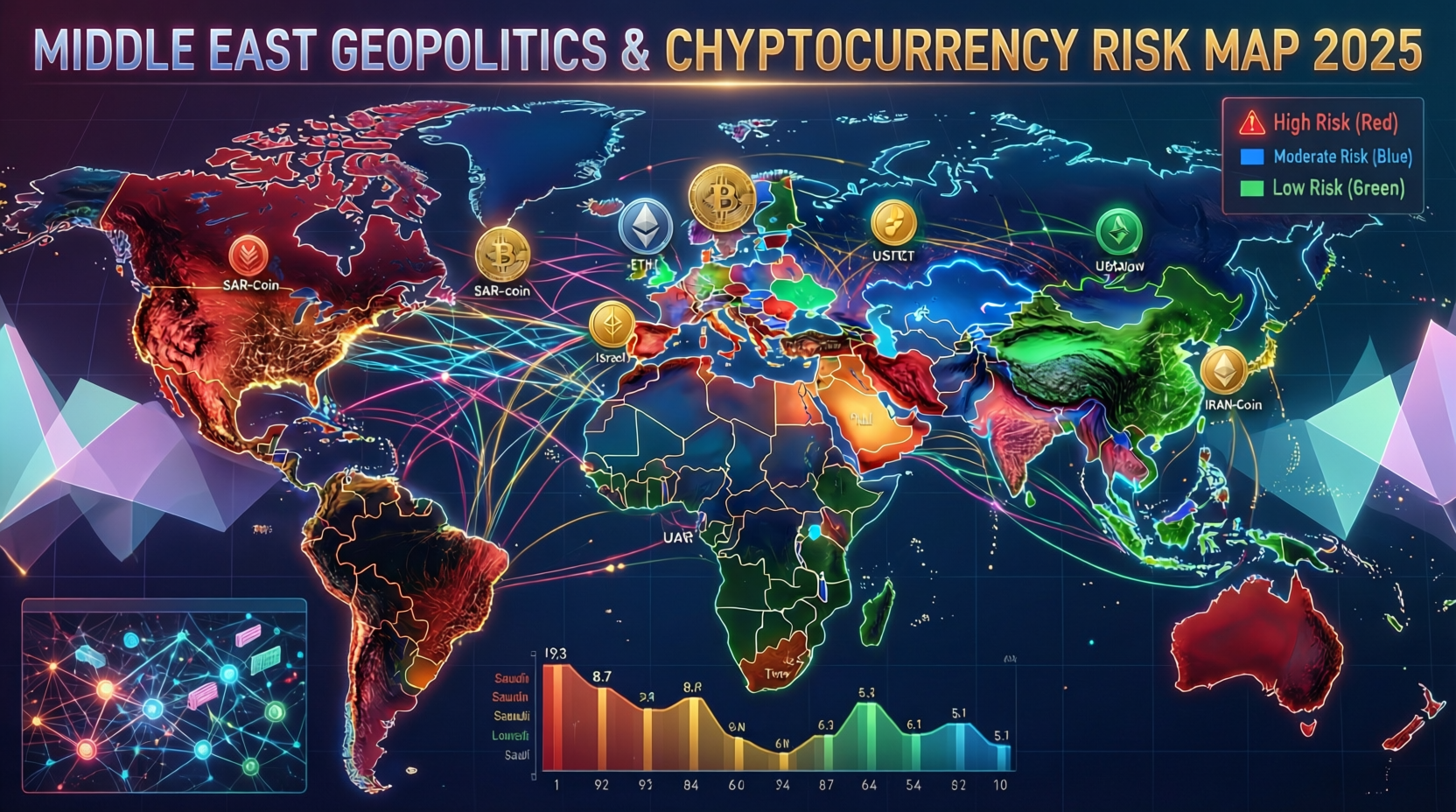

Middle East Geopolitics and Cryptocurrency: Investor Guide
Middle East geopolitics and cryptocurrency are linked because wars, sanctions and oil shocks change how dollars, stablecoins and Bitcoin move across borders, especially via hubs like Dubai and Doha. For US, UK and EU investors, this means headlines from Iran, Israel or the Gulf can trigger short-term crypto volatility while also redirecting longer-term liquidity and trading activity into regulated Middle East venues and stablecoin rails.
Introduction
In 2025, “Middle East geopolitics and cryptocurrency” is really about how power, energy and money move in real time. Oil flows, sanctions on Iran or Russia, and conflicts involving Israel, Gaza or the Gulf states all reshape how dollars, stablecoins and Bitcoin circulate through regional hubs like Dubai, Abu Dhabi, Riyadh and Doha. For Western desks in New York, London and Frankfurt, those shifts now show up on-chain within minutes rather than months.
For investors, Middle East geopolitics and cryptocurrency are no longer separate conversations: they sit on the same risk dashboard, alongside FX, rates and commodities.
From Oil Shocks to On-Chain Flows.
In the 1970s, oil shocks mainly showed up through higher inflation and slower growth. Today, a Gaza escalation or an Iran–Israel clash can move three things at once: oil futures, Gulf equity markets and BTC–USDT order books. Yet 2025 also showed that oil’s “geopolitical premium” can be surprisingly muted even during war, thanks to record supply from the US and others, leaving more of the geopolitical stress to play out in FX, credit spreads and digital assets instead.
Who Cares? US, UK and EU Traders, Funds and Risk Teams
If you’re a US ETF allocator, a London prop desk or a Frankfurt risk officer, Middle East shocks now affect:
BTC and ETH volatility versus classic safe havens like Treasuries and gold.
Stablecoin liquidity in Tether and USDC books, which are increasingly used in emerging and frontier markets.
Access to Middle East venues in UAE, Israel or Qatar that must fit into MiCA, FCA, SEC/CFTC and FATF rules.
Many institutions respond by upgrading data and dashboards the kind of work you might build with specialised business intelligence services and secure web development.
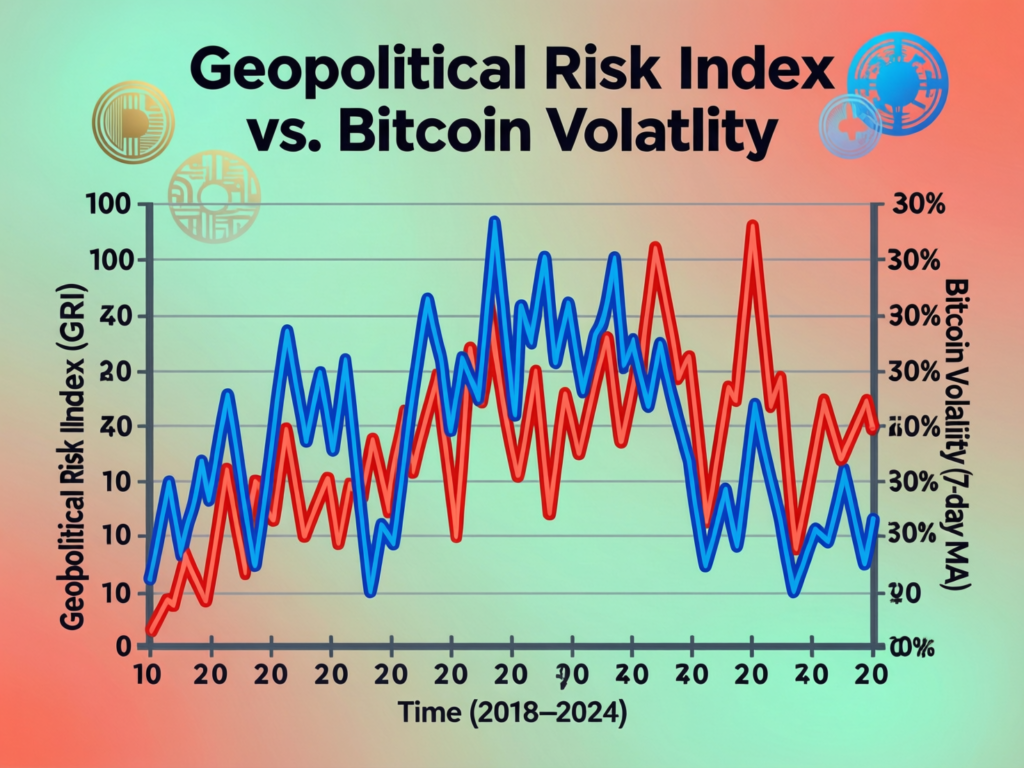
Imagine a simple chart with the Geopolitical Risk Index (GPR) on one line and Bitcoin returns/volatility on the other. When the GPR spikes around major conflicts, academic studies find that Bitcoin’s jumps and volatility usually rise, with clear evidence of herd behaviour during high-stress periods.
In practice, markets often sell BTC first alongside equities (“risk-off”), then reassess whether digital assets are trading more like tech stocks or digital gold as the conflict evolves.
How Middle East Conflicts Affect Crypto Markets and Bitcoin
Crisis Headlines and Order Books.
Micro AEO answer
Crypto typically sells off on the first “war” headline, then stabilises or rebounds once traders understand the real economic impact.
When missiles fly between Iran and Israel or shipping risks spike in the Red Sea, US and UK traders tend to de-risk: BTC, ETH and high-beta altcoins drop with equities, while liquidity migrates into dollars, major stablecoins and sometimes gold. As more information arrives (for example, confirmation that there’s no direct hit on Gulf oil infrastructure), spreads tighten and algorithmic strategies re-enter, often pushing BTC back up faster than regional equities.
Is Bitcoin a Safe Haven or a Risk Asset During Middle East Wars?
So far, the data still says Bitcoin is a hybrid. Over short windows, it usually trades as a risk asset, correlating with tech stocks rather than safe-haven assets like gold or US Treasuries. Over longer horizons, however, narratives such as “digital gold” and “inflation hedge” re-emerge – especially when investors in countries like Turkey, Egypt or Lebanon use BTC and stablecoins to escape local currency weakness triggered or worsened by Middle East conflict.
For GCC-based family offices and sovereign wealth funds, Bitcoin and crypto are more likely to sit in a diversified alternatives bucket, while local retail users might see BTC and stablecoins as practical tools against FX and banking risk.
Geopolitical Risk Index and Crypto Volatility.
Recent research that links the Geopolitical Risk Index (GPR) to crypto markets finds two key patterns: Bitcoin volatility rises when GPR jumps, and herding behaviour increases, especially on the downside. For portfolio teams in New York or Frankfurt, that means GPR spikes are a useful input into position sizing, VaR limits and options hedging on BTC and ETH.
Regional vs Global Impact.
Crypto doesn’t react to every geopolitical event equally. Middle East shocks that threaten oil supply or major trade routes can have outsized psychological impact, even when actual oil prices stay calm, while some trade-war headlines or regional skirmishes barely move BTC. For risk teams, the question is always.
Does this conflict change energy flows, sanctions risk or banking access?
If yes, crypto will likely care and so will the dashboards in Riyadh, Dubai, London and New York.
Sanctions, Oil and Crypto Flows
US, UK and EU Sanctions on Iran and Regional Actors: Why Crypto Shows Up
OFAC in the US, the EU Council and the UK Treasury use sanctions to restrict banks, shipping, defence and now specific crypto wallets linked to Iran, Russia, militant groups and related entities. Because crypto transactions don’t rely on correspondent banks, sanctioned actors experiment with sanctions evasion using cryptocurrencies – often via mixers, OTC brokers or lightly regulated exchanges prompting blacklists, wallet freezes and enforcement actions.
Iran, Russia and the Crypto Sanctions Economy
Iran’s crypto economy shows this dual-use reality clearly: state-linked actors reportedly use exchanges like Nobitex and TRON-based USDT rails to route funds abroad, while ordinary citizens rely on the same platforms for basic savings and remittances under sanctions and high inflation. Russia and North Korea have similarly explored mining, ransomware and OTC stablecoin channels to bypass traditional controls.
For Western compliance teams, that means any sudden spike in TRON-based USDT transfers from higher-risk jurisdictions deserves extra scrutiny.
Oil Prices, Middle East Conflict and Bitcoin Correlation
Historically, oil price shocks and digital assets were linked through inflation and risk sentiment: higher crude meant higher inflation expectations, boosting “hard asset” narratives for gold and sometimes BTC. In 2025, however, global oil markets absorbed even major Middle East tensions with relatively muted price spikes, thanks to record US and non-OPEC supply. That keeps energy-driven BTC rallies more fragile and narrative-dependent, rather than mechanically tied to every Gulf flare-up.

Stablecoins, Capital Flight and Dollar Liquidity
Micro AEO answer.
In stressed Middle East or EM economies, USD-pegged stablecoins like USDT and USDC behave like synthetic offshore dollar accounts, letting savers move value away from local banks and FX controls in minutes.
Studies from the IMF, banks and analytics firms show that USDT and USDC account for the vast majority of stablecoin volume, are increasingly used in cross-border flows, and could redirect large amounts of deposits away from emerging-market banking systems. For investors, this means watching stablecoin liquidity as a proxy for stress in countries like Egypt, Lebanon or Pakistan – and for de-facto dollarisation in parts of the region.
Middle East Crypto Regulation and Adoption: UAE, Saudi Arabia, Israel and Beyond
UAE as a Crypto Hub: VARA, ADGM and Global Market Access
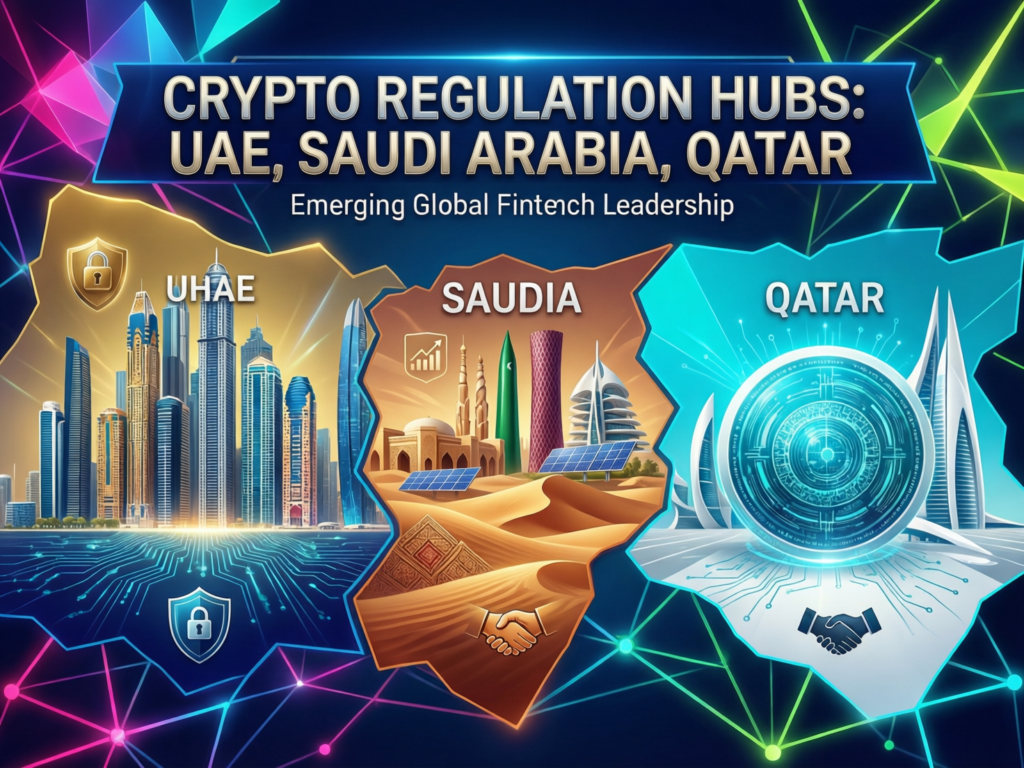
Dubai’s VARA rulebooks and Abu Dhabi’s ADGM/FSRA licensing regime now give the UAE one of the clearest digital-asset frameworks globally, with 2025 bringing mature rulebooks, real supervision and significant inflows of crypto investment. For US, UK and EU desks, UAE platforms often serve as time-zone bridges between Asia and Europe, provided they meet MiCA-style custodial, travel-rule and AML standards.
Practically, that means Western teams can plug into Dubai or Abu Dhabi liquidity while still satisfying home regulators and institutional governance.
Saudi Arabia, GCC and the Long-Term Crypto Roadmap
Saudi Arabia remains cautious: cryptocurrencies are not legal tender, and financial institutions face restrictions, yet the Kingdom is still one of the fastest-growing retail markets by adoption. Vision 2030 and experiments with central-bank-backed digital assets and stablecoins suggest a more structured role for virtual assets over time, echoed by evolving approaches in Qatar (QFC Digital Assets Regulations 2024) and other GCC states.
For GCC-based banks and fintechs, the direction of travel is clear: tighter rules, more institutional-grade infrastructure and closer alignment with FATF and Western standards.
Israel’s High-Tech Ecosystem, Security Lens and Crypto Regulation
Israel treats crypto as a taxable asset rather than legal tender, with strict AML/KYC, licensing and reporting duties for virtual asset providers, reflecting its broader security concerns. (lightspark.com) Tel Aviv’s strong cybersecurity and fintech ecosystem feeds into analytics, RegTech and risk platforms used by global exchanges – especially for terror-finance monitoring.
Iran’s Controlled Crypto Adoption Under Sanctions
In Iran, the state has encouraged mining and allowed a network of domestic exchanges that sit in a grey zone between official blessing and sanctions risk. Nobitex’s 2025 $90m hack – widely viewed as politically motivated highlighted how central that platform is to both regime strategies and ordinary users. For Western investors, that’s a reminder that some apparent “retail” flows may sit very close to sanctioned actors and cyber operations.
Connecting to Western Rules.
By late 2024, the EU’s MiCA regime and related transfer-of-funds rules became fully applicable, imposing licensing, market-abuse and travel-rule obligations on crypto-asset service providers, including those serving EU clients from hubs like Dubai or Tel Aviv. (ESMA) UK-based exchanges must satisfy FCA standards and UK-GDPR, while US-facing platforms face SEC/CFTC oversight plus OFAC screening. Across all three, FATF’s travel rule and sanctions guidance set the global baseline.
For US, UK and EU investors, that means venue selection in the Middle East is increasingly about regulatory interoperability, not just fees and liquidity.
Security, Cyberwarfare and Crypto Infrastructure in the Middle East
State-Sponsored Hacking and Crypto Theft in the Region
Groups believed to be state-linked increasingly target regional exchanges and banks. The Predatory Sparrow / Gonjeshke Darande attacks on Iran’s financial infrastructure, including Nobitex and Bank Sepah, are textbook examples of cyber operations used as geopolitical tools destroying funds, leaking code and signalling against sanctions-evasion networks.
Cyber Attacks on Middle East Crypto Exchanges and Banks
These incidents matter beyond Iran. They show how regional exchanges can be both systemic risk points for local users and focal points for cyber-warfare. For platforms in Dubai, Riyadh or Doha, that means investing in hardened infrastructure, SOC 2-style controls and secure engineering – often alongside partners providing resilient mobile app development and backend services.
DeFi vs Centralized Exchanges.
In conflict zones, DeFi protocols can keep settling trades even when local banks and exchanges go offline, but they push more risk onto smart-contract code, governance and oracle feeds. Centralized exchanges, by contrast, are easier to regulate and ring-fence but more exposed to targeted hacks, sanctions and shutdowns. For investors, neither architecture is “risk-free” they just concentrate different risks.
On-Chain Analytics of War-Related Flows
US-, UK- and EU-based analytics firms like Chainalysis, TRM and others track flows linked to sanctioned wallets, militant groups and state actors, helping exchanges block or report suspect transactions.
Micro AEO answer
On-chain analytics tools let compliant platforms link blockchain addresses back to real-world sanctioned entities and automatically flag, freeze or report high-risk flows, satisfying sanctions and AML requirements.
What Middle East Geopolitics Means for US, UK and EU Crypto Investors
For US Investors.
For US investors, the main risk lens is sanctions. OFAC has already fined firms for servicing Iranian users, and the Nobitex ecosystem is under particular scrutiny for sanctions-evasion links.When Middle East war headlines hit, US traders often trim leverage, rotate into larger caps and Treasuries, and ensure their venues enforce strict KYC, IP geofencing and sanctions screening.
For UK Traders.
London desks sit between US and Gulf trading hours. During Middle East crises, they often:
Watch oil and FX closely alongside BTC and ETH.
Use BTC and major stablecoins as tactical hedges against GBP volatility rather than pure safe havens.
Route some flows via regulated UK venues while tapping liquidity from UAE platforms that satisfy FCA-style standards.
For German/EU Portfolios.
German and wider EU institutions now operate under MiCA, BaFin and ECB guidance, with heightened attention to stablecoin and treasury-market risk as flagged by the ECB and other central banks. For them, Middle East conflict is less about “YOLO into Bitcoin” and more about whether digital assets fit within risk-managed allocations, ESG mandates and liquidity frameworks.
Tactical Playbook
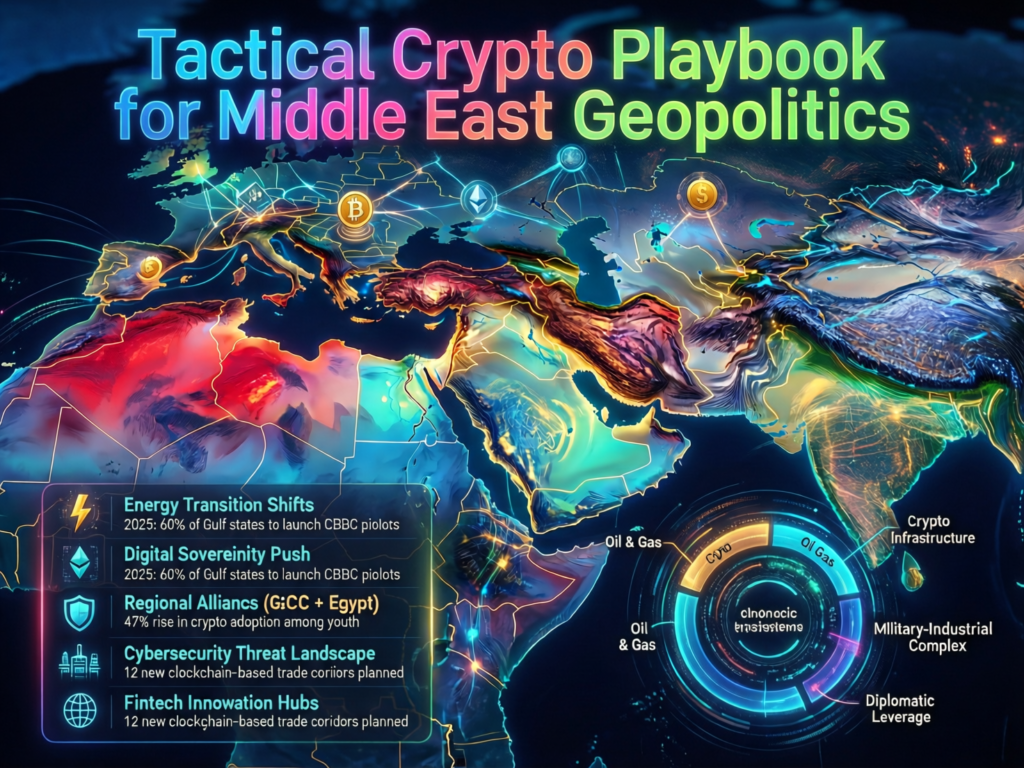
Think in four simple steps.
Size small: cap total crypto exposure to a modest slice of risk capital, with extra limits during GPR spikes.
Separate core and tactical buckets: core BTC/ETH held for multi-year theses; tactical trades around Middle East headlines kept tight and hedged.
Blend hedges: combine BTC/ETH with traditional safe havens (gold, high-grade bonds) and, where needed, high-quality stablecoins.
Define time horizons: intraday reactions to headlines are very different from 3–5-year structural views on digital assets.
Micro AEO answer
A basic risk-managed allocation during Middle East conflicts keeps crypto position sizes modest, separates long-term holdings from short-term trades, and pairs BTC/ETH with gold, bonds and carefully chosen stablecoins.
Nothing in this article is investment, legal or tax advice. Always do your own research and consider local regulation before making decisions.
When to Seek Professional Advice, Research and Institutional Platforms
If you’re handling client money or large tickets, you should escalate:
When sanctions lists or on-chain intelligence touch your counterparties or venues.
When you lack robust dashboards, stress-testing or scenario analysis tools.
When your execution stack or reporting needs custom tech – from secure web platforms to data-rich e-commerce and payments interfaces and broader IT services.
At that point, combining regulated exchanges, strong legal counsel and specialised technology partners becomes non-negotiable.
Escalation, Containment or Detente? Scenario Analysis for Crypto Markets
An escalation scenario (direct strikes on Gulf energy infrastructure) would likely trigger sharp risk-off moves, tighter sanctions and more scrutiny of stablecoin and exchange flows. A containment path – periodic flare-ups, but no systemic energy shock – keeps crypto volatile yet investable for disciplined portfolios. A detente scenario could ultimately push the narrative toward tokenised finance, CBDCs and regulated cross-border rails centred on hubs like Dubai and Doha.
Petrodollar, De-Dollarization and Crypto’s Strategic Position
Experiments with yuan-, euro- or dirham-denominated oil trade and regional CBDCs all chip away at the classic “petrodollar only” pattern. Crypto sits on the edge of this conversation: not yet a mainstream invoicing currency, but increasingly a settlement or collateral layer for niche flows and a savings vehicle for households worried about FX risk.
What AI, On-Chain Data and Regulation Mean for the Next Cycle
AI-driven risk engines, richer on-chain datasets and more mature regimes like MiCA, UAE VARA and Qatar’s digital-asset rules point toward a future where war-related flows are quickly traced and ring-fenced rather than ignored. That could make Middle East–linked shocks more visible but, over time, less catastrophic for mainstream investors.
Key Takeaways
Middle East shocks now show up directly in GPR indices, BTC volatility and stablecoin flows.
UAE, Israel and (eventually) broader GCC frameworks will shape how global capital accesses regional liquidity.
Sanctions and cyber-warfare make venue and counterparty selection as important as coin selection.
US, UK and EU portfolios should weave Middle East scenarios into their crypto risk, not treat them as one-off surprises.
Building resilient, compliant infrastructure from trading front-ends to data pipelines matters as much as any single trade, which is where partners like Mak It Solutions can help design robust systems.
If you’re a trader, allocator or risk lead trying to make sense of Middle East geopolitics and cryptocurrency, you don’t have to do it with spreadsheets and screenshots. Mak It Solutions can help you turn messy on-chain data, sanctions feeds and market signals into usable dashboards, apps and reports that match your governance standards.
Explore our broader services, or reach out via our contact page to discuss a tailored GCC-aware analytics and infrastructure roadmap for your US, UK or EU crypto operations.
FAQs
Q : Is crypto more sensitive to Middle East conflicts than to other global geopolitical shocks?
A : Crypto is sensitive to any large geopolitical shock, but Middle East events can matter more when they threaten energy supply, shipping lanes or sanctions regimes. Conflicts involving Iran, Israel or the Gulf can move both oil expectations and the Geopolitical Risk Index, which in turn tend to increase Bitcoin volatility and short-term downside pressure. However, crypto also reacts strongly to US–China tensions or Ukraine-related news, so risk teams in Riyadh, Dubai, London and New York should treat Middle East conflict as one key driver in a broader global risk set, not the only one.
Q : How do sanctions on Iran and other Middle East states practically affect the way exchanges list tokens or handle stablecoins?
A : Sanctions from OFAC, the EU and UK mean exchanges must screen users, wallets and flows linked to Iran, Syria, sanctioned militias and related entities, especially in USDT and USDC. In practice, that can mean geo-blocking certain jurisdictions, delisting tokens with high sanctions-evasion risk, blocking or freezing blacklisted wallets and filing suspicious-activity reports. Regional hubs in Dubai or Doha also need to align with FATF travel-rule expectations and local regulators such as VARA, ADGM/FSRA and QCB, so Western clients can demonstrate full compliance to their own supervisors and sanctions teams.
Q : Can gold and Bitcoin both act as safe havens during Middle East crises, or does one typically outperform the other?
A : Gold remains the classic safe haven: it tends to rise when geopolitical risk increases, especially if investors fear real economic damage. Bitcoin, by contrast, often sells off initially with risk assets, then may recover faster if investors lean into “digital gold” or inflation-hedge narratives once the dust settles. In some Middle East or EM markets – for example, in parts of Turkey or Egypt BTC and stablecoins can act as practical hedges against local FX and capital controls, while Gulf wealth and sovereign funds may still prefer gold, dollar assets and, increasingly, regulated exposure to BTC via offshore structures.
Q : What red flags should compliance teams in US, UK and EU watch for when monitoring Middle East–linked crypto flows?
A : Key red flags include large or repeated flows to or from known Iran-linked platforms, mixers or high-risk OTC brokers; clustering of wallets around sanctioned entities; and unusual spikes in TRON-based USDT or other stablecoin transfers from high-risk jurisdictions. Compliance teams in London, Frankfurt and New York should combine EU/UK/US sanctions lists with on-chain analytics, keep up-to-date whitelists and blacklists, and consider the guidance of SAMA, TDRA, QCB and UAE regulators when dealing with GCC-based partners.
Q : How might upcoming MiCA and GCC regulatory changes reshape liquidity routes between Dubai, London, Frankfurt and New York?
A : MiCA’s full application and related EU transfer-of-funds rules will make it harder for lightly regulated platforms to serve EU clients, likely concentrating liquidity in better-capitalised venues that meet strict custody, disclosure and travel-rule standards. At the same time, continued progress by VARA, ADGM and GCC regulators (including evolving stances from SAMA and QCB) should make Dubai, Abu Dhabi and Doha more attractive as regional booking centres. Over time, that could channel a larger share of Middle East–linked crypto liquidity through a regulated corridor connecting New York, London, Frankfurt and Gulf hubs, with shared standards on AML, sanctions and investor protection.