

Legal Risks of Cryptocurrency in Arab Countries for US & EU
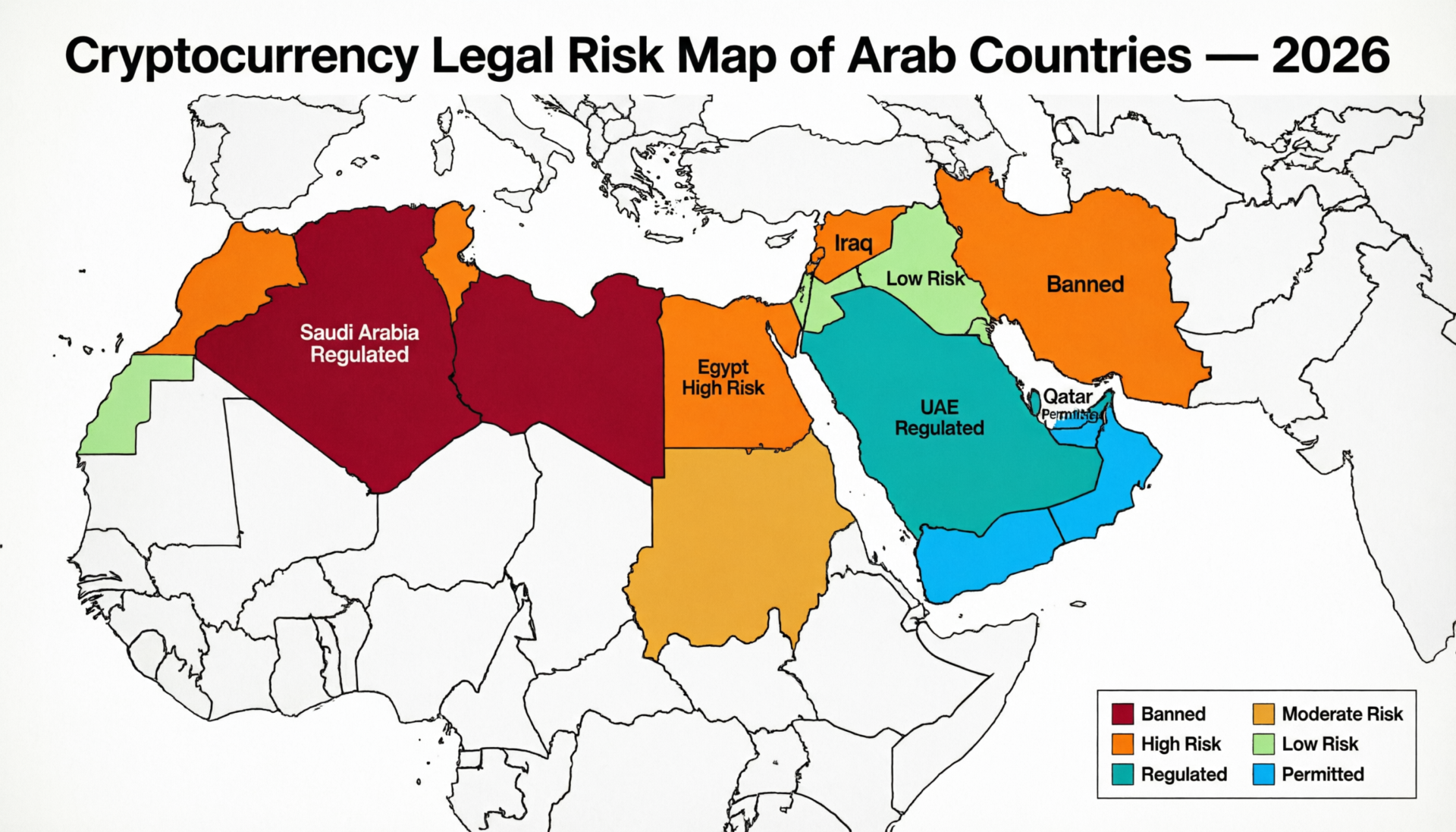
The main legal risks of cryptocurrency in Arab countries are that some jurisdictions (like parts of the United Arab Emirates and Bahrain) offer formal licensing regimes, while others (such as Egypt, Algeria and Kuwait) heavily restrict or ban most crypto activity, with real enforcement and even criminal penalties. For US, UK and EU investors, the practical risk is entering a market where basic trading, marketing or custody is either unlicensed, Sharia-sensitive or outright prohibited, creating exposure to asset freezes, regulatory action, sanctions issues and tax complications back home.
Introduction
The legal risks of cryptocurrency in Arab countries matter because the region is both a fast-growing crypto market and one of the most fragmented legally. The United Arab Emirates (UAE) now licenses global exchanges, while countries like Egypt and Algeria have near-total bans on crypto trading and promotion.
For investors and founders in the United States, United Kingdom and Germany (and the wider European Union), this is a classic “looks attractive, but is it legal?” scenario. MENA already accounts for around $330B of crypto value (about 7.5% of global volume) between mid-2023 and mid-2024. But the same growth is exactly why regulators are tightening rules, especially around AML, sanctions and investor protection.
Who this guide is for
This guide is written for.
US investors and crypto businesses navigating FATCA, SEC and FinCEN expectations when dealing with MENA platforms.
UK-based law firms, FCA-regulated fintechs and family offices in London looking at Gulf exposure.
BaFin-regulated banks and asset managers in Berlin and across the EU mapping MiCA vs Gulf crypto regimes.
Crypto founders, exchanges and Web3 teams who want to operate legally from hubs like Dubai or Abu Dhabi without tripping over bans elsewhere in the Arab world.
Legal, restricted and banned crypto regimes across Arab countries
At a high level, Arab-world crypto regimes fall into three buckets (with lots of nuance inside each)
Licensed / hub jurisdictions
UAE (Dubai/Abu Dhabi), Bahrain, parts of Oman and, increasingly, Jordan now offer licensing frameworks for virtual asset service providers (VASPs) and digital assets.
Restricted / grey-area jurisdictions
Saudi Arabia, Qatar (outside the Qatar Financial Centre), Lebanon and Tunisia tend to allow holding crypto but restrict financial institutions and advertising, or confine activity to pilot zones.
Banned or near-banned jurisdictions
Egypt, Algeria, Kuwait and historically Morocco either criminalise most crypto activity or treat it as a foreign-exchange breach, with draft laws only slowly softening that stance.
For a US or EU investor, the first category is where you can realistically license or partner; the second is where risk appetite and product design become critical; and the third is where you typically limit yourself to indirect exposure (e.g., investing in a Dubai-based VASP that blocks users in banned countries)
How to use this guide for pre-investment due diligence and risk triage
Use this guide as
A legality map to quickly see whether a country is broadly open, cautious or hostile to crypto.
A licensing compass to compare Dubai/Abu Dhabi, Qatar and Bahrain when choosing a Gulf base.
A risk triage checklist to filter deals or platforms by legality, Sharia alignment, AML/sanctions posture and tax impact in your home country.
Then combine it with specialist legal advice and a tech partner like Mak It Solutions to actually implement compliant, auditable infrastructure (KYC, on-chain monitoring, data residency under GDPR/UK-GDPR/SOC 2, etc.)
Is Crypto Legal in Arab Countries? Regional Status & Bans
AEO micro-answer
Across Arab countries, crypto spans a spectrum from licensed hubs (UAE, Bahrain, parts of Oman/Jordan) to restrictive regimes (Saudi Arabia, Qatar, Lebanon, Tunisia) and outright or near-bans (Egypt, Algeria, Kuwait and still-shifting Morocco). That means legality, licensing and even whether banks can touch crypto varies widely between the Gulf, the Levant and North Africa, so foreign investors must treat each jurisdiction as a separate legal bet, not “the Middle East” as one market.
Gulf Cooperation Council overview
Gulf states all want diversification beyond oil, but they don’t agree on how fast to open up to crypto:
UAE and Bahrain have gone “regulate, then attract.” Dubai’s Virtual Assets Regulatory Authority (VARA) licenses VASPs across onshore Dubai, while DIFC and the Dubai Financial Services Authority and the Abu Dhabi Global Market’s FSRA run separate, sophisticated crypto frameworks.
Saudi Arabia, Qatar, Oman and Kuwait have historically focused on warnings and pilot programmes, reluctant to let retail speculation run wild, but are gradually introducing digital-asset rules within controlled financial centres.
Economic policy explains a lot of the divergence: the UAE and Bahrain want to be regional booking centres for global crypto capital (a bit like New York with BitLicense), while Saudi Arabia and Qatar prefer “Web3 as infrastructure” rather than speculative trading.
High-risk jurisdictions.
If you’re a foreign investor or fintech, several Arab markets are red or deep amber on your risk map.
Egypt Law No. 194 (Central Bank and Banking System Law) effectively bans issuing, trading or promoting crypto without a licence from the Central Bank of Egypt, and Dar al-Ifta has a fatwa deeming crypto transactions haram. In practice, crypto is “effectively illegal” for most purposes.
Algeria a comprehensive ban on holding, mining, trading and promoting crypto, with criminal penalties, makes it one of the harshest regimes globally.
Kuwait the Capital Markets Authority announced an “absolute prohibition” on key crypto activities in 2023 and authorities continue to crack down, including on mining.
Morocco bitcoin has been formally banned since 2017, but the central bank is now developing a draft law to regulate crypto-assets and exploring CBDC for cross-border payments. Until that law is enacted, crypto remains a legal grey zone with enforcement risk.
For US/UK/EU investors, the key risk isn’t just “is crypto banned?” but how enforcement interacts with you: funding a local bank account with offshore trading profits, marketing a DeFi app into a banned country, or having local employees use your global platform can all create regulatory and even criminal exposure.
Country-by-country legality and regulator table
Always verify live sources this table is simplified and 2026-dated. Laws, fatwas and enforcement practice change quickly.
| Country / hub | Status (retail crypto) | Key regulator(s) | Main legal risks (high level) |
|---|---|---|---|
| UAE (Dubai mainland) | Licensed, hub | VARA, ESCA | Unlicensed VASP activity, weak AML/Travel Rule controls, mis-marketing to locals. |
| UAE (DIFC) | Licensed, hub | DFSA | Only approved token types; firm-level governance and prudential rules. |
| UAE (ADGM) | Licensed, hub | FSRA (ADGM) | Security-token classification, client protection, stringent AML. |
| Saudi Arabia | Restricted / grey | Saudi Central Bank, Capital Market Authority | No clear licensing for retail crypto; banks barred; strong warnings; regulatory pilots only. |
| Qatar (domestic) | Highly restricted | Qatar Central Bank | Banking ban on crypto trading and services. |
| Qatar (QFC) | Institutional digital-asset regime | QFC Authority, QFCRA | Digital Assets Regulations 2024 & Investment Token Rules for tokenisation/investment tokens. |
| Bahrain | Licensed, hub | Central Bank of Bahrain | Crypto-asset module, licensing for exchanges and custodians; robust AML/market conduct rules. |
| Oman | Evolving | Capital Market Authority | Virtual Assets Regulatory Framework in development; licensing path emerging. |
| Egypt | Near-ban | Central Bank of Egypt | Law 194 + Sharia fatwas; licensing theoretical but practically absent. |
| Algeria | Ban | Ministry of Finance / central bank | Law No. 25-10 criminalises most crypto activities, including holding. |
| Morocco | Ban → draft regulation | Bank Al-Maghrib, finance ministry | FX-based ban persists until crypto-asset draft law passes; active CBDC exploration. |
| Jordan | Legal but strictly regulated | Central Bank of Jordan and new VASP law | Licensing required; strict AML/Travel Rule compliance; banks largely barred from direct dealing. |
| Lebanon | Restricted / under-regulated | Banque du Liban | Public warnings; banking-system fragility and capital controls amplify operational risk. |
| Tunisia | Restricted / uncertain | Central Bank & FX authorities | Mixed signals; restrictions on FX and online payments can catch crypto. |
Licensing, Compliance & Enforcement in UAE, Saudi Arabia and Qatar
UAE crypto frameworks.
In the UAE, crypto regulation is multi-layered but increasingly harmonised.
VARA (Dubai) is the dedicated virtual-assets regulator for Dubai (excluding DIFC), issuing detailed rulebooks on licensing, marketing and market conduct for exchanges, brokers, custodians and other VASPs.
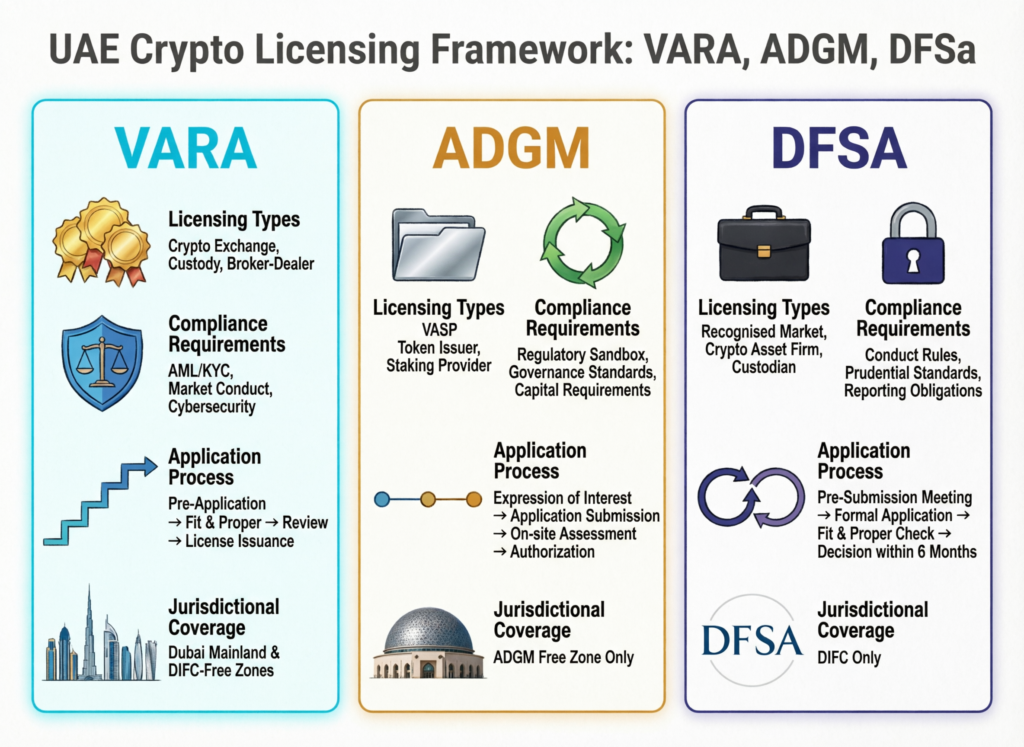
ADGM’s FSRA in Abu Dhabi treats many tokens as “crypto-assets” or “securities”, with a mature regime for exchanges, custodians, OTC desks and derivatives, long favoured by institutional players.
DFSA (DIFC) introduced a comprehensive crypto-token regime for firms in the Dubai International Financial Centre, aligning with FATF and international standards.
Since late 2024, the UAE has also exempted most virtual-asset transactions from the standard 5% VAT, which materially changes fee and pricing models.
For a London- or New York-based exchange, these frameworks feel closer to MiCA-style EU regulation than to lightly regulated offshore models: expect full KYC/AML, Travel Rule implementation, capital requirements and ongoing supervision.
Saudi Arabia and Qatar.
Saudi Arabia publicly warns against crypto trading and doesn’t recognise cryptocurrencies as legal tender, but it hasn’t passed a classic “crypto ban” statute. Banks and licensed institutions face strict limits, while sandbox and pilot projects explore tokenisation, CBDC and blockchain for market infrastructure.
Practically, this means
Retail crypto platforms cannot treat Saudi as a free-for-all market.
Institutional, B2B and infrastructure plays may be viable under close supervision.
In Qatar, the picture is split
The Qatar Central Bank maintains a de-facto ban on crypto services in the domestic banking system.
The Qatar Financial Centre (QFC) has gone the other way, issuing Digital Assets Regulations 2024 and Investment Token Rules 2024 for tokenised securities and digital-asset services in its offshore financial centre.
For a Berlin- or London-based firm, Qatar is more of an institutional tokenisation play than a retail exchange opportunity, at least in the short term.
Practical licensing roadmap for foreign exchanges, brokers and fintech apps
AEO micro-answer
A crypto exchange or fintech that wants to be fully licensed in Dubai or Abu Dhabi should (1) choose the right venue (VARA, ADGM or DIFC); (2) set up a local entity with real governance, senior management and compliance presence; (3) design products that fit the regulator’s permitted token and activity categories; (4) implement FATF-grade AML, Travel Rule and sanctions screening; (5) submit a detailed licence application after pre-application meetings; and (6) align marketing, data-hosting and cross-border flows with GDPR/UK-GDPR and local data-protection rules.
In a bit more detail, a typical roadmap looks like
Pick your regulator and perimeter VARA for onshore Dubai retail and institutional flows, ADGM if you’re more capital-markets focused, or DIFC if you’re plugging into existing financial-services ecosystems.
Gap-analyse your current stack does your platform already meet the expectations of regulators like ESMA, BaFin or the SEC? If not, prioritise risk-based KYC, Travel Rule-ready transaction monitoring and on-chain analytics for high-risk wallets.
Sharia and product design especially if you plan to target GCC retail users, work with Sharia scholars to review leverage, staking, interest-bearing lending and meme tokens that may fall foul of Islamic-finance principles.
Regulatory engagement hold pre-application meetings, prepare a realistic business plan, risk assessment and wind-down strategy, and expect questions about both your source of users (e.g., US/UK/EU) and your exclusion policies for banned MENA countries.
Implementation partner combine legal advice with a delivery partner (for example, Mak It Solutions for secure, audited cloud architectures) so the regulator sees you can actually build what your policies promise.
If you want those architectures aligned with broader digital-transformation work, you can also plug into Mak It Solutions and for regulated analytics and secure crypto or fintech apps.
Sharia Law, Halal/Haram Opinions and Legal Risk
AEO micro-answer
Sharia law doesn’t have a single, unified view on crypto some major fatwas (like Egypt’s Dar al-Ifta and the Syrian Islamic Council) say bitcoin-style currencies are haram, while other scholars and councils treat them as permissible digital assets if speculation, gambling and interest are controlled. In practice, these opinions heavily influence which products local regulators will actually license, which tokens banks are willing to touch and where retail marketing is tolerated.
Is bitcoin and crypto halal or haram? How major Sharia scholars and fatwas differ by country
Over the last decade, Sharia scholars have split into two broad camps.
Prohibitionist bodies like Egypt’s Dar al-Ifta and the Syrian Islamic Council have declared cryptocurrencies haram, citing volatility, lack of intrinsic value, and their use in fraud and money laundering.
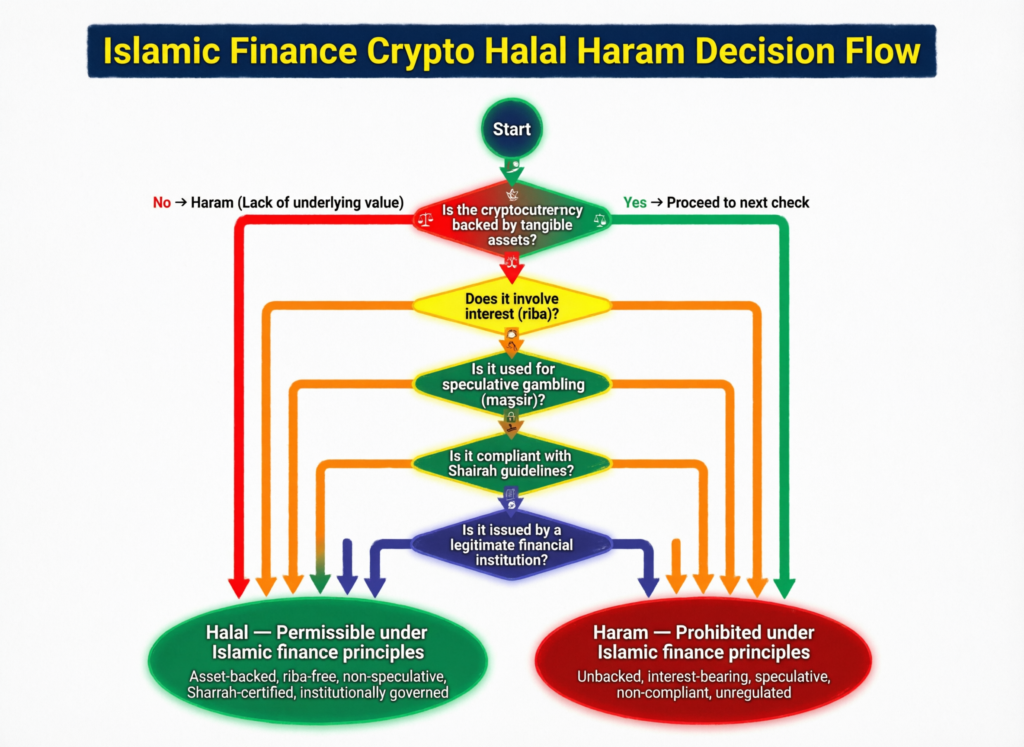
Conditionally permissive others argue that bitcoin can be treated like a digital commodity or currency if it avoids riba (interest), excessive gharar (uncertainty) and maysir (gambling) and if the underlying activity is ethical.
For a UK or EU firm, the key takeaway is fragmentation: a structure seen as halal in one Gulf jurisdiction may be unacceptable next door, depending on whose Sharia board is advising the regulator or local banks.
Structuring products to align with Islamic-finance principles
If you want serious Gulf adoption, you should assume that Islamic-finance principles will be applied, explicitly or implicitly.
Spot, fully funded trading in major tokens is generally easier to justify than leveraged derivatives or perpetual swaps.
Yield products that rely on interest-style lending or opaque DeFi protocols are high-risk; profit-sharing (mudarabah/musharakah-style) or asset-backed structures stand a better chance.
Tokenisation of real-world assets (e.g., sukuk, real estate) that already comply with standards from bodies like AAOIFI is often more acceptable than pure speculative coins.
Embedding Sharia-sensitive logic into your smart contracts and UX for example, preventing interest-bearing lending to users in Saudi Arabia or Qatar can reduce downstream complaints and enforcement risk.
When Sharia opinions translate into regulatory action, litigation or customer complaints
Sharia debates matter legally when they are
Codified in law (as with Egypt’s combination of fatwa + banking law)
Adopted by regulators or central banks as a risk signal for prohibiting certain products.
Used by courts in mis-selling or fraud cases brought by local investors.
Ignoring local Sharia sentiment can lead to
Licence rejections or restrictive conditions.
Product suspensions after public backlash.
Investor claims framed as “you misled us into buying a haram product.”
For US, UK and EU firms used to purely secular financial regulation, this is a cultural and legal adjustment but one you can navigate with early Sharia input and clear disclosures.
AML, Sanctions, Tax and Cross-Border Reporting Risks
AEO micro-answer
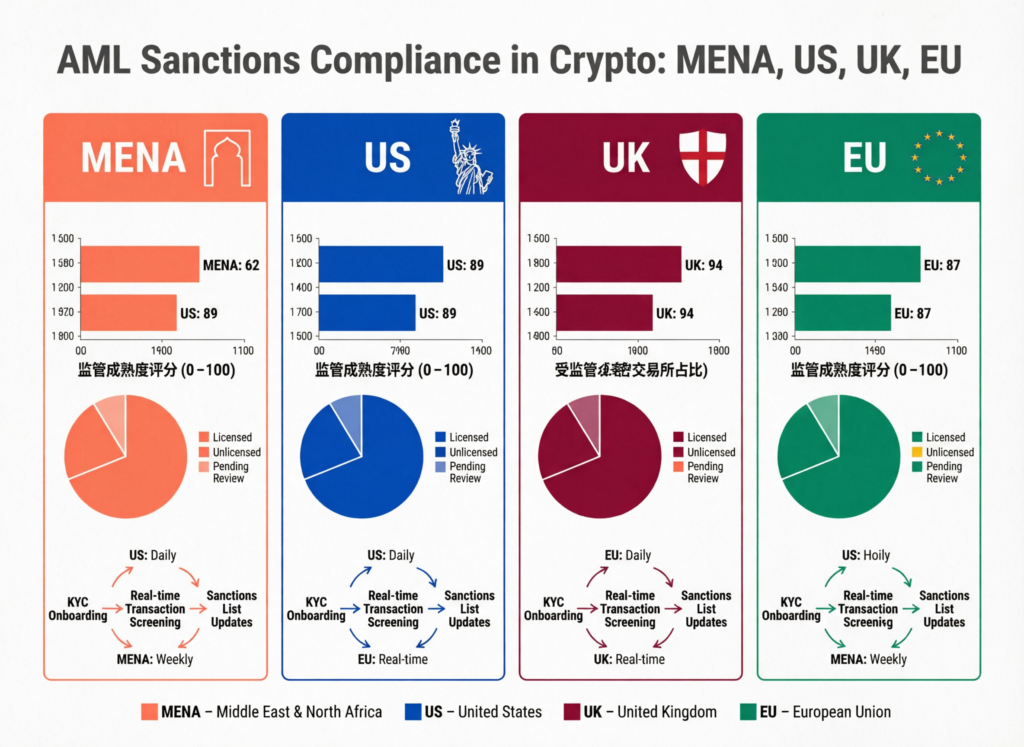
When using an Arab-based crypto platform, (1) test its AML/KYC depth against FATF standards and the Travel Rule; (2) confirm it screens wallets and customers against US, UK and EU sanctions lists; (3) check whether your activity will be reported under regimes like MiCA, 5AMLD/6AMLD and the OECD Crypto-Asset Reporting Framework (CARF); and (4) assume that you must self-report and pay tax on gains to the IRS, HMRC or your EU tax authority even if the Arab country doesn’t tax you locally.
AML/CTF expectations and Travel Rule obligations for crypto exchanges in Gulf hubs
FATF Recommendation 15 and its guidance on virtual assets and VASPs now set the baseline for Gulf regulators.UAE, Bahrain, Qatar QFC and others have explicitly committed to Travel Rule-style information sharing for transfers above certain thresholds.
For you, that means
A serious Gulf exchange should collect sender/receiver details and share them with other VASPs just like a bank which may feel intrusive but is mandatory in most hubs.
“Lite KYC” or totally anonymous services in the region are not just risky they are likely out of step with current law and could be shut down without notice.
Globally, there are now over 560 million crypto owners (around 6.8% of the world’s population), with UAE ownership estimated above 25% and Saudi around 15%. This level of adoption is exactly why regulators are closing AML loopholes quickly.
Sanctions, terrorist-financing and high-risk wallet exposure
Given the geopolitical profile of parts of the Middle East, US, UK and EU authorities are extremely sensitive to crypto being used to bypass sanctions or terrorist-financing controls.
Key practical risks
Using an Arab-based platform that does not robustly screen against OFAC/EU sanctions or local lists.
Interacting with wallets that belong to sanctioned individuals or entities in high-risk parts of the region.
Funding on-chain donations or remittances that inadvertently breach sectoral sanctions (e.g., energy, defence)
Even if your VASP is in Dubai or Bahrain, an enforcement action could still come from the US or EU if they see you as wilfully blind. Strong sanctions screening and blockchain analytics (and documentation of both) are essential.
Tax and reporting for US, UK and EU investors with crypto exposure in Arab countries
Most Arab jurisdictions either do not tax individual capital gains on crypto or lack detailed rules but that does not mean you are tax-free.
US persons must still report worldwide crypto gains under IRS rules; foreign accounts can trigger FBAR/FATCA reporting.
UK residents now face explicit HMRC focus on crypto; from 1 January 2026 CARF-based reporting rules begin requiring exchanges to report transaction data on UK users.
EU investors need to align MiCA, AMLD5/6 and the coming CARF rules, with the EU planning to adopt CARF via its Directive on Administrative Cooperation from 2026.
Meanwhile, the global crypto market is back near the $3T mark in 2025, and stablecoins have surged to over $300B in market cap. That scale has pushed tax authorities to treat “I used a Dubai exchange” as zero excuse for non-compliance.
If you’re building products that turn on this reporting layer dashboards, reconciliations, alerts Mak It Solutions’ [AI governance operating model for US, UK and EU and [AWS vs Azure vs Google Cloud comparison for compliant architectures]can help you align your tech stack with your legal obligations.
Risk Management Playbook for US, UK and EU Investors & Businesses
AEO micro-answer.
The main legal risks around Arab-world crypto are (1) legality (is the activity allowed at all?), (2) licensing (is the platform authorised?), (3) Sharia alignment, (4) AML/sanctions compliance and (5) home-country tax/reporting. A structured playbook – combining jurisdiction screening, platform due diligence, product design review and early engagement with local counsel and a compliant tech partner can turn that risk map into a repeatable decision process instead of a guessing game.
Due-diligence checklist before using an Arab-country exchange, broker or token project
Before you put serious money or customers onto a platform with MENA exposure, ask.
Where is the entity actually licensed?
VARA/ADGM/DFSA/QFC/CBB, or nowhere?
Which Arab countries does it openly serve and block?
A Dubai exchange that still accepts residents from banned countries is a red flag.
Does it publish licence numbers, rulebooks and regulator links?
Cross-check with regulator public registers.
What’s the AML/Travel Rule posture?
Look for references to FATF Recommendation 15/16, sanctions policies and use of on-chain analytics.
How does it handle Sharia-sensitive products?
Staking, margin trading and lending should be clearly described and, ideally, reviewed by Sharia advisors in key GCC markets.
Where is data stored?
For regulated sectors in the US/UK/EU (think HIPAA-sensitive health or NHS-adjacent data), insist on compliant hosting and data-residency guarantees.
Mak It Solutions often helps clients codify this into a repeatable vendor checklist and scoring model, integrated into their CRM and risk systems. Their can also support geo-targeted, compliant marketing so you are not inadvertently attracting users from banned jurisdictions.
Red-flag scenarios: when to pause onboarding, exit a relationship or decline an investment
Hit the brakes or walk away if you see.
A platform marketing aggressively into Egypt, Algeria, Kuwait or other banned jurisdictions without geoblocking or disclaimers.
Vague statements like “we follow international AML standards” with no detail on Travel Rule, sanctions or on-chain analytics.
“Sharia-compliant” labels with no named scholars, fatwa references or governance structure.
Complex DeFi yield products being pushed to retail users in Saudi Arabia or Qatar with no local legal analysis.
Resistance to basic documentation: audited financials, SOC 2 reports, penetration-test summaries, legal opinions, etc.
When to engage local counsel and cross-border crypto regulatory specialists
Engage specialists as soon as you
Plan to set up a presence in Dubai, Abu Dhabi, Bahrain or QFC.
Start marketing into high-risk markets from an EU or UK base MiCA, GDPR and local rules will collide.
Want to structure tokenised funds, RWAs or stablecoins with investors from GCC, US and EU simultaneously.
Think of the ideal team as.
A local/regional law firm (often in Dubai, Abu Dhabi or London) with deep MENA crypto experience.
Your existing US/UK/EU counsel for onshore securities/commodities/tax alignment.
A technology partner like Mak It Solutions to implement policy decisions in actual systems KYC flows, on-chain monitoring, logging, dashboards for boards and regulators.
Key takeaways
The Arab world is not one market: it’s a spectrum from licensed hubs (UAE, Bahrain, Oman, Jordan) to cautious (Saudi, Qatar, Lebanon, Tunisia) to near-total bans (Egypt, Algeria, Kuwait, Morocco for now)
Sharia opinions aren’t just theology they influence regulators, banks and courts, and shape which products you can realistically launch.
For US, UK and EU players, AML/sanctions and tax reporting under MiCA, AMLD and CARF are just as important as Arab-world law itself when mapping the legal risks of cryptocurrency in Arab countries.
Staying ahead of fast-moving Middle East crypto regulation
Regulation in the region is evolving almost as quickly as the tech.
VARA and ADGM keep updating rulebooks.
Qatar, Oman and Jordan are still refining new digital-asset frameworks.
EU and OECD tax-transparency projects will increasingly pull Gulf VASPs into global reporting.
That’s why you need ongoing regulatory monitoring and governance, not a one-off memo – ideally supported by robust analytics and reporting tools that your board and regulators can actually use.
What to prepare before speaking to a law firm or compliance adviser
To get value out of that first call, prepare
A one-page business model summary (products, tokens, target users, revenue, leverage)
A country heatmap showing where you operate today, and where you want exposure (UAE, Saudi, Qatar, Egypt, etc.)
Your existing policy stack (KYC, AML, sanctions, Sharia review, data protection, SOC 2/PCI DSS status).
Logs or reports from your current tech stack or a plan to build one with a partner like Mak It Solutions.
Walk in with this, and you’ll get a concrete, prioritised plan instead of an abstract legal lecture.
If you’re serious about Arab-world crypto exposure in 2026, “hoping the rules are fine” is not a strategy. Map your target markets, pick your prospective licensing hubs (Dubai, Abu Dhabi, Bahrain or QFC), and decide which banned or high-risk countries you’ll explicitly avoid.
Mak It Solutions can’t give you legal advice – but we can help you design and build cloud, data and application architectures that are ready for MiCA-grade, GDPR-compliant and Sharia-aware crypto operations across the US, UK, Germany, EU and the Gulf. If you’d like a scoped technical consultation to support your law-firm or compliance workstream, reach out to our team and we’ll help you translate this risk map into a concrete implementation plan.( Click Here’s )
FAQs
Q : Can a US or UK resident legally use a Dubai-based crypto exchange if their own Arab country has banned crypto?
Yes, in many cases a US or UK resident can legally use a Dubai-licensed exchange but there are three layers to check. First, your own country (US/UK/EU) must allow the activity with proper tax and AML reporting. Second, Dubai regulators (VARA, DFSA or ADGM FSRA) must have actually licensed the exchange you’re using. Third, if you are physically resident or domiciled in an Arab country with a ban (like Egypt, Algeria or Kuwait), local rules may still apply to you even when you use an offshore platform, especially when funds hit local banks. Always verify both residence-based and citizenship-based obligations before trading.
Q : What happens if an Arab-country bank account is funded from profits on an offshore crypto exchange?
A : Banks in high-risk jurisdictions will usually ask, “What is the economic source of these funds?” If the answer is crypto, they may:
Request detailed transaction histories and exchange statements.
Decline to accept funds from certain exchanges or jurisdictions.
File suspicious-activity or cross-border reports with regulators, especially if local law or fatwas oppose crypto.
In the worst case, funds can be frozen and investigated for AML, sanctions or FX-control breaches. If you plan to “cash out” into an Arab-country bank account, pre-clear the approach with both your bank and local counsel, and keep immaculate records.
Q : Do EU sanctions rules apply when sending stablecoins to wallets owned by people in sanctioned parts of the Middle East?
A : Yes. EU (and UK/US) sanctions typically apply regardless of payment rail fiat or crypto. If a wallet is owned or controlled by a sanctioned person or entity, or is located in a comprehensively sanctioned region, sending stablecoins to it can still breach sanctions.EU-regulated firms must carry out sanctions screening on customers and sometimes on counterparties’ wallets; even as an individual, you can be investigated if you knowingly facilitate sanctioned activity. Using Arab-based platforms with weak sanctions controls substantially raises your personal risk.
Q : How risky is it for a European startup to market a crypto app online that is accessible from banned-crypto countries in MENA?
A : Risky but manageable if you design for geo-compliance from day one. A MiCA-regulated EU VASP that lets users from Egypt, Algeria or Kuwait onboard without geoblocking or warnings may be seen as facilitating illegal activity in those countries, and regulators could question its risk controls.Best practice is to block or heavily restrict high-risk jurisdictions, include robust terms of use, and document your geo-filtering and sanctions controls so both EU and MENA regulators can see you are not deliberately targeting banned markets.
Q : What documentation should foreign investors keep to prove tax and AML compliance on crypto trades linked to Arab jurisdictions?
At minimum, keep.
A : Full exchange statements and trade logs (including from Dubai, Abu Dhabi or Bahrain platforms)
Wallet histories and on-chain transaction IDs for significant transfers.
Copies of KYC/AML checks performed by your providers, where possible.
Tax filings and working papers showing how you reported gains/losses in the US, UK or EU.
Any relevant legal or tax opinions about specific structures or markets (e.g., use of a QFC or ADGM entity)
This documentation helps convince tax authorities (IRS, HMRC, EU tax offices) and financial-crime units that you took reasonable steps to comply, especially as CARF-based cross-border reporting ramps up between 2026 and 2028.