
Is DeFi Halal? A Practical Guide for Muslim Investors
DeFi (decentralised finance) can be halal if a project avoids riba (interest), excessive uncertainty and gambling-like speculation and is tied to real economic activity. In reality, many current DeFi products do not meet these Sharia conditions, so Muslim investors should assess each platform case by case with qualified scholarly guidance rather than assuming that “all DeFi is halal” or “all DeFi is haram.”
This article is general education, not a fatwa or financial advice. Always check specific projects with scholars and professional advisers who understand both fiqh and crypto.
Introduction
DeFi has gone from crypto niche to a market measured in the hundreds of billions of dollars, with forecasts of strong growth into the early 2030s. Muslim investors in the United States, United Kingdom, Germany and wider European Union are understandably asking: is DeFi halal or haram for me?
At the same time, fatwas on crypto and DeFi differ: some scholars are strongly critical, others cautiously open, and many stress “it depends on the specific project.” Instead of relying on hype on X or Telegram, you need a framework for how DeFi fits into Islamic finance and a practical checklist so you can screen DeFi opportunities more confidently.
What Is DeFi and Why Muslims Ask “Is DeFi Halal or Haram”?
DeFi (decentralised finance) is blockchain-based financial services that run via smart contracts instead of banks or brokers. From a Sharia perspective, DeFi must be assessed using the same lenses as any financial contract: riba (interest/usury), gharar (excessive uncertainty), maysir (gambling) and whether it serves real economic benefit rather than pure speculation.
Plain-English definition of DeFi and key use cases
In plain English, DeFi is “money apps on public blockchains.”
Common use cases include.
Lending and borrowing
You deposit crypto into a pool, others borrow against collateral, and a smart contract sets rates and handles repayments.
Decentralised exchanges (DEXs)
You swap one token for another directly from your wallet without a central exchange holding your funds.
Staking and liquidity pools
You “lock” tokens or provide token pairs to a pool and earn a share of fees or protocol rewards.
Yield strategies
Multiple protocols are combined to automate earning yields.
Some of this mirrors conventional banking (deposits, loans, FX swaps), but without central intermediaries and often with far higher volatility and less regulation. For Muslims, the key question isn’t the technology itself, but whether these structures avoid interest, unfair risk transfer and gambling-like behaviour.
Core Sharia lenses on modern finance and DeFi
Islamic finance has long assessed products through.
Riba
Any guaranteed, predetermined return on a loan of money. Most classical scholars consider interest on fiat or crypto loans clearly haram.
Gharar
Excessive uncertainty or ambiguity in key contract terms (price, delivery, subject matter).
Maysir/qimar
Speculation where gain comes mainly from chance or zero-sum betting.
Asset-backing and ownership
Preference for contracts tied to real assets, services or productive ventures.
Risk-sharing
Profit should relate to taking productive risk, not simply to the passage of time.
Maqasid al-shariah (the higher objectives of Sharia) push finance toward justice, transparency, and support for the real economy. Applied to blockchain and smart contracts, the question becomes: does this DeFi protocol promote fair sharing of risk and reward, or is it just another way to chase volatile returns detached from real value?
Snapshot of current scholarly discussion on DeFi
Most contemporary scholars agree DeFi is not automatically halal or haram. Instead, three broad positions appear in the literature and on platforms like Islamic Finance Guru.
Mostly prohibitive
Focus on riba-like lending, extreme volatility and widespread speculation.
Cautiously permissive with conditions
Allow certain coins and structures if they resemble partnership or asset-backed contracts and avoid interest.
Case-by-case
Treat each token and protocol individually, examining its whitepaper, legal structure and economic substance.
For Muslim investors in places like London, New York City or Frankfurt, that means you cannot just ask “is DeFi halal or haram?” in general; you have to ask “is this DeFi project halal, based on what it actually does?”
Core Islamic Ruling: Is DeFi Halal or Haram?
In principle, DeFi can be structured in a Sharia-compliant way if it avoids riba, excessive uncertainty and speculation, and if returns are tied to real economic value. In reality, many popular DeFi products today are built around interest-like lending, leverage and casino-style trading, so a cautious, case-by-case approach is essential.
Applying classical fiqh to DeFi lending, staking and trading
Classical fiqh distinguishes between.
Qard (loan)
You lend money; the borrower must return exactly the same amount; any guaranteed excess is riba.
Murabaha
Cost-plus sale of a real asset with transparent markup.
Partnerships (mudarabah/musharakah)
Profit-and-loss sharing based on real business risk.
Much DeFi lending clearly resembles qard with interest: one party supplies capital and receives a variable or algorithmically set yield simply for lending tokens. Unless re-engineered around real assets or profit-sharing, this is very hard to justify as halal.
Staking is more nuanced. If you stake a proof-of-stake token to secure a network and are rewarded from transaction fees, some scholars see this closer to profit-sharing or ujrah (fee for service). Others argue that if returns are marketed as “fixed APY on your coins,” the perception and structure can slip toward riba. The fiqh analysis depends on:
What exactly you are doing (loaning tokens vs providing security/service)
How returns are calculated and whether capital is genuinely at risk.
Whether the token itself represents something permissible.
Where DeFi clearly conflicts with Sharia principles
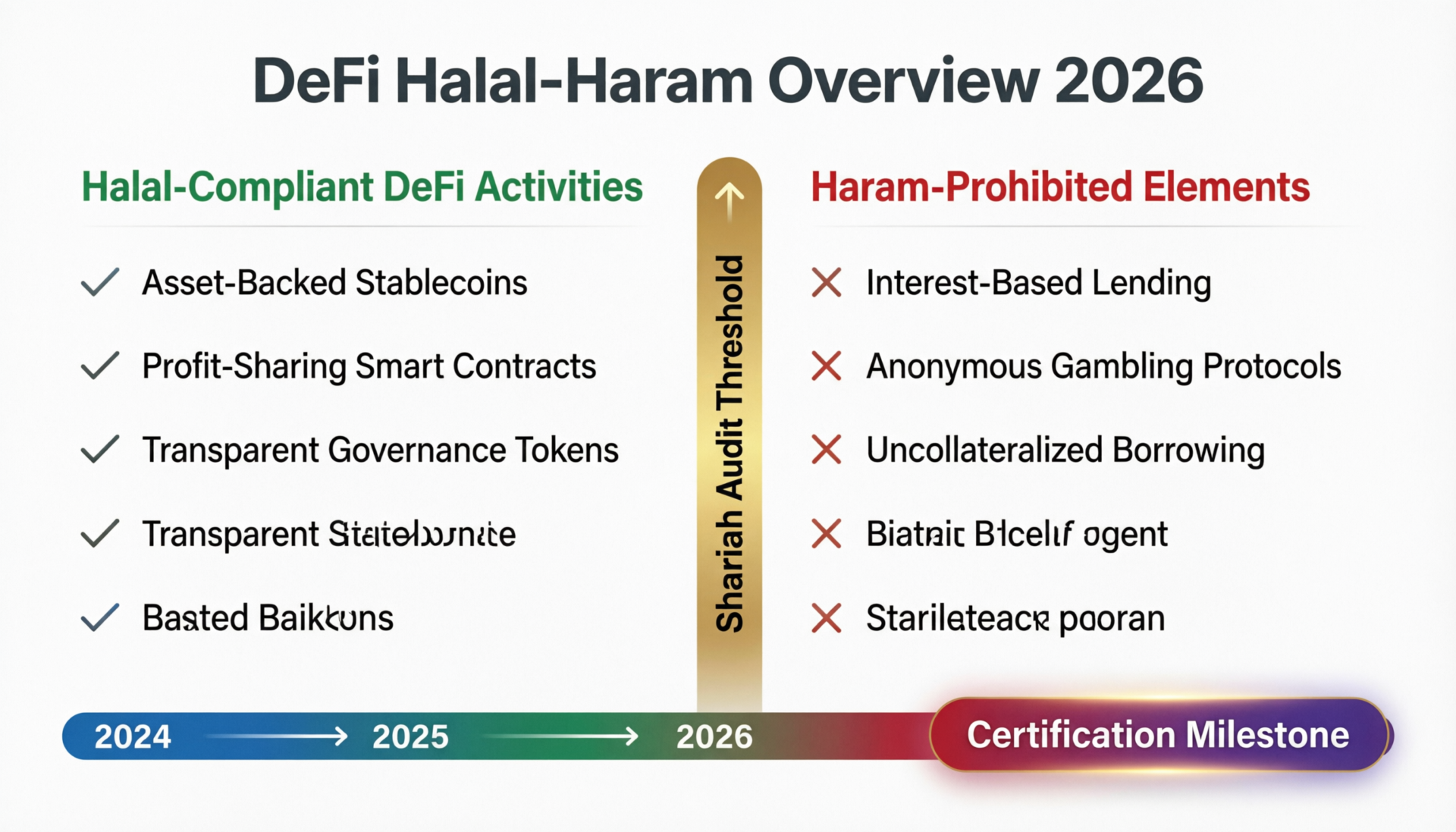
Many DeFi products obviously fall on the haram side, such as:
Interest-based lending protocols with guaranteed yields on pure token loans.
High leverage and perpetual futures that mimic speculative margin trading.
Meme-coin casinos where value is driven by hype and betting on price spikes.
“Degenerate” strategies openly marketed as gambling, lotteries, or “spin-to-win” features.
Even when the smart contract is technically transparent, these structures combine riba, gharar and maysir. High volatility alone is not haram, but when a protocol is designed primarily for short-term speculative gains, the line between investment and gambling becomes blurred.
Grey areas and emerging fatwas on DeFi and crypto
Recent fatwas on crypto show a wide spectrum: from outright prohibitions to conditional permissions on “utility-based” or asset-backed tokens. Some scholars permit limited staking or liquidity provision where.
The underlying token is halal (not representing debt, pornography, alcohol, etc.)
There is genuine risk of loss (no capital guarantee)
Rewards come from fees or real economic activity, not interest on loans.
Local context matters. Scholars in Berlin may weigh European crypto-asset rules differently from scholars in Kuala Lumpur or Istanbul. Always involve local, trusted scholars who understand both Islamic finance and the specific DeFi structure you are considering.
Conditions for a DeFi Platform to Be Sharia-Compliant
A DeFi platform moves closer to being halal when it avoids explicit interest, uses asset-backed or partnership-style models, is transparent in its smart contracts and governance, and is reviewed by credible, independent Sharia scholars. No label or marketing claim alone can guarantee compliance.
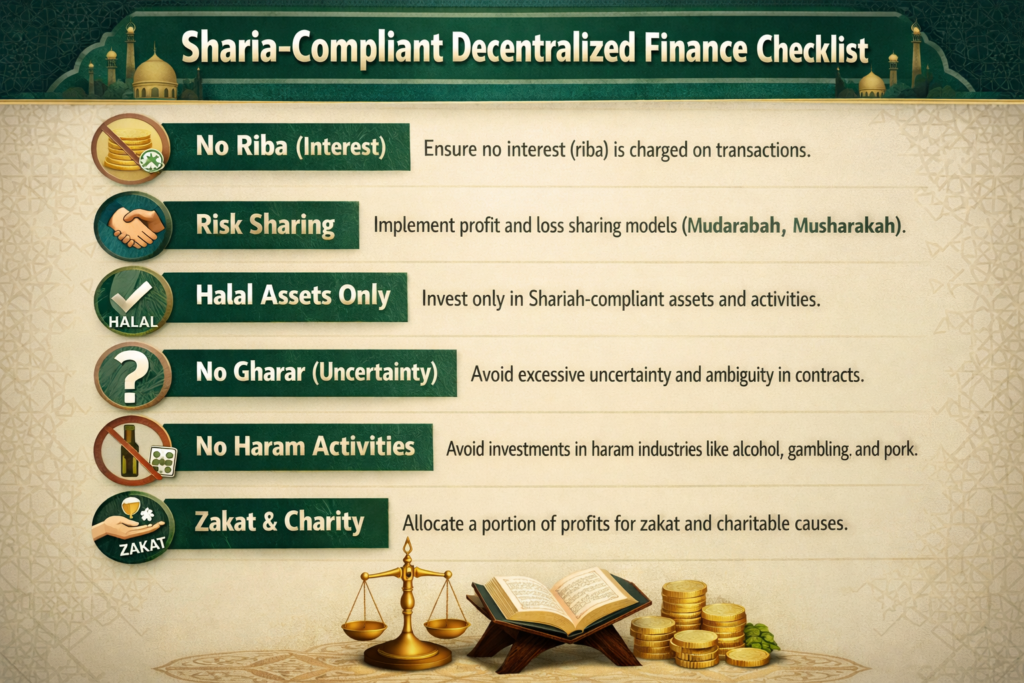
Sharia screening checklist for Muslim DeFi users
Before using any protocol, walk through a simple checklist:
Underlying asset type
Is the token a genuine utility or governance token, or just a speculative meme?
Does it represent haram activities or debt obligations?
Revenue model
Are returns based primarily on interest on loans, or on fees for real services (trading, payments, infrastructure)?
Are rewards structured like gambling (loot boxes, lotteries, random jackpots)?
Contract and risk transparency
Are smart contracts open-source and audited?
Does the documentation explain risks (impermanent loss, liquidation, de-pegs) in plain language?
Governance and ownership
Who controls upgrades and emergency pauses?
Is there meaningful community governance, or one anonymous team with total power?
This type of structured review is similar to how institutional investors screen sukuk and equities using standards from bodies such as the Accounting and Auditing Organization for Islamic Financial Institutions (AAOIFI) and the Islamic Financial Services Board (IFSB)
Role of Sharia boards, standards and independent audits
In Islamic banking, products are typically reviewed by a Sharia board, with ongoing supervision and periodic audits. Islamic DeFi should aim for something similar:
Named, qualified scholars with public bios and track records.
Published Sharia opinions (fatwas) explaining how the structure avoids riba, gharar and maysir.
Ongoing audits, especially after major protocol upgrades.
Clear rules to manage conflicts of interest, e.g., scholars paid by the project but bound by disclosure and independence standards.
As Web3 matures, we are beginning to see attempts to codify “Sharia-compliant decentralised finance” in line with traditional Islamic finance standards.
Islamic DeFi in practice project patterns, not names
There are emerging ecosystems that aim to be Islamic-friendly, such as HAQQ Network, MRHB Network, Sidra Chain and Inshallah.fi. Rather than blindly trusting any “Islamic” badge, look for patterns like:
Riba-free yield models based on fee-sharing or profit-sharing.
Ethical screens excluding haram industries and controversial tokens.
Charity/waqf components, e.g., a portion of protocol revenue going to vetted causes.
On-chain governance and transparent treasury management.
Use specialist media such as Salaam Gateway, FinTech Weekly or IslamicFinance.de to research what the market is saying about these trends; treat everything as input, not as a fatwa.
Halal DeFi Use Cases Across Key Western Markets
Practical scenarios for Muslim investors in North America and the UK
For Muslim users in cities like London, New York City or Toronto, DeFi can potentially support:
Payments and remittances using stablecoins, with instant settlement and lower fees, provided you avoid interest-bearing accounts.
Hedging currency exposure, for example, swapping between dollar and euro-pegged stablecoins in a non-leveraged way.

Access to tokenised halal assets, such as sukuk-like or commodity-backed tokens, where available.
Local tax authority rules (IRS in the US, HMRC in the UK) treat many DeFi activities as taxable events, so “passive income” can become a reporting headache. Muslim community organisations and education platforms like Islamic Finance Guru increasingly publish region-specific guidance that can help you ask better questions to both scholars and tax advisors.
Use cases and constraints in German-speaking and wider EU markets
In Germany and the wider European Union, stricter licensing rules, language fragmentation and smaller Muslim communities in some regions can limit access to Islamic-branded DeFi apps. The EU’s MiCA framework is bringing clearer rules to crypto-asset issuance and service providers, which may help “Sharia-compliant decentralised finance” emerge on more regulated platforms over time.
Supervisors like Federal Financial Supervisory Authority (BaFin) scrutinise whether tokenised products are effectively securities, funds or derivatives. That makes it difficult to launch unregulated “Islamic” protocols that touch retail investors. For many German-speaking Muslims, the realistic path may be.
Using compliant centralised platforms as on-ramps.
Applying strict personal screens (no leverage, no interest-bearing lending).
Focusing on well-documented, utility-driven projects.
Zakat, waqf and ethical social-impact use of DeFi profits
If you do earn Sharia-compliant DeFi profits, you can:
Allocate a portion to zakat once you meet the nisab and one lunar year passes on qualifying assets.
Support waqf and community projects, including health or education services similar in social role to how the National Health Service (NHS) is publicly funded, but via Islamic charitable structures.
Set up recurring donations via stablecoins to trusted charities.
Zakat on liquidity-pool tokens and yield-farming rewards can be complex because values and balances change frequently. High-level principles exist, but you should work with local scholars or Islamic finance advisors who understand both fiqh and crypto accounting.
Regulation, Compliance and Risk in Islamic DeFi
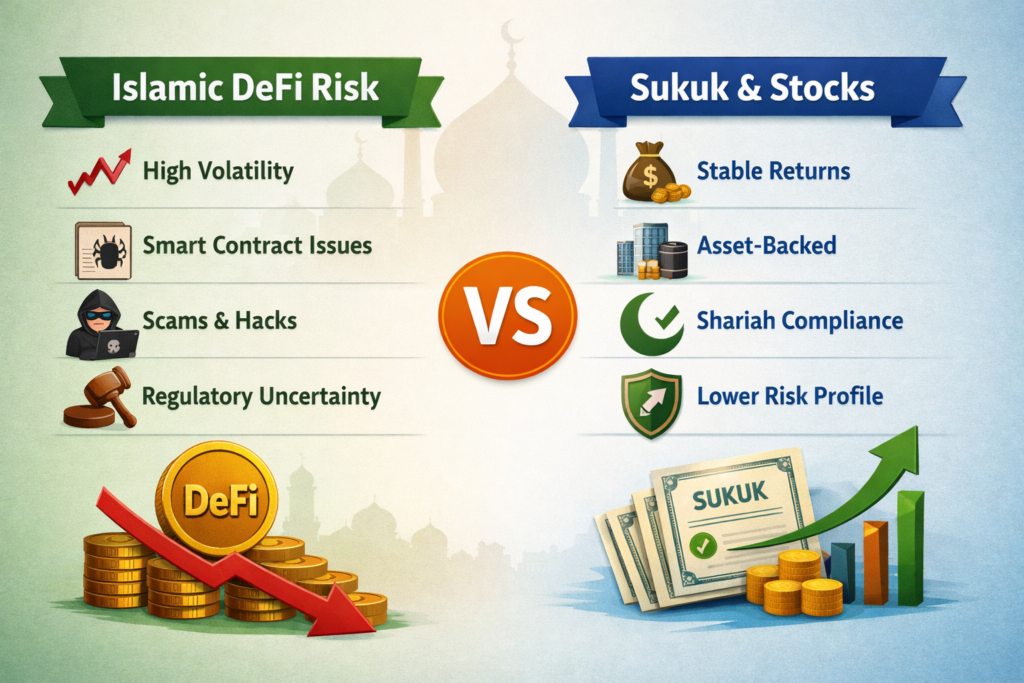
DeFi risk compared with Islamic assets like sukuk and screened stocks
Traditional Islamic assets such as sukuk and Sharia-screened equities usually sit in regulated markets with extensive disclosure. Global Islamic finance assets are estimated in the trillions of dollars and are expected to keep growing strongly this decade.(Standard Chartered Bank)
By contrast, DeFi carries protocol-specific risks:
Smart-contract bugs and exploits.
Stablecoin de-pegs.
Governance attacks and rug pulls.
In 2024 alone, crypto hacks and exploits led to around USD 2.2 billion in losses, with similar levels continuing into 2025.(Chainalysis) Even if a DeFi structure looks halal on paper, extremely high risk and “double or nothing” payoff profiles can start to resemble maysir, particularly when users do not understand the technical risks they are taking.
Navigating regulators, KYC/AML and data-protection rules
Most “Islamic” DeFi apps still sit under secular crypto rules. For example:
In the US, the U.S. Securities and Exchange Commission (SEC) and Financial Crimes Enforcement Network (FinCEN) care about whether your activity is a security or requires KYC/AML, not whether it is Sharia-compliant.
In the UK, the Financial Conduct Authority (FCA) sets rules on promotions, consumer duty and firm authorisation.
In the EU, crypto-asset rules intersect with data-protection frameworks like GDPR and sector-specific security standards for financial services.
Islamic DeFi teams must therefore design protocols that satisfy both religious compliance and regulatory compliance including KYC, AML and data-protection obligations where centralised components exist.
Tax treatment and documentation for halal DeFi profits
Across major Western markets, DeFi income is typically taxed under existing rules for.
Capital gains on disposals of tokens.
Income on yields, airdrops or rewards.
For halal DeFi users this has two implications:
Detailed record-keeping for tax authorities and for zakat.
Understanding when “compensation” for impermanent loss, airdrops or ve-token rewards are actually income events.
IT partners like Mak It Solutions already help clients in cloud and analytics build data pipelines and dashboards for complex, multi-source financial data; similar patterns can be applied to crypto transaction histories so Muslim investors can report and purify income more confidently.(Mak it Solutions)
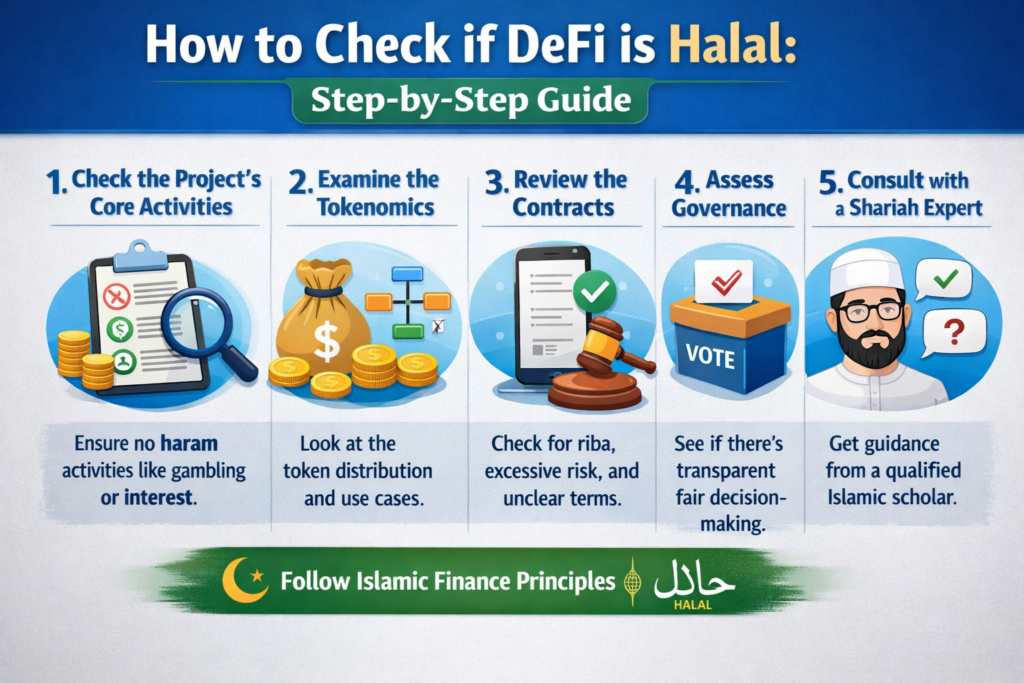
Step-by-Step: How to Check If a DeFi Project Is Halal
To check if a DeFi project is halal, you need to understand what the protocol does, how it makes money and which assets it touches. Then you review any Sharia opinions and audits and avoid platforms with interest-based models, gambling-like designs or opaque, unmanageable risks.
Quick initial screening
Clarify the core function
Is the project mainly about payments, trading, lending, gaming, synthetic assets or something else? Projects focused on simple payments or infrastructure can often be easier to justify than leverage-driven trading casinos.
Map the money flows
Ask: “Who pays, who gets paid, and for what?” If returns are simply “X% APY on deposits” with no clear underlying activity, that’s a red flag. If they come from transparent fees on real services, the structure may be more acceptable.
Traffic-light the use case
Red
Explicit interest, leverage, meme-coin gambling, anonymous teams.
Green
Non-leveraged payments, infrastructure, or asset-backed tokens with strong documentation.
Amber
Complex structures you don’t fully understand—park these until you can consult scholars or specialists.
Deep dive into documentation and Sharia oversight
Study whitepapers and audits
Read the project docs, not just X threads. Look for reputable smart-contract audits, clear risk disclosures and realistic roadmaps. Mak It Solutions’ work with enterprise blockchain in regulated sectors shows that transparency and robust testing are non-negotiable when real money is at stake.(Mak it Solutions)
Verify Sharia scholars and fatwas
If a protocol claims Sharia compliance, check.
Are scholar names given and independently verifiable?
Are their fatwas published, with reasoning?
Do they work with recognised institutions or are they marketing figures with little fiqh background?
Check independence and governance
Finally, review governance documents.
Can insiders override protocol rules at will?
Is there a process for updating Sharia assessments after major changes?
Are conflicts of interest (for founders, investors and scholars) disclosed and managed?
Common red flags that usually signal a haram DeFi product
Be extremely cautious if you see.
Guaranteed fixed returns on token deposits regardless of market conditions.
Aggressive marketing using casino language (“bet,” “spin,” “double or nothing”)
Hidden leverage or synthetic exposure you don’t fully understand.
Completely anonymous teams with no accountability.
Ponzi-like referral schemes where most “yield” comes from new user inflows.
If something feels “too good to be true,” it usually is both financially and Islamically.
Should You Personally Use DeFi as a Muslim?
A simple decision framework based on knowledge and risk appetite
Not every halal-possible activity is wise for every person. A simple framework:
Avoid
If you don’t understand how DeFi works, or you’re prone to FOMO and over-trading.
Observe and learn
If you’re curious, start by learning, using testnets, or tracking Sharia discussions without putting real money at risk.
Cautious use
If you have strong financial literacy, clear personal rules, and access to qualified scholars, you may consider a small allocation to rigorously screened, lower-risk projects.
When it is safer to stay away from DeFi entirely
It is often safer to stay out of DeFi if you.
Are a new Muslim still untangling previous financial commitments.
Already carry high-interest debt.
Find yourself emotionally pulled into high-risk trading or gambling-like behaviour.
In such cases, focusing on simpler halal assets (cash, gold, Islamic funds, screened equities) may better protect your faith and finances.
Next steps: seeking tailored fatwas and professional advice
Because Sharia views on DeFi are still evolving, your next steps should include:
Discussing specific projects with local scholars who understand both fiqh and technology.
Consulting Islamic finance professionals for portfolio-level questions (allocation, diversification, zakat).
Using structured checklists and, where available, screening tools or advisory services to assess Sharia-compliant decentralised finance.
Mak It Solutions can support this journey on the technology side from blockchain solution design to analytics dashboards that help Muslim investors see exactly where their crypto income comes from and how it aligns with their values.(Mak it Solutions)
Key Takeaways
DeFi itself is just technology; the Sharia ruling depends on each project’s economic reality, not its buzzwords.
Most current DeFi lending, leverage and meme-coin products are very likely haram due to riba, excessive uncertainty and gambling-like structures.
A Sharia-compliant DeFi platform needs transparent, asset-backed or partnership-style models, clear risk disclosures and credible, independent Sharia oversight.
Western Muslim investors must factor in local tax, regulatory and data-protection rules alongside Islamic rulings.
Practical halal DeFi screening starts with understanding what a protocol does, how it earns revenue and who guarantees what to whom.
If you are still asking “is DeFi halal or haram for me?”, a cautious or “observe only” stance is sensible until your knowledge, risk discipline and scholarly support are strong.
If you’re exploring DeFi but don’t want to compromise on Sharia or regulatory compliance, Mak It Solutions can help you design the technology foundations: from blockchain architectures to analytics that make your crypto activity fully transparent. Reach out to discuss a tailored workshop or discovery session on Islamic-aligned DeFi, tokenisation or blockchain analytics for your team in the US, UK, Germany or across the EU.( Click Here’s )
FAQs
Q : Is DeFi staking income treated as riba or profit-sharing in Islam?
A : It depends on what is really happening under the hood. If staking is effectively a loan of tokens with a guaranteed return, most scholars will see that as riba and therefore haram. Where staking rewards come from providing a genuine service—such as securing a network or validating transactions and your capital is at risk, some scholars treat it closer to profit-sharing, provided the token and wider structure are halal. You need to analyse each protocol’s mechanics and ideally consult a knowledgeable scholar.
Q : Are DeFi stablecoins halal if they are backed by interest-bearing reserves?
A : Most popular fiat-backed stablecoins hold reserves in bank deposits or short-term interest-bearing instruments. While users are not directly contracting for interest, some scholars argue that benefiting from a token built on riba-based reserves is problematic, while others allow practical use for payments and hedging if you avoid interest-bearing accounts yourself. Asset-backed or commodity-backed stablecoins may be more clearly halal in principle, but you must verify the underlying structures, audits and governance.
Q : Can I use a conventional crypto exchange as an entry point into Islamic DeFi platforms?
A : In many Western markets, regulated centralised exchanges are the main on-ramps into crypto. Using them purely to buy and withdraw halal-screened assets into your own wallet is generally seen as more acceptable than trading speculative derivatives or margin products on the exchange itself. Focus on spot purchases, avoid interest-bearing earn products, and withdraw to self-custody before interacting with any Islamic-oriented DeFi protocols you have screened. Local scholars can clarify how your jurisdiction’s rules and exchange practices affect the ruling.
Q : How should I calculate zakat on liquidity pool tokens and yield-farming rewards?
A : For zakat purposes, many scholars treat liquidity-pool tokens as a mix of the underlying assets plus any accumulated, realised rewards. You typically assess the zakatable value at your zakat due date based on the current market value of your share of the pool plus unspent halal rewards, then apply the standard 2.5% rate if you meet nisab and haul. Because values change quickly and some rewards may be doubtful, it’s wise to maintain detailed records and, where uncertain, purify by giving a cautious extra amount to charity after speaking with a knowledgeable scholar.
Q : Are there Islamic DeFi screening tools or indices that simplify choosing halal projects?
A : A small but growing number of platforms, indices and advisory services are emerging to rate or certify DeFi projects from a Sharia perspective, sometimes linked to networks like HAQQ Network or MRHB Network. These can be useful inputs, but they are not a substitute for your own due diligence or independent fatwas. Treat any rating as a starting point: review the methodology, check who sits on the Sharia board, and confirm whether their views align with the scholars and madhhab you follow. Ultimately, the responsibility for acting on halal information still rests with you.