
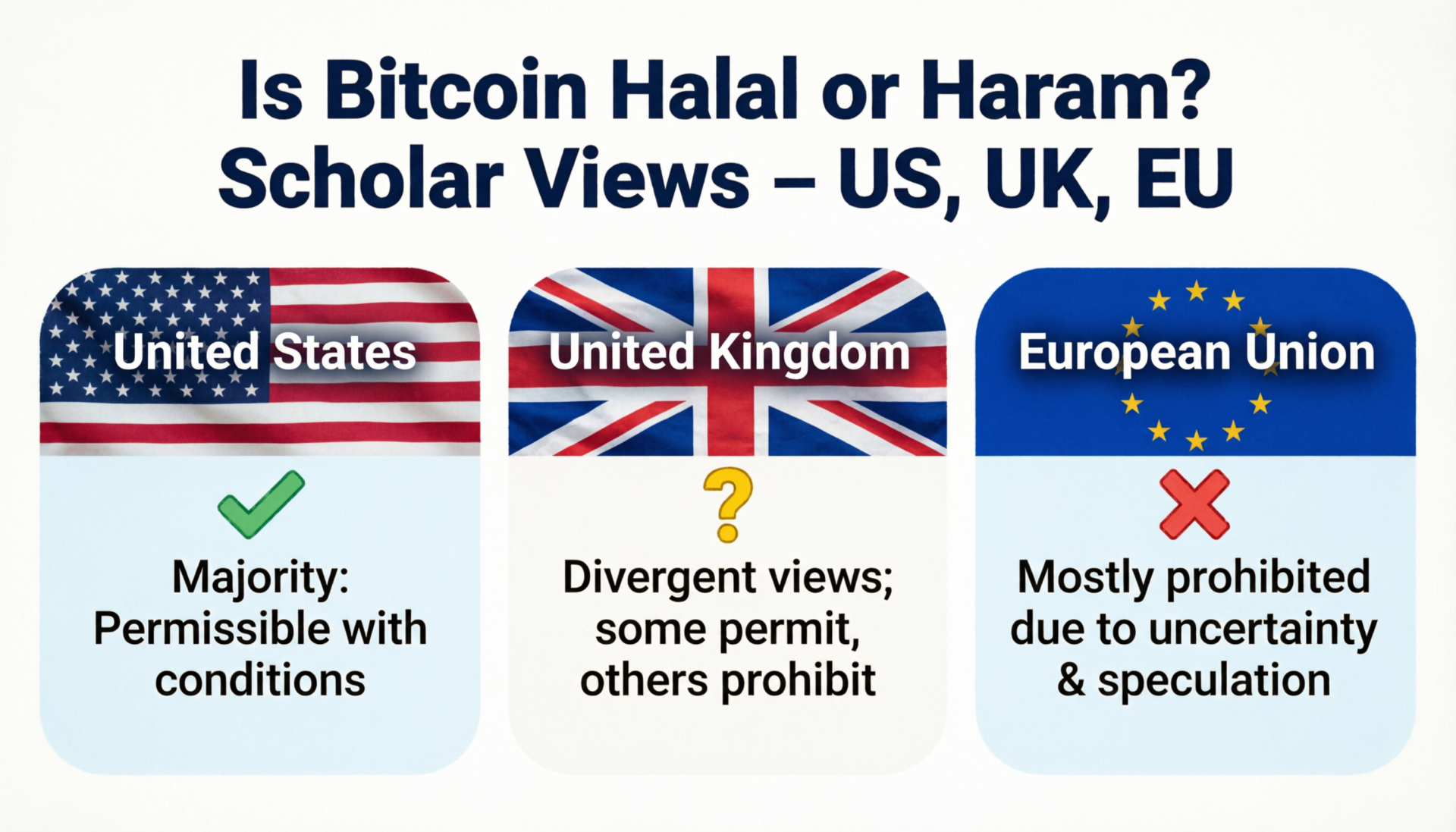

Is Bitcoin Halal or Haram? A Clear Scholar Guide
If you’re asking “is Bitcoin halal or haram?”, the honest answer is: it depends how you use it and which scholar you follow. Most contemporary scholars say Bitcoin is either haram, halal under strict conditions, or at least doubtful (shubuhāt). In practice, Muslims in the United States, United Kingdom, Germany and wider European Union are encouraged to follow a qualified scholar, avoid riba, gambling-style speculation and haram projects, and treat Bitcoin as a high-risk asset, not a guaranteed halal savings plan.
Within that framework, a cautious, spot-only approach using spare money that you can genuinely afford to lose is what many Islamic finance specialists would regard as the “least problematic” way to interact with Bitcoin and other crypto.
Introduction
Islamic scholars are genuinely split on whether Bitcoin is halal, haram, or halal only under strict conditions. Some contemporary muftis and research councils see it as a valid digital asset (māl) that can be used and traded carefully, while others view it as too speculative, too unstable and too tied to gambling-like behaviour to be permissible.
Here’s what this guide will walk you through.
The main fiqh arguments for and against Bitcoin and other cryptocurrencies.
How scholars classify it: money vs digital asset.
Practical trading rules (spot vs leverage, day trading vs long-term holding)
How law and tax in the US, UK, Germany and EU interact with Sharia.
Halal alternatives if you decide crypto isn’t for you.
This article is not a fatwa and not financial advice. It simply organises leading opinions, regulations and risk factors so you can speak to a scholar and a licensed financial adviser in a more informed way.
Quick Answer Is Bitcoin Halal or Haram?
Most contemporary scholars put Bitcoin into three practical buckets: haram, conditionally halal, or doubtful. In all cases, they agree Muslims must avoid riba (interest), high gharar (excessive uncertainty) and maysir/qimār (gambling-like speculation) when dealing with crypto.
Snapshot of Current Scholarly Opinions
Most Islamic opinions on Bitcoin and other cryptocurrencies fall into two main camps:
Haram / too doubtful
Argue that extreme volatility, lack of intrinsic value, gambling-style trading and links to crime mean Bitcoin should be avoided.
Some see it as closer to a betting chip than a real currency or productive investment.
Permissible as digital māl under conditions
Treat Bitcoin as a type of digital property that can be owned, transferred and inherited.
Allow buying/holding it if you avoid interest-based lending, leverage, and clearly haram use cases.
Platforms like Islamic Finance Guru publicly analyse coins and generally treat Bitcoin as a potentially permissible asset, while still warning about high risk.
Because credible scholars exist on both sides, most Muslims are advised to choose a qualified scholar or fiqh council, understand their reasoning, and then stick consistently to that view.
Is Bitcoin Treated as Money or Just a Digital Asset in Sharia?
A key difference between rulings is how Bitcoin is classified.
Māl (valuable property): something people desire, can own, store and benefit from.
Thaman (money): widely accepted as a unit of account, medium of exchange and store of value (like fiat currencies).
Commodity / digital good: tradable but not used as everyday money.
Many modern fiqh discussions say most cryptocurrencies are currently closer to māl or urūḍ (trade goods) than proper money.If Bitcoin is “just” a digital asset, then.
You can buy and sell it like other goods, using normal sale rules.
Zakat often follows the rules of trade inventory or cash (more on this below)
Volatility becomes an issue of risk management and gharar, not an automatic haram label.
Others argue that because Bitcoin is marketed as “digital money” but is extremely volatile and not widely used for everyday payments in cities like New York, London or Berlin, it fails as a stable thaman and should be treated with extra caution.
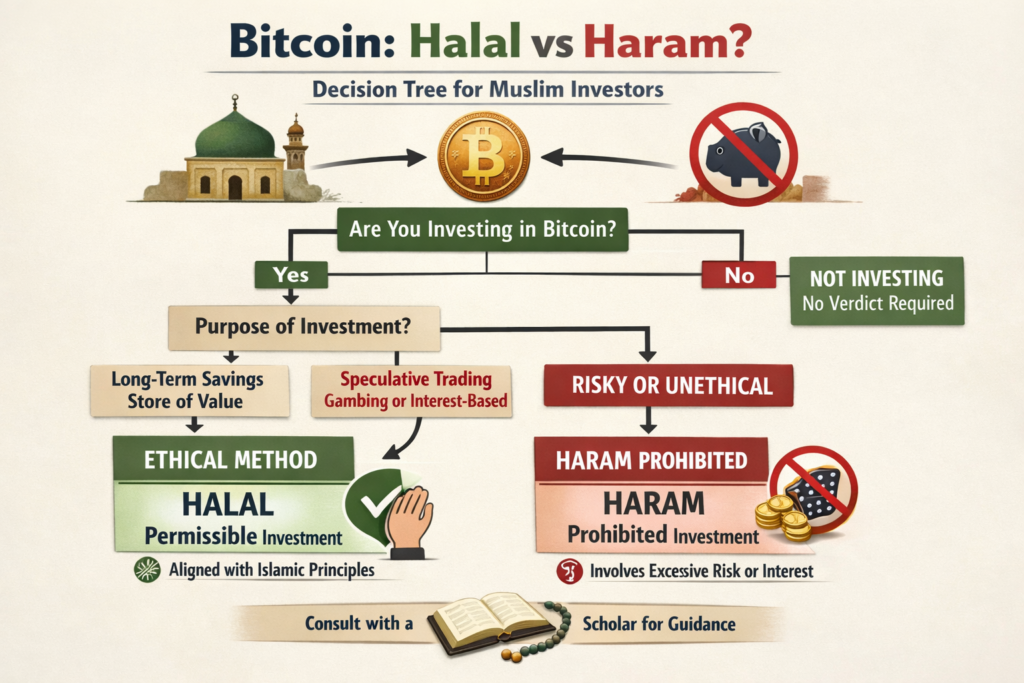
When Should You Personally Treat Bitcoin as Halal, Haram or Doubtful?
A simple decision flow you can use in the US, UK or Europe.
Follow a trusted scholar or council
If your local imam, fiqh council or an online body you trust has given a clear ruling, that is your primary reference.
If opinions differ, check your own heart and risk profile
If you feel uneasy, or your behaviour looks like gambling, many hadiths advise leaving doubtful matters (shubuhāt)
Make niyyah (intention)
Are you investing as part of a balanced, halal financial plan, or chasing pumps you saw on TikTok and X? Intention alone doesn’t make haram halal, but it reveals whether you’re acting responsibly.
How Scholars Analyse Bitcoin in Islamic Fiqh
Key Sharia Principles Applied to Bitcoin
When scholars issue a sharia-compliant cryptocurrency ruling, they usually apply
Riba.
Is there interest, a guaranteed return, or lending with extra payment?
Gharar.
Is the contract excessively uncertain or ambiguous?
Maysir/qimār (gambling)
Is the main motivation “I might double my money tonight”?
Ihtikār (hoarding/manipulation)
Are a few whales manipulating prices and harming small investors?
Maṣlaḥa (public interest)
Does this technology ultimately benefit society or mainly facilitate harm?
They also distinguish between.
Technology (blockchain, smart contracts) usually seen as neutral or even beneficial.
Use cases (trading, DeFi lending, meme coins) where riba, gharar and maysir can appear.
So the Islamic view on digital currencies is not one-size-fits-all: one scholar might be open to blockchain-based sukuk but reject meme coins and high-leverage trading completely.
Islamic View on Digital Currencies and Blockchain Technology
Across research papers and think-tanks, there is growing recognition that blockchain itself can support Islamic finance, for example through transparent smart sukuk and microfinance. Platforms like Blossom Finance have already issued sukuk on blockchain using Sharia-compliant structures.
Universities and centres connected to places such as King’s College London discuss how crypto could expand access to Islamic financial products globally.
The bottom line in many papers.
Blockchain: generally permissible and even promising for transparency and trust.
Specific coins/tokens: need individual sharia screening based on their purpose, structure and economic reality.
Overview of Major Fatawa from Different Regions
A simplified pattern in current opinions.
Middle East & Gulf
Some national fatwa councils and muftis have warned against or banned crypto for retail investors; others allow it as a speculative asset for those who truly understand the risks.
UK & Europe
Independent scholars, boards and Islamic fintechs often treat Bitcoin as potentially halal māl, with strong warnings about volatility and gambling-like trading.
US mosque boards
Often more cautious because of regulatory uncertainty and fear of scams; many simply tell congregants to avoid what they don’t understand.
Because there is no single global Islamic authority on crypto yet, mufti opinions on Bitcoin and crypto remain diverse which is why your personal scholar choice matters so much.
Why Some Scholars Say Bitcoin and Crypto Are Haram
Riba, Gharar and Gambling Concerns in Bitcoin Trading
Scholars who say Bitcoin is haram usually point to three things:
Extreme volatility
Bitcoin can move 10–20% in a single day or more. In 2025, for example, its price at one point exceeded $120,000 after a wave of spot ETF approvals and new US regulations, before later dropping sharply again.
Speculative day trading that resembles gambling
Many retail traders use money they cannot afford to lose, chasing short-term pumps based on rumours, influencers or Telegram groups behaviour that looks very close to maysir in Islamic law.
Interest-based products
Margin accounts, futures and some lending/staking products involve borrowing with interest or unclear risk sharing, raising serious riba and gharar concerns.
For these scholars, riba and gharar in cryptocurrency markets are simply too high for the average Muslim, and the difference between Bitcoin and gambling in Islam becomes more theoretical than practical.
Issues of Intrinsic Value, Volatility and Real-World Utility
Other objections are more conceptual.
Bitcoin has no physical backing and no central issuer guaranteeing value.
In many countries, it is rarely used as actual currency day-to-day; it is mainly held as a speculative asset.
Using something so unstable as your “savings” can undermine family financial security, which conflicts with the Sharia objective of protecting wealth (ḥifẓ al-māl
Combined, these points lead some scholars to say: better to avoid crypto entirely and focus on productive, real-economy investments such as halal stocks, property or businesses.
Sharia Concerns Around Crime, Hacks and Unregulated Platforms
There are also ethics and compliance concerns.
Crypto has been used in money laundering, scams, Ponzi schemes and rug pulls.
Poorly regulated exchanges can suffer hacks or disappear with user funds.
Anonymous meme coins can pump thousands of percent before insiders dump on late buyers.
From a Sharia perspective, mass harm (ḍarar) and systemic injustice can outweigh any individual benefit. Scholars who see crypto as dominated by these harms argue for blanket avoidance, at least until stronger regulation (like EU-wide MiCA-style rules) is fully in place.
Why Other Scholars Allow Bitcoin as a Halal Asset Under Conditions
Treating Bitcoin as Māl (Valuable Property) Instead of Pure Speculation
On the other side, permissive scholars argue.
People clearly desire Bitcoin and pay money for it.
It can be owned, transferred, inherited and stored (for example, in self-custody wallets)
Many treat it as “digital gold” or an alternative store of value.
Recent Islamic finance research increasingly recognises digital assets as legitimate forms of māl, including Bitcoin, so long as they are not inherently tied to haram activity.
So these scholars say in simple terms.
Bitcoin itself is not automatically haram; what matters is how you acquire it, how you trade it, and whether you use it in a halal or haram context.
Conditions Commonly Mentioned for Bitcoin to Be Halal
If you follow scholars who allow Bitcoin, they usually insist on conditions like.
Spot ownership only
Buy with money you already have; actually own the coins (no interest-bearing leverage, futures, or options).
Halal platforms and projects
Use regulated exchanges; avoid coins linked to gambling, pornography, predatory lending or obvious pump-and-dump schemes.
Balanced portfolio
Treat Bitcoin as a small, high-risk slice of your wealth, not your emergency fund or only retirement plan.
Good record-keeping
Track purchases, sales, fees and zakat; declare taxes honestly.
Examples of Pro-Halal Fiqh Analyses and Sharia Boards
Permissive views often come from.
Islamic finance research papers that classify crypto as māl and emphasise maqāṣid al-sharia (protecting wealth, enabling beneficial innovation)
Sharia advisory boards attached to Islamic funds, which may allow limited Bitcoin exposure in professionally managed portfolios.
Independent scholars who publish long papers instead of one-line verdicts, explaining exactly why they see crypto as halal, haram or makruh.
If you want to rely on a permissive opinion, it’s wise to read (or at least skim) the full fatwa, not just a 10-second TikTok summary.
Is Bitcoin Trading Halal or Haram in Practice?
Spot vs Leverage, Futures and Options What’s Halal, What’s Problematic?
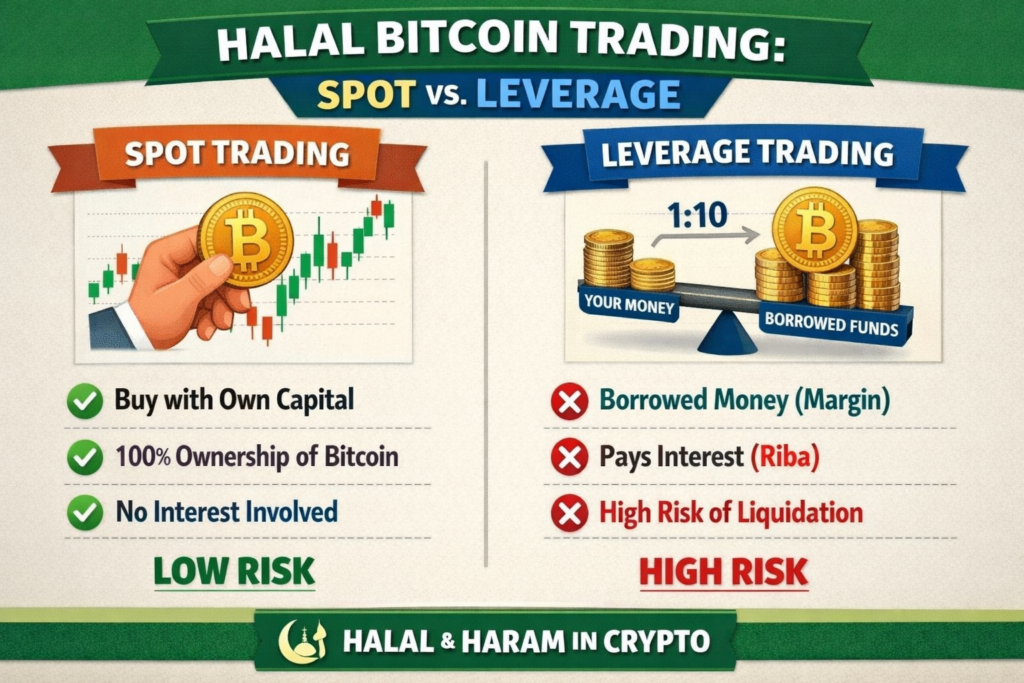
Most scholars who allow Bitcoin insist that only spot trading where you fully own the coins is potentially halal. Margin trading, perpetual futures and complex options are usually seen as haram because they combine riba, excessive gharar and gambling-like risk.
In simple terms.
Potentially halal
Buying Bitcoin with your own cash on a spot market.
Selling it later at a profit or loss.
Generally haram
Borrowing to trade (margin)
Derivatives that mimic betting on price movement without real delivery.
Platforms that pay or charge interest on crypto balances.
If you see words like “100x leverage”, “perps”, “funding rates” or “guaranteed yield”, it is almost certainly not a simple spot trade anymore.
Day Trading vs Long-Term Holding When Does It Become Gambling?
Even on spot markets, behaviour can slide into gambling:
You trade based on emotion and hype, not analysis.
You constantly check prices and can’t sleep when the market is down.
You use money you need for rent, food, pension contributions or family obligations.
You scalp tiny movements with no clear plan, just chasing dopamine hits.
If that sounds familiar, your trading may be closer to maysir than investment, regardless of what any fatwa says. A calmer, long-term approach using small amounts of truly spare capital is closer to the Islamic ideal of responsible wealth management.
Choosing Halal-Friendly Crypto Platforms in US, UK and Germany
For Muslims in the US, UK, Germany and EU, think about.
Regulation and licensing
In the UK, look for exchanges registered with Financial Conduct Authority.
In Germany, check if the platform is supervised by BaFin, including under EU MiCA/MiCAR rules.
No forced interest or leverage
Ability to disable margin, futures and “earn” products.
Transparency and security
Clear terms on how your coins are stored, whether they’re lent out, and what happens if the exchange fails.
You might also prefer platforms that invest in strong security controls, SOC 2-style reports and PCI DSS-like safeguards, and that are open about GDPR/DSGVO and UK-GDPR compliance especially if you ever connect your crypto activity to a fintech app you build or use.
Law, Tax and Compliance in the US, UK, Germany and Europe
Does the Legal Status of Bitcoin Make It More or Less Halal?
Many scholars say that legal recognition supports permissibility but doesn’t guarantee it. If a government treats Bitcoin as lawful property or a regulated asset, this strengthens its case as valid māl but if you still earn interest or gamble on it, that remains haram.
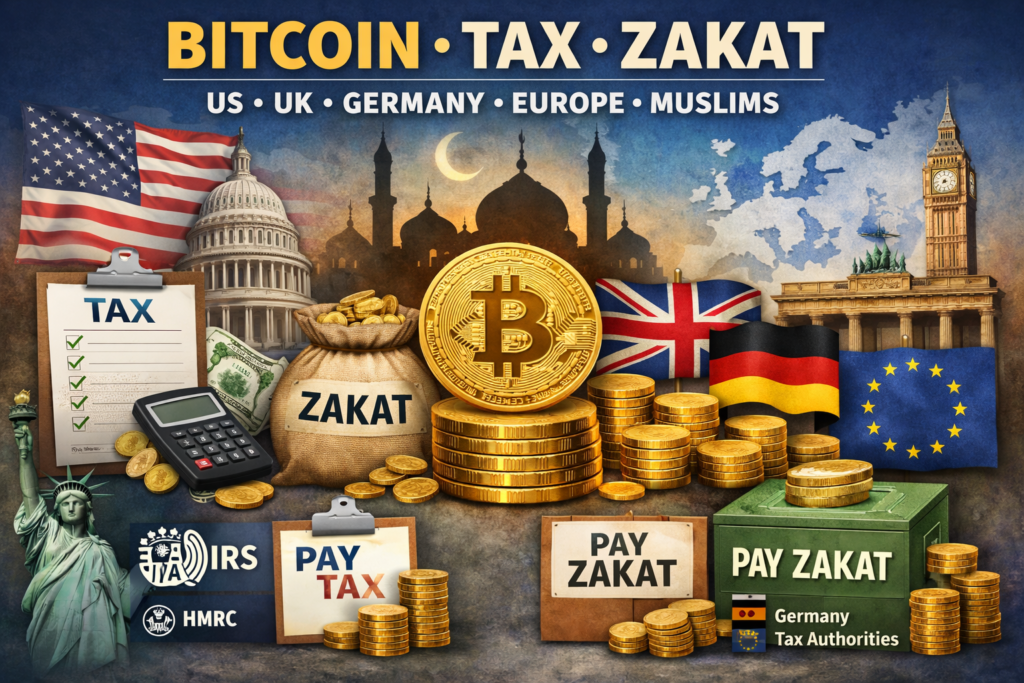
In the US, the Internal Revenue Service (IRS) treats virtual currencies and other digital assets as property for tax purposes, not as foreign currency.
In the UK, HM Revenue & Customs (HMRC) generally applies capital gains tax rules when individuals dispose of cryptoassets.
In Germany and across the EU, new rules under the Markets in Crypto-Assets framework classify many crypto assets as regulated financial instruments, with service providers needing authorisation and facing transparency requirements.
From a Sharia angle, respecting local law (qānūn) is itself an obligation as long as it doesn’t force you into haram. So paying your due tax on crypto is part of staying halal.
Tax Treatment for Muslims in the US, UK, Germany and the EU
Very briefly (always confirm live rules or speak to a tax professional)
US
Crypto is taxed like property; selling, swapping or spending it can trigger capital gains or losses.
UK
Most individuals face capital gains tax when they dispose of crypto; some income tax cases (e.g., mining, certain staking) also apply.
Germany/EU
Germany has specific rules on private sales of crypto and designates BaFin as regulator under MiCA; there may be reliefs or exemptions for long-term holding, but details are complex and change over time.
Tax evasion is clearly haram. Whether you are a software engineer in Berlin or an NHS clinician in the UK weighing Bitcoin vs your pension, reporting crypto honestly is part of your Islamic duty.
Zakat on Bitcoin and Crypto Assets in the US, UK and Europe
Many scholars treat Bitcoin and liquid crypto (that you can easily sell) as zakatable wealth similar to cash or trade inventory. Studies on crypto and zakat suggest that if your holdings.
Reach or exceed the nisab (threshold, often benchmarked to gold or silver).
Are held for one lunar year (ḥawl)
…then you pay around 2.5% of their value in zakat each year.
Questions still debated include.
Which wallets to count (cold storage vs trading accounts)
How to value assets on the zakat date (daily close price, monthly average, etc.)
Here, Muslims in the US, UK and Europe should follow local scholars or trusted international bodies specialising in Islamic finance and zakat.
Halal Alternatives to Bitcoin and How to Decide What’s Right for You
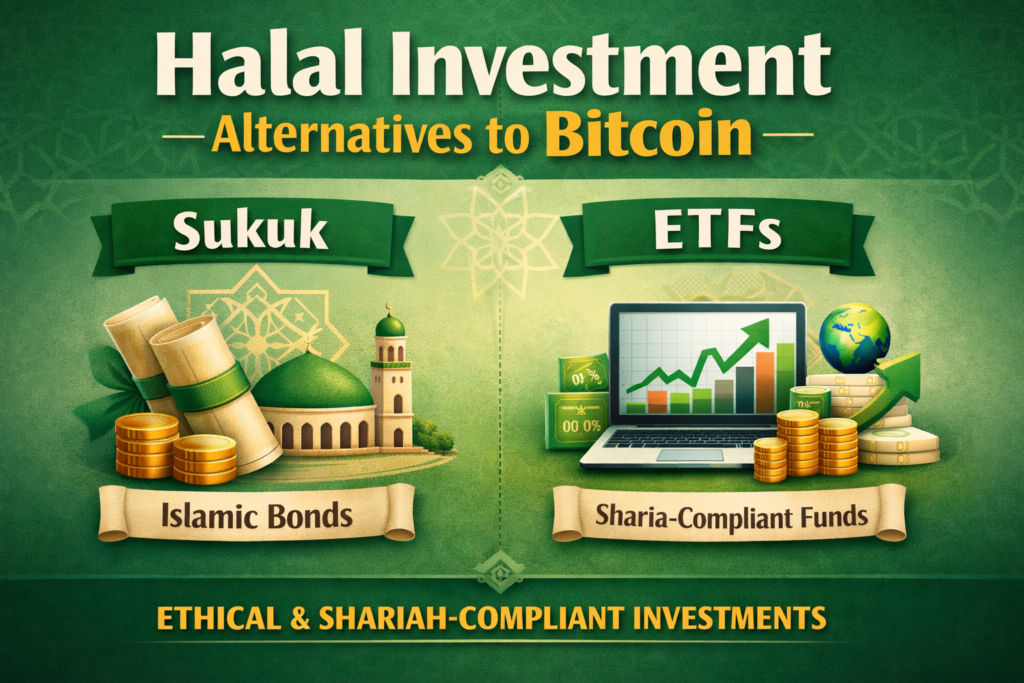
Halal Investment Alternatives to Bitcoin
If you decide crypto is not for you or you only want a very small allocation there are many halal alternatives.
Sharia-compliant equity funds screened against interest, gambling, alcohol, etc.
Sukuk (Islamic bonds), including innovative blockchain-based sukuk projects.
Halal ETFs and robo-advisors that screen global markets.
Islamic savings accounts and Takaful-style protection products.
In the US and UK, Islamic fintech platforms now offer robo-advisors and portfolios tailored to Muslims. In Germany and the wider EU, BaFin-approved Islamic funds are slowly growing as an alternative to speculative crypto.
When Bitcoin Might Suit You vs When to Avoid It Completely
Bitcoin might be more suitable if.
You have no high-interest debt, your zakat and family obligations are covered, and you accept high volatility.
You’re a younger investor with time to recover losses and you treat Bitcoin as a small, speculative slice of a diversified, halal portfolio.
You might avoid it completely if:
You are a cautious saver, close to retirement, or a busy professional (for example an NHS doctor) with limited time to research and monitor risk.
You feel persistent doubt or fear that your behaviour is drifting into gambling.
Practical Checklist Before You Buy Any Bitcoin
Before buying even a small amount of Bitcoin, walk through this checklist.
Scholar consultation.
Which specific scholar or fiqh council are you following on crypto?
Financial planner.
Does a qualified, licensed adviser think this fits your risk profile and goals?
Platform due diligence
Regulated in your country?
No mandatory leverage or interest-bearing products?
Clear, GDPR/DSGVO and UK-GDPR-aware privacy policy?
No leverage, no debt.
Never borrow to invest; never use rent or emergency savings.
Zakat and tax tracking.
Decide your zakat date now; log every trade for future tax returns (IRS, HMRC, local tax authority)
Written plan.
Note your maximum allocation, time horizon and exit rules. If you can’t write it down in a page, you probably don’t understand it well enough.
Key Takeaways
Scholars are genuinely divided: some forbid Bitcoin, others allow it as digital māl under conditions.
The core Sharia issues are riba, gharar, maysir and public harm; blockchain technology itself can be beneficial.
If you engage with crypto, stick to spot trading, avoid leverage and interest, and treat it as high-risk.
Law, tax and zakat matter: being compliant with IRS, HMRC, BaFin and EU rules is part of staying halal.
There are plenty of halal investment alternatives if you prefer to avoid crypto entirely.
How to Keep Learning and Stay Within Halal Boundaries
This field is evolving quickly: regulations like EU MiCA, US tax guidance and new Islamic finance research keep shifting the landscape. Following reputable Islamic finance bodies, academic centres and specialist platforms can help you review your position every year.
If you do choose to invest in Bitcoin or other crypto, approach it with taqwa, knowledge and humility and be ready to step back if you feel it is pulling your heart towards greed or gambling.
Disclaimer.
This article is for general education only. It is not a fatwa, investment advice or tax advice. Always consult a qualified scholar and a regulated financial professional before making decisions.
If you’re building or scaling a halal-friendly fintech, trading platform or investment app, Mak It Solutions can help you design secure, compliant and GDPR-aware architecture around crypto and digital assets. From web development and mobile apps to cloud, BI and security, our team already supports clients across the US, UK, Germany and wider EU.
Explore our services at Mak It Solutions, or reach out to discuss how we can help you build a platform that respects both regulation and Sharia principles.( Click Here’s )
FAQs
Q : Is buying a small amount of Bitcoin just to “try it out” considered gambling in Islam?
A : Buying a tiny amount of Bitcoin to learn how wallets and exchanges work is not automatically gambling, but your intention and behaviour matter. If you understand that you can lose everything, use genuinely spare money, and don’t start chasing quick profits, it looks more like learning and high-risk investing. If you’re secretly hoping to “flip it overnight” or feel addicted to price movements, many scholars would see that as drifting into maysir/qimār, which is haram.
Q : Can I keep my emergency savings in Bitcoin instead of cash from an Islamic perspective?
A : Most scholars and Islamic financial planners strongly discourage using Bitcoin as an emergency fund. Emergency savings should be low-risk and easily accessible; Bitcoin is highly volatile and could drop sharply just when you need the money. From a Sharia perspective, protecting your dependants and being able to pay rent, food and medical bills is a priority, so crypto usually belongs if at all in your high-risk, non-essential investment bucket, not your safety net.
Q : Is staking or earning yield on crypto always haram, or are there Sharia-compliant structures?
A : Many common staking, lending and “earn” products are problematic because they involve interest-like returns, unclear risk sharing or lending to unknown borrowers. However, there is active research into Sharia-compliant profit-sharing models using blockchain, for example smart sukuk and tokenised mudarabah structures. The ruling depends on the exact contract: how risk is shared, what assets are financed, and whether returns are genuinely linked to real economic activity. You should get a fatwa on the specific product, not just the marketing label.
Q : How do Islamic scholars view meme coins and highly speculative altcoins compared to Bitcoin?
A : Even scholars who are relatively open to Bitcoin are often much harsher on meme coins and ultra-speculative altcoins. Many of these tokens have no clear utility, tiny teams, anonymous founders and marketing that openly encourages gambling-like behaviour. From an Islamic point of view, this combines excessive gharar, maysir and potential deception, making them far harder to justify than a more established asset with real liquidity and use cases. If you already find Bitcoin borderline, meme coins are usually far beyond the line.
Q : Do I have to pay zakat every year on long-term Bitcoin holdings if the price keeps changing?
A : Most contemporary zakat discussions say yes: if your crypto holdings stay above the nisab for a full lunar year, you pay zakat annually, even if the price has moved up and down in between. Many people value their holdings at the market price on their chosen zakat date each year, then pay about 2.5% of that amount. Because crypto is volatile, some scholars allow averaging prices over a short period to avoid big swings, but you should follow the specific method recommended by your local scholar or zakat body.