


Inside the Dubai Web3 Startup Ecosystem (2026 Guide)
Dubai’s Web3 startup ecosystem combines specialist crypto regulators (VARA and ADGM), founder-friendly corporate tax (including 0% on qualifying free-zone income) and dense hubs like DMCC, DIFC and Hub71. For US, UK and EU founders, that mix makes the Dubai Web3 startup ecosystem one of the most realistic places to relocate, license and scale Web3 businesses while still serving global markets.
Introduction
In one line, Dubai’s Web3 startup ecosystem mixes clear virtual-asset regulation, low or zero tax in key free zones, and dense hubs such as DMCC, DIFC and Hub71 that make it a serious relocation option for US, UK and EU founders.
Over the last few years the UAE has branded itself as the “Crypto Oasis”, and the numbers back it up: the wider UAE blockchain ecosystem passed roughly 2,040 active organisations and 10,600 professionals by Q1 2024. This isn’t just retail trading; it includes infrastructure, DeFi, exchanges, tokenisation, gaming and enterprise blockchain.
This guide is written for founders and investors in New York, San Francisco, London, Berlin, Frankfurt and across the EU who keep hearing “everyone is moving to Dubai” and want a precise answer to two questions:
Should we plug into Dubai at all?
If yes, how do we do it without blowing up SEC/FCA/BaFin, MiCA or GDPR obligations at home?
By the end, you’ll have a realistic view of hubs and licenses, tax and data residency, plus a practical expansion playbook you can actually execute.
Dubai Web3 Startup Ecosystem in 2025–2026: The Snapshot
From ‘Crypto Oasis’ to Global Web3 Hub Status
Dubai’s Web3 startup ecosystem is the combination of free zones (DMCC, DIFC, Dubai Silicon Oasis and others), regulators (VARA, SCA, ADGM, DIFC), infrastructure (cloud, banking, corporate services) and community platforms such as Crypto Oasis and Dubai AI & Web3 Campus. Crypto Oasis alone tracks more than 2,000 Web3-adjacent organisations across the UAE, making it one of the fastest-growing blockchain ecosystems globally.
What makes Dubai attractive versus other hubs is the mix of:
A dedicated Virtual Assets Regulatory Authority (VARA) for most of Dubai
A separate ADGM framework in Abu Dhabi with its own digital-asset rulebook
Free-zone corporate tax regimes that can offer 0% on qualifying income for properly structured entities
Purpose-built clusters like DMCC Crypto Centre, DIFC Innovation Hub and the Dubai AI & Web3 Campus, targeting hundreds of AI/Web3 companies by 2028
In plain English: Dubai gives you a real regulator to speak to, somewhere to sit, and a community that already understands your playbook.
Who This Guide Is For (US, UK, German/EU Founders & Investors)
This guide is designed for.
US founders operating Delaware C-Corps from New York, Miami or the Bay Area who are running into SEC/CFTC risk.
London-based fintechs and FCA-authorised firms exploring a Dubai booking centre or Web3 spin-out.
Berlin/Frankfurt and wider EU teams who will live under BaFin, ESMA and MiCA but want a more flexible Web3 sandbox.
European family offices (Zurich, Paris, Amsterdam, Nordics) looking at UAE Web3 exposure via funds, venture studios or direct investments.
Typical questions we hear.
How risky is it to add a Dubai entity on top of existing SEC/FCA/BaFin oversight?
Which licenses do we actually need (if any) for infra, DeFi, custody or NFTs?
What are realistic timelines and costs for a VARA or ADGM license?
Can we keep engineering in London/Berlin and put compliance/commercial in Dubai?
We’ll address each of these explicitly as we go.
Quick Pros and Cons.
Upsides
Regulatory clarity
Dedicated virtual-asset regulators (VARA, ADGM FSRA) with public rulebooks instead of pure enforcement-by-headline.
Speed to decision
Licensing paths with defined phases vs open-ended “no-action” limbo.
Tax
0% corporate tax on qualifying free-zone income and 9% headline rate otherwise, still attractive against many US/EU jurisdictions.
Ecosystem density
Crypto Oasis networks, DMCC Crypto Centre events and DMCC/Bybit Web3 hackathons.
Talent attraction
Visas and lifestyle that appeal to founders from London, Berlin, Zurich and beyond.
Trade-offs
Distance & time zones from US HQs.
Dual-compliance load (for SEC/FCA/BaFin/MiCA + VARA/ADGM).
Different risk culture around marketing, promotions and retail access.
Banking & substance expectations you’re meant to be really in Dubai, not just a brass plate.
High-level verdicts
US teams should seriously consider Dubai if they are Web3-native, global by design, and already feeling constrained by uncertain US policy.
UK firms should look at Dubai/DIFC as a complementary hub when they need wider GCC access and are comfortable with dual FCA + VARA/DIFC supervision.
EU/German founders should treat Dubai as a specialised Web3 and GCC go-to-market hub layered on top of MiCA-compliant entities in Berlin/Frankfurt, Paris or Amsterdam.
Key Web3 Hubs and Free Zones in Dubai and the Wider UAE
DMCC Crypto Centre, DIFC Innovation Hub and Dubai’s Main Web3 Districts
Founders often ask: “Where exactly do Web3 people sit in Dubai?” In practice, most end up in:
DMCC Crypto Centre (JLT) very strong for exchanges, trading firms, infrastructure and service providers clustering around Crypto Oasis.
DIFC Innovation Hub & Dubai AI & Web3 Campus (DIFC) ideal for fintech/Web3, tokenisation, institutional DeFi and anything that needs an eventual financial-services license.
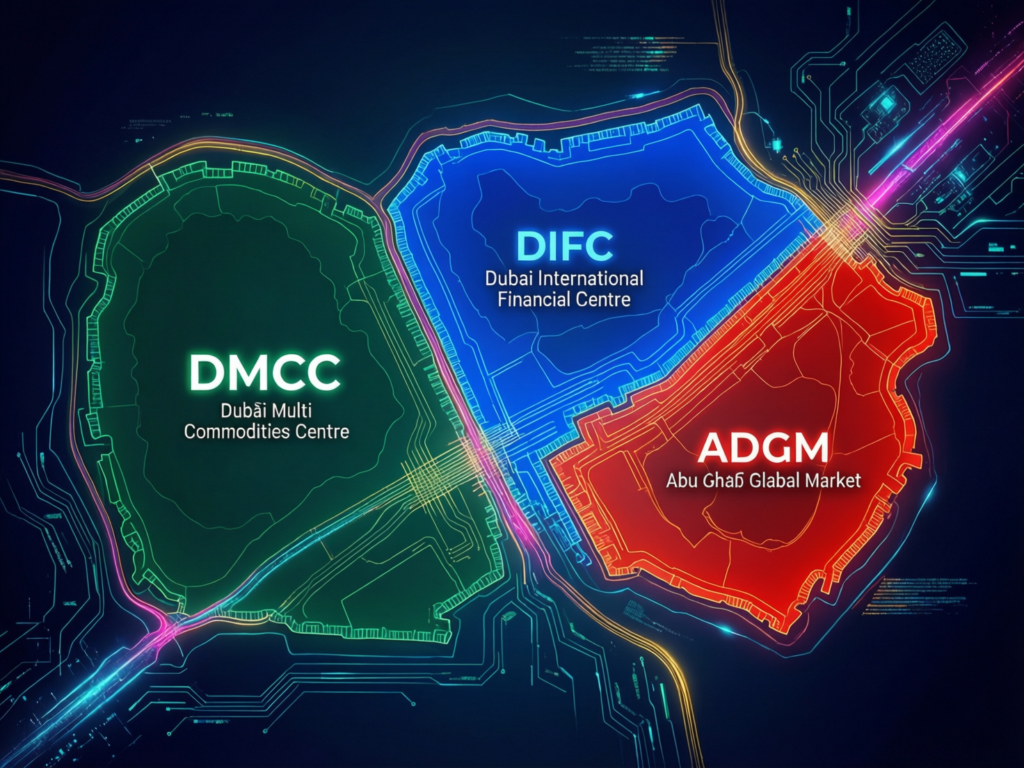
Dubai Internet City / Dubai Silicon Oasis better for pure tech/product, gaming, tooling and SaaS with optional Web3 rails.
If you’re a New York or San Francisco exchange, DMCC + VARA is usually the first stop. A London fintech eyeing tokenised deposits might lean towards DIFC. A Berlin gaming studio experimenting with NFTs and on-chain assets can be perfectly happy in Dubai Internet City while keeping a regulated EU payments entity at home.
ADGM, Hub71 and Other UAE Crypto Hubs Beyond Dubai
For some projects, Abu Dhabi is a better fit than Dubai.
Abu Dhabi Global Market (ADGM) on Al Maryah Island has its own Financial Services Regulatory Authority (FSRA) and a mature digital-asset framework used by several major global players. ([en.adgm.thomsonreuters.com][3]) Hub71 and its Hub71+ Digital Assets programme sit on top of this, offering incentives, capital access and a curated Web3 cohort with more than 300 startups and about USD 2.1B in funding raised by the community in 2024.
You typically choose ADGM over VARA/DIFC if.
You’re building institutional or capital-markets infrastructure.
You want an FSRA licence that maps neatly to other common-law regulators.
Your investors (often from Zurich or London) prefer an ADGM court system and English-law comfort.
Matching the Right Free Zone to Your Use Case
So which free zone is “best” for your Web3 startup? Roughly.
CeFi exchanges, custodians, brokers
DMCC + VARA, or ADGM/FSRA, depending on your target markets and risk appetite.
DeFi protocols and infra projects
DMCC for entity + developers in Dubai Internet City/Silicon Oasis; ADGM/DIFC only if you’re interfacing heavily with regulated institutions.
NFT/gaming, creator and metaverse projects
Dubai Internet City / Dubai Silicon Oasis; layer in VARA/ADGM only if you cross into exchange/custody territory.
For many UK Web3 startups, DMCC or DIFC Innovation Hub is the sweet spot. For US exchanges, DMCC or ADGM is more common. For German fintechs, DIFC or ADGM typically feel most culturally familiar thanks to the EU-style prudential approach.
Regulation, Licensing and VARA for Crypto Startups
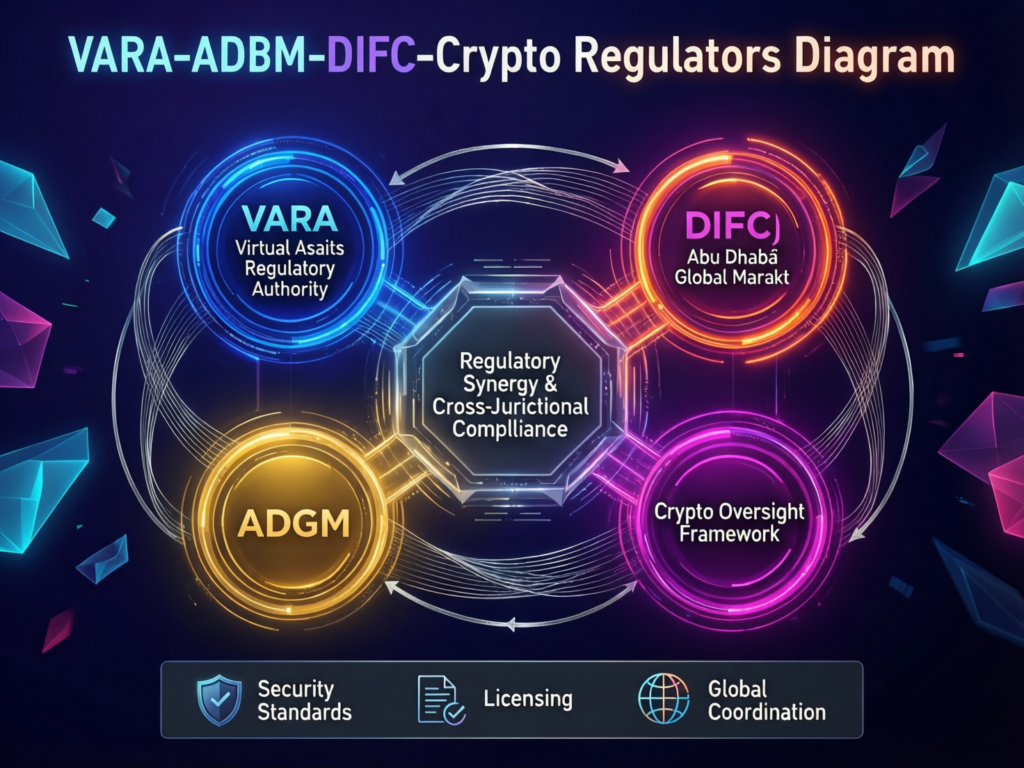
Who Regulates Virtual Assets in Dubai and the UAE?
Yes, crypto is legal in the UAE but it’s heavily regulated and split across several authorities.
VARA is the dedicated virtual-assets regulator for most of Dubai’s mainland and free zones, excluding DIFC.
The Securities and Commodities Authority (SCA) regulates securities and virtual assets at federal level, outside VARA/ADGM/DIFC pockets.
ADGM FSRA and DIFC each operate their own digital-asset frameworks within their financial free zones.
All of them implement FATF standards, including the Travel Rule, robust KYC/AML, sanctions screening and detailed marketing requirements.
In other words: you can build crypto products here, but you’re expected to behave like a financial institution from day one.
Which Licenses Do Web3 & Crypto Startups Actually Need?
Licensing depends on what you actually do, not what you call yourself. Common categories under VARA/ADGM/DIFC include:
Exchange / multilateral trading facility (MTF)
Broker-dealer / dealing in investments as agent/principal
Custody and safekeeping
Portfolio management and advisory
Payments, remittance and stablecoin issuance
Infrastructure, dev shops and pure tooling often fall outside full VASP licensing but still need appropriate commercial licences and careful legal analysis. Exchange/custody/token-issuer models almost always trigger regulated activity.
Mini-FAQ by home market.
US-based exchanges expect to life-cycle off-shore activity into a Dubai/Abu Dhabi entity with full VARA or ADGM authorisation while still managing US exposure (state MSB, money-transmitter, SEC/CFTC analysis).
UK FCA-regulated firms can add a DIFC or VARA-licensed entity, but should map permissions cleanly and plan for group-level risk/compliance coordination.
BaFin/MiCA-regulated EU entities usually retain an EU investment-firm or e-money licence, then add UAE entities for non-EU markets, making sure MiCA passporting and reverse-solicitation rules are respected.
For a deeper UAE-specific comparison, pair this guide with Mak It Solutions’ dedicated walkthrough on cryptocurrency regulation in UAE for GCC founders.
Timelines, Costs and Pitfalls of the Dubai VARA Crypto License
At a high level, VARA licenses typically move through four stages:
Initial scoping and in-principle approval.
Detailed application, governance and policies.
Conditional approval and build-out of local “substance” (offices, staff).
Full licence once conditions and testing are complete.
Indicative ranges (heavily dependent on your model; always.
Timeline: roughly 6–18 months from first engagement to full licence.
Costs: often mid-six figures (USD/EUR) for serious exchanges once you add legal, advisory, internal compliance, capital and tech tooling.
Frequent pitfalls.
Underestimating local board, risk and compliance expectations.
Ignoring Travel Rule and sanctions tooling until late in the process.
Treating Dubai as a “light touch” jurisdiction and re-using lax policies from other offshore centres.
If you’ve never built regulated infra before, you’ll want partners that understand both VARA/ADGM and global DevSecOps, SOC 2, PCI DSS and similar standards areas Mak It Solutions regularly covers in its DevSecOps best practices guide for US & Europe.
Tax, Residency and Cross-Border Compliance for US, UK and EU Teams
Corporate Tax, Personal Tax and ‘Zero-Tax’ Narratives in the UAE
The “zero-tax Dubai” meme is outdated. The UAE now has a federal corporate tax:
0% on taxable income up to AED 375,000 and on qualifying free-zone income.
9% on income above that threshold and on non-qualifying free-zone income.
A 15% minimum top-up tax for very large multinationals is also being implemented.
Founders from New York, London or Berlin still need to think about:
US
CFC/Subpart F, GILTI and global intangible income rules.
UK
Worldwide taxation for UK-domiciled individuals plus anti-avoidance rules.
Germany/EU
CFC and substance rules under ATAD, as well as local anti-abuse provisions.
Dubai can materially reduce corporate tax on non-US/EU business, but it doesn’t magically erase your home-country rules especially for founders and investors who remain tax-resident in the US, UK or EU.
Important.
Nothing in this guide is legal, tax or investment advice. Always get qualified advice in each relevant jurisdiction before executing.
Staying Compliant with SEC, FCA, BaFin, MiCA and GDPR While in Dubai
A Dubai licence does not replace home-market supervision. If you are already under:
SEC/CFTC in the US,
FCA in the UK, or
BaFin/ESMA/MiCA in the EU,
you’ll often face dual supervision for global products, especially if you touch US/UK/EU clients.
On top of financial regulators, you still need to meet sectoral and cross-cutting standards:
GDPR/DSGVO and UK-GDPR for EU/UK data subjects.
HIPAA (for US health-data overlaps like NHS pilots or insurance), PCI DSS and SOC 2 for sensitive financial and health data.
Mak It Solutions’ work on carbon-neutral cloud architectures and multi-cloud strategy in the Middle East provides practical patterns for meeting these obligations while still hosting parts of your stack in UAE regions.
Data Hosting, Open Banking and Cross-Border Architectures
For many London and Frankfurt-born Web3 startups, the real constraint isn’t trading it’s data.
Patterns that work well in practice.
Keep regulated EU/UK customer data (banking, NHS-related, open-banking/PSD2) in EU/UK clouds; share only derived or minimised datasets into UAE.
Use regional clouds (AWS, Azure, GCP) and local GCC providers to meet both GCC and EU data-residency expectations.
Implement strict data-mapping, DPO oversight and cross-border transfer assessments aligned with GDPR and UK-GDPR guidance.
GDPR doesn’t stop you from running a Dubai-based crypto startup, but it forces you to design data flows and hosting locations intentionally rather than by accident.
Funding, Talent and Community in Dubai’s Web3 Scene
VCs, Funds and Ecosystem Capital in Dubai and Abu Dhabi
The UAE Web3 capital stack blends:
Regional VC funds with Web3 theses, often anchored in Dubai or ADGM.
Family offices from the Gulf, Zurich and London allocating to digital assets.
Ecosystem vehicles tied to DMCC, DIFC and Hub71 programmes.
Ticket sizes range from early-stage cheques for gaming/DeFi protocols to larger growth rounds for infrastructure plays. Compared to New York or London, cheque volume may be smaller, but competition for high-quality Web3 deals is also less intense which can be an advantage if you already have traction.
Talent, Visas and Building Your Core Team on the Ground
Dubai’s selling point is how quickly you can get key people into the country. The UAE continues to expand golden visas, talent visas and founder-friendly residence categories for technology and Web3 entrepreneurs.
Most teams end up with a hybrid model.
Senior leadership, risk, compliance and BD in Dubai or Abu Dhabi.
Product and engineering retained in London, Berlin, Warsaw, Lisbon or remote-first hubs.
Specialist analytics and infra work distributed globally exactly the kind of pattern Mak It Solutions supports across unstructured data analytics for US, UK and EU enterprises.
Accelerators, Meetups and Hackathons to Plug Into Fast
If you land in Dubai tomorrow and want to meet other Web3 founders and investors in your first 30 days, you’ll want:
Hub71 and Hub71+ Digital Assets cohorts in Abu Dhabi.
DIFC Innovation Hub events, especially around the Dubai AI & Web3 Festival.
DMCC Crypto Centre meetups, demo days and Web3 Unleashed hackathons with partners like Bybit.
Show up, listen first, and you’ll quickly find the counsel, service providers and early hires you need.
Dubai vs Global Web3 Hubs.
Dubai vs London, New York and Berlin
Compared to New York, London and Berlin, Dubai.
Offers more explicit rulebooks and dedicated authorities (VARA, ADGM) rather than high-profile enforcement followed by slow guidance.
Trades some depth of capital markets for faster licensing and clearer token-rules.
Provides excellent time-zone coverage across Europe, Africa and Asia, making it a strong global HQ for teams with users in both London and Singapore.
If you’re purely EU/UK-focused and already MiCA-ready, Berlin or London may still be your primary regulatory home. If you’re global or rest-of-world-heavy, Dubai can be the more pragmatic base.
Dubai vs Singapore and Other Low-Tax Crypto Hubs
Singapore remains the key comparator, along with other centres like Hong Kong or certain Caribbean jurisdictions.
Where Singapore wins.
Deep institutional capital markets and asset-management ecosystem.
Proximity to North Asian liquidity and markets.
Where Dubai is now stronger for many Web3 teams:
Faster, clearer build-out of AI and Web3 clusters (Dubai AI & Web3 Campus)
A larger regional “Crypto Oasis” narrative spanning the entire UAE.
Easier base for serving both Europe and Asia from one location.
Best Country to Start a Web3 Company in 2026?
There is no single “best” country only the best fit for your risk profile and markets. A simple scorecard:
Regulation & clarity
UAE (Dubai/Abu Dhabi), Singapore, then selected EU countries under MiCA.
Tax & incentives
UAE free zones and some Asian jurisdictions.
Capital access
US, UK, Singapore, increasingly UAE.
Talent & lifestyle
Dubai/Singapore for relocation; London/Berlin/Amsterdam for deep technical hiring.
So is Dubai really the best place to start a Web3 company in 2026? If your focus is global markets beyond the US and EU, with serious licensing and a founder-friendly tax regime, Dubai and Abu Dhabi belong on any short-list—and for many teams will be the most balanced option.
Practical Expansion Playbook for US, UK and EU Web3 Founders
From First Scouting Trip to Licensed Entity
Here’s a pragmatic “how-to” you can follow from New York, London or Berlin.
Scouting trip (Week 0–2)
Visit DMCC, DIFC, ADGM/Hub71; attend at least one DMCC or DIFC event.
Shortlist your free zone (Week 2–4)
Map your use case (exchange, DeFi, gaming, infra) against DMCC, DIFC and ADGM options.
Engage legal and compliance counsel (Month 1–2)
Choose firms with proven VARA/ADGM files and SEC/FCA/BaFin literacy.
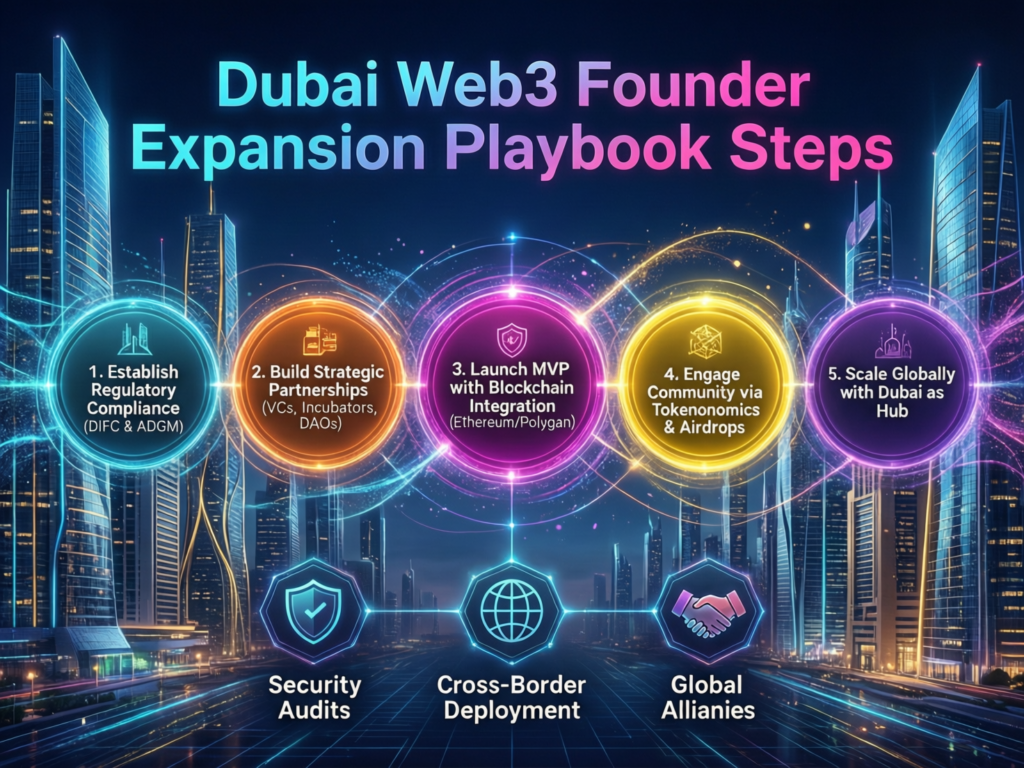
Design group structure and data architecture (Month 2–3)
Separate EU/UK regulated entities from UAE rest-of-world entities; lock in GDPR-compatible hosting using patterns like those in Mak It Solutions’ data analytics and BI for the Middle East.
Apply for commercial and (if needed) VASP licences (Month 3–9+)
Start with the free-zone company, then progress into VARA/ADGM licensing stages.
Build substance and launch (Month 6–18)
Hire core team locally, roll out compliant infra using modern stacks (SSR/SSG and AI tooling as covered in Mak It Solutions’ Server-Side Rendering vs Static Generation guide).
Variants.
US Delaware C-Corp → DMCC/DIFC/ADGM keep Delaware parent, add UAE subsidiaries for non-US operations, strictly separate US-facing flows.
UK FCA firm → Dubai presence build a DIFC/VARA entity as regional hub, maintain UK regulatory core and consolidated risk oversight.
BaFin/MiCA EU entity → UAE use EU entity as MiCA anchor, UAE as GCC + RoW booking centre with carefully designed group policies and resolution playbooks.
Choosing the Right Local Partners (Law, Compliance, Banking, Infrastructure)
You’ll need four main partner types.
Law firms / regulatory advisors VARA/ADGM track record, deep understanding of your specific business model.
Compliance / KYC vendors Travel Rule and sanctions tooling, GDPR-aware data processing, multi-region coverage.
Banks and payment partners ideally with both UAE presence and corridors into the US, UK and EU.
Cloud/infrastructure partners comfortable running multi-cloud, multi-region architectures like those in Mak It Solutions’ AWS vs Azure vs Google Cloud comparison.
Evaluate them on.
Closed-book examples of past licences and audits.
Familiarity with SEC/FCA/BaFin and MiCA language, not just UAE regulations.
Operational maturity: SLAs, incident response, documentation.
When Dubai Is (and Isn’t) the Right Move.
You’re probably ready to expand into Dubai if you can tick:
Real product-market fit (beyond a token listing spike).
At least 18–24 months runway or funding in sight.
A leadership team prepared to relocate or spend serious time in the UAE.
A compliance mindset that treats UAE regulators as partners, not obstacles.
It might be too early if you’re still at pre-product stage, heavily US-retail focused, or viewing Dubai as a way to dodge all regulation.
For US, UK and EU founders, the cleanest way to expand is to keep your home-market entity fully compliant, then add a Dubai/Abu Dhabi hub with clear scoping, regional focus and documented group-level governance.
Key Takeaways
Dubai and Abu Dhabi together form a 2,000+ company “Crypto Oasis” with dedicated Web3 hubs like DMCC Crypto Centre, DIFC Innovation Hub and Hub71.
VARA, ADGM and DIFC provide clearer virtual-asset rules than many US and EU jurisdictions, but expect bank-grade KYC/AML, Travel Rule and marketing compliance.
UAE corporate tax is now 0%/9% with free-zone incentives not a no-rules tax haven and interacts with US, UK and EU anti-avoidance regimes.
Funding, visas and community programmes (DMCC hackathons, Hub71+, Dubai AI & Web3 Festival) make it feasible to relocate key leadership while keeping engineering distributed.
A structured playbook from scouting trip to licence application lets US, UK and EU founders plug into the Dubai Web3 startup ecosystem without breaking SEC, FCA, BaFin or GDPR rules.
If you’re seriously weighing Dubai or Abu Dhabi for your Web3 startup, your next step isn’t another Twitter thread it’s a concrete, region-aware plan. Mak It Solutions can help you map regulation, cloud, data and engineering into a single expansion architecture tailored to your US, UK or EU obligations.
Share your current structure, target markets and rough roadmap, and request a scoped advisory session to stress-test whether Dubai is the right move and if it is, how to get from “interest” to a licensed, live entity without losing sleep (or regulators) ( Click Here’s )
FAQs
Q : Can I run a Dubai Web3 startup and still serve US customers without a US license?
A : You can operate a Dubai or Abu Dhabi-based Web3 entity and still have US users, but you can’t assume a UAE licence replaces US rules. If your product touches US residents or companies, you may still trigger SEC, CFTC, FinCEN or state money-transmitter obligations, especially for exchanges, derivatives and yield products. Many teams ring-fence US clients (geo-blocking, separate entities, stricter KYC) and treat Dubai as their non-US hub. Always get specialist US counsel to map your exact flows.
Q : Do UK residents pay tax on crypto gains earned through a Dubai-based startup?
A : Generally, UK tax is based on residence and domicile, not where your startup sits. A UK-resident founder can still owe UK tax on salary, dividends or carried interest from a Dubai entity, and UK anti-avoidance rules can look through offshore structures if they mainly hold UK-connected value. A Dubai free-zone company can reduce corporate tax on non-UK business, but it doesn’t automatically make your personal crypto gains tax-free. Coordinate UAE and UK tax advisors before moving yourself or your cap table.
Q : What’s the difference between setting up in DMCC, DIFC and ADGM for a crypto company?
A : DMCC is a commercial free zone with a strong Crypto Centre and a large cluster of trading, exchange and services firms, usually regulated by VARA for virtual-asset activity. DIFC is a financial free zone with its own regulator and innovation licences, good for fintech and institutional Web3 plays. ADGM is another financial free zone in Abu Dhabi with a mature digital-asset framework run by the FSRA, attractive for institutional exchanges and capital-markets infrastructure. The right choice depends on whether you are more retail-trading, B2B infra or institutional finance.
Q : How much internal compliance resourcing does a Dubai-licensed Web3 startup realistically need?
A : For any serious exchange, broker or custodian you should plan for at least one senior compliance head on the ground, plus 2–5 FTEs across AML, monitoring, reporting and ops within the first 12–24 months. Larger or higher-risk models may need full-time MLROs, sanctions specialists and internal audit capacity. Expect to budget for third-party KYC, Travel Rule, transaction-monitoring and sanctions-screening tools as well. Treat this like building a regulated financial institution lean but real not a side function.
Q : Is it better to move my whole founding team to Dubai or keep product and engineering in Europe/US?
A : Most high-performing teams choose a hybrid model: C-suite, risk and BD in Dubai/Abu Dhabi; product and engineering largely in Europe or the US where talent pools are deepest. That gives you regulatory intimacy and regional presence without disrupting existing engineering hubs in London, Berlin, Lisbon or New York. Over time you can add a UAE engineering pod for latency-sensitive or confidential work, especially once you’ve stabilised licensing and capital. The key is aligning leadership travel, governance and time zones so both halves of the company stay in sync.