

How to Store Crypto Safely in UAE Securely
Storing crypto safely in the UAE comes down to one smart habit: do not mix convenience with long-term storage. For most people in Dubai, Abu Dhabi, or Sharjah, the safest approach is to use a regulated, UAE-friendly platform for buying and selling, then move longer-term holdings to a wallet you control. VARA maintains a public register for licensed or in-principle-approved providers in Dubai, while ADGM/FSRA and DFSA oversee separate parts of the UAE market.
A simple answer works best here: keep only your trading balance on an exchange, and store larger Bitcoin, Ethereum, or stablecoin holdings in self-custody with proper backups. That setup gives you access, liquidity, and better protection against exchange risk, phishing, and account compromise.
Crypto adoption is high enough in the UAE that security is no longer a niche concern. Triple-A estimated more than 560 million crypto owners globally in 2024, with UAE ownership around 24.4%. At the same time, the FBI said crypto-related investment fraud losses topped $6.5 billion in 2024, and Chainalysis estimated roughly $17 billion stolen through crypto scams and fraud in 2025.
How to Store Crypto Safely in UAE.
For most UAE residents, the safest setup is a layered one.
Use a regulated or clearly supervised platform for AED deposits, buying, and selling
Keep only short-term or trading balances on exchange
Move long-term holdings to self-custody
Back up your seed phrase offline in secure locations
Use app-based 2FA, not just passwords or SMS where possible
That is the most practical balance between usability and control. It works well for beginners, long-term investors, and even many active traders who want cleaner risk separation.
The safest setup for most UAE residents
If you are just getting started, open one trusted exchange account, secure it properly, and link it only to the bank account you actually use. Then create a personal wallet for savings. Once your balance becomes meaningful, a hardware wallet is usually the better choice.
This matters even more in the UAE, where adoption is strong and the local market is more mature than many people realize. In practice, a hybrid setup is safer than leaving everything on a single app.
When to use exchange custody, a mobile wallet, or a hardware wallet
Use exchange custody for.
Active trading
Recurring buys
Quick conversion to and from AED
Small temporary balances
Use a mobile wallet for
Smaller amounts you may need regularly
Day-to-day transfers
Learning self-custody before moving to hardware
Use a hardware wallet for.
Medium to large balances
Long-term Bitcoin or Ethereum holdings
Funds you would not want exposed to browser or app-based attacks
Understand Your Crypto Storage Options in UAE
The main difference in crypto storage is simple: who controls the keys? If the platform controls them, you are using custodial storage. If you control them, you are using self-custody.
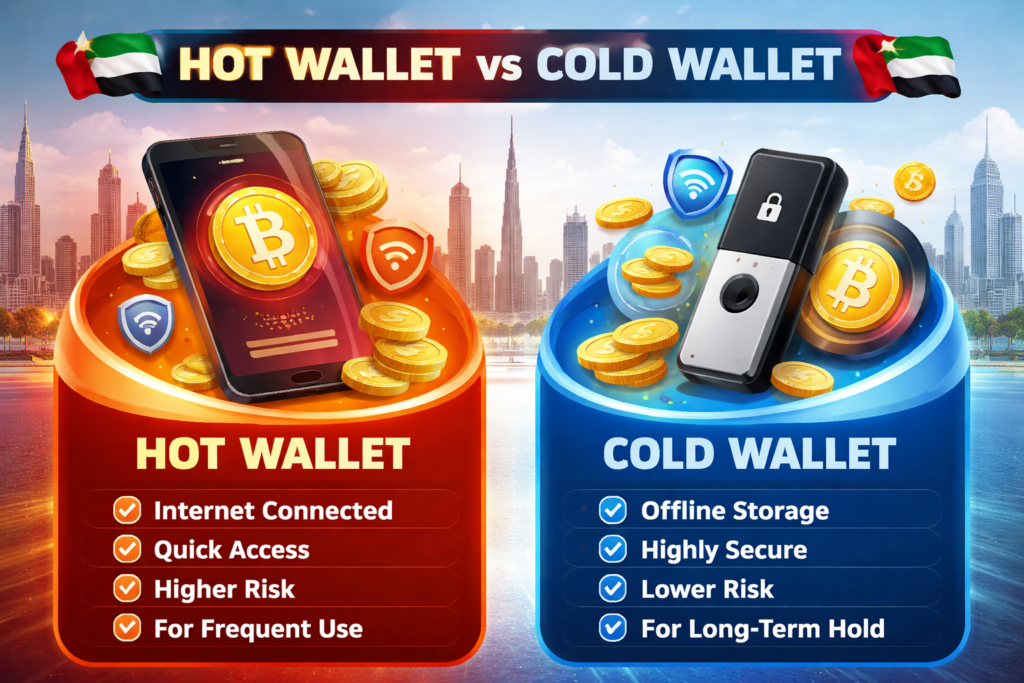
Hot wallet vs cold wallet UAE.
A hot wallet is connected to the internet. It is faster and easier to use, but also more exposed to phishing, malware, malicious approvals, and browser-based drains.
A cold wallet keeps signing activity offline, which reduces the attack surface. That is why cold storage is usually the better fit for long-term holdings and larger balances.
For most UAE users, the real question is not “hot or cold?” It is “how much of my crypto should stay online at all?”
Self-custody crypto UAE.
Self-custody gives you direct control over your recovery phrase and private keys. That is powerful, but it also means the responsibility is yours. Lose the seed phrase, and there is often no reset option. Store it badly, and a scammer may not need access to your phone or exchange account to empty the wallet.
Exchange custody is easier, but it means you depend on the platform’s controls, solvency, withdrawal policies, and operations.
Exchange custody vs personal wallet for Bitcoin and altcoins
For Bitcoin, the argument for self-custody is especially strong if you are holding for years instead of weeks.
For altcoins and stablecoins, storage is not just about the wallet. It is also about network selection. Sending an asset over the wrong chain can still cause permanent loss, so your wallet setup should always match the network you intend to use.
Best Crypto Wallet Setup in UAE by User Type
The best crypto wallet setup in UAE depends more on behavior than brand.
For beginners
Start with.
One regulated exchange account
One secure mobile wallet
Strong unique passwords
Authenticator-based 2FA
A written checklist before every withdrawal
That is enough for most people to build safer habits without getting overwhelmed.
For active traders
Active traders may keep more on exchange than long-term holders, but profits and idle balances should still be swept out regularly. Convenience is useful. Concentration risk is not.
For long-term holders
Long-term holders should lean toward.
A hardware wallet
Offline seed phrase backups
A passphrase where appropriate
Documented recovery steps
Periodic permission reviews for connected apps
High-balance users, family offices, and founders may also want multi-signature setups with approval separation. That can make sense for UAE-based businesses, London-connected households, or Germany-linked teams that care about access controls and governance. GDPR remains relevant for EU users handling personal data through exchanges, KYC vendors, or service providers.
For broader digital security thinking, see Mak It Solutions’ guides on remote work security policy, DevSecOps in the Middle East, and incident response planning.
Use Regulated Platforms Before Moving to Self-Custody
Regulation does not remove risk, but it does improve your starting point.
VARA says its public register lists firms that are fully licensed or hold in-principle approval in Dubai. ADGM/FSRA provides its own virtual asset framework in Abu Dhabi, and DFSA applies a separate crypto token regime in DIFC, including rule changes that took effect on January 12, 2026.
What VARA, ADGM/FSRA, and DFSA mean in practice
“Regulated in the UAE” is not one single label.
VARA covers Dubai mainland and many Dubai free zones, but not DIFC
ADGM/FSRA governs virtual asset activity in Abu Dhabi’s ADGM
DFSA regulates crypto-token-related activity in DIFC
So before using any platform, check which regime applies and whether the provider appears on the relevant official register or framework.
What to look for in a UAE-friendly exchange
Choose a platform with.
Visible licensing or registration signals
Clear KYC and withdrawal policies
Strong account security controls
Transparent support and compliance processes
Workable AED deposit and withdrawal options
RAKBANK’s crypto brokerage flow is one example of how local AED integration can make funding and withdrawals more straightforward for eligible users.
For businesses building secure fintech and mobile products, Mak It Solutions also offers mobile app development services, business intelligence services, and broader services.
How to Move Crypto Safely from a UAE Exchange to a Wallet
Most avoidable losses happen during transfer, not storage.
Use this pre-transfer checklist
Before sending crypto out of an exchange.
Verify the wallet address carefully
Confirm the exact network
Review withdrawal fees and minimums
Send a small test transaction
Confirm it arrives before sending the full amount
That one habit saves people from a surprising number of irreversible mistakes.
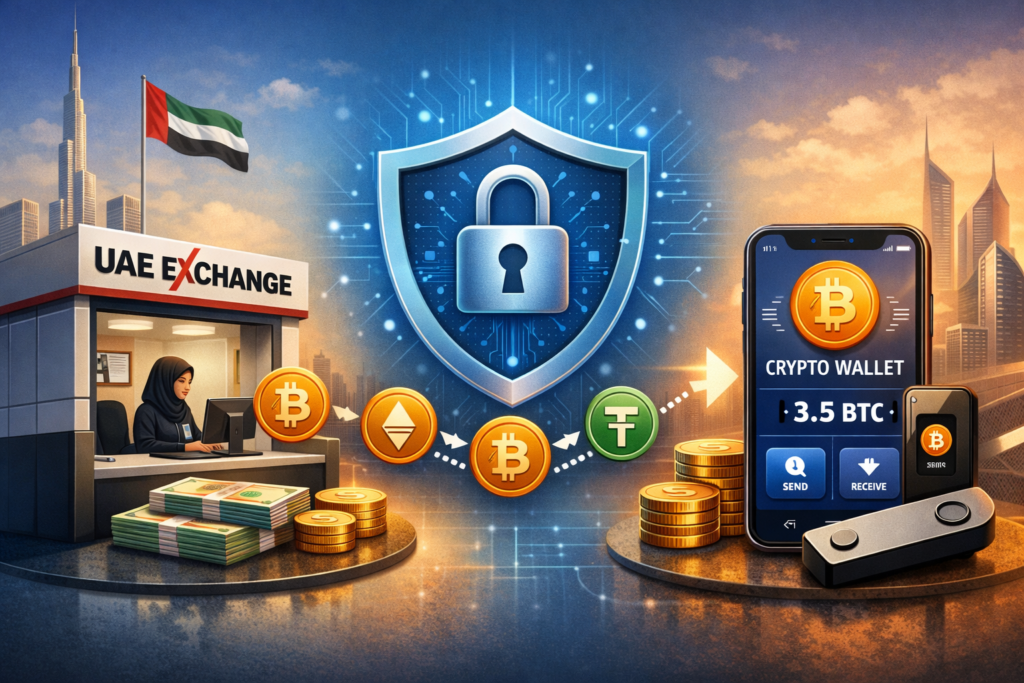
The safest way to move crypto to cold storage
Set up the wallet on a clean device. Update firmware. Write your seed phrase offline. Then verify the receiving address on the wallet’s own screen, not just on your computer or phone.
Once the test transaction is confirmed, move the remaining balance. Save the transaction ID for your records, but never store your seed phrase in screenshots, email, or cloud notes.
AED-linked workflows need recordkeeping too
If you fund crypto purchases in AED, keep your KYC details current and make sure your bank and exchange records line up. In regulated environments, larger transfers may trigger source-of-funds or verification checks. That is normal, and clean records make those conversations much easier. Emirates NBD, for example, highlights KYC updates as part of secure verification.
Seed Phrase Backup, Device Security, and Scam Prevention in UAE
Seed phrase security is the center of self-custody. If someone gets the phrase, they usually get the assets.
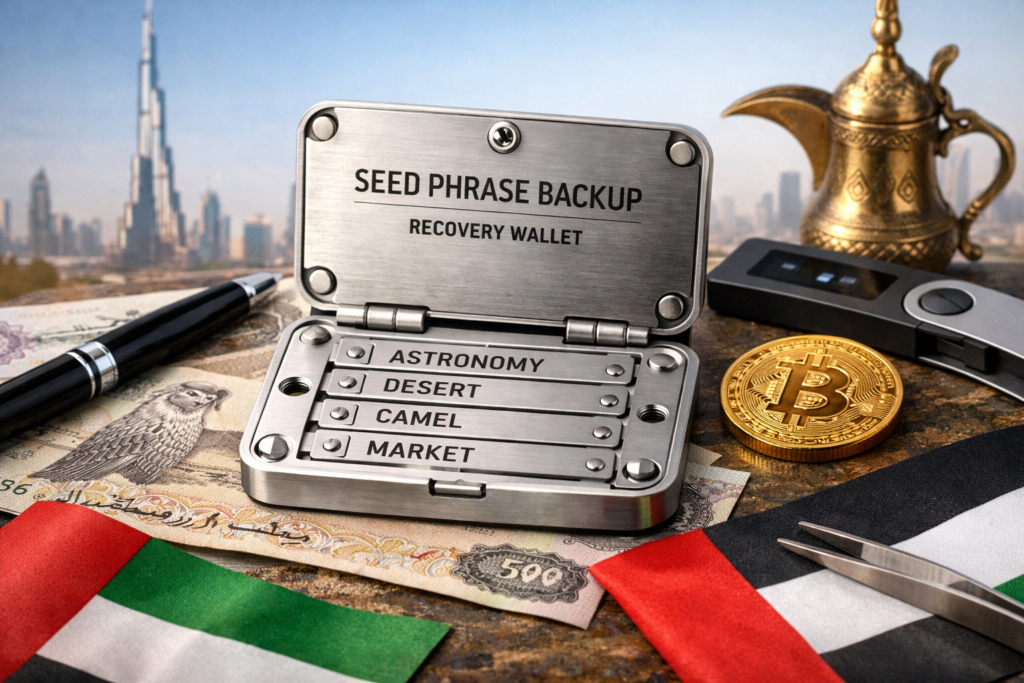
How to back up a seed phrase safely
A safer backup approach looks like this.
Write it offline
Keep copies in separate secure places
Never save it in cloud storage
Never send it through chat apps
Consider a more durable backup method for larger balances
Review your recovery plan once or twice a year
The scam patterns UAE users should watch
The biggest risks are usually not technical hacks. They are social-engineering attacks:
Fake exchange login pages
Impersonated support staff
“Verification” messages
Telegram or WhatsApp recovery scams
Malicious wallet approvals
Copied or substituted wallet addresses
Chainalysis says AI-enabled scams have become more profitable, while the FBI continues to report major losses tied to phishing, spoofing, and crypto-related fraud. In a high-adoption market like the UAE, healthy skepticism is part of good wallet security.
Basic device hygiene still matters
Use an authenticator app. Keep your phone and wallet firmware updated. Use a password manager. Avoid large transfers over public Wi-Fi. And do not approve smart-contract permissions you do not understand.
These habits sound simple because they are. They also stop a lot of real-world losses.
Compliance Tips for UAE Residents, UK Expats, US Expats, and EU Users
Storage decisions affect more than security. They also affect records, portability, tax exposure, and privacy.
UAE users still need clean records
The UAE does not levy income tax on individuals, but recordkeeping still matters for banking reviews, source-of-funds checks, and future cross-border reporting questions. That is especially true if you later relocate or move funds between Dubai, Abu Dhabi, London, Berlin, or the US.
What UK and US-linked users should keep in mind
UK expats should think beyond wallet choice and pay attention to tax records, statements, and data handling. US persons should be especially careful about foreign account and asset reporting rules, including FATCA-related obligations where relevant. Platforms with clean downloadable statements and predictable compliance processes can save a lot of trouble later.
GDPR and privacy for EU and Germany-based users
If you are linked to the EU or Germany, privacy still matters even when storing crypto in or through the UAE. KYC providers, support systems, analytics tools, and cloud workflows may all touch personal data. That is why choosing service providers with sensible data controls is not just a legal issue. It is a practical risk issue too.
This article is for general information only and is not financial, legal, or tax advice.
Mak It Solutions’ data analytics and business intelligence in the Middle East and Top CIO priorities 2025 are also worth reading if you want a wider governance and security lens.
The Safest Crypto Storage Strategy for UAE Users in 2026
For most people, the safest way to store crypto safely in UAE today is still the same: use a regulated entry point, keep small working balances on-platform, and move serious holdings into self-custody with proper offline backups.
Best low-risk setup by balance size
| Holding Size | Sensible Setup |
|---|---|
| Small | Regulated exchange + app-based 2FA |
| Medium | Exchange for access + dedicated wallet |
| Large | Hardware wallet + offline backups + stronger access separation |
When a hardware wallet is worth buying
A hardware wallet becomes worth it when the value you are protecting is much higher than the cost of the device. For many users, that point arrives earlier than expected.
A simple next-step checklist
Choose a UAE-friendly regulated platform
Secure the account with app-based 2FA
Create your wallet before buying serious size
Test every withdrawal with a small amount first
Back up your seed phrase offline
Review your setup every 6 to 12 months.
To Sum Up
Storing crypto safely in the UAE is not about finding one perfect wallet. It is about building a setup that matches your risk, habits, and the size of your holdings. For most users, the strongest approach is simple: use a regulated platform for access and liquidity, then move long-term assets into self-custody with secure offline backups. That balance gives you both convenience and control without relying too heavily on either side.
The key is consistency. Verify addresses, double-check networks, protect your seed phrase, and review your security routine regularly. Whether you live in Dubai, Abu Dhabi, or move between the UAE and other countries, clean records and careful storage habits can prevent costly mistakes. In crypto, strong storage is not optional. It is the foundation of everything else.( Click Here’s )
FAQs
Q : Is crypto storage in the UAE safer on a wallet or an exchange?
A : Both have a role. A regulated exchange is usually better for buying, selling, and AED-linked access. A personal wallet is usually better for long-term control. For most UAE users, the strongest setup is exchange for activity and wallet for savings.
Q : Do I need a hardware wallet if I only hold Bitcoin long term in Dubai?
A : If the balance is meaningful to you, usually yes. Long-term Bitcoin storage has different risks than short-term trading, and a hardware wallet plus offline backups generally gives better protection than leaving everything on exchange.
Q : Can expats in the UAE use the same crypto wallet they used in the UK or EU?
A : Usually yes. The wallet itself is often portable. What matters more is keeping clean purchase records, transfer history, and source-of-funds documentation if your banking or tax position spans multiple countries.
Q : What should I check before withdrawing crypto from a UAE platform?
A : Check the destination address, supported network, fees, minimum withdrawal amount, and whether the receiving wallet supports the asset and chain. For larger transfers, send a test amount first.
Q : How often should I review my wallet security and backups?
A : A good baseline is every 6 to 12 months, or right after a major device, residence, or life change. Review firmware, passwords, 2FA, seed phrase storage, and any old wallet permissions.