
How to Buy Bitcoin in UAE Safely (Guide)
You can buy Bitcoin in the UAE by opening an account with a virtual-asset exchange that is licensed or approved by regulators such as VARA, ADGM / FSRA or the Securities and Commodities Authority (SCA), completing KYC, funding in AED, and placing a BTC order. For most new investors, the safest route is to use a regulated exchange, start with a small test purchase, and then move longer-term holdings to a secure wallet you control.
You buy Bitcoin in the UAE by using a regulated crypto exchange, completing identity verification, depositing AED or a supported foreign currency, buying BTC, and then moving it to a secure wallet if you plan to hold long term. As an expat, tourist or remote worker, the key is to stick to virtual-asset providers licensed by UAE regulators and avoid unlicensed brokers, P2P “deals” on social media, and any platform that can’t prove its approvals.
Introduction
The United Arab Emirates has become one of the world’s most active crypto hubs, with the Virtual Assets Regulatory Authority (VARA) in onshore Dubai and the ADGM/FSRA regime in Abu Dhabi providing dedicated virtual-asset frameworks. For expats from the USA, UK, Germany, France, the Netherlands, Spain or Italy living in Dubai, Abu Dhabi or Ras Al Khaimah and for frequent travelers bouncing between New York, London and Berlin the question is no longer “can I buy Bitcoin?” but “how do I do it safely and legally?”
Early on, here’s the short version of how to buy Bitcoin in UAE in 2026: use a virtual-asset exchange that is licensed or recognized by UAE regulators, complete KYC with valid ID and proof of address, fund your account in AED (or a supported foreign currency), place a small BTC order, and move any long-term holdings to a secure wallet you control.
By the end of this guide you’ll know whether Bitcoin is legal for individuals, which types of exchanges are allowed, how to buy using AED or foreign cards, what cross-border and tax issues to watch for, and how to store BTC securely in a Bitcoin wallet for UAE residents. We’ll keep things practical and regulation-aware so you can act confidently while still staying on the right side of both UAE and home-country rules.
Is Bitcoin Legal in UAE?
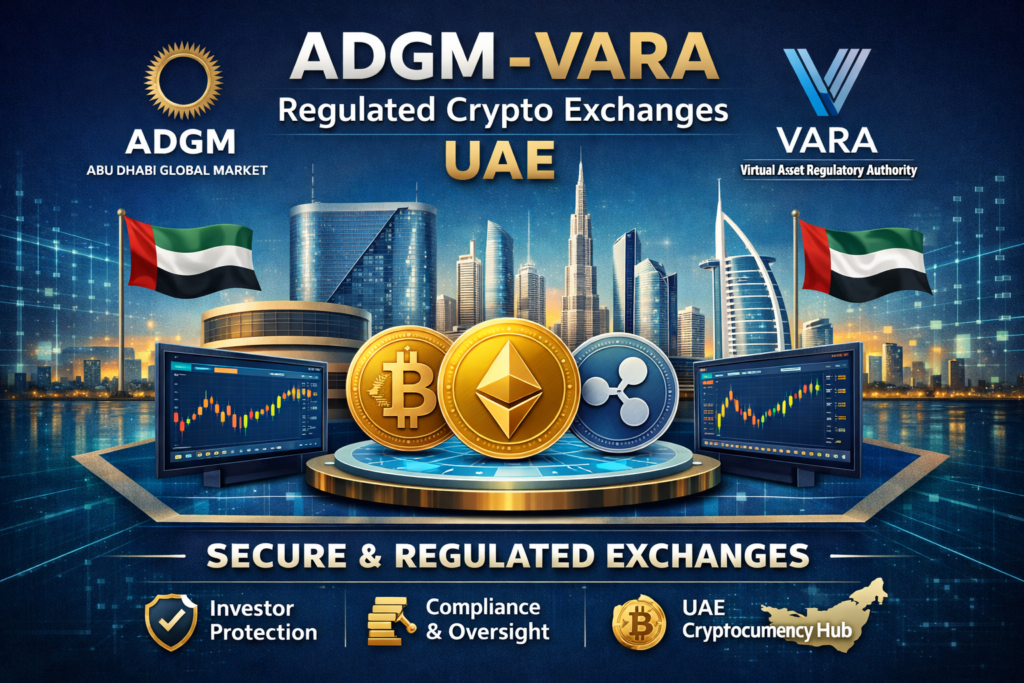
Yes, individuals can legally buy and hold Bitcoin in the UAE, provided they use virtual-asset service providers that are licensed or approved by regulators such as VARA, the federal SCA and free-zone regulators like ADGM’s FSRA. Unlicensed exchanges, brokers and OTC desks are prohibited from offering virtual-asset activities by way of business in Dubai and most of the onshore UAE.
Crypto is regulated rather than banned. The UAE has deliberately built a multi-layered framework: national rules from the SCA, specialist free-zone regimes in Abu Dhabi Global Market (ADGM) and DIFC, and emirate-level rules via VARA in Dubai. The idea is to attract serious, well-run crypto businesses while keeping unlicensed operators and scams out of the market.
Key Regulators You Should Know
Several regulators interact when you buy Bitcoin in the UAE
VARA (Virtual Assets Regulatory Authority)
Dubai’s dedicated virtual-asset regulator, responsible for licensing exchanges, brokers and custodians in onshore Dubai and most free zones there (excluding DIFC), and for policing virtual-asset marketing to UAE residents.
ADGM & FSRA
The ADGM free zone in Abu Dhabi, via its Financial Services Regulatory Authority, runs an ADGM virtual-asset framework that licenses exchanges, brokers and custodians and maintains an “accepted tokens” list for trading pairs.
SCA (Securities and Commodities Authority)
The federal onshore virtual-asset regulation still underpins virtual-asset trading and issuance outside financial free zones, including licensing of exchanges and brokers.
Central Bank of the UAE (CBUAE) –
Oversees payment tokens and card/payment schemes through the Payment Token Services Regulation (PTSR), which now fully applies across mainland UAE and also touches VARA-licensed entities.
When you choose a crypto exchange in Dubai regulated by VARA or an ADGM-licensed platform, you are operating under these frameworks by design.
What’s Allowed for Individuals vs. Businesses?
For individuals, buying and holding Bitcoin through licensed virtual-asset service providers (VASPs) is permitted. The UAE’s main virtual-asset laws focus on prohibiting unlicensed business activity like running an exchange, custody business or broker desk rather than banning individuals from investing.
If you want to run a brokerage, OTC desk, proprietary trading firm, custody service, or operate a P2P marketplace, you are squarely in “by way of business” territory and will need the appropriate license from VARA, ADGM/FSRA, SCA or another competent regulator. Even marketing and educational content aimed at UAE residents is now regulated in Dubai: promotions must follow VARA’s marketing and promotions rulebook, including risk warnings and restrictions on targeting certain segments.
Tax, Reporting and CARF Basics
As of early 2026, the UAE does not levy personal income tax on individuals’ capital gains from crypto trading, so Bitcoin profits made by UAE tax residents are currently not taxed locally. However, the Ministry of Finance has committed to implementing the OECD Crypto-Asset Reporting Framework (CARF), with systems scheduled to go live in 2027 and the first automatic exchanges of information between tax authorities expected in 2028.
If you’re a US citizen, UK resident or German/EU taxpayer, you may still owe tax on Bitcoin gains in your home jurisdiction even if you bought BTC in Dubai or Abu Dhabi and kept it offshore. The Internal Revenue Service (IRS), HM Revenue & Customs (HMRC) and regulators like BaFin increasingly expect worldwide reporting of crypto holdings, so plan ahead rather than waiting until you fly back to New York, London or Berlin.
Not tax or legal advice
Treat this section as general information only. Always confirm the latest position with a qualified tax adviser in your own country.
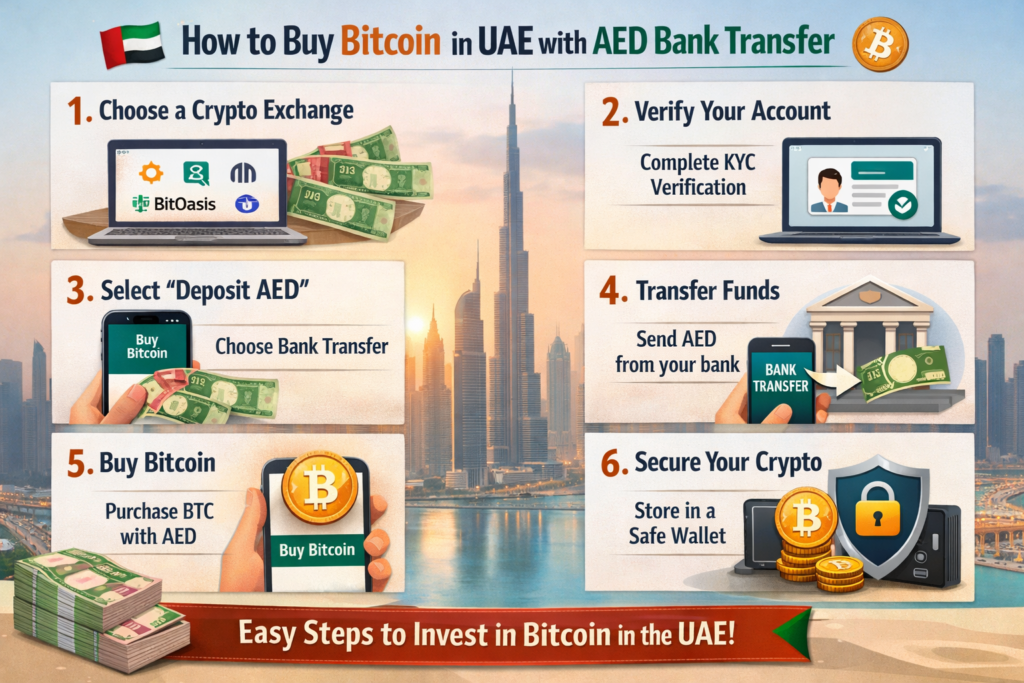
Step-by-Step: How to Buy Bitcoin in UAE Safely
Pick a regulated UAE or ADGM/VARA-authorised exchange.
Complete KYC with your passport and proof of UAE or foreign address.
Deposit AED via bank transfer, card or a supported payment service.
Choose a BTC trading pair such as BTC/AED or BTC/USDT and place your order.
Move BTC to a secure wallet if you plan to hold long term.
This is the safest way to buy Bitcoin in the UAE as a new investor: use a licensed exchange, follow AML/KYC requirements for buying crypto in UAE, start small, and never share your wallet’s private keys or seed phrase.
Documents You Need for KYC
Most exchanges will ask for.
Passport (typically the photo page)
Emirates ID or UAE residence visa page (if you have one)
Proof of address this could be a DEWA bill, Etisalat/du bill, tenancy contract, or a foreign document if you’re onboarding as a non-resident.
Acceptable foreign proofs often include UK council tax or utility bills, NHS or HMRC letters, German tax letters overseen by Bundeszentralamt für Steuern, and US IRS or bank statements, as long as they clearly show your name and address. Exchanges also ask you to complete a short questionnaire about your source of funds and investment experience to meet global AML standards like the FATF Travel Rule.
Funding Your Account in AED
You typically have three ways to fund your account in AED.
Local AED bank transfer
From a UAE bank account to your exchange account. This is usually the cheapest method, but it can take a business day or two to clear, and banks may ask questions on large transfers.
Debit/credit card
Fast and convenient, including some foreign cards, but fees can be higher and some banks treat crypto purchases as cash advances. Most reputable exchanges use PCI DSS-compliant payment gateways and SOC 2-style controls to protect card data and platform operations.
Fintechs like Wise or Revolut
You can convert USD/GBP/EUR into AED and send a transfer to your exchange, which is helpful for residents of the United States, United Kingdom, Germany, France, the Netherlands, Spain or Italy who don’t yet have a UAE bank account.
If you’re specifically wondering, “How can I buy Bitcoin in UAE using an AED bank transfer?”, the practical answer is: choose a regulated exchange, select bank transfer as your funding method, generate the exchange’s AED bank details and reference, send a small test payment from your bank, then fund the full amount once the test arrives and is credited.
Placing Your First Bitcoin Order
Once your AED has arrived.
Go to the BTC/AED or BTC/USDT market.
Decide between a market order (instant fill at the best available price) and a limit order (you specify your price and wait).
Check the trading fee, spread and any extra FX or funding fees.
Start with a small amount many exchanges let you buy Bitcoin in the UAE with as little as 50–100 AED and avoid margin or leverage until you fully understand the risks.
Recent surveys rank the UAE among the top countries globally for crypto ownership, with estimates above 20% of the population holding some form of digital asset. So you’re not alone in starting small and learning as you go.
Buying Other Cryptos (ETH, USDT) With the Same Flow
If you want to buy ETH, USDT or other approved assets, the steps are almost identical: fund in AED, pick the relevant trading pair (e.g., ETH/AED, ETH/USDT), place your order, and review fees. The difference is that, under the ADGM virtual-asset framework and similar regimes, only specific tokens are approved for trading so stick to assets listed by licensed exchanges rather than chasing obscure coins on unregulated platforms.
Best Crypto Exchanges and Payment Methods in UAE
For most people, the best exchange is one that is actually licensed or recognised in the UAE, supports AED funding, and has clear security and compliance disclosures. Avoid choosing solely based on the “lowest fees” banner.
Regulated Global Exchanges Serving UAE
Large global platforms such as Binance and eToro increasingly serve UAE residents, with some obtaining licenses or approvals under the ADGM framework or other local regimes. ADGM’s FSRA has granted a global license to Binance.com, making it the first crypto exchange to secure this type of authorization under that framework an important signal about how seriously global platforms are taking UAE regulation.
Pros of these exchanges include deep liquidity, strong mobile apps, multi-language support, and advanced security tooling like address-screening and Travel Rule integration. Cons can include FX costs when funding from UK, EU or US bank cards in non-AED currencies and a more complex fee schedule than local broker apps.
Local/Regional Apps and Brokers
Regional wealth platforms like Sarwa and other UAE-licensed wealth and crypto apps let you buy BTC alongside stocks, ETFs and sometimes robo-advised portfolios, often regulated either in ADGM, DIFC or onshore.
These are ideal if you.
Want a simple, long-term investing app rather than an advanced trading interface
Prefer AED funding from a local bank account
Value telephone or in-app support in English and Arabic
For many new investors, a UAE-native app that lets you DCA (dollar-cost average) into BTC each month can be safer and less stressful than trying to time the market on high-leverage global derivatives platforms.
Comparing Fees & Funding.
Here’s how the main options compare.
AED bank transfer
Usually the cheapest for spot buying. Expect low percentage fees and no card surcharge, but allow time for transfers and extra checks on large amounts.
Credit/debit cards
Instant but often around 2–4% in fees plus possible cash-advance charges from your bank. Good for small starter amounts or tourists, but not ideal for large purchases.
P2P marketplaces
Some regulated exchanges offer P2P within their licensed environment, but many P2P apps operate informally. You might get good FX rates, but scam risk is higher, so stick to platforms that provide escrow, verified users and clear dispute mechanisms.
OTC/cash desks
High-net-worth investors in Abu Dhabi or Dubai sometimes use licensed OTC desks for large tickets. These can offer discreet execution but still need to be properly licensed and fully KYC’d.
For most people, the cheapest and safest combination is a regulated exchange funded via AED bank transfer, then a withdrawal to your own wallet once you’re comfortable.
Buying Bitcoin in UAE From USA, UK, Germany and EU
If you’re buying from abroad or planning to return home, you need to think about both funding and tax/reporting.
For US Citizens and Residents
US citizens remain taxable on worldwide income and gains, even if they live in the UAE. You can.
Send USD via SWIFT from a US bank to your UAE bank, convert to AED, then fund a UAE exchange.
Use a US debit/credit card on a UAE-licensed app that accepts foreign cards (watch for FX and cash-advance fees)
Buy BTC on a US-regulated exchange (like Coinbase or Kraken), then send Bitcoin between UAE and international wallets if you move.
However, holding Bitcoin on a foreign exchange may trigger FATCA/FBAR reporting if account values exceed thresholds, and all disposals are reportable to the IRS for capital-gains purposes. Always keep meticulous records of dates, amounts and wallet addresses.
For UK and EU Residents
UK and EU residents often use.
UK banks or fintechs (Wise, Revolut) to send GBP or EUR to UAE bank accounts, then fund exchanges in AED
SEPA transfers from euro-area banks to platforms that support EUR funding
Platforms regulated by their home regulator (e.g., FCA in the UK or BaFin in Germany), then sending BTC to a UAE wallet for spending or long-term holding
Your personal data will typically be handled under GDPR/DSGVO or UK-GDPR-equivalent standards, even when processed by UAE entities that target EU/UK customers, so look for clear privacy and data-processing disclosures.
Tax and Reporting When You Return Home
High-level only (this is not tax advice)
USA
The IRS taxes capital gains on worldwide disposals of crypto, regardless of where you bought or held it. Crypto may also appear in FBAR/Form 8938 if held in foreign accounts above thresholds.
UK
HMRC treats most individuals’ Bitcoin gains as capital gains; you must report disposals (including swapping BTC to ETH or to fiat) once above annual allowances, even if the trades happened in Dubai or Abu Dhabi.
Germany / wider EU
In Germany, certain long-term holdings may qualify for favourable treatment (e.g., disposal after one year), but rules are nuanced and still evolving across the EU. Consult a tax adviser familiar with German and EU crypto law before relying on any “one-year rule” for large balances.
When in doubt, assume your home authority expects disclosure and seek a qualified tax professional before you repatriate large amounts.
How to Store Bitcoin Safely After You Buy in UAE
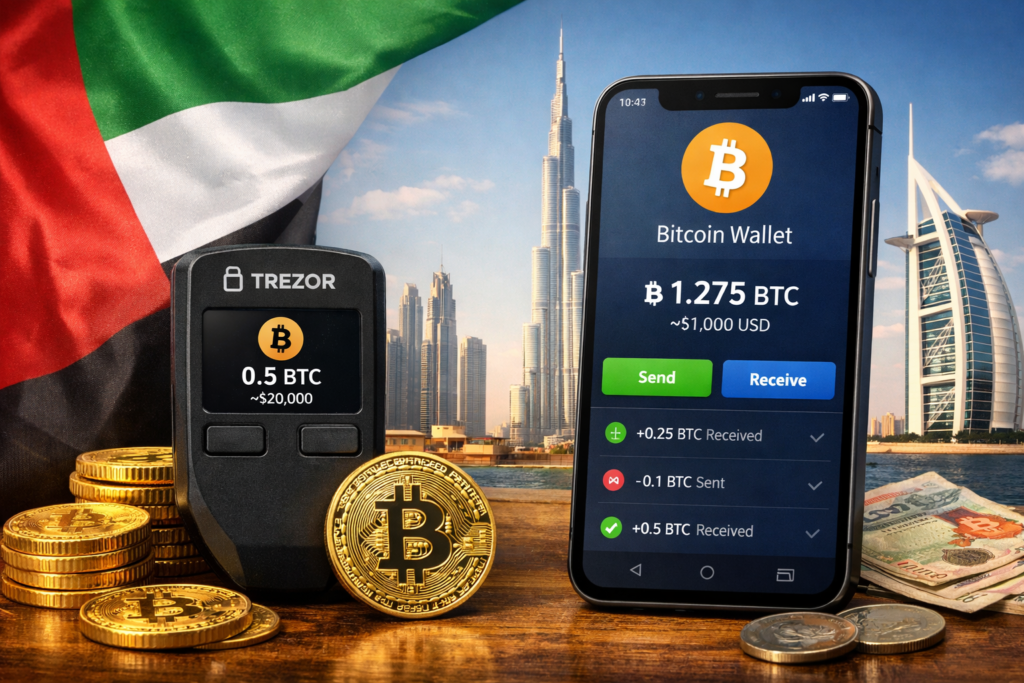
The safest approach for most people is to buy Bitcoin on a licensed exchange, then move it to a reputable hardware or non-custodial software wallet where you control the private keys. Keep only a small balance on exchanges for active trading or quick sales.
Exchange Wallet vs. Self-Custody Wallet
Exchange wallets are convenient: they handle backups, address management and sometimes insurance for certain types of losses. Many licensed exchanges tout SOC 2-aligned processes, proof-of-reserve reports and cold-storage setups.
However, “not your keys, not your coins” still applies. If an exchange is hacked, has its license revoked or freezes withdrawals, you’re a creditor, not an owner of on-chain keys.
Self-custody wallets whether mobile, desktop or hardware put you in control. That means:
Nobody can freeze or rehypothecate your BTC
You must protect your device, seed phrase and backups yourself
If you lose the seed phrase and all devices, there is no “forgot password”
For most medium-to-long-term holders, a hardware wallet plus a small “spending” wallet on your phone is a reasonable balance.
Setting Up a Bitcoin Wallet for UAE Residents
To set up a wallet.
Choose a reputable mobile or hardware wallet from a well-known vendor.
Download only from official app stores or the vendor’s official website never from random links.
When you create the wallet, carefully write down the 12–24-word seed phrase on paper or metal, offline.
Store backups in separate, secure locations (e.g., home safe and safe-deposit box). Don’t email or photograph the seed phrase, and don’t store it in cloud drives.
Once set up, you can send coins from your UAE exchange to your wallet, and later from that wallet to foreign exchanges like Coinbase or Kraken if you move back to Europe or the US.
Moving Bitcoin Off the Exchange Step-by-Step
This is a simple but critical flow.
Generate a receive address
In your self-custody wallet, click “Receive” and copy the BTC address (or scan the QR code).
Send a small test transaction
From your exchange, withdraw a tiny amount of BTC to that address. Wait for at least one on-chain confirmation.
Verify and label
Check the wallet has received the test amount and label the address in your notes so you know it’s yours.
Send the full amount
Only after the test succeeds, withdraw the rest of your BTC from the exchange to your wallet.
Confirm and secure
Once the full transfer is confirmed, review your backup plan again and enable any extra security options (e.g., passphrases) supported by your wallet.
Risks, Scams and Mistakes to Avoid in UAE
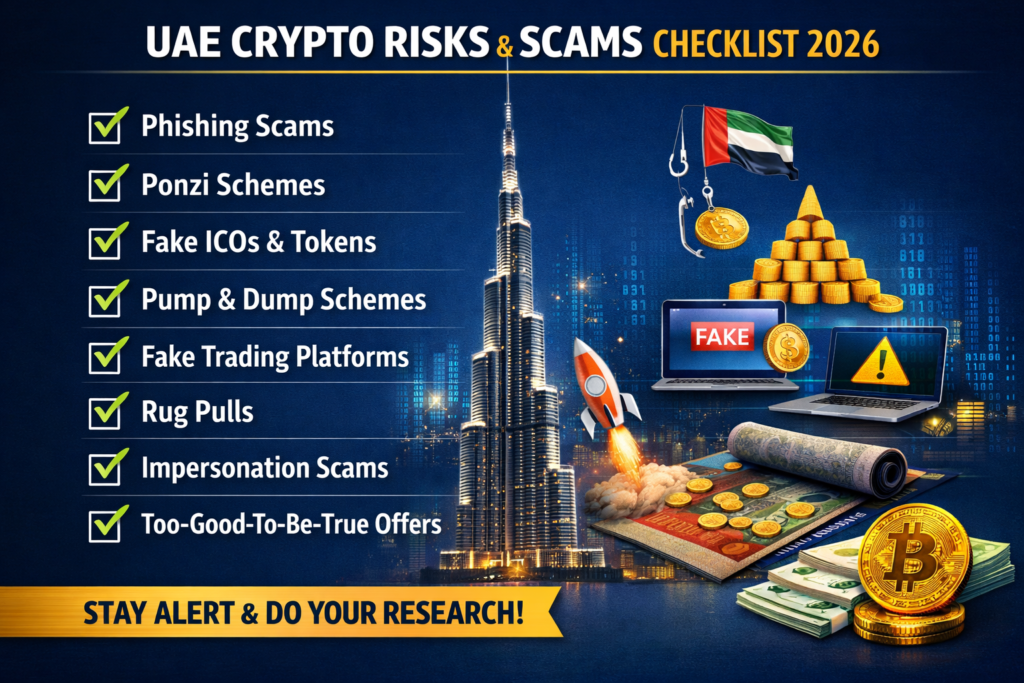
A regulated environment doesn’t eliminate risk. The main threats are unlicensed providers, social-engineering scams and poor personal hygiene around wallets and banking.
Unlicensed Brokers, P2P Scams and Social-Media Tips
Be extremely cautious of.
“Relationship managers” on WhatsApp or Telegram promising guaranteed returns
Brokers who insist you move funds from a licensed app to a private wallet they control
P2P deals where the counterparty asks you to cancel bank transfers after on-chain receipts
You can and should check whether a platform or firm appears on public registers kept by VARA, SCA or ADGM/FSRA before sending money. If someone refuses to provide their legal entity name, license number or regulator, treat that as a red flag.
Mining, “Cloud Mining” and Golden Visa Myths
The UAE does see legitimate crypto-mining and hosting ventures, including data-center-grade operations. But many “cloud mining” websites are just high-yield schemes with slick dashboards. Skepticism is healthy: if the projected daily return looks too smooth, it probably is.
Also, while Dubai and Abu Dhabi do welcome crypto investors, simply buying Bitcoin or paying for real estate in BTC does not automatically grant you a Golden Visa. Recent official clarifications confirm that crypto holdings or even buying property using crypto—do not by themselves qualify you for the UAE Golden Visa; eligibility is still based on traditional criteria like property value, business ownership or professional status.
Bank De-Risking and Frozen Transfers
Even if Bitcoin itself is legal, your banks in the UAE, UK, EU or US may still question or temporarily freeze large transfers connected to crypto platforms. That’s not unique to the UAE; it’s part of global AML trends. To reduce friction.
Use only licensed, well-known exchanges and brokers
Keep clear records (invoices, screenshots, contracts) for big deposits and withdrawals
Avoid mixing personal investing with business payments through the same accounts
Be prepared to explain your activity calmly if compliance teams ask questions
Checklist, Next Steps and When to Get Professional Advice
10-Point Checklist Before Your First Purchase
Before you buy your first sats in Dubai or Abu Dhabi:
Confirm that Bitcoin is legal for individuals buying via licensed providers in the UAE.
Pick a UAE-regulated or ADGM/VARA-authorised exchange.
Prepare your KYC documents (passport, ID/visa, proof of address)
Check deposit options (AED transfer, card, fintech) and compare fees.
Start with a small test deposit.
Enable 2FA (ideally an authenticator app, not just SMS)
Plan your wallet strategy (exchange-only vs hardware + mobile wallet)
Understand your home-country tax rules and reporting thresholds.
Review scam red flags and verify licenses on public registers.
Only then place your first small BTC order no leverage, no borrowing.
When to Speak to a Professional
If your portfolio grows into six- or seven-figure AED territory, if you’re considering running a brokerage or OTC desk, or if you have cross-border holdings across multiple exchanges and wallets, it’s worth talking to professionals:
A licensed financial adviser in the UAE
A tax specialist in your home country (US, UK, Germany, France, Netherlands, Spain, Italy, etc.)
Legal counsel familiar with VARA, SCA and ADGM/FSRA rules
Specialist firms and consultancies can also help design compliant architectures and integrations, from regulated custody to reporting dashboards, often alongside broader cloud and data projects you might already be planning with partners like Mak It Solutions.

If you’re serious about building compliant, secure digital products around crypto whether that’s a regulated exchange front-end, a reporting dashboard for CARF and Travel Rule, or wallet integrations for customers Mak It Solutions can help with the web, mobile and cloud side. Explore our web development services and mobile app development services to see how we support teams across the USA, UK, Germany and wider Europe. When you’re ready, get in touch with us for a no-pressure chat about your roadmap.
Key Takeaways
Bitcoin is legal for individuals in the UAE when bought through licensed VASPs regulated by bodies such as VARA, SCA and ADGM/FSRA; unlicensed business activity is prohibited.
The safest way to buy Bitcoin in the UAE is to use a regulated exchange, complete full KYC, fund via AED bank transfer or a reputable payment provider, and start with a small test trade.
Cross-border investors from the USA, UK, Germany and EU must remember home-country tax and reporting obligations, even if the UAE doesn’t tax their crypto gains.
Long-term holdings are best stored in reputable hardware or non-custodial wallets, keeping only small balances on exchanges for trading.
Tourists and non-residents can often buy BTC using foreign cards or fintech transfers, but should expect higher fees and must still use licensed platforms.
As CARF and global regulations tighten, robust records, compliant platforms and secure architectures will matter just as much as price charts.
FAQs
Q : Can tourists in Dubai or Abu Dhabi buy Bitcoin without a UAE bank account?
A : Yes, many tourists can buy Bitcoin in Dubai or Abu Dhabi without a UAE bank account by using debit or credit cards on licensed exchanges or regional apps that accept foreign cards. Some platforms also allow funding via international bank transfer in USD, GBP or EUR through providers like Wise or Revolut. Fees will usually be higher than local AED transfers, and you must still complete full KYC, so bring your passport and proof of address from home. Always check that any app you use is licensed or approved under VARA, SCA or a financial free zone such as ADGM.
Q : What is the minimum amount of AED I need to buy Bitcoin in the UAE?
A : Most exchanges set relatively low minimums, often allowing you to start from around 50–100 AED per trade, though exact thresholds vary by platform and payment method. That makes it easy to place a small “test trade” to learn the interface and how deposits and withdrawals work before scaling up. Some wealth apps also let you set up recurring buys (DCA) with similar minimums, which can be useful if you want to invest gradually rather than in one lump sum.
Q : Can I use my UK or EU bank card directly on a UAE crypto exchange?
A : In many cases yes, but it depends on both your card issuer and the exchange. Several UAE-licensed platforms accept international Visa and Mastercard cards from the UK and EU, processing them through PCI DSS-compliant gateways, but your bank may still treat the transaction as a cash advance or block it if it flags “crypto risk.” If card payments fail, a common workaround is to use a fintech such as Wise or Revolut to send a bank transfer to your AED account or directly to the exchange’s bank details, then fund in AED.
Q : Is peer-to-peer Bitcoin trading on apps legal in the UAE, and what are the risks?
A : Peer-to-peer Bitcoin trading is not banned outright, but any platform facilitating it “by way of business” must still comply with UAE virtual-asset regulations and licensing rules. Using P2P inside a licensed exchange’s environment is generally safer because KYC, escrow and dispute processes are in place. The biggest risks come from informal P2P groups on Telegram or WhatsApp: fake payment confirmations, chargebacks, identity theft and dealing with unlicensed brokers. If you do use P2P, stick to regulated platforms, start small and never release coins before you see cleared funds in your own account.
Q : Do I owe tax in Germany, the UK, or the US on Bitcoin I bought while living in the UAE?
A : Possibly, yes. The UAE currently doesn’t tax individuals’ capital gains on crypto, but countries like the US, UK and Germany tax residents on worldwide income and gains, regardless of where the assets were bought. That means Bitcoin you purchased in Dubai could still trigger IRS capital-gains reporting, HMRC self-assessment or German tax filings when you dispose of it or move back home. Always keep full records of your trades and wallet transfers, and speak to a qualified tax adviser in your home jurisdiction before repatriating large amounts.