


How to Buy Bitcoin in Egypt Safely in 2025
In 2025, Egypt has a strictly restrictive stance on cryptocurrencies. Under Central Bank of Egypt Law No. 194 of 2020, issuing, trading or promoting crypto without prior CBE approval is prohibited, and authorities regularly renew public warnings.
For most people with links to Egypt, the safest approach is not to trade through unlicensed local brokers. Instead, you typically:
Buy Bitcoin on a well-regulated exchange in your country of residence (USA, UK, Germany, wider EU),
Follow all local laws and tax rules, and
Avoid any use that conflicts with Egyptian regulation or religious guidance.
This is not legal, tax, investment or religious advice. Laws and fatwas can change; always confirm with a qualified lawyer, tax adviser or imam before acting.
Introduction
If you’re wondering how to buy Bitcoin in Egypt safely in 2025, the honest answer is that it’s complicated. Yes, you can get exposure to Bitcoin if you have links to Egypt, but doing it legally and safely is tricky.
Egypt’s Central Bank and Banking System Law No. 194 of 2020 bans issuing, trading or promoting cryptocurrencies without prior approval from the Central Bank of Egypt (CBE), and so far there is no broad retail licence regime.The CBE has also issued repeated warnings against dealing in crypto via local or international platforms, highlighting fraud, volatility and capital-flight risks.
Yet interest keeps growing. One recent estimate suggests around 3 million Egyptians hold some form of crypto, even though adoption is still below 5% of the population. Globally, between roughly 560 and 660 million people owned cryptocurrency by the end of 2024–2025, as total market cap nearly doubled in 2024 alone.
So this guide walks a very specific line: how to buy Bitcoin in Egypt as safely and legally as possible, or how to buy it abroad (USA, UK, Germany, wider EU) when you ultimately want to support someone in Cairo, Alexandria, Giza or New Cairo without encouraging you to ignore local law or religious guidance.
Nothing here overrides CBE regulations, MiCA, FCA/BaFin rules, IRS/HMRC/BZSt guidance, or sharia rulings. When in doubt: stop, ask a professional, then decide.
Who this guide is for
This guide is designed for.
Egyptians in Cairo, Alexandria or elsewhere who are curious about Bitcoin but worried about CBE rules.
Egyptians and expats living abroad (New York, London, Berlin, Dubai, etc.) who want to buy Bitcoin in regulated markets and sometimes send value toward Egypt.
Overseas family members who send remittances into Egypt and are wondering whether BTC could be part of that mix.
If you’re a bank, fintech or regulator researching the Central Bank of Egypt cryptocurrency law, this article can also help you understand user-level patterns but you should still go back to the primary legal texts.
Quick disclaimer: legal, religious and tax risks
Legal
Unlicensed crypto trading in Egypt may violate Law No. 194 of 2020 and related CBE regulations. Penalties can include fines and even imprisonment.
Religious
Egypt’s Dar al-Ifta issued a fatwa in 2017 stating that Bitcoin transactions are haram (forbidden), which continues to influence policy and individual decisions.
Tax
If you live in the USA, UK, Germany or elsewhere in the EU, your local tax authority will usually treat Bitcoin as a taxable asset (capital gains or income).
How this guide is structured
We’ll move in this order.
Safest legal route for Egypt-linked users.
Step-by-step beginner flow (anchored in regulated countries).
Platforms and payment rails you’ll hear about.
Why Egypt restricts Bitcoin (law + fatwa context).
Security and wallets for Egypt-linked flows.
USA/UK/Germany workflows for supporting family in Egypt.
Risks, scams and red flags.
Summary, checklist and safer learning resources.
Along the way, we’ll reference practical tech topics like secure apps, data protection and compliance—areas where teams like Mak It Solutions work every day on web development, cloud and business intelligence projects for clients in the US, UK, Germany and across the EU.
What Is the Safest Legal Way to Buy Bitcoin in Egypt Right Now?
The safest legal pattern today is usually not to buy Bitcoin through unlicensed local brokers in Egypt at all. Instead, if you are legally allowed, you buy Bitcoin on a regulated exchange in your country of residence (for example under the SEC/CFTC in the US, the FCA in the UK, or BaFin and MiCA rules in the EU), then only hold or send it in ways that do not violate the Central Bank of Egypt’s ban on unlicensed issuance, trading or promotion.
That might mean: keeping BTC as a long-term investment abroad, using it for diversified savings, or not involving Egypt at all if that would conflict with local law or the Egypt Bitcoin fatwa and sharia compliance guidance.
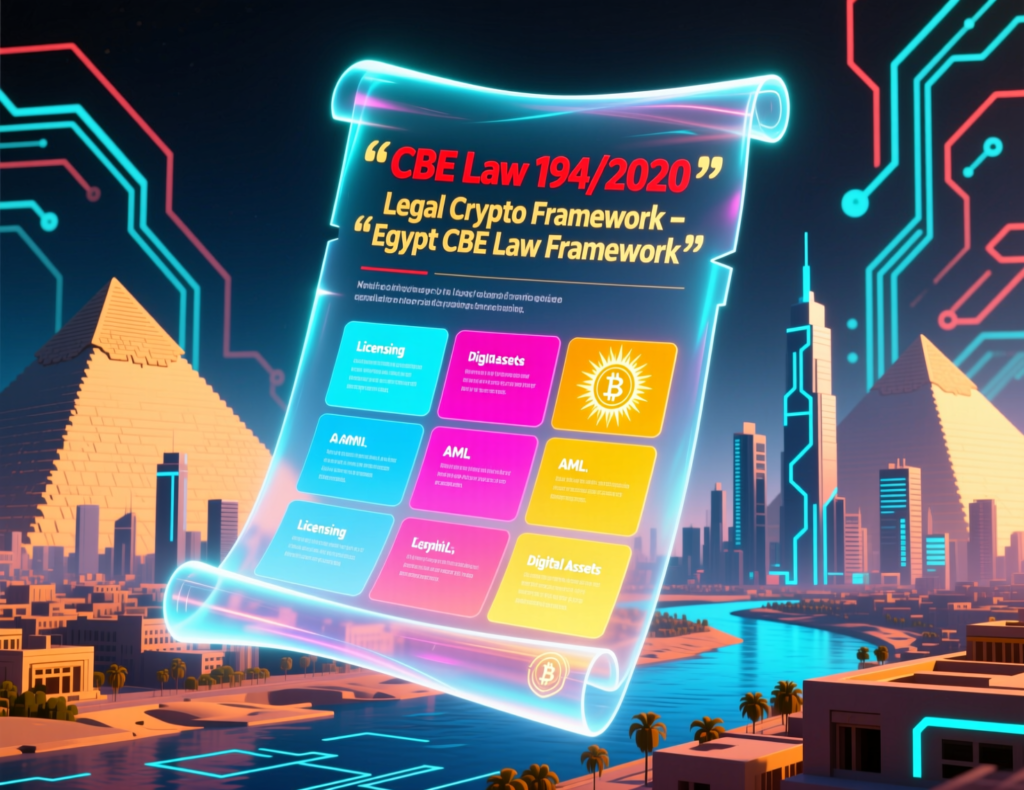
Snapshot of Egypt’s current crypto stance
Law No. 194 of 2020 gives the CBE explicit authority over “encrypted currencies” and bans their issuance, trading and promotion without a specific licence.CBE’s 2023 warning reiterates that dealing in crypto whether via regional or international platforms can be legally criminalised and is seen as a risk for money laundering and terrorism financing.
In plain language.
There is no open, retail crypto licence regime in Egypt similar to MiCA in the EU.
Most everyday trading is treated as illegal unless it falls under a very narrow Central Bank approval.
Enforcement has focused more on warnings and selective crackdowns, but that can change quickly.
Licensed vs unlicensed activity
Under Egypt’s framework:
Clearly prohibited without CBE approval:
Issuing your own token or “cryptographic unit”
Operating an exchange or broker
Advertising, marketing or promoting crypto trading services
Grey-zone areas
Holding Bitcoin in a non-custodial wallet if acquired abroad
Talking about crypto in private communities
Using P2P platforms that technically operate offshore
This “legal grey zone” is why many Egyptians either avoid crypto altogether or use offshore exchanges at their own risk—something this guide does not recommend or endorse.
Practical options that minimise legal and compliance risk
Depending on your situation, safer patterns might include.
You live in Egypt full-time
Focus on learning only: understand crypto investment risks in Egypt, but avoid trading until there’s a clear CBE-licensed route.
If you already hold BTC from earlier abroad, speak to a lawyer about how to treat it now.
You live in USA/UK/Germany/EU and only visit Egypt
Use a regulated exchange in your home country (Coinbase, Kraken, Bitstamp, etc.) that follows SEC/FCA/BaFin or MiCA rules.
Keep your main trading and custody within that legal environment.
If you send BTC to someone in Egypt, make sure they fully understand the legal and religious implications on their side.
You send money to family in Egypt
Compare traditional remittance (Wise, banks) vs BTC carefully; sometimes classic rails are safer and cheaper once spreads are included.
If you still opt for BTC, use modest amounts, document everything, and confirm that neither side is breaching local rules.
Sometimes the safest choice is doing nothing now and waiting for clearer regulation especially if you are physically in Egypt and unsure how Law 194/2020 applies to you.
How to Buy Bitcoin in Egypt Safely in 2025: Step by Step
If you’re allowed to trade where you live (for example in New York, London, Manchester, Berlin, Munich or elsewhere in the EU), the basic steps to buy Bitcoin are simple: choose a regulated exchange, complete KYC, deposit money, buy BTC, then move it to a secure wallet. The catch is that if Egypt is involved because you live there or send BTC there—you must double-check that each step respects CBE rules and any relevant fatwas before you proceed.
Decide where you’re based
Your country of legal residence is what really matters:
Living in Egypt: treat this guide as educational only. You should not assume you can simply open an offshore account and start trading; engaging in unlicensed crypto activity may be illegal.
Living in USA: you’re primarily under SEC/CFTC/FinCEN rules; most large exchanges serving New York or Los Angeles require full KYC and strong AML controls.
Living in UK: use FCA-regulated firms; the FCA has specific marketing and disclosure rules for crypto.
Living in Germany/EU: pick exchanges authorised under BaFin or MiCA; ESMA has warned firms not to mislead customers about their regulatory status.
Once you know which regulators cover you, you can narrow platform options far more safely.
Choose a regulated exchange or app
Look for
Licensing & supervision
USA: money-services/BitLicense where required, plus SEC/CFTC oversight for some products.
UK: FCA-registered crypto-asset firm.
Germany/EU: BaFin-licensed or MiCA-authorised crypto-asset service provider.
Security practices
SOC 2 audits, cold storage, strong KYC/AML, transparent proof-of-reserves.
Data protection
GDPR/DSGVO or UK-GDPR compliance for EU/UK users.
Platforms often mentioned in 2025 comparison guides include Binance, Coinbase, Kraken, Bitstamp, Bitcoin.com, Bitget and others each with different country coverage, fees and risk profiles.
If you ever build your own crypto-related tooling dashboards, data pipelines, AML analytics teams like Mak It Solutions can help with business intelligence, cloud cost optimisation and secure web development so that compliance and performance are designed in from day one.
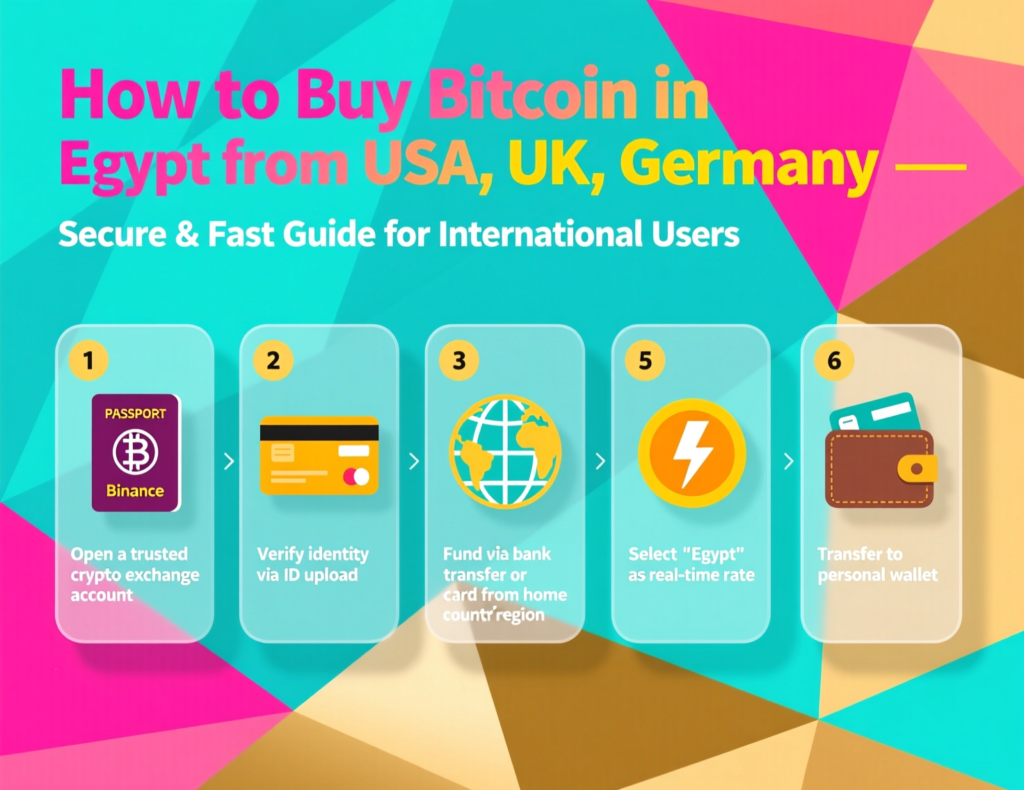
Verify your identity (KYC)
Most regulated exchanges will ask for.
Passport or national ID
Proof of address (utility bill, bank statement) in your country of residence
Sometimes a selfie or live video check
If you hold an Egyptian passport but live abroad, some exchanges will onboard you if you can prove residence in a supported country (for example Germany with a local address and IBAN). Others, like Coinbase, may not support Egypt-issued IDs unless you can prove residency elsewhere so always read their country lists carefully.
Deposit money
Common funding methods include:
Bank transfer (ACH in the US, Faster Payments in the UK, SEPA in the EU/Germany)
Debit/credit card (often higher fees)
Local fiat rails (e.g., instant payments from UK banks like Monzo or Revolut, or German IBAN transfers from banks in Berlin or Frankfurt)
Bank transfers in USD, GBP or EUR are usually cheaper than cards, especially when you’re already planning to convert into BTC and then maybe to EGP. Always watch FX spreads when moving from USD/GBP/EUR to BTC and then indirectly to the EGP to BTC exchange rate you care about.
Buy BTC and review fees, spreads and limits
Once your account is funded:
Select BTC in the trading interface.
Choose a simple “market buy” order if you’re a beginner.
Double-check total fees (trading fee + spread + funding fee).
Start with a small test amount.
After purchase, move Bitcoin to a non-custodial wallet if your risk profile and local law allow (we’ll cover wallets below).
Because crypto is extremely volatile, never risk money you cannot afford to lose. In 2024, total crypto market cap almost doubled year-on-year great for early buyers, painful for those who bought at the wrong time.
Platforms, Apps and Payment Methods for Egypt-Linked Buyers
No major international exchange is fully licensed in Egypt itself under a dedicated domestic regime. Most Egypt-linked users rely on offshore platforms in jurisdictions where they live (USA, UK, Germany, EU, Gulf) and sometimes P2P marketplaces that offer EGP pairs. ([Bitcoin][13]) If you’re physically in Egypt, you must assume that using these platforms to trade can still fall foul of CBE’s rules even if the platform itself is legal in another country.
Centralised exchanges for expats and overseas family
If you live outside Egypt, centralised exchanges (CEXs) can offer.
Clear licensing in your jurisdiction
Fiat on-ramps (USD, GBP, EUR via bank or card)
Reasonable liquidity and fees
Guides for 2025 frequently mention Binance, Coinbase, Kraken, Bitstamp, Bitcoin.com, SpectroCoin, Cryptomus, Changelly and others as options, with Binance and Bitget particularly strong in Middle East and Africa coverage.
Treat any “best exchange in Egypt” marketing with caution and always cross-check the fine print against Law 194/2020 and CBE warnings.
P2P marketplaces and local brokers
P2P platforms like Binance P2P, LocalCoinSwap, Bitmama and informal OTC desks let people buy BTC directly from other users, often using EGP bank transfers or cash. Binance P2P, for example, lists Egypt among the countries where its P2P service is available, though features may be restricted by local regulation.
Pros.
Local payment methods (EGP transfers, wallets, sometimes cash)
Sometimes better FX rates than cards
Cons / red flags.
High scam risk (fake proofs, chargebacks, social engineering)
No guarantee of compliance with CBE rules
Disputes can be messy and stressful
If a Telegram or WhatsApp broker in Cairo promises fixed daily returns, that’s not “smart investing” it’s almost certainly fraud.
Payment methods compared
Most Egypt-linked buyers end up choosing between
Credit/debit cards: fast but higher fees (often 2–5%+) and higher chargeback risk.
Bank transfers / SEPA / Faster Payments / German IBAN: slower but cheaper, better paper trail for tax compliance.
EGP cash wrappers (informal brokers): maximum risk frequently unlicensed and deep in the danger zone under CBE law.
Fees and FX spreads
EGP → USD/GBP/EUR → Exchange funding fee → BTC trading fee → Spread → Withdrawal fee
Always look at the total journey
On small remittances for family in Egypt, traditional rails can sometimes win once you include all those layers. Using basic analytics on your own transfers something Mak It Solutions often helps businesses do for payment flows and business intelligence dashboards can highlight which route is actually cheapest and safest for you.
Why Is Bitcoin Trading Restricted in Egypt and What Does the Law Say?
Bitcoin trading is restricted in Egypt because regulators see cryptocurrencies as highly volatile, prone to fraud and capital flight, and difficult to supervise under existing banking law. Law No. 194 of 2020 therefore bans issuing, trading and promoting crypto without a Central Bank licence, and this approach is reinforced by Dar al-Ifta’s earlier fatwa classifying Bitcoin as haram.
Central Bank of Egypt warnings and enforcement
The CBE’s fourth warning statement (2023) specifically cautions against:
Participating in or being targeted by fraudulent crypto schemes
Dealing with unlicensed entities offering crypto services
Assuming that using international platforms shields you from Egyptian law
More recent government communications repeat that cryptocurrencies are outside the formal banking system and carry heightened AML/CFT risks.
Religious guidance.
Dar al-Ifta’s fatwa, issued by the Grand Mufti in 2017, declared that buying, selling or leasing cryptocurrencies is forbidden (haram) due to concerns such as speculation, lack of intrinsic value, and potential use in illegal activities.
Across the wider Islamic finance world, scholars disagree: some see certain crypto uses as potentially halal if they meet conditions around transparency and asset-backing, while others echo Egypt’s more restrictive stance. If sharia compliance matters to you, it’s essential to speak with a trusted local scholar before making decisions not rely only on generic online opinions.
“Legal grey zone” vs reality on the ground
Despite the restrictions, crypto interest is rising Egypt ranked in the mid-30s worldwide in one 2023 adoption index, with usage driven partly by pound devaluation and remittance needs.Many users access Bitcoin via
Offshore exchanges accessed from abroad
P2P platforms that match Egyptian buyers and sellers
Informal local OTC desks
These channels can expose users to legal, financial and scam risks. You’re effectively operating between the lines of the law, which can close quickly.
When to speak to a lawyer, tax adviser or imam
You should absolutely get professional advice if:
You’re resident in Egypt and already hold BTC or plan to buy it.
You intend to use Bitcoin as part of a business model touching Egypt (e-commerce, SaaS, tourism).
You have religious concerns about whether a specific use is halal.
A good starting point is reading CBE statements and then consulting a professional in Cairo or Alexandria who understands both Central Bank of Egypt cryptocurrency law and international frameworks like MiCA or FCA rules.
Security, Wallets and Moving Bitcoin To and From Egypt
The safest pattern, if you’re legally allowed to hold BTC, is: buy on a regulated exchange, then move coins to a secure, non-custodial wallet you control, and only send funds to trusted addresses after verifying legal and compliance implications.
Choosing a Bitcoin wallet for Egypt-linked users
You’ll usually pick between.
Custodial wallets (on-exchange, some apps):
Easier to use, password reset possible.
You don’t truly control the keys; if the provider blocks Egypt or your account, access can be lost.
Non-custodial wallets (mobile/desktop apps, hardware wallets):
You hold your seed phrase and private keys.
Safer against exchange failure but higher personal responsibility.
Popular hardware wallet brands include Ledger and Trezor, which support strong encryption and offline storage.
Hardware wallets and shipping to Cairo, Alexandria and beyond
If you live in the USA, UK, Germany or EU, you can usually order hardware wallets from official stores or authorised resellers and then:
Keep them with you while travelling to Cairo or New Cairo (subject to local customs rules), or
Store them securely in your home jurisdiction (for example in a safe in London or Frankfurt).
Avoid buying from unverified marketplaces to reduce the risk of tampered devices.
How to send BTC from USA, UK or Germany to someone in Egypt
High-level steps (only if both sides understand the risks and local rules):
You (abroad) buy BTC on a regulated exchange in your country.
Recipient in Egypt sets up a secure wallet, ideally with guidance on seed storage and phishing risks.
You send a small test transaction first.
Once confirmed, you send the main amount, keeping transaction IDs and screenshots for your tax/audit records.
Recipient decides whether to hold in BTC or convert via P2P or other means—knowing that local conversion may conflict with CBE law.
Document everything, and never pressure someone in Egypt to receive crypto if they are uncomfortable with the legal or religious implications.
Converting EGP to BTC and BTC back to fiat safely
Converting EGP → BTC is where legal and scam risk spikes in Egypt; great caution is needed.
Converting BTC → USD/GBP/EUR in regulated markets (e.g., London, Berlin, New York) is usually safer, but taxable.
You can reduce price risk by sending BTC and asking the recipient to convert promptly, or by using stablecoins where appropriate and legal (though these raise their own regulatory questions).
Again, sometimes the most responsible choice is to keep remittances on classic rails and use Bitcoin only where regulation (like MiCA in the EU) is clear and robust.
How Can People in the USA, UK or Germany Buy Bitcoin for Use in Egypt?
If you live in the USA, UK or Germany, the safest pattern is to buy Bitcoin on a regulated local exchange using your domestic bank account or card, meet all tax and reporting duties, and only send funds to Egypt where it does not breach Egyptian law, sanctions or religious guidance.
For Americans: buying with US bank accounts and cards
Use US-registered exchanges that comply with federal and state rules.
Fund via ACH or wire from banks in New York, Los Angeles or elsewhere.
Track your cost basis and realised gains; the IRS treats crypto as property.
If you send BTC to family in Egypt, treat it like any other cross-border asset transfer: keep records and consider gift/FBAR/other reporting obligations when relevant.
FCA-regulated exchanges, Revolut and sending BTC
Choose FCA-registered crypto firms and pay attention to risk warnings; UK data shows ownership among adults fluctuating with market cycles.
Fund via Faster Payments from banks in London, Manchester or Birmingham, or via compliant apps like Revolut (for supported products).
Remember that HMRC expects full reporting of disposals and may request exchange records.
For Germans and EU residents
Look for providers authorised either by BaFin (Germany) or under the EU’s Markets in Crypto-Assets Regulation (MiCAR).
Fund via SEPA transfers from banks in Berlin, Frankfurt, Munich or other EU cities (Paris, Madrid, Amsterdam, Warsaw).
Be aware that EU regulators like ESMA are increasingly strict about how crypto firms can market their MiCA status.
Tax and reporting when you send BTC abroad
In most Western jurisdictions.
Buying and holding BTC usually creates a taxable event only when you sell or spend it.
Sending BTC as a gift or remittance can have tax or reporting implications depending on amount, country and timing.
You must still keep records of cost basis, transfers and recipients, even if no tax is due now.
This is where data and analytics help: treating your own crypto flows like a mini-ledger, similar to how businesses track KPIs in BI tools, can make filing much less painful later.
Risks, Scams and Red Flags When Buying Bitcoin “In” Egypt
Because formal on-ramps are restricted, Egypt has become fertile ground for high-risk schemes. Key red flags include: unlicensed brokers promising guaranteed returns, anonymous WhatsApp/Telegram groups, anyone asking for your wallet seed phrase, platforms that ignore KYC/AML entirely, and any advice telling you to hide activity from regulators or family.
Common scam patterns targeting Egyptians and expats
Watch out for
“Investment clubs” that promise fixed daily or weekly returns in BTC
Influencer-driven Ponzis targeting Egyptians in the Gulf who send funds back home
Fake P2P buyers who send fraudulent payment confirmations
Romance scams where the other party slowly nudges you into crypto “investments”
If it sounds like free money, it’s almost always a trap.
How to vet an exchange or P2P counterparty
Basic due-diligence checklist
Is the company licensed by a credible regulator (FCA, BaFin, etc.)?
Does it publish security and compliance reports (e.g., SOC 2, PCI DSS for card handling, GDPR/DSGVO statements)?
Are reviews consistent across multiple sites not just on their own landing page?
For P2P: does the platform have escrow, clear dispute processes, and visible reputation scores?
Operational security basics
Good hygiene, without trying to dodge the law, looks like:
Strong, unique passwords stored in a password manager
Hardware-based 2FA keys where possible
Never sharing your seed phrase or private keys not even with “support” agents
Being careful with VPNs: they’re fine for privacy, but using them to bypass geo blocking or evade local regulation is risky and often illegal
When it’s safer not to buy at all
You should pause or walk away if:
You’re based in Egypt and not comfortable with the legal or religious ambiguity
You feel pressured by family, friends or online groups
You don’t fully understand how wallets, seed phrases or price volatility work
It’s perfectly rational to sit on the sidelines, learn more, and wait for clearer rules especially in a country whose regulators and religious authorities are still strongly sceptical of Bitcoin.
Summary, Next Steps and Safe Alternatives
Key takeaways in one minute
Egypt’s Law 194/2020 and CBE warnings make most unlicensed crypto activity illegal, even via foreign apps.
The safest pattern is usually to buy and hold BTC in regulated markets (USA, UK, Germany, EU) and be very cautious about involving Egypt at all.
When sending BTC to Egypt, small amounts, strong documentation and informed consent on both sides are essential.
Many users are turning to regulated alternatives like improved online banking, compliant fintech apps and strong multi-currency accounts while they wait for clearer crypto rules.
Checklist: questions to ask yourself before buying Bitcoin in or for Egypt
Am I legally allowed to buy/hold BTC where I live?
How do Egypt’s CBE regulations and Dar al-Ifta’s fatwa affect my situation?
Do I fully understand the technical basics: private keys, fees, volatility?
Is Bitcoin really the best tool for what I’m trying to do (saving, remittance, speculation)?
Have I compared total cost and risk with traditional remittance or bank transfers?
Where to learn more safely
Start with official and reputable sources
CBE news and warning statements (for Egypt).
EU MiCA/MiCAR resources via ESMA and national regulators.
FCA and BaFin guidance on crypto marketing and consumer protection
Independent education hubs like Bitcoin.com’s guides and neutral research reports from firms like Chainalysis or Triple-A.
And if your organisation is exploring crypto-adjacent products wallet analytics, dashboards or compliance tooling Mak It Solutions can help architect secure web, mobile and cloud platforms that respect regulations from Cairo to Berlin.
If you’re evaluating whether crypto has a safe, compliant role in your product or remittance strategy, you don’t need to figure it out alone. Mak It Solutions works with teams across the US, UK, Germany, the wider EU and the Middle East to design secure, regulation-aware web and cloud architectures. Explore our services or reach out via the Mak It Solutions website to discuss a scoped, compliance-first roadmap tailored to your market.
FAQs
Q : Can I legally hold Bitcoin in Egypt if I bought it while living abroad?
A : There’s no simple yes or no answer. Egypt’s Central Bank and Banking System Law No. 194 of 2020 bans issuing, trading or promoting cryptocurrencies without CBE approval, but it does not clearly describe every scenario where someone already holds BTC that was purchased abroad.Practically, people do return to Egypt while owning crypto, but that doesn’t guarantee their situation is risk-free. If this is you, speak to a local lawyer who understands both Egyptian banking law and any tax rules in the country where you bought the Bitcoin.
Q : Which app is best for tracking the EGP to BTC price when sending money to Egypt?
A : You don’t have to use an Egyptian exchange to track prices. Many global market-data apps and sites (for example, CoinMarketCap, TradingView or major exchange apps) let you view BTC prices in multiple fiat currencies, including EGP, even if you’re trading in USD, GBP or EUR.Pick a reputable app with transparent data sources, enable 2FA, and remember that price feeds can differ slightly between platforms, especially during high volatility.
Q : Can I use a UK or EU exchange while physically staying in Cairo or Alexandria?
A : Technically, some UK or EU exchanges may accept your account if you’re a legal resident there, even if you temporarily travel to Cairo or Alexandria. But using those platforms from Egyptian soil may still conflict with CBE rules on unlicensed crypto trading, regardless of where the company is based.In short: your account might work, but you could still be at legal risk in Egypt, so you should ask an Egyptian lawyer before trading.
Q : What is the cheapest way to move money from a US bank account to Bitcoin and then to Egypt?
A : There’s no universal “cheapest” path, because costs vary by bank, exchange, payment rail and BTC price at the time you convert. A common pattern is: ACH from your US bank to a low-fee exchange, buy BTC, then send a single on-chain transaction. However, once you include network fees, spreads, and any EGP off-ramp costs in Egypt (often through risky P2P markets), classic remittance channels can come out cheaper and safer.Always compare total fees and risks end-to-end before deciding.
Q : Are Bitcoin ATMs available in Egypt, and are they safe to use for tourists or expats?
A : As of late 2025, there is no evidence of a widespread, regulated Bitcoin ATM network operating openly in Egypt. Most global ATM maps show little or no coverage in Cairo, Alexandria or Giza, which aligns with Egypt’s restrictive stance under Law No. 194 of 2020 and repeated CBE warnings.If you encounter a machine claiming to sell BTC for EGP, treat it with extreme caution and assume it is unregulated unless proven otherwise. For tourists and expats, it is generally safer to transact in your home jurisdiction instead