
Ethereum L2 Starknet suffers 2nd mainnet outage in 2 months
Starknet’s mainnet recently faced a major disruption when its sequencer went down, freezing activity for almost three hours. The outage, which lasted 2 hours and 44 minutes, halted block production and left users unable to process transactions as usual. Many had to resubmit their pending transactions once the system came back online, highlighting the challenges of maintaining smooth operations on Ethereum Layer-2 networks.
The incident has sparked renewed debate over Starknet’s reliability, especially as sequencer stability is crucial for user trust and network adoption. While the team was able to restore normal activity, the downtime raised concerns about how well-prepared the network is to handle technical setbacks. For a platform aiming to scale Ethereum, ensuring consistent uptime will be key moving forward.
What happened
Starknet’s mainnet experienced degraded performance when its sequencer—the component that orders and batches transactions failed to recognize certain Cairo0 code paths. During the Starknet sequencer outage, block creation slowed to a crawl and pending transactions accumulated across RPC providers.
Key details at a glance:
Duration: ~2h44m of disrupted block production
Impact: Transactions submitted between 02:23–04:36 UTC were not processed
Chain state: A reorg from block 1960612 was committed, requiring affected users to resubmit transactions
Recurrence: This is the second major halt in two months; a previous incident on July 18 lasted about 13 minutes
This Starknet sequencer outage is notable not only for its length but also because Starknet ranks among Ethereum’s larger L2s by TVL, heightening scrutiny from developers and investors.
Why it matters
Layer-2 networks inherit Ethereum’s security while outsourcing throughput to offchain components like sequencers. When a sequencer misbehaves or fails:
Transactions stall and user experience degrades
Reorgs can invalidate recent activity, forcing replays/resubmissions
Apps and market makers face operational risk and potential losses
Perception risk grows for institutions evaluating L2 dependability
For an ecosystem positioning itself for mainstream adoption, another Starknet sequencer outage underscores the need for redundancy, robust code paths across compiler versions, and clearer rollback/resubmission playbooks.
The team’s response and next steps
Starknet reported the network is “fully operational” with block production back to normal. Most RPC providers have updated, with stragglers expected to follow. The team has promised a full timeline and root-cause analysis alongside long-term prevention measures. Until that postmortem lands, the Starknet sequencer outage will remain a reference point in L2 reliability debates.
How Starknet scales Ethereum
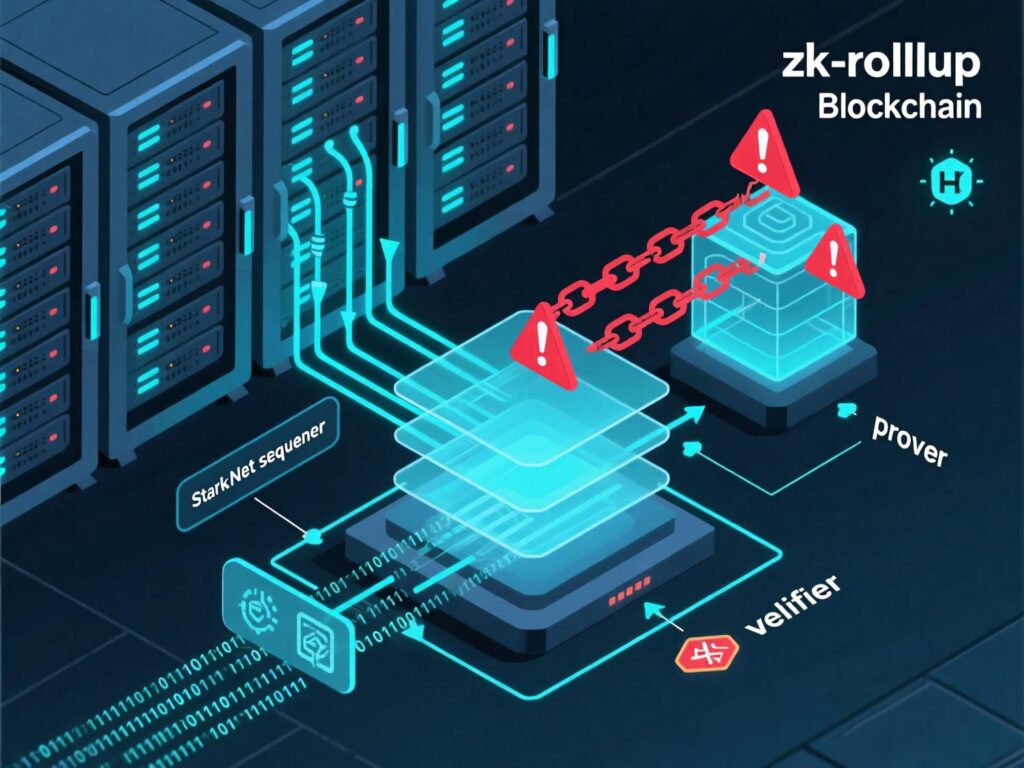
Starknet is a ZK-rollup that uses STARK proofs to compress thousands of transactions into succinct proofs posted to Ethereum. The sequencer orders L2 transactions, producing blocks that are later proven on L1. While this design offers high throughput and low fees, it concentrates liveness on the sequencer path making hardening and failover essential.
What users should do now
If you interacted with Starknet during the window:
Check your wallet or explorer for finality after block 1960612
Resubmit any unconfirmed transactions from 02:23–04:36 UTC
Monitor your dApp/RPC provider status pages for any lingering delays
Keep logs/tx hashes in case support or dApp teams request details


The bottom line
Starknet managed to restore operations quickly, but this marks the second major halt in just two months. The repeated issues are likely to intensify discussions around adopting multi-sequencer models, tightening compiler compatibility checks, and building stronger automated rollback tools to minimize future disruptions.
Until the team releases a detailed postmortem with clear solutions, the recent sequencer outage will remain a critical point of concern. Both developers and investors are expected to weigh this event heavily when assessing Starknet’s reliability and the broader operational risks tied to Ethereum Layer-2 platforms.