
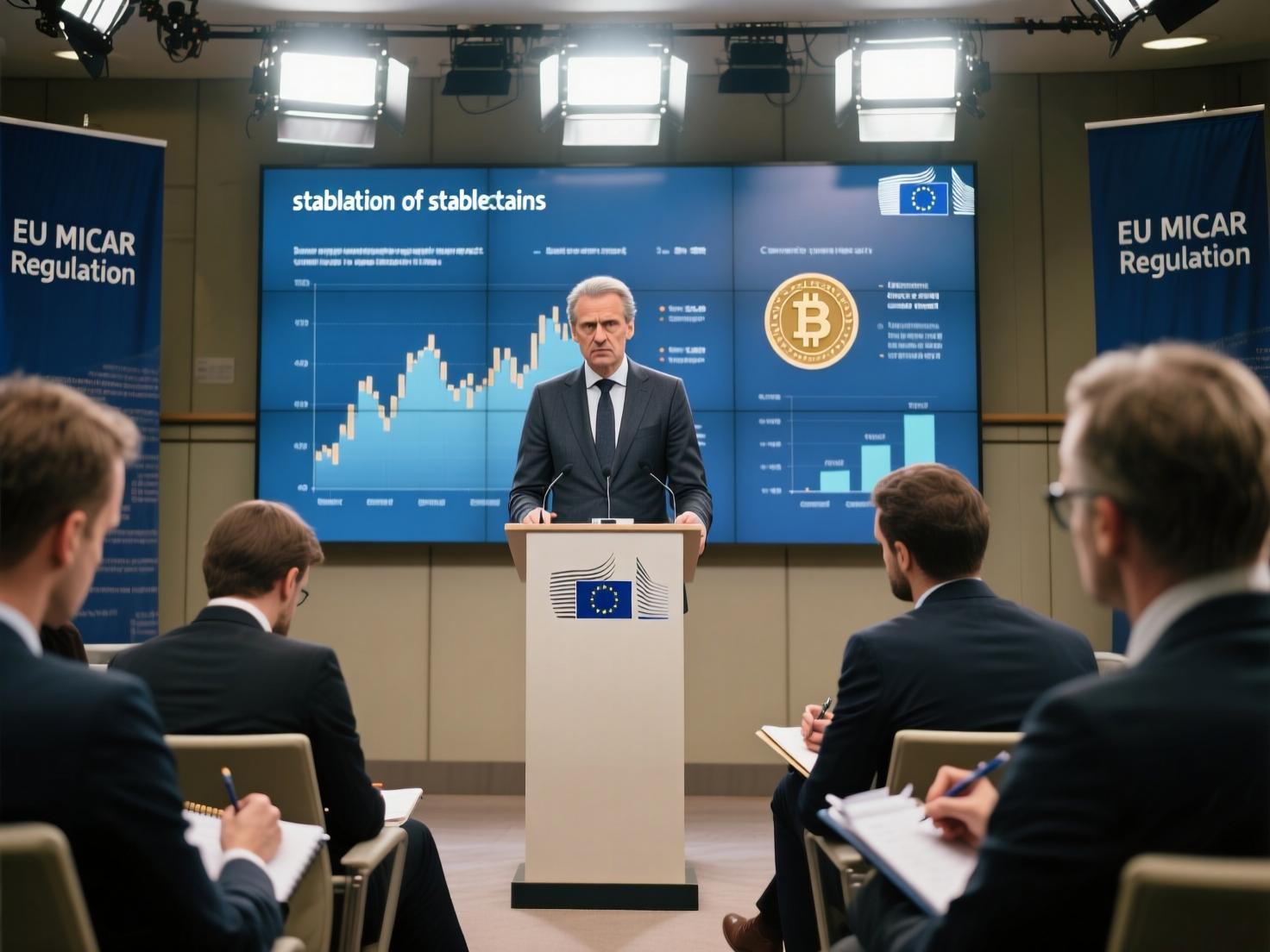

ECB’s Lagarde says EU should close loopholes in stablecoin regulation
European Central Bank President Christine Lagarde has urged EU legislators to address regulatory loopholes in cryptocurrency oversight, particularly concerning foreign stablecoin issuers. She warned that potential runs on stablecoins could create significant redemption pressures within the European Union if non-EU companies aren’t subject to the same regulatory standards as European firms. This concern highlights vulnerabilities in the current system where foreign issuers may operate with less stringent oversight.
Lagarde’s statements bring renewed attention to the EU’s Markets in Crypto-Assets Regulation (MiCAR) framework and its treatment of international stablecoin providers. The key issue centers on how to regulate non-EU issuers whose reserve assets may be partially or wholly held within European borders. This regulatory gap could potentially expose EU financial stability to risks from inadequately supervised foreign cryptocurrency operations, prompting calls for more comprehensive international coordination in digital asset oversight.
Key points at a glance
Lagarde: require “robust equivalence” for non-EU stablecoin issuers.
Concern: redemption runs could concentrate inside the EU, where fees are banned.
Italy’s CONSOB: clarify that stablecoins aren’t legal tender—only the euro is.
Next step: legislators to align cross-border reserve and redemption rules.
Why the ECB is pushing now
The EU’s Markets in Crypto-Assets Regulation (MiCAR) already imposes some of the world’s strictest rules on stablecoins, including full reserve backing and redemption rights. But Lagarde argues that without reciprocal standards abroad, firms issuing tokens both inside and outside the bloc may channel stress toward the EU in a crisis. Strengthening EU MiCAR stablecoin regulation to cover foreign issuers through equivalence would, in her view, reduce that “path of least resistance.”
The loophole Lagarde wants closed
MiCAR lets holders redeem where it’s most advantageous. In a market panic, investors may prefer the EU—where redemption fees are prohibited and oversight is tighter—potentially overwhelming EU-held reserves if large shares of issuance sit offshore. Lagarde’s fix: make access to the EU contingent on foreign issuers meeting safeguards comparable to those under EU MiCAR stablecoin regulation and on clear rules for moving reserve assets between EU and non-EU entities.
Italy’s stance on legal tender
Speaking at the same event, Federico Cornelli, a commissioner at Italy’s market watchdog CONSOB, underscored that crypto assets, including stablecoins, are not legal tender for settling obligations. Only the euro, issued by the ECB, has that status. The statement aims to stop confusion among consumers and firms as payments experiments evolve under EU MiCAR stablecoin regulation and national supervisory practice.
What stronger rules could include
Equivalence tests for foreign issuers:
Grant EU market access only if the home regime matches core MiCAR standards on reserves, custody segregation, audits, and redemption.Cross-border reserve mobility controls:
Explicit safeguards for transferring high-quality liquid assets between EU and non-EU affiliates during stress.Supervisory cooperation:
Binding information-sharing and crisis-management protocols so a run cannot be “exported” to EU balance sheets.Clear consumer messaging:
Consistent disclosures that stablecoins aren’t deposits or legal tender—even under enhanced EU MiCAR stablecoin regulation.Resolution and wind-down plans:
Playbooks for orderly redemption, including intraday liquidity and back-up banking lines.
International coordination
Lagarde emphasized that crypto risks are borderless; fragmented standards let capital and risk—flow to lighter-touch jurisdictions. Convergence around EU MiCAR stablecoin regulation principles could anchor a global baseline, limiting regulatory arbitrage and reducing systemic spillovers into EU banks, market funds, and payment rails.

Conclusion
The European Union has established stringent standards through its Markets in Crypto-Assets Regulation (MiCAR), creating a robust regulatory framework for digital assets. However, ECB President Christine Lagarde emphasizes that regulatory work remains incomplete. Without ensuring foreign stablecoin issuers face equivalent requirements, the EU risks becoming a crisis refuge point where market participants flee during turbulent times.
Future MiCAR developments will likely focus on three critical areas: establishing regulatory equivalence with international partners, managing cross-border reserve asset mobility, and implementing coordinated supervisory mechanisms. These enhancements aim to prevent the EU from becoming the “strongest door” that attracts destabilizing capital flows during global cryptocurrency market stress, ensuring balanced international regulatory standards.
FAQs
Q1 : What is changing under EU MiCAR stablecoin regulation that Lagarde wants?
A : She’s urging equivalence so foreign issuers meet the same safeguards as EU firms under EU MiCAR stablecoin regulation, reducing redemption-run risks.
Q2 : Why are redemption runs a concern for the EU?
A : Investors could redeem in the EU where fees are banned, concentrating stress on reserves located in the bloc unless EU MiCAR stablecoin regulation is mirrored abroad.
Q3 : Are stablecoins legal tender in the EU?
A : No. Regulators reiterated that only the euro is legal tender; EU MiCAR stablecoin regulation governs issuance and redemption but doesn’t grant legal-tender status.
Q4 : What safeguards might be required for non-EU issuers?
A : Comparable reserve quality, segregation, audits, crisis playbooks, and supervisory cooperation aligned with EU MiCAR stablecoin regulation.