

Dubai Metaverse Strategy 2030: Global Investor Guide
The Dubai metaverse strategy is Dubai’s 2030 plan to become a top-10 global metaverse economy by adding around $4 billion to GDP, creating more than 40,000 virtual jobs and attracting over 1,000 blockchain and Web3 companies.
For US, UK and EU founders, it offers a relatively clear virtual-assets regulatory framework, tax-efficient hubs and direct access to the wider MENA metaverse ecosystem from a single Gulf base, with regimes such as VARA, DIFC and ADGM now specifically addressing digital assets and metaverse activities.
Introduction
Launched in 2022, the Dubai metaverse strategy sets out how the emirate wants to be one of the world’s top 10 metaverse economies by 2030, with billions in added GDP and tens of thousands of “virtual jobs” across sectors like government, tourism and real estate.
For founders and investors in the US, UK, Germany and the wider EU, this isn’t just another city slogan. It’s a concrete attempt to turn Dubai into a Web3 and immersive-tech operations base with relatively clear virtual-asset rules, competitive tax and strong connectivity to Europe, the US and Asia.
In this guide, you’ll get a structured view of Dubai’s 2030 vision, how it fits into the wider UAE digital-economy agenda, what the regulatory stack really looks like (VARA, DIFC, ADGM, SCA), the current Web3 ecosystem, real use cases in Dubai and the Middle East, and practical playbooks for US, UK and EU teams deciding whether to plug into the virtual economy in Dubai.
What Is the Dubai Metaverse Strategy 2030?
The Dubai Metaverse Strategy is the emirate’s 2030 plan to become a top-10 global metaverse economy by attracting Web3 firms, creating tens of thousands of virtual jobs and adding several billion dollars to GDP through immersive tech in sectors like government, tourism and real estate.
In practice, it’s a policy and ecosystem roadmap: build digital infrastructure, attract 1,000+ blockchain and metaverse firms, and make immersive services part of day-to-day life in Dubai.
Core Vision, Jobs and GDP Targets to 2030
Officially, Dubai wants the metaverse sector to add around $4 billion to the local economy by 2030, support more than 40,000 virtual jobs and attract over 1,000 specialist companies in blockchain and metaverse technologies.
“Virtual jobs” here means work done in or for immersive environments: XR designers, 3D environment artists, digital-twin engineers, virtual customer-support teams, smart-contract developers and governance staff for tokenised economies.
This puts Dubai alongside early metaverse policy movers like Seoul and Shanghai, and regional rivals such as Riyadh. Strategy& (part of PwC) estimates the metaverse could add roughly $15 billion to GCC economies by 2030, with the UAE and Saudi Arabia as the main beneficiaries.
For founders watching long-term market size, global metaverse estimates often cluster between roughly $90–140 billion in 2023 and well over $1 trillion by 2033, depending on methodology and what you count as “metaverse.
Strategy Pillars Talent, Infrastructure, Regulation, Use Cases
Under the hood, Dubai’s metaverse strategy leans on four main pillars:
Talent
Upskilling local and regional talent in XR, game engines, blockchain and data science, and bringing in experienced founders from the US, UK and EU.
Infrastructure
5G (and future 6G), cloud and regional data centres, plus dedicated spaces like Dubai Internet City and Dubai Multi Commodities Centre (DMCC)
Regulation
Embedding metaverse and virtual assets into Dubai’s regulatory innovation agenda via VARA and DIFC/ADGM digital-assets laws.
Use cases
Priority sectors such as government services, tourism, real estate, retail, finance and education.
For US and European teams used to fragmented Web3 rules, Dubai’s combination of infrastructure and virtual-assets regulation is a major part of the appeal.
How the Metaverse Strategy Fits the Wider UAE Digital Vision
The Dubai metaverse strategy sits inside a bigger UAE digital-economy playbook that includes AI strategy, blockchain initiatives and Dubai’s D33 Economic Agenda.
Institutions like Dubai Future Foundation and the Higher Committee for Future Technology and Digital Economy coordinate much of this, including the Dubai Metaverse Assembly and related reports.
At the national level, the UAE is diversifying away from hydrocarbons into high-value digital sectors and “future of work” industries. For a German industrial group exploring digital twins of logistics hubs, or a UK fintech building Web3 rails, that means metaverse pilots are not side projects they’re part of the country’s long-term economic strategy.
Dubai’s Role in the Middle East Metaverse & Web3 Landscape
Dubai acts as one of the leading metaverse and Web3 hubs in the Middle East, competing and collaborating with Riyadh, Abu Dhabi, Doha and others by combining aggressive digital policy, talent hubs and investor-friendly regulation.
For US, UK and EU companies, it often serves as the default gateway into the wider MENA metaverse ecosystem.
Metaverse Middle East Market Overview and Key Hubs
Across the Middle East, governments in the UAE, Saudi Arabia, Qatar, Bahrain, Kuwait and Oman are all experimenting with metaverse projects, from smart cities and tourism to esports and education.
Middle East & Africa’s metaverse market alone is projected to reach roughly $4.6 billion by 2030, growing at a CAGR of around 36–37% from the mid-2020s.
Key hubs include.
Dubai
Metaverse strategy, DEWAverse, Ministry of Economy’s metaverse HQ.
Abu Dhabi (Hub71, ADGM)
Deep fintech and digital-assets regulation, strong sovereign-wealth backing.
Riyadh / Saudi Arabia
Vision 2030 megaprojects and heavy investment in gaming and esports.
Doha / Manama / Kuwait City / Muscat
Targeted pilots in tourism, education and financial services.
How Dubai Compares to Riyadh, Abu Dhabi, Doha and Others
Dubai’s edge is its mature “Gulf city as a service” model: DIFC as a global financial centre, Dubai International Airport as a mega hub, and a long track record of attracting multinational HQs.
Versus Riyadh
Saudi Arabia leans on massive sovereign funding and gaming/esports; Dubai leans on services, tourism and a broader MENA metaverse ecosystem.
Versus Abu Dhabi
ADGM is often seen as more institutional and finance-heavy; Dubai (DIFC, DMCC, Internet City) is more mixed-use, with strong startup, agency and brand activity.
Versus Doha/Manama
Dubai has a much larger pipeline of private Web3 agencies, accelerators and events (GITEX, Web3/metaverse summits).
For a US startup in Austin or a London-based studio building metaverse experiences, Dubai often becomes the “front door” into clients spread across Riyadh, Doha and the rest of the Gulf.
Why Global Analysts See Dubai as a Lead Regional Market
Consultancies and think tanks repeatedly highlight Dubai as a leading regional metaverse market due to regulatory visibility, infrastructure and early public-sector pilots.
Global law firms and media now regularly brief clients in New York, London, Berlin and Amsterdam on Dubai metaverse 2030 jobs and GDP targets so your legal and compliance teams are likely already tracking it.
Why the UAE Is Becoming a Global Hub for Metaverse and Web3 Regulation
The UAE is emerging as a metaverse and Web3 regulatory hub because it combines specialised virtual-asset regulators like VARA with sandbox-style frameworks in DIFC and ADGM, offering clearer rules than many Western markets while staying aligned with global standards.
For founders, this means you can choose a licensing route that fits your risk appetite and business model.
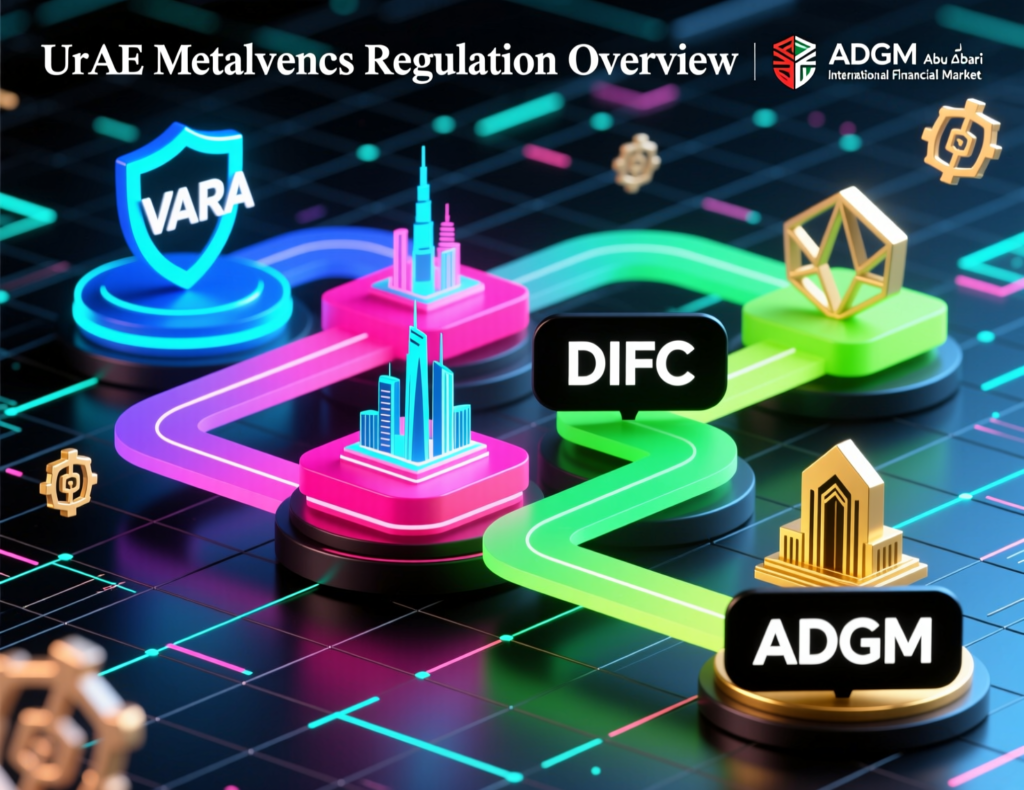
Overview of VARA, DIFC/DFSA, ADGM/FSRA and SCA
At a high level.
VARA (Dubai Virtual Assets Regulatory Authority) oversees virtual-asset activities in Dubai outside DIFC, including exchanges, custodians and certain token issuers.
DIFC & DFSA regulate financial-services Web3 plays tokenised securities, custody, payments through a common-law framework.
ADGM & FSRA (Abu Dhabi) provide one of the region’s most developed digital-assets regimes and are currently updating their framework for areas like staking.
SCA (Securities and Commodities Authority) is the federal regulator covering securities and many virtual-asset activities across the mainland.
Overlaying all of this is the Responsible Metaverse Self-Governance Framework (2024), a UAE-wide initiative that sets principles for safety, privacy, IP, interoperability and sustainability in metaverse platforms.
Comparing UAE Rules with SEC, FCA, BaFin and MiCA
For US, UK and EU stakeholders, the question is usually: “Will UAE rules conflict with home-market regulators?”
SEC (US)
Tends to treat many tokens as securities through enforcement. UAE frameworks, by contrast, explicitly classify virtual-asset activities and licensing categories often giving more upfront certainty, even if you still need US counsel for US investors.
FCA (UK)
Strict on marketing and consumer harm. UAE regulators are converging on similar themes (disclosure, suitability, AML), but with a stronger focus on attracting responsible innovation.
MiCA/BaFin (EU)
MiCA introduces EU-wide licensing and passporting; BaFin is already tough on unlicensed crypto. UAE licences won’t automatically passport into the EU, but they can help you demonstrate robust governance to BaFin or ESMA when arguing that parts of your Web3 stack sit in a highly regulated third country.
On the data side, GDPR/DSGVO and UK-GDPR rules on international transfers still apply if you process EU/UK personal data in Dubai or Abu Dhabi. Many companies handle this with SCCs, TIAs and careful architectural choices (for example, in-region EU data lakes with anonymised or pseudonymised data in UAE environments).
What US, UK and EU Founders Must Know About Data, KYC/AML and Cross-Border Risk
If you’re running a metaverse or Web3 product from Dubai that touches EU/UK or US users, expect to.
Map data flows carefully between EU/UK, the UAE and any other regions.
Align KYC/AML controls with both UAE expectations (VARA, ADGM, DIFC) and FATF guidance especially if you’re dealing with retail users or DeFi-like structures.
Involve UAE-based digital-assets counsel early when your product spans multiple regulators (for example, VARA + SCA + BaFin)
This is where specialised partners help. Firms like Mak It Solutions can work with your legal teams to design architectures web, mobile and data that respect GDPR/DSGVO, UK-GDPR and PCI DSS while still leveraging UAE infrastructure
Inside the Dubai Web3 Ecosystem Talent, Capital and Infrastructure
Dubai’s Web3 ecosystem combines free-zone hubs like DIFC and DMCC, programmes such as Hub71 and metaverse accelerators, plus a growing base of dev shops, agencies and venture funds serving regional and global projects.
For many startups, this is where the real “should we move?” due diligence happens.
Hubs, Free Zones and Accelerators (DIFC, ADGM, Hub71, Dubai Future Foundation)
Key physical and legal hubs include.
DIFC
Global financial centre with its own digital-assets law and metaverse accelerator platform.
DMCC & Dubai Internet City
Popular with Web3 studios, agencies and SaaS teams.
ADGM / Hub71 (Abu Dhabi)
Strong for institutional and deep-tech Web3 plays.
Dubai Future Foundation
Convenes the Dubai Metaverse Assembly and runs future-tech programmes.
These hubs are where you’ll meet founders from New York, London, Berlin and Paris who now split their time across Dubai, Riyadh and Doha.

Web3 Development Companies, Agencies and Service Providers in Dubai
Dubai’s Web3 ecosystem now includes a dense layer of blockchain dev shops, metaverse studios, smart-contract auditors, marketing agencies and compliance boutiques targeting Gulf, European and US clients.
Mak It Solutions itself works across web development, headless CMS, mobile apps and analytics, giving metaverse teams the basics they still need fast, SEO-friendly sites, dashboards and integration layers between XR front-ends and back-office systems.
Funding, Middle East Metaverse Funds and Corporate Innovation
Capital comes from.
Local VCs and family offices backing Web3 and gaming plays.
Government-backed funds and programmes aligned with Dubai and Abu Dhabi digital strategies.
Global capital from the US, UK and Europe increasingly comfortable with UAE-regulated tokens and equity plays.
Events like GITEX, Web3 and metaverse summits, and fintech conferences in Dubai and Riyadh are often where first term-sheets get drafted so plan at least one on-the-ground visit before committing.
Metaverse Use Cases in Dubai and the Middle East Today
In Dubai and the wider Middle East, the metaverse is already used for real-estate sales, tourism experiences, public-sector services and even online dispute resolution through initiatives like DEWAverse and ADGM’s “Mediation in the Metaverse.
These aren’t just demos they’re live signals for regulators, investors and enterprise buyers.
Real Estate, Tourism and Smart City Pilots in Dubai
Dubai developers increasingly use metaverse tools for.
Virtual showrooms and launches for residential and commercial projects.
Digital twins of communities and logistics zones to support smart-city planning.
Virtual tours of landmarks and attractions, extending Dubai’s tourism funnel to users in New York, London, Berlin or Munich before they book flights.
Combined with the city’s smart-city agenda, this is building a practical “virtual economy in Dubai,” where meaningful transactions leases, bookings, consultations can originate from immersive environments.
Justice and Online Dispute Resolution DIFC Courts & ADGM Metaverse Mediation
DIFC Courts have experimented with metaverse services, while ADGM’s Arbitration Centre has implemented “Mediation in the Metaverse,” allowing cross-border disputes to be resolved in 3D virtual environments.
For Web3 founders, that matters because your disputes over IP, NFTs, DAOs, token allocations won’t always be theoretical. Knowing that regional courts and arbitration centres understand virtual assets and immersive environments reduces perceived risk for both you and your investors.
Marketing and Brand Activations for US, UK and European Brands
Dubai has become a testbed for metaverse marketing across luxury, retail, entertainment and sports.
US and UK brands use Gulf-focused metaverse campaigns to trial avatars, digital goods and event formats, then scale globally. German and French corporates often pilot industrial or B2B experiences with regional partners before rolling them into EU operations.
Culture and religion still matter
you’ll need to think about avatar design, moderation, gambling mechanics and content policies in ways that work for users in Dubai, Riyadh, Doha and wider MENA, as well as regulators in the US, UK and EU.
How International Startups Can Plug Into Dubai’s Metaverse Strategy
International startups plug into Dubai’s metaverse strategy by choosing the right free zone, securing VARA or financial-regulator approvals, aligning with EU/UK data and crypto rules, and using local accelerators, dev partners and law firms to structure Web3 operations.
The process is manageable if you treat it as a structured expansion play, not a quick “entity-in-a-box” decision.
Choosing Between Dubai, Abu Dhabi and Other Gulf Metaverse Hubs
From a founder’s perspective.
Dubai works well if you want diverse sector access (real estate, tourism, retail, fintech), strong events and a big expat community.
Abu Dhabi may be better for institutional finance, deep-tech and longer-runway projects anchored in ADGM and Hub71.
Riyadh and Doha are compelling if your focus is on Saudi Vision 2030 megaprojects or Qatar’s sports and events ecosystem but you may still want a Dubai or Abu Dhabi base for international investors.
Time-zone-wise, Dubai gives you overlap with both London and much of the US East Coast, plus fast flights to Frankfurt, Amsterdam, Paris and beyond.
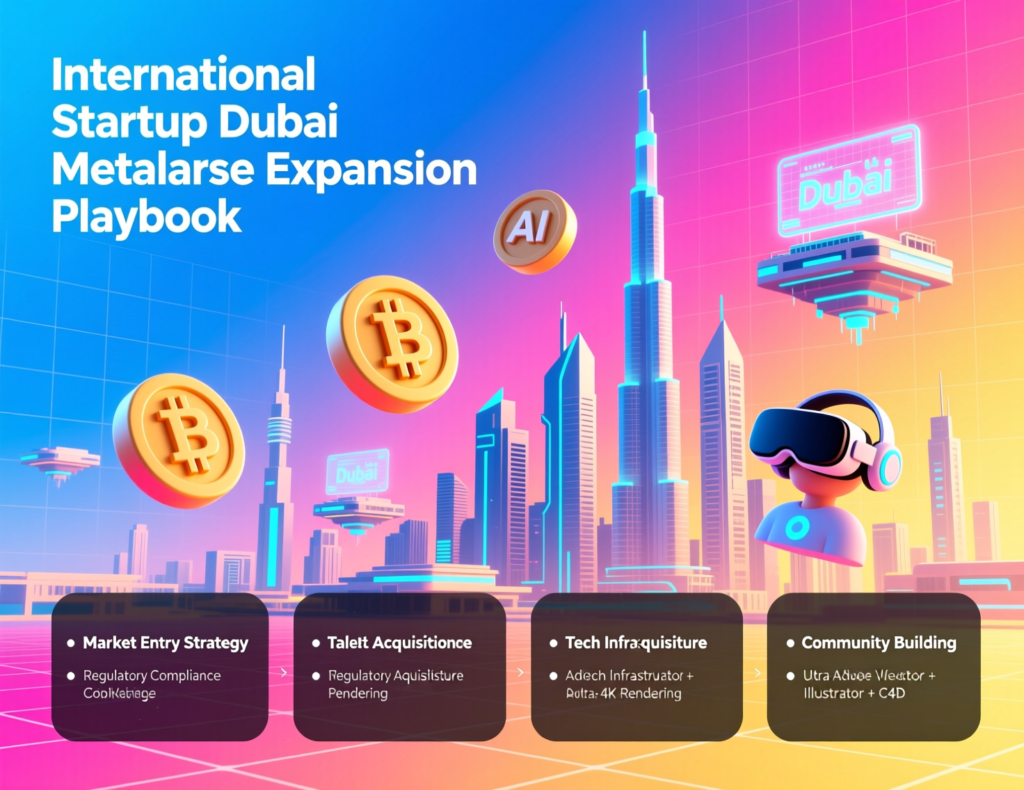
Setup and Licensing Pathways for US, UK and EU Founders
A typical path looks like this
Select your free zone and structure
DIFC, DMCC, ADGM or others, depending on whether you’re more “financial services,” “platform” or “agency.”
Determine if you need a VARA, ADGM, DFSA or SCA licence
Or a combinationbased on your token model, custody, exchange functionality and user base.
Align with home-market rules
SEC, FCA, BaFin, MiCA, GDPR/DSGVO, UK-GDPR, PCI DSS, SOC 2 and potentially HIPAA/NHS rules for health or med-tech pilots.
Build the product stack
Using partners for web, mobile and analytics (for example, Mak It Solutions’ front-end, headless CMS and mobile-app services).
Pilot with regional clients
For example, a smart-city digital twin in Dubai, an industrial metaverse proof-of-concept in Abu Dhabi or a tourism experience in Qatar.
Local digital-asset law firms and compliance specialists are essential here. They can help map multiple regulators to a single project and flag any sanctions or export-controls considerations for US founders.
GEO-Specific Playbooks US, UK and Germany/EU
US founders/investors should pay close attention to SEC and CFTC guidance, sanctions, export controls and tax. Many structure their UAE entities so they can clearly separate US activities from global token operations while still serving North American users via compliant front-ends.
UK firms can leverage the UK–UAE fintech corridor, open-banking-style APIs and strong London–Dubai connectivity. For NHS-adjacent or health pilots involving VR/AR, expect to navigate both UK-GDPR and sector-specific rules.
German/EU companies have to reconcile MiCA, BaFin expectations and DSGVO with UAE data laws. A common pattern is to keep sensitive data in EU clouds while using Dubai for immersive front-ends, MENA-focused marketing and regional partnerships especially in industrial metaverse, logistics and automotive.
Bottom Lines
Dubai’s metaverse strategy is unusually concrete: clear 2030 targets for jobs and GDP, dedicated virtual-asset regulators and a growing pipeline of public- and private-sector pilots. It’s especially attractive if you’re building Web3 infrastructure, metaverse platforms, digital-twin or XR products, or regulated fintech/crypto that needs a hub between Europe, the US and Asia.
If your organisation is ultra-risk-averse, or you must keep all data strictly on-shore in the EU or UK, Dubai may be more of a partnership hub than a primary base for now. But for many US, UK and EU founders, a carefully structured UAE presence backed by solid legal, compliance and technology partners can turn the MENA metaverse ecosystem into a very real growth market, not just a headline.
If you’re seriously considering Dubai, Abu Dhabi or another Gulf hub for your metaverse or Web3 roadmap, this is the moment to move from headlines to a structured plan.
Mak It Solutions can help your team map regulations to architecture, design Gulf-ready web and mobile experiences, and build the analytics foundations you’ll need for investors and regulators.
Share your current product, target markets (US, UK, EU, MENA) and risk constraints, and we’ll help you outline a practical Dubai/UAE expansion blueprint covering tech stack, data flows and integration with your existing platforms.( Click Here’s )
FAQs
Q : Is Dubai’s metaverse strategy realistic, or mostly marketing hype?
A : Dubai’s metaverse strategy is ambitious but not purely marketing. It’s backed by specific 2030 targets (GDP, jobs, company numbers), evolving regulations like VARA’s rulebooks, DIFC’s digital-assets law and the Responsible Metaverse Self-Governance Framework.The real test is execution, but the combination of public-sector pilots (DEWAverse, virtual Ministry of Economy HQ, metaverse courts) and sustained investment suggests the city is treating this as a long-term economic pillar.
Q : Can I run a Dubai-licensed metaverse startup while my team stays in the US, UK or EU?
A : Yes, many founders operate UAE entities while keeping distributed teams in the US, UK or EU. You’ll still need genuine local substance for licensing (offices, responsible officers, regulated staff), but much of your engineering and design work can remain remote.The main challenge is aligning time zones, board governance and cross-border data flows areas where having clear documentation and a well-architected platform is crucial.
Q : How much does it typically cost to get a VARA or UAE Web3 licence for a startup?
A : Costs vary widely depending on your activity (exchange vs. utility token vs. NFT marketplace) and whether you’re in Dubai onshore, DIFC or ADGM. Regulatory fees may range from tens of thousands of dollars upward, and you’ll need to budget for local legal counsel, compliance staff and technical controls.Most early-stage teams treat licensing as part of their Seed or Series A plan, not an MVP-only expense.
Q : Do GDPR/DSGVO rules stop EU companies from hosting user data on metaverse platforms in Dubai?
A : GDPR/DSGVO and UK-GDPR do not ban transfers to the UAE outright, but they require safeguards such as SCCs, TIAs and robust security controls when sending personal data to a non-adequate country. EU and UK companies often keep the most sensitive data in EU-based infrastructure, with pseudonymised or tokenised data in Dubai for analytics and experience layers. Legal counsel should review your architecture before you scale.
Q : Which sectors are seeing the fastest ROI from metaverse pilots in Dubai and the wider Middle East?
A : So far, the fastest visible ROI tends to come from real estate (virtual launches, remote tours), tourism and destination marketing, immersive retail, and industrial or logistics digital twins. Public-sector services (utilities, ministries, justice) are experimenting heavily, which in turn creates demand for tooling, security and integration from private vendors. Health, education and esports are emerging as important mid-term opportunities, especially across the UAE and Saudi Arabia.