
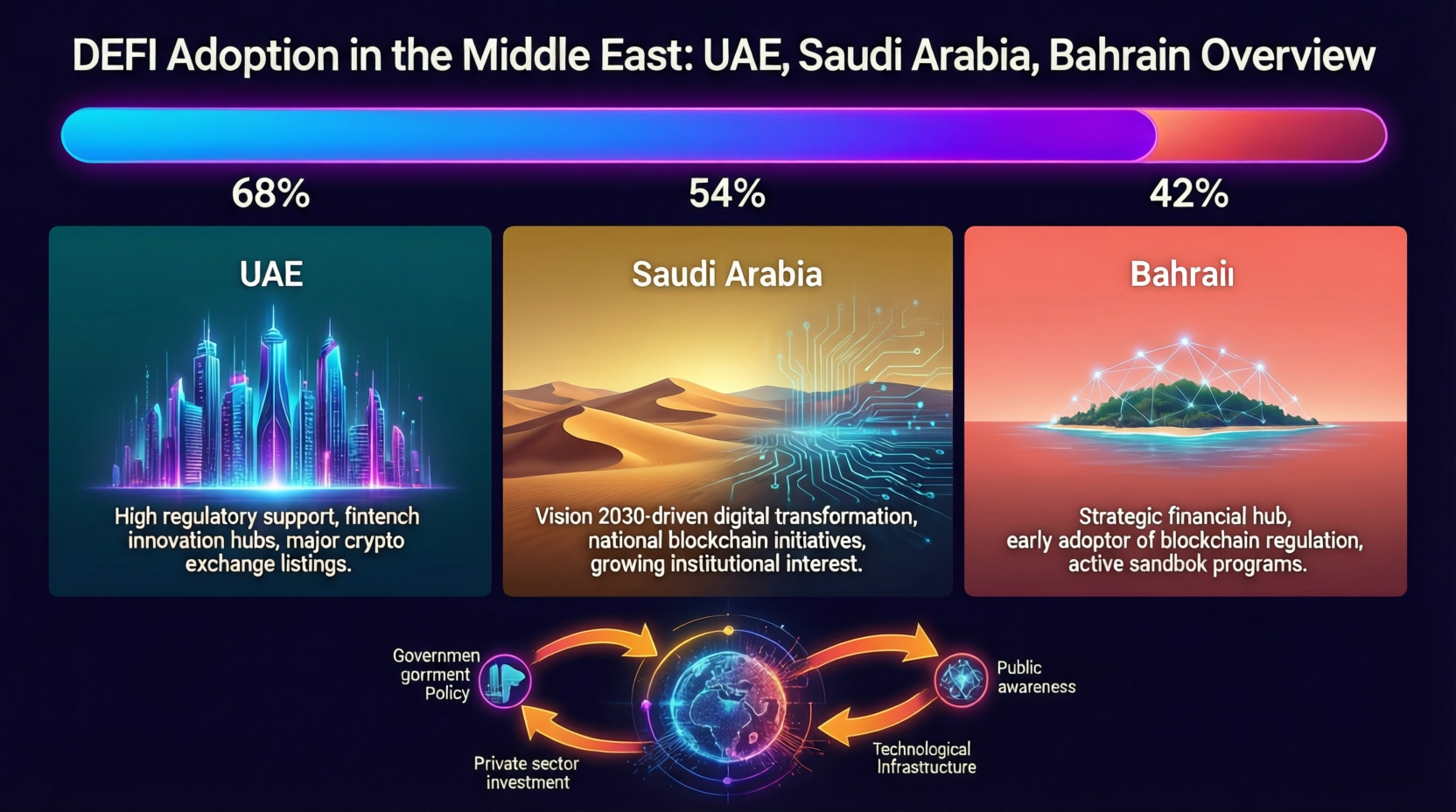

DeFi Adoption in the Middle East for Global Investors
Between 2024 and 2026, DeFi adoption in the Middle East is led by the UAE, Saudi Arabia and Bahrain, where on-chain activity and virtual-asset rulebooks are maturing faster than in many other emerging markets. For US, UK, German and wider EU institutions, these hubs now offer regulated gateways into DeFi, but success depends on aligning exposure with MiCA, BaFin, FCA and sanctions/AML expectations.
Introduction
Decentralised finance (DeFi) in the Middle East now means more than early-stage experimentation on a few protocols. In markets like the UAE, Saudi Arabia and Bahrain, DeFi sits on top of increasingly sophisticated virtual-asset frameworks, institutional on-ramps and large cross-border payment corridors.
When we say “Middle East” here, we primarily mean the Gulf Cooperation Council (GCC) notably Dubai and Abu Dhabi in the UAE, Riyadh and Jeddah in Saudi Arabia, and Manama in Bahrain plus Qatar, Oman and Kuwait, with Israel and selected wider MENA markets (e.g. Egypt, Morocco) where they’re relevant to flows.
On-chain, MENA ranked around 7th globally by crypto transaction volume in 2024, with about $338.7 billion received between July 2023 and June 2024, roughly 7.5% of global volume . In 2025, overall MENA crypto volumes still exceeded half a trillion dollars, despite slowing growth versus earlier bull runs . At the same time, DeFi’s share of activity has been rising relative to pure trading, particularly where clear rulebooks exist.
For desks in New York, London, Frankfurt and Zurich, that combination real volume plus clearer rules in hubs like Dubai, Abu Dhabi and Manama is why DeFi adoption in the Middle East has moved from niche curiosity to serious strategic question. None of this is investment, legal or tax advice; always do your own research and obtain professional advice before deploying capital.
The State of DeFi Adoption in the Middle East
AEO core answer
Today, DeFi adoption in the Middle East is led by the UAE, Saudi Arabia and Bahrain, with Israel and North African markets contributing additional activity. Together, they sit on a regional crypto market that has seen double-digit growth since 2023, even as more mature EU markets trade sideways under stricter rules.
How Fast Is DeFi Adoption Growing in MENA 2024–2026?
From 2023 to 2025, MENA crypto volumes grew by roughly one-third, to more than half a trillion dollars in annual on-chain value slower than some emerging markets, but from a much higher base . Within that, DeFi’s share has multiplied since mid-2023 as users move from pure trading to yield, lending and on-chain stablecoin payments.
Market researchers estimate the Middle East DeFi market at about $1.3 billion in 2025, with a projected CAGR above 50% to 2033 . While forecasts are always directional, they reflect a visible on-chain trend: more liquidity in DeFi pools, more wallets interacting with DEXs from Gulf IPs, and more regulated funds allocating to DeFi strategies.
Macro conditions are a big part of the story.
Inflation and FX pressure push users in Turkey, Egypt and parts of the Levant toward dollar-linked stablecoins.
Capital controls and banking frictions make cross-border value transfer via DeFi attractive compared with traditional correspondent banking.
Remittances from Europe and the US into MENA create natural demand for stablecoin rails and DeFi lending.
Conflict risk and sanctions concerns lead to both legitimate hedging behavior and heightened regulatory scrutiny around illicit flows.
Which Middle East Countries Lead DeFi Usage? UAE vs Saudi Arabia vs Bahrain vs Others
In practice, “who leads” depends on the metric:
UAE (Dubai, Abu Dhabi)
The UAE is the region’s most visible DeFi and virtual-asset hub, thanks to Dubai’s VARA and Abu Dhabi’s ADGM FSRA regimes.
Dubai tends to dominate institutional and high-net-worth flows via global exchanges, custodians and market-makers.
ADGM in Abu Dhabi is positioning as a base for regulated DeFi and tokenised securities, attractive to European banks.
Saudi Arabia
SAMA and the Capital Market Authority maintain a cautious stance, but Riyadh’s fintech sandboxes show growing interest in tokenised assets and DeFi-adjacent payment use cases.
Grassroots usage is meaningful, even where formal regulations lag.
Bahrain
The Central Bank of Bahrain (CBB) has an established Crypto-Assets Module and, in 2025, launched a dedicated Stablecoin Issuance and Offering (SIO) framework one of the first in the region.
Manama punches above its size in institutional flows, especially for stablecoins and payment-focused DeFi.
Israel and wider MENA
Tel Aviv hosts a strong base of blockchain engineers and security teams, feeding DeFi infrastructure worldwide.
Egypt, Morocco and North African markets show fast retail-led growth, often focused on stablecoin savings and remittances.
Qatar, Oman and Kuwait remain more restrictive on retail crypto and DeFi, but are active in wholesale and experiment via sandboxes relevant for long-term flows even if today’s volumes are modest.
DeFi vs CeFi in the Middle East
Today, DeFi in the Middle East largely runs on top of centralized rails, not instead of them. Most users and institutions still on-ramp through licensed centralized exchanges and custodians in ADGM, Dubai (under VARA) or Bahrain (under CBB), then interact with DeFi for yield, liquidity and cross-border transfers.
A typical pattern looks like.
Fiat in via a bank account in Dubai, Riyadh, London or Frankfurt.
Conversion to stablecoins or blue-chip assets on a regulated exchange.
Movement into DeFi protocols (DEXs, lending markets, L2s) for yield, swaps or remittances.
Back to CeFi for compliant off-ramp and reporting.
So for anyone asking what DeFi adoption in the Middle East looks like today, the answer is: a layered stack where licensed CeFi entities act as compliance and fiat gateways, while DeFi provides liquidity, programmability and cross-border reach.
Why the Middle East Is Becoming a Strategic DeFi Hub
AEO core answer
The Middle East is becoming strategic for global DeFi projects because it combines large remittance corridors, strong dollar demand and young digital-native populations with increasingly clear virtual-asset regimes in hubs like Dubai, Abu Dhabi and Bahrain. For institutions in the US, UK and EU, these hubs provide regionally regulated gateways into DeFi liquidity, tokenised assets and Gulf capital pools.
Remittances, Dollar Demand and Young Digital Natives
Gulf economies sit at the crossroads of US/EU → MENA remittance flows and global trade. Millions of workers in Dubai, Riyadh and Doha send money back to Egypt, Pakistan, the Philippines and beyond often from or through cities like London, New York and Frankfurt.
TRM Labs and others estimate that stablecoins now make up roughly 30% of all on-chain transaction volume globally, with over $4 trillion in stablecoin flows in 2025, up more than 80% year-on-year . Much of that demand is for dollar exposure, which resonates strongly in high-inflation or FX-controlled environments across MENA.
Add to that.
A young, mobile-first population, comfortable with apps and digital wallets.
Large under-banked or thin-file segments, especially among migrant workers.
Business users seeking USD working capital without holding balances in fragile local banks.
DeFi stablecoins, lending pools and yield strategies naturally plug into this environment, especially where local rules explicitly recognise virtual assets.
Inside the Gulf Crypto Hubs.
If you sit on a desk in London or New York, the Gulf currently looks like four main pillars:
Dubai (VARA)
Dubai’s Virtual Assets Regulatory Authority runs a dedicated VA framework, licensing exchanges, custodians, brokers and advisory firms across the mainland and free zones (except DIFC).Dubai’s pitch to Frankfurt, Paris and Zurich is clear: regulated, tax-efficient access to MENA and Asian liquidity.

Abu Dhabi (ADGM FSRA)
ADGM’s FSRA regime focuses on prudentially supervised virtual-asset activities and is popular with global banks and trading firms exploring tokenisation, OTC services and DeFi-adjacent products.
Riyadh/Jeddah (Saudi Arabia)
While not yet an open crypto hub, Saudi sandboxes are testing tokenised deposits, trade finance and programmable money crucial for future DeFi integration with large banks
Manama (Bahrain)
The CBB’s Crypto-Assets Module plus the 2025 Stablecoin Issuance and Offering (SIO) framework position Bahrain as a specialist hub for fiat-backed stablecoins and payment tokens, attractive to EU-regulated PSPs and EMIs.
Why US, UK, German and EU Institutions Care About Middle East DeFi
For a New York asset manager, a London-based fintech or a BaFin-regulated bank in Frankfurt, Middle East DeFi is appealing because it offers:
Yield and diversification beyond saturated US and EU venues.
Exposure to Gulf capital and sovereign-linked projects.
Access to tokenised real-world assets (RWAs) anchored in energy, trade and infrastructure.
Jurisdictions aiming to align with MiCA, FATF and FSB frameworks, making cross-border compliance more predictable.
In short, for global DeFi strategies, the Middle East is where liquidity, regulation and geopolitics intersect, creating a “third pole” between US and Asian crypto hubs.
DeFi Regulation in the Middle East vs MiCA, BaFin and UK Rules
AEO core answer
Compared with EU MiCA and BaFin/FCA rules, Middle East regimes in Dubai, Abu Dhabi and Bahrain already cover many CeFi-style activities licensing exchanges, custodians and stablecoin issuers but are still evolving on fully decentralised DeFi, staking and cross-border data. For US/European institutions, alignment with MiCA, BaFin and UK-GDPR is possible, but requires careful mapping of each activity to local VA rulebooks.
Snapshot of Key Middle East Regimes.
UAE
VARA (Dubai) issues a dedicated Virtual Assets and Related Activities Regulation, covering licensing categories like exchanges, brokers, custodians and advisory firms, with specific rules on market abuse, disclosure and AML.
ADGM FSRA treats virtual assets as a regulated financial instrument, with detailed rules for custody, exchanges and OTC desks.
Bahrain
The CBB Crypto-Assets Module regulates exchanges, brokers and custodians.
The Stablecoin Issuance and Offering Module (SIO) sets licensing, reserve and governance standards for fiat-backed stablecoins, effective July 2025.
Saudi Arabia, Qatar, Oman, Kuwait
Generally cautious, with limited public support for retail crypto trading, but active fintech and open-banking sandboxes testing tokenisation and distributed-ledger use cases.
The picture for DeFi is uneven: regulated entities can offer some DeFi-adjacent services (e.g. staking-like yields, tokenised notes referencing DeFi pools), but “pure DeFi protocols” often fall into grey zones or rely on offshore structures.
How Middle East DeFi Rules Compare with EU MiCA, BaFin and UK-GDPR/FCA Guidance
MiCA, supervised by ESMA and national regulators like BaFin, brings a harmonised regime for crypto-asset service providers (CASPs), whitepapers and stablecoin issuers in the EU.
A rough mapping looks like this.
CASP licensing vs VASP licensing
VARA and ADGM’s licensing of exchanges, custodians and brokers is conceptually similar to MiCA’s CASP model and BaFin’s crypto custody licences.
ESMA has already warned CASPs not to misrepresent MiCA authorisation across regulated and unregulated products a lesson Gulf firms are watching closely
Whitepapers and disclosure
MiCA mandates approved whitepapers for certain tokens.
Gulf regimes often require offering memoranda or prospectus-like documents for token offerings involving retail investors, even if not called “whitepapers.”
Stablecoins
MiCA’s “e-money tokens” and “asset-referenced tokens” regime has clear overlaps with Bahrain’s SIO framework and emerging UAE guidance.
For UK players in London or Manchester, the FCA’s crypto roadmap and UK-GDPR requirements add an extra layer, particularly around marketing, consumer duty and data rights. And for German institutions, BaFin’s expectations on cross-border crypto services and outsourcing due diligence still apply when engaging with VARA/ADGM entities from Frankfurt or Munich.
Data, Sanctions and AML/CFT.
Institutions looking at Middle East DeFi must join the dots between.
Global AML/CFT standards
FATF travel rule, FATF/FSB guidance on crypto-asset supervision, and sanctions screening expectations.
US and EU sanctions
OFAC lists, EU designations, and sectoral sanctions that may touch counterparties in Tel Aviv, Riyadh or Doha.
Data protection
GDPR/DSGVO and UK-GDPR for EU/UK users; plus sectoral rules such as HIPAA (for health data), PCI DSS (payments) and SOC 2 (vendor governance) when DeFi or Web3 components touch regulated stacks like NHS systems or European banks’ customer data.
Micro-answer
Compared with MiCA/BaFin and FCA/UK-GDPR, Middle East DeFi regimes are converging on similar AML/CFT and market-abuse standards, but differ on consumer-duty expectations, data localisation and the explicit treatment of fully decentralised protocols. Institutions must treat each DeFi touchpoint on-ramp, protocol, off-ramp as a separate regulated relationship.
Institutional DeFi Use Cases and Opportunities in the Middle East
AEO core answer
Today, US, UK and EU institutions typically access Middle East DeFi via regulated funds, liquidity provision arrangements and stablecoin-based payment flows through UAE and Bahrain VASPs. Over time, more banks and corporates are experimenting with tokenised trade finance, treasury products and RWA platforms anchored in Gulf jurisdictions.
Cross-Border Payments and Remittances Using Stablecoins
For many institutions, the lowest-risk starting point is payments.
A London-based fintech partners with a VARA-licensed exchange in Dubai to offer USD stablecoin remittances from the UK to Egypt or Pakistan, settling via DeFi pools and off-ramping locally.
A Frankfurt corporate treasury uses on-chain USD liquidity in Abu Dhabi to hedge EM FX exposures and manage cash between Europe, Riyadh and Dubai.
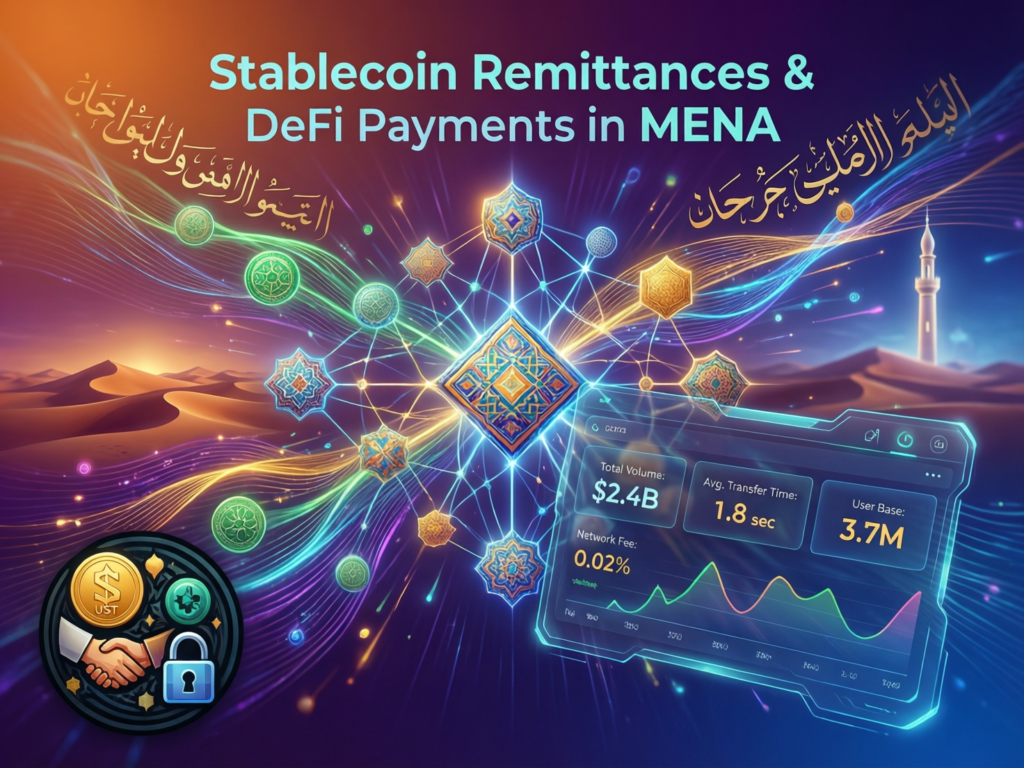
TRM Labs data shows stablecoins’ share of global on-chain volume surged to around 30% in 2025, with over $4 trillion in stablecoin flows year-to-date and strong growth in North African corridors . This is exactly where Middle East DeFi infrastructure especially in UAE and Bahrain can act as a regional settlement layer.
Trade Finance, Treasury and Liquidity for Banks and Corporates
Beyond remittances, the next wave of use cases includes.
Tokenised trade receivables and supply-chain finance, where exporters in Germany or France sell tokenised invoices to Gulf investors via regulated platforms in ADGM or Dubai.
Short-term liquidity pools for working capital, where corporates in Riyadh or Doha tap DeFi-style lending structures, wrapped in regulated fund or note vehicles.
Co-branded products between international banks and local VASPs for example, a Luxembourg-domiciled fund investing in DeFi strategies executed from Abu Dhabi.
Architecturally, these models often lean on modern microservices and API-driven stacks the kind of design Mak It Solutions often explores in its work on microservices vs monolith migrations and cloud-native modernization (Mak it Solutions).
Strategic Entry Points for US, UK and EU Institutions
Typical entry paths we see from New York, London, Berlin or Zurich include.
LP positions in regulated DeFi funds e.g. Cayman or Luxembourg funds with on-the-ground execution teams in Dubai or Abu Dhabi.
Liquidity provision to protocols via market-making partnerships or structured products referencing DeFi yields.
Co-branded offerings stablecoin payment rails or tokenised asset platforms with Gulf VASPs under VARA, ADGM or CBB oversight .
For all of these, MiCA-compliant CASPs, BaFin/FCA licences and internal risk appetite frameworks drive what’s actually possible and where Mak It Solutions–style partners can help stitch together technical, regulatory and data-governance requirements (Mak it Solutions).
Risks, Security and Consumer Protection in Middle East DeFi
Hacks, Rug Pulls and Illicit Finance Risks Affecting MENA Users
The opportunity story sits alongside a harsh reality: DeFi remains a prime target for hacks and scams. Chainalysis and industry analysts estimate crypto theft hit tens of billions of dollars in 2025, with DeFi exploits and sophisticated impersonation scams playing a major role.
Key risk vectors for MENA users include.
Smart-contract exploits and oracle manipulation.
Governance attacks and hostile takeovers of protocol treasuries.
Rug pulls, where liquidity vanishes overnight.
Phishing and social-engineering scams targeting Arabic- and Urdu-speaking users across Dubai, Riyadh, Cairo and beyond.
These risks intersect with terrorism financing and sanctions evasion concerns — especially around conflict zones and sanctioned entities that may try to route funds through DeFi pools touching Middle East VASPs.
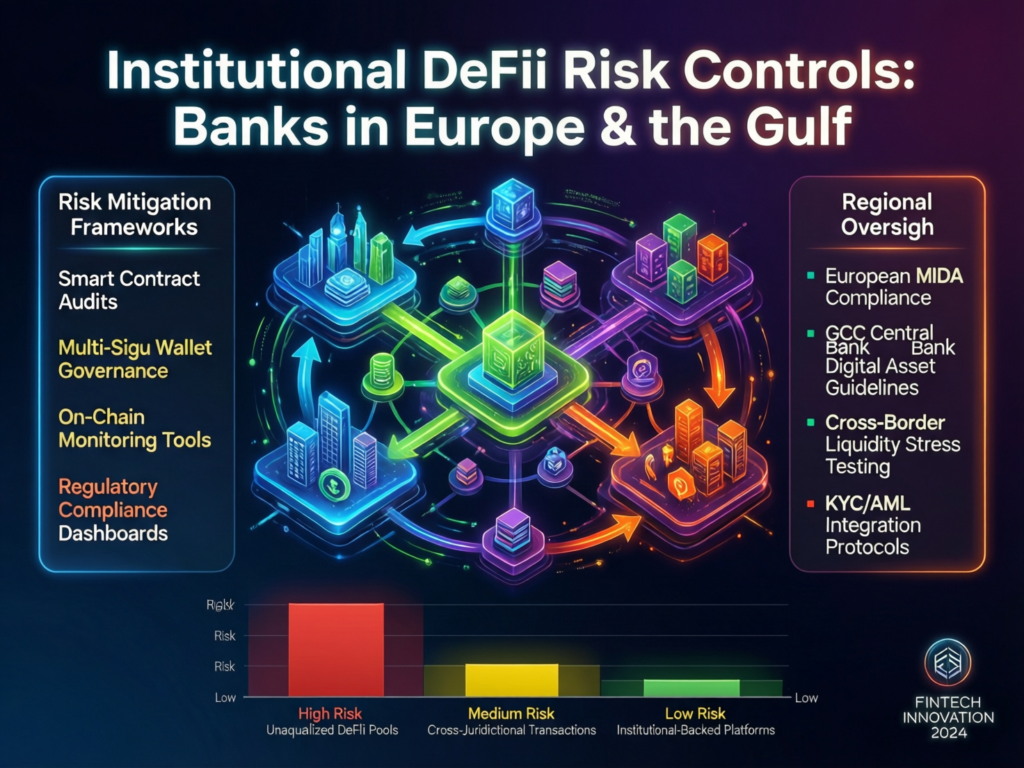
How Regional Regulators Are Responding.
Regulators are ramping up.
VARA has extended its rulebook to cover market-abuse monitoring, suspicious transaction reporting and stricter governance for token issuances.
ADGM FSRA and CBB emphasise robust AML/CFT controls, chain-analytics use and fit-and-proper tests for virtual-asset entities.
Saudi authorities coordinate closely with FATF and the FSB as they experiment via sandboxes, mindful of reputational risk.
FSB reviews in 2025 still found significant gaps in global crypto rule implementation, raising the risk of regulatory arbitrage between EU, US and emerging markets — another reason major institutions must build their own cross-border risk views rather than just “trusting the licence.
What US, UK and German Risk Teams Should Ask Before Touching Middle East DeFi
For risk and compliance teams in New York, London or Frankfurt, due diligence should include at least:
Protocol governance: who controls upgrades, emergency pausing, treasury spend?
Security posture: audit history, bug-bounty programs, incident response playbooks.
AML and sanctions: travel-rule compliance, OFAC/EU list screening, use of reputable chain-analytics tools.
Data protection: where logs and analytics live; alignment with GDPR/DSGVO, UK-GDPR, HIPAA/PCI DSS where relevant (esrb.europa.eu).
Vendor governance: SOC 2-style control reporting for key service providers, as emphasised by EU frameworks like DORA and DAC8
Micro-answer
Regulators and compliance teams can mitigate AML/CFT, hacking and consumer risks in Middle East DeFi by insisting on regulated on-/off-ramps, mandatory chain-analytics coverage, strong security audits and clear escalation channels between VARA/ADGM/CBB, ESMA, BaFin, FCA and US agencies.
How US, UK and EU Institutions Can Approach Middle East DeFi Safely
Phased Entry Strategy for US, UK and German Institutions
practical way into Middle East DeFi is to use a three-phase roadmap.
Observe & monitor
Map relevant VARA, ADGM and CBB-licensed entities.
Track on-chain flows into/out of the region using analytics tools, focusing on protocols touching New York, London, Berlin or Zurich clients.
Limited exposure via regulated intermediaries
Allocate to regulated funds or structured products whose DeFi execution sits in the UAE or Bahrain, but whose investor protections align with MiCA/BaFin/FCA norms.
Direct protocol participation with strong controls
Once governance, security and legal opinions are in place, consider direct liquidity provision, market-making or RWA platforms, with DeFi infrastructure integrated into existing bank/fintech stacks .
US investors must add OFAC, SEC/CFTC and state-level considerations; UK firms look to FCA and UK-GDPR; German banks and insurers must align with BaFin’s views on outsourcing and crypto custody.
Building a Compliance and Monitoring Stack Around Middle East DeFi
Regardless of phase, you’ll need a stack that can satisfy both local VA regimes and home-market supervisors.
Chain-analytics and transaction-monitoring tools for DeFi addresses.
Travel-rule and sanctions-screening integrations at on-/off-ramp points.
Automated reporting that maps DeFi positions to MiCA categories, capital models and DORA operational-risk frameworks (ESMA).
This is where multi-disciplinary partners like Mak It Solutions are helpful — combining cloud, data, application development and analytics to tie DeFi activity into broader risk dashboards CIOs already care about (Mak it Solutions).
Signals to Watch 2024–2026: Regulation, Volumes and Institutional Flows
To track DeFi adoption in the Middle East over the next two years, watch:
Regulatory milestones further VARA rulebook updates, UAE-level DeFi guidance, Bahrain’s SIO implementation, and ESMA’s MiCA Level-2 and market-abuse guidelines
Volume indicators MENA’s share of global on-chain volume in Chainalysis/TRM reports, and DeFi vs CeFi split
Institutional newsflow new licences, partnerships and RWA launches involving banks in London, Frankfurt, Paris or Zurich with UAE/Bahrain entities
Micro-answer
If you periodically review Gulf VA rulebooks, Chainalysis/TRM adoption indices and ESMA/FSB updates, you’ll have a workable early-warning system for shifts in Middle East DeFi risk and opportunity.

Key Takeaways
Adoption
DeFi adoption in the Middle East is growing from a substantial base, with UAE, Saudi Arabia and Bahrain leading institutional and retail flows.
Regulation
VARA, ADGM and CBB frameworks are converging with MiCA/BaFin/FCA expectations on licensing and AML, but remain more flexible and therefore more variable on fully decentralised DeFi.
Use cases
The most credible institutional plays today are stablecoin payments, trade-finance tokenisation and liquidity provision via regulated funds, not “degen yield” strategies.
Risks
Hacks, scams and sanctions-evasion risks are material, and FSB/ESMA continue to flag gaps in global implementation cross-border governance is non-negotiable.
Strategy
A phased entry, backed by analytics, strong vendor governance and cloud/data architectures that already meet EU/UK standards, is the safest route into Middle East DeFi.
For institutions in the US, UK and EU, the question is less “in or out?” and more “on what timeline, with which partners and under what controls?”
If you’re a US, UK or EU institution weighing DeFi adoption in the Middle East, the real question isn’t whether to engage, but how fast and under what controls. The combination of Gulf capital, maturing rulebooks and rising DeFi liquidity will keep pulling global flows towards Dubai, Abu Dhabi and Manama.
Mak It Solutions can help you map those opportunities to your existing cloud, data and risk stack from discovery workshops with your CIO and compliance leads, to designing tracking dashboards and integration patterns your regulators will understand. Start by scoping a small, evidence-driven pilot, then scale once you’re confident your governance and data foundations are solid.( Click Here’s )
FAQs
Q : Is DeFi legal in Dubai and Abu Dhabi for retail and institutional investors?
A : Yes, DeFi-related activity is possible in both Dubai and Abu Dhabi, but almost always via licensed virtual-asset service providers rather than direct, unmediated use of any protocol. VARA in Dubai and the FSRA in Abu Dhabi’s ADGM authorise exchanges, custodians, brokers and advisors, some of which build or integrate DeFi-style products such as staking, lending or liquidity pools. For retail and institutional investors in London, New York or Frankfurt, the safest path is to use entities that hold VARA/ADGM licences and can evidence strong AML, sanctions and market-abuse controls that align with MiCA, BaFin and FCA expectations.
Q : Can US investors access Middle East DeFi projects without breaching OFAC or sanctions rules?
A : US investors can access Middle East DeFi projects, but they must treat OFAC and other sanctions rules as hard constraints. The safest approach is to use US-compliant intermediaries and VASPs that screen addresses against OFAC and EU lists, apply the travel rule, and can provide evidence of sanctions controls. Direct LP positions in protocols that cannot or will not apply such controls are high-risk. US investors should also consider SEC/CFTC guidance on digital-asset securities and derivatives, and may want to route exposure through regulated funds or products that specifically address sanctions and reporting obligations.
Q : How do Bahrain’s crypto and stablecoin rules support Sharia-compliant DeFi products?
A : Bahrain’s CBB Crypto-Assets Module and the 2025 Stablecoin Issuance and Offering (SIO) framework create a structured environment for fiat-backed, fully reserved stablecoins and other virtual-asset services. That foundation makes it easier for issuers and DeFi platforms to work with Sharia boards on structures where reserves, profit-sharing and risk are transparent and auditable. While “Sharia-compliant DeFi” is not a regulated label by itself, Bahrain’s rules around reserves, governance and disclosure give Islamic-finance stakeholders clearer information to assess products especially for payment tokens and tokenised sukuk-like instruments.
Q : What are the main differences between Middle East DeFi hubs and EU-based DeFi platforms under MiCA?
A : EU DeFi platforms operating under MiCA tend to face more uniform investor-protection and disclosure rules, with ESMA and national regulators like BaFin supervising CASPs and stablecoin issuers. Middle East hubs such as Dubai, Abu Dhabi and Manama have comparable licensing for CeFi-style services but offer more bespoke, jurisdiction-specific regimes for DeFi and tokenisation. In practice, that can mean faster innovation and flexible sandbox arrangements in the Gulf, but also more variability in consumer-duty standards and fewer explicit protections for users interacting directly with protocols.
Q : Which risk controls should UK and German banks require from DeFi protocols based in the Gulf?
A : UK and German banks should treat DeFi protocols touching Gulf jurisdictions as critical vendors, applying controls similar to other high-risk financial partners. That means insisting on independent security audits and bug bounties, clear governance and upgrade paths, robust AML/CFT and sanctions screening via reputable analytics providers, and transparent data-hosting arrangements that respect GDPR/DSGVO and UK-GDPR. They should also require SOC 2-style reporting from technical operators, test DeFi integrations in segregated environments, and map each protocol’s risk to DORA operational-resilience requirements and BaFin/FCA outsourcing expectations before approving any production use