

Cryptocurrency Regulation in Egypt: Compliance Guide
In 2026, cryptocurrency regulation in Egypt makes most real-world use effectively illegal in practice. Issuing, trading, promoting or operating platforms dealing with “cryptographic units” is prohibited unless the Central Bank of Egypt (CBE) explicitly licenses the activity and no such licences have been granted.
US, UK, German and wider EU banks and fintechs should treat Egypt as a high-restriction market, geo-block or heavily limit crypto services for users located in Egypt, and align their Egypt controls with MiCA, FCA, BaFin, SEC, CFTC and other home regulators’ expectations.
Cryptocurrency regulation in Egypt is among the toughest in the world, yet interest in Bitcoin, stablecoins and trading apps keeps growing among its 100M+ citizens. Recent analysis suggests around 3 million Egyptians hold some form of crypto, and the country ranked roughly 26th in a recent global adoption index despite a prohibitive legal stance.
So, is crypto legal in Egypt in 2026? On paper, the law says crypto activity is prohibited unless the Central Bank of Egypt approves it. In practice, no licences exist, so most real-world use is effectively banned.
This guide is written for
Compliance leads at banks and fintechs in New York, London, Frankfurt and Paris
Legal teams serving US, UK, German and EU-regulated institutions
Founders of cross-border exchanges, wallets and payment firms
Expats and remote workers with ties to Egypt and to US/UK/EU financial systems
You’ll find a structured view of the legal status, penalties, enforcement climate and critically what foreign institutions should do with Egypt-linked customers.
What Is the Legal Status of Cryptocurrency in Egypt in 2026?
In 2026, Egypt prohibits issuing, trading, promoting or running platforms for cryptocurrencies or “cryptographic units” unless the CBE has expressly approved them. No such approvals have been announced, so the framework operates as a de-facto ban on retail crypto activity.
Is crypto legal, banned, or just “restricted” in practice?
Legally, the system is framed as “prohibited unless licensed”: Article 206 of Law No. 194 of 2020 (Central Bank and Banking System Law) bans issuance, trading, promotion and platform operation without prior CBE consent.In practice, with no licensing regime publicly open for exchanges or brokers, crypto is for all practical purposes banned for individuals and most businesses.
There is a difference between.
Passive holding of legacy crypto acquired abroad, with no Egypt-linked trading, and
Active trading, marketing, brokerage or platform operation involving persons in Egypt or Egyptian infrastructure.
Religious and policy context reinforce this hard line. Egypt’s Grand Mufti issued a 2018 fatwa declaring cryptocurrencies haram (forbidden) due to speculation and association with illicit activity, and the state has repeatedly cited monetary stability and AML concerns as justification for the ban.
Activities covered: trading, promotion, platforms and mining
Article 206’s language is broad. It captures.
Issuance creating or launching tokens or “cryptographic units”, including many stablecoins.
Trading buying, selling, exchanging or broker-dealing in crypto.
Promotion/marketing advertising or otherwise inviting the public in Egypt to invest or trade.
Operating platforms exchanges, custodial wallets or brokerage apps serving Egyptian users.
This is wide enough that P2P/OTC dealing can still be seen as unlicensed trading, and crypto mining can be characterised as unlicensed “creation” of cryptographic units.
Stablecoins (USDT/USDC and similar) are not given a special category they are generally treated as part of the same “cryptographic units” family under the prohibition, even when they are used informally for remittances or savings.
Residents, expats and non-residents.
The ban primarily targets activities in Egypt or directed at persons in Egypt, regardless of nationality. That means.
Egyptian citizens in Cairo or Alexandria using offshore exchanges
Foreign nationals living in Egypt (for example, a London software engineer relocated to Cairo)
Foreign firms marketing crypto services into Egypt, even from abroad
Using a foreign exchange from an Egyptian IP address, via a local bank account, or while physically present in Egypt can still carry local risk, even if the platform is licensed in London, Frankfurt or New York.
This article cannot substitute for legal advice; anyone with meaningful Egypt exposure individual or institutional should consult local counsel before taking action.
Law No. 194 of 2020 and Article 206 Explained
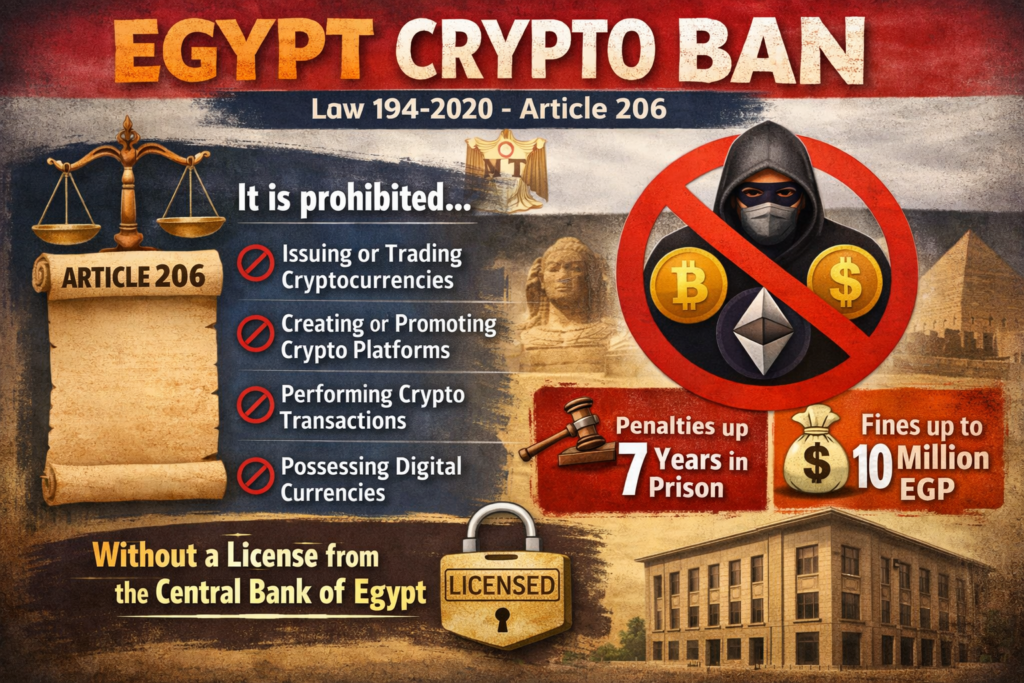
Law No. 194 of 2020 modernised Egypt’s banking framework and, at the same time, gave the CBE explicit authority over payment systems, digital money and “cryptographic units”. Article 206 is the key provision: it bans issuing, trading, promoting or operating platforms for crypto without prior CBE approval and attaches criminal penalties for violations.
Overview of the Central Bank and Banking System Law
Law 194/2020 was introduced to.
Update banking oversight
Bring payment systems, fintech and digital wallets under tighter control
Align with global AML/CFT standards
Crypto fits into this framework in two ways:
General provisions on payment systems and digital money
Dedicated references to cryptographic units and platforms dealing with them
These sit on top of older banking, FX and AML rules and give the CBE a “single switch” to allow or disallow crypto-related services.
Article 206: explicit prohibitions on crypto and e-money
In plain English, Article 206 says.
No one may issue, trade, promote or operate a platform dealing in cryptocurrencies or cryptographic units without CBE approval; breaching this rule is a criminal offence with fines and imprisonment.
Legal commentary reports that fines can range from roughly EGP 1 million to EGP 10 million, alongside potential prison sentences.
Critically, there is no public, retail-facing licensing regime for crypto platforms, brokers or token issuers; no major international exchange or custodian has announced an Egyptian licence as of early 2026.
Grey areas remain around.
NFTs and gaming tokens often reliant on crypto rails, even if presented as “collectibles” or in-game items.
Loyalty points and closed-loop tokens – if they are tradable, transferable or redeemable for value, they risk falling into the same net.
Licensing in theory vs reality.
On paper, Article 206 allows the CBE to approve crypto-related services. In reality, repeated warning statements by the CBE stress that:
No licences have been issued for crypto trading platforms in the domestic market
Crypto activity is associated with fraud, financial crime and “electronic piracy”
Citizens face severe penalties and lack legal protection if they participate.
This creates a “licensing in theory, prohibition in practice” environment. Large exchanges and custodians serving London or Frankfurt have chosen not to pursue Egyptian licences and instead tend to geo-block Egypt or avoid onboarding Egypt-resident users.
For foreign firms hoping to “regularise” legacy Egypt-linked users, the message is simple. there is currently no clear, realistic path to a fully licensed, Egypt-onboarded retail crypto product.
Cryptocurrency Regulation in Egypt.
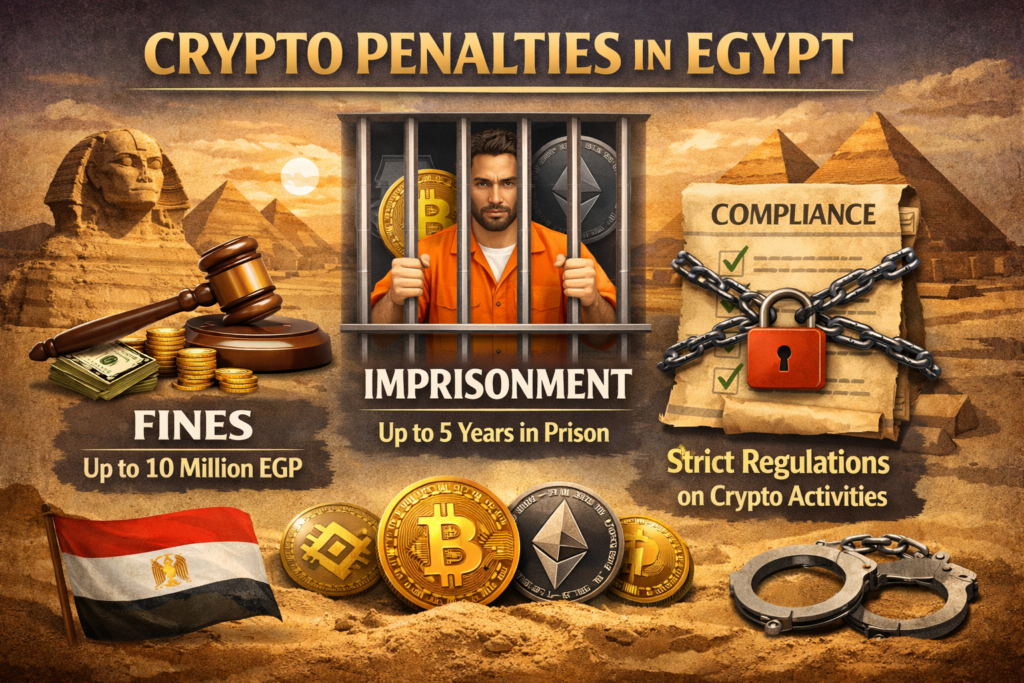
Breaching Egypt’s crypto rules can lead to imprisonment and fines reported between EGP 1 million and EGP 10 million, with confiscation of assets and follow-up AML investigations in serious cases.
Criminal and financial penalties under Article 206
Article 206 violations are criminal offences. Lexology and other legal commentaries highlight.
Fines up to EGP 10 million for unlicensed issuance, trading, promotion or platform operation
Possible imprisonment, especially where fraud, large-scale loss or organised crime are involved
Aggravating factors where offences overlap with money laundering, terrorist financing or cybercrime
Importantly, “marketing” or “promotion” alone can be enough for example, a Berlin or London-based startup running Arabic Facebook ads targeted at users in Cairo for an unlicensed exchange.
Complementary enforcement tools include Egypt’s AML statute and cybercrime laws, which can be used to pursue online investment scams and social-media schemes even if no formal “exchange” exists.
Central bank warning statements and fraud concerns
The CBE has issued a series of high-profile warning statements in 2018, 2021, 2022, 2023 and again after a spike in online ads in 2025 emphasising.
Extreme volatility and risk of total loss
Rising fraud, pyramid schemes and fake investments
Lack of any legal protection or recourse for users
The fact that no bank or financial institution is authorised to offer crypto services
These warnings are aimed at both retail users and institutions. Banks in Cairo increasingly embed them in their own risk policies and may block or question transfers involving known crypto exchanges.
Role of the non-bank regulator and other authorities
The Egyptian Financial Regulatory Authority (FRA) has also warned against unlicensed entities promoting virtual assets and “investment opportunities” to the public.
Enforcement spans
FRA actions against scam “investment companies” and pseudo-ICOs
Public prosecution of fraud and cybercrime cases involving crypto
Cooperation with law enforcement when social-media influencers promote unlicensed schemes
For foreign institutions, the key takeaway is that Egypt treats crypto as both a financial stability and consumer fraud issue, not just a narrow technical regulatory topic.
What Egypt’s Crypto Ban Means for Individuals and Businesses
For individuals and businesses in or connected to Egypt, the ban translates into serious legal, banking and operational risk, even when using foreign platforms.
Using foreign crypto exchanges from Egypt: legal and banking risk
Accessing offshore exchanges such as those in the US, UK or EU from within Egypt whether via direct bank transfers, P2P networks or informal money changers remains risky under Article 206, because the underlying activity (trading, promotion, platform operation) is still unlicensed from Egypt’s standpoint.
Banks may
Block or scrutinise transfers to/from known crypto platforms
Ask for detailed source-of-funds explanations
Treat repeated crypto-related activity as grounds for de-risking a customer relationship
Technical “workarounds” such as VPNs or informal off-ramp arrangements do not remove the local legal risk. This guide strongly discourages attempts to evade Egyptian law and instead recommends obtaining legal advice and, where appropriate, avoiding crypto activity while physically in Egypt.
Impact on remittances, payroll and business operations
Egypt is one of the world’s largest remittance markets; remittances make up around 5% of GDP, and crypto-based flows have attracted attention as a potential informal channel.
The prohibition affects.
Remittances families using stablecoins from London or Dubai to Cairo risk being caught by local enforcement if recipients interact with unlicensed platforms.
Freelancers and remote workers developers in Cairo or Alexandria paid in BTC or USDT from San Francisco or Berlin may face difficulties cashing out locally and may expose themselves to legal risk.
Local businesses merchants accepting crypto in Cairo shopping malls or online stores run the risk of violating Article 206, even as a “pilot” or marketing stunt.
Safer alternatives and strategic choices
Instead of unlicensed crypto use, individuals and firms should prioritise:
Regulatory monitoring and education tracking future developments on CBDC and digital payments.
Tokenless blockchain pilots using permissioned ledgers for trade finance, logistics or carbon markets without public crypto exposure, something Egyptian authorities have cautiously allowed in specific sectors.
Participation in compliant fintech programmes e-money wallets, prepaid cards and digital banking tools that operate within CBE rules.
For institutions in Cairo and for foreign partners in London, Frankfurt or New York, this may be the moment to involve specialist counsel and RegTech vendors to design Egypt-aware policies and monitoring rules.
Mak It Solutions already supports regulated organisations with cloud, data and compliance-sensitive builds across the Middle East and Europe, from secure web platforms to analytics pipelines that encode complex jurisdiction rules.
Cross-Border Compliance for US, UK and EU Firms
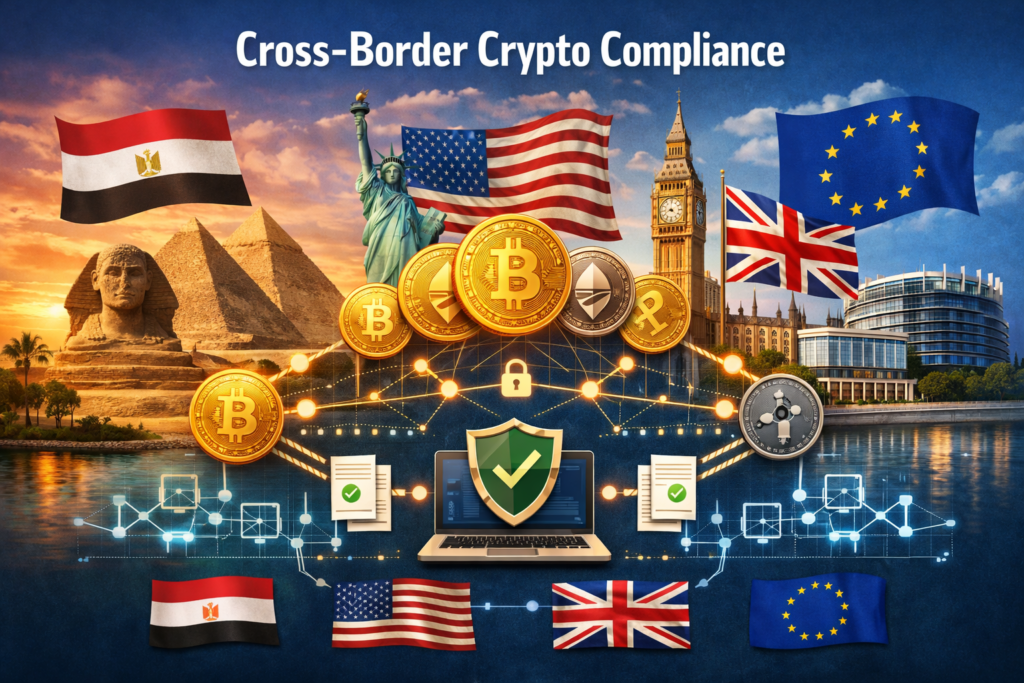
Foreign banks and fintechs should treat Egypt as a high-restriction or prohibited jurisdiction for retail crypto services, similar to other markets where local law bans or severely restricts digital asset activity. That means enhanced due diligence, restricting Egypt-based users from crypto products, and alignment with MiCA in the EU plus expectations from regulators like the FCA, BaFin, the SEC and the CFTC.
Mapping Egypt exposure in onboarding and monitoring
To assess compliance risk when customers in Egypt use crypto services, foreign institutions should:
Identify Egypt-linked customers in KYC data citizenship, residency, tax status and actual location (IP, device geo).
Detect Egypt-linked activity for example, a Berlin-based user regularly logging in from Cairo, or card transactions originating from Egyptian merchants.
Clarify source of funds/wealth where customers declare crypto gains but have ties to Egypt, documenting how and where those positions were acquired.
Mixed profiles such as Egyptian expats living in London or Paris but regularly visiting Cairo require nuanced treatment and clear documentation for auditors and regulators.
Common policy responses from global institutions
Global institutions supervised by BaFin in Frankfurt, the FCA in London or ESMA under MiCA tend to cluster around a few standard responses for high-risk markets like Egypt:
Geo-blocking Egypt-based IPs from trading interfaces
Product restrictions – no spot trading, derivatives or staking for Egypt-resident customers
“View-only” access for legacy positions, with no new trades or cashflows
Hard bans on onboarding Egypt-resident users for crypto-specific products
Documenting these choices and the underlying legal analysis helps during supervisory reviews by the SEC, CFTC, FCA, BaFin and other authorities, especially where MiCA’s third-country provisions intersect with local bans.
You can see a similar jurisdiction-sensitive approach in how Mak It Solutions designs regulated cloud and data architectures for US and EU enterprises, aligning with GDPR, UK-GDPR, PCI DSS and SOC 2 while also respecting local rules in MENA.
Special cases expats, remote workers and cross-border payroll
Edge cases often generate the most regulatory questions.
Expats physically in Egypt but paid by US, UK or EU employers via crypto-friendly platforms
Remote contractors billing from Cairo into a Paris or London-based Web3 firm
Cross-border payroll hubs serving teams in both Berlin and Cairo
For these, foreign employers should.
Avoid requiring or encouraging employees or contractors in Egypt to use crypto rails
Offer alternative payment channels (SWIFT, SEPA, Faster Payments, local bank transfers) wherever someone is physically present in Egypt
Record clearly in policy that employees should not be asked to perform tasks that would breach Egyptian law
This is also an area where “not financial advice” applies: treasury, payroll and product teams should always align decisions with internal legal, tax and HR guidance.
Egypt vs MiCA and Other Global Approaches (Plus Key Takeaways)
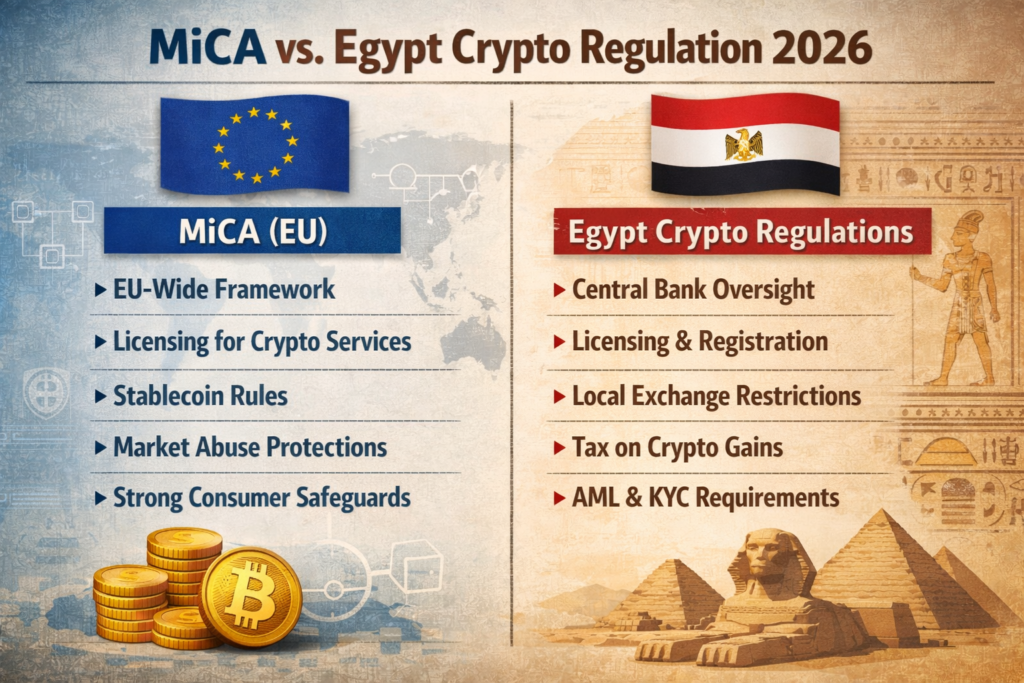
Egypt sits at the prohibition-by-default end of the spectrum, while the EU’s MiCA framework builds a full licensing regime for crypto-asset service providers. US and UK regulators, by contrast, apply a risk-based approach allowing crypto but targeting misconduct through enforcement and conduct rules.
Egypt’s prohibition-by-default vs EU’s MiCA licensing regime
Under MiCA, EU-based providers can obtain authorisation as Crypto-Asset Service Providers (CASPs), passport their licence across Member States and operate under uniform rules on transparency, disclosure and prudential safeguards.
For an EU-licensed exchange in Paris or Frankfurt, Egypt is therefore a third country with a local ban. The typical response is.
Exclude Egypt from the firm’s geographic target market in MiCA disclosures
Geo-block or restrict services for users located in Egypt
Treat Egypt alongside other “prohibited” jurisdictions in internal taxonomies, often with reference to global overviews like those maintained by ESMA and public watchdogs.
In the US and UK, regulators like the SEC, CFTC and FCA have not banned crypto outright; they instead enforce securities, derivatives and consumer protection law on top of existing AML rules, making Egypt’s approach notably stricter than that of New York or London.
CBDC, fintech and possible reform pathways
Despite the ban, Egyptian authorities are actively exploring CBDC and digital payments modernisation, partly to manage remittances and reduce reliance on informal channels.
Three plausible scenarios over the next few years.
Continued strict prohibition crypto stays banned; CBDC and bank-led fintech expand instead.
Tightly controlled pilots selected institutions in Cairo operate blockchain-based systems under heavy supervision, but without retail public tokens.
Partial opening via licences narrow authorisations for specific use cases (for example, institutional custody), influenced by how MiCA beds in across the EU and how global standard-setters shape expectations.
For now, the working assumption for US, UK, German and EU firms should be: no meaningful liberalisation has yet been implemented.
Key takeaways and compliance checklist for decision-makers
10-second summary for boards
Egypt’s Law 194/2020 + Article 206 = crypto effectively illegal without CBE approval.
Penalties include fines up to EGP 10m and prison.
CBE and FRA have issued repeated warnings; no crypto trading platforms are licensed.
Treat Egypt as a high-restriction jurisdiction, similar to other outright bans.
Practical checklist
Classify Egypt in your jurisdiction matrix as “prohibited/high-restriction for retail crypto”.
Update onboarding and monitoring rules to flag Egypt-resident customers, Egypt IPs and Egypt-linked payment flows.
Adjust product availability so Egypt-based users cannot trade, stake or access leverage, even if they are EU- or UK-licensed elsewhere.
Document your rationale referencing CBE statements, Law 194/2020 and global comparators (MiCA, FCA, BaFin guidance)
Train front-line teams (compliance, operations, product) on Egypt-specific rules, including how to handle expat and travel scenarios.
Mak It Solutions can support this with jurisdiction-aware data platforms, dashboards and rules engines that encode complex regulatory maps across the US, UK, Germany, EU and MENA, similar to how the team helps clients design data lakehouse architectures and multi-cloud environments that respect regional law.
Key Takeaways
Egypt treats cryptocurrencies as illegal in practice, with Law 194/2020 and Article 206 banning issuance, trading, promotion and platform operation without CBE approval.
Penalties are severe fines in the low-to-mid millions of EGP plus possible imprisonment, with overlapping AML and cybercrime exposure.
Individuals and businesses in Cairo face real legal and banking risk when using offshore exchanges, even when those platforms are licensed in London, Frankfurt or New York.
Foreign banks and fintechs in the US, UK and EU should geo-block or heavily restrict Egypt-based users, and align controls with MiCA, FCA, BaFin, SEC and CFTC expectations.
Strategic opportunities lie in compliant fintech, tokenless blockchain and CBDC pilots, not in unlicensed trading or speculative schemes.
For anyone responsible for cryptocurrency regulation in Egypt within a global risk framework, these points should feed directly into your country risk taxonomy and product-governance decisions.
If you’re responsible for crypto, payments or data platforms that touch Egypt from a London neobank to a Frankfurt crypto prime broker this is the moment to harden your jurisdictional controls. Mak It Solutions can help you map cryptocurrency regulation in Egypt and similar high-risk regimes into your cloud, data and app architecture, so your teams in New York, London, Berlin and Cairo see the same, consistent picture.
Ready to stress-test your Egypt exposure or design a compliant-by-default platform? Contact the Mak It Solutions team to schedule a focused discovery session.
FAQs
Q : Can tourists or short-term visitors use crypto to pay for goods and services while in Egypt?
A : In practice, tourists in Cairo or Sharm El Sheikh should avoid using crypto to pay for goods or services while physically in Egypt. The law does not distinguish between residents and visitors what matters is that issuance, trading or use of crypto in Egypt is prohibited unless the CBE licenses it, and no such licences exist. Paying a hotel or tour operator in Bitcoin or stablecoins, even via a foreign app, could place both sides uncomfortably close to Article 206 territory, so conventional payment methods are strongly safer.
Q : Are NFTs and gaming tokens treated the same as cryptocurrencies under Egyptian law?
A : Egyptian law talks broadly about “cryptographic units” rather than only coins like Bitcoin. Legal analysis suggests that NFTs and gaming tokens that rely on crypto rails or can be traded for value are likely to be treated similarly to other cryptoassets, especially where they are marketed as investments or used for transfers of value. ([eg.andersen.com][3]) Purely cosmetic in-game items that never leave a closed ecosystem may be lower risk, but the line is blurry, so Egypt-facing projects should obtain specific local legal advice before launching NFT or token-based products.
Q : Does Egypt’s crypto ban apply to company crypto held in offshore treasury accounts?
A : If a London or Delaware-incorporated company holds Bitcoin on a regulated custodian in New York, that offshore treasury position is primarily governed by the laws of that jurisdiction. However, Egypt’s ban may still matter if Egyptian-resident directors control the wallet, if the company actively markets crypto services into Egypt, or if Egypt-based staff or entities are involved in trading or promotion. In those cases, the presence of crypto on the balance sheet can create a nexus for enforcement and should be reviewed with both Egyptian and home-country counsel.
Q : How do religious rulings (fatwas) influence Egyptian banks’ attitude toward crypto transactions?
A : The 2018 fatwa from Dar al-Ifta (Egypt’s Islamic advisory body) declared major cryptocurrencies haram, citing speculation, fraud and illicit use. While fatwas are not laws, they are influential in a majority-Muslim country and reinforce the CBE’s secular policy concerns about volatility and financial crime. For banks and fintechs, this combination of religious and regulatory caution makes crypto a reputational and compliance risk, encouraging conservative internal policies even beyond the strict legal minimum.
Q : What red flags should compliance teams watch for in payments that might hide Egypt-linked crypto activity?
A : Key red flags include repeated small transfers from EU or UK exchanges to personal accounts in Egypt; payments from Cairo merchants referencing “investment”, “trading course” or “signals” with no clear underlying service; and card or wallet transactions to known on- and off-ramp services used by crypto platforms. Patterns of funding from London, Frankfurt or Dubai into accounts in Egypt that correspond with social-media promotions promising “guaranteed returns” should also trigger review. Screening tools, robust KYC data and analytics like those Mak It Solutions builds into BI and AML dashboards are essential to surface these signals at scale.