
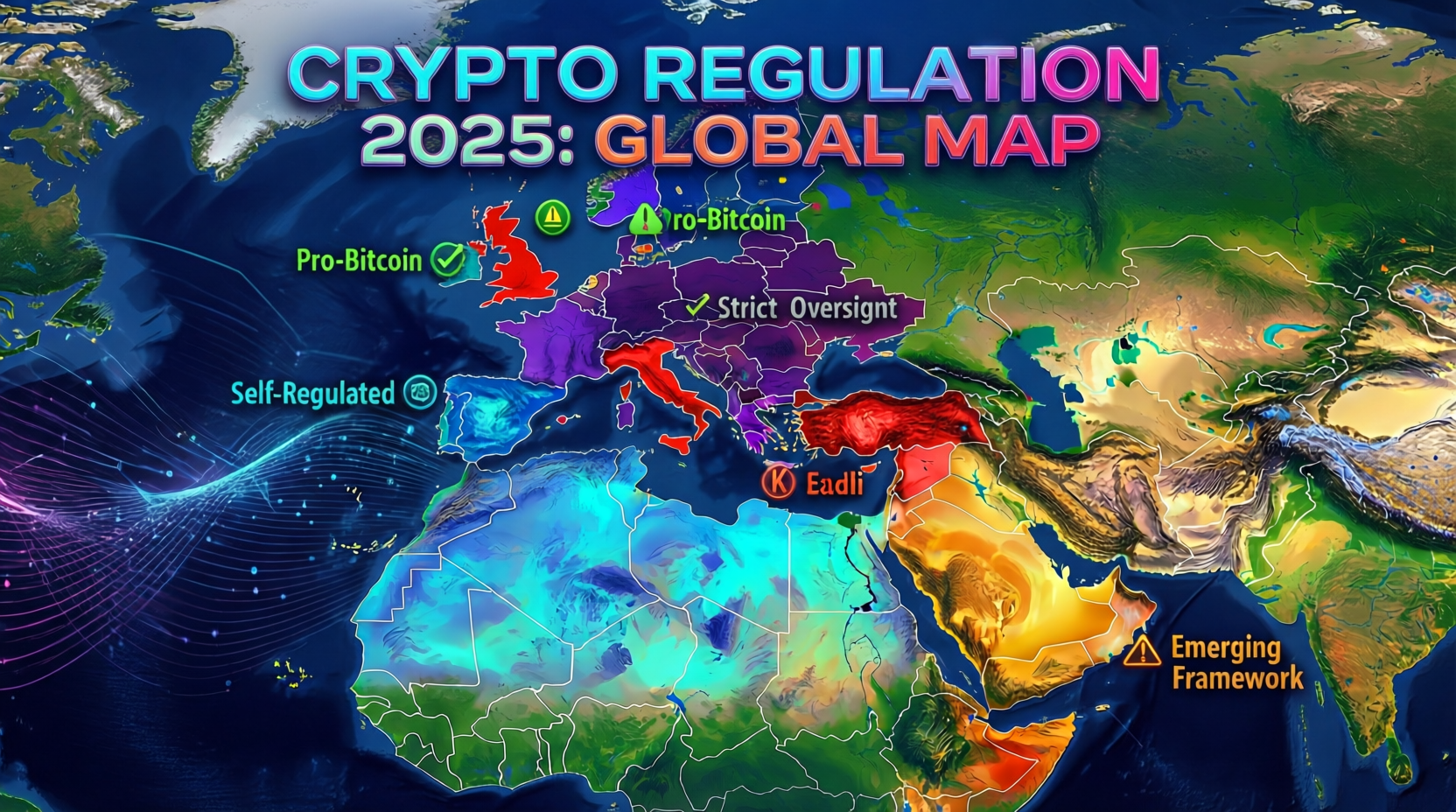

Crypto Regulation 2025: UAE, Saudi, EU & UK Guide
Crypto regulation 2025 is shaped by three big shifts: MiCA now fully applies in the EU, the UAE has moved into live supervision under VARA and the Central Bank’s Payment Token Services Regulation (PTSR), and the UK and Saudi are shifting from consultations and pilots toward full regimes. For US, UK, EU and Gulf-facing crypto firms, staying compliant now usually means anchoring in a primary hub (often MiCA or the UAE) and layering additional licences, AML controls and data safeguards for every market you actively serve.
Introduction
Crypto regulation 2025 is the moment when years of consultation finally crystallise into day-to-day rules. MiCA is now fully applicable to EU crypto-asset service providers (CASPs) and stablecoin issuers, with transitional regimes only lasting into mid-2026.
In the UAE, Dubai’s VARA rulebooks and the Central Bank’s Payment Token Services Regulation (PTSR) have moved from “emerging frameworks” to live supervision, with the PTSR transition ending in 2025.
At the same time, Saudi Arabia is testing CBDCs and tokenisation under tight controls, the UK has fixed October 2027 as the start date for a full FSMA-style crypto regime, and the US is edging towards federal stablecoin rules.
This guide is written for exchanges, fintechs, DeFi/TradFi bridges and law/compliance teams in the US, UK, EU and Germany who are evaluating the UAE and wider GCC, deciding where to license, and trying to turn a moving rulebook into a concrete 2025–2027 roadmap.
2025 Global Crypto Regulation Snapshot
Key 2024–2025 milestones in crypto regulation worldwide
In 2025, the most important global crypto regulation changes are MiCA becoming fully applicable to EU CASPs and stablecoin issuers, the UAE completing the PTSR transition, and the UK and Gulf regulators moving from discussion papers to concrete draft laws and pilots. MiCA’s stablecoin rules started applying in June 2024, with the main CASP authorisation regime live from 30 December 2024 and transitional national regimes running up to mid-2026.
In parallel, the UAE’s PTSR took effect in 2024 with roughly a one-year transition, after which unlicensed payment-token and stablecoin activity becomes a regulatory breach. Saudi Arabia and other GCC states are expanding CBDC/tokenisation pilots such as Project Aber and mBridge rather than rushing into retail-facing rules, while the UK has locked in an October 2027 go-live for its activities-based regime.
Against this backdrop, global crypto ownership has been estimated at roughly 650–700 million people by the end of 2024, with adoption strong in the US, India and parts of the Middle East.
The big themes.
Across major markets, crypto regulation in 2025 is less about banning crypto and more about pulling stablecoins and service providers into familiar financial-services rules. Policymakers are converging on full-reserve, well-governed stablecoins (MiCA’s ART/EMT buckets in the EU, PTSR “payment tokens” in the UAE, and dedicated stablecoin frameworks in markets such as the US and UK)
AML/KYC expectations have also hardened. FATF’s updates to Recommendation 15 and Recommendation 16 (the Travel Rule) mean most VASPs/CASPs must collect and transmit counterparty information for on-chain transfers above relatively low thresholds, with a 2025 update tightening payment-message data consistency.
Licensing is the third theme. Instead of “light-touch” registrations, regulators now demand full-blown authorisations with governance, prudential, IT/security and market-abuse controls aligned to traditional finance. This is true whether you’re applying for a MiCA CASP licence in Frankfurt, a VARA exchange licence in Dubai, or an FCA-supervised crypto permission under the UK’s upcoming FSMA regime.
How 2025 regulation reshapes location strategy
Because rules are hardening everywhere, location strategy in 2025 is about balancing certainty and flexibility. The EU offers high legal certainty under MiCA, but also prescriptive requirements. The UAE offers specialised virtual asset regulation, strong institutional support, and a growing Digital Dirham ecosystem, while remaining relatively open to innovation.
The UK is on a clear but slower 2025–2027 path; the US is moving towards federal stablecoin and market-structure rules but still relies heavily on existing securities and commodities laws.
For most serious operators, the answer is a portfolio of licences. A typical mix might include a MiCA CASP licence passported from Berlin, a VARA licence in Dubai plus PTSR permissions for payment tokens, and a UK FSMA roadmap for London-based institutional clients. Cloud and architecture choices (for example, multi-region setups across AWS, Azure and Google Cloud) then need to align with this regulatory footprint. (Mak it Solutions)
UAE 2025 VARA, PTSR and the Digital Dirham
Dubai VARA rulebooks and the wider UAE virtual asset map
In 2025, Dubai’s VARA is the main regulator for most virtual asset activity conducted in or from Dubai (outside the DIFC), while the UAE Central Bank and financial free-zone regulators cover payment tokens and securities-like products elsewhere in the country.

The map looks like this.
VARA (Dubai) regulates virtual asset service providers (VASPs) across free zones and mainland Dubai, under compulsory rulebooks (Company, Compliance & Risk, Technology & Information, Market Conduct) and activity-specific rulebooks (exchange, custody, lending/borrowing, advisory and more)
CBUAE (onshore) supervises payment tokens under the PTSR and the broader Digital Dirham programme.
ADGM FSRA (Abu Dhabi) and DIFC DFSA (Dubai International Financial Centre) run their own securities-style virtual asset frameworks, popular with institutional players in Abu Dhabi and DIFC.
For a New York- or London-based crypto exchange looking at Dubai, this typically means you’ll engage VARA for trading/custody and the Central Bank/PTSR framework if you touch dirham-linked payment tokens.
Payment Token Services Regulation (PTSR) and stablecoins
From 2025, unlicensed payment-token and stablecoin services in onshore UAE risk being shut down or sanctioned under the PTSR. The PTSR, issued via CBUAE Circular 2/2024, defines “payment tokens” (including AED-pegged stablecoins) and sets licensing, prudential, reserve, governance and conduct expectations for issuers and service providers.
It entered into force in mid-2024 with roughly a one-year transition, meaning 2025 is when firms either complete licensing, obtain a no-objection or exit the market. This framework interacts closely with the UAE’s Digital Dirham policy: the Digital Dirham is a central-bank digital currency now designated legal tender, while private stablecoins are tightly regulated payment tokens that must coexist with, not replace, state money.
For US or EU stablecoin issuers, this means you’ll need to reconcile MiCA-style rules with PTSR expectations on reserves, redemption, local presence and technology, especially if you want to be a core payment rail for residents in Dubai, Abu Dhabi or Sharjah.
Go-to-market paths for US, UK and EU/German firms in Dubai/UAE
Typical journeys for Western firms entering Dubai look like.
US exchanges obtain a VARA exchange and custody licence, implement the FATF Travel Rule across hosted wallets, and integrate UAE-specific KYC/AML requirements. Many also explore PTSR permissions if they issue or distribute stablecoins.
UK/EU/German CASPs leverage MiCA-ready governance and IT/security frameworks to support VARA and FSRA/DFSA applications, often via local subsidiaries. German BaFin-regulated providers are used to rigorous supervision but still face UAE-specific technology and Shari’a-compliance questions.
Common hurdles include finding credible local partners in Dubai or Abu Dhabi, handling GCC data-residency expectations, implementing Travel Rule tools that support multiple chains, and aligning SOC 2/PCI DSS-level security with VARA and Central Bank expectations.
Many teams turn to specialist law firms and consultancies at this stage, while leveraging internal engineering teams (and, in some cases, partners like Mak It Solutions in New York, London or Berlin) to adapt cloud, mobile and analytics infrastructure for production-grade compliance. (Mak it Solutions)
Saudi Arabia & the GCC in 2025 Cautious Retail, Strategic Digital Assets
Current legal status of crypto in Saudi Arabia
As of 2025, Saudi Arabia has not enacted a dedicated “crypto law”, and crypto trading is discouraged but not generally criminalised for individuals. The Saudi Central Bank (SAMA) and Capital Market Authority (CMA) have issued strong risk warnings, restricted banks and licensed financial institutions from offering retail trading, and rely on existing payments, FX and securities rules to keep activity tightly constrained.
For a Riyadh-facing business, that translates into a few working assumptions:
retail-facing crypto services are high-risk and may not be welcome without explicit approval;
institutional/tokenisation pilots require close coordination with SAMA/CMA and often tie into CBDC and wholesale-payments initiatives.
This is a very different environment from Dubai or Abu Dhabi, even though your user base may sit only a short flight apart.
State-backed projects.
Across the GCC, regulators are far more enthusiastic about CBDCs and tokenised finance than about unregulated retail trading. Saudi Arabia and the UAE have run Project Aber, a wholesale CBDC experiment for cross-border payments, and both participate in the BIS-backed mBridge platform. Bahrain, Oman and Qatar are also exploring CBDC and digital-asset frameworks.
For crypto businesses in London, Frankfurt or New York, this matters because:
riyal-linked or dirham-linked stablecoins will increasingly have to align with CBDC infrastructure and payment-system rules;
tokenisation and institutional use-cases (for example, tokenised sukuk or trade finance) are more welcome than speculative retail trading.
GCC comparison: UAE, Saudi, Qatar, Bahrain and others
In 2025, the UAE remains the most licensing-friendly GCC hub for both retail and institutional crypto. Dubai and ADGM offer clear virtual asset regulation, relatively low tax and multiple sandboxes. Saudi Arabia, Qatar and Oman are more focused on pilots and tokenisation, with limited scope for mass-market exchanges; Bahrain sits somewhere in the middle, with earlier-stage licensing regimes and a history of hosting international exchanges under close supervision.
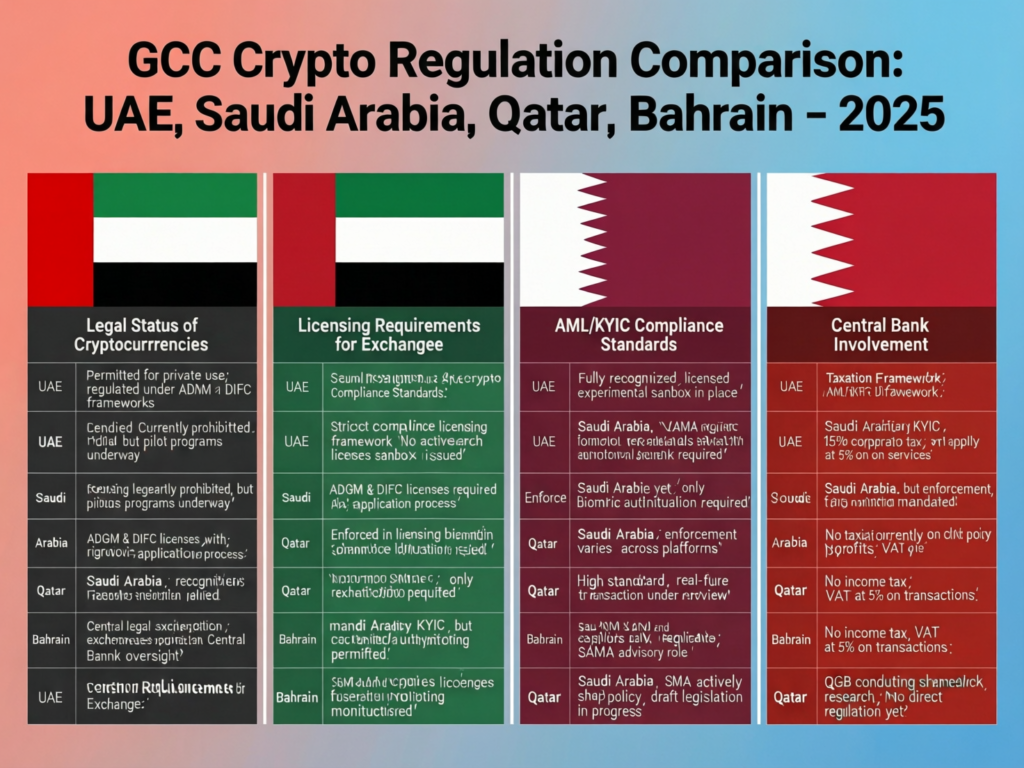
For location strategy, most firms serving GCC users from the US, UK or EU opt for:
a UAE hub (Dubai/Abu Dhabi) for licensing and operations;
carefully scoped Saudi/Qatar/Bahrain exposure via institutional partnerships, sandboxes or tokenisation projects rather than broad retail offerings.
MiCA in the EU & Germany 2025 Rules for CASPs and Stablecoins
MiCA timelines and what is live in 2025
In 2025, CASPs serving EU clients must either be authorised under MiCA or rely on limited national transitional regimes that run no later than mid-2026; after that, full MiCA licences will be mandatory across the bloc.
The key dates to keep in mind are.
30 June 2024 stablecoin (ART/EMT) provisions begin to apply.
30 December 2024 main CASP authorisation regime goes live.
Up to mid-2026 optional national transitional windows for existing providers.
For US or UAE-based firms passporting into Paris, Berlin or Luxembourg, this means 2025 is your transition year: building MiCA-grade governance, IT/security (including DORA), market-abuse and AML frameworks that can withstand ESMA and national competent authority (NCA) scrutiny.
Impact on stablecoins and non-compliant tokens
MiCA splits stablecoins into asset-referenced tokens (ARTs) and e-money tokens (EMTs), imposing strict requirements on reserves, redemption rights, issuer governance and disclosures. CASPs face restrictions on offering non-compliant stablecoins to EU clients, which has already triggered a rotation towards MiCA-compliant euro- and dollar-pegged tokens and away from offshore options.
Chainalysis and others note that this is beginning to reshape global stablecoin flows, with EU-facing firms de-risking high-volume pairs and preferring regulated EMTs. For US or UK issuers, the takeaway is simple: if you want deep liquidity in Frankfurt, Paris or Luxembourg, you need to design with MiCA in mind, not just US or UAE rules.
What German CASPs and fintechs must do under BaFin supervision
Germany remains one of the strictest EU jurisdictions. Even with MiCA passporting available, BaFin can still “gold-plate” supervision through detailed expectations on governance, outsourcing, IT security and incident reporting.
A practical checklist for a Berlin-based CASP would include.
Authorisation & governance MiCA CASP licence plus robust board-level oversight.
Prudential capital, liquidity and reserve arrangements aligned to MiCA and local add-ons.
Market integrity surveillance for manipulation, wash trading and insider dealing.
AML/CTF FATF-aligned controls, Travel Rule compliance and EU AMLR readiness.
IT/security DORA-grade resilience, incident response and third-party risk management.
Reporting regular regulatory reporting plus ad-hoc notifications for major incidents.
UK 2025–2027 From Interim Oversight to a Full Crypto Regime
Where UK crypto regulation stands in 2025
In 2025, the UK regulates crypto primarily via the FCA’s AML registration regime and a strict promotions framework, but the full activities-based regime for cryptoassets is still in draft form.
Crypto firms marketing to London or Manchester retail users must comply with detailed financial-promotion rules, cooling-off periods and appropriateness tests. At the same time, HM Treasury and the FCA are consulting on secondary legislation that will bring exchange, custody, lending, staking and other activities formally inside the FSMA perimeter.
Timeline to the 2027 go-live and what will change
The UK finance ministry has confirmed that full crypto asset regulation will commence in October 2027, with legislation under the 2023 Financial Services and Markets Act extending existing financial-services rules to crypto.
Between 2025 and 2027, expect.
FCA and Bank of England rulebooks for trading, custody and systemic stablecoins;
refined decisions on how far the Consumer Duty applies to crypto (early signs suggest a tailored or delayed approach)
more clarity on DeFi, staking and lending within an activities-based perimeter.
For US, UAE or EU firms, this means that London remains an important but still-evolving hub. Many firms will keep their primary licence in the EU or UAE, and treat the UK as a separately regulated add-on market.
How UK rules compare with MiCA and UAE VARA/PTSR
By 2027, the UK is likely to sit between the EU’s more prescriptive MiCA model and the UAE’s specialised virtual asset regulators in terms of flexibility versus legal certainty. MiCA offers pan-EU passporting but tight, uniform rules; the UK will fold crypto into existing FSMA concepts with some bespoke adjustments; the UAE continues to run dedicated VARA/PTSR regimes that explicitly prioritise innovation and tokenised finance.
For a London-plus-Dubai strategy, you’ll be juggling three layers: FSMA permissions, VARA licences and, if you also serve Berlin or Paris, MiCA CASP/ART/EMT authorisations. At this point, mapping licences, data flows and cloud regions (for example, multi-cloud deployments across EU, UK and Gulf regions as discussed in Mak It Solutions’ cloud comparison and cost-optimisation guides) becomes a board-level exercise, not just a compliance afterthought. (Mak it Solutions)
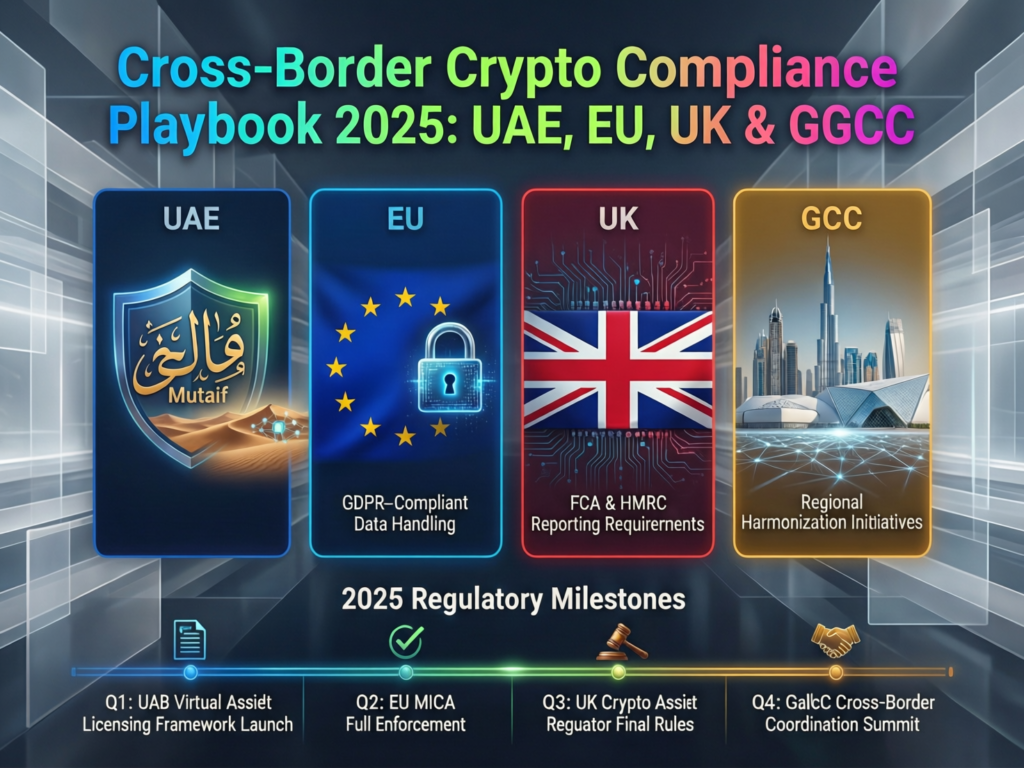
Cross-Border Compliance Playbook for 2025
Mapping licences and permissions across UAE, EU, UK and Saudi/GCC
In practice, most global firms will anchor in one primary regime usually MiCA in the EU or VARA/PTSR in the UAE and then add targeted licences where they have significant user bases. A common stack for a business serving New York, London, Berlin, Dubai and Riyadh might look like:
MiCA CASP licence in Germany, passported across the EU.
VARA exchange/custody licence in Dubai, plus PTSR permissions for AED-linked payment tokens.
UK FSMA roadmap aimed at 2027, with immediate FCA registration and promotions compliance.
Saudi/GCC exposure handled via institutional pilots, CBDC/tokenisation projects and sandboxes rather than retail trading, coordinated closely with SAMA/CMA and peers in Doha, Bahrain and Oman.
For a UK- or EU-based business serving users in the UAE and other Gulf countries after 2025, staying compliant usually means:
licensing where you have a physical or significant economic presence (for example, VARA + PTSR in Dubai, MiCA in Frankfurt, FCA in London)
mapping cross-border marketing and onboarding rules carefully for Riyadh, Doha and Manama;
aligning AML, Travel Rule, sanctions and data-protection controls across entities so regulators see a coherent global framework rather than fragmented policies.)
Key horizontal obligations
Whatever your hub, some obligations cut across all jurisdictions
AML & Travel Rule
FATF standards and local AML laws (EU AMLR/AMLD5+, UK Money Laundering Regulations, US Bank Secrecy Act, MENAFATF expectations in the Middle East) demand robust KYC, transaction monitoring and Travel Rule implementation.
Data protection
GDPR and UK GDPR apply whenever you handle EU or UK residents’ data, even from Dubai or New York, requiring lawful basis, minimisation and appropriate transfer safeguards. (EUR-Lex) In health-adjacent use-cases (for example, tokenising NHS or US healthcare payments), HIPAA also becomes relevant.
Security & assurance
PCI DSS if you process card data, plus SOC 2-type controls for enterprise clients, are fast becoming baseline expectations, especially for institutional products. (PCI Security Standards Council)
Designing your infrastructure for example, rendering strategy, caching and regional hosting for web and mobile front-ends should integrate these controls from day one, not as a bolt-on. That’s where technical partners who understand both cloud architecture and compliance (for instance, the approaches described in Mak It Solutions’ articles on SSR vs static generation and cloud cost optimisation) can materially de-risk rollouts. (Mak it Solutions)
Operational checklist for US/UK/EU teams planning 2025–2027 moves
A simple 2025–2027 checklist for boards and leadership teams
Run a regulatory gap analysis map where you operate (or want to operate), which licences you hold today, and how MiCA, VARA/PTSR, UK FSMA, US stablecoin laws and Saudi/GCC positions affect you.
Choose your primary hub(s) for many, that’s an EU MiCA licence in Berlin or Paris plus a UAE hub in Dubai or Abu Dhabi; UK and US permissions follow as add-ons.
Align risk appetite and product roadmap decide how far you’ll go into leverage, staking, DeFi integration, tokenisation and institutional services, and document what you will not do.
Design architecture for compliance pick cloud regions (US/EU/UK/GCC), data-residency patterns and logging/monitoring that support Travel Rule, GDPR, SOC 2 and incident-response expectations.
Budget and timeline authorisations can take 12–24 months; allocate senior time, legal/compliance budget and engineering capacity accordingly.
Engage the right experts combine internal counsel, specialist law firms in Dubai, Riyadh, London, Brussels and Washington, and technical partners who can implement the required monitoring, reporting and security.
Many firms turn this into a phased internal roadmap starting with “minimum viable compliance” and scaling toward a fully harmonised, multi-jurisdiction framework as user numbers in New York, London, Berlin, Dubai and Riyadh grow.
2025–2027 Action Plan
60-second summary for executives
Crypto regulation 2025 is the first year where MiCA, VARA/PTSR and UK/US roadmaps all overlap enough that boards must treat regulation as a strategic driver, not just a legal risk.
MiCA is now fully applicable to CASPs and stablecoin issuers, with transitional regimes only lasting to mid-2026.
The UAE has moved from vision to execution: VARA rulebooks, PTSR for payment tokens and the Digital Dirham as legal tender form a coherent virtual-asset stack.
Saudi and the wider GCC are cautious on retail but ambitious on CBDCs and tokenised finance.
The UK has set October 2027 as the start of its full crypto regime, while the US is moving towards federal stablecoin and market-structure rules.
Cross-border AML, Travel Rule and data-protection expectations are converging, making sloppy compliance a reputational and regulatory non-starter.
Prioritised actions by company type (exchange, fintech, bank, Web3 project)
Global exchange (US/EU/UK) lock in MiCA CASP authorisation, pursue VARA + PTSR if you want Gulf depth, and plan for UK FSMA permissions by 2027.
Fintech / neobank treat stablecoins and tokenised deposits as regulated products; align card, Open Banking and crypto rails to PCI DSS, SOC 2, GDPR and Travel Rule obligations.
Bank or TradFi institution focus on tokenisation pilots and custody/market-access roles, not just speculative retail trading; harmonise bank-level risk frameworks with crypto-specific rulebooks.
Web3 / DeFi project identify where you, your foundation or core contributors may fall within EU, UK or UAE definitions of controlled activity, and design front-ends, governance and tokenomics accordingly.
How to stay ahead of the next regulatory wave
To stay ahead of 2026–2027 changes, plug into primary sources: ESMA and the European Commission for MiCA and AMLR; VARA, CBUAE, ADGM FSRA and DFSA for the UAE; SAMA/CMA for Saudi; the FCA, Bank of England and HM Treasury for the UK; SEC, CFTC, FinCEN and US Treasury for the US; and FATF and MENAFATF for AML and Travel Rule guidance.
Overlay this with analytics tooling from vendors such as Chainalysis, Elliptic and TRM Labs to track cross-border flows, sanctions exposure and Travel Rule compliance at scale.
Key Takeaways
2025 is the first year where MiCA, VARA/PTSR and UK/US roadmaps are all live enough that boards must treat crypto regulation as a strategic driver, not just a narrow legal risk.
Stablecoins and payment tokens are now central to regulatory agendas; issuers and distributors must design for reserves, redemption, disclosures and cross-border usage constraints.
Horizontal controls AML, Travel Rule, data protection and security — increasingly dictate whether your multi-jurisdiction strategy is feasible.
Most serious firms will adopt a “portfolio of licences” anchored in one primary regime (often the EU or UAE) with targeted add-ons in London, Riyadh, Doha and New York.
Close collaboration between legal, compliance, product and engineering teams (and the right external partners) is the only sustainable way to keep up with 2025–2027 rule changes.
If you’re planning a 2025–2027 move into the UAE, Saudi, UK or EU under MiCA, this is the moment to turn broad regulatory awareness into a concrete roadmap. The Mak It Solutions team works daily with founders and compliance leads from New York and Austin to London, Berlin and Dubai on cloud, mobile and analytics platforms that can withstand real-world regulatory scrutiny.
Share your current architecture, target markets and licence plans, and we can help you translate them into a phased technical and data strategy that actually fits MiCA, VARA/PTSR and upcoming UK rules not just a slide deck.( Click Here’s )
FAQs
Q : Is crypto trading banned in Saudi Arabia in 2025, and what risks do investors face?
A : No, Saudi Arabia has not passed a specific “crypto ban” law, but regulators strongly discourage retail trading and limit how banks and licensed financial institutions can interact with crypto. For investors in Riyadh or expats using offshore platforms, key risks include account closures, difficulty funding or withdrawing through local banks, and evolving enforcement against unlicensed intermediaries. Institutional pilots around CBDCs and tokenisation are more welcome, but they are tightly supervised and rarely open to retail investors.
Q : Do I need a local entity to get a VARA or PTSR-related licence in the UAE?
A : In almost all realistic cases, yes you will need a locally incorporated entity (often in a Dubai free zone) to obtain a VARA licence, and CBUAE expects a meaningful onshore presence for PTSR-related permissions. Many groups use a UAE holding or operating company that coordinates with EU and UK subsidiaries. This structure helps with substance, governance and data-residency issues, but it also adds complexity to your global tax and regulatory footprint, so it should be designed alongside specialist legal and tax advice.
Q : How does MiCA treat DeFi protocols and NFTs in 2025 are they fully in scope?
A : MiCA does not create a full DeFi or NFT regime. Instead, it focuses on intermediaries that issue, list, trade or custody crypto-assets for others, plus stablecoin issuers. Where a DeFi or NFT project has a clear “controlling entity” for example, a team running the front-end, treasury or marketing EU regulators can still apply MiCA, MiFID, AMLR and consumer-protection rules. Purely decentralised protocols without a clear controller are a grey area, but in practice most real-world projects have enough centralisation that regulators expect MiCA-grade standards, especially for EU retail users.
Q : Can a single MiCA CASP licence cover my UK and GCC clients, or do I need extra authorisations?
A : A MiCA CASP licence gives you passporting across the EU, but it does not automatically cover the UK or GCC. The UK is building its own FSMA-based regime for cryptoassets with a 2027 start date, and the GCC (including the UAE and Saudi) relies on local regulators such as VARA, CBUAE, ADGM FSRA, DFSA and SAMA/CMA. In practice, you’ll need separate permissions or structured partnerships in London, Dubai/Abu Dhabi and Riyadh, even if your main risk and technology stack is centred in Frankfurt or Paris.
Q : What are the biggest penalties crypto firms faced in 2025 for non-compliance with AML or Travel Rule requirements?
A : In 2025, regulators continued the trend of imposing large AML and sanctions-related penalties, including eight- and nine-figure settlements for exchanges with weak KYC, Travel Rule and sanctions-screening controls. Patterns include failures to collect required originator/beneficiary data on transfers, inadequate transaction monitoring, and poor governance around high-risk jurisdictions. For global firms, the lesson is that Travel Rule and AML frameworks must be embedded into architecture and operations — not treated as a narrow “compliance product” bolted on at the last minute.