Crypto Microtransfers
Crypto microtransfers have crossed from theory into practice. Between Bitcoin’s Lightning Network (LN) and Ethereum’s Layer-2 (L2) rollups, sub-$0.05 payments, pay-per-use APIs, creator tipping, machine-to-machine (M2M) streams, and micropaid media are no longer science projects they’re deployable products.
LN enables instant, near-fee-less BTC transfers inside consumer apps like Cash App and Strike, while L2s like Arbitrum, Base, and Optimism deliver cheap, programmable payments (often stablecoin-denominated) for web and mobile experiences. Cash App publicly states Lightning transfers are “typically little to no fees” and instantaneous, making them suitable for small amounts.
Meanwhile, average fees on leading L2s frequently sit in the cent-range (e.g., Arbitrum averages just a few cents), unlocking crypto microtransfers for stablecoins, subscriptions, and automation. Optimism’s Bedrock upgrade specifically targeted lower fees to remain among the cheapest EVM rollups. tokenterminal.com+2tokenterminal.com+2
This guide shows how teams can evaluate LN vs. L2s, design practical user journeys, estimate fees, and ship an MVP for crypto microtransfers in 30 days plus playbooks, integrations, and compliance notes.
Why Crypto Microtransfers Now?
Cost curves collapsed
LN and L2s reduced per-payment costs to cents or fractions of a cent. Arbitrum’s average fee data and OP’s Bedrock push illustrate how aggressively costs are trending down.Consumer-grade front ends
Cash App’s Lightning support, and Strike’s expansion across markets, have normalized the experience.B2B payment rails are still pricey
Real-time payment networks in the U.S. often carry multi-cent network fees, with banks charging significantly more per transaction micro-use cases struggle there. LN/L2 shine for sub-$1 pricing.
The Rails, in Brief
Lightning Network (LN)
What it is: A Layer-2 payment network for Bitcoin enabling instant settlement via payment channels and route discovery.
Why it matters for crypto microtransfers
Extremely low fees and near-instant finality; excellent UX when wallets interoperate (LNURL, BOLT11, and emerging BOLT12 offers for static/recurring invoices).Who supports it
Consumer apps like Cash App and Strike; enterprise tooling from infra providers.
Ethereum Layer-2s (Optimistic & ZK Rollups)
What they are
Execution layers that batch transactions and settle to Ethereum, dramatically dropping fees.Why they matter for crypto microtransfers
Cheap, programmable payments (stablecoins!), smart-wallet UX, bundling/automation. Arbitrum and Optimism routinely show low average fees; Base is rising for stablecoin commerce.
Cost Reality Check (2025)
LN (BTC)
Consumer implementations (e.g., Cash App Lightning) emphasize instant transfers with “little to no fees,” suitable for tipping, P2P, and micro-commerce. Strike advertises ultra-low fees in general.L2 (Stablecoins & ETH)
Recent data shows average transaction fees on Arbitrum around a few cents and OP explicitly optimizing to be among the cheapest. This is viable for crypto microtransfers under $1.Traditional Real-Time Payments (RTP)
Typical end-user per-payment costs often range $0.25–$1 too high for micro-events.
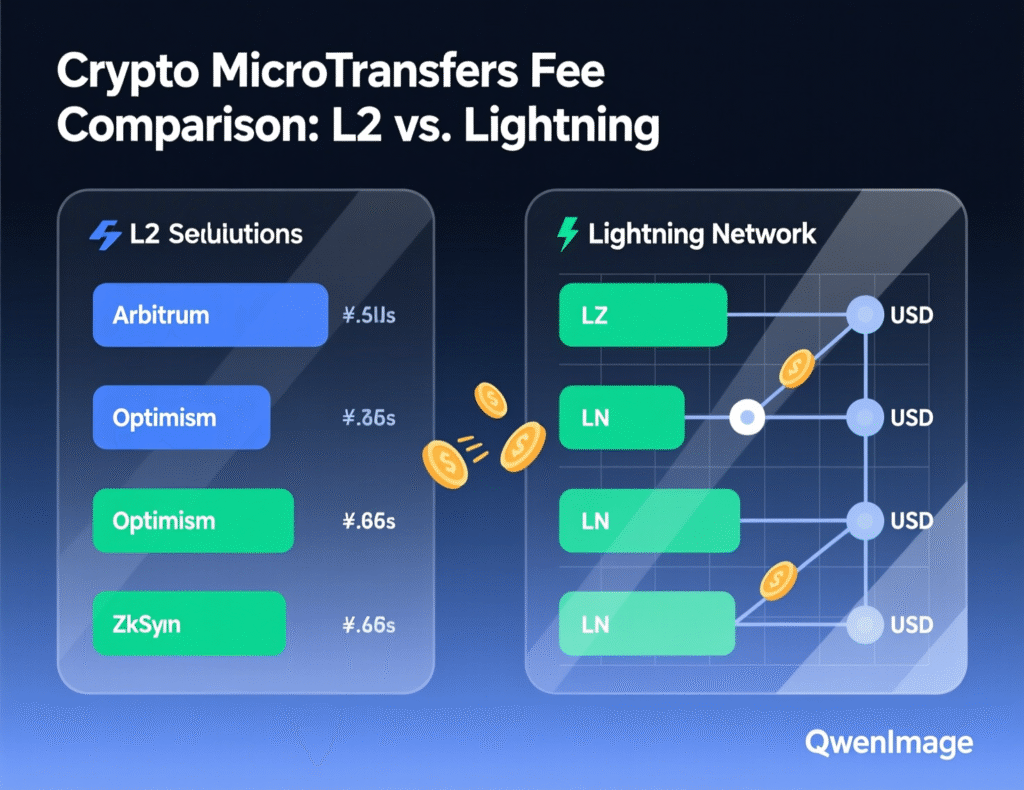
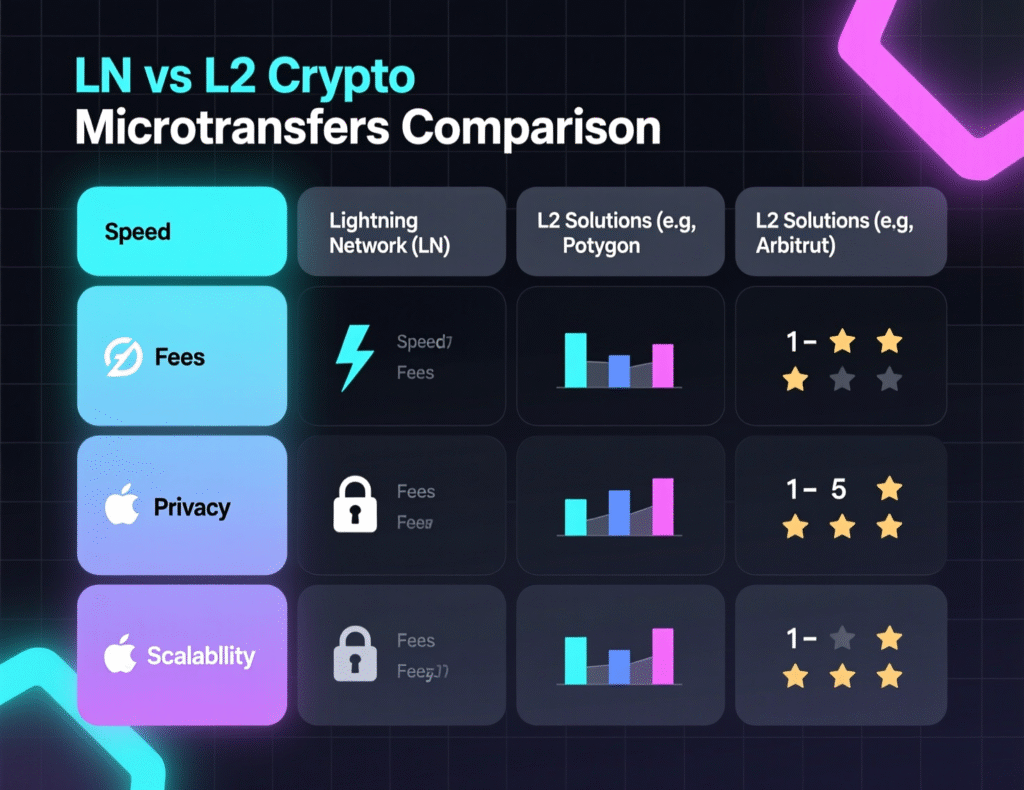
LN vs. L2 for Crypto Microtransfers: Decision Matrix
| Requirement | Lightning Network | Ethereum L2 (Arbitrum/Base/OP) |
|---|---|---|
| Typical fee | Near-zero to fractions of a cent in many app paths | ~1–5¢ typical (varies with gas/rollup) |
| Currency | BTC | Stablecoins (USDC/USDT), ETH, tokens |
| Speed | Instant | Seconds to sub-minute |
| Programmability | Limited on-chain logic; invoices/Offers for recurring | Full smart contracts; subscriptions via contracts |
| Consumer familiarity | Growing via Cash App, Strike | Growing via stablecoin wallets & CEX bridges |
| Best for | P2P tips, micro-donations, small cart BTC payments | Pay-per-use APIs, streaming, automated micro-subscriptions |
UX Patterns that Work
Tap-to-Tip (LN)
Present a static QR (BOLT12 “Offers”) so fans can tip repeatedly without regenerating invoices. Great for creators.
Pay-Per-Article (L2)
One-click USDC payment gated behind a soft paywall. Bundle multiple articles into a single batched tx if needed.
M2M Metering (Both)
IoT devices or bots pay per API call; LN for pure value transfer, L2 for programmable rules and escrow.
Recurring Micro-Subs
LN via BOLT12 Offers or L2 smart contracts with top-up thresholds and pause/resume.
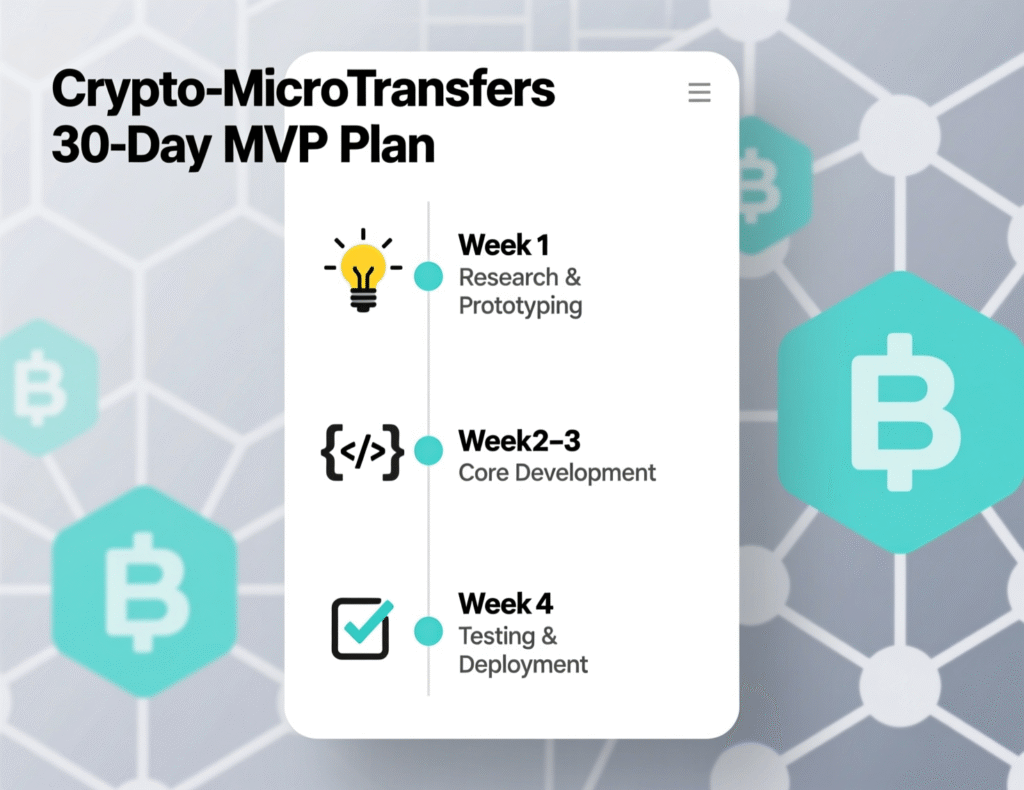
30-Day Implementation Plan (MVP)
Week 1 Choose rails & scope
Pick BTC via LN for tips/donations; choose L2 + USDC for programmable micro-commerce.
Define min payment size, daily caps, and regions.
Week 2 Integrations
LN: Integrate a managed node or SDK; support LNURL-Pay & static QR Offers for repeat payments.
L2: Choose Arbitrum/Base/OP; add a stablecoin on-ramp; implement contract for receipts & refunds. Fee test with public explorers/metrics.
Week 3 UX & Risk
One-tap pay, clear success state, and “spent this month” meter.
Add velocity limits, AML/KYT provider hooks for larger flows.
Week 4 Pilot & Iterate
Run a 500–2,000 user pilot.
Measure: payment success %, average fee, support tickets, chargeback analogs.

Real-World Examples
Consumer Tipping & Micropayments (LN)
Cash App’s Lightning integration positions BTC sends as instant and “typically little to no fees.” This is ideal for creator tipping or pay-per-message.Stablecoin Commerce (L2)
Processors report rising L2 stablecoin usage across Polygon/Arbitrum/Base/OP for day to-day payments showing a clear trend toward cheap, programmable transfers that suit crypto microtransfers.
Compliance & Ops Notes
KYC/AML
For custodial flows, apply risk-based KYC. For non-custodial, monitor on/off-ramps.Tax & Accounting
LN/L2 micro-events can be aggregated; maintain monthly summaries for VAT/sales tax where applicable.Fraud Controls
Velocity limits, device fingerprinting, and proof-of-payment receipts (tx hash or LN proof).
Developer Considerations
LN Tooling
Support BOLT11/12, LNURL-Pay, keysend where relevant; handle route failures with retries.L2 Contracts
Minimal proxy pattern for upgrades; emit events for each micro-event to reconcile.Fee Estimation
For L2s, call fee oracles and display estimated cents per action. For LN, surface “routes found / not found” and fallback to custodial rails if needed.
Roadmap: What’s Next
Static, reusable LN invoices (BOLT12 offers) will reduce QR churn and simplify recurring payments.
Cheaper L2 data availability and account abstraction will keep driving down total cost and UX friction further expanding crypto microtransfers into mainstream apps.


Bottom Lines
Crypto microtransfers are production-ready. LN excels at instant, ultra-low-fee BTC transfers and community tipping; L2 rollups shine for stablecoin-based, programmable payments. With thoughtful UX, clear risk policies, and fee benchmarking, product teams can ship micro-paid content, API metering, and M2M automation in weeks not months.
CTA.
Want an end-to-end plan tailored to your stack and market? Get our 30-day launch template and fee model contact our team to start your crypto microtransfers pilot this month.
FAQs
Q : How do crypto microtransfers work on the Lightning Network?
A : LN channels route BTC instantly across nodes. Users pay invoices (BOLT11) or static offers (BOLT12) by scanning a QR or clicking a Lightning link; fees are typically negligible in consumer apps like Cash App. (Schema expander: “Lightning Network,” “invoice,” “offers,” “routing.”)
Q : How do crypto microtransfers compare to U.S. RTP fees?
A : RTP networks often have fixed network fees (e.g., ~4.5¢) and banks may charge $0.25–$1, which can dwarf sub-$1 transactions. LN/L2 rails can be far cheaper for micro-events. (Schema expander: “comparative fee examples.”)
Q : How can I do micro-subscriptions?
A : Use LN BOLT12 Offers for recurring invoices or deploy a simple L2 subscription contract that charges USDC periodically. (Schema expander: “recurring payments,” “subscription smart contract.”)
Q : How fast are crypto microtransfers?
A : LN is typically instant once a route is found; L2s generally confirm in seconds and finalize shortly after. (Schema expander: “instant,” “seconds,” “finality.”)
Q : How do I keep fees predictable?
A : On L2s, show a live fee estimate (in cents) and batch actions if needed; on LN, prefer static offers and reliable routes. (Schema expander: “fee estimation,” “batching.”)
Q : How can creators accept micro-tipping today?
A : Publish a Lightning QR (Offer) for repeat tips; also list a USDC address on a low-fee L2 to catch non-BTC users. (Schema expander: “Lightning QR,” “USDC on L2.”)
Q : How do taxes work on microtransfers?
A : Aggregate by month; export CSVs from wallets/processors. Treat BTC/ETH differently from stablecoin revenue per your jurisdiction and consult a tax professional. (Schema expander: “aggregation,” “CSV export.”)
Q : How can we reduce fraud?
A : Set per-day limits, add device fingerprinting, and provide tamper-proof receipts (tx hash or LN proof). (Schema expander: “velocity limits,” “receipts.”)
Q : How does Lightning differ from L2 stablecoins?
A : Lightning is BTC-native and optimized for value transfer; L2s are programmable and stablecoin-friendly, better for automated or conditional flows. (Schema expander: “BTC,” “stablecoins.”)