
Crypto Layer-3 Ecosystem Expansion
After EIP-4844 (Dencun), rollups got dramatically cheaper and more efficient, setting the stage for a rapid rise in Layer 3 blockchain designs that sit atop L2s. L3s promise tailored performance, custom gas tokens, specialized privacy, and business-model flexibility—without forcing apps to run on congested shared L2s.
Vitalik’s long-standing view is that L2s do the heavy lifting for general-purpose scaling, while L3s focus on customized functionality such as privacy, specialized VM logic, or domain-specific performance. In 2024–2025 this vision shifted from blog posts to production networks: Orbit (Arbitrum), OP Stack L3s (Superchain), ZK Stack hyperchains (zkSync), and Starknet appchains now power real apps in gaming, social, and DeFi.
What is a Layer 3 blockchain?
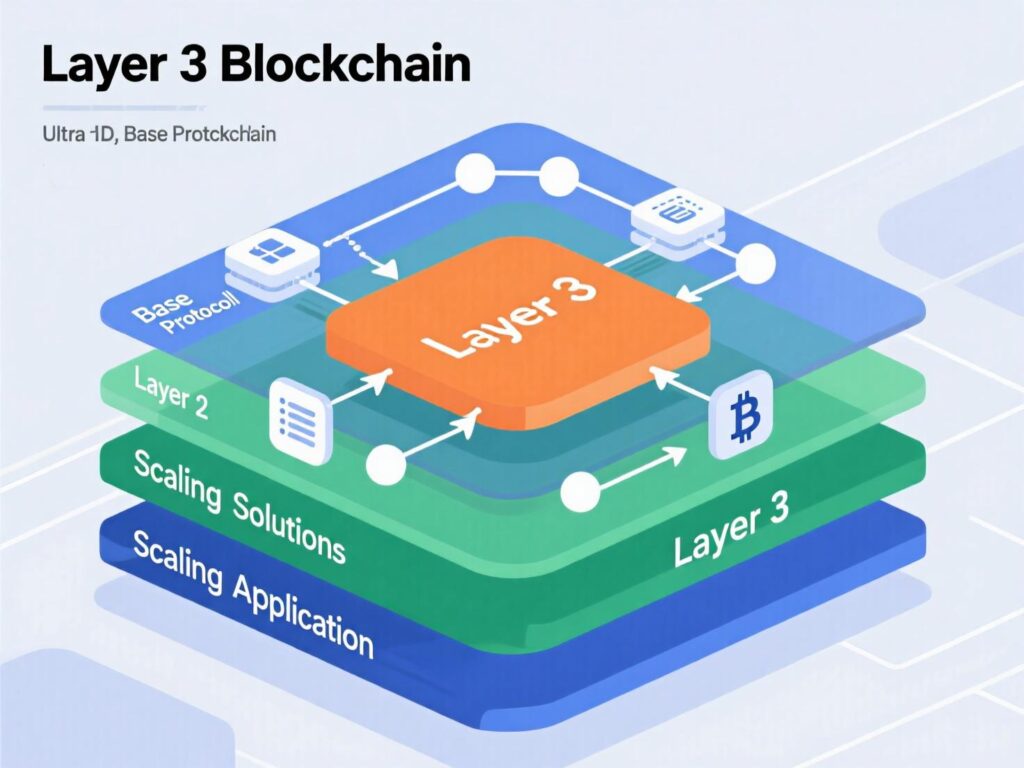
A Layer 3 blockchain is a chain that settles to a Layer 2 instead of directly to L1. It inherits many benefits from its L2 host while adding app-specific controls: fee tokens, allowlists, privacy circuits, domain-specific throughput, and faster UX. Vitalik frames it succinctly: L2s scale generally; L3s add customized scaling and functionality rather than “scaling squared.”
Key properties
Customization:
fee token, permissioning, sequencing, MEV policy, privacy modes.Lower costs:
DA and settlement choices optimized for the use case (e.g., AnyTrust/EigenDA).Faster UX:
dedicated sequencers and shorter block times for specific workloads.
Why the Layer 3 blockchain wave now?
Post-Dencun economics.
Proto-danksharding (EIP-4844) introduced blob transactions that slashed L2 data costs many L2s reported order-of-magnitude fee reductions. Cheaper L2s make “L2-as-a-platform” viable, enabling L3s to stack on top with acceptable end-user costs.
Maturing stacks.
Production-ready frameworks (Orbit, OP Stack, ZK Stack, Starknet appchains) and RaaS providers (Conduit, Caldera, QuickNode, AltLayer, Gelato, Zeeve) now handle the unglamorous parts sequencers, DA integrations, monitoring so teams can focus on app logic.
Business pull.
Teams want lower fees, branded UX, custom gas tokens, and growth loops around their own economy classic product reasons to own more of the stack. OP Stack and Orbit both highlight native support for custom gas tokens and L3 configurations.
Frameworks powering the Layer 3 blockchain expansion
Arbitrum Orbit (Nitro/ Stylus)
Orbit lets you launch L2 or L3 chains, including custom gas tokens and various DA options (e.g., AnyTrust, external DA). A robust ecosystem of RaaS partners (Conduit, Caldera, AltLayer, Gelato, QuickNode, Zeeve) streamlines deployment. Case studies include Xai (gaming) and Proof of Play’s Apex chain.
OP Stack L3s (Superchain)
Optimism announced that L3s built with the OP Stack can join the Superchain, with features like custom gas tokens and “Plasma mode” to suit specialized use cases. Projects such as Stack’s loyalty points L3 and Degen-adjacent L3s on Base illustrate the pattern.
ZK Stack Hyperchains (zkSync)
ZK Stack allows developers to launch sovereign ZK chains as L2 or Layer 3 blockchain “Hyperchains,” with rollup/validium/volition modes, configurable sequencing, and native interoperability. This is a modular path to domain-specific L3s backed by Ethereum via validity proofs.
Starknet L3 appchains (StarkWare)
StarkWare positions L3s as app-tailored layers on top of Starknet for even lower costs and more customization, frequently cited for privacy or domain-specific throughput.
Data availability & middleware choices for a Layer 3 blockchain
DA spectrum. Teams can choose Ethereum DA (via L2), AnyTrust-style committees, or emerging DA networks like EigenDA. EigenDA (built on EigenLayer) targets high throughput DA to reduce costs for rollups and appchains.
RaaS accelerators. Providers such as Conduit and QuickNode expose “one-click” Orbit/OP/ZK Stack deployments, frequently integrating DA backends (EigenDA/others) and observability from day one. Gelato documents EigenDA performance characteristics in testing (10 MB/s with scale targets).
Case studies: L3s in the wild
Xai (Arbitrum Orbit L3 for gaming)
Xai markets itself as a pioneering L3 for AAA on-chain games, using Orbit/Nitro to enable low fees and responsive gameplay UX—critical for mass-market titles. Offchain Labs features Xai as a flagship Orbit case. Arbitrum, and the Ecosystem
Degen Chain (OP Stack x Orbit x Base)
Syndicate helped launch Degen Chain as an ultra-low-cost L3 using Arbitrum Orbit tooling, settling to Base (OP Stack). The chain features a custom gas token (DEGEN) and reached high early usage, illustrating how social/gaming communities can justify a dedicated Layer 3 blockchain.
Takeaway: These examples show how purpose-built L3s can unlock UX wins (gasless, instant feel), marketing leverage (branded economy), and flexible economics (fee token, sequencer policy) that are harder to get on shared L2s.
When you should not build a Layer 3 blockchain
You need maximum neutrality/sovereignty:
Compounded trust and operational complexity an L3 inherits L2 and L1 risks; L2BEAT notes L3 risk depends on both the L3 and its host chain.Your workload is small or fits neatly on shared L2s:
A “fat L2” plus account abstraction might be enough.You lack ops maturity:
Running a chain (even via RaaS) demands SRE, monitoring, incident response, and governance.
How to launch your Layer 3 blockchain
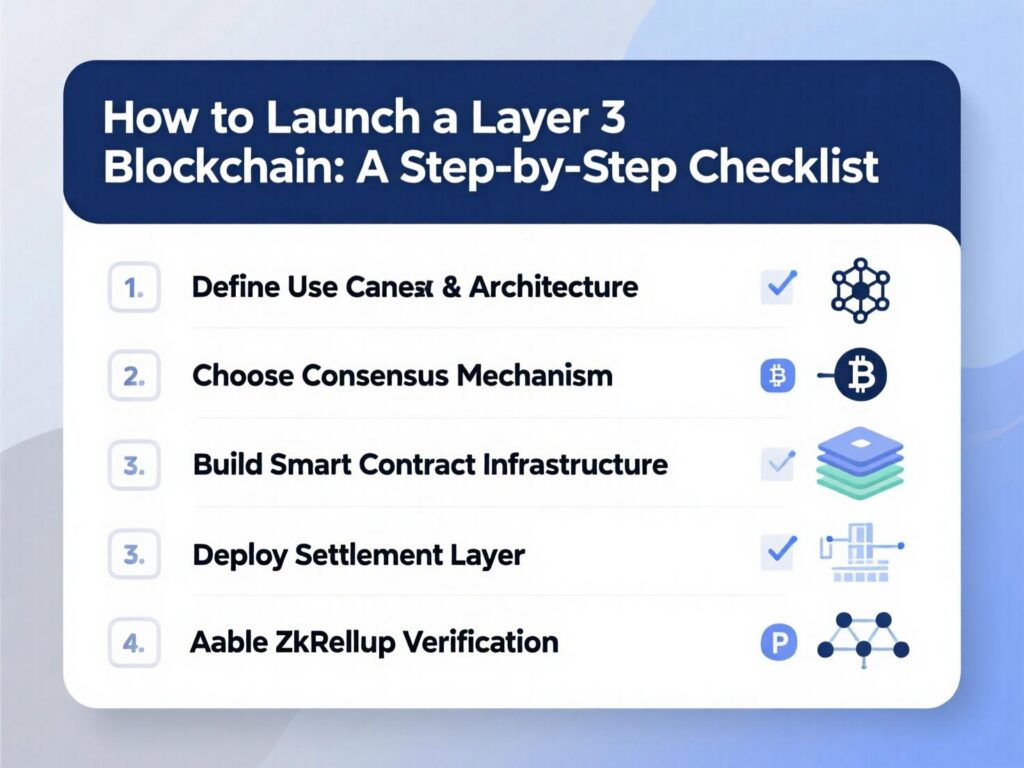
Define requirements:
TPS, latency, gas ceiling, privacy, KYC needs.
Pick the stack:
Orbit (Nitro/Stylus), OP Stack (Superchain), ZK Stack (Hyperchains), Starknet appchains map to your EVM needs and proof system.
Choose DA & settlement:
Ethereum (via L2), AnyTrust, EigenDA; weigh cost vs. security.
Decide on fee token & sequencing:
Custom gas tokens and central/decentralized sequencing.
Select a RaaS partner:
Conduit/QuickNode/AltLayer/Gelato/Caldera for faster spin-up and SRE.
Testnets & audits:
Load test, replay worst-case mempool scenarios, fuzz bridges.
Mainnet with observability:
On-call rota, runbooks, fraud/validity proof monitoring, DA health checks.
Architecture debate: L3s vs Aggregation layers
Polygon argues that “AggLayer + CDK” can deliver shared liquidity and UX without stacking L3s, challenging the need for a Layer 3 blockchain in many cases. Practically, builders should compare: (a) a dedicated L3, versus (b) an L2 connected to an aggregation layer for liquidity/state unification. Your choice is product- and ecosystem-driven.

Real-life examples (brief)
Case 1 Gaming (Xai)
A studio ships an on-chain action game where <1s perceived latency matters. An Orbit-based Layer 3 blockchain with short block times + subsidized gas yields onboarding comparable to Web2, improving retention and IAP-like spend loops.
Case 2 Social/Creator (Degen Chain)
A community wants micro-tipping and high-frequency experiments. A custom gas token on an OP-adjacent/Orbit L3 makes fees negligible and lets creators own the economic surface (rewards, mints, games) without spiking L2 gas.
The business model of Layer 3 blockchain ecosystems
Monetize blockspace:
Keep a slice of sequencer revenue; price priority slots.Native gas token:
Design incentives for builders/users (careful with compliance).Platform fees:
SDK integrations, oracle/data services, cross-chain relays.Co-marketing & IP:
Branded hubs (gaming/social) to attract studios and creators.

Concluding Remarks
The Layer 3 blockchain era is less about “more TPS” and more about control over user experience, economics, and compliance posture while still inheriting L1/L2 security. With post-Dencun costs down and mature stacks available, L3s are becoming a pragmatic choice for high-volume, community-centric apps in gaming, social, and specialized DeFi. Your decision isn’t “L2 vs L3” in the abstract; it’s a product call: where does your app best balance cost, UX, liquidity, and governance?
CTA: Want a build/buy analysis and a launch plan for your Layer 3 blockchain in 30 days? Get our free L3 Readiness Checklist and architecture review—let’s map your path to mainnet.
FAQs
1) What is a Layer 3 in crypto?
A . A Layer 3 is a blockchain that builds on a Layer 2 (not directly on L1). It’s typically used for customized scaling (e.g., privacy, fee tokens, domain-specific throughput) rather than generic scale.
2) How do Layer 3 blockchain fees get so low?
A . They inherit cheap data posting from L2 (post-EIP-4844 blobs) and can further optimize DA/settlement choices (e.g., AnyTrust/EigenDA), reducing end-user costs for targeted workloads.
3) How does an L3 differ from launching on a shared L2?
A . An L3 gives you app-specific control: fee token, sequencing policy, allowlists, and performance tuning versus competing for shared L2 blockspace.
4) How can I build an L3 with existing stacks?
A . Use Orbit (Arbitrum), OP Stack (Superchain), ZK Stack (zkSync), or Starknet appchains often via RaaS providers like Conduit, QuickNode, or AltLayer.
5) How do L3s impact security?
A . Risk compounds: an L3 depends on its host L2 and, ultimately, L1. You must evaluate both the L3 design and the L2 it settles to.
6) How does OP Stack support L3s?
A . Optimism enables L3s to join the Superchain, with features like custom gas tokens and plasma-like modes to suit L3 builders.
7) How do ZK Stack Hyperchains work as L3s?
A . They’re sovereign ZK chains (rollup, validium, or volition) interoperable via the Elastic Network. Builders can configure DA and sequencing, including Layer 3 blockchain topologies.
8) How can gaming benefit from an L3?
A . Dedicated throughput, subsidized or custom gas, and game-specific features improve latency and retention. Example: Xai on Arbitrum Orbit.
9) How do aggregation layers (e.g., Polygon AggLayer) compare to L3s?
A . AggLayer argues you can get shared liquidity/state at L2 without adding another layer. Both approaches should be compared based on your requirements.