
Crypto Infrastructure
Crypto infrastructure is undergoing a shift from purely financial rails to real-world systems that put hardware, connectivity, storage, and compute on-chain. Under the umbrella of Decentralized Physical Infrastructure Networks (DePIN) and decentralized compute markets, communities deploy devices, contribute GPUs/CPUs, and get paid via tokens for verifiable work.
This article unpacks how crypto infrastructure powers physical networks (wireless, sensors, mapping, energy) and compute networks (GPU rendering, AI inference/training, video processing) and how builders can evaluate which primitives to use. Along the way, we’ll look at live examples like Helium (people-built wireless), WeatherXM (community weather data), Akash and io.net (decentralized GPU marketplaces), Render (GPU rendering), Golem (general compute), Filecoin/Arweave (data backbone), and Livepeer (video compute). We’ll close with a practical framework and step-by-step “How-To” for shipping your first workload on this crypto infrastructure stack.
Reality check: the sector is maturing. 2025 data shows growing usage: DePIN ecosystems on Solana highlight millions of monthly transactions and hundreds of millions of dollars in annual rewards; decentralized GPU markets are competing with hyperscalers on price and availability.
Why Crypto Infrastructure Now?
Hardware supply meets token incentives
DePIN coordinates geographically distributed hardware using tokens to bootstrap supply before demand aggregates e.g., Helium’s Proof-of-Coverage for wireless.AI compute crunch
GPU marketplaces (Akash, io.net, Render) mobilize idle or independent capacity, often at materially lower cost than cloud incumbents.Composability
Storage (Filecoin/Arweave) + compute (Akash/Render/Golem/Livepeer) + oracles + restaking security creates a modular crypto infrastructure stack.
The Two Pillars: Physical Networks (DePIN) & Compute Networks
DePIN: Bringing Physical Networks On-Chain
What it is
DePIN networks incentivize deployment of physical infrastructure wireless coverage, sensors, mapping, energy by rewarding verifiable contributions. Think “Proof of Physical Work” (PoPW) designs that measure real-world output.
Common DePIN categories
wireless (Helium Mobile/IoT), sensors (WeatherXM), mapping (Hivemapper), storage (Filecoin, Arweave), energy (various pilots).
Case in point.
Helium (Mobile/IoT)
Uses Proof-of-Coverage to verify honest radio coverage and reward operators. Helium Mobile is packaging people-built coverage into consumer phone plans.
WeatherXM
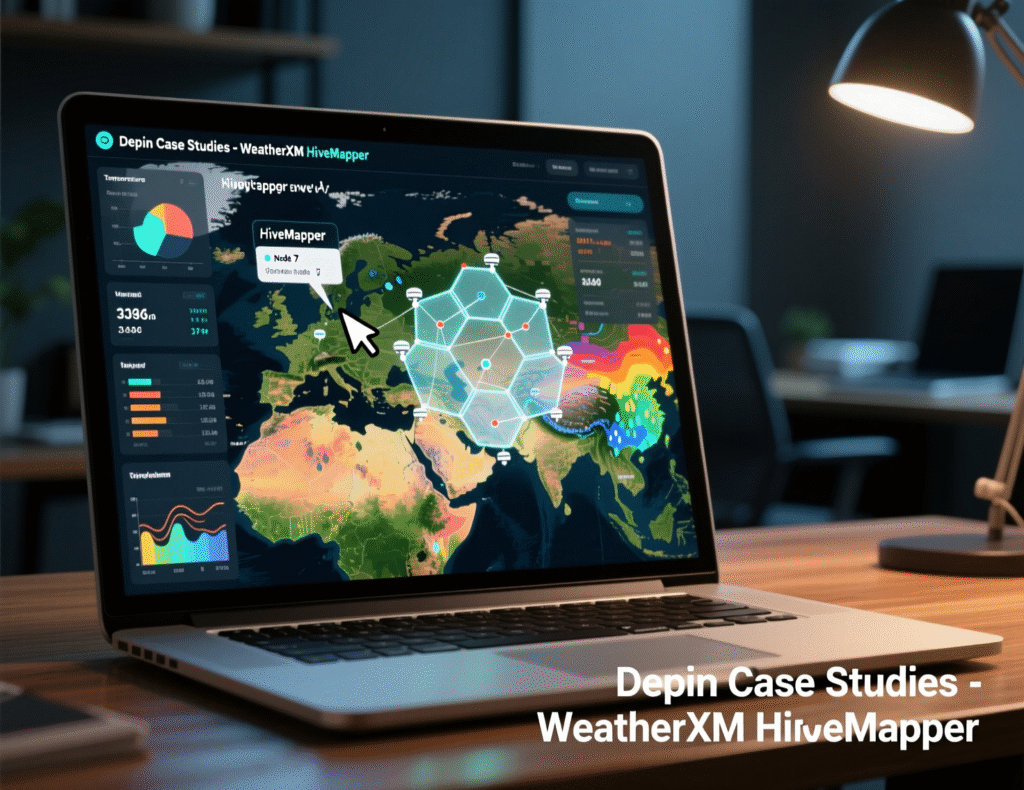
A global community weather station network with thousands of active stations and quality-checked data for agriculture and insurers.Hivemapper
A decentralized mapping project where drivers collect street-level imagery; the network has scaled unique km at a rapid clip since launch.

Key design questions for DePIN builders.
Proofs
What cryptographic/crypto-economic proof verifies the physical service? (e.g., Proof-of-Coverage for Helium).Supply acquisition
How do you seed devices and reduce capex friction?Demand channels
Who buys the data/service (e.g., carriers, insurers, logistics, govtech)?Unit economics
Can token emissions taper as fee revenue grows?
On-Chain Compute: Decentralized GPU/CPU & Specialized Pipelines
Why it matters
The AI cycle strained centralized GPU supply and budgets. Decentralized compute marketplaces unlock alternative capacity, peer-to-peer pricing, and transparent economics core to modern crypto infrastructure.
Notable networks.
Akash Network
A decentralized compute marketplace with transparent GPU pricing and “supercloud” positioning for AI workloads.io.net (on Solana)
Aggregates 10,000s of GPUs; markets up to ~70% cost savings vs. AWS for AI workloads and frequent integrations with AI stacks.Render Network
Decentralized GPU rendering used by 3D/AI creators; providers monetize idle GPUs.Golem
Generalized compute market for requestors/providers with GLM payments (often on Polygon to cut fees).Livepeer
Video compute (AI video/transcoding) for real-time media workloads.
Data backbone.
Filecoin
Open market for verifiable storage with active deal flow in the exabytes. Strategy increasingly targets high-value data + compute adjacent workloads.Arweave (+ AR.IO)
Permanent storage via a one-time fee model and decentralized gateways for retrieval at scale.
Security Layer: Restaking for Crypto Infrastructure
DePIN and compute protocols can “rent” cryptoeconomic security from restaking layers.
EigenLayer (Ethereum)
Restaking creates a “marketplace for trust” where AVSs (Actively Validated Services) can inherit security from staked assets; slashing/rewards frameworks matured through 2025.Babylon (Bitcoin)
Enables native BTC time-locked staking to secure PoS chains exporting Bitcoin’s economic security without bridges.
These security primitives are increasingly relevant as crypto infrastructure applications depend on robust validation and service-level assurance.

Real-World Results (Mini Case Studies)
Case Study A People-Built Wireless Meets Consumer Plans
Helium Mobile bundles community coverage into phone plans. Its blog showcases ongoing product iterations and incentives aimed at mainstream adoption, while the IoT network relies on Proof-of-Coverage to verify radio service. For municipal and enterprise buyers, people-built coverage can fill gaps faster than legacy rollouts. Helium Mobile Blog+1
Case Study B AI Teams Cut GPU Costs with Decentralized Marketplaces
AI startups report savings and fast provisioning by tapping decentralized GPU capacity on Akash (public price boards vs hyperscalers) and io.net (claims of 30k+ GPUs and sizable cost reductions), with specialized rendering on Render where applicable. The combined stack store training data on Filecoin/Arweave, spin workloads on Akash/io.net/Render forms a pragmatic crypto infrastructure pipeline for inference and fine-tuning.
Architecture: The On-Chain Infra Stack You Can Assemble Today
Data layer
Filecoin (verifiable storage deals), Arweave (+AR.IO gateways for retrieval).Compute layer
Akash (general/GPU), io.net (GPU clusters), Render (rendering), Golem (task-based compute), Livepeer (video/AI video)Physical input layer (DePIN)
Helium (wireless), WeatherXM (weather), Hivemapper (mapping).Security layer
EigenLayer AVSs; Babylon BTC restaking for PoS.
Evaluating Crypto Infrastructure Networks (Scorecard)
Verification
Is there a robust proof (PoC/PoPW)? (Helium’s PoC is the reference).
Demand
Who pays end users, devs, or enterprises? Evidence of paying customers?
Cost & Performance
Concrete savings vs. cloud incumbents (Akash/io.net publish pricing/claims).
Resilience
Storage redundancy (Filecoin proofs), retrievability (AR.IO gateways), fault tolerance.
Token Emissions
Clear path from subsidies to fee revenue.
Governance & Upgrades
DAO maturity, roadmap credibility.
Regulatory & Data Risk
Especially for telecom, mapping, and personal data.
Quick Start: Shipping a Workload on the Stack
Persist data
Store datasets on Filecoin for cost-effective deals or Arweave for permanence (via SDKs). Provision compute: Price GPUs on Akash or io.net; route rendering jobs to Render; generic jobs to Golem.
Media pipeline
For video, offload transcoding/AI-video to Livepeer.
Real-world data
If your app benefits from physical inputs, tap WeatherXM or Helium device data feeds (where available).
Harden security
Explore EigenLayer AVSs or Babylon for economic guarantees.
Risks & Realities
Bootstrapping challenges
Over-incentivized supply without sticky demand can depress token economics. (Industry analyses in 2025 emphasize revenue-backed projects.)Performance variability
Latency, reliability, and SLAs vary across community nodes; benchmarking is essential.Regulatory gray zones
Telecom, mapping, and data markets require careful compliance.Market cycles
Funding and network utilization correlate with broader crypto cycles. (Sector overviews and reports track these correlations.)

Last Words
The next wave of crypto infrastructure is practical, not speculative: individuals deploy hardware, share GPUs, and contribute data then get paid for provable services. DePIN and decentralized compute are converging into an end-to-end stack: store data on Filecoin/Arweave, process workloads via Akash/io.net/Render/Golem/Livepeer, ingest real-world signals from Helium/WeatherXM/Hivemapper, and harden security with restaking.
As the stack matures, buyers will prioritize networks with clear proofs, transparent pricing, enterprise-grade reliability, and real customers. If you’re building, start with one workload and one demand channel. Let economics not narratives determine where you scale across this crypto infrastructure.
CTA
Want a tailored deployment plan (pricing, SLAs, and architecture) for your use case? Reach out and we’ll blueprint your crypto infrastructure stack in one working session.
FAQs
Q1 : How do DePIN networks verify real-world work?
A : They use crypto-economic proofs (e.g., Helium’s Proof-of-Coverage) to verify that devices provide the claimed service. Witnessing/attestation and cryptographic challenges reduce spoofing and tie rewards to measurable outputs. PoC beacons and witnesses play a key role, while penalties discourage dishonest reporting.
Q2 : How can decentralized compute be cheaper than hyperscalers?
A : Marketplaces aggregate idle or independent GPU capacity with transparent, auction-like pricing. Akash and io.net publish real-time price boards that often undercut centralized clouds, especially for spot-like usage. Users should benchmark per-hour GPU costs before committing, referencing each provider’s price page.
Q3 : How does storage fit into crypto infrastructure?
A : Filecoin provides verifiable storage contracts with enterprise-style workloads, while Arweave offers permanent storage via a one-time fee, supported by AR.IO gateways for retrieval. Proofs such as PoRep and PoSt verify reliability, and gateway routing connects these storage layers to compute and DePIN data.
Q4 : How can we secure DePIN/compute services economically?
A : Restaking frameworks like EigenLayer (ETH) and Babylon (BTC) allow services to borrow security from staked assets. Slashing deters misbehavior, while AVSs and time-locked BTC enhance service guarantees through cryptoeconomic enforcement.
Q5 : How do I choose between Akash, io.net, Render, and Golem?
A : Match workloads to each network’s strength: Akash for general or GPU tasks, io.net for clustered GPUs, Render for rendering, and Golem for generic distributed computing. Compare price-performance ratios, scheduling features, and data locality. Run pilots across at least two providers for validation.
Q6 : How can my app use real-world data without running devices?
A : Access open DePIN networks such as weather feeds or coverage maps, or collaborate with existing operators. Validate the accuracy and licensing of incoming data before using it commercially. Most networks provide APIs and dashboards for secure data integration.
Q7 : How do tokens transition from emissions to fees?
A : Networks gradually reduce token emissions while growing fee-based revenue from real users. Watch for governance updates on emission halving, marketplace take rates, and treasury sustainability metrics key indicators of a network’s long-term economic health.
Q8 : How can teams ensure compliance with mapping/telecom data?
A : Teams must establish consent, follow local data laws, and filter sensitive imagery or PII. Using quality gates and enterprise-level agreements ensures compliant commercial use. Jurisdictional differences and data minimization principles are critical for large-scale deployments.
Q9 : How does Livepeer fit AI video use cases?
A : Livepeer specializes in decentralized transcoding and real-time AI video compute. It integrates with social and media dApps, while orchestrators and transcoders earn via LPT staking. In 2025, governance proposals expanded its reach across on-chain media ecosystems.