

CredShields-backed analysis informs OWASP Smart Contract Top 10 2026 rankings
OWASP has released the OWASP Smart Contract Top 10 2026, presenting it as a practical risk framework rather than a purely theoretical list. The update reflects real-world security challenges seen in blockchain and smart contract ecosystems.
The framework is based on observed exploit patterns and common failure modes from 2025 and earlier years. This approach helps developers, auditors, and security teams focus on risks that have actually caused losses, making the guidance more actionable and relevant.
What OWASP says the list is for
OWASP describes the Smart Contract Top 10 as an awareness document for Web3 developers and security teams, intended to help organizations prioritize prevention and assessment against the most common and impactful weaknesses found in smart contracts. OWASP also notes the 2026 ordering is “forward-looking,” using 2025 incident and survey data to forecast which risks are likely to matter most next.
OWASP Smart Contract Top 10 2026 risk list: the ranked risks
OWASP’s published 2026 ranking lists the following categories (in order):
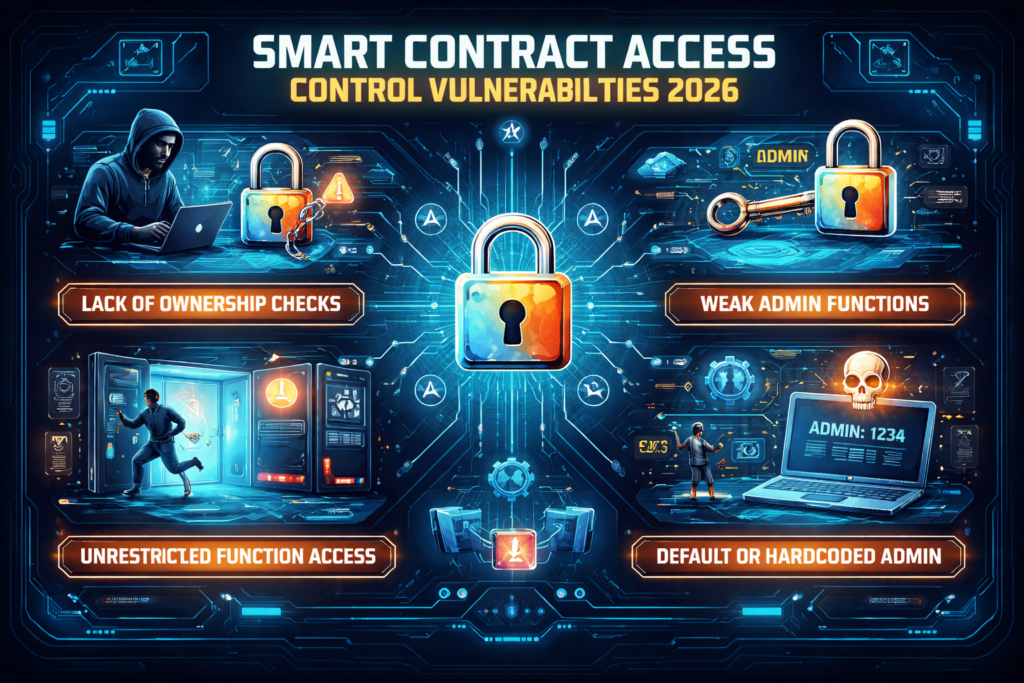
Access Control Vulnerabilities
Business Logic Vulnerabilities
Price Oracle Manipulation
Flash Loan–Facilitated Attacks
Lack of Input Validation
Unchecked External Calls
Arithmetic Errors (Rounding & Precision)
Reentrancy Attacks
Integer Overflow and Underflow
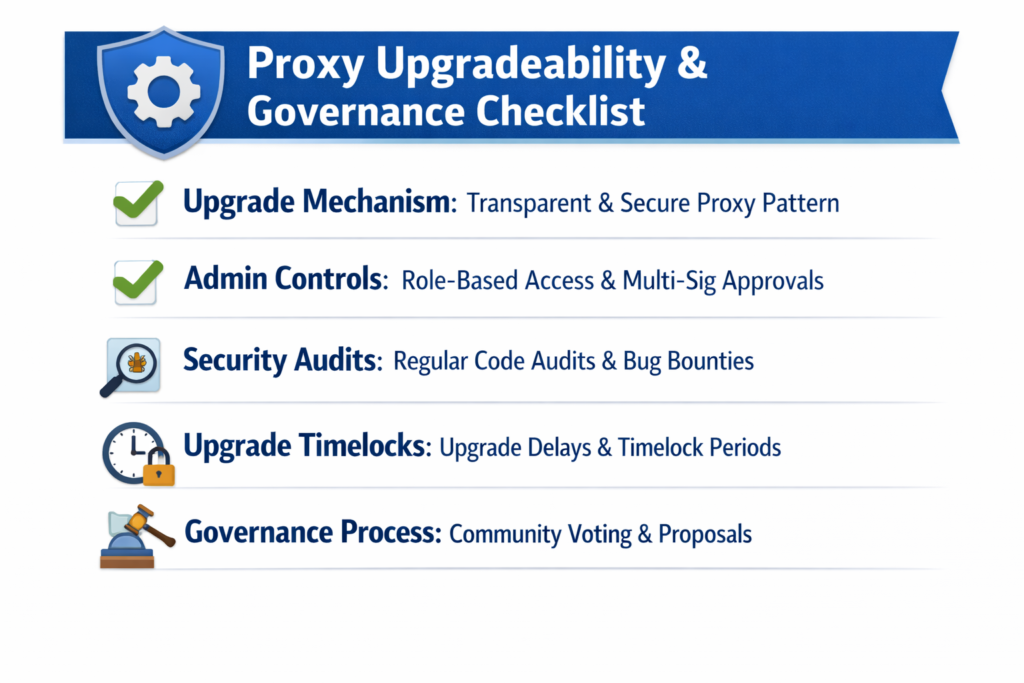
Proxy & Upgradeability Vulnerabilities
Why the OWASP Smart Contract Top 10 2026 risk list elevates “structural” failures
OWASP’s descriptions emphasize that several top-ranked items frequently lead to broad compromise because they involve privileged functions, governance, upgrade paths, and economic design assumptions not just low-level coding mistakes. For example, OWASP’s “access control” entry explicitly ties risk to exposed admin, governance, or upgrade paths, while “business logic” focuses on design-level flaws that can break intended economic or functional rules.
OWASP also highlights “honourable mentions” including cross-chain MEV and governance-specific attack vectors, pointing to a 2025 cross-chain MEV case in which attackers extracted $5.27M by exploiting information leakage and transaction ordering asymmetry.
Methodology signals from 2025 incidents
On its 2026 Top 10 site, OWASP summarizes the incident basis as 122 deduplicated smart-contract incidents analyzed and approximately $905.4M in 2025 smart-contract-involved losses (as scoped by the project’s data sources).
Separate coverage and press-release materials describe CredShields supported by its platforms SolidityScan and Web3HackHub as contributing to structured incident aggregation and pattern analysis used to inform the ranking.
Beyond contract code: OWASP’s “Alternate Top 15”
OWASP’s 2026 materials also point readers to an “Alternate Top 15 — Web3 Attack Vectors (Beyond Smart Contracts),” framing some of the largest losses in 2025 as driven by off-chain and operational threats (for example, multisig and supply-chain risks) rather than contract bugs alone.
Context & Analysis
The practical implication of OWASP’s ordering is that “secure code” checks may be insufficient if governance, upgrade authority, or oracle integrations create a single point of failure. OWASP’s own category descriptions repeatedly tie catastrophic outcomes to privileged access and design-level economic behavior areas that may not be fully addressed by traditional vulnerability scanning alone.
Concluding Remarks
OWASP’s 2026 smart contract ranking reinforces a shift in industry attention toward access control, governance/upgrade design, and economic/business-logic resilience while still keeping classic issues like reentrancy and arithmetic errors in view. For teams building DeFi, bridges, and on-chain governance, the framework is positioned as.
FAQs
Q : What is the OWASP Smart Contract Top 10 2026?
A : OWASP Smart Contract Top 10 2026 is a ranked list of common smart contract weakness categories, published under OWASP’s Smart Contract Security effort, based on 2025 incident data and practitioner input.
Q : Which risks are ranked highest in 2026?
A : Access Control Vulnerabilities and Business Logic Vulnerabilities are ranked #1 and #2, followed by Price Oracle Manipulation and Flash Loan–Facilitated Attacks.
Q : How much loss data does OWASP summarize for 2025 incidents?
A : OWASP’s 2026 analysis summarizes approximately $905.4 million across 122 deduplicated smart contract incidents, as defined by the project scope.
Q : Why does the ranking emphasize governance and upgrades?
A : OWASP highlights that mismanaged admin roles, governance controls, and upgrade mechanisms often expose privileged paths that can result in full protocol compromise.
Q : Does an audit guarantee a protocol is safe?
A : No. OWASP notes that even audited protocols can fail due to design flaws, governance risks, oracle dependencies, and operational weaknesses beyond code review.
Q : What is the “Alternate Top 15” mentioned alongside the Top 10?
A : It is a separate OWASP list that expands beyond smart contract code to cover broader Web3 attack vectors, including off-chain and operational threats.
Q : Where can I read the OWASP Smart Contract Top 10 2026 risk list?
A : The list is published on OWASP’s Smart Contract Security website and is also linked from the main OWASP project page.
Facts
Event
OWASP publishes Smart Contract Top 10 for 2026, ranking common smart contract weakness categories using 2025 incident data and practitioner input.Date/Time
2026-02-19T00:00:00+05:00 (release date as stated in materials)Entities
OWASP (Open Worldwide Application Security Project); OWASP Smart Contract Security (SCS); CredShields; SolidityScan; Web3HackHubFigures
122 deduplicated incidents; ≈ USD 905.4M analyzed 2025 smart-contract-involved losses; cross-chain MEV example: USD 5.27M extractedQuotes
“Derived from security incidents and survey data collected during 2025” — OWASP Smart Contract Top 10 2026 siteSources
OWASP Smart Contract Top 10 2026 page; Chainwire release; CSO Online coverage