

Convert Crypto to Cash in Dubai: Safe Guide
You can convert crypto to cash in Dubai using licensed OTC desks, regulated exchanges with AED withdrawals, P2P platforms and a few crypto cards that support AED. The safest option is to pick a VARA-regulated provider, complete KYC, and compare the crypto-to-AED exchange rate and all fees before sending any coins.
Dubai has become one of the easiest places in the world to convert crypto to cash in Dubai but it’s also somewhere you don’t want to make rushed, sloppy decisions. As a visitor from the US, UK, Germany or wider EU, you can sell Bitcoin or USDT in person, use a VARA-regulated exchange, or cash out via bank and fintech apps. The key is to stay inside Dubai’s rules, understand your crypto-to-AED exchange rate, and keep your home-country tax obligations in mind.
Below, we’ll walk through legality, the main options, a practical step-by-step flow, OTC desks, bank routes, tax, KYC and how to choose the safest path before you even board a flight from New York, London or Berlin.
Can You Legally Convert Crypto to Cash in Dubai?
Yes, you can legally convert crypto to cash in Dubai, as long as you use licensed providers, follow VARA rules, and complete standard KYC/source-of-funds checks. There is no specific UAE law that bans converting cryptocurrency to cash, provided the funds are legitimate and AML requirements are met.
How Dubai regulates crypto and cash-outs
Dubai is actively positioning itself as a global crypto hub, with billions of dollars in crypto flowing through the UAE each year. Between July 2023 and June 2024, the UAE received roughly $30–34 billion in digital assets, putting it among the top 40 crypto economies globally.
The Virtual Assets Regulatory Authority (VARA) is the dedicated regulator for virtual assets across Dubai’s mainland and free zones (except DIFC). It issues the Virtual Assets and Related Activities Regulations and activity-specific rulebooks for exchanges, brokers, custodians and other VASPs.
In practice
Cash withdrawals
Typically handled by OTC desks and money-service style providers, many of which are now moving under VARA’s framework.
Bank transfers and card withdrawals
Handled via regulated exchanges and bank-integrated brokerages; funds move as normal AED payments under UAE banking rules.
Cards and fintechs
Some apps let you spend crypto directly, but in the background they usually sell your coins and settle in AED via licensed partners.
Dubai’s framework doesn’t make crypto legal tender, but it does make regulated trading and cash-outs legal if you use authorized channels and pass compliance checks.
Is it legal to cash out crypto in Dubai as a foreigner?
Yes. You do not need UAE residency to sell BTC or USDT and receive AED in Dubai, whether you’re a tourist, expat or company director. What you do need is:
A valid passport
Standard KYC (ID verification, selfies, sometimes proof of address)
Source-of-funds documentation if your ticket size is material
For visitors from the US, UK, Germany and the wider EU, the key distinction is where your tax obligations sit: Dubai doesn’t tax personal crypto gains for individuals, but your home country usually still does (more on that later)
So you can absolutely land in Dubai for a week, sell crypto and walk out with AED cash or a bank transfer just don’t treat that as a way to “disappear” taxable gains.
Anonymous vs compliant: what’s realistically possible?
Completely anonymous, large crypto-to-cash deals are rare and high-risk in 2025. VARA’s rules, UAE-wide AML/CTF guidance and banking scrutiny all push serious OTC desks and platforms to collect:
Full ID and selfie checks
Proof of address for non-residents
Source-of-funds/source-of-wealth for higher amounts
For a few thousand dollars equivalent, you might see “lighter” checks. Once you move into $10,000+ territory, expect robust KYC and questions about where the crypto came from. This protects providers from regulatory trouble and you from being dragged into investigations later.
If you’re a high-value traveler, it’s almost always safer to pick regulated, compliant desks and accept the paperwork instead of chasing “no-ID” offers with too-good-to-be-true rates.
Main Ways to Convert Crypto to Cash in Dubai
The main ways to convert crypto to cash in Dubai are OTC desks, centralized exchanges with AED withdrawal, P2P platforms, and a few crypto cards/fintech apps that spend or withdraw in AED. Each has different trade-offs for speed, privacy, limits and documentation.
OTC crypto desks and in-person exchanges
An OTC crypto desk in Dubai is an in-person office where you can sell Bitcoin, USDT and other coins for AED cash or bank transfer. It’s the classic “sell bitcoin for cash in Dubai” experience: you book a slot, visit an office near Dubai Marina or Business Bay, send coins from your wallet, and receive cash or an instant transfer.
Typical patterns
Use cases
Tourists wanting a few thousand AED, expats moving larger sums, high-net-worth individuals liquidating six- or seven-figure positions.
Assets
USDT on Tron or Ethereum is extremely common; BTC and major altcoins also see strong demand.
Ticket sizes
Many desks publish minimums (e.g. 5,000–10,000 AED) and can handle well into six figures with prior notice.
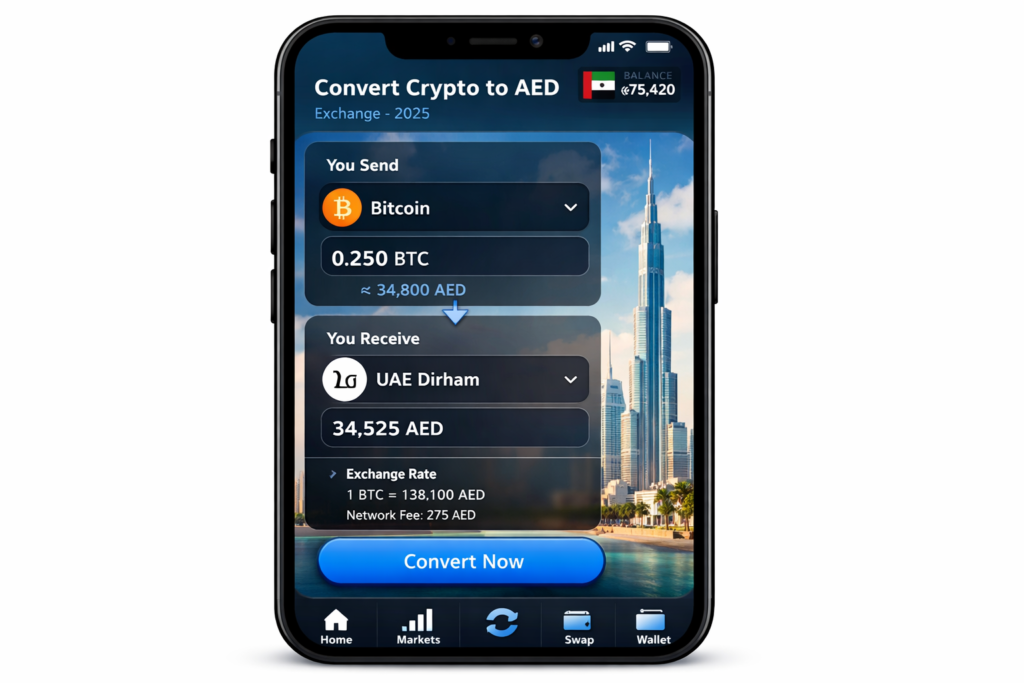
Rates usually track the global crypto to AED exchange rate, minus a spread that depends on liquidity, size and your relationship with the desk.
Centralized exchanges and AED withdrawals
If you prefer apps over offices, you can use global exchanges like Binance or OKX (where available to you) to sell BTC/USDT into AED and then withdraw to a UAE bank account or card. Many UAE residents also use local, fully regulated brokers and banks.
One high-profile example is RAKBANK, which launched a crypto brokerage in partnership with Bitpanda, allowing customers to trade crypto in AED directly from their bank app via a VARA-regulated VASP.
Pros vs OTC.
Pros
Clear digital records, potentially tighter spreads, easier for smaller trades, integrates with your UAE bank.
Cons
Usually requires a local bank account, residency and full KYC; not ideal for short-term tourists.
P2P, Bitcoin ATMs and crypto cards
P2P marketplaces (including newer Symlix/1Tab-style platforms) match you with buyers in Dubai who pay by bank transfer or, occasionally, cash. Escrow features hold your crypto until you confirm that fiat has arrived.
Bitcoin ATMs used to be the classic “bitcoin to cash near me in Dubai” search result, but today publicly listed crypto ATMs in the UAE are extremely limited, with some earlier installations removed or inactive.
Crypto cards and fintech apps are an increasingly popular alternative. Some EU- or UK-issued cards let you:
Spend crypto that’s auto-converted to AED at POS
Withdraw limited amounts of cash in AED from ATMs
They’re convenient for tourists from London or New York, but usually have tighter limits and less attractive FX than a well-negotiated OTC or banked off-ramp.
Step-by-Step: How to Convert Crypto to Cash in Dubai
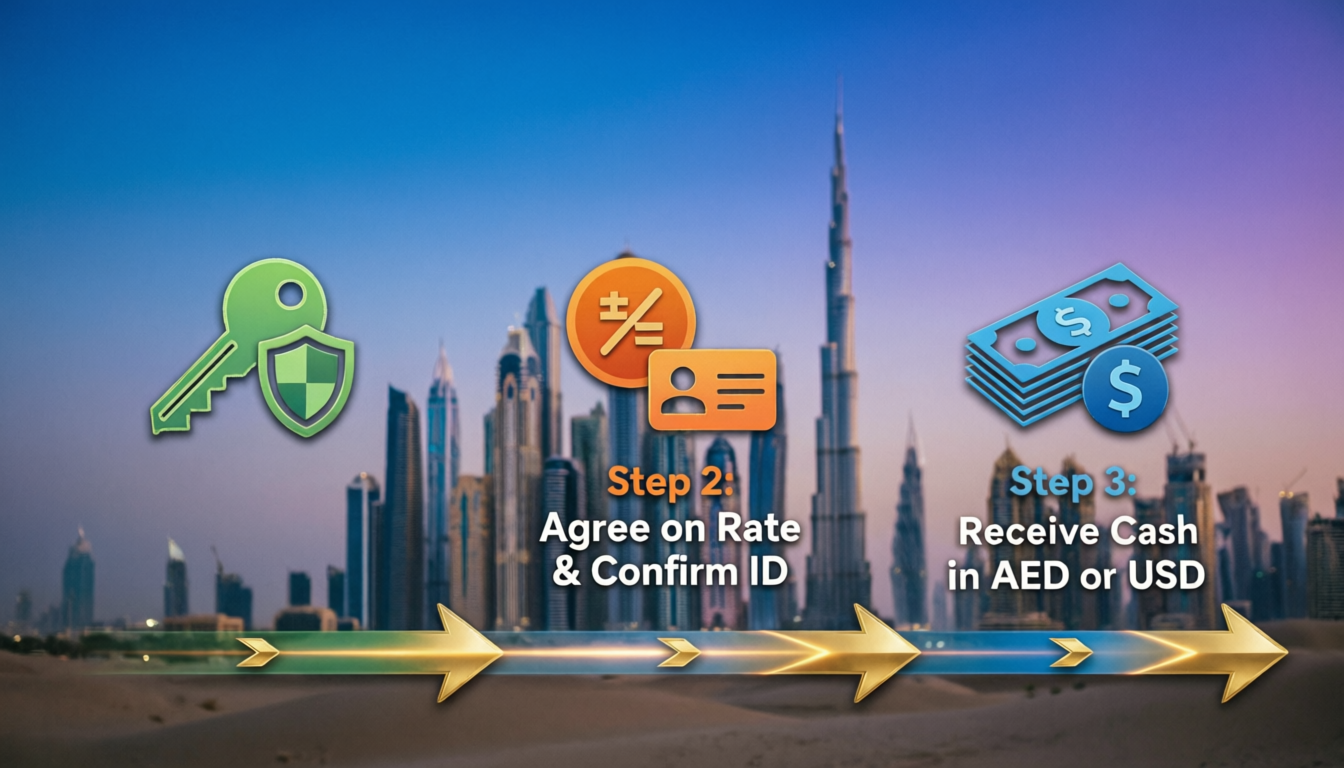
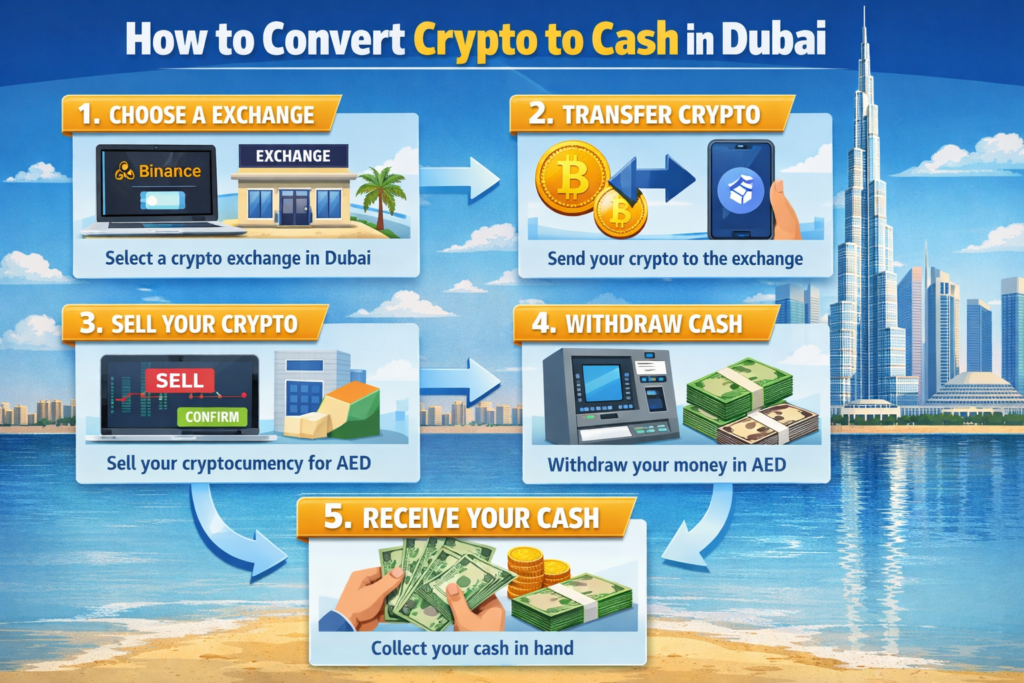
To convert crypto to cash in Dubai, choose a method (OTC, exchange, P2P), confirm the current crypto-to-AED exchange rate and all fees, pass KYC, send your coins, then receive AED as cash or to your bank/card. Here’s a practical three-step flow you can follow.
Choose your route: OTC, exchange or bank off-ramp
Start by matching the route to your profile.
Short-stay tourist – 1–20k USD equivalent; you want speed and clear instructions. OTC desks or P2P with strong reviews work well.
Expats / long-term residents May prefer exchange + UAE bank for an audit-ready paper trail.
Companies & high-net-worth individuals Large OTC deals, scheduled in advance, often a mix of cash and bank transfers.
Quick decision logic
Need maximum speed and in-person reassurance? → Reputable OTC desk.
Want the cleanest documentation and easy wires back to Europe? → Regulated exchange + UAE bank.
Only cashing out a small amount from your phone? → P2P or card/fintech app, with careful attention to fees.
Prepare your wallet, documents and limits
Before you even leave Berlin or Frankfurt, make sure:
Your BTC/USDT/other coins are in a wallet you control and can send from quickly.
You have your passport, and if applicable, UAE residency ID and proof of address.
For larger tickets (10k+ USD), you can show source-of-funds: exchange statements, purchase receipts, or company documents.
Most OTC desks and licensed VASPs set daily limits. Once you move toward $50,000+, it’s normal to pre-book so compliance teams can review your file and arrange sufficient liquidity.
Execute the trade and collect your AED
At an in-person OTC office, the flow typically looks like this:
You agree a quote based on the live crypto-to-AED exchange rate and spread.
You scan a QR code and send the agreed amount from your wallet.
Once the transaction receives enough confirmations, you receive:
AED cash (in a private room), and/or
An immediate local bank transfer or card top-up
On an app or exchange, you’ll:
Deposit crypto
Sell into AED
Request a cash withdrawal, card withdrawal, or bank transfer
Whichever route you choose, double-check the rate and fees, count physical cash carefully, and request a receipt or on-chain + banking confirmation for your records.
Cashing Out Bitcoin & USDT in Person: Dubai OTC Desks
For larger amounts or in-person service, Dubai crypto OTC desks let you sell Bitcoin or USDT and receive AED cash or bank transfer, but you should book ahead, pass KYC, and compare rates and reviews.
Who Dubai OTC desks are best for
OTC offices are tailor-made for
High-limit traders (50k+ USD) moving significant value
Company owners rebalancing treasury holdings
Long-term holders who prefer face-to-face settlement
Tourists and expats from the US, UK, Germany and EU also like OTC because they get a human to talk to and avoid surprises with their crypto to AED exchange rate. Many will happily accept smaller amounts too, depending on their business model.
What to expect at an OTC office in Dubai
Most reputable OTC desks are located in business districts like Dubai Marina, Business Bay and near Dubai Mall, often in regular office towers. Expect:
Booking
WhatsApp/Telegram or web forms to schedule your slot.
Security
CCTV, professional staff, private counting rooms, and clear visitor procedures.
Rates
Either a visible board or a quote shared in chat; spreads can improve with size or repeat business.
You’ll usually complete or update KYC during your visit and sign basic trade confirmations, particularly for large tickets.
Comparing popular OTC brands & reading reviews
You’ll see names like Pallapay, DubaiOTC and Coincashy in search results. These are examples of OTC and payment players active in the market, not endorsements.
When comparing any OTC desk, focus on:
Licensing / registration status and VARA mention
KYC approach and how they handle source-of-funds
Responsiveness over chat and clarity of pricing
Reviews across Reddit, Google Maps and Trustpilot-style sites — watch for patterns, not one-off rants
Converting Crypto to AED via Banks & Local Apps
If you prefer a fully banked route, you can sell crypto on regulated platforms that integrate with UAE banks, then withdraw in AED to your account or card, usually with higher compliance but clearer records.
Crypto-friendly UAE banks and AED accounts
UAE banks are cautiously warming up to regulated crypto activity. Some, like RAKBANK, now offer direct crypto brokerage in partnership with regulated VASPs, allowing customers to buy and sell digital assets in AED from their bank apps.
To open an account as an expat or resident you’ll typically need:
Passport and UAE visa
Emirates ID
Proof of address and sometimes employment / company documents
Short-stay tourists usually won’t get a full local account, so this path is best if you’re already based in the UAE or planning to stay.
Using exchanges and local apps to convert crypto to AED
The typical “banked” flow is:
Deposit crypto into a regulated exchange or local app
Sell to AED (spot trade or instant sell)
Withdraw to your UAE bank account or card
Compared with OTC desks, you might see:
Lower spreads but extra platform fees
Longer settlement times for bank wires (hours instead of minutes)
Better options to convert stablecoins to cash in Dubai using local AED rails
For business users, this route also makes accounting, audits and tax reporting easier back in the US, UK, Germany or wider EU.
Sending AED back to US/UK/EU bank accounts
Once you have AED sitting in a UAE bank, you can wire funds back to:
USD accounts in New York
GBP accounts in London
EUR accounts in European Union hubs like Frankfurt or Luxembourg
You’ll pay FX spreads and possibly correspondent banking fees. Banks may also ask additional questions if they see large inbound AED from a crypto-linked platform, so keep your exchange statements and OTC receipts.
In Europe and the UK, modern open-banking and PSD2-style rails can make incoming EUR/GBP easier to track and reconcile across your accounts and apps. (Mak It Solutions)
Rules, KYC & Tax for US, UK, German & EU Citizens
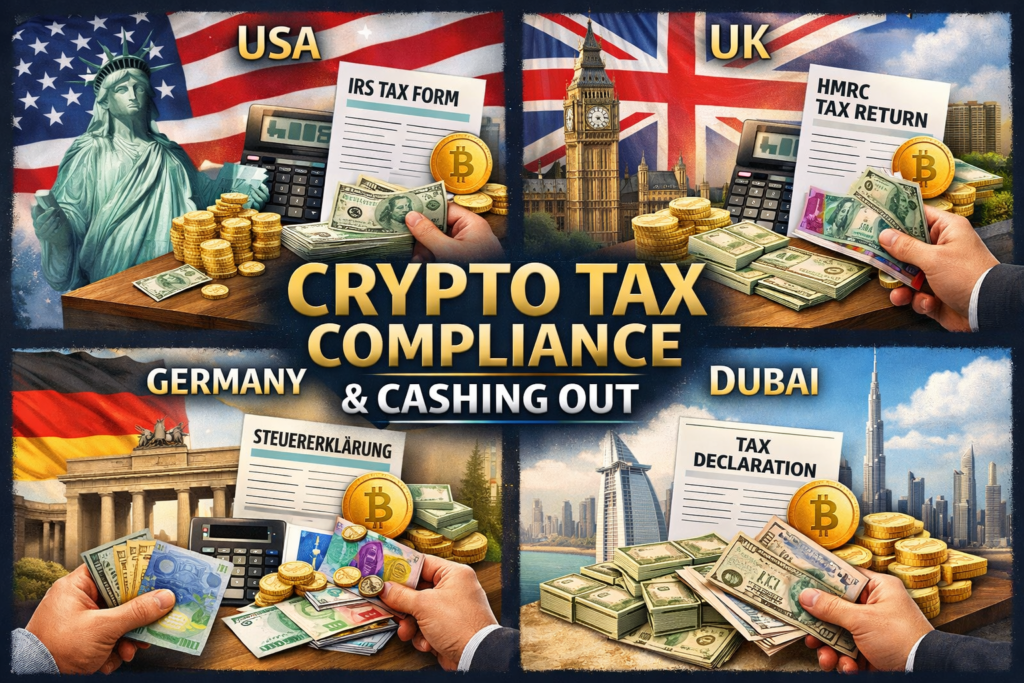
Cashing out crypto in Dubai does not erase your home-country tax obligations; US, UK, German and EU residents usually must report disposals to the IRS, HMRC or their local tax office, even if the sale happens in Dubai.
VARA, AML and source-of-funds checks in Dubai
Dubai’s VARA rulebooks set out detailed requirements for VASPs around KYC, AML and market conduct. VASPs have until mid- to align with Rulebook version 2.0, raising the compliance bar even further.
That’s why OTC desks and platforms:
Ask for ID and proof of address
Request source-of-funds and source-of-wealth information
Monitor large cash transactions and report suspicious activity under UAE AML/CTF rules (AML UAE)
If someone offers a big, no-questions-asked cash deal, assume you’re not only outside VARA’s comfort zone, but possibly stepping into AML trouble.
Financial data from OTC desks and banks is governed by financial-sector and data-protection laws like GDPR/DSGVO, not medical-privacy frameworks such as the NHS or HIPAA. It’s serious, but it’s not the same category of sensitivity.
Reporting Dubai crypto cash-outs at home
United States (IRS)
The IRS treats digital assets as property, and requires you to report disposals (sales, swaps, or using crypto to buy things) on your tax return, regardless of where the transaction happens. Recent IRS guidance explicitly reminds taxpayers to answer the digital asset question and declare all crypto income and gains.
United Kingdom (HMRC)
HMRC’s Cryptoassets Manual sets out how UK tax law applies to crypto. UK residents typically pay capital gains tax on profits over their annual allowance, even if they cashed out in Dubai while on holiday.(GOV.UK)
Germany / EU (Finanzamt & BaFin)
Germany has issued detailed BMF guidance on the income-tax treatment of crypto, updated as recently as March 2025. Holding periods, classification of activity and documentation all matter; disposals abroad are still taxable events if you’re German-tax-resident.
How to stay compliant if you’re flying in from abroad
If you’re flying in from the US, UK or Germany, a few habits keep you out of trouble:
Document your history Keep wallet histories, exchange CSVs and OTC receipts.
Match each disposal to a record Note date, amount of crypto and AED received.
Get professional advice For significant sums, speak to a US CPA, UK tax adviser or German Steuerberater who understands cross-border crypto.
Think of Dubai as a location choice, not a tax-eraser. You still want a clean, well-documented file if your home tax authority ever asks questions. This article is general information, not tax, legal or investment advice.
Choosing the Safest Way to Convert Crypto to Cash in Dubai
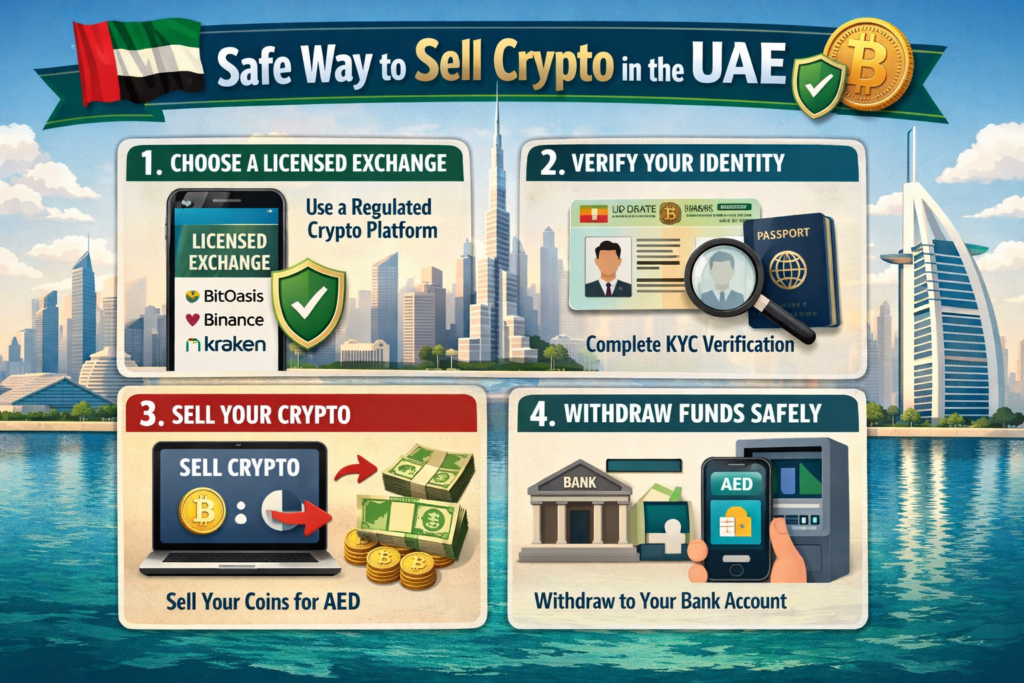
The safest way to convert crypto to cash in Dubai is to use a licensed OTC desk or regulated exchange that clearly states its fees, KYC rules and VARA compliance, and to avoid unlicensed “no-ID” offers.
Quick decision framework by profile
Tourists (New York → Dubai)
Small–medium tickets
Look for OTC desks near Dubai Marina/Downtown with strong reviews and clear quotes
Bring your passport and basic documentation
Expats (London / Abu Dhabi / wider UAE)
Prefer banked solutions and ongoing use
Use VARA-regulated exchanges and crypto-friendly banks with AED accounts
High-net-worth & company owners (Berlin, Frankfurt, Zurich)
Large tickets, multiple deals per year
Book OTC in advance, split across days if needed, and ensure multi-step compliance and settlement plans
Red flags when cashing out crypto in Dubai
Walk away if you see
“No KYC needed” for large amounts
No clear office address or they insist on meeting in a random café or hotel lobby
No written quote or signed confirmation
Rates that are far better than the real-time crypto-to-AED exchange rate on major exchanges
If you’re already in a meeting and feel uncomfortable, say you’ve changed your mind, send no coins and leave. There are enough compliant providers that you don’t need to force a bad situation.
How to prepare before you fly from New York, London or Berlin
Before you board your flight
Decide how much you want to cash out and whether you’ll bring BTC or stablecoins.
Shortlist 2–3 providers (OTC desks or exchanges) and ask about limits and documentation.
For 10,000+ USD cash-outs, pre-book a time slot and send your documents in advance so compliance reviews don’t delay you.
If you run a fintech, exchange or bank serving customers moving between the US/UK/EU and UAE, consider partnering with a specialist product and data team like Mak It Solutions to design secure, compliant off-ramp experiences that integrate with your existing apps and analytics stack.
Key Takeaways
You can legally convert crypto to cash in Dubai if you use licensed, VARA-aligned providers and complete normal KYC/AML checks.
Main routes include OTC offices, exchanges with AED withdrawals, P2P marketplaces and a few crypto cards/fintech apps that support spending or withdrawing in AED.
High-value travelers from the US, UK, Germany and EU should prioritize regulated OTC desks or bank-integrated platforms, not “no-ID” offers with unrealistic rates.
Cashing out in Dubai does not remove home-country tax duties; IRS, HMRC and German Finanzamt generally tax worldwide crypto disposals.
Preparing documents, limits and provider shortlists before flying from New York, London or Berlin makes your cash-out smoother, safer and easier to report later.
If you’re a bank or fintech, partnering with a specialist development team for compliant web, mobile and data solutions helps you deliver seamless, audit-ready off-ramps for your customers. For example, Mak It Solutions’ web development services and business intelligence services are built around secure, data-heavy financial products.
If you’re planning to convert crypto to cash in Dubai, treat this as a project, not a last-minute errand. Shortlist your providers, check VARA alignment, and line up the documentation you’ll need so your time on the ground is focused on execution, not panic.
If you’re on the business side a bank, exchange, wallet or fintech building your own crypto off-ramp Mak It Solutions can help you architect compliant web and mobile journeys, analytics pipelines and reporting around UAE and international rules. Explore our services overview, check out our work on Middle East web development trends, or contact the team to discuss a scoped engagement.( Click Here’s )
FAQs
Q : Can I convert crypto to cash in Dubai without a UAE ID or residency?
A : Yes, you can usually convert crypto to cash in Dubai as a tourist using your passport and standard KYC, without a UAE ID or residency card. Most OTC desks and platforms happily onboard foreign visitors from the US, UK, Germany and other EU countries. For higher amounts, expect extra questions and proof of address or source-of-funds, but residency itself is not required.
Q : What is the minimum and maximum amount of crypto I can cash out in Dubai in one day?
A : Minimums vary by provider, but many OTC desks start around 3,000–5,000 AED equivalent per trade, while P2P platforms and apps can support much smaller amounts. There’s no single legal “maximum,” but regulated providers and banks will set their own daily and monthly limits based on risk and AML rules, and large tickets (like 50,000+ USD) almost always require advance booking and documentation. Always confirm limits before you travel.
Q : Is it cheaper to sell Bitcoin or USDT for cash in Dubai compared to my home country?
A : Sometimes yes, sometimes no it depends on spreads, liquidity and your home-country banking friction. Dubai’s competitive OTC market can offer attractive rates for BTC and USDT, especially for larger tickets, but you must factor in spreads, any travel costs and the benefit of staying within your domestic banking system. Always compare all-in rates (including fees and FX) versus options in New York, London, Berlin or your local exchange.
Q : Do I still pay US/UK/German taxes if I cash out crypto while on holiday in Dubai?
A : In most cases, yes. The US IRS taxes worldwide income and capital gains for US taxpayers; HMRC and German tax authorities do the same for UK and German residents. Selling crypto in Dubai is still a taxable disposal in your home country, even if the UAE itself doesn’t levy personal capital gains tax on individuals’ crypto trades. You should track your transactions and speak to a qualified tax adviser if you’re unsure.
Q : How far in advance should I book a Dubai crypto OTC desk for a 10,000+ USD cash-out?
A : For anything above roughly 10,000+ USD equivalent, it’s smart to contact OTC desks at least a few days before arrival, and a week or more for very large six-figure deals. This gives compliance teams time to review your documents, confirm availability of AED cash or bank liquidity, and lock in procedures so you’re not waiting around in the office while approvals happen. Pre-booking also helps you negotiate better spreads and schedule multiple smaller trades if needed.