

Bitcoin in Egypt: A 2025 Guide for US & EU Investors
Bitcoin in Egypt sits in a legal grey zone. Under Law No. 194 of 2020 and repeated Central Bank of Egypt (CBE) warnings, issuing, trading or promoting crypto without a licence is prohibited – and no such licences currently exist. At the same time, after years of high inflation and repeated Egyptian pound devaluations, some Egyptians still use Bitcoin and, more often, dollar-pegged stablecoins informally for savings, remittances and cross-border payments via P2P and offshore platforms, despite material legal and enforcement risk.
Important disclaimer
This guide is informational only and is not legal, tax or investment advice. Crypto laws change fast; always check current rules with qualified counsel in Egypt and in your home jurisdiction before acting.
Introduction
If you follow Bitcoin, emerging markets or macro risk, bitcoin in Egypt keeps popping up in research notes, Telegram chats and portfolio reviews. Egypt has gone through repeated Egyptian pound devaluations, an expanded $8 billion IMF programme and inflation that spiked to around 38% in 2023 before easing to roughly 12–13% by late 2025.
For locals in Cairo, Alexandria or Hurghada, that has meant sudden jumps in food prices, FX shortages and tight banking rules. For US, UK, German and wider EU investors in places like New York, London, Berlin or Frankfurt, Egypt has become a live case study in how Bitcoin and stablecoins behave under currency stress and capital controls.
This guide breaks down inflation, legality, adoption and realistic access paths plus how to watch “Bitcoin in Egypt” from abroad without stumbling into AML, sanctions or local-law trouble.
Bitcoin in Egypt in 2025 at a Glance
Bitcoin in Egypt sits at the intersection of an FX crisis, tight regulation and grassroots interest in digital dollars. Legally, crypto is effectively banned onshore without Central Bank of Egypt approval; in practice, a small minority still experiment via P2P and offshore routes and bear the risk personally.
Can You Use Bitcoin in Egypt Today?
In strict legal terms, no. Ordinary Egyptians are not allowed to issue, trade or promote Bitcoin or other cryptocurrencies without a licence from the CBE, and none have been granted.
In practice, some residents and expats do interact with Bitcoin and especially stablecoins through informal P2P trades, offshore exchanges or relatives abroad. That activity remains legally risky, can attract fraud and scams, and may trigger AML or capital-flight scrutiny. From a compliance point of view, you should assume that onshore retail crypto use in Egypt is not permitted under current law.
Key Facts.
| Factor | 2023–2025 picture (approx.) | Why it matters for Bitcoin in Egypt |
|---|---|---|
| Inflation | Annual urban inflation peaked around 38% in Sept 2023, then eased to ~12.3% in Nov 2025 after aggressive rate hikes and an IMF-backed programme. [VERIFY LIVE] ([Reuters][2]) | High but falling inflation keeps demand for hedges (USD, gold, BTC, stablecoins) alive. |
| Pound devaluations | Since 2022, the EGP has repeatedly slid, including a sharp move in early 2024 when the pound was allowed to float as part of an $8 billion IMF deal, taking it above 47 EGP per USD. [VERIFY LIVE] ([Reuters][3]) | Repeated devaluations anchor the “crisis hedge” story and push informal dollarization. |
| FX shortages & controls | Egypt has cycled through periods of hard-currency shortage, import restrictions and requirements to use letters of credit, though some rules were relaxed in 2023. [VERIFY LIVE] ([Trade.gov][4]) | Scarcity of dollars encourages remittance channels and digital dollars, sometimes via crypto rails. |
| Crypto legal stance | Law No. 194 of 2020 and multiple CBE warnings prohibit issuing, trading or promoting crypto without CBE approval; violations can involve fines and prison. ([Andersen Egypt][1]) | Crypto is effectively illegal for onshore retail, pushing any usage into a grey/black market. |
Who This Guide Is For
This 2025 guide is designed for three overlapping groups:
US investors and expats wondering how to interpret Egypt as a Bitcoin/stablecoin case study without breaching OFAC, SEC or FinCEN-relevant rules.
UK, German and wider EU investors operating under MiCA, GDPR/DSGVO and UK-GDPR, including those who use London, Frankfurt or other hubs to access global crypto markets.
Egyptian diaspora and remitters in the US, UK, Germany, the GCC (Saudi Arabia, UAE, Qatar) and across the EU weighing whether crypto rails make sense for sending money to Cairo, Giza or the Red Sea resorts.
If you’re a fintech, cloud or data team serving this audience, Mak It Solutions can help with compliant data architectures, analytics and dashboards rather than regulated financial advice.
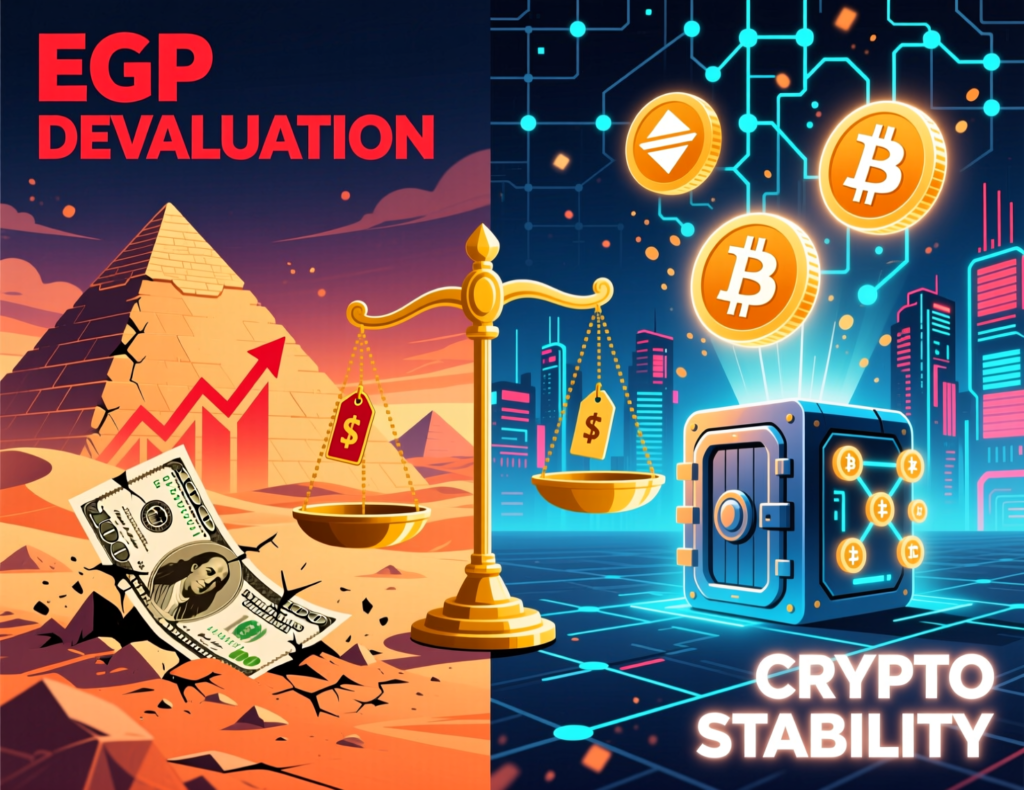
Egypt’s Inflation, Devaluations and the Case for Bitcoin
After multiple devaluations and an IMF-backed Extended Fund Facility, Egypt has shifted from 30–40% inflation spikes to still-elevated but much lower double-digit rates.That backdrop keeps hedges like physical dollars, gold, Bitcoin and especially stablecoins firmly on the table for households and SMEs.
Timeline: IMF Programmes, FX Shortages and Pound Slides
Egypt’s recent macro story, simplified.
2022–2023
FX shortages build; a heavily managed exchange rate leads to periodic “step” devaluations, with the pound losing around half its value in less than a year.
March 2024
The IMF expands its support package to about $8 billion; Egypt commits to a more flexible exchange rate, higher interest rates and structural reforms.
2024–2025
Inflation gradually cools from the high-30s to low-teens; IMF reviews continue, but disbursements can be delayed when reforms slip.
For ordinary Egyptians, that has meant periodic shortages of imported goods, uncertainty about the true FX rate and a constant question: should I hold pounds at all?
How FX Controls and Dollar Scarcity Hit Households and SMEs
During periods of FX stress, importers have faced tight rules around letters of credit, cash-deposit requirements and documentation all of which slow trade and raise costs.
Households feel this via
Higher prices for food, fuel and rent as the weaker pound feeds into imports.
Limits on dollar access, making it difficult to pay foreign tuition, medical bills or e-commerce purchases.
Informal FX markets, where dollars trade at a premium to the official rate.
SMEs in Cairo or Alexandria that import raw materials or software licences can find themselves queuing for bank approvals or turning to alternative payment corridors.
Why Some Egyptians Look to Bitcoin vs USD Cash, Gold or Local Deposits
Against that backdrop, you see informal dollarization in Egypt.
Wealthier households and small businesses hoard USD cash or buy gold jewellery.
A more digital-native cohort experiments with Bitcoin or, more commonly, USD-pegged stablecoins on P2P platforms and messaging apps.
Globally, stablecoins now account for roughly 30% of on-chain crypto volume and had already crossed about $4 trillion in yearly transaction value by late 2025.Standard Chartered estimates dollar stablecoins could draw up to $1 trillion of deposits out of emerging-market banks over three years, with Egypt listed among the most at-risk countries.
For Egyptians, the appeal is simple
“Return of capital matters more than return on capital” a digital dollar in a reputable wallet may feel safer than pounds in a local account.
How US, UK, German & EU Investors Read Egypt as a Crisis-Hedge Case
For investors in New York, London or Berlin, Egypt looks less like “buy BTC in Cairo” and more like:
Macro signal: a live example of how Bitcoin and stablecoins behave under FX stress and IMF conditionality.
Frontier risk lab: how quickly people adopt crypto when inflation spikes then falls but remains high, and how regulators respond.
Portfolio input: a reason to consider emerging-market currency risk and digital-asset exposure together, not in silos.
Rather than seeking direct exposure to onshore Egyptian flows (legally messy), most institutional readers track Egypt as part of a broader thesis on EM currency crises and crypto adoption, similar to Turkey, Nigeria or Argentina.
How Egyptians Actually Use Bitcoin and Crypto
Despite bans and legal risk, some Egyptians still use Bitcoin and, more commonly, stablecoins informally. Typical uses include savings, remittances and cross-border payments routed through P2P markets and offshore platforms, often favouring USD-pegged tokens over BTC itself.
Savings, Informal Dollarization and Escape From EGP Volatility
Crypto is not mass-market in Egypt, but among certain Telegram/WhatsApp circles you see behaviours like:
Converting spare EGP into USDT/USDC via informal brokers or P2P marketplaces.
Holding balances in offshore wallets as a hedge against another pound devaluation.
Occasionally rotating into Bitcoin for longer-term “digital gold” bets.
This sits alongside more traditional hedges (USD cash, gold, foreign property), but with extra legal and counterparty risk because crypto trading itself is prohibited onshore.
Remittances From USA, UK, Germany & EU
Egypt’s remittance and cross-border fintech market is estimated at roughly $30+ billion a year, driven by Egyptians working in the GCC, Europe and North America.
Most flows are still via formal channels (banks, Western Union, money transfer operators). But a minority uses crypto rails.
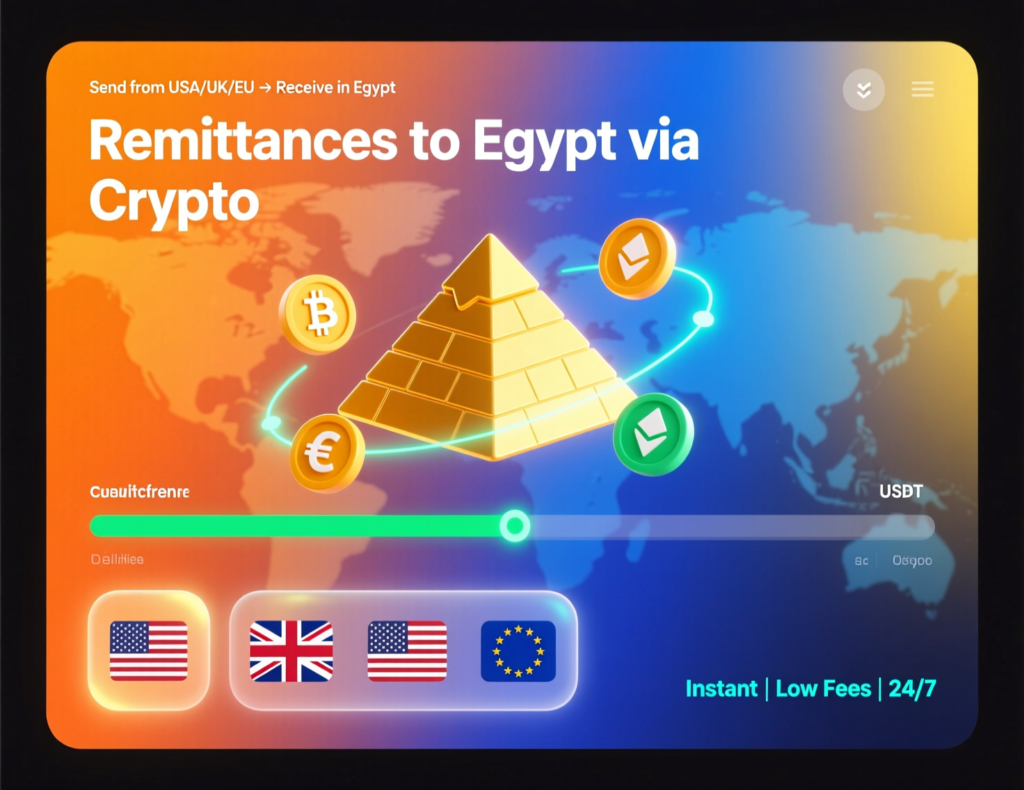
A worker in Berlin or London buys stablecoins on a MiCA-compliant exchange and sends them to a relative’s wallet in Cairo.
The relative cashes out informally via P2P trades settled with local bank transfers, mobile wallets or Egypt’s Instant Payment Network (IPN)/InstaPay rails.
This can be faster and cheaper but again, onshore recipients shoulder legal and AML risk, and participants may be violating both Egyptian law and provider ToS.
Everyday Use.
You’ll also find niche pockets where
Freelancers in Cairo or Alexandria accept stablecoins from US or EU clients on global platforms.
Small e-commerce sellers test crypto payments for international customers, then try to convert discreetly back into EGP.
Digital-native founders route some cross-border B2B payments through stablecoins when card rails or bank transfers are blocked or delayed.
Here, Egypt’s rapid shift towards digital payments over 11.5 million people registered on instant rails processing about $3.6 billion within a year makes it easier to move fiat around once value has been “bridged in” via crypto.
From Cairo to the Red Sea.
In tourism hubs like Hurghada, Sharm el-Sheikh or the North Coast, you sometimes see property or high-end rentals advertised informally with prices “also payable in BTC or USDT”, especially when marketed to Europeans or GCC buyers.
Most of these deals are structured offshore (for example, a German buyer paying BTC to a foreign-incorporated company that then settles in USD), precisely because Egyptian law is hostile to onshore crypto settlement. From a risk perspective, buyers should treat such offers as highly speculative and ensure any contract is recognised under a jurisdiction they trust.
Is Bitcoin Legal in Egypt?
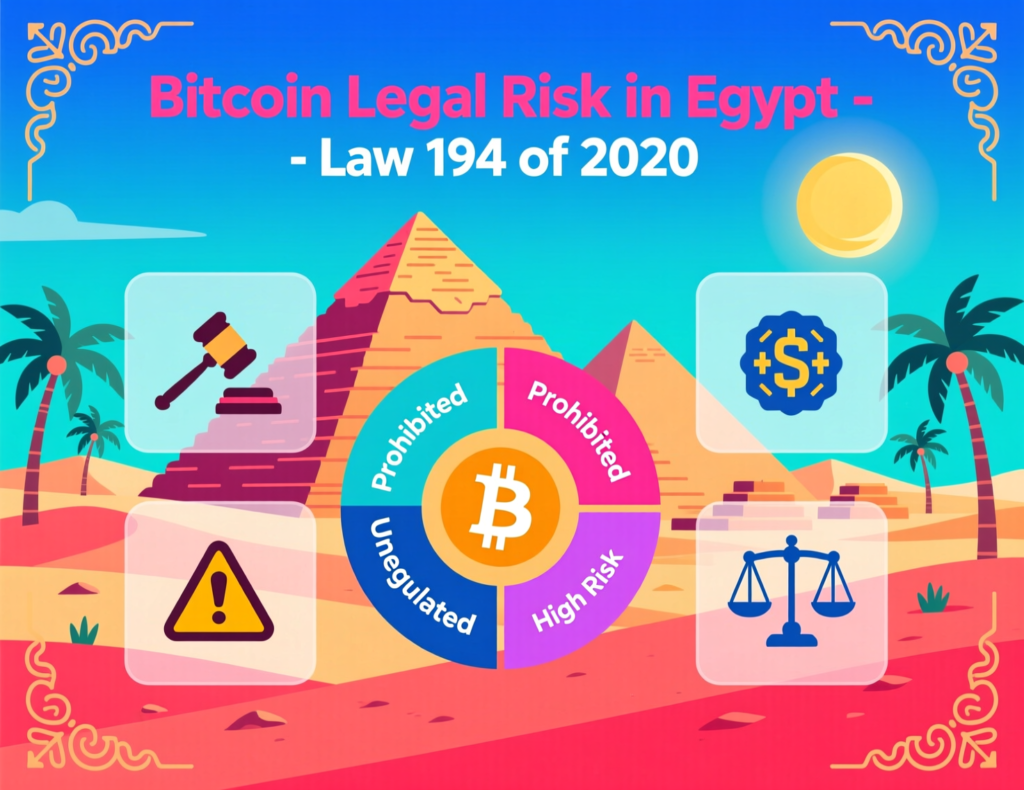
Under Egypt’s Central Bank and Banking System Law No. 194 of 2020 and repeated CBE warnings, issuing, trading or promoting cryptocurrencies without a CBE licence is prohibited and can attract fines and even imprisonment. No licences have been granted, so for retail users crypto is effectively illegal onshore.
Law 194 of 2020, CBE Circulars and Renewed Warnings
Key points in plain English.
Law No. 194/2020 bans the issuing, trading or promotion of crypto or operating its trading platforms without prior CBE approval.
Penalties can include fines and prison terms, though exact application depends on the case.
The CBE has published multiple warning statements since 2018 stressing that no entity is licensed to offer crypto services in Egypt and highlighting risks of fraud and volatility.)
Put simply: there is no regulated way for ordinary Egyptians to buy or trade Bitcoin or stablecoins onshore today.
Religious Rulings Is Bitcoin Haram?
Egypt’s Dar al-Iftaa (the official Islamic legal authority) issued a high-profile fatwa in 2017–2018 declaring Bitcoin transactions haram (forbidden), citing speculation, volatility and potential for illicit finance.
Since then, scholars globally have debated whether certain uses (for example, cross-border payments or stablecoins backed by real assets) could be permissible under strict conditions. But in Egypt, the default official stance remains strongly negative, both legally and religiously. Any Muslim investor should get independent religious as well as legal advice before touching crypto in this context.
FATF, AML/CTF and Capital-Flight Concerns
In the background sits the FATF framework on AML/CFT and virtual assets, including Travel Rule requirements and guidance on financial inclusion. For a country wrestling with FX shortages and capital-flight risk, Egypt’s authorities see:
Crypto as a potential channel for unrecorded outflows, undermining FX management.
P2P platforms as hard to supervise for AML, CTF and fraud.
Domestic banks as already under pressure, with stablecoins posing extra deposit-flight risk.
That combination helps explain why regulatory rhetoric remains tough even as grassroots interest grows.
What US, UK, German & EU Residents Must Check
If you’re based in the US, UK or EU and even indirectly interact with “Bitcoin in Egypt”, you need to factor in.
MiCA (EU) determines how EU-based exchanges and custodians can offer crypto services, including to third-country residents like Egyptians.
FCA rules (UK) strict financial-promotion rules apply to cryptoassets, including for overseas firms marketing into the UK.
BaFin guidance (Germany) crypto custody and trading platforms are regulated financial services; unlicensed providers are a red flag.
GDPR/DSGVO & UK-GDPR any platform holding your personal data must treat it under strict data-protection rules.
OFAC & EU sanctions any cross-border flows related to sanctioned entities or regions are extremely sensitive.
The takeaway: focus on fully regulated providers in your own jurisdiction and avoid any arrangement that looks like helping an Egyptian counterparty evade local rules.
Access Routes
In practice, Egyptians who touch crypto often do it via offshore exchanges, P2P platforms or informal brokers, sometimes funding via cards, wallets or cross-border transfers. Every route carries legal, counterparty and AML risk in Egypt’s current regime, and none should be seen as “safe” or endorsed.
P2P and Escrow Marketplaces
P2P marketplaces including smaller escrow-style platforms and informal Telegram groups typically match buyers and sellers who settle in:
Cash in Cairo, Giza or Alexandria.
Local bank transfers or InstaPay-enabled instant payments between accounts or mobile wallets.
While escrow and reputation systems exist, users face:
Legal exposure (trading itself is prohibited).
High scam risk and fake payment confirmations.
Potential freezing of local accounts if banks flag suspicious flows.
Using Global Exchanges From Abroad
Egyptians living in the US, UK, Germany or other EU countries often use regulated exchanges or even US-listed Bitcoin ETFs for their personal exposure.
If they later send value back to Egypt in fiat via remittance providers, or in crypto to relatives the legal picture changes.
The investor abroad must comply with local rules (MiCA, FCA, SEC, BaFin, GDPR, etc.).
The recipient in Egypt is still exposed to local crypto prohibitions and potential AML scrutiny.
For that reason, many compliance teams now prefer purely fiat remittance flows into Egypt, even if crypto is used earlier in the value chain.
Bitcoin Real Estate and High-Ticket Purchases
You will see international real-estate brokers and resort developers (especially around the Red Sea) touting the option to pay in Bitcoin or stablecoins.
In almost all legitimate cases:
Crypto is settled offshore, in a foreign entity.
Actual property transfer is recorded in EGP terms with Egyptian authorities.
Buyers still pass through KYC, source-of-funds checks and sometimes enhanced due diligence if crypto is involved.
If someone in Egypt offers to “skip the paperwork” and accept direct BTC for land or apartments, assume extremely high legal and fraud risk.
Risk Checklist Custody, Fraud, KYC/AML Flags
If you’re analysing or touching these flows from abroad, keep a strict mental checklist.
Legal
Does this clearly violate Law 194/2020 or CBE warnings for any Egyptian resident involved?
Custody
Who controls private keys or wallet access a reputable custodian or a random Telegram handle?
KYC/AML
Are counterparties screened against sanctions lists? Is source of funds documented?
Fraud & scams
Unrealistic yields, no-questions-asked cash outs or pressure to go “off-platform” are major red flags.
Data protection
Where is customer data stored and under what privacy regime (GDPR, UK-GDPR, none?).
From a risk-management perspective, many institutional players will treat onshore Egyptian retail flows as “do not touch” until regulation changes.
Risks, Reforms and Scenarios for Bitcoin in Egypt
For locals, using Bitcoin in Egypt today blends legal, political, FX and fraud risk. For foreign investors, the bigger question is how Egypt’s IMF programme, FX reforms and digital-payments push will reshape crypto’s role over the next five years from total ban to tightly supervised sandbox, or something in between.
Legal, Political and Enforcement Risks
Onshore users face potential criminal charges, account freezes and confiscation of assets linked to illegal crypto trading.
Foreign counterparties (exchanges, OTC desks, remittance partners) risk regulatory blowback at home if they knowingly facilitate illegal activity in Egypt or breach FATF expectations.
Policy shifts can be abrupt; new warnings or enforcement campaigns can arrive with little notice.
IMF Reviews, FX Reforms and Digitalisation
The IMF’s 46-month programme for Egypt hinges on FX flexibility, fiscal discipline and structural reforms, with reviews influencing investor sentiment and FX availability.
Parallel to that, Egypt is.
Rolling out instant payments and encouraging digital wallets.
Tightening oversight of remittances and cross-border flows.
If reforms succeed and inflation stays low, the “crisis hedge” appeal of Bitcoin in Egypt may fade; if reforms stall and FX stress returns, crypto pressures will resurface even in the face of a ban.
Possible Regulatory Paths.
Over the next 3–5 years, reasonable scenarios include.
Status quo plus warnings de facto ban continues; small underground crypto community persists.
Sandbox licences tightly controlled pilots for tokenised deposits, CBDC or limited stablecoin use in remittances, potentially in cooperation with the IMF and World Bank.
Sharper enforcement more visible prosecutions and bank-level crackdowns on suspicious crypto-linked flows.
For now, nothing in official communications suggests a fast pivot to open retail trading.
Scenario Planning for US/UK/German/EU Investors and Expats
If you’re watching from abroad, think in scenarios
Bullish reform / lower-crypto scenario
FX stabilises, inflation stays in low teens or single digits, IMF reviews progress; Egypt becomes less prominent in “crypto as crisis hedge” narratives.
Stalled reform / renewed stress
IMF reviews delayed; FX squeezes return; underground stablecoin usage climbs; regulators double down on bans and warnings.
Selective opening
Egypt experiments with CBDC or regulated stablecoin corridors for remittances while keeping retail trading off-limits.
Your exposure decisions (if any) should be based on your home-country regulatory perimeter, not on trying to front-run onshore Egyptian flows.
Investor Playbook
The safest strategy for most US, UK, German and EU investors is to treat “Bitcoin in Egypt” as macro signal, not trading venue. You can gain Bitcoin or frontier-market exposure without touching onshore Egyptian flows at all.
For US Investors
If you’re in the United States, typical routes include.
US-listed Bitcoin products spot or futures-based ETFs and trusts under SEC oversight.
Listed miners and infrastructure firms with global operations.
Frontier-market equity or bond funds that hold Egyptian risk under strict compliance and disclosure.
All of these let you express a view on Bitcoin or Egypt’s macro path without routing transactions through Egyptian residents which would add OFAC, AML and local-law complexity.
For UK, German & EU Investors.
From London, Frankfurt or elsewhere in the EU/UK, use regulated rails.
MiCA-regulated exchanges and custodians for your own BTC or stablecoin exposure.
Providers supervised by BaFin (Germany) or other competent authorities for crypto asset services.
Firms that clearly explain how they handle GDPR/DSGVO and UK-GDPR obligations for your data.
When dealing with Egyptian counterparties for example, paying freelancers in Cairo consider using regulated fiat remittance or card channels instead of on-chain transfers, unless you have specialist legal advice.
Due-Diligence Framework Questions to Ask Any Exchange, P2P Platform or Remittance Partner
When your business or family money is involved, treat every provider like a critical vendor. At a minimum, ask.
Licensing & supervision
Which regulator oversees you (FCA, BaFin, another EU NCA, etc.)
Can you point me to your public registration or licence number online?
KYC/AML & sanctions
How do you screen customers and transactions against FATF standards and sanctions lists?
Do you explicitly block transactions involving Egypt or other higher-risk countries if local law prohibits them?
Custody, security & outages
Are customer assets segregated and insured?
What happens if your platform is hacked or goes offline?
Data protection & GEO
Where is my data stored, and under which privacy regime (GDPR, UK-GDPR)
Can I get a data-processing addendum that reflects EU/UK standards?
Teams building fintech or analytics products around these flows can lean on Mak It Solutions for secure cloud architectures, BI dashboards and compliance-friendly data pipelines spanning AWS, Azure and GCP.

When “Bitcoin in Egypt” Is a Signal vs a Portfolio Position
In many cases, the smartest move is to treat Egypt’s Bitcoin/stablecoin story as an indicator of macro pressure, not a call to allocate capital to Egyptian-linked crypto flows.
You might
Track P2P volumes and stablecoin premiums as a stress barometer for EM FX.
Use Egypt as one datapoint in a diversified EM macro thesis, alongside Turkey, Nigeria or Argentina.
Keep your actual BTC or stablecoin positions in fully regulated Western venues.
That mindset keeps you aligned with MiCA/FCA/BaFin/SEC expectations while still learning from Egypt’s experiment in crisis-era digital finance.
Concluding Remarks
Egypt’s move from ~38% to ~12% inflation, repeated devaluations and FX shortages created fertile ground for informal dollarization, including niche Bitcoin and stablecoin use.
Law 194/2020, CBE warnings and Dar al-Iftaa fatwas combine to make onshore retail crypto effectively illegal and religiously contentious.
Actual usage skews heavily toward stablecoins for savings and remittances, often via P2P and instant-payment rails, not toward high-street Bitcoin payments.
For US/UK/DE/EU investors, the safest approach is indirect exposure via regulated products and exchanges at home, not direct involvement in Egyptian onshore flows.
What to Watch in the Next 12–24 Months
Over the next two years, keep an eye on.
IMF review milestones and FX reforms delays or progress will influence pressure on the pound and demand for hedges.
New CBE statements on crypto, CBDC pilots or fintech sandboxes.
Standard-setting moves under MiCA, FATF and national regulators like the FCA and BaFin, which will shape how Western firms can interact with high-risk EM markets, including Egypt.
Bitcoin in Egypt is ultimately a story about money, trust and institutions — and about how digital rails react when a large, strategically important country tries to manage a complex FX and inflation shock.
Key Takeaways
Onshore ban, offshore workarounds
Crypto is effectively illegal for retail use inside Egypt, but some usage persists via P2P markets and offshore exchanges, with users bearing significant legal and fraud risk.
Stablecoins > BTC for everyday use
Egyptian savers, freelancers and remitters who do touch crypto overwhelmingly prefer dollar-pegged stablecoins over Bitcoin itself.
Macro signal for EM risk
For US/UK/DE/EU investors, Egypt is more valuable as a case study in FX crisis dynamics than as a direct Bitcoin market.
Regulation drives opportunity
MiCA, FCA rules, BaFin guidance and FATF standards heavily influence which business models around “Bitcoin in Egypt” are even thinkable for regulated firms.
Mak It Solutions’ role
Mak It Solutions can help fintechs, banks and analytics teams design compliant cloud, data and BI architectures that observe and analyse these trends without breaching regulatory perimeters.
If you’re building products, risk dashboards or analytics around emerging-market FX, remittances or crypto, you don’t just need code you need compliant data, cloud and integration architecture.
Mak It Solutions can help you design secure, multi-cloud platforms, build real-time BI for FX and crypto signals, and align with data-protection and localization rules across the US, UK, Germany and the wider EU.
Ready to go deeper? Reach out to Mak It Solutions via the website to book a consultation and scope a focused discovery sprint for your next fintech, payments or analytics initiative.( Click Here’s )
FAQs
Q : Can Egyptians legally hold Bitcoin in offshore wallets or foreign exchanges?
A : Under current law, Egyptians are prohibited from issuing, trading or promoting cryptocurrencies without CBE approval, and no licences have been granted.Even if the wallet or exchange is offshore, an Egyptian resident who buys, sells or promotes Bitcoin may still be breaching Law 194/2020. In practice some people do hold coins abroad, but that does not make it legal or risk-free. Anyone considering this should get professional legal advice and assume authorities can treat offshore activity as within scope.
Q : How do Egyptian banks treat transfers to and from international crypto platforms?
A : Egyptian banks are cautious about any flows that look linked to crypto, especially incoming or outgoing wires to known exchanges or P2P brokers. Transfers may be delayed, questioned or blocked under AML and capital-flight rules.In extreme cases, accounts can be frozen pending investigation. From a risk standpoint, it is safer for Egyptian residents to assume that direct bank-to-exchange transfers are unwelcome and could draw scrutiny.
Q : Are there Bitcoin ATMs or in-person cash-for-crypto brokers operating in Egypt?
A : Officially, there are no licensed Bitcoin ATMs or regulated retail brokerages in Egypt today.You may find individuals advertising cash-for-crypto services in person or via social media and messaging apps, but these are unregulated and likely illegal. Users face layered risks: legal charges, robbery, counterfeit cash or being unwittingly involved in money laundering. This is one of the highest-risk ways to touch Bitcoin in Egypt in 2025.
Q : What are the tax implications if an EU resident earns Bitcoin income from Egyptian clients?
A : If you live in the EU or UK, your tax obligations follow your residency, not your client’s. Bitcoin income from Egyptian clients is typically treated as taxable income or capital gains in your home country, even if Egypt itself doesn’t recognise the transaction. You must also ensure compliance with MiCA (where applicable), GDPR/DSGVO for client data and any local rules on self-employment or corporate income.Given the regulatory complexity, cross-border freelancers should get local tax advice rather than relying on crypto’s pseudo-anonymity.
Q : How does Egypt’s Bitcoin and inflation story compare with countries like Turkey, Nigeria or Argentina?
A : All four have seen currency stress, high inflation and periodic capital controls, which tends to drive interest in Bitcoin and especially stablecoins.Compared with Turkey, Nigeria or Argentina, Egypt has a particularly strict legal stance on crypto, combining central-bank bans with religious opposition from Dar al-Iftaa. At the same time, its large population, strong remittance flows and rapid payments digitalisation mirror broader EM trends. For global investors, Egypt sits in the same “crypto under pressure” cluster but with a harder legal line than many peers.