

Best Cryptocurrency Exchanges for Middle East Traders Guide
The best crypto exchange Middle East in 2025 is one that combines genuine local regulation (e.g. VARA, ADGM, CBB), strong security controls, deep liquidity and cheap funding in AED, SAR, QAR and KWD alongside USD, EUR and GBP.
Middle Eastern traders should focus on platforms that are properly licensed, publish transparent fees, and offer reliable fiat on/off-ramps that fit their country, bank and trading style.
Important
This guide is educational only, not investment, legal or tax advice. Always check your own country’s rules and do your own research before trading.
Introduction
The Middle East has quietly become one of the fastest-growing and most heavily regulated crypto regions in the world. Between 2024 and 2025, the UAE alone is estimated to have received well over $50 billion in on-chain value, driven by Dubai and Abu Dhabi’s push to attract global digital asset firms.
If you’re a trader in Dubai, Riyadh, Doha, Manama or Kuwait City or a US, UK or German resident using a Gulf-based platform the “best crypto exchange Middle East” for you will be the one that:
Holds a real local license (VARA, ADGM FSRA, Central Bank of Bahrain, etc.)
Offers strong KYC/AML, proof-of-reserves and SOC 2-style controls
Has deep liquidity for BTC, ETH and major stablecoins
Lets you move money in and out easily in AED, SAR, QAR, KWD plus USD/EUR/GBP
This guide gives you a practical shortlist of MENA crypto trading options, a country-by-country view for UAE, Saudi, Qatar, Bahrain and Kuwait, and a clear decision framework you can actually use.
Best Cryptocurrency Exchanges for Middle East Traders
Top exchanges for Middle Eastern traders.
For everyday use, many Middle East traders end up mixing a locally regulated platform with one or two global derivatives venues. Across the GCC, popular options often include regional players such as Rain, BitOasis and CoinMENA, alongside global platforms like Binance, OKX, Bybit and Kraken (licensing status varies by country and changes frequently always check the relevant regulator’s register).
Micro-snippet
In 2025, many Middle East traders split activity across 5–7 platforms: UAE/Bahrain-licensed exchanges (e.g. Rain, BitOasis, CoinMENA), one or two high-liquidity global venues (e.g. Binance, OKX, Bybit) and sometimes a specialist P2P platform. Locals prioritise AED/SAR rails; US/UK/DE traders care more about wires, SEPA and GBP on-ramps.
Example mapping (illustrative, not endorsements)
UAE-licensed / GCC-focused (buy & hold, salary → USDT)
Persona
Dubai or Abu Dhabi resident funding in AED

Typical choices
Regional platforms operating under VARA/ADGM/SCA rules, or CBB-licensed players in Bahrain with Gulf coverage.
Low-fee global spot (frequent trader, altcoin hunter)
Persona
Active spot trader from Dubai, Riyadh, Istanbul or Cairo
Platforms
Global exchanges with strong volume across MENA, usually licensed in another jurisdiction rather than your specific country.
High-liquidity derivatives (futures, perpetuals, options)
Persona
Professional trader or family office in Dubai, London or Frankfurt
Platforms
Major derivatives venues with deep BTC/ETH perps, portfolio margin and robust risk engines.
P2P-focused (remittances & capital controls)
Persona
Worker sending SAR/QAR/AED back to Egypt, Jordan or Pakistan
Platforms
Exchanges with strong P2P order books and AED/SAR/QAR postings, plus escrow and KYC checks.
Beginner-friendly (expat from US/UK/DE in Dubai or Doha)
Persona
UK expat in Dubai, US engineer in Abu Dhabi, German consultant in Doha
Platforms
Simple UX, English/Arabic/German support, clear KYC and card/bank funding in AED, USD, GBP and EUR.
None of these are one-size-fits-all. The best crypto exchange Middle East for you depends on where you live, where your bank is, whether you want derivatives, and how much you trade each month.
What is the safest regulated cryptocurrency exchange for Middle East traders right now?
The safest exchanges for Middle Eastern traders are those that combine a real local license (for example from VARA in Dubai, ADGM FSRA in Abu Dhabi or the Central Bank of Bahrain) with strict KYC/AML, institutional-grade security and transparent proof-of-reserves.Licensed platforms in Dubai and Bahrain have to meet capital, governance and risk standards similar to Western regulators such as the FCA or BaFin.
Examples you’ll often see mentioned include UAE-regulated entities under VARA/ADGM and CBB-licensed platforms in Bahrain. But safety is dynamic: always confirm current license status on the regulator’s public register, check recent news, and start with small test deposits before scaling up. ([rulebooks.vara.ae][6])
Which exchange fits which type of trader?
Here’s a simplified matrix to map exchange types to trading styles. It’s illustrative only not a recommendation list.
| Trader type | Regulator / Geo focus | Fiat rails (examples) | Leverage / products | Language & support | Fees (typical) |
|---|---|---|---|---|---|
| Buy-and-hold investor | VARA / ADGM / CBB, EU MiCA | AED/SAR/QAR/KWD, USD/EUR/GBP bank & card | Mostly spot, some staking | Arabic / English | Tiered maker-taker, low FX |
| Frequent spot trader | Global + UAE/Bahrain licensed entities | AED on-ramp, USD/EUR wires, SEPA/FasterPay | Spot, margin | English, Arabic, often Turkish | Aggressive volume tiers |
| Derivatives trader (perps/futures) | Global (offshore) + selected local | USD/USDT/USDC margin only, some AED | Perps, options, portfolio margin | English | Very low trading, higher funding |
| P2P / remittance-focused | Global P2P + regional players | Cash, local bank, wallets in AED/SAR/QAR | Spot only | Arabic / Urdu / English | Zero maker, higher spreads |
| Institutional / family office | ADGM/VARA/CBB, FCA, BaFin, MiCA CASPs | SWIFT, SEPA, local GCC rails | OTC, RFQ, derivatives | Multi-lingual desks | Negotiated, tiered, RFQ-based |
Use this as a starting point, then dive into the country-specific sections below.
Best Crypto Exchanges in UAE, Saudi, Qatar, Bahrain and Kuwait
Best crypto exchange UAE for local residents and expats
For many traders, the UAE is the practical hub for the best crypto exchange Middle East. Dubai’s VARA regulates virtual asset activity across most of the emirate, while Abu Dhabi’s ADGM FSRA has a detailed digital asset framework for exchanges, brokers and custodians.
Day-to-day, UAE residents in Dubai and Abu Dhabi often split flows between:
Locally licensed platforms under VARA/ADGM/SCA with AED bank transfers, card deposits and clear dispute resolution in the UAE courts.
Unlicensed global exchanges accessible from the UAE but regulated elsewhere (e.g. EU, Seychelles, BVI). These may offer more coins or leverage, but you usually give up local legal recourse.
For “best crypto exchange UAE for US residents”, the key questions are
Will the exchange accept US persons at all (many don’t, for SEC/CFTC reasons)?
Can you legally send USD wires from a US bank to a UAE platform and stay compliant with US reporting rules?
For UK expats in Dubai (“best crypto exchange in Dubai for UK expats”), FCA rules on financial promotions and UK tax still matter even if your chosen platform is licensed by VARA.
For German traders (“beste Krypto Börse VAE für deutsche Trader”), BaFin, MiCA and Germany’s tax rules remain relevant if you’re a German tax resident trading via a UAE account.
In all of these cases, residency, citizenship and tax residency can differ talk to a professional if you’re unsure.
Best bitcoin and crypto exchanges in Saudi Arabia, Qatar, Bahrain and Kuwait
Saudi Arabia (KSA)
Crypto isn’t legal tender in KSA, and regulators remain cautious. SAMA and the Capital Market Authority operate fintech sandboxes; banks generally cannot touch crypto without explicit approval. Many Saudi traders therefore.
Use regional hubs such as UAE or Bahrain-licensed exchanges
Or rely on P2P markets with SAR funding always a higher-risk route
Qatar
Qatar has taken one of the strictest stances in the Gulf. The Qatar Central Bank and QFCRA have banned local financial institutions and QFC-authorised firms from providing most virtual asset services, though some tokenised securities activity is carved out.Residents who still choose to use offshore exchanges are doing so at their own regulatory risk.
Bahrain
Bahrain is a true Gulf region crypto regulations pioneer. The Central Bank of Bahrain runs a detailed crypto-asset module that licences exchanges, brokers, custodians and portfolio managers; several well-known exchanges now operate from Manama under CBB licences.For many Gulf investors, a CBB-licensed platform plus a UAE venue is a strong combination.
Kuwait
Kuwait has tightened rules on crypto marketing and some forms of trading, and there have even been reports of crackdowns on mining in high-consumption areas like Al-Wafrah. ([CoinLaw][12]) Many Kuwaiti traders therefore route via UAE/Bahrain platforms with KWD → AED or KWD → USD conversion.
Across Saudi, Qatar, Bahrain and Kuwait, on/off-ramp options range from full local bank transfers (Bahrain) to almost entirely offshore (Qatar). When in doubt, look to UAE and Bahrain as primary regulated hubs.
Options for US, UK and German/EU residents using Middle East exchanges
Remote onboarding is now common for many MENA crypto trading platforms, but compliance has tightened. Expect:
KYC: passport, selfie, sometimes video-KYC
Proof of address: utility bill or bank statement from New York, London or Frankfurt
Source of funds: questions for high-volume users and family offices
Typical funding flows.
US → UAE exchange
USD wire from a US bank or brokerage; sometimes via Wise/Revolut to AED, then deposit to an exchange account (check each service’s ToS).
UK → UAE exchange
GBP → AED via UK Open Banking or international transfer, then AED bank transfer into a Dubai-based platform.
Germany/EU → GCC
SEPA EUR to a European partner bank, then FX into AED; look for GDPR/DSGVO-aligned privacy disclosures in the onboarding journey.
Always confirm that.
Your home regulator (FCA, BaFin, SEC) doesn’t prohibit use of that platform.
Your bank is comfortable sending wires to the exchange’s beneficiary bank.
You understand your tax reporting duties back home.
Licensing, Regulation & Shariah Alignment for Middle East Crypto Exchanges
What licenses and regulators should Middle Eastern traders look for?
A regulated crypto exchange in the Middle East is one that holds a current licence from a recognised local authority, follows AML/CFT rules and meets capital, governance and security requirements similar to traditional financial firms.
VARA (Dubai) sole virtual asset regulator for most of Dubai, excluding the DIFC.
ADGM FSRA (Abu Dhabi) operates the ADGM digital asset regulatory framework for exchanges, custodians and OTC desks.
Central Bank of Bahrain (CBB) detailed crypto-asset framework governing trading, custody and brokerage from Bahrain.
Comparable Western peers include.
FCA (UK) consumer protection, marketing rules and AML for UK-facing crypto businesses.
BaFin (Germany) plus MiCA in the wider EU – unified licensing and investor protection for crypto-asset service providers.
SEC/CFTC (US) securities/derivatives oversight and enforcement for US-facing crypto products.
Micro-answer.
In practice, you want exchanges licensed by VARA, ADGM FSRA or the CBB (for GCC), or by established Western regulators like the FCA, BaFin or under EU MiCA. Licensed platforms must follow strict AML, capital and security standards and are generally easier to hold accountable than offshore, unregulated venues.
How can traders in the Middle East check if a crypto exchange is properly licensed and compliant?
To verify a platform, you can follow a simple, repeatable process.
Check the regulator’s public register search the name on VARA, ADGM FSRA or CBB websites and confirm licence type and status.
Verify the legal entity and address does the entity name on the register match the one in the exchange’s terms, and is it actually in ADGM, DIFC, Bahrain, etc.?
Review KYC/AML disclosures look for references to FATF standards, sanctions screening and travel rule compliance.
Check data & security frameworks privacy notices mentioning GDPR/DSGVO or UK-GDPR, plus references to PCI DSS and SOC 2-style controls for data and payments.
Micro-answer
To confirm whether a Middle East crypto exchange is truly licensed, search its legal entity on your country’s regulator register, then match that entity and address to the names in the platform’s terms. Next, review KYC, AML and privacy disclosures for FATF-aligned controls and GDPR-style data protection. Walk away if anything doesn’t line up.
Shariah-compliant and FATF-aligned crypto exchanges in the Middle East
A Shariah-compliant crypto exchange generally avoids interest-bearing products, highly speculative leveraged derivatives and haram-screened assets, and may work with a Shariah advisory board to review listed products and staking or yield features.
Institutional and HNWI investors in Riyadh, Doha or Dubai increasingly ask.
Is there a Shariah advisory board and public opinion or fatwa?
Are there no interest-based margin loans, or are they clearly segregated?
How does the platform implement the FATF travel rule and cross-border AML checks for large transfers?
Due-diligence checklists from Islamic investors often cover both Shariah screening and FATF alignment the combination of ethical finance and robust AML is what gives boards and compliance teams comfort.
Why the UAE Is a Leading Global Hub for Crypto Exchanges Serving Middle Eastern Investors
Why is the UAE considered a leading global hub for Middle East crypto investors?
The UAE is seen as a top global crypto hub because it offers clear, dedicated virtual asset regimes (VARA and ADGM FSRA), serious but commercially aware regulators, strong banking and payment rails, and a concentration of global exchanges, family offices and tech talent in Dubai and Abu Dhabi.
Independent data backs this up: the UAE ranks among the largest crypto economies in MENA, with on-chain inflows estimated at tens of billions of dollars per year and double-digit growth, and GCC crypto market revenue projected to grow at over 16% CAGR through 2033.
Micro-answer
Put simply, the UAE combines regulatory clarity, political stability, tax efficiency and world-class infrastructure. VARA and ADGM give exchanges a clear rulebook; Dubai and Abu Dhabi offer access to banks, cloud regions and professional services; and regional wealth makes it a natural home base for Middle East crypto investors.
Why might Middle Eastern traders choose a UAE-based exchange over global platforms like Binance or Bybit?
Many traders prefer a UAE-based exchange because.
It offers local licences and legal recourse under UAE law instead of distant offshore courts.
Funding in AED via local banks or salary transfers is usually easier and cheaper than cross-border USD wires.
Arabic and English support teams are time-zone aligned with Riyadh, Doha, Manama and Kuwait City.
Global platforms like Binance or Bybit can still be attractive for liquidity and derivatives, and some do hold Middle East licences (for example in Bahrain or under UAE regimes) but you must confirm the specific licensed entity and what it’s actually allowed to offer.
For many traders, the sweet spot is: one UAE/Bahrain-regulated account for fiat on/off-ramp + one or two global venues for advanced products, always keeping track of your overall risk and compliance footprint.
How VARA and ADGM compare with BaFin, FCA and ESMA/MiCA
If you’re relocating from New York, London or Frankfurt, you’ll notice some key differences
Investor protection
FCA, BaFin and MiCA regimes tend to be more prescriptive about retail marketing, leverage caps and risk warnings; UAE regulators are catching up fast but retain some flexibility for professional investors.
Leverage & product scope
US rules are stricter on retail derivatives, and MiCA will standardise product rules across the EU. UAE frameworks permit sophisticated products but expect strong risk controls and suitability checks for retail.
Tax nexus
The UAE has no federal capital gains tax on individuals today, but relocating doesn’t automatically erase obligations in your previous tax residence.
Overall, UAE and Bahrain are increasingly seen as complementary to, not a replacement for, US/UK/EU frameworks particularly for family offices splitting activity across regions.
Fees, Funding Methods & Advanced Trading Features on Middle East Exchanges
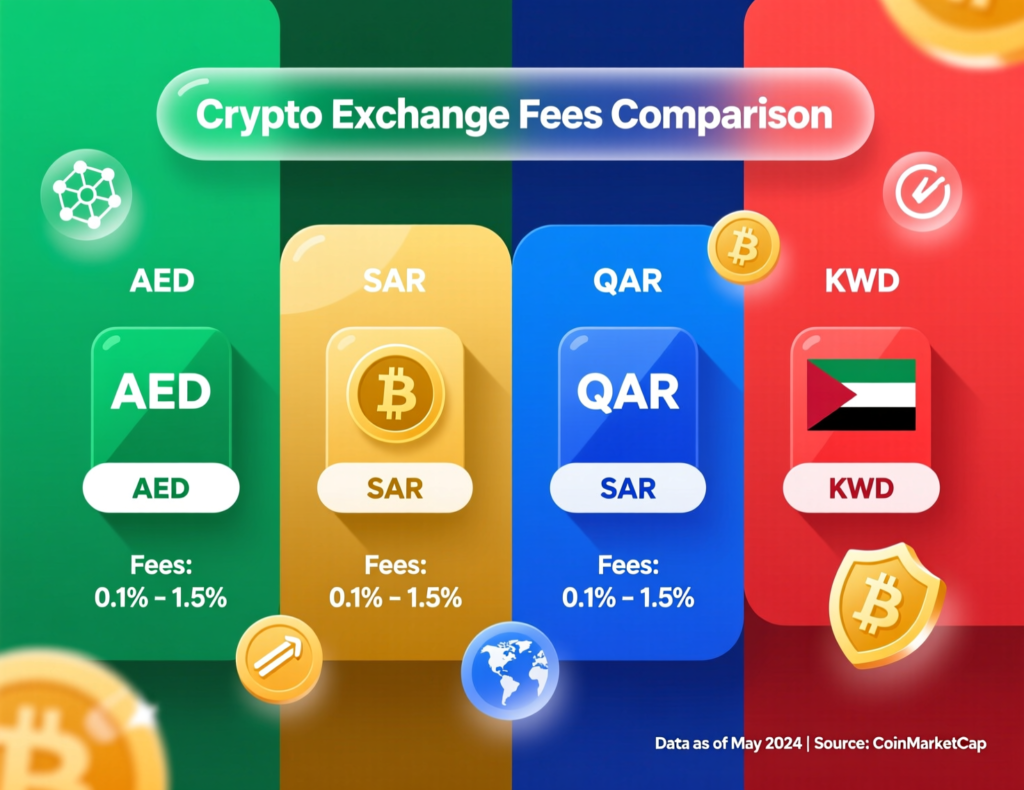
How do fees, funding methods and supported currencies differ between top Middle Eastern crypto exchanges?
Maker/taker fees, spreads and FX charges vary widely across Middle East exchanges. In general, locally licensed AED on-ramp and off-ramp exchanges tend to charge slightly higher trading or FX fees in exchange for local bank convenience, while offshore venues push ultra-low trading fees but require USD stablecoin or cross-border wires.
Micro-answer
There’s no single “lowest fee crypto exchange Middle East” it depends on your monthly volume, whether you fund via AED/SAR/QAR/KWD or USD/EUR/GBP, and whether you mostly use spot, P2P or derivatives. Always compare all-in costs: trading, deposit/withdrawal and FX spreads, not just headline maker/taker percentages.
AED, SAR, QAR, KWD, USD, EUR and GBP
Common flows you’ll see in the region.
Salary in AED → USDT → BTC/ETH for Dubai and Abu Dhabi professionals
SAR/QAR → BTC/USDT for Saudi and Qatari traders using regional hubs or P2P
EUR/GBP → AED → USDT for Europeans and Brits using UAE-based accounts
From the US, a typical flow might be.
USD from a New York bank to a UAE exchange via SWIFT or an intermediate fintech like Wise/Revolut (if permitted),
Then convert to AED or directly to USDT/USDC for trading.
UK and German users will lean on Faster Payments and SEPA respectively, often converting into USD or AED before moving into crypto.
Whatever your route, test small amounts first to confirm which banks, rails and exchanges play nicely together especially in more cautious markets like Saudi Arabia or Qatar.
Derivatives, P2P and high-liquidity order books for Middle Eastern traders
For advanced traders, three questions matter.
Derivatives access
Which exchanges offer deep BTC/ETH perpetuals, options and portfolio margin, and what’s the legal status of those products in your country?
P2P markets
How strong are P2P books in AED and SAR for remittance-style flows, especially for workers sending money between GCC, Egypt, Turkey and South Asia?
Order book quality
CoinGecko-style liquidity and trust metrics are invaluable when comparing venues; high reported volume doesn’t always mean real liquidity.
Derivatives venues with Gulf-friendly hours and Arabic/English support are particularly attractive for traders in Dubai, Riyadh and Doha — but remember that leveraged trading can wipe you out quickly. Never take leverage you don’t fully understand.
How to Choose the Right Crypto Exchange as a Middle East Trader
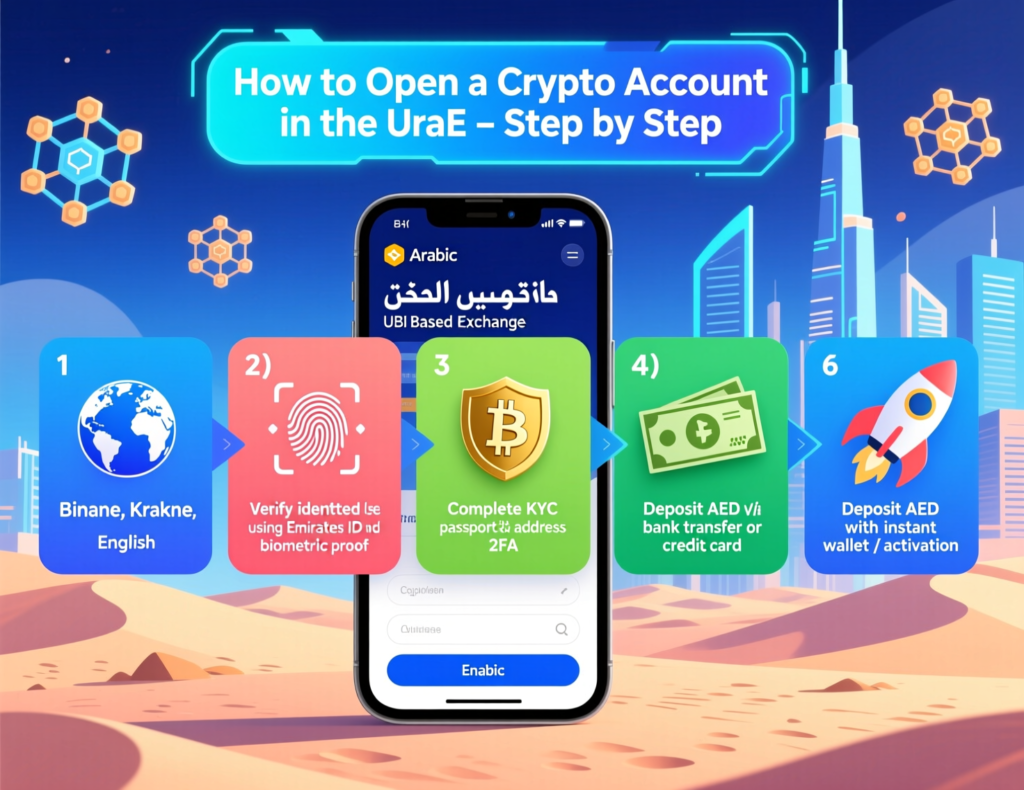
How to open a crypto account in the UAE or wider Middle East
Here’s a practical flow you can adapt whether you’re in Dubai, Abu Dhabi, Manama or Kuwait City.
Shortlist 2–3 regulated platforms
Filter for VARA/ADGM/CBB licences, strong reviews and clear fee schedules.
Check geo & KYC rules
Confirm your nationality and residency (e.g. UAE resident, UK expat, German in Oman) are accepted.
Prepare documents
Local resident in UAE: Emirates ID, passport and proof of address (DEWA bill, tenancy).
UK user opening from abroad: passport, UK utility/bank statement, potentially proof of UAE visa.
German/EU user: passport/ID, SEPA-linked bank statement think “wie kaufe ich Bitcoin in den VAE per SEPA”.
Complete KYC and source-of-funds
Expect questions about salary, employer, business or investment income, especially above certain thresholds.
Test a small bank transfer or card deposit
For example, try a small AED bank transfer from Dubai, a GBP card payment from London, or a SEPA EUR transfer from Frankfurt.
Buy your first asset with a simple pair
Typical first trade: AED → USDT or EUR/GBP → BTC on a spot market with low slippage.
Enable security features before scaling up
Turn on 2FA, withdrawal whitelists and device approvals. Never keep more on an exchange than you can afford to lose.
How to use a Middle East crypto exchange from the US, UK or Germany
If you’re a US, UK or German resident using a Middle East platform, think about three layers:
Residence vs citizenship vs tax residency a US citizen living in Dubai may still have US tax duties and SEC-sensitive status; a German citizen who has cut German tax residency may have more flexibility, but should document it carefully.
Onboarding checks expect enhanced screening for US persons, PEPs and residents of higher-risk jurisdictions. FATF pressure means GCC exchanges are under more scrutiny, not less.
Bank and sanctions friction some US and EU banks still flag or block wires to foreign exchanges. Plan alternatives in advance (e.g. EUR → UAE multi-currency account → AED → exchange), staying fully within the law.
Always read the platform’s terms on “restricted jurisdictions”, and if in doubt, ask support in writing before funding.
Choosing the best crypto trading platform for Middle Eastern investors
Use this checklist as your last step before committing serious capital:
Regulation & licence
VARA, ADGM, CBB or another recognised regulator?
Is the legal entity clear and visible on a public register?
Fees & funding
Transparent maker/taker schedule?
Local currency support (AED/SAR/QAR/KWD) plus USD/EUR/GBP rails, cards and P2P?
Features
Do you actually need derivatives, staking or P2P, or is spot enough?
Are you comfortable with how liquid the main pairs are?UX & support
Arabic/English (and ideally German) support?
24/7 live chat, or only tickets and email?
Data & security
Clear references to GDPR/DSGVO, SOC 2-style security controls, PCI DSS for cards and robust cold storage plus proof-of-reserves?
Once 2–3 platforms pass this checklist, start with small test deposits and withdrawals. Scale positions gradually as you gain confidence in each exchange’s reliability.
Final Words
Middle Eastern traders today have more choice than ever from VARA-licensed platforms in Dubai to CBB-regulated venues in Bahrain and global derivatives giants. The right best crypto exchange Middle East for you will blend strong regulation, smooth funding in your home currency and features that match your trading style, not someone else’s.
Use the matrices and checklist above, combine them with your own risk tolerance and tax situation, and start with one or two carefully chosen platforms. In such a fast-moving space, caution and diversification are real edges.
If you’re planning a regulated crypto, trading or data-heavy project that touches the Middle East, you don’t just need an exchange you need the right architecture, data and compliance foundations behind it. Mak It Solutions already helps teams design cloud, data and analytics platforms for GCC and EU-regulated workloads.
Talk to us about your roadmap, from GCC data localisation through to analytics dashboards for your trading or fintech platform. Our team can help you map the regulatory, cloud and data layers so your crypto or Web3 product is ready for both MENA and US/UK/EU users. ( Click Here’s )
FAQs
Q : Is cryptocurrency legal in all Middle Eastern countries, or only in places like the UAE and Bahrain?
A : No, crypto is not treated the same across the Middle East. The UAE and Bahrain have full licensing regimes for exchanges and custodians, while Saudi Arabia and Kuwait remain cautious and often limit banks from touching crypto directly. Qatar is particularly strict, with bans on many virtual asset services in its financial centre. Regulations evolve quickly, so always check the latest guidance from your local central bank or securities regulator before you trade.
Q : Can US citizens legally use UAE or Bahrain-regulated crypto exchanges, and what are the main risks?
A : Some UAE and Bahrain platforms do onboard US citizens, but many either restrict them or apply enhanced checks due to SEC/CFTC expectations and US tax rules. The key risks are breaching your home-country reporting requirements, having wires blocked by US banks, or trading products that US regulators later classify as unregistered securities or derivatives. Always read each platform’s “restricted jurisdictions” page carefully and, if needed, obtain professional legal or tax advice before moving significant funds.
Q : Do UK and German residents pay tax on profits made using UAE-based crypto exchanges?
A: Some UAE and Bahrain platforms do onboard US citizens, but many either restrict them or apply enhanced checks due to SEC/CFTC expectations and US tax rules. The key risks are breaching your home-country reporting requirements, having wires blocked by US banks, or trading products that US regulators later classify as unregistered securities or derivatives. Always read each platform’s “restricted jurisdictions” page carefully and, if needed, obtain professional legal or tax advice before moving significant funds.
Q : Which Middle East crypto exchanges offer the best P2P markets for AED and SAR buyers and sellers?
A : P2P liquidity for AED and SAR is strongest on large global exchanges and a few regional platforms that actively cultivate local merchant networks. Order book quality changes daily, so rather than chasing a “best” name, compare spreads, completion rates and dispute-resolution processes on two or three platforms. Look for escrow mechanisms, clear KYC, and positive feedback for high-volume merchants rather than just lowest price.
Q : Are there Shariah-compliant crypto investing options for Muslim traders in the Middle East, and how can I verify them?
A : Yes, several exchanges and products now market themselves as Shariah-compliant, often by avoiding interest-based lending, high-risk leverage and certain tokens, and by working with Islamic finance scholars or advisory boards. To verify, ask to see the underlying Shariah opinion (fatwa), confirm who sits on the advisory board, and check whether it is updated as new products are launched. As with any religious or ESG claim, treat “Shariah-compliant” as a starting point for due diligence, not a guarantee.