
Best Crypto Wallets for Arabs: Secure & Easy
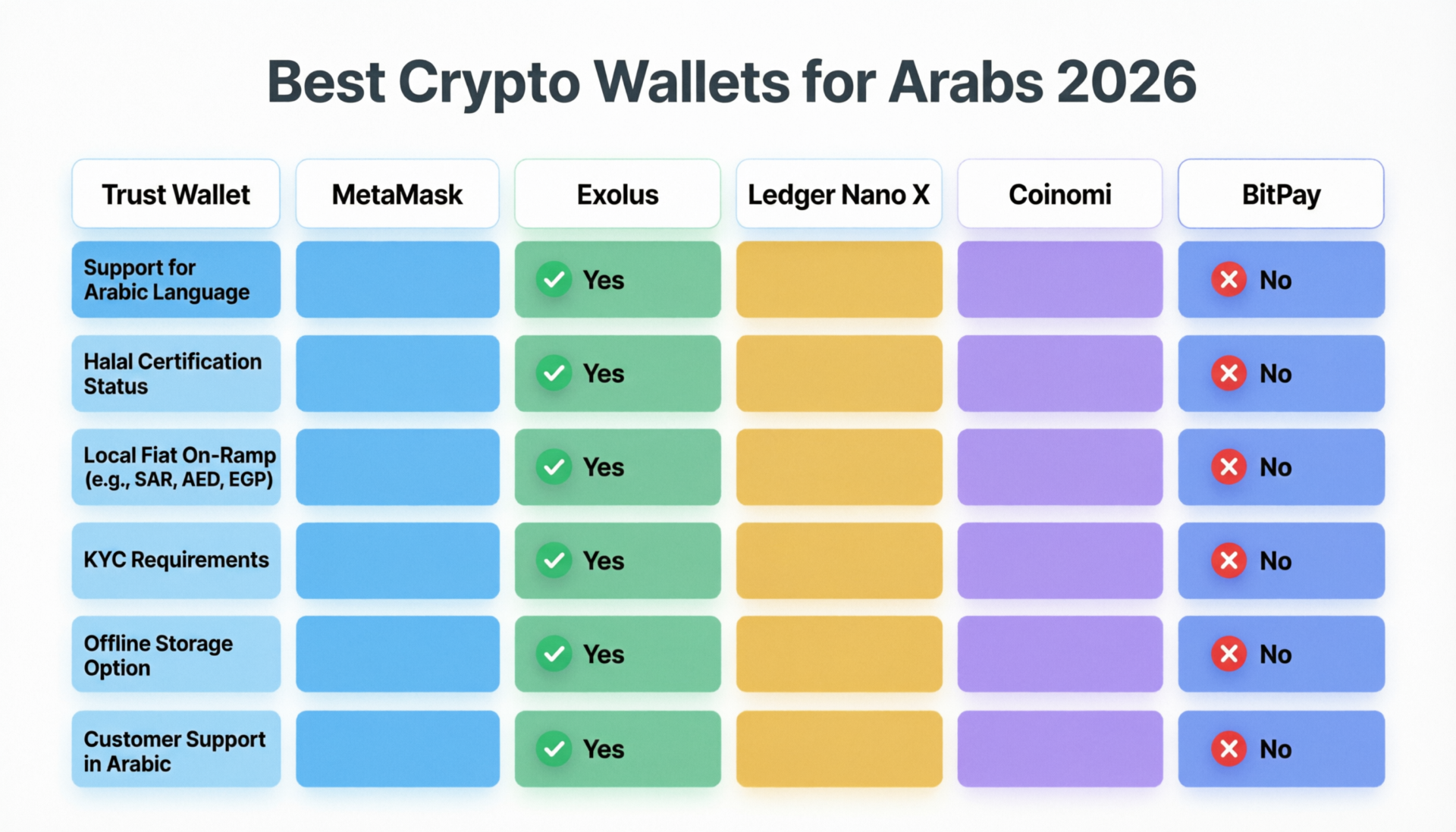
Choosing the best crypto wallets for Arabs in 2026 is less about hype and more about fit. The right wallet should be easy to use, clear in Arabic where possible, secure enough for self-custody, and practical for users living in the UAE, Saudi Arabia, the UK, Germany, or the USA.
For most beginners, Trust Wallet is the easiest place to start. Meta Mask makes more sense for Ethereum, DeFi, and Web3 use. Ledger is the stronger choice for people who want long-term security and prefer to store assets offline. For Arab users, Arabic UX, scam awareness, and local payment friction often matter more than brand recognition alone.
Which Crypto Wallet Is Best for Arabs?
The best crypto wallet for Arabs depends on how you plan to use crypto.
If you want a simple mobile wallet for everyday use, Trust Wallet is usually the easiest option. If you need access to Ethereum-based apps, token approvals, and DeFi platforms, Meta Mask is often the better fit. If your priority is protecting savings for the long term, Ledger stands out because it adds hardware-level security.
That difference matters in real life. A user in Dubai may care about ecosystem credibility and easy onboarding. Someone in London or Berlin may care more about compliance awareness, EUR or GBP payment friction, and safe transfers from regulated platforms. An Arab user in New York may simply want a wallet that is easy to understand before moving funds off an exchange.
Who This Guide Is For
This guide is for Arabic-speaking.
Beginners entering crypto for the first time
Expats in the UAE, UK, USA, and Germany
Bitcoin holders looking for safer storage
DeFi users exploring Ethereum and Web3
Muslim users thinking about halal-friendly usage and self-custody
The goal is practical guidance, not theory. A wallet may look great in a review but still feel confusing when you actually need to back up a seed phrase, switch networks, or avoid a phishing link.
What Makes a Crypto Wallet Good for Arabic-Speaking Users?
A good wallet for Arabic-speaking users should do four things well: make onboarding easier, explain self-custody clearly, reduce confusion around security, and work smoothly in the country where the user lives.
Arabic language support and translation quality
Arabic support is not just a bonus feature. It affects whether users understand recovery phrases, transaction prompts, wallet permissions, and scam warnings.
A wallet can technically support Arabic and still feel hard to use if the translations are clunky or the security language is vague. For beginners in Cairo, Riyadh, Dubai, Amman, Manchester, or Chicago, language clarity can make the difference between safe self-custody and a costly mistake.
Mobile usability for everyday users
Many Arab users, especially beginners, are mobile-first. They want a wallet that feels simple on a phone without needing advanced browser extension knowledge.
That is one reason Trust Wallet appeals to many first-time users. The interface is built around mobile behavior, and the learning curve is usually lighter than a more technical wallet setup.
Fiat access for diaspora users
Users in the USA, UK, and Germany often care about practical buy-and-transfer flows more than token variety.
A wallet may support dozens of chains, but that does not help much if card purchases fail, bank transfers are inconsistent, or local providers add friction. In practice, Arab users in London may care about GBP-friendly access, while users in Germany often pay more attention to EUR support and compliance posture.
Security education and trust signals
The best wallets do more than store assets. They also help users understand self-custody, backups, and phishing risk.
A strong wallet should make it clear that the user is responsible for the recovery phrase, private keys, and transaction approvals. That matters even more for new users coming into crypto through TikTok, Telegram groups, or informal community recommendations.
Best Crypto Wallets for Arabs Compared
For most Arabic-speaking users, three wallets stand out for different reasons: Trust Wallet, Meta Mask, and Ledger.
Trust Wallet: best for mobile-first Arabic-speaking beginners
Trust Wallet is the most balanced option for many beginners who want a non-custodial crypto wallet with broad asset support and a simple mobile experience.
It works well for users who want.
an easy mobile-first setup
support for multiple chains
A smoother entry into self-custody
A wallet that feels less intimidating on day one
For users in Dubai, Jeddah, Doha, Kuwait City, or among Arab communities in the UK and USA, Trust Wallet is often the easiest starting point because it keeps the experience relatively simple.
Meta Mask: best for Ethereum, Web3, and DeFi users
Meta Mask remains one of the strongest options for users focused on Ethereum and EVM-compatible chains.
It is usually the better choice for.
DeFi users
NFT buyers and collectors
People connecting wallets to Web3 apps
users who need browser extension flexibility
The trade-off is that Meta Mask asks more from the user. You need to understand networks, gas fees, approvals, and phishing risks more clearly. For Arab users who are already comfortable with crypto basics, that flexibility is a major advantage. For complete beginners, it can feel like a lot at first.
Ledger: best for long-term security and cold storage
Ledger is the strongest fit for users whose main goal is security.
If you are holding Bitcoin or other major assets for the long term, a hardware wallet usually offers stronger protection than keeping everything on a phone or browser-based wallet. Ledger is especially appealing for.
Long-term investors
Bitcoin-focused users
Security-first users
Muslim users who want a simpler, storage-first approach rather than constant DeFi activity
In practice, Ledger makes the most sense when the amount you are protecting is meaningful enough that convenience should take a back seat to security.
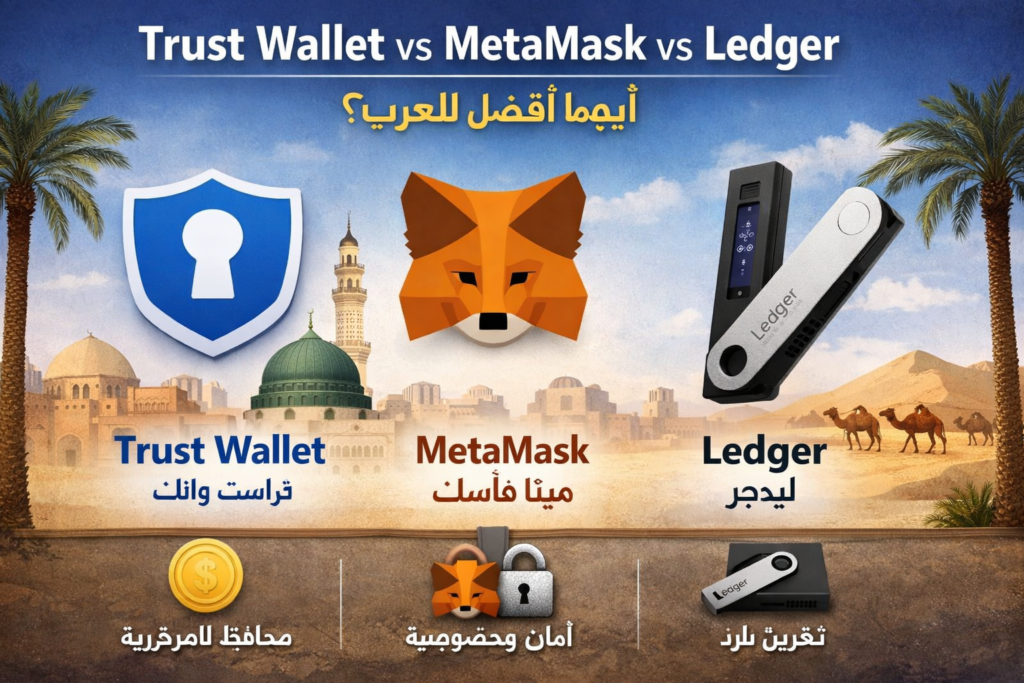
Trust Wallet vs Meta Mask vs Ledger for Arabs
For Arab users, the choice usually comes down to comfort level, use case, and security priorities.
Best for beginners
Trust Wallet is usually the easiest choice for beginners because it feels more natural on mobile and does not demand as much technical knowledge upfront.
Best for Ethereum and Web3
Meta Mask is the better option if your main use case is Ethereum, token swaps, decentralized apps, or wallet-based logins.
Best for long-term holders
Ledger is the stronger pick for users who care more about secure storage than daily convenience.
Best by user type
| User type | Best wallet |
|---|---|
| Beginner | Trust Wallet |
| Ethereum / DeFi user | Meta Mask |
| Bitcoin holder | Ledger |
| Long-term investor | Ledger |
| Mobile-first user | Trust Wallet |
| Web3 explorer | Meta Mask |
No single wallet wins for everyone. The best choice depends on what you are actually trying to do.
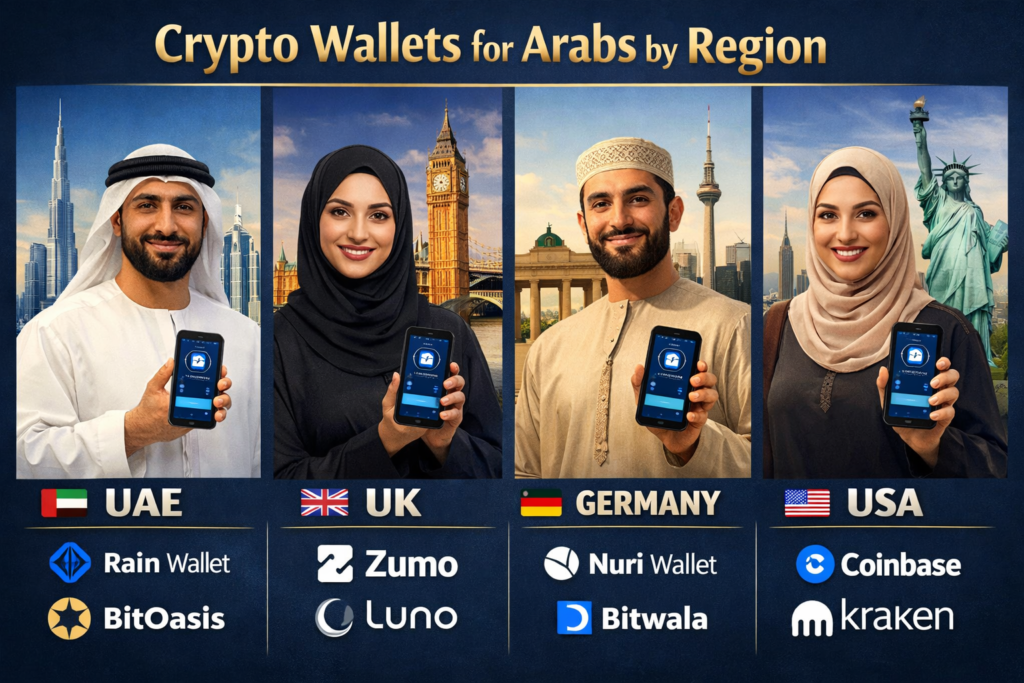
UAE, Gulf, UK, USA, and Germany: Which Wallet Fits Your Region?
Regional context can shape wallet experience more than many users expect.
UAE and Gulf users
For users in Dubai, Abu Dhabi, Riyadh, Doha, and Kuwait City, the broader crypto environment often matters a lot. People usually pay close attention to whether exchanges, ramps, and crypto services feel regulated, familiar, and credible.
That does not automatically change which wallet is best, but it does affect how easy the overall user journey feels. In the Gulf, many users want something simple, credible, and easy to pair with trusted platforms.
UK-based Arabs
Arab users in London, Birmingham, or Manchester often care about transfer clarity, safe off-exchange storage, and fewer mistakes during onboarding.
In the UK, many users prefer wallets that are well documented and simple enough to reduce confusion when moving funds from regulated platforms into self-custody.
USA-based Arabs
In the USA, wallet experience can still vary depending on provider access and state-level restrictions around crypto services.
For Arab users in places like New York, New Jersey, Texas, or Michigan, simplicity matters. The safer option is often the wallet that helps you avoid wrong-network transfers, rushed approvals, and poor backup habits.
Germany and EU users
For Arabs in Berlin, Frankfurt, or Munich, compliance awareness and structured onboarding tend to matter more.
Users in Germany often value
Clearer recovery steps
Stronger documentation
Predictable wallet behavior
Safer long-term storage habits
For this audience, a wallet that feels calm and transparent usually beats one that feels flashy but confusing.
Security and Self-Custody for Arabic-Speaking Beginners
Self-custody gives you more control, but it also gives you more responsibility.
That is the real trade-off. You are not depending on an exchange to hold your crypto, but you also need to protect your recovery phrase, avoid scams, and understand what you are signing.
Hardware vs software wallets
Software wallets are more convenient. Hardware wallets are usually safer for serious holdings because your keys stay isolated from the phone or browser environment you use every day.
A good rule is simple.
Use a software wallet for learning and smaller balances
Use a hardware wallet when your holdings become important enough to protect more carefully
How to protect your seed phrase
A lot of users lose funds because of very basic mistakes.
Do not.
Save your seed phrase in cloud notes
Email it to yourself
Keep it in Telegram or WhatsApp chats
Store it in screenshots on your phone
Instead
Write it down offline
Store it in a secure place
Test your backup process before sending large amounts
Keep it private, even from people who seem helpful
Common scams targeting Arab crypto beginners
New users in MENA and diaspora communities are often targeted through social platforms, group chats, and fake support messages.
Common scams include.
Fake wallet support accounts
Giveaway links
Phishing pages asking for a recovery phrase
“Verification” requests
Fake investment communities pushing urgent trades
In practice, the safest mindset is slow and skeptical. Real wallet providers do not need your seed phrase.
Halal, Compliance, and Trust Concerns
When people ask for a halal crypto wallet, they are usually asking the wrong question.
The wallet itself is mostly a tool. The more important issue is how you use it, what assets you hold, and whether your activity involves things like interest-based returns, excessive speculation, leverage, or questionable token projects.
What people usually mean by a halal crypto wallet
Most Muslim users want a setup that helps them.
Hold assets directly
Avoid unnecessary speculation
Stay away from unclear yield products
Keep more control over custody
That is why Ledger often feels attractive to halal-conscious users. It naturally supports a slower, storage-first mindset. Trust Wallet can also work well for simple spot holding. MetaMask is usable too, but it requires more discipline because it opens the door to a much wider DeFi environment.
Are Trust Wallet and Meta Mask suitable for Muslim users?
Yes, both can be suitable as tools.
The key question is not whether the wallet is Muslim-friendly by branding. The key question is whether your own usage aligns with your standards. Holding Bitcoin or Ethereum in self-custody is very different from using high-risk yield strategies or speculative meme-token behavior.
Compliance still matters
Even with a non-custodial wallet, compliance does not disappear.
KYC usually shows up at the exchange, payment provider, or on-ramp layer rather than inside the wallet itself. So whether you are in the Gulf, the UK, Germany, or the USA, you should still expect regulated providers to ask for identity checks when you buy crypto.
How to Choose the Right Wallet as an Arab User
Choosing the best crypto wallets for Arabs gets easier when you focus on your actual use case instead of trying to find one wallet that does everything.
Choose Trust Wallet if you want
The easiest beginner experience
A mobile-first wallet
Multi-chain convenience
A simpler path into self-custody
Choose Meta Mask if you want.
Ethereum and EVM-chain access
DeFi and Web3 flexibility
Browser extension support
More advanced control over on-chain activity
Choose Ledger if you want.
Stronger long-term security
Offline protection for private keys
Safer Bitcoin storage
A lower-risk, storage-first setup
A simple checklist before you decide
Before choosing a wallet, ask yourself.
Is the Arabic UX clear enough for me?
Do I understand seed phrase backup?
Will I mostly use mobile, browser, or hardware?
Do I need DeFi access, or just storage?
How much risk am I comfortable taking with self-custody?
Those five questions are often more useful than comparing flashy feature lists.

Final Thoughts
The best crypto wallets for Arabs in 2026 are the ones that match real needs, not just popular names. Trust Wallet works well for beginners who want a mobile-first experience, Meta Mask suits users exploring Ethereum and Web3, and Ledger is ideal for long-term holders focused on stronger security. For Arabic-speaking users, clear language, simple recovery steps, and scam awareness can matter as much as technical features.
Regional context also plays a big role. Users in the UAE, UK, Germany, and the USA may face different payment, compliance, and onboarding experiences. A good wallet should feel practical, understandable, and safe in everyday use. Start with the wallet that fits your current level, then upgrade your security and strategy as your confidence and holdings grow.( Click Here’s )
Key Takeaways
Trust Wallet is the easiest starting point for many Arabic-speaking beginners.
Meta Mask is the better fit for Ethereum, Web3, and DeFi users.
Ledger is the strongest choice for long-term holders who prioritize security.
Regional context matters in the UAE, Gulf, UK, USA, and Germany.
A halal-friendly setup is usually about usage and asset choice, not the wallet brand alone.
Self-custody only works well when backups, scam awareness, and recovery planning are taken seriously.
FAQs
Q : Which crypto wallet is easiest for Arabic-speaking beginners?
A : For most Arabic-speaking beginners, Trust Wallet is the easiest option because it is mobile-first, broad in asset support, and simpler to understand without deep Web3 experience. Meta Mask is better once the user is comfortable with networks, approvals, and DeFi. Ledger is better suited to long-term storage than everyday beginner use.
Q : Do crypto wallets support Arabic by default?
A : Not all of them do, and Arabic support quality varies. Some wallets offer stronger localization than others, while some rely heavily on device language settings or partial translations. That is why checking real in-app clarity matters before you commit.
Q : Is a hardware wallet worth it for a small crypto portfolio?
A : Usually not at the beginning. A software wallet is often enough while you learn the basics and hold smaller amounts. A hardware wallet becomes more worthwhile once the portfolio grows or long-term protection becomes a real priority.
Q : Can Arab users in Europe buy crypto directly from a wallet app?
A : Sometimes, yes. But the experience depends on the wallet, payment provider, country, and compliance flow. Many users still find it easier to buy through a regulated exchange and then move assets into a self-custody wallet.
Q : What should expats check before choosing a crypto wallet in the UAE or UK?
A : Start with three things: language clarity, fiat on-ramp friction, and your own readiness for self-custody responsibility. In the UAE, the surrounding crypto ecosystem often matters more. In the UK, safe transfers and compliance-aware habits are usually bigger concerns.