
Safest & Best Crypto Wallet for Arabic Speakers Today
For most Arabic-speaking beginners, a safe and simple setup is Trust Wallet or Coinbase Wallet (Base app) in Arabic on your phone, plus a Ledger hardware wallet as a long-term “cold storage” backup. Trust Wallet works well for everyday DeFi and mobile use, Coinbase Wallet/Base is great for Web3 dApps in the US/UK/EU, and Ledger gives you hardware-level security with an Arabic-friendly interface for serious savings
Introduction
If you’re searching for the best crypto wallet for Arabic speakers, you’re probably scrolling through dozens of apps in the App Store and Google Play many in English only, some marketed as “halal”, and some outright scams. It’s even more confusing if you live in New York, London, Berlin or Paris but still rely on exchanges or content from Dubai, Riyadh or Doha.
The good news: in 2025 there are a few wallets that combine Arabic language support, strong non-custodial security, and options that respect halal-conscious investing. At the same time, global crypto ownership is estimated around 650–660 million people by the end of 2024, so the tools, regulations and risks are evolving fast.
This guide walks you through how to choose safely as an Arabic speaker in the US, UK, Germany and wider EU, which wallets actually offer usable Arabic interfaces, and how to move away from leaving everything on big exchanges like Binance and Coinbase.
Best Crypto Wallet for Arabic Speakers.
For most Arabic-speaking beginners who want security and Arabic language support, the best setup is one mobile wallet in Arabic for daily use plus one hardware wallet for long-term storage. In practice, that usually means Trust Wallet or Coinbase Wallet (Base app) on your phone, backed up by a Ledger Nano device running with Ledger Live in Arabic.
We’ll compare these and a few alternatives, and also show you how to set up your first wallet step-by-step, how to think about halal-conscious investing, and what changes when you’re in the US vs UK vs Germany/EU.
Who this guide is for: Arabic speakers in the US, UK, Germany & wider Europe
This guide is written for
Arabic-speaking expats, refugees and students living in the US, UK, Germany and the wider EU.
Second-generation diaspora who speak Arabic at home but use local banks in New York, London, Manchester, Berlin, Munich, Paris or Amsterdam.
Professionals and small business owners who want to receive crypto payments, hold Bitcoin or stablecoins, or explore DeFi without losing security or halal-consciousness.
We assume you already use a smartphone and basic banking apps, but may be new to crypto or nervous about English-only interfaces.
If you just want the shortlist
Trust Wallet
Mobile-first, supports Arabic interface on iOS, multi-chain, great for everyday sending, swapping and DeFi. Best for users comfortable managing their own keys directly on their phone.
Coinbase Wallet / Base app
Non-custodial wallet from a US-regulated group, with Arabic-localised App Store onboarding in some regions and tight integration with Coinbase exchange. Good if you already use Coinbase in the US or UK and want to connect to Web3 dApps.
Ledger hardware wallet + Ledger Live
Hardware devices (Nano S Plus, Nano X, Stax) plus the Ledger Live app, which supports Arabic content and guidance via Ledger’s Arabic support site. Ideal for long-term “cold” storage of larger balances.
Use Trust Wallet or Coinbase Wallet for daily transactions; use Ledger as your vault.
How we picked these wallets: security, Arabic support, halal & regulation
We focused on four pillars.
Security & self-custody
Private keys stay with you (non-custodial).
Strong security track record, reputable teams, frequent updates.
Where relevant, independent security certifications like ISO 27001, SOC 2 or secure hardware designs similar to those used in payment cards and PCI DSS-aligned environments.
Arabic language & UX
Real Arabic UI on at least one major platform (iOS or Android).
Support content in Arabic, e.g., Ledger and Binance Academy maintain Arabic sections and guides.
Halal-conscious usage
Wallets that don’t force leverage, margin, or interest-bearing products.
Transparent fee structures and the ability to avoid certain tokens or protocols if your scholar advises so.
GEO availability & compliance context
Downloadable from Apple App Store and Google Play in the US, UK, Germany and EU.
Built or offered by companies that at least acknowledge regulations like SEC/CFTC rules (US), FCA (UK) and BaFin / MiCA (EU).
What Makes the Best Crypto Wallet for Arabic Speakers?
The best crypto wallet for Arabic speakers combines Arabic-friendly UX, strong non-custodial crypto wallet security, practical GEO availability, and the ability to use it in a halal-conscious way. That means the app speaks your language, you control your private keys, and you aren’t pushed into interest, leverage or opaque products.
Arabic-friendly UX.
“Arabic language support” in a wallet means more than just translating a few buttons. At minimum, it should include Arabic menus, settings, help centre content, notifications and error messages, ideally with proper right-to-left (RTL) layout.
Some practical checks.
App store language info
For example, Trust Wallet’s iOS listing explicitly lists Arabic (AR) as a supported language.
Help centre
Ledger has a dedicated Arabic support portal and Arabic getting-started guides for Ledger Live.
Onboarding in Arabic
Install with your device language set to Arabic and see if the onboarding, seed phrase screens and warnings are translated.
Arabic UX matters because over 230 million internet users worldwide use Arabic online, and that number is still growing.
Security fundamentals
A secure wallet, especially for non-custodial crypto wallet security, should:
Give you a seed phrase (12–24 words) that only you control.
Use strong local encryption and secure enclaves where available (e.g., on modern iPhones/Android devices).
Offer biometric locks and app-level PINs.
Be backed by a company that invests in security audits, bug bounty programs and certifications such as SOC 2 or ISO 27001, especially for backend services and cloud infrastructure (often on AWS, Azure or GCP).
Remember: if you don’t control the seed phrase or private keys, it’s not really “your” wallet.
GEO realities.
Many Arabic speakers in Europe and the US still want to use regional exchanges in Dubai, Abu Dhabi, Riyadh or Doha, but your wallet app itself must also obey local rules
On Apple App Store and Google Play, crypto apps face policies on KYC, fees and regions.
Some wallets or features (like buying crypto with card) can be limited by FCA, SEC, CFTC, BaFin, or MiCA rules.
In practice, Trust Wallet, MetaMask, Coinbase Wallet/Base and Ledger Live are broadly accessible in US, UK and most EU countries, including Germany. Always check local availability and legality before you rely on them.
Halal-conscious features
A “halal-conscious” wallet doesn’t automatically make every token or protocol halal, but it should allow you to avoid what your conscience or scholar says is haram. In reality, that looks like:
No forced margin trading or leveraged derivatives.
Clear on-chain network fees and spreads when swapping.
Ability to avoid interest-bearing products or certain DeFi protocols.
Transparent token lists, so you can filter and research using fatwa councils, Shariah advisory boards or Islamic finance research bodies.
Tools like Binance Academy’s Arabic content can help you understand concepts like staking, lending, and leverage so you can ask informed questions locally.
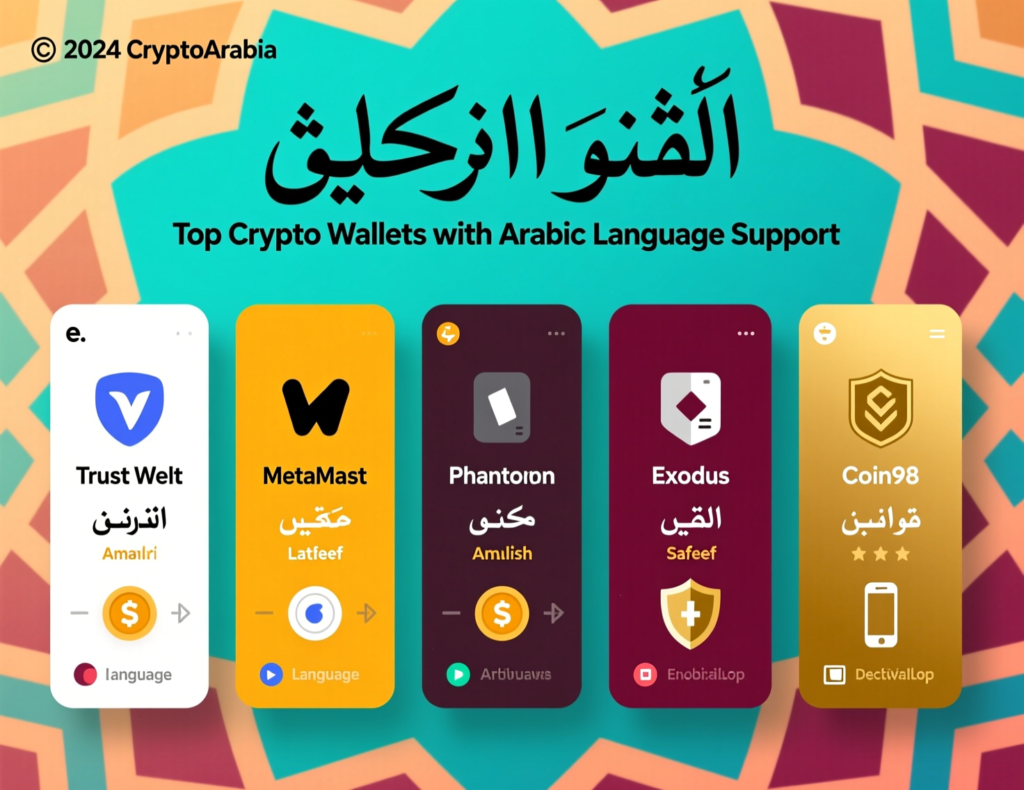
Top Crypto Wallets with Arabic Language Support (2025 Picks)
The global crypto wallet market is estimated around US$10–11 billion in 2024 and is forecast to grow strongly towards 2033, so new wallets appear every year. ([SkyQuest Technology Consulting][11]) This section focuses on established wallets with meaningful Arabic support or Arabic-friendly usage.
Trust Wallet
Micro-answer (AEO)
Trust Wallet is usually the best starting point for Arabic-speaking beginners who want a mobile-first, multi-chain DeFi wallet with a real Arabic UI and simple onboarding.
Key points
Arabic interface
Trust Wallet’s iOS app supports Arabic as a system language, so menus, buttons and labels display in Arabic for many users
Multi-chain
Supports major chains like Bitcoin, Ethereum, BNB Chain and many more in one app.
DeFi & dApps
Built-in browser for Web3 dApps and DeFi protocols, similar to MetaMask.
Non-custodial
You get a seed phrase; Trust Wallet doesn’t hold your keys.
GEO
Available through global App Store and Google Play in countries like the US, UK and across Europe, plus MENA countries like Saudi Arabia and UAE.
Trust Wallet is best if you mainly operate directly on your phone and want easy access to a DeFi wallet with Arabic support without complicated extensions.
Coinbase Wallet & MetaMask
Coinbase Wallet / Base app
Coinbase Wallet (now evolving into the Base app) is a non-custodial wallet from the same group that runs one of the most regulated exchanges in the US and Europe.
Integrates smoothly with Coinbase exchange accounts in US, UK and EU, making it easy to move funds.
App Store presence in Arabic-speaking markets shows localised interfaces for some users, though full RTL coverage can still be patchy.
Great for interacting with Coinbase’s Base L2 network and Ethereum dApps.
MetaMask
MetaMask is still the default Web3 wallet for many dApps in DeFi and NFTs.
It supports many languages, but Arabic support has historically been requested and is not consistently available yet; community threads show ongoing feature requests from Arabic speakers.
Even if the UI is English, you can still use it if you’re comfortable with technical terms.
If you’re in London, Manchester, Berlin or Amsterdam, a common stack is
Coinbase exchange (on-ramp) → Coinbase Wallet/Base or MetaMask for dApps → Ledger for cold storage.
Ledger Live + Ledger hardware wallets.
Ledger devices (Nano S Plus, Nano X, Stax) are hardware wallets that keep your private keys offline. The Ledger Live companion app is available on desktop and mobile, with Arabic support and Arabic onboarding guides.
Why Arabic-speaking users like Ledger
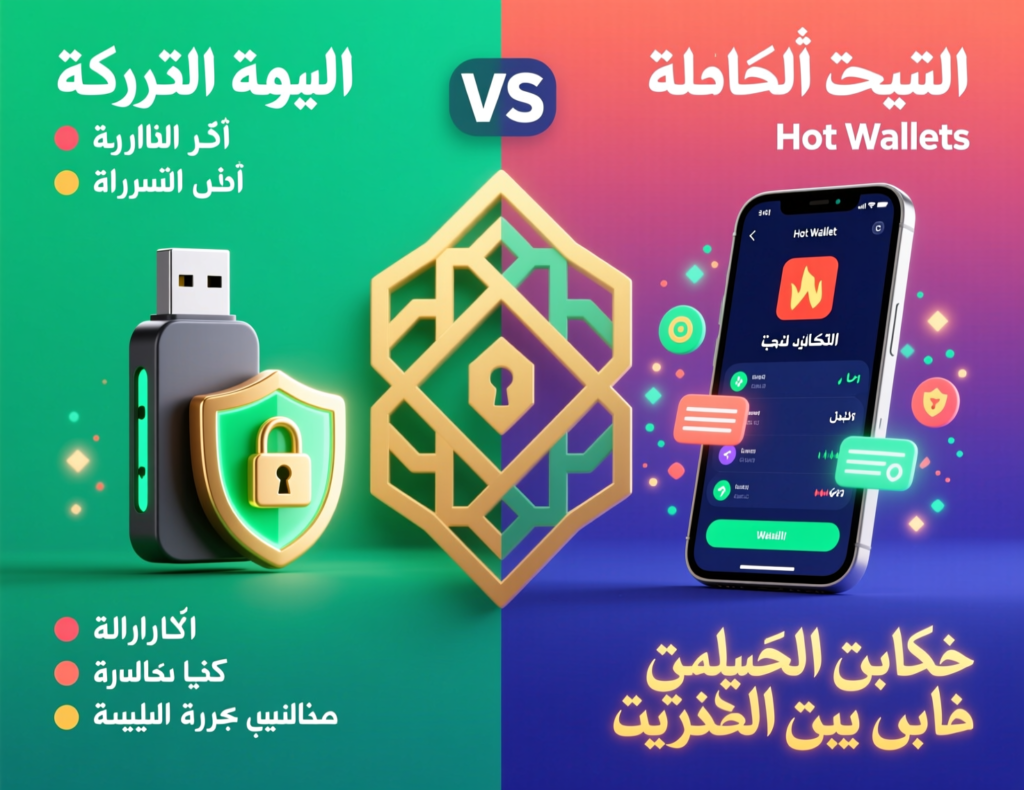
Hardware cold wallet vs hot wallet
Hardware wallets are “cold” (offline, long-term), while apps like Trust Wallet are “hot” (online, daily use).
Arabic help centre
Full support site available in Arabic, including setup and troubleshooting.
Global shipping & support
Available across US, UK, Germany and EU; many regional resellers exist.
Ledger is ideal if you hold larger amounts of Bitcoin or long-term ether/stablecoins and want hardware cold wallet vs hot wallet separation.
Other notable options for Arabic speakers (Exodus, Phantom, regional wallets)
Exodus
Popular, UX-friendly multi-asset wallet with growing language support. Currently, language support focuses on English and a few other languages; Arabic is not yet fully supported, though localisation features are expanding.
Phantom
Great Solana wallet; UI is mainly English-focused today, but still usable if you’re comfortable in English.
Regional MENA wallets (e.g., Sahal Wallet)
Some wallets marketed as “Shariah-compliant” or “halal” focus on GCC users in Dubai, Abu Dhabi, Riyadh, Jeddah, Doha, Kuwait City, etc. Always verify.
Who regulates the company (e.g., VARA in Dubai, FSRA in ADGM, SAMA/CMA in Saudi Arabia)?
Does the Shariah advisory board publish clear fatwas or guidelines?
Feature comparison: fees, staking, Arabic support, platforms
(High-level — always verify details in the app before using.)
| Wallet | Type | Arabic UI / Help | Platforms | Typical Use Case |
|---|---|---|---|---|
| Trust Wallet | Hot, mobile | Yes (iOS UI) | iOS, Android | Everyday mobile, DeFi, multi-chain |
| Coinbase Wallet/Base | Hot, mobile | Partial/localised | iOS, Android, web | Web3 + easy link to Coinbase exchange |
| MetaMask | Hot, browser & app | English-first | Extension, mobile | DeFi/NFTs, dApps on Ethereum & L2s |
| Ledger + Ledger Live | Cold hardware | Help in Arabic | Hardware + apps | Long-term secure storage (Bitcoin, ETH, etc.) |
| Exodus | Hot, desktop/mobile | Limited Arabic | Desktop, mobile | UX-focused multi-coin wallet |
Security & Self-Custody for Arabic Users
For Arabic-speaking users, the safest crypto wallet is less about brand and more about self-custody plus good habits. That means non-custodial wallets, hardware backups, and basic operational security.
Hot vs cold wallets explained in simple terms
Micro-answer (AEO)
A hot wallet (like Trust Wallet or MetaMask) is connected to the internet and sits on your phone or browser for daily use; a cold wallet (like a Ledger device) stays offline and only connects when you need to sign a transaction. For beginners, a small balance in a hot wallet for spending and a hardware cold wallet for savings is usually safest.
Think of it like this
Hot wallet = your daily spending wallet usable like a debit card, but more exposed to hacks, malware and phishing.
Cold wallet = your home safe slower to use, but much harder to attack remotely.
Hardware wallet usage is rising globally; the hardware wallet market is estimated around US$470–480 million in 2024 and projected to grow several-fold by 2033, reflecting users moving to self-custody.
Non-custodial vs exchange wallets.
Exchanges like Binance or Coinbase are convenient, especially for KYC & AML-compliant on-ramps in the US, UK and EU. However:
On an exchange, they control the keys. If they freeze accounts (regulatory request, risk flags) or face insolvency, your funds can be stuck.Non-custodial wallets (Trust, MetaMask, Coinbase Wallet, Ledger) give you full control but also full responsibility.
That’s why many users buy on regulated exchanges (compliant with SEC, CFTC, FCA, BaFin, MiCA rules) and then withdraw to a private wallet for safekeeping.
Security standards to look for.
When evaluating wallets.
Prefer teams that publish audits of smart contracts and backend services.
Look for references to SOC 2, ISO 27001 and PCI DSS-aligned practices, especially when dealing with card payments and fiat on-ramps.
Open-source code (like parts of MetaMask and Trust Wallet Core) adds transparency, but still needs active maintenance and bug bounties.
Backup & recovery best practices.
For Arabic speakers (or anyone), the number one rule
Good practice
Write your 12–24 word seed phrase clearly on paper (in Arabic or English — whichever you’ll read correctly).
Create 2–3 physical copies and store them in separate safe locations (e.g., home safe + trusted family member in Riyadh + bank box in Berlin).
Consider metal backups that can survive fire or water.
Never take screenshots or upload your phrase to WhatsApp, email, Google Drive or iCloud.
Region-specific risks.
Arabic-speaking users often face a combination of.
SIM swap attacks in places like the US, UK and Germany, where attackers convince telcos to re-issue your number.
Phishing in Arabic fake Binance Academy pages or pseudo-halal investing schemes shared in Telegram or WhatsApp groups.
Fake apps in app stores: apps mimicking MetaMask, Trust Wallet or regional brands, targeting “Arabic crypto wallet” searches.
Always
Verify the publisher name in the App Store/Play Store (e.g., “DApps Platform Software Services Ltd.” for Trust Wallet).
Bookmark official URLs and use them rather than following random links.
Treat anyone offering “guaranteed returns” or asking for your seed phrase as a scammer this is exactly what regulators like the FCA and SEC warn about.
Halal, Regulation & Compliance Considerations
What “halal crypto wallet” really means (and what it doesn’t)
Micro-answer (AEO)
A “halal-friendly crypto wallet” usually means a non-custodial wallet that lets you avoid interest, excessive leverage, and opaque or clearly haram projects it does not guarantee that every token or dApp inside the wallet is Shariah-compliant by default.
Wallets are tools
A hardware wallet like Ledger or a mobile wallet like Trust is essentially just a key manager and transaction signer.
Whether your usage is halal depends on what you store, trade or stake, and on the rulings of your scholars or fatwa councils.
How Muslims can vet projects and wallets
Practical steps
Look for Shariah advisory boards with named scholars and published fatwas on specific projects.
Prefer projects with transparent tokenomics (no hidden minting, clear revenue models).
Use educational hubs like Binance Academy (Arabic) to understand mechanisms like staking, yield farming and lending to discuss with scholars.
For wallets, review privacy policies, fee structures and risk disclosures especially if they use third-party on-ramps.
Key regulators & rules to know in US, UK, Germany & EU
US
The SEC and CFTC oversee parts of the crypto sector; investor-facing alerts stress that crypto can be highly speculative and unprotected.
FinCEN handles AML/KYC regimes, particularly for exchanges and money services.
Security benchmarks like SOC 2 and PCI DSS are often used by US-based fintechs handling cards and payments.
UK
The FCA regulates cryptoasset promotions and certain firms; estimates suggest around 12% of UK adults have held crypto at some point.
UK-GDPR covers personal data, and Open Banking/Faster Payments make it easier to fund exchanges from banks serving London, Manchester or Birmingham.
Germany/EU
BaFin oversees crypto custody and licensing in Germany.
MiCA provides a unified EU framework for crypto-asset service providers (CASPs), gradually coming fully into force from 2024 onwards.
GDPR/DSGVO and SEPA rules apply to personal data and euro transfers.
Why compliance matters even for non-custodial wallets
Even if your wallet is non-custodial.
The company still processes device data, IP addresses and sometimes analytics.
App store distribution must comply with Apple/Google rules and local marketing regulations, especially around risk warnings in the UK and EU.
GDPR and UK-GDPR still apply to how wallet providers store and process your personal data.
Bottom line: a compliant wallet provider is more likely to survive long-term and less likely to disappear overnight.
GEO Guide: Using Crypto Wallets as an Arabic Speaker in USA, UK, Germany & EU
Living in the USA: Arabic-speaking diaspora, on/off-ramps & tax basics
In the US, many Arabic speakers in New York, Dearborn, Houston or California use:
Regulated exchanges (e.g., Coinbase, Kraken) as on-ramps.
Non-custodial wallets (Trust, Coinbase Wallet, Ledger) for storage.
Remember
Crypto transactions may be taxable events; the IRS treats many crypto trades as property transactions.
US regulators like the SEC strongly warn that you can lose all your money in risky crypto investments.
In the UK: Arabic users, FCA-regulated on-ramps & bank transfers
In London, Manchester, Birmingham and beyond
The FCA regulates UK-based cryptoasset promotions and some exchanges; always check if your chosen platform appears in FCA registers or warnings.
Funding is often via Faster Payments and Open Banking APIs, which many exchanges and fintechs use for instant GBP deposits.
Using a non-custodial wallet in the UK is legal, but you still owe capital gains tax where applicable speak to a tax advisor.
In Germany & wider EU.
Germany and the EU host large Arabic-speaking communities in Berlin, Frankfurt, Munich, Paris, Amsterdam and Malmö.
BaFin in Germany and other national regulators are strict about unlicensed foreign exchanges targeting residents.
MiCA is harmonising rules for crypto service providers across the EU, which should make choosing regulated on-ramps easier over time.
SEPA transfers make funding euro-denominated accounts easier, especially from banks in Germany, France and the Netherlands.
Refugees or asylum seekers without full banking access often rely on P2P marketplaces this increases risk, so hardware wallets and strict self-custody hygiene become even more important.
When you still rely on MENA exchanges (UAE, Saudi, Qatar) from Europe or the US
Many Arabic speakers abroad still use.
UAE-based platforms under VARA or FSRA/ADGM.
Saudi exchanges under or alongside SAMA/CMA experimentation.
If you do this while living in the US, UK or EU.
Make sure using that exchange doesn’t violate local sanctions or licensing rules.
Disclose taxable activity in your country of residence.
Withdraw to a non-custodial wallet where you control keys and can manage risk locally.
Beginner-Friendly Setup.
Choosing the right wallet type (mobile, browser, hardware)
As a beginner.
Start with one mobile wallet in Arabic (Trust Wallet or Coinbase Wallet/Base).
Plan to add a Ledger hardware wallet once your holdings grow beyond what you’d carry in cash.
Avoid starting with just a browser extension on a shared laptop mobile plus biometric lock is often safer for newcomers.
Installing a wallet with Arabic interface (iOS/Android examples)
On iOS or Android
Set your device language to Arabic in system settings (optional but helpful).
Open the Apple App Store or Google Play and search for:
“Trust: Crypto & Bitcoin Wallet” (check the official publisher).
“Coinbase Wallet” or Base app (by Coinbase).
Check that:
The app has strong reviews and a large number of downloads.
The listing shows Arabic in the languages section (where applicable).
Install only from official stores never from random APK links unless you are very experienced and have verified signatures.
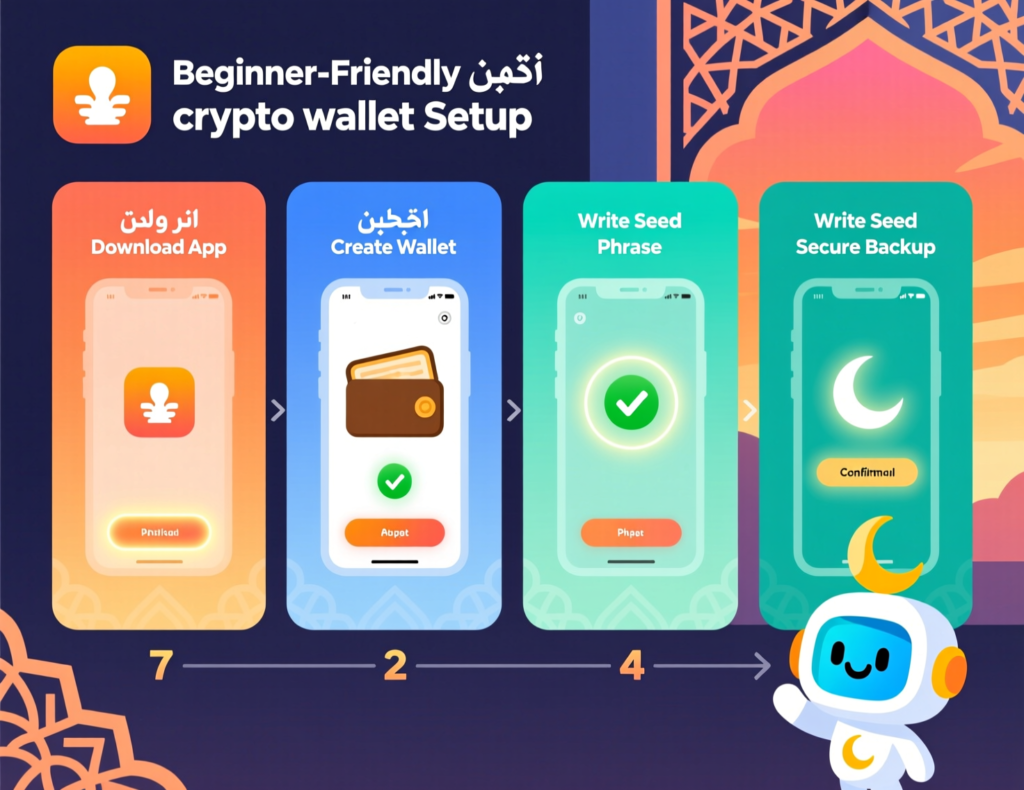
Creating a wallet, writing down your seed phrase and testing a small transaction
When you open the wallet.
Choose “Create new wallet” (not “Import”, unless you already have one).
When shown the seed phrase.
Write it clearly on paper.
Confirm each word in order when the app prompts you.
Add security
Enable biometric lock (Face ID, fingerprint) and an app PIN.
Test with a small first deposit for example, send $10–$20 equivalent from Binance or Coinbase to your new address on a single network
Only after the test arrives safely should you move larger amounts.
Moving funds from Binance/Coinbase to a private wallet safely
Micro-answer (AEO)
To move funds safely, choose the right network, send a tiny test transaction, confirm it arrives correctly, then send the remaining amount and verify the address again before you log out.
Checklist.
On your exchange (Binance, Coinbase, etc.), go to Withdraw.
In your wallet (Trust, Coinbase Wallet, Ledger Live), copy your receive address for the correct network.
Paste the address into the exchange and double-check the first and last 4–5 characters.
Send a small test (e.g., $5–$10 equivalent).
Wait for confirmation in the wallet.
If successful, send the rest in one or more larger batches.
Never let anyone in a Telegram group “help” you with this via screen-sharing.
How to Choose the Right Wallet for Your Situation
If you’re a total beginner (US/UK/Germany/EU).
For a student in London or a worker in Berlin just starting out.
On-ramp: Regulated exchange in your country.
Wallet: Trust Wallet or Coinbase Wallet/Base on your phone with Arabic-friendly interface.
Security upgrade: Add a Ledger once your holdings grow beyond a few hundred dollars/euros.
This setup keeps complexity low but gives you full self-custody.
If you’re an active DeFi user
If you’re active on DeFi, yield farming or NFTs.
Use MetaMask or Coinbase Wallet/Base as your main Web3 wallet for dApps.
Keep a separate wallet (and seed) for high-risk farming vs longer-term holdings.
Periodically move profits into a Ledger cold wallet with Arabic support in Ledger Live.
This gives you flexibility while protecting your long-term bag.
If halal is your top priority.
If halal is your non-negotiable.
Prefer non-custodial wallets where no one earns interest on your deposits without your consent.
Check whether the wallet or its integrated services advertise margin, futures, or interest-bearing “earn” products avoid if this conflicts with your scholar’s guidance.
Review the project’s documentation and any Shariah board statements.
Use educational content like Binance Academy (Arabic) to understand any product before using it.
Wallets and “investment apps” Arabic speakers should avoid
Avoid any wallet or app that.
Promises guaranteed returns, “fixed daily profit”, or “double your money in 7 days”.
Asks you to share your seed phrase, private key or one-time codes.
Has no clear company name, address, or regulation (no mention of FCA, SEC, BaFin, VARA, SAMA, etc.).
Only exists via WhatsApp/Telegram groups without official websites or app store listings.
Regulators around the world repeatedly highlight these patterns in scam warnings; if it sounds too good to be true, it probably is.
Download, secure, and set up your wallet
Once you’ve chosen.
Install one primary Arabic-friendly wallet (Trust or Coinbase Wallet/Base).
Follow the seed phrase + test transaction steps above.
Plan your hardware wallet purchase within your next 1–3 months if you intend to hold medium-to-large amounts.
Concluding Remarks
Everyday mobile & DeFi
Trust Wallet with Arabic UI.
Web3 dApps linked to a big exchange
Coinbase Wallet/Base, plus MetaMask for advanced use.
Long-term savings & “safest wallet” intent
Ledger hardware wallet + Ledger Live in Arabic.
Halal-conscious usage
Any non-custodial wallet, combined with careful project vetting and Shariah guidance.
Security habits that matter more than the brand you choose
The wallet brand is only half the story. What really protects you is:
Never sharing your seed phrase.
Keeping separate wallets for high-risk experiments vs savings.
Regularly reviewing permissions and revoking dApp approvals.
Staying skeptical of “too good to be true” offers in any language.
Where to learn more in Arabic.
To keep learning.
Binance Academy (Arabic) structured Arabic-language crypto education. Arabic Support Arabic guides for hardware wallets and Ledger Live.
Local Arabic-speaking communities in London, Berlin, Paris, Amsterdam, Dubai, Riyadh, Cairo and Casablanca ideally those that emphasise security and compliance over hype.
If you’re planning a crypto, fintech or DeFi product and want it to feel native for Arabic speakers in the US, UK, Germany and the wider EU, Mak It Solutions can help. Our team designs multi-language, RTL-friendly UX, integrates with secure cloud stacks (AWS, GCP, Azure) and respects both regulatory and Islamic finance constraints from day one.
Share your idea or existing prototype with us and we’ll help you scope an Arabic-friendly wallet or Web3 experience that users trust and regulators can live with. ( Click Here’s )
FAQs
Q : Is Trust Wallet safe for Arabic-speaking beginners in the Middle East and Europe?
A : Trust Wallet is a non-custodial hot wallet, which means you control your seed phrase and keys, not the company. That’s a strong security foundation, especially when combined with device biometrics and a PIN. The iOS version supports Arabic, making it friendlier for beginners who prefer native language menus. ([App Store][1]) However, safety still depends on your habits: only download from official app stores, back up your seed phrase offline, avoid suspicious dApps and never approve transactions you don’t understand.
Q : Which hardware wallet is best for Arabic speakers who want to store Bitcoin long term?
A : For most Arabic speakers, a Ledger Nano (S Plus or X) paired with Ledger Live is a strong default for long-term Bitcoin storage. Ledger devices keep keys offline, and Ledger provides Arabic-language support content that helps with setup and troubleshooting.You can receive Bitcoin from exchanges in the US, UK or EU and then leave it untouched for years. Always buy hardware wallets directly from the manufacturer or authorised resellers and verify the device is sealed and unmodified.
Q : Can I use a halal crypto wallet in the US or UK if the company is based in Dubai or Saudi Arabia?
A : Yes, you can often use wallets or apps from Dubai, Abu Dhabi, Riyadh or Jeddah while living in the US or UK, but you must respect both sets of rules. Locally, the provider may be under VARA, FSRA/ADGM, SAMA or CMA; in your country of residence you still answer to SEC/CFTC rules in the US or FCA rules in the UK, plus tax obligations.Being “halal-friendly” doesn’t exempt you from those. Use the wallet in a way that respects local law, and ensure any Shariah claims are backed by named scholars and transparent documentation.
Q : How do I change the language to Arabic in popular crypto wallets like MetaMask or Coinbase Wallet?
A : For Coinbase Wallet/Base, the language usually follows your phone’s system language and regional App Store settings, so setting your iPhone or Android to Arabic often localises parts of the UI.For MetaMask, you can change language in Settings → General → Current Language, but Arabic support has historically been limited and mainly requested by users rather than fully shipped, so you may need to use English or another supported language. Always update to the latest version before checking language options.
Q : What is the safest way for Arabic-speaking users to back up their seed phrase and keep it away from hackers?
A : The safest approach is completely offline storage. Write your seed phrase on paper or metal plates in Arabic or English, but very clearly and keep multiple copies in separate safe places (for example, one at home, one with a trusted relative in Riyadh or Cairo, and another in a secure box in Berlin or London). Never store it in photos, screenshots, WhatsApp, email or cloud drives, and never share it with support staff or “helpers” in Telegram groups. Hardware wallets plus offline seed backups are one of the few defences that still work even if your phone or laptop is hacked.