
Best Crypto Exchanges for Arab Users (Safe & Halal)
The best crypto exchanges for Arab users are regulated platforms that combine low spot trading fees, strong security, Arabic language support, and on-ramps for AED, SAR and other GCC currencies. In practice, many Arab crypto traders use a mix of large global exchanges (for deep liquidity) and regional platforms licensed in the UAE, Saudi Arabia, Bahrain or wider GCC to cash in and out in a halal-conscious way.
Nothing here is financial or religious advice always do your own research and speak with qualified Islamic scholars or advisors where needed.
Finding the best crypto exchanges for Arab users is not as simple as choosing the lowest fees. You’re balancing Arabic language support, halal concerns (no riba, fewer gambling-like products), blocked or restricted exchanges in some countries, and limited AED/SAR support from banks and fintechs. Add sanctions lists, KYC friction and remittance needs to the mix and it’s easy to see why so many Arab crypto traders feel overwhelmed.
This guide narrows the field to a vetted shortlist of global and regional platforms, broken down by region (UAE, Saudi & wider GCC, plus Arab users in the US, UK, Germany and the EU). You’ll also see filters for Arabic UX, Islamic-friendly features, and practical remittance flows, plus a step-by-step account opening checklist.
The methodology is straightforward: start with regulation and licensing, then total cost (fees + spreads + FX), then availability for your specific country, and finally Arabic/Islamic features and the ease of moving money between local banks and exchanges.
Top Crypto Exchanges for Arab Users in 2026
What are the best crypto exchanges for Arab users who want Arabic language support and low fees?
The best crypto exchanges for Arab users combine strong regulation, low spot trading fees, Arabic interfaces or support, and convenient ways to deposit and withdraw in AED, SAR and other GCC currencies. In real life, most Arab crypto traders end up using a handful of large global exchanges alongside one or two regional platforms licensed in the UAE, Bahrain or other GCC hubs.
Below is a practical shortlist to narrow your search. Always double-check country availability and fee schedules before you sign up these change frequently.
Quick shortlist (2026 snapshot – verify locally)
Binance
Best overall liquidity and low spot fees for many GCC users; Arabic support; broad coin list (strong for Dubai/Riyadh users, limited for US residents).
OKX
Regulated in Dubai under VARA and licensed in Europe under MiCA, Arabic app and site good for advanced traders who still want Arabic UX.
Crypto.com
VARA-licensed UAE presence with AED deposits, Arabic among supported app languages, strong for Arab expats in the EU/UK as well.
Kraken
Highly regulated in the US, UK and EU; strong choice for Arab users in the United States (US), United Kingdom (UK) and Germany who want a conservative, compliance-first exchange.
Coinbase
Simple UX and heavy regulation (including a German BaFin license), ideal for beginners in London, Berlin, Frankfurt and across the EU, then sending crypto to MENA
BitOasis
Long-standing Dubai-based exchange built for MENA, with AED/SAR support and Arabic UX; good starting point for residents of the United Arab Emirates (UAE) and Saudi Arabia.
Rain
Licensed by the Central Bank of Bahrain with a Sharia compliance certificate; strong option for halal-conscious users in Bahrain, UAE and wider GCC.
CoinMENA
Sharia-reviewed exchange, licensed by the Central Bank of Bahrain, and VARA-licensed in Dubai; attractive for users who want explicit Islamic finance oversight.
Bitget
Global exchange with Arabic language support for 11+ MENA markets and MENA-focused growth; a flexible choice for active traders across Morocco, Egypt and the wider region.
MEXC
Large exchange with Arabic support on web/DEX+ and a long list of supported countries, including many Arab states (but not the US)
Important
None of these are endorsements or fatwas. Treat them as starting points for your own screening (regulation, halal filters, usability, tax situation)
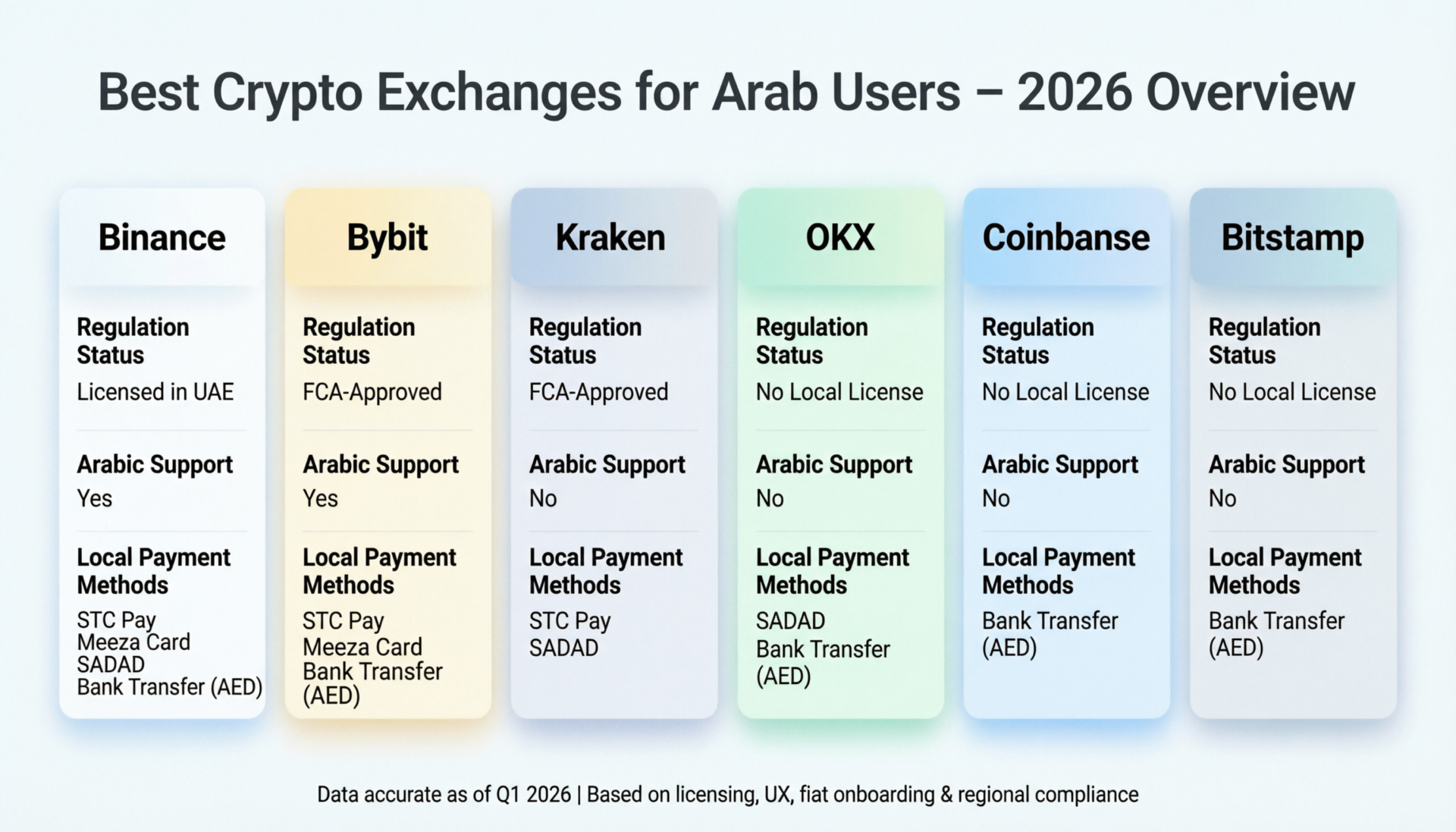
Quick comparison: fees, Arabic support, halal features, country coverage
Below is a simplified comparison snapshot. Exact fees, countries and products change fast; always check official fee and country pages before funding your account.
| Exchange | Spot fees (approx.) | Arabic UI / support | Halal-conscious usage notes | GCC coverage (UAE / KSA / GCC) | US / UK / EU coverage |
|---|---|---|---|---|---|
| Binance | Base ≈0.1% maker/taker, discounts with token | App & support in Arabic | Can be used spot-only with derivatives and earn features disabled | Available in many GCC states including UAE, KSA, Qatar (check live list) | Limited for US (use Binance.US or alternatives); broad but evolving presence in UK/EU |
| BitOasis | Low spot fees; some card deposits around ~3–4% | Arabic app/interface | Primarily spot and simple earn; user can avoid interest by skipping funding/earn products | Built for GCC: UAE, KSA, Bahrain, Kuwait, Oman, Qatar plus several MENA countries | Not aimed at US/UK/EU residents |
| Rain | Often 0% or low trading fees with spreads | Arabic support channels for MENA | Sharia certificate for core brokerage; easy to trade spot only | Licensed in Bahrain, expanding into UAE under ADGM; serves multiple GCC markets | Not a primary choice for US/UK, but can receive transfers from global exchanges |
| CoinMENA | Competitive spot fees, transparent schedules | Arabic website and support | Sharia-reviewed, CBB-licensed; can stick to spot only | Strong in Bahrain, UAE (via VARA licence), Qatar and other GCC markets | Limited or unavailable in US; expanding into EU under additional licences |
| Crypto.com | Tiered maker/taker fees around 0.075–0.1% for many users | Arabic in app language list; Arabic community channels | Offers card, earn, lending and derivatives – halal-conscious users should stick to spot and avoid interest | Licensed in Dubai via VARA supported in multiple GCC states including UAE, Kuwait and Jordan | Strong presence in US, UK and EU; useful “bridge” exchange |
| OKX | Low spot fees; competitive for futures and options | Full Arabic website and app | Offers extensive derivatives; halal-conscious users can restrict themselves to spot trading pairs | Licensed under Dubai’s VARA for exchange and derivatives; expanding from UAE into MENA | MiCA-licensed in EU; good for users in Germany, France, Netherlands and wider EEA |
| Kraken | Low spot fees; particularly strong for euro/GBP pairs | English-only UI but responsive global support | Very derivatives-heavy for advanced users; spot-only usage is possible on standard markets | Not a GCC native; some users in UAE/Saudi use it only as a “first leg” from EU/US | US, UK and EU-licensed; ideal for Arab users in London, Manchester, New York, Berlin, Frankfurt |
| Coinbase | Simple fee structure; slightly higher than pro-trader platforms | English UI, extensive documentation | Primarily spot, with some staking/earn products that can be avoided | Not a regional GCC player; coins usually bridged to MENA exchanges | Regulated in EU (Cyprus, Germany under BaFin) and UK; strong option for cautious beginners |
Most Arab crypto traders only need
One global exchange for deep liquidity (Binance / OKX / Kraken / Coinbase / Crypto.com).
One GCC-licensed platform (BitOasis, Rain, CoinMENA) for cashing in and out in AED, SAR, QAR and other local currencies.
Who each exchange is best for (UAE, Saudi Arabia, GCC, diaspora)
Think of it this way
Best for residents in UAE (Dubai / Abu Dhabi)
BitOasis, CoinMENA and Crypto.com (VARA/ADGM-linked, AED bank transfers)
Binance, OKX and Bitget for higher liquidity or derivatives, once you’re comfortable with cross-border regulation.
Best for residents in Saudi Arabia and Gulf countries
BitOasis and Binance for SAR and GCC support.
Rain and CoinMENA for explicit Sharia oversight and strong ties to Bahrain and regional banking.
Best for Arab expats in USA/UK/Germany who send money home
Kraken and Coinbase to connect US, UK or EU bank accounts under tight regulation.
Crypto.com, Bitget and MEXC when you need broader coin lists, SEPA/Faster Payments and Arabic support.
Best for advanced traders vs. beginners
Advanced
OKX, Binance, Bybit and Bitget (complex order types, futures and options).
Beginners
Coinbase, BitOasis, Rain and CoinMENA (simpler interfaces, fewer “DeFi rabbit holes”)
Best Crypto Exchanges by Region: UAE, Saudi Arabia, GCC & Arab Diaspora
Best crypto exchange UAE (Dubai, Abu Dhabi)
If you live in the UAE or frequently move between Dubai and Abu Dhabi your safest route is to prioritise platforms licensed by the Virtual Assets Regulatory Authority (VARA) or the Abu Dhabi Global Market (ADGM)’s FSRA. VARA oversees virtual asset activity in Dubai, while ADGM has its own digital asset framework in Abu Dhabi.
Good UAE-focused options include
BitOasis
Dubai-born, strong AED support, Arabic UX, long MENA track record.
CoinMENA
VARA-licensed entity for UAE residents, plus CBB licence.
Crypto.com
VARA VASP licence and AED support, with a deep global product stack.
OKX
VARA VASP licence, Arabic app and a growing local office presence.
From inside the UAE, local bank transfers in AED can usually be used to fund these platforms. From abroad, many Arab expats in London, Berlin or New York fund a global exchange first, then send crypto to their UAE-licensed platform before cashing out in AED.
Best crypto exchange for Saudi Arabia, Qatar, Kuwait, Bahrain & Oman
For Saudi Arabia, Qatar, Kuwait, Bahrain and Oman, the key questions are: “Does this exchange actually accept residents from my country?” and “Does it connect to local banks or at least support SAR/QAR/KWD/BHD/OMR on- and off-ramps?”
In practice.
Rain and CoinMENA are strong for Bahrain, Saudi and wider GCC, thanks to Central Bank of Bahrain licensing and partnerships across the region.
BitOasis supports residents of all six GCC countries plus Egypt, Jordan, Morocco, Algeria, Tunisia and more – handy if you have family in North Africa.
Binance, OKX, Bitget and MEXC are widely available in many GCC states, but bank connectivity is often via international wires or cards rather than local account numbers.
Local P2P markets on these platforms are heavily used for “remittance-style” flows: selling USDT or BTC to local buyers in SAR or QAR. That can be convenient, but it also adds counterparty risk always use escrow, verified traders and small test transactions.
Best crypto exchanges for Arab users in USA, UK, Germany & wider Europe
For Arab crypto traders in New York, London, Berlin, Frankfurt or elsewhere in the US/UK/EU, a typical game plan is:
Use a local, well-regulated exchange for bank deposits and KYC.
Buy a widely supported asset (USDT, USDC, BTC, ETH)
Transfer funds to a GCC or MENA-focused platform or to a self-custodial wallet for family remittances.
Good “first leg” options
US
Kraken and Coinbase for USD funding under strong US and state-level regulation.
UK
Kraken (FCA-registered cryptoasset business) and Coinbase UK.
Germany & EU
Coinbase Germany (BaFin-licensed) and OKX/Bitget/Crypto.com with MiCA-compliant licences passported across the EEA.
Example journeys
Arab student in the US: funds Coinbase via ACH → buys USDT → sends to Rain or BitOasis → cashes out to a bank in Saudi Arabia or the United Arab Emirates (UAE).
Family in London or Berlin: uses UK Faster Payments or SEPA to fund Kraken/Coinbase → buys USDT or BTC → sends to CoinMENA or BitOasis → family cashes out in AED/SAR or uses local P2P in Egypt, Jordan, Morocco, Algeria or Tunisia.
Halal Crypto Exchanges & Islamic Trading Platforms
What makes a crypto exchange suitable for Muslim or halal-conscious traders?
A halal-conscious crypto platform avoids or clearly separates interest-bearing products, keeps spot trading transparent, and does not push users into high-leverage derivatives, gambling-like tokens or excessive uncertainty (gharar). Ideally, the exchange publishes guidance from Sharia scholars or an Islamic finance advisory board so users understand how to avoid riba and speculative traps.
Key screening factors for Muslim traders
Spot vs. futures
Use spot markets with immediate settlement; avoid perpetual futures and very high leverage.
Interest / staking / “earn” products
Many of these look like interest-bearing accounts; some scholars are more comfortable with profit-sharing models but not fixed yield.
Margin trading
Borrowing funds to trade on margin often involves interest/fees that can be problematic from a riba perspective.
Token selection
Meme coins, casino tokens and highly speculative gaming tokens are more questionable than major assets used for payments or real-world utility.
Transparency
Look for clear terms, Sharia certificates (e.g., from recognised review bureaus) and explicit “Islamic account” modes where available.
Is crypto trading halal or haram on exchanges?
Scholars disagree, and this article is not a fatwa. A common view is that buying and selling established cryptocurrencies on spot markets (with immediate delivery, no interest and reasonable risk) can be halal under certain conditions. Concerns grow when you move into:
Very high leverage and perpetual futures.
Interest-bearing lending, borrowing or “earn” products.
Highly speculative tokens with no underlying utility.
Many Arab users therefore treat crypto more like a volatile asset class than a casino: avoiding leverage, focusing on spot trades and steering clear of ultra-speculative coins. For religious questions, you should consult trusted scholars or local Islamic finance advisors in your country (e.g., in Riyadh, Jeddah, London or Berlin).
Examples of Islamic or riba-free crypto trading options
You’ll find three broad approaches in 2026.
Explicitly Sharia-reviewed exchanges
Rain Sharia compliance certificate from Shariyah Review Bureau.
CoinMENA Licensed by CBB with Shariyah Review Bureau oversight; marketed as Sharia-compliant.
“Islamic mode” or spot-only accounts on general exchanges
Some platforms let you disable margin and futures and avoid earn products entirely; you just trade spot (BTC/USDT, ETH/USDT, etc.) and withdraw.
Manual self-filtering on global platforms
On Binance, OKX, Bitget, MEXC, Crypto.com and others, you can:
Turn off futures and margin.
Avoid “earn”, “staking”, lending or structured yield products.
Focus only on spot markets and reasonable assets.
This is still an evolving area. Nothing replaces personal due diligence and religious guidance that fits your madhhab and local context.
Arabic Language, Local Fiat & Remittances
Crypto exchanges with Arabic language apps and support
Arabic localisation can make or break the experience for new Arab crypto traders, especially in Egypt, Jordan, Morocco, Algeria and Tunisia, where English-only UIs can be a barrier.
Notable Arabic-friendly exchanges
Binance
24/7 multilingual support including Arabic.
OKX
Dedicated Arabic website and app.
BitOasis
Built around Arabic and English interfaces for MENA users.
Rain and CoinMENA
MENA-focused, with Arabic support and materials.
Bitget
Arabic support for 11+ MENA markets.
MEXC
Extended language pack including Arabic on its DEX+ interface.
Crypto.com
Arabic among supported app languages and regional Telegram channels.
Look for fully localised apps (menus, buttons, KYC forms) rather than just an Arabic FAQ page.
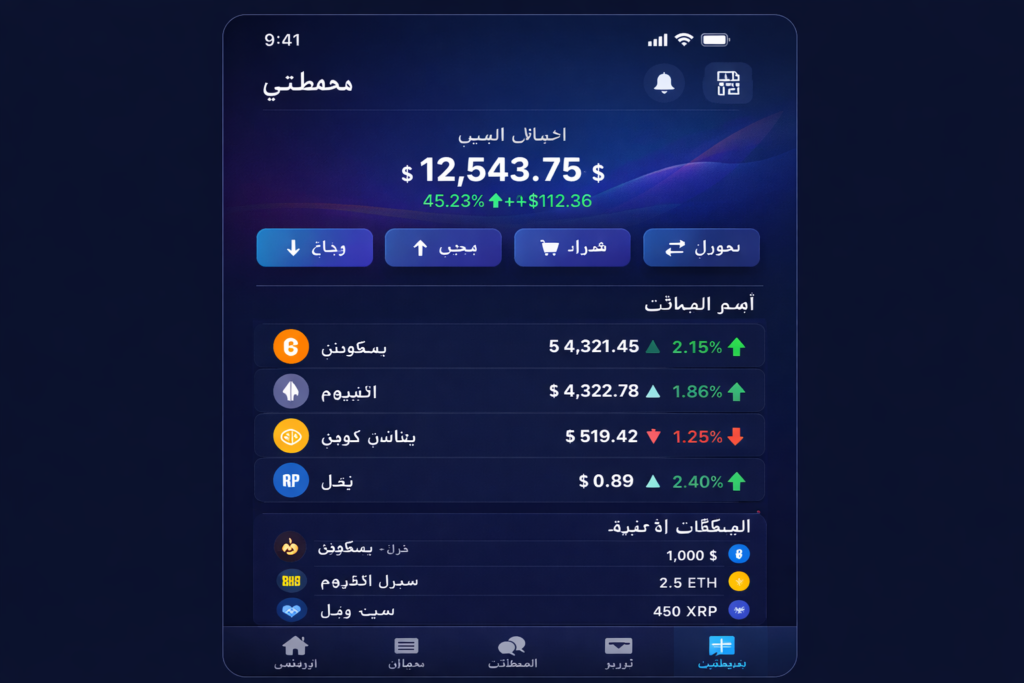
Exchanges that support AED, SAR, QAR, KWD, BHD, OMR and euro/SEPA
For Arab users, the on/off-ramp is everything. Crypto itself is often dollar-denominated, but funding via AED, SAR, QAR, KWD, BHD, OMR, EUR or GBP is what actually shapes your total cost.
Common funding methods.
Local bank transfer (UAE domestic, SADAD in KSA, etc.)
SEPA transfers in the eurozone (for Arab users in Berlin, Frankfurt, Paris, Amsterdam)
UK Faster Payments for London-based users.
SWIFT wires (slower, higher fees).
Cards (instant, but often 2–4% processing fees)
Many Arab users in Europe will:
Fund a euro account via SEPA on Coinbase, Kraken, OKX, Bitget or Crypto.com.
Buy USDT or BTC.
Send that crypto to a GCC platform like BitOasis, Rain or CoinMENA.
Convert to AED/SAR and withdraw to local banks or use P2P.
This often avoids double FX spreads (EUR → USD → AED/SAR) and gives you flexibility in timing transfers.
How do Arab expats in the USA, UK or Germany safely move money between local banks and crypto exchanges serving the Middle East?
The safest route is to use a regulated exchange in your country for bank deposits and KYC, buy a widely supported asset like USDT or BTC, then transfer it to a licensed regional exchange or trusted wallet before cashing out to AED, SAR or other GCC currencies. Always double-check withdrawal networks, fees and receiver-country rules before sending.
Example: USA → GCC
Open an account with Kraken or Coinbase using your US ID and bank details.
Deposit USD via ACH or wire.
Buy USDT (on a common network like TRON or Ethereum).
Send USDT to your BitOasis / Rain / CoinMENA wallet address.
Sell USDT for AED/SAR on the regional exchange and withdraw to UAE or Saudi banks.
Example: UK/EU → GCC/North Africa
In London or Berlin, deposit GBP/EUR into Kraken, Coinbase, OKX, Bitget or Crypto.com via Faster Payments or SEPA.
Buy BTC or USDT.
Transfer to a GCC-focused exchange or trusted wallet held by family in Dubai, Riyadh, Doha or Manama.
Family cashes out via local bank or P2P in AED, SAR or local currency.
Always test with a small transaction first, confirm the correct network (for example, don’t send TRC-20 USDT to an ERC-20-only address), and keep screenshots/receipts in case of support issues.
Regulation, Safety & Compliance Checks for Arab Users
Why do some crypto exchanges work in UAE or Saudi Arabia but not for other Arab countries?
Crypto exchanges choose countries based on licences, banking partners, sanctions and risk ratings. An exchange can be fully authorised and banked in the UAE or Saudi Arabia, but geoblock residents from other Arab countries such as Syria, Yemen or Sudan due to sanctions or missing licences.
Differences to watch.
Onshore licences (e.g., VARA, ADGM, CBB, Capital Market Authority (Saudi CMA)) vs. offshore registrations in lightly regulated jurisdictions.
Global vs. regional entities: Binance.com vs. a local GCC entity; Crypto.com’s UAE entity vs. its EU/US operations; OKX UAE vs. OKX Europe.
Sanctions and high-risk lists: US, UK and EU sanctions lists push many exchanges to restrict residents from high-risk Arab states.
That’s why you may see friends in Dubai happily using a platform that shows “service not available in your country” when you log in from another Arab state.
Why should Arab users check local licenses and Sharia-compliance before choosing a crypto exchange?
Checking licences and Sharia-compliance helps Arab users avoid frozen accounts, surprise bans and products that go against their values. A properly regulated exchange must follow rules on client fund segregation, security, reporting and transparency; a Sharia review adds an extra filter for interest-bearing or gambling-like products.
Where to check
Public registers for VARA, ADGM, CBB, FCA, BaFin and others.
Legal or “Licences & Registrations” pages on the exchange’s website.
Sharia board or Islamic finance disclosures from review bureaus.
KYC, sanctions and privacy for Arab crypto traders in US, UK, EU & MENA
Almost every serious exchange in 2026 requires Know-Your-Customer (KYC) and Anti-Money Laundering (AML) checks. That can be frustrating, especially for nationals of sanctioned or high-risk countries, but it’s also why banks are willing to connect to these platforms.
Key points.
KYC friction
Syrians, Yemenis, Sudanese and some other nationalities may face enhanced checks or outright blocks, even when living in Germany, the United Kingdom (UK) or the United States (US)
Data protection
In the EU, the General Data Protection Regulation (GDPR) sets strict rules on how exchanges process personal data; the UK has its own UK-GDPR after Brexit.
Security standards
Look for PCI DSS and SOC 2 as signs that card processing and backend systems are audited against recognised benchmarks.
If privacy is a major concern, consider:
Using exchanges that clearly document their data practices and data residency (for example, EU servers).
Moving long-term holdings to self-custody wallets once you’ve completed your trades.
Avoiding P2P trades with strangers where you share personal documents outside the exchange.
How to Choose and Open Your Account (Step-by-Step)
How can Arab users compare fees, KYC rules and fiat support across global and regional crypto exchanges?
Start by listing 3–5 exchanges that explicitly accept customers from your country. Then compare: trading and withdrawal fees, supported fiat currencies and local banks, KYC requirements, Arabic or English support, and whether they push interest or leveraged products you’d rather avoid. Pick the platform that balances strong regulation, low total costs and easy access to your preferred fiat.
A simple personal scorecard might include columns for.
Regulation strength (local licence? onshore or offshore?)
Fiat support (AED/SAR vs only USD/EUR)
Total fees (including spreads, funding/withdrawal)
Arabic UX and support quality.
Availability of “danger zones” (futures, margin, casino-style tokens)
If you’re building internal tools or dashboards to track this, Mak It Solutions can help you design custom web and mobile portals similar to its work on GCC sovereign cloud and data residency and multi-cloud governance.
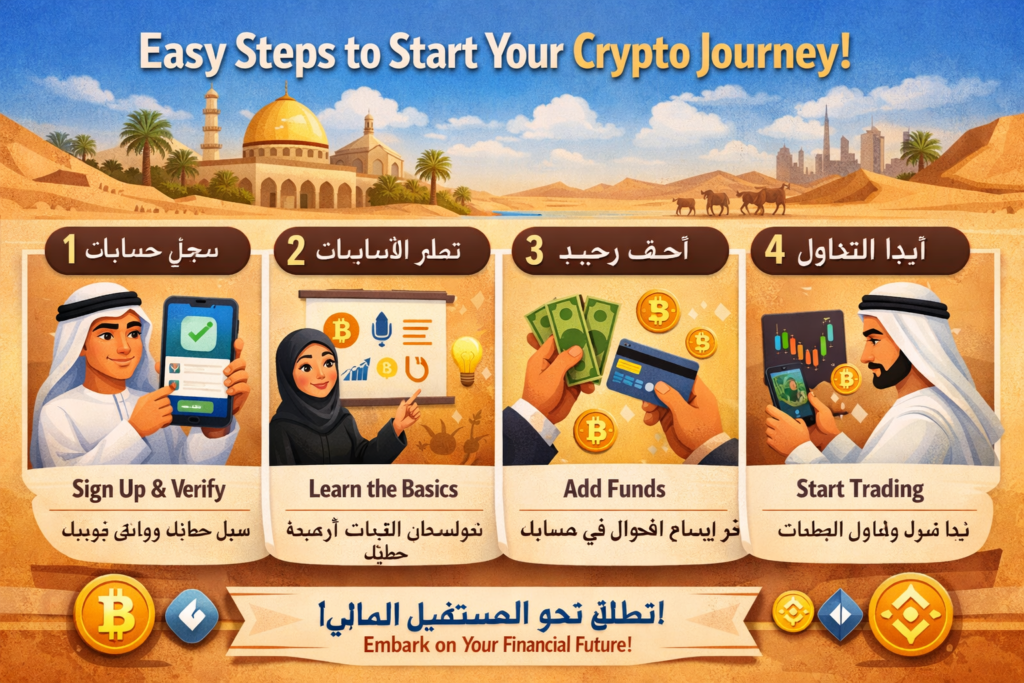
Step-by-step: opening an account, passing KYC and making your first halal-conscious trade
Check country eligibility and licences
Confirm that the exchange accepts residents of your country and holds recognisable licences (VARA, ADGM, CBB, FCA, BaFin, etc.)
Register and enable 2FA
Sign up with your email/phone, set a strong password, and immediately enable app-based two-factor authentication.
Complete KYC (with Arab-specific tips)
Use a valid passport or national ID.
For expats in London, Berlin, Paris or New York, your residence permit and local utility/bank statement often serve as proof of address.
If your nationality is on a higher-risk list, expect extra questions or slower approval.
Deposit via local bank / card / SEPA / other rail
In Dubai/Abu Dhabi, use AED bank transfers where possible.
In the UK, use Faster Payments; in Germany or elsewhere in the EU, use SEPA.
Avoid high-fee card deposits unless you need instant funding.
Place your first halal-conscious spot trade
Stick to a simple market or limit order (e.g., buy BTC/USDT or USDT/AED)
Avoid futures/leveraged tokens, and do not opt into “earn” or “staking” products unless you’ve checked their permissibility.
Optional: withdraw to self-custody or a regional exchange
For long-term holdings, consider a hardware or software wallet where you control the keys.
For remittances, send from your global exchange to your GCC or North African exchange, then cash out.
Final checklist & next steps for Arab crypto traders
Before you fund any platform, ask.
Is the exchange licensed and accessible from your country today?
Does it support your primary fiat currency (AED, SAR, EUR, USD, GBP) and local banks?
Are you comfortable with its halal/haram implications (spot vs. leverage, interest, token types)
Is Arabic support available, or at least responsive English support?
Next step: shortlist 2–3 exchanges from this guide, check their licences and country pages, run one small test deposit and withdrawal each, and only then scale up.
If you’re building your own crypto, fintech or analytics platform for Arab users, Mak It Solutions can also help you design compliant, multi-region architectures similar to the firm’s work on GCC-sovereign clouds, KSA/UAE/Qatar-ready infrastructure and high-performance mobile apps.You can explore their Services, Web Development, Mobile App Development and Search Engine Optimization offerings, then connect via the About Us and Contact pages when you’re ready to talk.
Key Takeaways
Use two tiers of exchanges: one tightly regulated platform in your country of residence (US/UK/EU) and one GCC-licensed exchange to cash in and out in AED, SAR or other local currencies.
Halal-conscious usage is possible: many Arab crypto traders stick to spot trading, avoid leverage and interest-bearing “earn” products, and favour exchanges with Sharia review.
Arabic UX matters: exchanges like BitOasis, Rain, CoinMENA, Binance, OKX, Bitget, MEXC and Crypto.com offer Arabic interfaces or support, making life easier for new users.
Regulation isn’t just a logo: check public registers for VARA, ADGM, CBB, FCA, BaFin and others to verify real licences, not just marketing.
Remittances favour stablecoins: for Arab expats in the USA, UK, Germany and wider Europe, routing money via USDT/BTC on regulated exchanges can reduce fees — if you handle networks and KYC carefully.
Mak It Solutions can help on the tech side: from building compliant crypto apps and dashboards to architecting GCC-ready cloud infrastructure, you don’t have to design everything alone.
If you’re serious about serving Arab crypto traders whether you’re a fintech founder in Dubai, a Web3 startup in London, or a bank in Berlin exploring Sharia-compliant digital assets you’ll need more than just a list of the best crypto exchanges for Arab users. You need UX, security, regulation and data all working together.
Mak It Solutions can help you design and build Arabic-friendly, region-aware web and mobile platforms that respect Middle East crypto regulations and Islamic finance constraints. Reach out via the Mak It Solutions contact page to book a consultation or request a scoped estimate for your next crypto, remittance or analytics product.
FAQs
Q : Can Arab users rely on P2P crypto marketplaces instead of fully regulated exchanges?
A : P2P marketplaces can be useful for buying and selling crypto in SAR, AED or local currencies where banking rails are weak, especially in countries like Egypt, Morocco or Algeria. However, they come with higher counterparty risk, more scams and less regulatory protection than licensed exchanges. If you use P2P, always stick to the platform’s escrow system, trade with well-rated counterparties, keep trades small at first, and never send funds off-platform (e.g., via WhatsApp) to avoid fraud.
Q : Do Arab expats in Europe or the UK pay tax when sending crypto profits back home to family?
A : In most European countries and in the UK, tax is based on your residence, not where your family lives. That means crypto gains realised in London, Berlin, Paris or Amsterdam may be taxable even if you later send the funds back to family in the Middle East. Some countries treat long-term holdings more favourably; others tax every disposal into fiat or another coin. Always check local rules or speak with a tax advisor before moving large amounts, and keep detailed records of deposits, trades and withdrawals so you can prove the source of funds if asked.
Q : Which types of crypto products (futures, staking, lending) raise the biggest halal concerns for Muslim traders?
A : The most sensitive products are usually high-leverage futures and perpetual swaps (due to speculation and complex funding fees), interest-bearing lending products, and fixed-yield “earn” programmes that look similar to savings accounts. Some scholars are more comfortable with profit-sharing or staking models when they are tied to real protocol rewards and clearly documented risks, but opinions vary. If you want to stay conservative, many Muslim traders simply avoid leverage, lending and fixed-yield products, focusing instead on spot trades in a small set of established cryptocurrencies.
Q : What should Arab users do if their exchange suddenly blocks logins from their country or freezes withdrawals?
A : First, don’t panic sometimes restrictions are temporary while the exchange updates its compliance rules. Try to contact support with proof of identity and residence, and check if residents from your country are now barred from new registrations. If your country has been reclassified as high-risk or sanctioned, you may be asked to close your account and withdraw to a bank or wallet in another jurisdiction you legally control. This is why it’s wise to avoid leaving all your funds on one exchange and to maintain at least one alternative platform and a self-custody wallet for emergencies.
Q : Are hardware wallets or self-custody necessary for Arab users who mainly trade on regulated exchanges?
A : If you are actively trading small amounts, regulated exchanges can be convenient enough, especially in well-regulated markets like the UAE, UK, Germany or the US. But for larger, long-term holdings, many users prefer hardware wallets or reputable software wallets so they aren’t fully exposed to exchange hacks, insolvencies or regulatory changes. A common pattern is: keep only what you actively trade on exchanges, and move the rest to self-custody – while making sure your backup phrases and access instructions are safely stored and understandable to your family.