

Best Crypto App UAE for Expats & Locals (Low Fees Guide)
There is no single “best crypto app UAE” in 2026, but a small group of regulated platforms such as OKX, BitOasis, Binance, Rain, Crypto.com and Bybit cover most needs for UAE residents and expats. The best choice depends on whether you prioritise strict Dubai/Abu Dhabi regulation, halal-aligned features, low-fee trading, or easy funding from US, UK and EU bank accounts.
Introduction
The United Arab Emirates (UAE) has become the most mature regulated crypto hub in the Middle East, with dedicated virtual asset frameworks in Dubai and Abu Dhabi and hundreds of licensed or registered firms. For everyday users, that translates into crypto trading apps that feel closer to a bank in London or New York than to an offshore casino.
In the last few years, Dubai’s Virtual Assets Regulatory Authority (VARA) and Abu Dhabi’s Abu Dhabi Global Market (ADGM)/Financial Services Regulatory Authority (FSRA) have built clear licensing regimes for exchanges, brokers and custodians. DMCC’s Crypto Centre alone now hosts more than 650 crypto firms, underlining how much infrastructure is being built onshore.
So when people search “best crypto app UAE”, they’re usually asking four things at once.
Which app is safest and properly regulated in Dubai or Abu Dhabi?
Which has the lowest fees for buy-and-hold BTC/ETH or active trading?
Which works smoothly with AED bank transfers and cards?
Which offers more halal-aligned features for Muslim investors?
Use cases range from simple buy & hold and mobile bitcoin wallet apps, to low-fee crypto trading, to sending USDT into the UAE from abroad. This guide is educational only it’s not investment, legal or tax advice, and you should always verify licences and rules yourself.
What Is the Best Crypto App in the UAE for 2026?
For beginners in 2026, the “best crypto app UAE” is usually a regulated exchange with AED deposits, simple UI and strong support. Many residents start with OKX, BitOasis, Crypto.com or Rain. More advanced traders often add Binance or Bybit for deeper liquidity, derivatives and API access, while still checking that they’re using licensed entities.
There is no single winner: a UK expat day-trading from Dubai will not choose the same app as a Saudi user sending SAR into USDT, or a German engineer in Abu Dhabi dollar-cost-averaging into BTC. Think in “best for” buckets instead.
Quick Shortlist: Top UAE Crypto Apps at a Glance
Below is a non-exhaustive shortlist of major apps that, as of early 2026, have meaningful regulatory, operational or partnership footprints in the UAE. Always confirm status on the official VARA and ADGM registers before you sign up.
OKX Best for low-fee spot trading with AED bank transfers
VARA VASP licence in Dubai; rolling out regulated AED deposits and withdrawals via local bank transfer.
Good for UAE residents who want a modern crypto trading app with English/Arabic support and low maker/taker fees.
BitOasis Best for regional familiarity & AED on-ramp
Home-grown UAE broker-dealer with a full VARA VASP licence and active status.
Supports AED deposits/withdrawals, simple UI and a focused coin list for buy-and-hold.
Binance Best for deep liquidity & global access
Recently secured global authorisation under the ADGM framework, allowing its main platform to operate as a regulated exchange from Abu Dhabi.
Suitable for high-volume users needing many markets, advanced order types and a mobile crypto wallet.
Rain Best for GCC users & halal-signalling
Licensed by the Central Bank of Bahrain and authorised in ADGM; holds a Sharia compliance certificate from Shariyah Review Bureau.
Popular with Saudi, Bahraini and Kuwaiti users who want a bitcoin wallet app with regional support and SAR/AED rails.
Crypto.com Best for card spend & ecosystem perks
Holds a VARA VASP licence with a limited derivatives licence extension, and is partnering with ADGM-regulated Changer.ae to simplify crypto-fiat conversion in the UAE.
Bybit Best for derivatives traders
Holds the UAE’s first full SCA Virtual Asset Platform Operator licence and a provisional VARA licence.
Geared to pro traders comfortable with leverage, options and API-driven strategies.
Some of these apps support full AED bank transfers; others rely more on cards, USD wires or stablecoin deposits. Many offer English and Arabic interfaces, but always double-check language and funding support before you commit.
Who This Guide Is For
This guide is aimed at
UAE residents buying crypto in AED from cities like Dubai, Abu Dhabi or Sharjah.
US, UK, Germany and wider European Union expats using home bank accounts but living in the Gulf.
GCC users in Saudi Arabia, Qatar, Kuwait and Bahrain who treat UAE exchanges as their main on-ramp.
How We Rated the Best Crypto Apps in the UAE
We assessed apps across
Regulation & licensing presence on VARA, ADGM/FSRA or other Gulf regulators’ registers.
Security – custody arrangements, proof-of-reserves disclosures, SOC-style audits and PCI DSS-compliant card handling where applicable.
Fees & spreads – transparent spot and derivatives fees, FX margins and funding costs.
Liquidity & markets depth on BTC/ETH pairs vs thin, speculative tokens.
User experience & language quality of mobile apps, web platforms and English/Arabic help centres.
Compliance & halal signalling Sharia boards, screened product lists, and whether the platform avoids interest-bearing or highly speculative features by default.
Support & reputation community feedback, independent reviews and transparency in incident reporting.
We also drew on regional work Mak It Solutions does for regulated fintechs, drawing parallels with cloud, IAM and data-residency projects across the Gulf. (Mak it Solutions)
Is Crypto Legal in the UAE and How Is It Regulated?
Crypto trading for individuals is legal in the UAE, but exchanges and wallet providers must operate under one of several regulatory frameworks, mainly VARA in Dubai and ADGM/FSRA in Abu Dhabi. Users should stick to licensed platforms listed on official public registers rather than offshore apps with no local permissions.
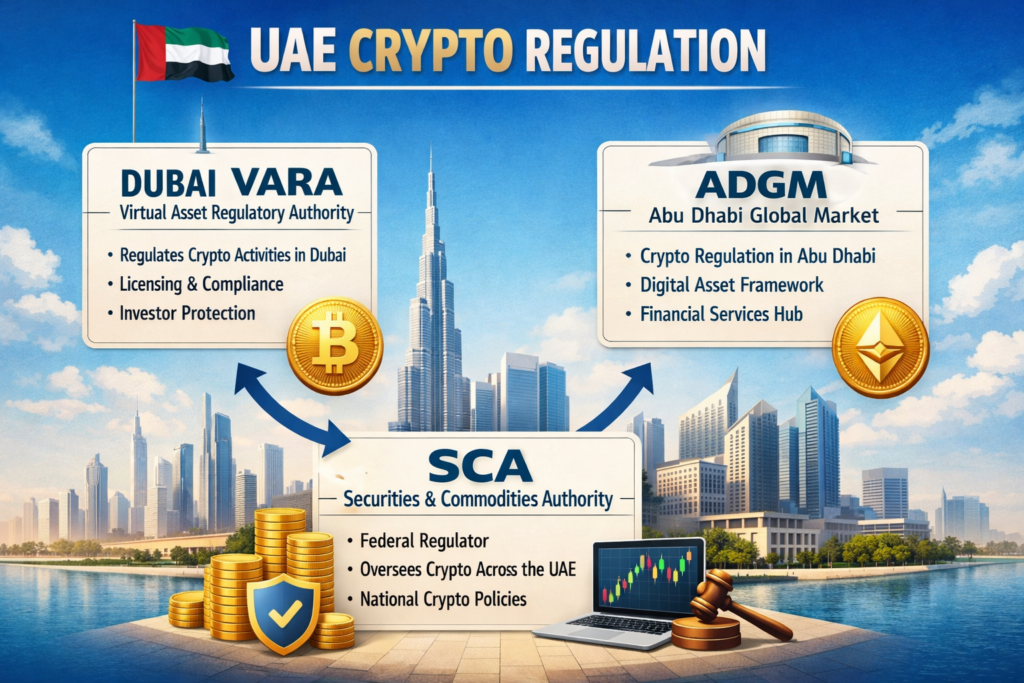
Overview of UAE Crypto Rules: Dubai vs Abu Dhabi
Dubai regulates virtual asset service providers through its dedicated VARA framework, established under Virtual Assets Law No. 4 of 2022 and detailed rulebooks for exchanges, brokers, custody and staking.Abu Dhabi uses the ADGM virtual assets framework, where FSRA grants Financial Services Permissions for exchanges, brokers and custodians operating from its financial free zone.
Key distinctions
Trading legality vs business licensing individuals across the UAE can generally hold and trade crypto; the focus is on licensing the businesses that serve them.
Tax there is currently no personal income tax on crypto for individuals in the UAE, but businesses can face 9% corporate tax, and foreign residents may still owe tax in their home countries.
Free zones DIFC, ADGM and emerging hubs like RAK DAO each have their own environments for digital-asset firms, layered on top of federal laws.
Why Choosing a Regulated Platform Matters in the Middle East
Using a regulated crypto trading app in the UAE means the platform is subject to capital requirements, governance rules, AML/KYC standards and, in some cases, custody and segregation mandates.If something goes wrong, you have at least a known regulator and dispute channels, rather than dealing with an anonymous offshore operator.
However, regulation does not guarantee profits or eliminate market risk. BTC can still drop sharply; stablecoins can de-peg; even regulated firms can fail. Think of VARA/ADGM oversight as similar to the way UK investors trust the FCA or German investors look to BaFin useful, but not a promise that every trade is safe.
Red Flags: How to Spot an Unlicensed or Risky Crypto App
Watch out for.
No listing on VARA, ADGM/FSRA or other recognised registers.
Huge “risk-free” bonuses or guaranteed monthly returns.
No KYC at all, or obviously fake “proof of address” workarounds.
No clear physical address, ownership or audited financials.
Aggressive pressure to deposit quickly via obscure payment methods.
Before funding, search the app name + “scam”, check official registers, and test a tiny deposit and withdrawal first. Treat it like you would a new bank or broker account in London, New York or Berlin.
Best Crypto Apps in the UAE (Dubai & Abu Dhabi) Compared
Several high-quality apps now serve UAE users, but “best” depends on whether you’re a beginner, low-fee spot trader, day trader or GCC cross-border user. Broadly, OKX, BitOasis, Binance, Rain, Crypto.com and Bybit cover most use cases, with newer institutional venues like GFO-X emerging on the ADGM side.
Comparison Table: Fees, AED Support, and Core Features
Use this simplified view as a starting point; always check each exchange’s latest fee schedule and product list:
| App | Primary Regulation (UAE/GCC) | AED Deposits/Withdrawals | Notes on Features & Positioning |
|---|---|---|---|
| OKX | VARA VASP (Dubai) | Bank transfer, cards; phased rollout | Low-fee spot & derivatives, English/Arabic app, good for active traders. |
| BitOasis | VARA VASP broker-dealer | Strong AED on/off-ramp | Regional brand, beginner-friendly UI, curated coin list. |
| Binance | ADGM FSRA global licence | AED pairs via partners | Deep liquidity, advanced order types, futures & options. |
| Rain | CBB & ADGM licences | AED/SAR/BHD via bank & cards | GCC focus, Sharia certificate, straightforward bitcoin wallet app. |
| Crypto.com | VARA VASP + derivatives licence | AED via cards, partners | Strong mobile experience, cards, staking, and growing UAE partnerships. |
| Bybit | UAE SCA + VARA provisional | USD/AED via cards, wires | Suited to pro derivatives traders and high-volume users. |
Best Crypto App UAE for Beginners and Long-Term Investors
For beginners who want to buy and hold BTC or ETH over years, the best crypto app in the UAE is usually.
Fully regulated (VARA or ADGM)
Supports AED deposits via bank transfer or local cards
Has a clean, simple interface with clear explanations of order types
Platforms like BitOasis, OKX’s beginner mode, Crypto.com and Rain often tick these boxes for UAE residents. Start with small recurring buys (for example, weekly DCA), learn simple limit and market orders, and focus on BTC/ETH before dabbling in high-risk altcoins or meme tokens.
For Dubai or Abu Dhabi residents thinking long term, pairing a regulated crypto trading app with an external hardware wallet for larger holdings can be a good balance between convenience and security.
Best Crypto Apps for Active Traders and High-Volume Users
If you’re closer to a professional trader or run quant strategies from London, New York or Frankfurt while living in the UAE, your priorities change:
Tight maker/taker fee tiers and rebates for providing liquidity
Deep derivatives markets (perps, options)
Robust API access and FIX/WebSocket support
High or negotiable deposit/withdrawal limits
Here, OKX, Binance and Bybit tend to dominate, with Rain and GFO-X appealing on the institutional Abu Dhabi side.Make sure you understand funding rates, liquidation mechanics and cross-margin risk before using leverage; many new UAE traders get liquidated simply because they treat 10x leverage like spot.
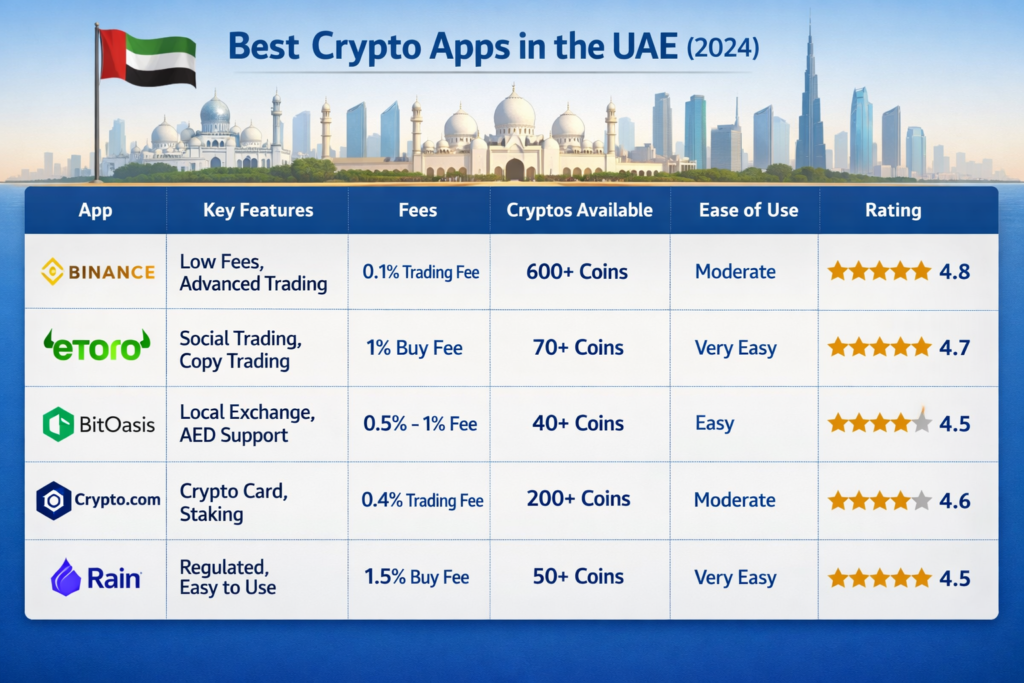
Best Crypto Apps for US, UK and EU Expats Using UAE Platforms
US, UK and EU expats living in Dubai or Abu Dhabi can usually fund UAE crypto apps using international cards or bank transfers, but fees, FX and home-country reporting rules still apply. It’s common for a “best crypto app for UK expats in Dubai” to be one that balances UK bank friendliness, UAE regulation and clean tax records.
Using a UAE Crypto App from a US, UK or EU Bank Account
You’ll typically see three routes:
Card deposits (Visa/Mastercard)
Fast and convenient, but often carry 1.5–3% fees and poorer FX rates.
SWIFT wires (USD/GBP/EUR)
Better for larger amounts, but expect 1–3 business days, intermediary bank fees and stricter bank monitoring.
SEPA transfers (for EUR)
For EU expats, sending EUR by SEPA to an exchange’s EU account can be cheaper, then converting to AED-linked stablecoins or USDT before moving onto a UAE platform.
Some US and UK banks may decline card payments to crypto exchanges or require pre-notification; this is similar to how banks treat other high-risk merchants. Always keep screenshots and statements, especially if your home tax authority asks how funds reached the UAE.
Cheapest Ways to Move USD/GBP/EUR into AED for Crypto
Cost-conscious expats often
Use fintech FX apps to convert USD/GBP/EUR into AED at tight spreads, then fund a UAE bank account and deposit to a local exchange.
Combine a SEPA EUR transfer with a euro-denominated crypto account, then send stablecoins (like USDT or USDC) into a UAE-regulated crypto trading app. Searches like “send EUR to UAE crypto exchange via SEPA” are usually about minimising FX plus network fees.
Compare P2P and OTC desks on regulated platforms for better FX on large tickets.
Always watch hidden FX margins: a “0% fee” card top-up can still cost more than a small flat fee plus a tight FX spread.
Tax & Reporting Basics for American, British and German Expats
Even if the UAE charges 0% personal tax on your crypto gains, US, UK and German tax rules may still apply if you remain tax-resident there.
US citizens may owe IRS capital gains regardless of where they live.
UK and German residents need to consider HMRC/BMF rules on disposal, holding periods and staking.
Many expats keep full transaction logs from their regulated crypto exchange and use specialist tax software or advisors.
This article is not tax advice; for anything beyond small test trades, speak with a qualified cross-border tax professional.
Saudi Arabia and Wider GCC: Which Crypto Apps Actually Work?
Crypto rules in Saudi Arabia and parts of the GCC are stricter than in the UAE, with banking controls and repeated warnings from the Ministry of Finance and Saudi Central Bank (SAMA). Yet many residents in Riyadh, Jeddah, Qatar and Kuwait still use a mix of foreign and UAE-based apps within a complex grey area.
Current Status of Crypto in Saudi Arabia
Saudi authorities have repeatedly warned that cryptocurrencies are not legal tender and that dealing in them is outside the regulatory framework, with banking restrictions applied to local institutions.Owning crypto privately is not usually prosecuted, but operating a local exchange or promoting unlicensed schemes can attract serious enforcement.
Distinguish between
Owning crypto in a private wallet or offshore account.
Running a local exchange or brokerage, which may conflict with current rules.
Using bank cards and transfers for crypto, where banks often block transactions outright.
Best Crypto Apps for Saudi, Qatar, Kuwait and Bahrain Users
Many GCC residents look to UAE-regulated platforms like Rain, OKX or Binance, plus Bahrain- or EU-based entities that accept GCC IDs. Options depend heavily on:
Whether SAR/QAR/KWD/BHD funding is supported directly or via USD stablecoins.
Language support (Arabic and English)
Local on-ramp partners (for example, remittance houses or fintechs).
For example, Bahraini users might lean towards Rain’s CBB-licensed platform, while some Saudi traders prefer using AED or USD stablecoins via UAE exchanges due to friendlier banking rails.
Why Some Apps Are Blocked by Banks and Workarounds Users Rely On
Banks across the GCC use merchant category codes (MCCs) and internal rules to automatically block card payments to crypto trading apps they view as high-risk or unlicensed. AML rules and FATF guidance pressure them to de-risk certain flows, especially from retail customers.
Common legal workarounds include.
Using regulated P2P desks on licensed exchanges.
Working with local OTC partners vetted by banks and regulators.
Moving funds via fully documented FX and remittance channels, not cash couriers or hawala.
If your bank says “no crypto”, don’t try to hide your activity you risk account closure.
Halal and Sharia-Compliant Crypto Apps in the Middle East
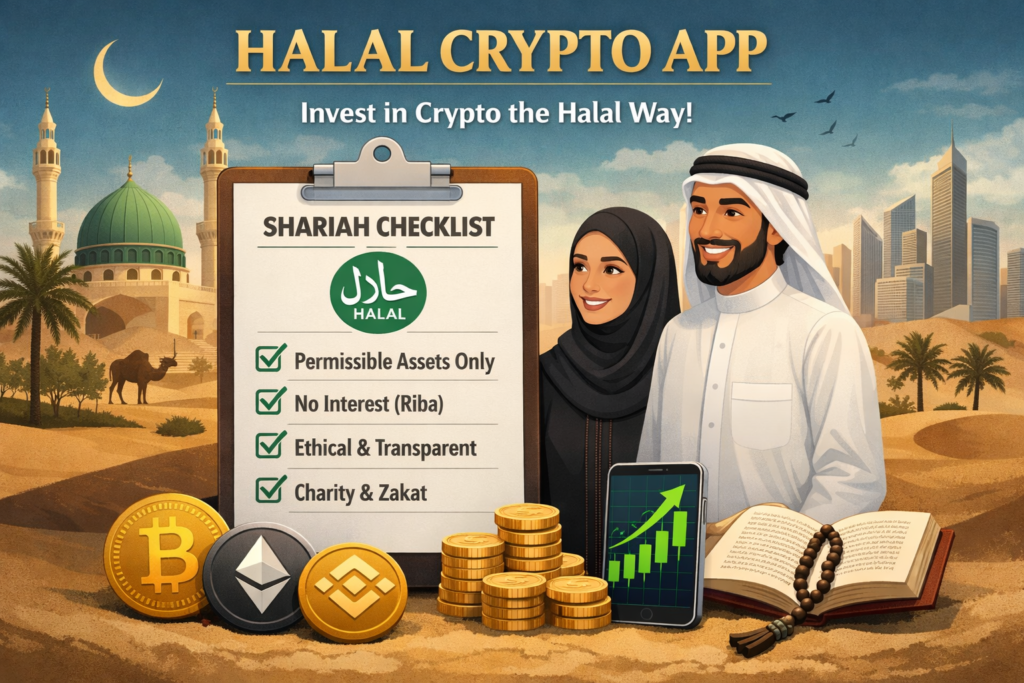
Scholars differ on whether trading crypto is halal, but many agree that spot ownership of major assets like BTC and ETH is more acceptable than interest-bearing lending or highly speculative gambling-style products. Users who want halal-aligned crypto investing should look for clear Sharia governance, screened products and avoidance of riba-like interest.
Is Crypto Trading Halal in the UAE and Saudi Arabia?
There is no single Islamic ruling on crypto.
Some scholars view established cryptocurrencies as a form of digital asset or maal, making spot trading potentially permissible with conditions.
Others worry about volatility, lack of intrinsic value and speculative behaviour, especially with meme coins and leveraged derivatives.
In practice, many halal-conscious investors in the UAE and Saudi Arabia differentiate between:
Spot buying/holding of widely used assets versus day-trading volatile micro-caps.
Leverage, futures and margin, which many scholars consider too close to gambling or riba.
Interest-bearing products (yield on idle balances, lending desks), which many avoid. (Mak it Solutions)
How to Check if a Crypto App Is Sharia-Compliant
Look for
A named Sharia advisory board or certification from recognised bodies, as with Rain’s Shariyah Review Bureau certificate. (Rain)
Clear documentation of screened asset lists, especially avoiding tokens linked to prohibited industries.
Explicit options to opt out of interest (no lending, no savings yield) and avoid margin products.
Transparent terms for staking and rewards some treat staking as transaction validation rather than lending, but you should read the fine print or get specialist advice.
Examples of Halal-Friendly Features and What to Avoid
Features many faith-aligned investors like.
Focus on major assets (BTC, ETH, high-quality stablecoins).
No interest-bearing accounts, or the ability to donate any yield.
No leveraged futures by default in the retail app.
Features to treat with caution or avoid
High-leverage futures, perpetual swaps and options if you’re not well-versed in Sharia opinions on derivatives.
Meme-coin gambling, “spin the wheel” bonuses, mystery boxes and loot-box NFTs.
Unclear tokens with no real-world utility and aggressive marketing.
For banks and wallets designing Sharia-compliant offerings, working with partners who understand both Islamic finance and cloud-native architectures like Mak It Solutions on projects across Saudi, UAE and Qatar can reduce missteps and time-to-market. (Mak it Solutions)
How to Choose the Best Crypto App in the UAE (Step-by-Step Checklist)
To narrow down to one or two apps, follow a simple checklist: confirm regulation, check security, compare costs, test funding, then start small.
Security, Regulation and Data Protection
Verify the licence
Check the app on VARA’s public register or ADGM/FSRA’s public register; if it’s not there, treat it as high-risk. (VARA)
Look for proof-of-reserves or independent audits – Many exchanges now publish attestations aligned with SOC 2-style controls.
Check data protection posture
For EU and German users used to GDPR standards and BaFin-regulated banks, see whether the app references GDPR-style privacy, PCI DSS certification and modern IAM controls similar to those used in critical apps like national healthcare portals.
Mak It Solutions often helps clients design these controls when building web, mobile and analytics platforms on AWS, Azure or Google Cloud the same principles apply to a crypto trading app. (Mak it Solutions)
Fees, Spreads and Hidden Costs to Compare Before You Sign Up
Even “0% commission” platforms still make money somewhere. Compare:
Maker/taker fees on spot and derivatives.
FX markup when converting USD/GBP/EUR into AED.
Card deposit fees vs bank transfers.
Blockchain network fees on withdrawals (especially for ERC-20 tokens).
A platform charging 0% trading fee but adding a 2.5% FX markup can be more expensive than a 0.1% fee exchange with tight FX spreads. Always run a test order with a small amount to see the real fill price.
Onboarding, KYC and Making Your First Deposit into a UAE Exchange
Your first steps will usually look like this:
Download the app and complete KYC – passport, Emirates ID/residency visa (if you have one), proof of address and a selfie.
Enable strong security – app-based 2FA, withdrawal address whitelists, and login alerts.
Make a small test deposit via AED bank transfer or card, then a small test withdrawal back to your bank.
Place your first tiny trade (even $20–50) in BTC or ETH to familiarise yourself with market vs limit orders.
Once you’re comfortable, you can scale up, but avoid over-trading especially if your main goal is long-term savings rather than day-trading.
Common Mistakes UAE & Expat Traders Make With Crypto Apps
New UAE and expat traders often make the same 3–5 mistakes: using unlicensed apps, over-leveraging, ignoring total fees and neglecting basic security. The good news is that each is easy to avoid with a bit of structure.
Security & Account Protection Errors
The most common security mistakes are basic: re-using passwords from email or social media, not enabling 2FA, or clicking phishing links. SIM-swap attacks are a real risk in every region, including Dubai and Abu Dhabi.
Where possible, use.
A password manager plus unique, strong passwords.
App-based 2FA (not SMS)
Withdrawal address whitelists and, for large balances, hardware security keys or cold wallets.
Financial Mistakes: Over-Trading, Leverage and Chasing Hype
Low-fee mobile crypto wallets make it tempting to trade constantly, especially when friends in London or Riyadh boast about overnight gains. Common pitfalls:
Opening big leveraged positions without understanding liquidation.
Chasing meme coins mentioned on X/Telegram.
Going “all-in” right before major macro events or local news.
Basic risk management position sizing, using only money you can afford to lose, and sticking to a simple plan matters more than finding the “perfect” crypto trading app.
Operational Friction: Funding, Withdrawals and Getting Stuck
Operational mistakes hurt just as much as bad trades.
Never testing withdrawals before sending in large amounts.
Ignoring daily/weekly limits and then needing urgent liquidity.
Not understanding that some US or UK banks may question or block transfers to certain offshore exchanges.
Best practice is simple: test funding both ways with tiny amounts first, read the app’s limits and fee pages carefully, and keep copies of key documents if a bank or regulator ever asks for source-of-funds evidence.
Key Takeaways
The UAE is now one of the world’s leading regulated crypto hubs, with clear frameworks in Dubai (VARA) and Abu Dhabi (ADGM/FSRA)
There is no single “best crypto app UAE” OKX, BitOasis, Binance, Rain, Crypto.com and Bybit each serve different niches (beginners, low fees, pro trading, halal focus, GCC users)
US, UK and EU expats should optimise for safe funding routes (SEPA/SWIFT + local AED rails), transparent fees and clean tax reporting at home.
Saudi and wider GCC users face stricter banking rules and should be especially careful to stick to legal, well-documented channels.
Halal-aligned investing is possible but requires extra diligence on Sharia governance, asset screening and avoidance of leverage/interest.
Long-term success depends less on which app you pick and more on basic security, risk management and only investing what you can afford to lose.
If you’re planning a regulated crypto trading app, wallet or analytics platform for users in Dubai, Abu Dhabi or the wider GCC, you don’t have to navigate regulation, cloud and mobile UX alone. The team at Mak It Solutions already helps banks, fintechs and SaaS providers design secure, compliant architectures across KSA, UAE and Europe including what “best crypto app UAE” really means for your target customers.
Reach out to discuss your roadmap from data residency and GDPR-style controls to mobile app development and BI dashboards and get a scoped plan for your next crypto or digital-asset product.( Click Here’s )
FAQs
Q : Can I use my US or UK bank card on a UAE crypto app, and what fees should I expect?
A : Yes, most major UAE crypto apps accept US and UK-issued Visa/Mastercard cards, but banks increasingly monitor and sometimes block crypto-coded payments. Expect card processing and FX fees in the 1.5–3% range plus any spread the exchange adds on top of mid-market rates. Some expats find it cheaper to use SWIFT or SEPA transfers into AED or USD and then fund via bank transfer instead of cards.
Q : Do I need a UAE residency visa or Emirates ID to open an account with a UAE crypto exchange?
A : Many exchanges let non-resident foreigners open accounts using passports and foreign proof of address, although having a UAE residency visa and Emirates ID often unlocks higher limits and AED on-ramp options. Check each platform’s KYC requirements; some ADGM or VARA-licensed broker-dealers are more flexible for GCC or European users, while others focus on fully on-shore UAE residents.
Q : Which UAE crypto apps support instant AED deposits and withdrawals to local bank accounts?
A : BitOasis, OKX’s UAE entity, Rain’s ADGM unit and certain banks’ own crypto-adjacent platforms all focus on AED rails, often via instant or near-instant local transfers. Precise processing times depend on your bank, cut-off times and risk checks, so always test a small AED deposit and withdrawal first. As the ecosystem matures, more UAE-regulated apps are adding direct AED support rather than forcing users through USD stablecoins.
Q : How do crypto taxes work if I trade on a UAE app but I’m still tax-resident in the US, UK or Germany?
A : The UAE currently has no personal income or capital gains tax on crypto trading for individuals, but that does not override your home-country rules. If you remain tax-resident in the US, UK or Germany, you may still need to declare disposals, staking income or airdrops to the IRS, HMRC or your local Finanzamt. The safest approach is to keep complete transaction records from your UAE crypto apps and work with a cross-border tax specialist.
Q : What is the safest way to store coins bought on a UAE crypto app leave them on the exchange or move to a wallet?
A : For small, active trading balances, keeping funds on a well-regulated exchange with strong security controls can be practical. For long-term holdings, many users prefer moving a portion to a self-custodial hardware wallet, accepting the responsibility of safely backing up recovery phrases. A balanced approach is common: keep day-to-day trading funds on your chosen regulated crypto app, and store longer-term holdings offline in a hardware wallet you fully control.