
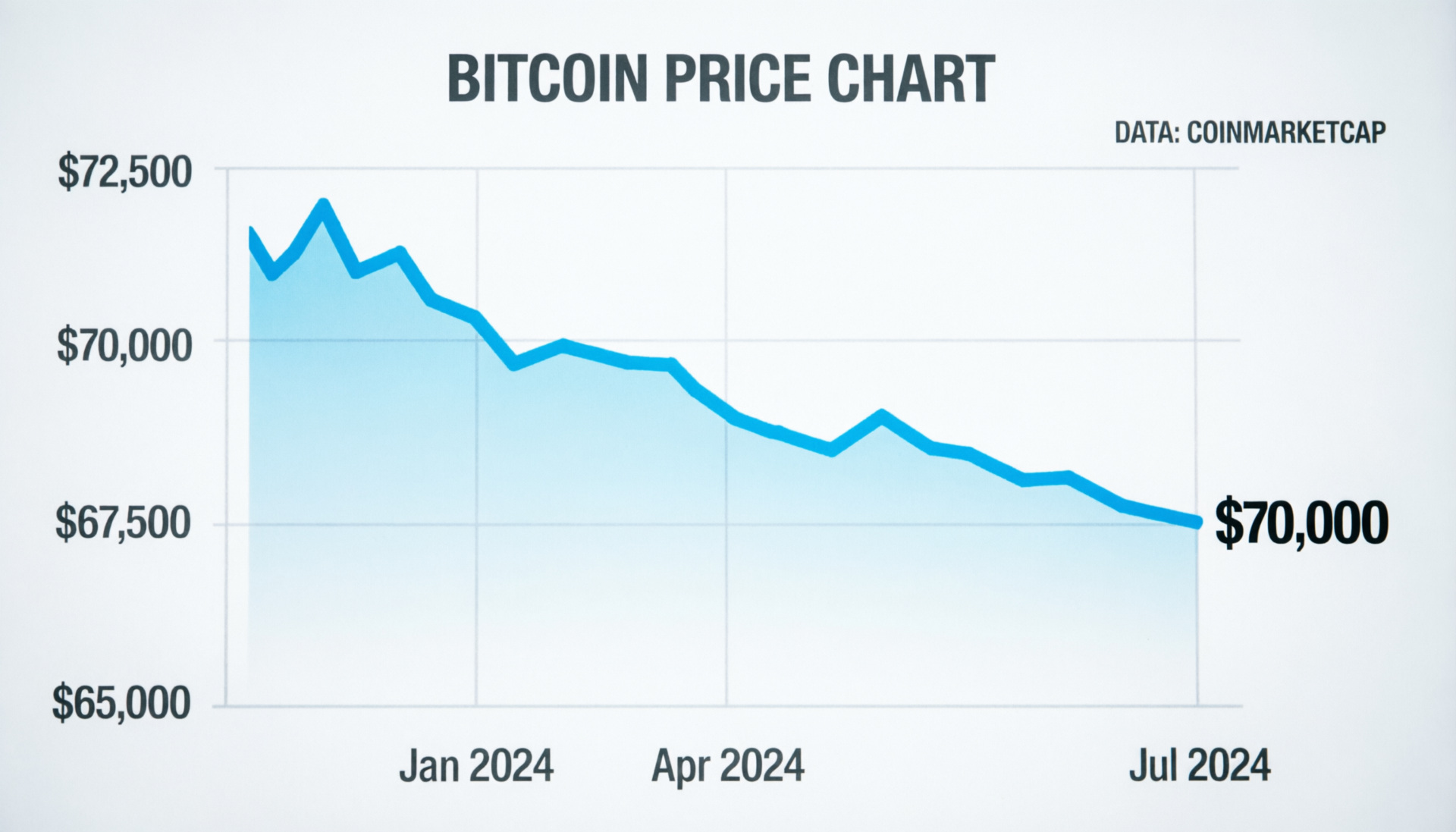

Bitcoin falls below $70,000 as oil spikes and Fed holds rates
Bitcoin slips to $70,000 as investors digest a fast-moving mix of geopolitical and monetary pressure. The largest cryptocurrency fell below the key price level Thursday after oil and gas prices surged on fresh attacks involving Gulf energy infrastructure and after the Federal Reserve left U.S. interest rates unchanged, reinforcing a broader retreat from risk assets.
Bitcoin slips to $70,000 amid a broader macro selloff
Bitcoin traded below $70,000 on March 19, 2026, while ether also moved lower, extending weakness across digital assets. CoinDesk reported bitcoin down 1.6% since midnight UTC and ether down 1.7% to about $2,160 in early Thursday trading. Barron’s separately reported bitcoin around $69,782, down 5.5% on the day, underscoring how quickly prices were moving as macro sentiment deteriorated.
The decline in crypto mirrored pressure across other risk-sensitive markets. AP reported world shares retreated and U.S. futures edged lower as higher energy prices, rising yields, and a firmer macro backdrop weighed on sentiment. That matters for crypto because bitcoin and ether have recently traded more like high-beta risk assets than safe havens during sharp macro shocks.
Why Bitcoin slips to $70,000 when oil jumps and the Fed pauses
The immediate catalyst was a sharp rise in energy prices tied to escalating conflict in the Middle East. Reuters reported Brent crude jumped above $119 intraday before trading near $114.77, while AP said European benchmark natural gas prices rose about 24% and reached their highest level in more than three years. Higher energy prices can revive inflation fears, tighten financial conditions, and reduce appetite for speculative assets such as cryptocurrencies.
At the same time, the Fed held the federal funds target range at 3.50% to 3.75%. In its statement, the central bank said “uncertainty about the economic outlook remains elevated” and noted that the implications of Middle East developments for the U.S. economy are uncertain. A steady Fed in the face of an energy shock can be read as less supportive for risk assets, especially if traders think rate cuts may be delayed.

Energy markets, inflation fears, and crypto positioning
Oil’s rally was not just a commodity story. Reuters said the market reaction followed Iranian attacks on energy facilities across the Middle East after Israel struck Iran’s South Pars gas field. AP added that the attack on Qatar’s Ras Laffan LNG facility intensified fears of longer-lasting supply disruption, with potential inflation consequences for the global economy. That backdrop makes traders more cautious about owning volatile assets.
The crypto market’s own structure may have amplified the move. The raw report cites roughly $600 mn in liquidations, falling open interest, negative funding rates, and weaker altcoin liquidity. CoinGlass does provide market-wide derivatives and liquidation data, and its 2025 annual report confirms a separate $19 bn liquidation event in October 2025, but the specific March 19 figures in the raw copy were not independently confirmable from primary pages available during verification. Those figures should therefore be treated as provisional unless matched to live terminal data or exchange disclosures.
Bitcoin slips to $70,000 as altcoins underperform
The raw copy says several altcoins fell more sharply than bitcoin, with thin liquidity contributing to deeper losses, while a few tokens such as NEO and ETHFI outperformed. That pattern is broadly consistent with risk-off trading, where capital tends to leave thinner markets first. Still, the named token moves and the index-level declines for CD20, DFX, and CDMEME were not independently verified from primary issuer or exchange data in this review, so they should remain attributed to the source report unless separately confirmed.
Context and Analysis
The bigger story is that crypto is trading inside a wider macro regime, not outside it. When oil spikes, inflation expectations can firm, bond yields can stay elevated, and central banks can look less likely to ease. In that environment, bitcoin may still outperform some assets over longer periods, but intraday moves often resemble the behavior of tech stocks and other risk trades.
There is also a second-order effect: volatility itself becomes an asset class. The raw copy points to rising implied volatility and stronger demand for downside protection in options markets. While those specific derivatives readings were not independently confirmed line by line here, the direction aligns with the broader market response to the combined oil shock and Fed pause.

Concluding Remarks
Bitcoin’s slide below $70,000 reflects more than a crypto-specific pullback. It sits at the intersection of an oil shock, renewed inflation worries, and a Federal Reserve that chose not to add fresh support for risk assets. The next phase for crypto will likely depend on whether energy prices stabilize, whether broader markets recover, and whether incoming Fed communication changes expectations for rate cuts.
FAQs
Q : Why did bitcoin fall below $70,000?
A : Bitcoin fell as oil and gas prices surged, the Fed kept rates unchanged, and risk appetite weakened across global markets.
Q : Is Bitcoin slips to $70,000 mainly a Fed story or an oil story?
A : It is both. The oil shock raised inflation concerns, while the Fed’s pause reinforced the view that financial conditions may stay tight for longer.
Q : How did ether perform compared with bitcoin?
A : The source report said ether also declined, dropping about 1.7% to roughly $2,160 in early Thursday trading.
Q : Why do rising oil prices matter for crypto?
A : Higher oil prices can lift inflation expectations and reduce the chance of near-term monetary easing, which tends to weigh on speculative assets such as cryptocurrencies.
Q : Were altcoins hit harder than bitcoin?
A : The source report said many altcoins underperformed because of thinner liquidity, though a small number posted gains. Some token-specific moves still need independent confirmation before publication.
Q : What should traders watch next?
A : Traders will be watching oil and gas prices, further developments in the Middle East, and whether Fed messaging shifts expectations for future rate cuts.
Facts
Event
Bitcoin fell below $70,000 as oil and gas prices surged and the Federal Reserve held rates steady.Date/Time
2026-03-19T16:15:17+05:00 (last verified timestamp used for this review).Entities
Bitcoin (BTC); Ether (ETH); Federal Reserve; Federal Open Market Committee (FOMC); Brent crude; QatarEnergy; Ras Laffan; South Pars gas field.Figures
Brent high $119.13; Brent at $114.77 by 1026 GMT; European gas roughly +24%; Fed target range 3.50%–3.75%.Quotes
“Uncertainty about the economic outlook remains elevated.” — FOMC statement. “We just don’t know.” Jerome Powell on oil and tariffs, via AP.Sources
Federal Reserve statement; Reuters energy report; AP market report; CoinDesk market report.