
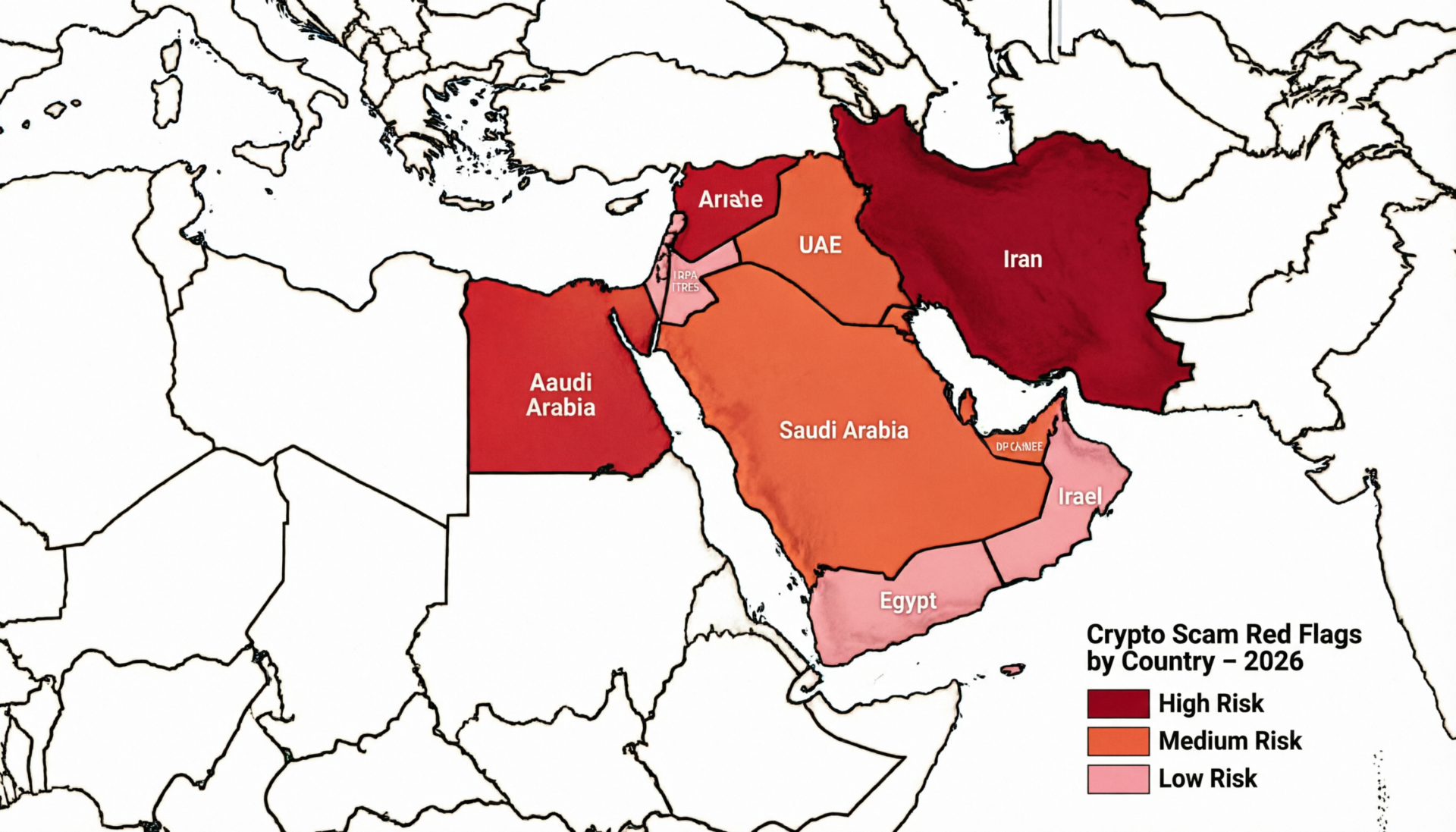

Crypto Scams in Middle East: UAE Risk Guide
Crypto scams in Middle East markets usually follow a familiar pattern: fake exchanges, WhatsApp or Telegram “investment” groups, wallet-drain setups, and firms that borrow regulator language to look legitimate. The safest move is simple but often skipped: verify the legal entity, check the licence on the correct regulator register, and test withdrawal terms before sending any meaningful funds.
That matters because the biggest risk is rarely “Middle East crypto” in general. It is poor due diligence. A Dubai address, a polished dashboard, or a sales rep quoting AML/CFT and SOC 2 does not make a platform safe on its own. For readers in the US, UK, and Europe evaluating UAE- or Saudi-facing offers, the difference between a real platform and a costly mistake often comes down to whether the entity, jurisdiction, and withdrawal process can actually be verified.
What crypto scams in Middle East markets usually look like
Most crypto scams in the Middle East do not begin with sophisticated hacking. They begin with trust.
A smooth website. A “VIP analyst” on Telegram. A private WhatsApp group showing fake wins. A platform that looks international enough to feel credible, especially when it mentions Dubai, Abu Dhabi, Riyadh, or a regulator name the average investor does not fully recognize.
The most common formats include.
Fake exchanges and cloned trading apps
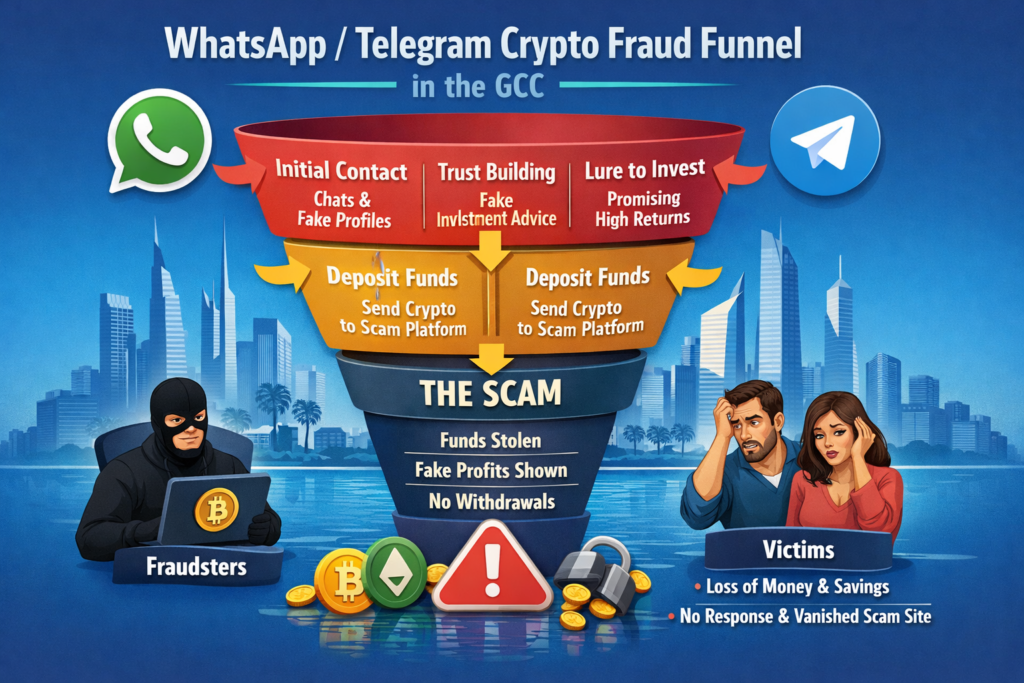
WhatsApp and Telegram investment groups
Pig butchering scams built around long conversations
Wallet-drain schemes hidden behind approval requests
Regulator impersonation and fake compliance claims
Recovery scams that target victims after the first loss
Across the UAE, Saudi Arabia, and the wider GCC, the pattern is often the same. You are shown small paper profits, encouraged to “top up,” and blocked when you try to withdraw. Then come the extra fees: tax fees, release fees, compliance unlock fees, or account-verification charges. None of that proves a real investment ever existed.
Why Dubai and the UAE appear so often in crypto scam pitches
Dubai has become a visible crypto hub, and scammers know that. To an investor sitting in New York, London, Manchester, Berlin, or Munich, “Dubai-based” can sound safer than “offshore,” even when the seller cannot prove who is behind the platform.
That is exactly why Dubai branding is used so heavily in cross-border sales funnels. The city carries real business credibility, but scammers borrow that credibility without earning it.
The key point is this: a Dubai office, UAE trade licence, or premium address does not automatically mean a platform is licensed to provide virtual asset services.
UAE and Dubai scam risk: where investors get caught
A polished site is not proof. A Dubai address is not proof. Even a licence number is not proof unless it matches the exact legal entity and activity on the correct official register.
That is where many investors slip. They verify the brand name, not the legal entity. They check that a company exists somewhere, but not whether it is authorized for the activity being promoted.
Fake exchanges, dashboards, and recovery firms
Many fake crypto exchanges now look more like fintech SaaS products than obvious scams. The design is clean. The onboarding is smooth. There is an “account manager,” a dashboard, and a portal that seems built for serious investors.
The warning signs show up later
Withdrawals are delayed or denied
Support exists only on Telegram or WhatsApp
New deposits are required before funds can be released
You are asked to pay “tax” or “unlock” fees in crypto
The company becomes vague when asked for its exact legal entity
Recovery firms are another major trap. After an initial scam, victims are often contacted by someone claiming they can trace funds, pressure exchanges, or “unlock” frozen assets. Some may sound legal or technical. Many are just a second scam aimed at people who are already vulnerable.
DFSA, VARA, and ADGM FSRA.
This is one of the easiest areas for scammers to exploit because many investors outside the region do not know which regulator covers which location.
In simple terms
VARA covers virtual asset activities in or from Dubai outside DIFC
DFSA regulates financial services in the DIFC and has its own crypto token regime
ADGM FSRA oversees digital-asset regulation inside Abu Dhabi Global Market
If a firm mentions Dubai, Abu Dhabi, or DIFC but cannot clearly explain which regulator applies to its exact activity and location, treat that as a serious red flag.
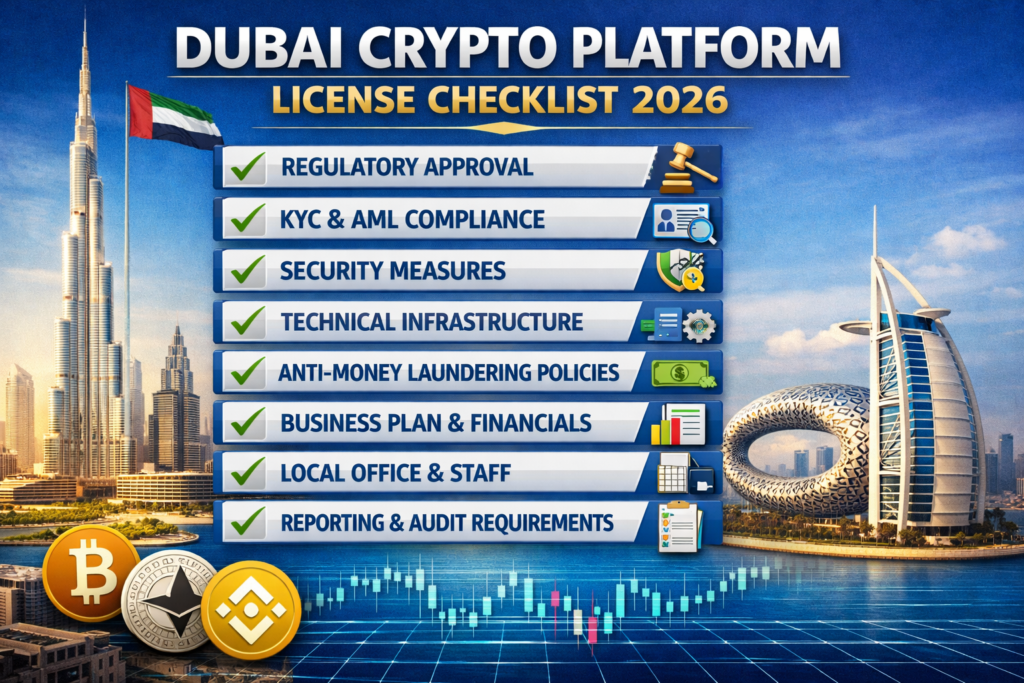
The first checks UAE readers should make
Before sending money, start here.
Check the licence on the correct regulator register.
Match the exact legal entity name, not just the brand.
Read the withdrawal terms and fee language.
Check whether support exists outside private chat apps.
Review whether the domain looks recently created or inconsistent.
Compare the legal entity across the website, privacy policy, and terms.
Test a small withdrawal before making a meaningful deposit.
That same verification mindset matters in other digital-trust decisions too. Businesses evaluating fintech or platform risk often use the same governance approach they apply to cloud, app, or DevSecOps environments, which is why structured validation matters more than surface-level polish.
Saudi Arabia and GCC crypto fraud risks
Saudi-related crypto scam pitches often rely on localization. The ad may be in Arabic. The salesperson may reference Riyadh or Jeddah. The app may look tailored for GCC users. But the legal structure behind the offer is often offshore, vague, or deliberately layered.
That matters because branding is not authorization.
In Saudi-facing promotions, urgency is a common tactic: limited access, insider timing, VIP entry, private groups, or “approved” opportunities that supposedly should not be discussed publicly. That combination of authority and exclusivity is exactly what makes these scams persuasive.
Across Bahrain, Qatar, Kuwait, Oman, and Egypt-focused campaigns, the broader pattern is similar. Public ads pull people into private chats. Private chats lead to fake apps or dashboards. The fake platform shows profits. The withdrawal problem appears only after trust and deposits have grown.
How to spot a fake crypto platform before you send money
A real due-diligence process does not have to be complicated. It just has to be disciplined.
A 7-point verification checklist for US, UK, and EU readers
Use this before funding any Middle East crypto platform.
Verify the licence on the correct official register
Match the legal entity name exactly
Confirm the jurisdiction and regulated activity
Read withdrawal terms carefully
Check whether support exists beyond Telegram or WhatsApp
Review domain history and consistency across company documents
Test the withdrawal process with a very small amount first
If one of those checks breaks down, stop.
That is especially important for overseas readers. A cross-border investor can be impressed by international branding and still have no clear recourse if the operator turns out to be unauthorized or based behind layered entities.
Why WhatsApp, Telegram, and social platforms are so effective for scammers
These channels help scammers do three things well: build trust quickly, isolate the victim from public scrutiny, and keep the conversation active.
They can switch between text, screenshots, voice notes, and emotional pressure. They can present mentorship, romance, insider access, or a “VIP” investing story. And because the relationship feels personal, warning signs get rationalized away.
That is why so many crypto scams now look less like ads and more like guided relationships.
Red flags in “Dubai crypto opportunity” and “Saudi trading” pitches
Watch for these warning signs.
Guaranteed or unusually consistent returns
Pressure to deposit quickly
Regulator logos without verifiable licence details
A brand name that does not match the legal entity
Support only through private messaging apps
A claim that withdrawals require extra taxes or unlock fees
Vague answers about where client assets are held
Celebrity references or “exclusive access” language
Recovery promises after a loss
For UK and EU readers, these pitches are often designed to sound globally polished: Dubai prestige, Saudi growth story, compliance language, and just enough financial jargon to feel legitimate.
What victims should do after a crypto scam linked to the Middle East
If you think you have been scammed, act fast and preserve evidence immediately.
Save.
Wallet addresses
Transaction hashes
Screenshots of balances and withdrawal errors
Chat logs and usernames
Emails and deposit instructions
Invoices, receipts, and bank references
Copies of any KYC documents you submitted
The platform URL and any linked domains
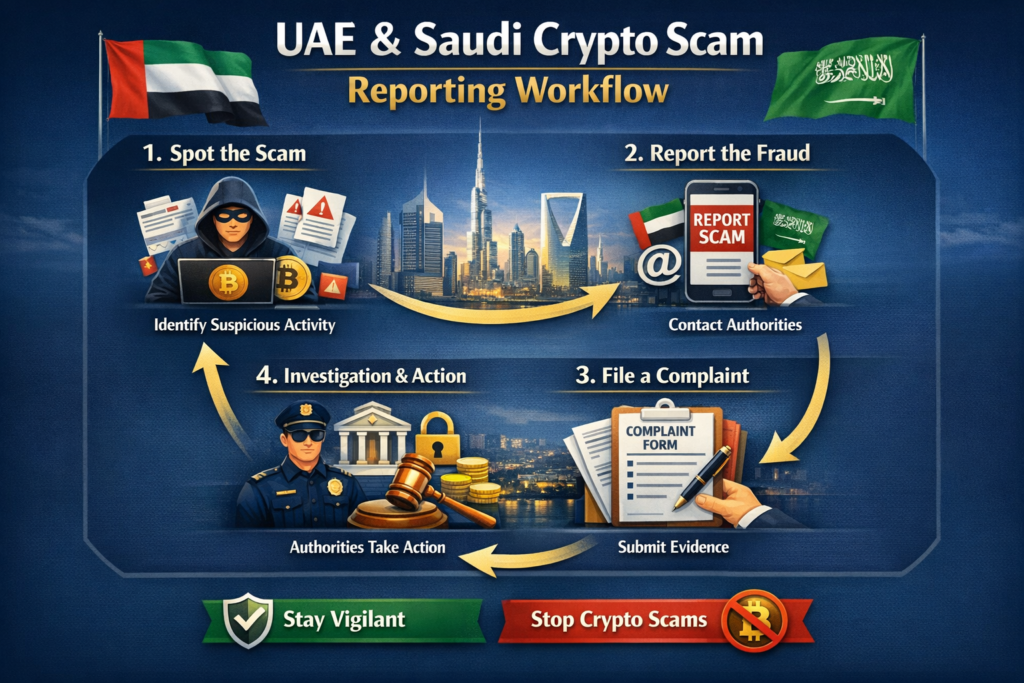
Then report the case through the relevant channels. That usually means the local regulator tied to the pitch, your home-country reporting route, your bank, and any exchange that touched the transfer path.
How to report a UAE-linked or Saudi-linked crypto scam
If the pitch referenced Dubai, Abu Dhabi, DIFC, or ADGM, start by identifying the correct regulator for the claimed jurisdiction. Then file reports in your home country too.
For practical purposes.
US readers: use the FTC and IC3
UK readers: use Action Fraud and review the FCA Warning List
Germany and EU readers: document everything for BaFin, local police, and relevant consumer-reporting channels
The faster you preserve the payment trail, the better your chance of helping an exchange, regulator, or investigator understand what happened.
Can funds be recovered?
Sometimes, but expectations need to stay realistic.
Recovery is more likely when funds move through a cooperative exchange quickly enough for tracing and intervention to matter. In many cases, though, recovery is partial or impossible. That is why victims should be extremely cautious with anyone promising guaranteed recovery, insider exchange contacts, or regulator access in exchange for upfront payment.
This is not financial or legal advice. It is a practical fraud-prevention framework, and serious cases should be reviewed with the appropriate authorities or qualified counsel.
Regulation, licensing, and compliance signals that matter in 2026
For readers in the US, UK, and EU, trust checks now sit at the intersection of regulation, disclosures, and data handling.
MiCA has made authorization and transparency more important for EU-facing firms. BaFin and the FCA continue to matter for warning signs and unauthorized activity. GDPR, DSGVO, and UK-GDPR also matter when a platform asks for passports, IDs, proof of address, or biometric KYC.
But there is an important distinction many readers miss: compliance language is not the same as permission to operate.
Trust signals versus proof of legitimacy
Some firms lean heavily on terms like
AML/CFT
PCI DSS
SOC 2
enterprise-grade security
institutional custody
audited workflows
Those may be useful trust signals in the right context. They are not proof of licensing.
A serious platform should be able to show
The exact legal entity
The exact regulated activity
The exact jurisdiction
A verifiable register entry
Clear withdrawal rules
A credible dispute or complaints path
That is the difference between operational language and legal legitimacy.
A safer due-diligence framework for investors and expats
Whether you are a retail investor, an expat in Dubai, or a Europe-based buyer evaluating a GCC-facing offer, the practical rule is the same: trust verification over marketing.
Before sending funds, ask.
Who is the exact legal entity?
Which regulator covers this activity?
Can I verify the licence independently?
What are the withdrawal rules?
Where are client assets held?
What happens if there is a dispute?
Can support be reached outside private chat apps?
Those are not awkward questions. They are basic protection.
For cross-border users, that discipline matters even more. A company can market in English, use Arabic support, mention Dubai, quote EU-friendly language, and still leave you with no meaningful protection if the core entity is unauthorized.
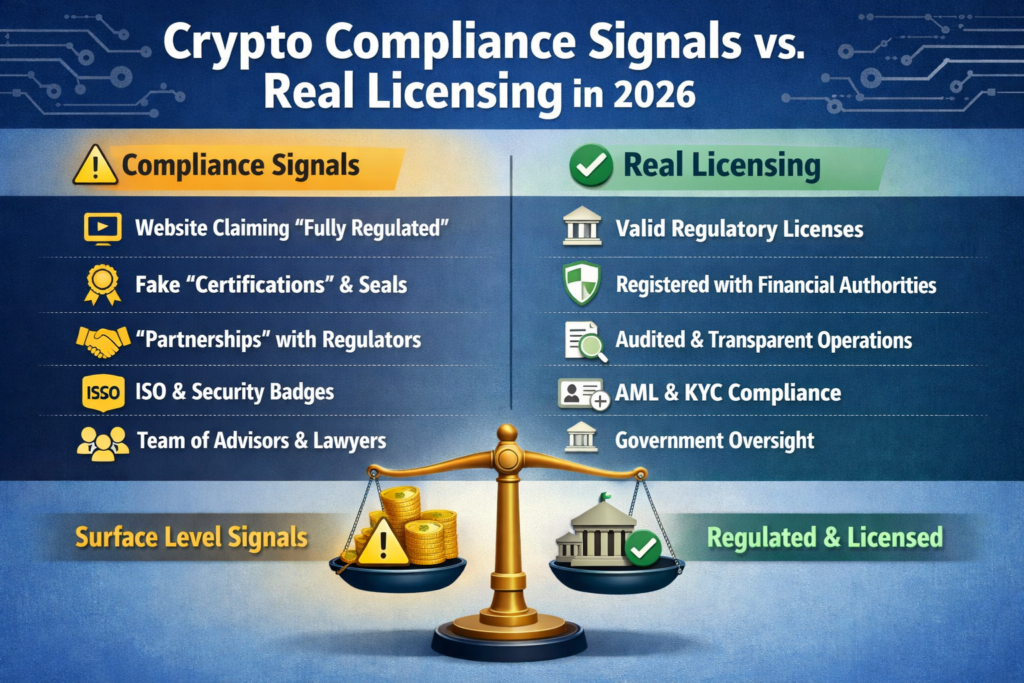
Final takeaway: trust verification over marketing
The best defense against crypto scams in Middle East markets is not hype, speed, or social proof. It is slow, boring, repeatable verification.
In 2026, the safer investor is the one who checks the register, matches the legal entity, tests the withdrawal path, and ignores the story until the facts hold up. That is true whether the pitch comes from Dubai, Riyadh, Abu Dhabi, or a Telegram group pretending to be all three at once.( Click Here’s )
Key takeaways
Most crypto scams in the Middle East begin with social engineering, not advanced hacking.
Dubai branding or a UAE office address does not prove a platform is licensed.
DFSA, VARA, and ADGM FSRA cover different jurisdictions, so the correct register matters.
Saudi and GCC-related scams often rely on unapproved promotions, fake apps, and private chat funnels.
AML/CFT, PCI DSS, and SOC 2 can support trust, but none replaces licensing verification.
Victims should preserve wallet data, chats, URLs, receipts, and hashes before reporting.
FAQs
Q : How can I tell whether a Dubai crypto company is licensed or just using a virtual office?
A : Start with the exact legal entity name, not the brand name. Then check whether that entity appears on the correct register for the claimed jurisdiction: VARA for Dubai outside DIFC, DFSA for DIFC, or ADGM FSRA for Abu Dhabi Global Market. A serviced office, coworking address, or UAE trade licence does not automatically mean the company is licensed to provide virtual asset services.
Q : Are crypto recovery services after a UAE scam legitimate or just another fraud risk?
A : A few tracing or legal-advisory services may be genuine, but the category is heavily abused. Many recovery operators simply target victims a second time by promising guaranteed results, insider contacts, or regulator access in exchange for upfront crypto payments. Treat guarantees as a red flag.
Q : What should I save before reporting a crypto scam?
A : Save everything that helps reconstruct the pitch and payment trail: wallet addresses, transaction hashes, screenshots, chat logs, profile names, emails, invoices, deposit instructions, withdrawal-error messages, and any KYC documents you submitted. Fast documentation can make reporting more useful.
Q : Do EU consumer protections still matter if a platform targets Germany from outside the EU?
A : Sometimes, yes, but cross-border recovery gets harder when the operator sits outside the EU or hides behind layered entities. For German and wider EU readers, MiCA-era checks make authorization, disclosures, and entity transparency more important before investing, not after.
Q : Why do so many Middle East crypto scams use mentorship, romance, or VIP trading-group stories?
A : Because those stories create trust faster than generic ads. Once the victim feels guided, included, or emotionally connected, they are more likely to ignore warning signs and keep depositing. Private chat apps make that process easier and harder to challenge publicly.