
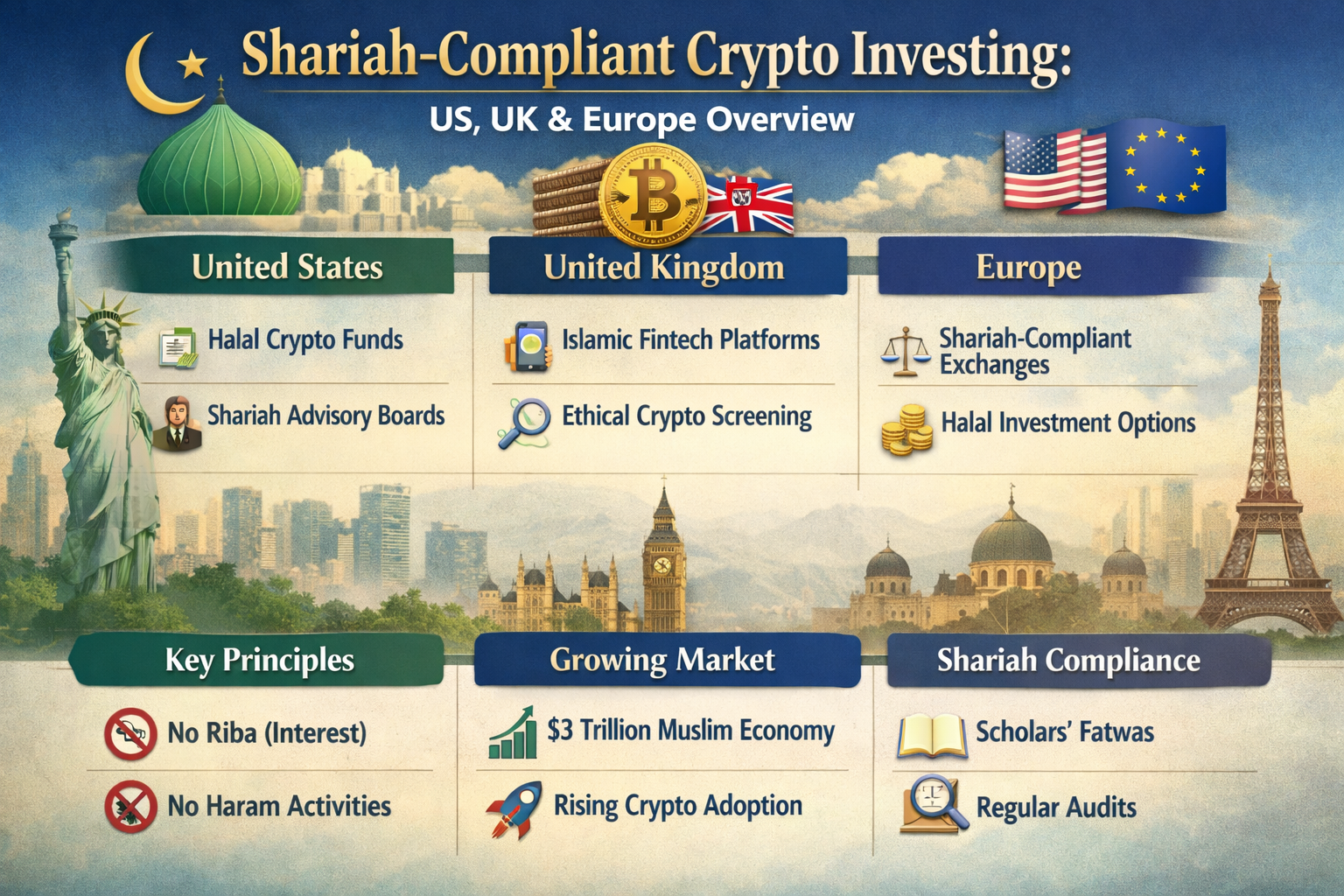

Shariah-Compliant Crypto Investing: Halal Income Guide
Shariah-compliant crypto investing means buying, holding and using digital assets in a way that avoids riba (interest), excessive gharar (uncertainty) and maysir (gambling), while respecting Islamic rules on ownership, exchange and ethical income. For Muslims in the US, UK, Germany and wider Europe, that usually translates into spot-only trading, avoiding interest-based or highly speculative products, and following qualified scholars on what counts as halal income and what needs to be purified or avoided.
Introduction
Picture a Muslim data analyst in London, a doctor in New York or an engineer in Berlin watching Bitcoin hit the headlines again. Global crypto market cap is now estimated at around the $2.5 trillion mark in early 2026, showing that digital assets are firmly mainstream.
They want diversification and protection from inflation but they also want to sleep at night knowing their portfolio is halal. At the same time, tax authorities like the IRS and HMRC treat crypto as taxable property, and regulators such as BaFin, the Securities and Exchange Commission (SEC) and the Financial Conduct Authority (FCA) are tightening rules on crypto platforms.
This guide gives Muslim investors in the United States, United Kingdom, Germany and wider European Union a practical roadmap for Shariah-compliant crypto investing focused on education, not fatwa-giving or financial advice. We reference bodies like the International Islamic Fiqh Academy, platforms such as Islamic Finance Guru and IslamQA, and mainstream regulators so you can discuss details confidently with your own scholar and tax advisor.
What Is Shariah-Compliant Crypto Investing?
Shariah-compliant crypto investing means using digital assets in ways that avoid riba (interest), excessive gharar (uncertainty) and maysir (gambling), while ensuring lawful ownership and real economic value. In practice, that typically means spot-only transactions, no interest-bearing products, no haram sectors and a focus on assets with a clear use case or benefit.
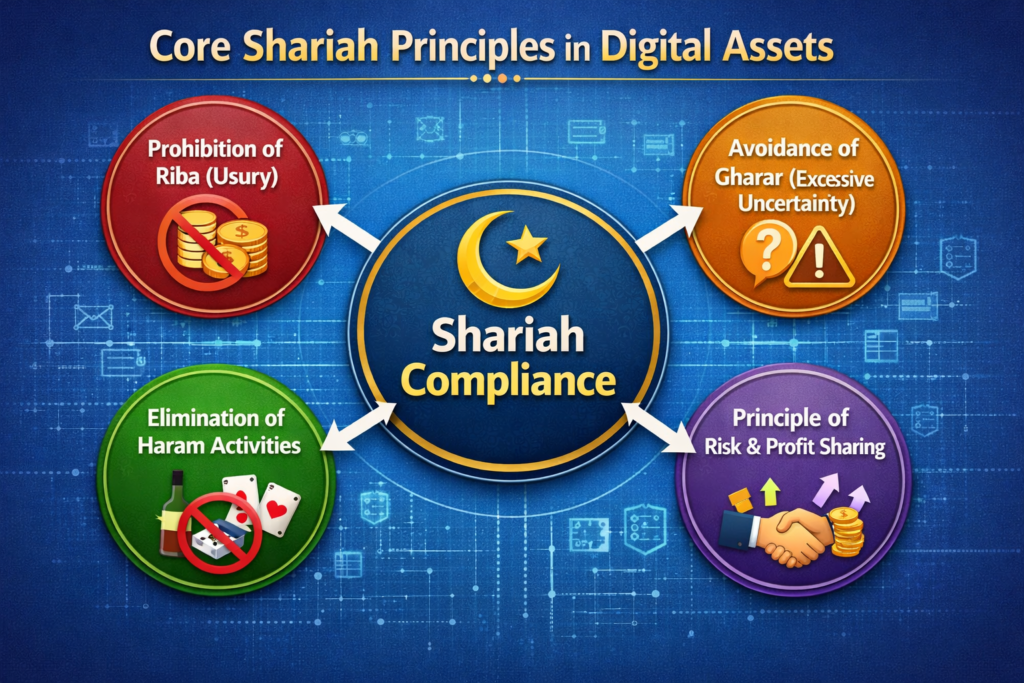
Core Shariah Principles Applied to Digital Assets
Classically, riba refers to interest or unjust increase in loans or ribawi exchanges; gharar to serious ambiguity or uncertainty in a contract; and maysir to gambling or zero-sum speculation. For an asset to be halal, you also need lawful ownership (you actually control it) and some form of real economic value or benefit.
Here’s how this maps to common crypto types.
Bitcoin and similar payment tokens
Some scholars treat them as a form of “digital money” or property; others see them as excessively speculative.
Stablecoins
May be closer to IOUs or e-money; their Shariah status depends on reserve structure, contracts and whether there’s hidden interest.
Utility tokens
Often linked to access to a service or protocol; the question is whether that service is halal and truly functional.
Security tokens
Resemble shares or sukuk; Shariah compliance depends on the underlying business and capital structure.
NFTs
Depend on what’s being tokenised (e.g. art, in-game assets, real estate rights) and whether the contracts avoid gharar and maysir.
Because these structures are new, major institutions like the International Islamic Fiqh Academy have explicitly said that some aspects of cryptocurrencies still require deeper study before universal rulings can be finalised.
How Shariah-Compliant Crypto Investing Differs from Normal Trading
Most “normal” crypto trading on big exchanges assumes you’re fine with leverage, futures, perpetual swaps, margin interest and meme-coin lotteries. Shariah-compliant crypto investing, by contrast, restricts you to real ownership, spot trading (no leverage), no interest and more conservative strategies focused on long-term benefit rather than short-term gambling.
In very simple terms
Commonly not allowed (according to many scholars and fatwa platforms)
Margin or leveraged trading that involves borrowing with interest
Futures, perpetual swaps and most high-risk derivatives
Interest-bearing lending, “earn” programs or yield products based on riba
Pure speculation on meme coins with no real project or utility
Potentially allowed (subject to scholar view)
Spot buying and selling of screened cryptocurrencies
Holding coins as long-term investments
Some validator / fee-sharing rewards with clear real-world work
Asset-backed tokens (e.g. gold or sukuk-style RWAs) with proper Shariah structures
Global Context: Muslim Investors in the US, UK, Germany & Europe
By 2020 there were already around 45–50 million Muslims in Europe (about 6% of the population) and millions more across North America, and those numbers have grown further since.
Many Muslim professionals in New York, Chicago or Dallas want inflation protection and diversification; in London, Birmingham and Manchester, remittances and cross-border payments are also strong use-cases; in Frankfurt, Hamburg or Cologne, investors are watching MiCA and KT Bank AG as signals that Germany is serious about both Islamic finance and tighter crypto regulation.
Access to clearly Shariah-labelled products still varies widely. London and Frankfurt are ahead on Islamic finance infrastructure; New York is strong on regulated exchanges but weaker on explicit Shariah branding; many EU capitals rely on cross-border access, sometimes via hubs like Dubai and Abu Dhabi for more obviously Islamic options.
Is Crypto Halal or Haram? Major Scholarly Views
There is no single global fatwa on cryptocurrencies: some scholars deem most crypto haram due to speculative behaviour and structural issues, while others allow buying, holding and limited trading when coins have real benefit, clear ownership and are traded without interest, leverage or fraud.
Why Some Scholars Say Cryptocurrency Is Haram
On the prohibitive side, concerns usually cluster around three themes.
Extreme volatility and “casino-like” trading
Daily 10–30% swings, pump-and-dumps and meme-coin mania look very close to maysir.
Misuse and crime
Anonymity, scams, hacks and money-laundering risks are cited as reasons to avoid the space entirely.
Lack of intrinsic value
Many tokens are little more than speculative numbers on a screen, with no underlying asset or productive activity.
Some senior scholars (for example, those highlighted in comparative fatwa analyses and on Islamic Finance Guru) argue that these factors collectively make mainstream crypto trading too close to gambling to be permissible for the average Muslim.
Why Other Scholars Allow Crypto with Conditions
Other scholars, including several whose views are summarised on IslamQA and IFG, allow crypto with strict conditions.
Common conditions include.
You must have clear ownership of the asset (no unbacked IOUs or shady custodians).
Exchange should be immediate or near-instant, with no artificial delay in delivery.
No leverage, interest, futures or options.
Avoid tokens linked to haram activities (gambling, adult content, interest-based lending, etc.)
Avoid pure speculation; focus on real-world benefit and long-term investment.
Institutions like the International Islamic Fiqh Academy and national fatwa councils have published nuanced statements suggesting that the Shariah status of a specific cryptocurrency depends on its structure, purpose and usage rather than a one-word verdict on all crypto.
In practice, you’re encouraged to follow a combination of.
Your local scholar or trusted fatwa body
Reputable educational platforms (e.g. Islamic Finance Guru, Shariah-screening services)
Practical Takeaway for Everyday Investors
This guide assumes you follow scholars who allow crypto subject to conditions meaning you accept that some carefully screened assets and income types can be halal. If your preferred scholar forbids crypto entirely, your starting point will simply be “don’t invest”.
Either way, Muslim investors in the US, UK, Germany and EU should.
Double-check local rulings and guidance.
Understand their tax obligations (often capital gains plus income tax)
Halal Crypto Income Types Explained
Some crypto income can be halal such as spot buying, holding and certain profit-sharing or validator models while others, like interest-bearing lending, many staking programs and high-risk gambling-style trading, are more likely to be problematic or clearly haram.
Spot Buying, Holding and Simple Trading (Without Leverage)
For many scholars who allow crypto, the most straightforward halal approach is.
Buy approved coins on a regulated exchange, with your own funds (no loans)
Actually own the coins (ideally in your own wallet)
Trade only spot pairs no leverage, margin or derivatives.
Avoid day-trading purely for adrenaline; aim for thoughtful allocation.
Example scenarios.
A New York engineer uses a US-regulated exchange, buys Bitcoin and a screened basket of utility tokens with dollars, and holds them for several years as a small slice of their portfolio.
A London consultant accumulates screened assets monthly (“halal DCA”), never touches futures, and logs all trades for HMRC.
A Berlin-based professional uses a MiCA-authorised platform, stays within German holding-period rules and only trades spot in pairs that pass their Shariah screen.
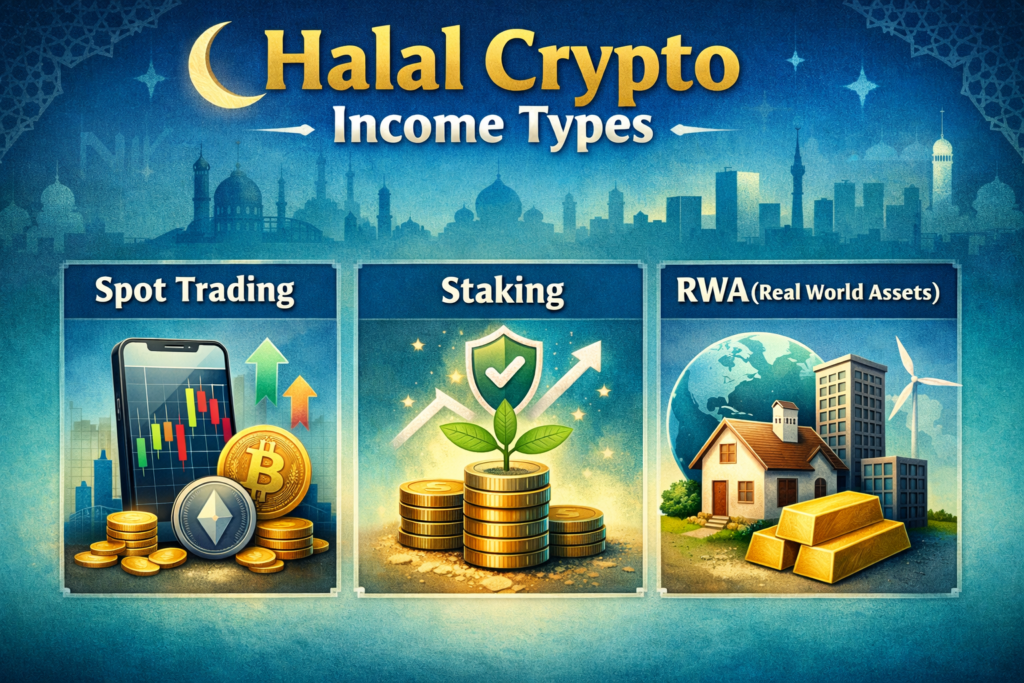
Staking, Yields and DeFi Rewards When Can They Be Halal?
Not all staking and DeFi rewards are the same. In Shariah terms, the key question is whether the return is interest-like or linked to real work or profit-sharing.
Broadly
Interest-like staking
If you deposit tokens into a pool and receive a fixed or floating yield that is essentially payment for lending your asset, many scholars treat this as riba and therefore haram.
Validator / fee-based rewards
If your reward comes from helping to secure a network (e.g. validator work) or sharing transparent transaction fees from halal activity, some scholars view this more like a service fee or profit-sharing (musharakah / mudarabah) potentially halal if structured carefully.
There are emerging Islamic DeFi experiments, including tokenised sukuk and Shariah-branded projects such as Islamic Coin, but each must still be screened like any other project; a “halal” label alone is not enough.
Mining, Airdrops, Liquidity Provision & Referral Bonuses
Mining
Running your own hardware, paying for electricity and earning block rewards is usually seen as payment for providing security and computation, which many scholars consider closer to halal business income. Risky cloud-mining schemes, especially those with vague structures or guaranteed returns, are another matter.
Airdrops and giveaways
If you receive tokens as a genuine marketing gift or user reward, many treat it as permissible; if the “airdrop” is tied to gambling mechanics (spins, loot boxes, casino-style games), it veers into maysir.
Liquidity provision (LP) in AMMs
LP income comes from swap fees; if those swaps include interest-based tokens, gambling platforms or leveraged products, your income may be contaminated. There’s a strong argument that a Shariah-conscious LP should restrict themselves to pools of screened, halal assets only and even then, impermanent loss makes this a higher-risk, advanced strategy.
How to Screen a Cryptocurrency or DeFi Project for Shariah Compliance
Muslim investors can screen crypto projects by examining the project’s purpose, business model, tokenomics and use of interest or gambling mechanics, and by cross-checking with credible Shariah-screening lists and scholar-backed reviews.
Practical Shariah Screening Criteria for Coins and Tokens
A simple checklist you can apply before buying any coin or joining any DeFi protocol:
Real-world benefit
What problem does this project solve? Payments, remittances, infrastructure, storage, identity, tokenised real-world assets? If you can’t explain it simply, that’s a warning sign.
Haram sectors
Does the token or platform directly support gambling, adult content, conventional interest-based lending, weapons or other clearly haram sectors? If yes, avoid.
How income is generated
Transparent trading fees or service charges → more likely halal.
Hidden interest, leveraged products or opaque yield strategies → likely haram.
Shariah screening ratios
You can borrow equity-style screens (e.g. limits on interest-bearing debt or haram income) and adapt them to crypto projects with real-world companies behind them.
Governance and documentation
Is there a clear whitepaper, identifiable team and track record? Anonymous “devs” with vague promises are often a red flag both financially and ethically.
Using Halal Crypto Screening Lists and Scholar-Backed Services
Several teams now specialise in screening digital assets.
Islamic Finance Guru (IFG)
Runs a live halal crypto list and detailed guides on specific coins and topics like staking and zakat on crypto.
Other Shariah-screening tools
For example, Malaysian and GCC-based services that publish crypto Shariah status and reasoning.
UK platforms like Qardus
Often focus on SME finance rather than crypto, but provide a good benchmark for how serious Islamic investing platforms handle governance and scholar oversight.
Use these lists as inputs, not as blind guarantees. Even Shariah-marketed projects such as Islamic Coin or “Islamic” exchanges should be examined with the same scepticism you’d apply to any other crypto project.
Red Flags: When a “Halal” Label Is Just Marketing
Be cautious when you see
Anonymous or barely identifiable teams
Vague or copy-pasted whitepapers
“Guaranteed” returns or fixed APY in a volatile market
Casino-style apps, leaderboards and lotteries dressed in Islamic branding
Unregulated “Islamic” exchanges that don’t clearly sit under the SEC, FCA, BaFin or equivalent regulators
As a rough rule: if a product wouldn’t survive scrutiny from regulators or from a conservative Shariah board, it’s not somewhere to park your halal savings.
Zakat, Tax and Regulation for Crypto in the US, UK, Germany & Europe
Most scholars who allow crypto agree that zakat is due on crypto held as an investment, typically at 2.5% of its zakatable value once a lunar year passes over your nisab. Tax, however, is calculated separately based on local laws so you can be fully Shariah-compliant yet still owe capital gains or income tax in your country.
Calculating Zakat on Crypto Holdings and Income
For many scholars and fatwa councils.
Crypto held as an investment is treated similarly to cash or trade inventory, and is usually 100% zakatable at 2.5% of its value at zakat date.
Long-term holdings, active trading bags and even some staking or validator income are all aggregated when you calculate your zakat.
Illiquid project tokens can be tricky; some opinions value them at a reasonable market or expected-realisation value rather than a theoretical peak.
Specialist zakat calculators run by Islamic charities and advisory firms increasingly include crypto fields denominated in USD, GBP and EUR, making it easier for Muslims in the US, UK and EU to compute combined zakat across bank balances, stocks and crypto.
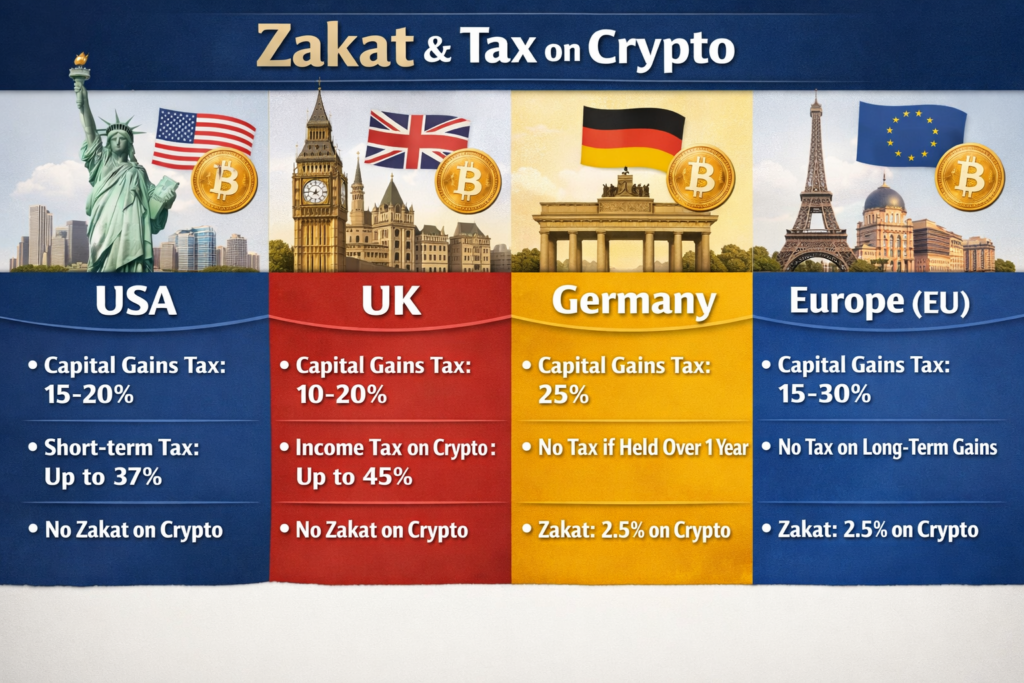
Aligning Zakat with IRS, HMRC, BaFin & EU Tax Rules
Shariah compliance does not replace your legal tax duties
United States
The IRS treats digital assets as property, so disposals (selling for USD, swapping one coin for another, or spending crypto) can trigger capital gains or income.
United Kingdom
HMRC’s cryptoassets manual explains that most individuals are subject to Capital Gains Tax (CGT) on disposals; frequent trading or DeFi activity may be treated as income.
Germany / EU
Under MiCA and local rules, crypto-asset service providers need licences, and investors may benefit from favourable treatment on assets held longer than certain periods, depending on national law.
A practical approach.
Keep very clear records of buys, sells, swaps and income.
Calculate zakat annually according to your scholar’s view.
File taxes accurately, even if the tax system doesn’t distinguish halal vs haram income.
KYC/AML, Data Privacy (GDPR/DSGVO) and Shariah Governance
Robust KYC/AML isn’t just a regulatory box-tick; it aligns with Islamic ethics by helping to prevent fraud, money laundering and financing of harm.
In Europe and the UK, data privacy rules like GDPR/DSGVO and UK-GDPR mean exchanges and fintechs must handle your personal data responsibly something CIOs already worry about when building compliant cloud and analytics architectures. (Mak it Solutions)
For any Shariah-compliant crypto platform or fund, look for
A named Shariah board with credible scholars
Documented governance processes
Clear alignment with local regulators (e.g. BaFin in Germany, FCA in the UK, SEC and state regulators in the US)
Shariah-Compliant Platforms, Accounts and Gold/RWA-Backed Tokens
Muslim investors can look for spot-only Islamic trading accounts, Shariah-compliant funds and asset-backed tokens (such as gold or tokenised sukuk) that are certified by trustworthy scholars and operate under recognised regulators.
Islamic Trading Accounts and Exchanges (Spot-Only, No Interest)
Some mainstream exchanges now offer explicitly Islamic or Shariah-friendly accounts. Bybit, for example, has launched an Islamic Account developed with Shariah advisory firms like CryptoHalal and ZICO that removes interest and certain products for Muslim traders.
Regional players such as Fasset are building Islamic wealth platforms focused on interest-free investing, often in partnership with banks like Ajman Bank and regulators in hubs like the United Arab Emirates.
Availability, however, differs by region
US
More limited choice of explicitly “Islamic” accounts; the focus is on using regulated spot exchanges and self-screening.
UK
Stronger Islamic finance ecosystem; easier to find local scholars and platforms aligned with FCA rules.
Germany / EU
Growing interest; investors sometimes combine local Islamic banks like KT Bank AG with MiCA-regulated brokers.
Shariah-Compliant Funds, Stablecoins and Gold/RWA Tokens
Asset-backed or RWA (real-world asset) tokens appeal to more conservative Muslim investors.
Gold-backed coins
Tokens fully backed by vaulted gold, with transparent audits, can resemble digital warehouse receipts.
Tokenised sukuk
Represent fractional ownership in Shariah-compliant financing structures, potentially offering income aligned with real assets.
Other RWA tokens
For example, real-estate or infrastructure-backed tokens, where Shariah compliance depends on underlying contracts and use of leverage.
Pros compared with holding assets directly.
Pros
Easier transfers, fractional ownership, 24/7 markets, potential for lower minimums.
Cons
Platform and smart-contract risk, regulatory uncertainty, reliance on custodians and sometimes higher complexity vs just owning gold or sukuk funds directly.
Comparing Options Across US, UK, Germany, Europe and UAE
Rough comparison.
New York / US
Strong on regulation and institutional exchanges; Islamic branding is weaker, but you can still build your own Shariah screen on top of compliant platforms.
London / UK
Combination of FCA regulation and Islamic finance expertise; services like IFG and Qardus make it easier to discover Shariah-aligned options.
Frankfurt / Berlin / wider EU
MiCA is standardising the rules; BaFin is already authorising crypto service providers. Investors can mix local Islamic banking (e.g. KT Bank AG) with EU-regulated brokers. (KT Bank AG)
Dubai / Abu Dhabi / UAE
Some of the most active Islamic digital asset experiments live here, with platforms like Fasset and Shariah-compliant stablecoin initiatives.
Step-by-Step Roadmap to Building a Halal Crypto Portfolio
A practical halal crypto plan starts with choosing the scholarly view you follow, then defining your risk profile and time horizon, strictly limiting yourself to screened assets and permitted income types, and reviewing your portfolio each year for zakat and risk.
Clarify Your Shariah Position, Risk Appetite and Time Horizon
Clarify your Shariah position
Decide whether you follow scholars who forbid crypto entirely or allow it with conditions. If you’re in doubt, err on the side of caution and invest less.
Define risk appetite
Are you conservative (a 10–20% downside would really hurt) or growth-oriented (comfortable with high volatility)? Crypto should usually be a small slice of your net worth, not the main pillar.
Set your time horizon
Are you thinking in 3–5 year cycles or just chasing next month’s pump? Shariah-conscious investors usually favour longer horizons with less churn.
Choose Coins, Platforms and Halal Income Strategies
Screen your assets
Use Shariah screening criteria and trusted lists (IFG, specialist screeners, local scholars) to build a short-list of permissible coins and tokens.
Shortlist platforms
Prioritise regulated spot exchanges and, where available, Islamic accounts (e.g. Bybit’s Islamic Account, or platforms like Fasset serving Muslim investors under strong regulatory oversight)
Select halal income methods
Stick to strategies endorsed by your scholar: usually spot buying/holding plus, where appropriate, transparently structured validator or fee-sharing rewards; avoid interest-bearing lending and aggressive DeFi.
If you’re building more complex architectures (e.g. for a crypto-enabled fintech or Islamic neobank), this is where an experienced technology partner like Mak It Solutions can help with secure cloud, confidential computing and multi-cloud compliance patterns for US/UK/EU workloads. (Mak it Solutions)
Ongoing Monitoring, Record-Keeping, Tax and Zakat
Monitor and review annually
Keep detailed logs of transactions for both tax and zakat.
Recheck each project’s Shariah status yearly; exit if it drifts into haram activity.
Rebalance so crypto exposure stays within your planned percentage.
HMRC estimates that around 7 million UK adults now hold roughly £12.9 billion in crypto, and it has sharply increased enforcement around undeclared gains a reminder that tidy records and timely tax returns are part of halal investing. (Financial Times)
For complex cases, consult both a local imam or Shariah advisor and a tax professional familiar with digital assets in your jurisdiction.

Concluding Remarks
If you’ve felt torn between wanting crypto exposure and fearing haram income, you’re not alone. With clear principles, disciplined screening and guidance from qualified scholars, it is possible to seek Shariah-compliant crypto investing in the US, UK, Germany and wider Europe.
Use this guide as a starting map then combine it with your own research, local fatwa resources and technology partners who understand security, compliance and data sovereignty in Western markets. None of this is financial or tax advice; always do your own research and seek personalised guidance before making investment decisions.
Key Takeaways
Shariah-compliant crypto investing focuses on real ownership, no interest, lower speculation and clear real-world benefit.
Scholarly opinion is split, but there is a strong “allowed with conditions” camp; always follow your own trusted scholar or board.
Halal income is more likely with spot trading, some profit-/fee-sharing models and asset-backed tokens, and less likely with leverage, interest-based lending and casino-style DeFi.
Robust Shariah screening combines qualitative checks (purpose, sectors, governance) with quantitative ones (debt/interest levels, income sources).
Zakat typically applies to crypto investments at around 2.5% annually, while tax in the US, UK and EU is governed by local capital gains and income rules.
Regulated spot platforms, Islamic accounts and gold/RWA tokens in hubs like London, Frankfurt and Dubai are improving access for Muslim investors in Western countries.
If you’re exploring a Shariah-compliant crypto roadmap for your organisation or personal wealth, Mak It Solutions can help you translate principles into secure, compliant technology. From confidential computing and data sovereignty to analytics that track zakat and tax implications across US, UK, German and EU regions, our teams design architectures that keep ethics and regulation front and centre.
Reach out to discuss a scoped discovery workshop, or explore how we’ve already helped clients build compliant cloud, data and fintech platforms that respect both Shariah and Western regulatory requirements.( Click Here’s )
FAQs
Q : Can I dollar-cost average into Bitcoin and still keep my crypto investing halal?
A : Dollar-cost averaging (DCA) into Bitcoin can be compatible with halal investing if your scholar considers Bitcoin permissible, you buy via spot-only trades with your own funds (no leverage or margin) and you keep your overall allocation within a sensible risk limit. Many Muslims in the US, UK and Europe treat Bitcoin like a small, high-risk slice of a diversified portfolio rather than their main asset. Track your DCA purchases carefully for both zakat and tax purposes in your country.
Q : Are meme coins or highly speculative tokens ever considered halal for Muslim investors?
A : Most scholars who allow crypto are still very cautious about meme coins and ultra-speculative tokens, because their price action often looks indistinguishable from gambling. Even if the underlying code isn’t haram, rushing into coins with no real utility, anonymous teams and pump-and-dump histories usually violates Shariah principles around gharar and maysir. A simple rule of thumb: if you can’t explain the project’s real economic value in a paragraph, it probably doesn’t belong in a halal portfolio.
Q : What should I do with past crypto income that I now believe was haram (e.g., leverage, interest-based staking)?
A : Many scholars advise that if you earned income through clearly haram means (leverage with interest, riba-based staking, gambling-style platforms) and only realised that later, you should repent and dispose of the haram portion of your gains. This often means donating it to general charity (not intending it as sadaqah reward, but as purification), while keeping your initial capital. The exact method can be nuanced, so it’s wise to discuss your specific transactions with a knowledgeable local scholar or Shariah advisor.
Q : How can Muslim entrepreneurs structure an ICO or token sale in a Shariah-compliant way?
A : A Shariah-conscious ICO or token sale starts with a halal underlying business model and fair risk-sharing. Entrepreneurs should avoid interest-based structures, speculative promises and vague whitepapers, and instead design clear contracts where token holders share in real utility or asset-backed cashflows. Working with an experienced Shariah advisory firm and ensuring alignment with regulators (e.g. SEC, FCA, BaFin) is crucial. Documented Shariah governance, transparent tokenomics and conservative marketing can all help build trust with Muslim investors.
Q : Is it halal to use crypto credit cards or earn cashback rewards in the US, UK or Europe?
A : Many “crypto credit cards” are linked to conventional credit lines that charge interest on unpaid balances, which is a major Shariah concern. Some debit-style cards or prepaid solutions that simply let you spend your own crypto or stablecoins can be more acceptable, but the details matter: underlying custody, fees and whether any interest or leveraged instruments are involved. As a rule, Muslims should avoid interest-bearing credit facilities and instead look for debit or charge-card models designed to be fee-based rather than interest-based, ideally with Shariah oversight.