
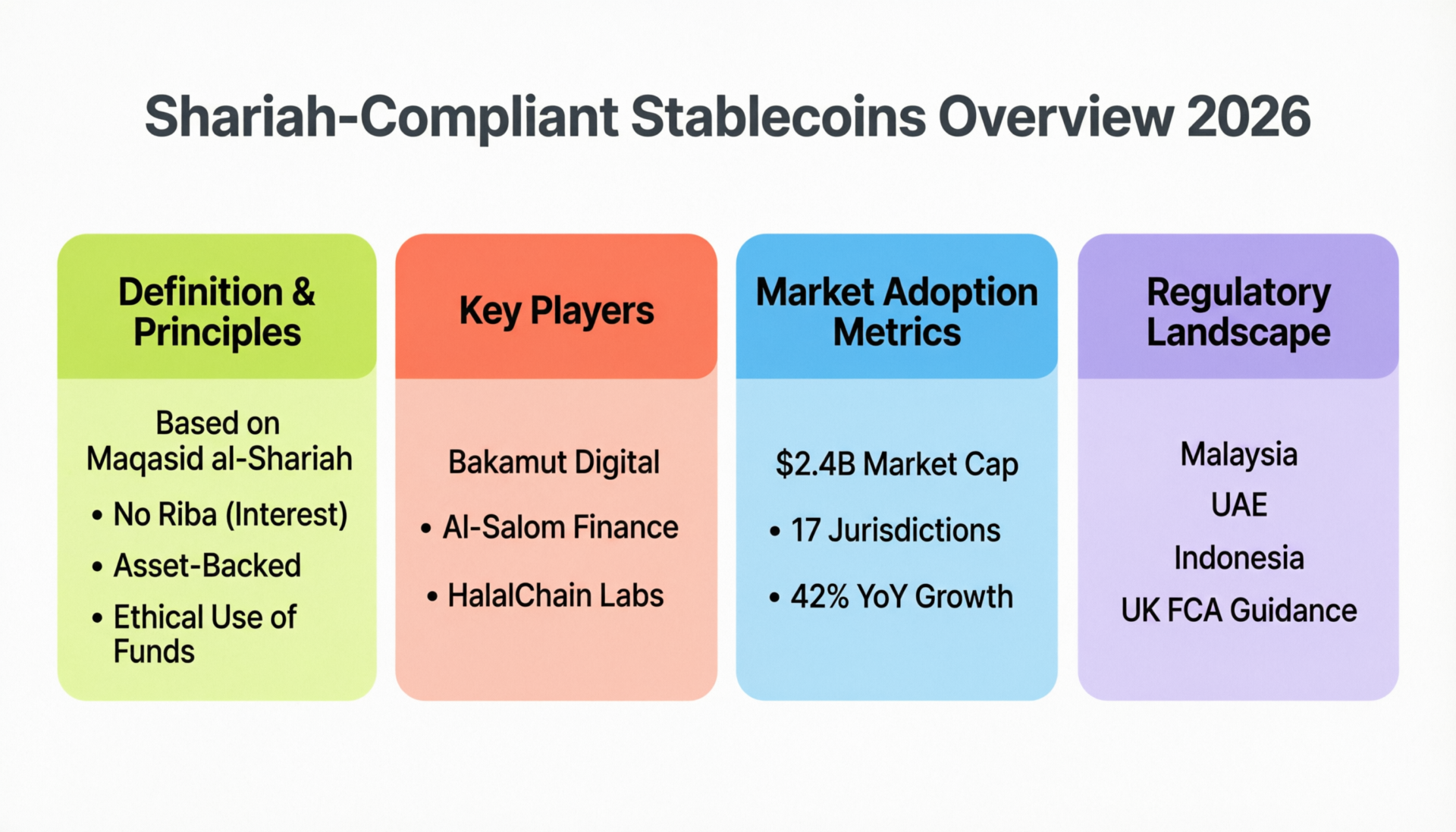

Shariah Compliant Stablecoins: Practical Guide
Shariah-compliant stablecoins are digital tokens designed to hold a stable value and be fully backed by identifiable, low-risk assets, with no interest (riba), excessive uncertainty (gharar) or gambling (maysir), and with oversight from qualified Shariah scholars. In practice, Muslim investors in the US, UK and Europe should prioritise transparently asset-backed stablecoins with strong regulation, independently audited reserves and credible Shariah governance, rather than speculative or algorithmic models.
Introduction.
Global stablecoin supply is estimated in roughly the $250–300 billion range as of early 2026, and regulators now treat them as systemically relevant, not just a crypto side-show. At the same time, reports from firms like TRM Labs suggest that over 70% of major jurisdictions advanced stablecoin rules in 2025 alone, with a strong focus on payments and settlement use cases.
For Muslim investors and Islamic fintechs in the United States, United Kingdom, Germany and the wider European Union, the core question is simple: “Can I use stablecoins in a halal, regulated way?”
The short answer is: yes but not all stablecoins are created equal. Only certain asset-backed structures, with clear legal rights and robust Shariah governance, currently sit within the “comfort zone” of many contemporary scholars. This guide unpacks those structures, the US/UK/EU regulatory landscape, and practical steps for investors, Islamic banks and fintechs who want institution-grade, faith-aligned products.
What Is a Shariah-Compliant Stablecoin in Islamic Finance?
A Shariah-compliant stablecoin is a digital token whose value is kept stable by holding real, identifiable assets (such as cash, sukuk or gold) and which avoids interest, excessive uncertainty and speculative gambling, under the oversight of qualified Shariah scholars. In other words, it is meant to operate like a fully backed, redeemable claim, not a leveraged trading chip.
From a Shariah perspective, the token should represent something meaningful in the real economy: a claim on cash in a segregated account, units in a Shariah-compliant fund, or fully allocated gold, for example. The issuer should give users enforceable rights (redemption, clear fees, clear risk factors), and the project should be supervised by a Shariah board that understands both fiqh al-mu‘amalat and digital assets.
Core Shariah Principles for Money and Digital Assets
In classical fiqh, three prohibitions drive most Islamic finance analysis.
Riba (interest) pre-agreed, guaranteed returns on money as money
Gharar (excessive uncertainty) ambiguous subject-matter, unclear rights or hidden risk
Maysir (gambling/speculation) zero-sum bets with no underlying productivity
Money should connect to real economic activity, not pure price betting. In the crypto context, this means
The token should represent clear, knowable value (e.g. $1 in a ring-fenced account, 1 gram of gold, or proportional units in a Shariah-screened portfolio)
Users must understand how the peg is maintained and what can cause it to break.
Returns, if any, must come from allowed contracts (e.g. murabaha-based MMFs or sukuk profit-sharing), not from interest-bearing deposits or margin lending.
Maqasid al-Shariah (the higher objectives of the law) add another layer: preserving wealth, preventing injustice and promoting transparency. A well-designed Shariah compliant stablecoin should make money safer and more useful for Muslim communities, not expose them to opaque risks.
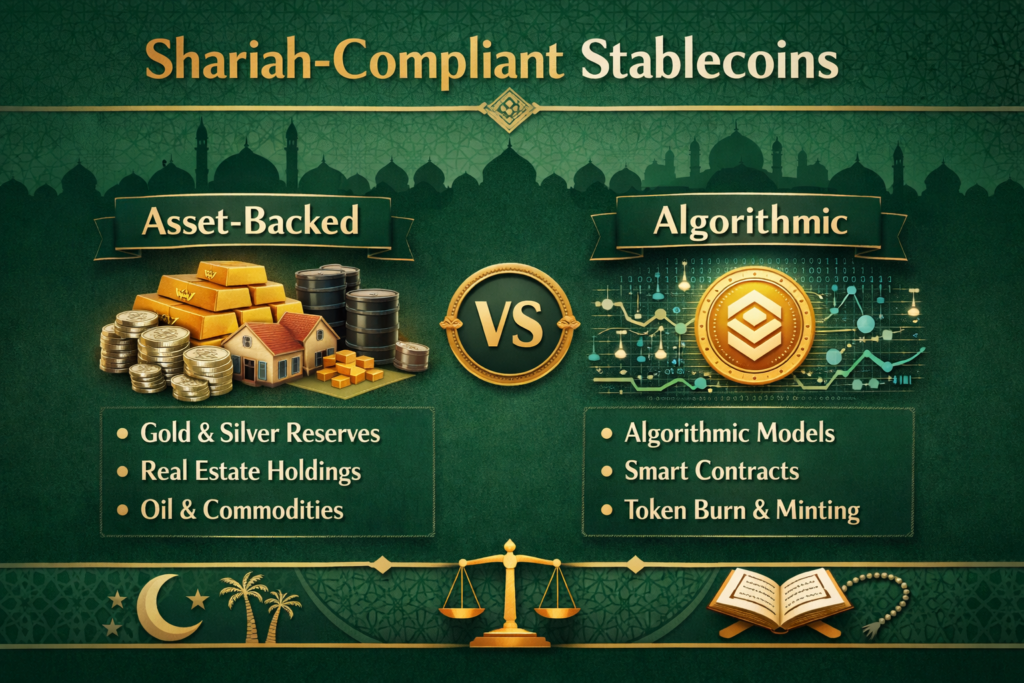
Types of Stablecoins and Their Shariah Profile (Fiat-Backed, Crypto-Backed, Algorithmic)
From a Shariah and risk perspective, not all stablecoins look the same:
Fiat-backed stablecoins tokens backed 1:1 by cash or cash-equivalent assets held with banks or custodians.
Commodity/gold-backed tokens backed by allocated gold or other tangible assets.
Crypto-collateralised tokens over-collateralised with volatile crypto assets.
Algorithmic stability is maintained via smart-contract algorithms and incentive games, often without clear, redeemable backing.
Most contemporary Shariah analyses treat asset-backed models (fiat or gold) with transparent, ring-fenced reserves as closer to permissibility than complex algorithmic designs. Crypto-collateralised models raise questions around volatility, forced liquidations and systemic gharar, while “pure” algorithmic pegs have already produced infamous collapses and are generally viewed as too speculative.
Micro-answer
Asset-backed, fully reserved stablecoins with transparent structures are generally viewed more favourably by scholars than highly engineered, algorithmic pegs.
Maqasid al-Shariah and Stablecoins.
When they work properly, stablecoins can.
Help preserve purchasing power versus highly inflationary local currencies
Lower remittance costs and settlement risk
Increase transparency (on-chain records, auditable reserves)
This supports Maqasid goals such as protection of wealth and fairness in contracts. But when the design is opaque, under-collateralised or heavily leveraged, the same instruments can undermine Maqasid by driving financial instability, runs and mis-selling.
For Muslim diaspora communities in cities such as London and Frankfurt – or US corridors like New York to MENA Shariah-compliant, well-regulated dollar or euro stablecoins could make cross-border payments cheaper and faster, while keeping clear audit trails for AML/CFT and tax.
Are Stablecoins Halal or Haram? Scholar Views in the US, UK and Europe
There is no single global fatwa on stablecoins, but a growing number of scholars lean towards conditional permissibility for clearly structured, fully backed stablecoins used for payments and short-term savings – not for leveraged speculation.
What Makes a Stablecoin Halal or Haram According to Islamic Scholars?
Key “halal vs haram” criteria commonly mentioned in scholarly analysis include:
Clear asset backing
Are reserves fully disclosed, high quality and bankruptcy-remote?
Enforceable redemption
Can holders reliably redeem at par, subject to fees and cut-off times?
No interest-based returns
Reserves should not rely on interest-bearing loans or conventional repo as the primary return source.
No exposure to haram sectors
Screening for industries like alcohol, gambling or adult entertainment.
Strong disclosure
Transparent whitepaper, audited financials and clear risk factors.
A stablecoin structure drifts into haram territory if.
It promises fixed interest on token balances
It hides material risks around reserves or governance
Its main use is speculative trading or leveraged yield farming rather than real-economy payments or savings
Bodies like AAOIFI and national Shariah councils provide reference points here, even if they haven’t yet issued detailed, token-by-token rulings.
Regional Scholar Opinions: US, UK, Germany & Wider Europe
In the US, Shariah advisory firms and crypto-focused fatwa resources are gradually addressing stablecoins – often treating them as “digital money market” tools whose permissibility depends on underlying assets, contracts and use cases.
In the UK, platforms like Islamic Finance Guru have amplified debates over whether particular stablecoins are halal or not, especially in London’s Islamic finance ecosystem. UK-based muftis increasingly distinguish between using a well-backed stablecoin as a payment rail versus trading it on margin.
In Germany and continental Europe, formal fatwas are fewer, but Islamic finance professionals often rely on globally recognised scholars plus local regulatory guidance from authorities such as BaFin and the European Securities and Markets Authority when assessing euro-pegged projects.
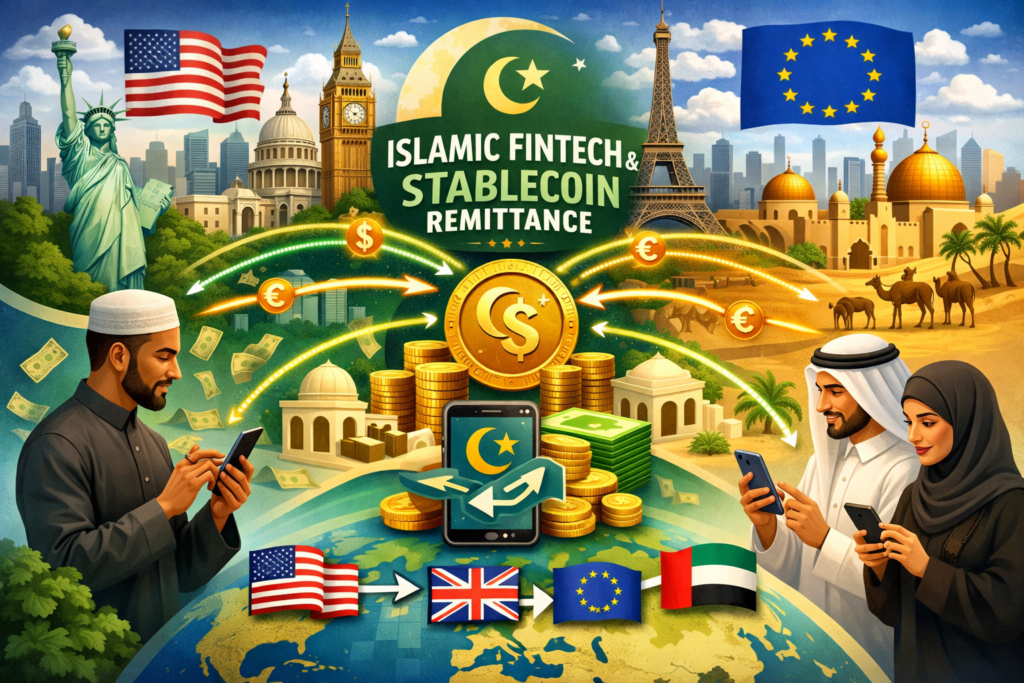
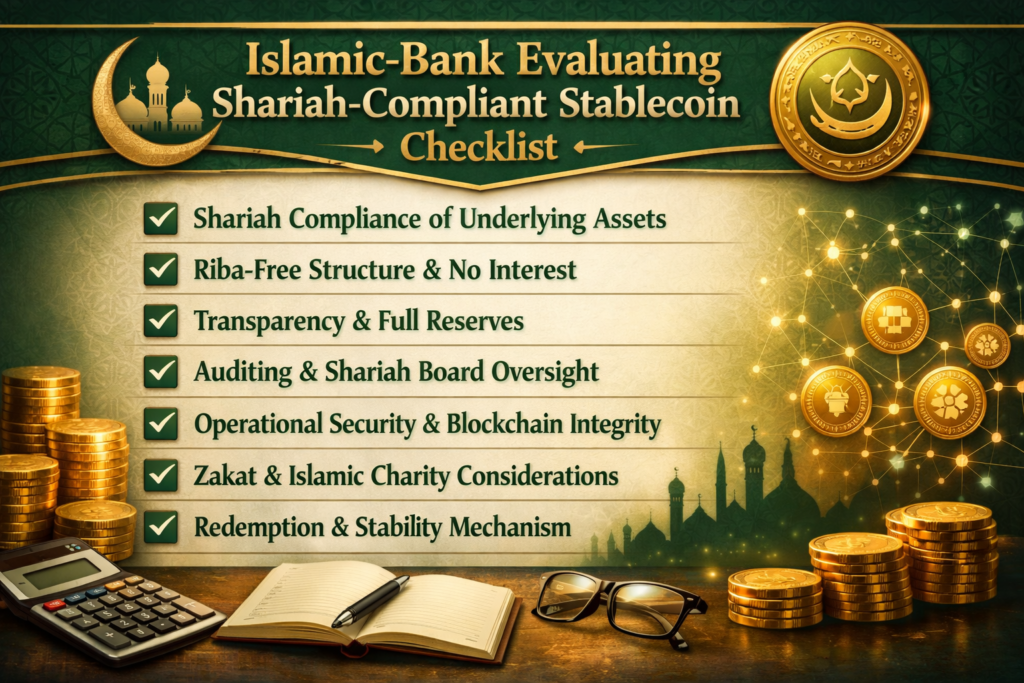
Practical Checklist: When a Stablecoin Is Typically Considered Halal
For a Muslim investor in the US, UK or EU, a practical “green-flag” checklist might include:
Backed 1:1 (or over-collateralised) by cash, sukuk or high-quality, Shariah-screened assets
Reserves held with reputable custodians in solid jurisdictions (e.g. US, UK, EU banks)
Regular, independent reserve audits with public reports
Named, credible Shariah scholars and a clear Shariah governance framework
Regulatory permissions
MiCA-authorised issuer in the EU, FCA/BoE-linked regime in the UK, bank or trust charter / money transmitter licensing in the US.
Micro-answer
Before treating a stablecoin as “halal enough” for savings, a Muslim investor should insist on clear backing, independent audits, named scholars and robust regulation.
Regulation, Risk & Shariah Governance for Stablecoins (US/UK/Germany/EU)
Across the US, UK and EU, stablecoins are being pulled into bank-like regulatory regimes. Shariah-compliant projects therefore have to satisfy both secular law (MiCA, BoE, SEC, BaFin, etc.) and Islamic governance standards at the same time.
MiCA and EU Oversight: Asset-Referenced Tokens, E-Money Tokens & Islamic Finance
In the EU, MiCA treats most “stablecoins” as either asset-referenced tokens (ARTs) or e-money tokens (EMTs). ARTs are linked to baskets of currencies or other assets; EMTs are essentially e-money in token form, pegged 1:1 to a single fiat currency like the euro. Issuers must meet strict rules on authorisation, reserves, disclosure and redemption rights.
For Islamic banks or funds looking at euro-pegged stablecoins, MiCA’s framework actually aligns with several Shariah priorities:
Full-reserve or high-quality reserve requirements
Strong disclosure and white-listing of assets
Redemption and complaint-handling processes
That said, some Islamic structures (e.g. sukuk-backed EMTs) will need careful legal engineering to sit cleanly inside MiCA while still reflecting risk-sharing rather than simple debt.
Germany Focus: BaFin Guidance, Euro Stablecoins and Islamic Institutions
Germany is one of the more cautious EU jurisdictions on stablecoins. European Banking Authority guidance, enforced locally by BaFin, treats asset-referenced tokens as regulated crypto assets, with expectations around reserve quality, marketing and risk disclosure.
Recent BaFin approvals and sandbox projects involving euro-denominated tokens send a useful signal: if you can demonstrate robust reserves, clear governance and MiCA-plus compliance, regulators will consider stablecoin structures. For Islamic investors and fintechs in Germany, that opens the door to BaFin-supervised, Shariah-compliant euro stablecoins serving mosques, community banks and digital-only platforms.
UK & US Stablecoin Regimes Through an Islamic Lens
The Bank of England has proposed a regulatory regime for “systemic” sterling stablecoins, focusing on backing-asset rules, risk management and user protection, while the Financial Conduct Authority would supervise non-systemic issuers and custodians.
In the US, the picture is more fragmented: some bank-issued tokens may fall under existing prudential rules, while non-bank issuers face a mix of state money transmitter laws, potential e-money classifications and enforcement risk from the Securities and Exchange Commission if their tokens resemble securities.
For Islamic projects, this means
In the UK, aligning Shariah governance with BoE/FCA systemic vs non-systemic regimes
In the US, designing products that can tolerate long regulatory timelines and a shifting federal landscape
Shariah Governance Framework for Stablecoin Issuers
A credible Shariah governance framework should sit alongside risk, compliance and technology:
Shariah board
Experienced scholars with crypto/digital-asset literacy, issuing initial fatwas and periodic reviews.
Internal Shariah compliance
Day-to-day monitoring of reserves, contracts, marketing and operational incidents.
Regular Shariah audits
Independent reviews and public summaries, similar to financial audits.
This framework should align with global standards (AAOIFI, IFSB) and local regulators such as the FCA, BaFin, ESMA/EBA and central banks. For complex deployments (e.g. multi-cloud, data residency, PCI DSS and GDPR/UK-GDPR obligations), teams like Mak It Solutions can help integrate Shariah requirements into real-world cloud and security architectures, drawing on experience with regulated sectors in the US, UK, Germany and the EU. (Mak it Solutions)
Why Are Stablecoins Increasingly Discussed in Islamic Banking & Fintech Across the US, UK and Europe?
Islamic banks and fintechs are looking closely at Shariah compliant stablecoins because they promise faster, cheaper cross-border payments and programmable finance, while potentially fitting within Shariah rules when carefully structured.
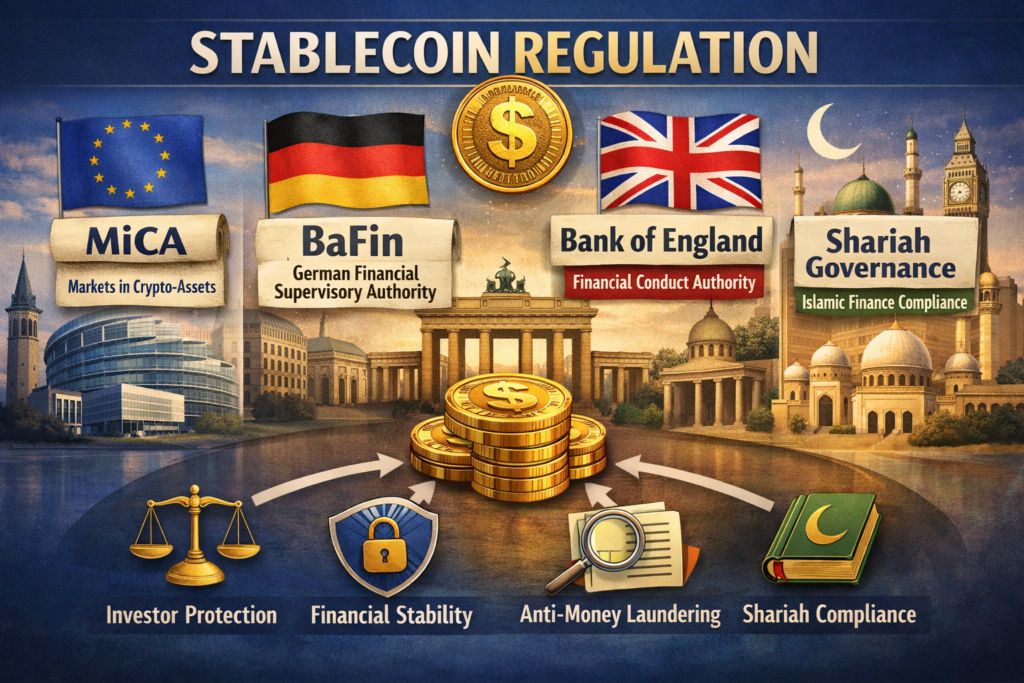
Shariah-Compliant Stablecoin Use Cases for Cross-Border Remittance
Key Muslim diaspora corridors include.
US–MENA and US–South Asia
UK–Pakistan/Bangladesh
Germany/France–Turkey/North Africa
In these routes, dollar- or euro-backed halal stablecoins can.
Reduce FX spreads and remittance fees
Cut settlement times from days to minutes
Provide transparent on-chain records that support AML/CFT and tax compliance (ESMA)
To stay Shariah-compliant and legally sound, remittance use cases must respect local payment rules, travel-rule obligations and KYC/AML standards in both sending and receiving countries.
Tokenised Sukuk, Liquidity Management and Treasury Use Cases
For Islamic banks and funds in hubs like London and Frankfurt, stablecoins can act as.
Settlement tokens for trading tokenised sukuk
Liquidity buffers in digitally native money-market or cash-management products
Bridges between traditional core banking and DeFi-like rails that respect Shariah rules
Law firms such as White & Case have already mapped how tokenised sukuk and Islamic structures can sit within EU and UK digital-asset rules, giving Islamic treasurers new tools for intraday liquidity and cross-border treasury management.
Islamic Neobanks, Halal DeFi and Case Studies (US/UK/Europe)
Islamic neobanks and super-apps in the US, UK and EU are experimenting with:
Card-linked wallets funded by compliant stablecoins
Gold- or fiat-backed “savings jars” on-chain
DeFi-style yield products built on sukuk or Shariah-screened MMFs, rather than interest lending.
Open banking in the UK and EU makes it easier to connect bank accounts with stablecoin wallets, but UX, trust signals and Shariah communication remain critical. Clear fatwas, dashboards showing reserve composition and easy-to-understand risk warnings are often more convincing than technical whitepapers alone.
How to Design or Choose a Shariah-Compliant Stablecoin
How Can an Islamic Bank or Fintech Structure a Shariah-Compliant Stablecoin Under US/UK/EU Regulations?
At a high level, the issuer must choose.
Legal wrapper
E-money institution, MiCA ART/EMT issuer, bank-issued token, trust structure, or a combination. (Cambridge University Press & Assessment)
Asset backing
Fiat reserves in segregated accounts, short-term government sukuk, high-quality Shariah-compliant MMFs.
Contract form
Mudharabah, wakalah, or other structures that define profit-sharing or agency fees without guaranteeing interest.
Regulators care about solvency, risk and consumer protection; Shariah boards care about riba, gharar and maysir. Successful projects design redemption mechanics, disclosure and governance so they satisfy both sets of requirements from day one.
How Should Muslim Investors in the US, UK and Europe Evaluate Whether a Specific Stablecoin Is Shariah Compliant?
A practical due-diligence flow for Muslim investors
Read the whitepaper and T&Cs
What exactly does each token represent? Who issues it?
Check reserves and attestation reports
Are they frequent, independent and detailed?
Verify Shariah governance
Who are the scholars? Is there a public fatwa? How often is it reviewed?
Confirm licences
MiCA authorisation in the EU, FCA-linked regime in the UK, bank/trust charter or money transmitter licences in the US.
Use halal lists carefully
Platforms that score “halal crypto” can be helpful, but investors should still read the underlying reasoning and understand what is not covered.
The same checklist can be adapted by Islamic banks’ Shariah committees and risk teams.
Operational & Technical Design: Risk, Security and Data Compliance
Even the “most halal” structure can fail if the tech and operations are weak. Issuers should.
Run independent smart-contract and security audits
Use segregated, institution-grade custody for reserves
Select compliant on/off-ramp partners with strong AML/KYC
On the data side, GDPR/DSGVO, UK-GDPR and sectoral rules (HIPAA, PCI DSS, SOC 2) all matter when stablecoins touch healthcare, card payments or sensitive personal data. Cloud and data-residency patterns like those described in Mak It Solutions’ GCC sovereign cloud and multi-cloud strategy content can be reused for Islamic digital-asset platforms in the US, UK, Germany and EU. (Mak it Solutions)
Risks, Red Flags & the Future of Islamic Crypto Stablecoins
Key Shariah and Regulatory Risks to Watch
Key risk areas include
Reserve and governance failures under-collateralisation, conflicts of interest, poor disclosure
Regulatory arbitrage marketing tokens as “safe money” while operating from lightly regulated jurisdictions
Mis-selling to Muslim consumers over-promising “Shariah compliance” with weak or cosmetic fatwas
Global watchdogs such as the FSB and central banks warn that stablecoins, if poorly regulated, can create bank-run dynamics and undermine monetary policy. For Shariah-minded users, those same systemic risks translate into serious Maqasid concerns.
Why Many Islamic Finance Experts Prefer Asset-Backed Over Algorithmic Stablecoins
Many Islamic finance experts are sceptical of algorithmic stablecoins because:
Their pegs depend on volatile crypto collateral or complex game-theory mechanisms.
Holders may not have a clear, enforceable claim on tangible assets.
De-pegging events can wipe out value quickly, resembling speculative gambling. (Sharlife)
By contrast, asset-backed models, when properly structured, look more like fully reserved e-money or sukuk/MMF claims with knowable underlying value and clearer redemption rights.
Looking Ahead: CBDCs, Bank Deposit Tokens and Shariah-Compliant Digital Currencies
The European Central Bank and other central banks are exploring CBDCs and bank deposit tokens that could compete with, or complement, private stablecoins. Recent ECB work suggests heavy stablecoin use could weaken monetary policy transmission in the euro area, prompting calls for stricter oversight and stronger reserve rules.
For Islamic product teams, the smart strategy is often hedged:
Explore Shariah-compliant stablecoins now for remittances and treasury
Monitor CBDC and bank-token pilots closely
Design platforms that can switch between different “digital money” rails as the landscape matures
Concluding Remarks
In practice, a Shariah-compliant stablecoin is.
Fully backed by high-quality, Shariah-screened assets
Transparent about reserves, risks and governance
Used mainly for payments, remittances and liquidity, not speculative leverage
US, UK and EU regimes are converging on bank-like rules for stablecoins, while Shariah boards are refining their views as real-world case studies grow. The safest path is to treat each token as a specific product, not a generic “crypto,” and run it through both regulatory and Shariah filters.
This article is general information, not financial advice or a fatwa. Muslim investors and institutions should always consult qualified scholars and regulated professionals before making decisions.
When to Engage Shariah Advisory, Legal Counsel and Technology Partners
You should bring in specialist Shariah advisors, digital-asset lawyers and technology partners when.
Designing a new stablecoin or digital-asset product
Onboarding stablecoins for an Islamic bank’s treasury or neobank wallet
Planning cross-border, multi-cloud infrastructure with strict data-residency and security requirements
A typical roadmap: feasibility assessment → Shariah and legal scoping → technical architecture and pilot issuance → ongoing Shariah and compliance monitoring. Teams like Mak It Solutions can help you navigate the technology, cloud and data-protection side, while you work with qualified scholars and legal counsel on the fiqh and regulatory layers.
If you’re exploring Shariah-compliant stablecoins for your bank, fintech or investment platform in the US, UK or Europe, this is the time to move from theory to concrete design. Start by mapping your use cases (remittances, treasury, neobank wallets), then line them up against both regulatory and Shariah requirements.
Mak It Solutions can collaborate with your Shariah board and legal advisors to design cloud-ready, compliant architectures for Islamic digital-asset products. Reach out to discuss a scoped assessment or to turn your Shariah-compliant stablecoin concept into a pilot-ready roadmap.( Click Here’s )
FAQs
Q : Is a US dollar stablecoin like USDC automatically halal for Muslim investors?
A : No, a dollar stablecoin is not automatically halal just because it tracks USD. Muslim investors need to check what backs the token, how reserves are managed, whether returns come from interest, and whether credible scholars have reviewed the structure. They should also consider how they use it: using a well-backed stablecoin as a short-term payment rail or savings tool is very different from margin-trading it on speculative platforms. Independent audits and clear disclosure are essential before treating any USD stablecoin as Shariah-compliant.
Q : Can zakat, waqf or charity funds be safely held or transferred using Shariah-compliant stablecoins?
A : In principle, yes but only if the stablecoin structure and its use respect Shariah rules and regulatory obligations. For zakat or waqf, trustees must ensure that the token is fully backed, legally robust and easily redeemable, and that custody, private keys and operational risks are carefully managed. For transfers, a Shariah-compliant stablecoin can cut costs and improve transparency, but institutions should document their policies and obtain explicit approval from their Shariah and legal advisors.
Q : What documentation should an Islamic bank’s Shariah committee request from a stablecoin issuer before approving it?
A : A Shariah committee should at minimum ask for the whitepaper, legal terms and conditions, reserve policy, recent audit or attestation reports, and details of bank/custodian relationships. They should also see regulatory licences or applications, risk disclosures and any existing Shariah opinions on the structure. On top of that, access to ongoing reporting reserve composition, incidents, governance decisions – helps committees monitor compliance over time rather than granting a one-off approval.
Q : How do Shariah-compliant stablecoins compare with Islamic bank deposit accounts for everyday payments and savings?
A : A Shariah-compliant stablecoin can offer 24/7 transfers, instant settlement and global interoperability that many traditional accounts lack. However, it does not usually come with the same level of deposit insurance, consumer protection or branch infrastructure as an Islamic bank account. For everyday payments and small balances, a well-regulated stablecoin may feel similar to digital money, but for long-term savings, many users still prefer Islamic banks where prudential rules and safety nets are mature.
Q : What are the main risks if a “halal” stablecoin loses its peg or its issuer becomes insolvent?
A : If a stablecoin loses its peg, users can suffer immediate capital losses, especially if they bought in at par expecting stability. If the issuer or custodian becomes insolvent, recovery depends on how well reserves were segregated, the quality of legal documentation and the strength of the jurisdiction. Even a token marketed as “halal” can expose users to serious risk if reserves are opaque or governance is weak. That’s why independent audits, strong regulation and clear Shariah oversight are crucial – and why no stablecoin should ever be treated as risk-free.