

Halal Crypto Investing: Shariah Guide for Western Muslims
Halal crypto investing means treating cryptocurrencies as real digital assets and applying core Islamic finance rules: avoid riba (interest), excessive uncertainty (gharar) and gambling-like speculation (maysir). In practice, that means focusing on useful, Shariah-compliant digital assets, avoiding leverage and high-risk products, and only investing what you can afford to lose while following guidance from a scholar you trust.
Introduction
Halal crypto investing has moved from a fringe topic to an everyday question for many Muslims in cities like London, New York, Berlin and across the wider US, UK and EU. Crypto is now part of workplace chats, news headlines and, increasingly, long-term wealth planning and pensions.
North America alone had roughly 5.9 million Muslims by 2020, and the number is growing quickly, so more young professionals are asking how to build wealth without compromising on Deen.
In England and Wales, Muslims now number around 3.9 million (6.5% of the population), while Germany has about 5.5 million Muslims (around 6–7% of its population) At the same time, the global crypto market has hovered in the $2.3–2.5 trillion range in early 2026, putting digital assets firmly into the “mainstream finance” bucket.
So it’s natural that Muslim professionals in hubs like Birmingham, Manchester and Frankfurt want clear, grounded answers on halal crypto investing not a blanket “it’s haram, end of story” or hype-driven TikTok threads.
Quick answer: When can crypto be halal to invest in?
Crypto can be halal when you treat it as a real digital asset, use it in a lawful way, and avoid riba, gharar and maysir. In simple terms, that often means.
Focusing on Shariah-compliant digital assets with real utility
Avoiding interest-based lending, leveraged trading and gambling-style behaviour
Staying away from projects tied to haram industries (e.g. conventional gambling)
Only investing capital you can afford to lose, with proper risk controls
Disclaimer: Education, not a personal fatwa
This guide is educational. It summarises common fiqh principles and public scholar views, but it is not a personal fatwa or investment recommendation. Your madhhab, your local scholar and your personal circumstances matter a lot. Always check rulings with a qualified scholar and get tax/financial advice from regulated professionals before you invest.
What Is Halal Crypto Investing?
From gold dinar to digital assets.
Classical Islamic finance recognised different forms of value: gold and silver coins, agricultural goods, livestock and later paper money. The core idea has always been that money should be a medium of exchange and a store of value not something that creates money from money through riba.
Today, many scholars treat major cryptocurrencies as a new category of “digital asset” or “digital property”. In this view, owning Bitcoin or another coin is closer to owning a commodity or foreign currency than to owning a share in a company.
For halal crypto investing, the key question is.
Is this token a real, ownable digital asset with lawful use cases, or just a casino chip?
When the token represents genuine utility (payments, settlement, infrastructure, access to a network) and isn’t tied to haram activities, it can often be considered within the scope of Shariah-compliant digital assets subject to the other rules below.
Key concepts.
In crypto, the big three prohibitions show up like this:
Riba (interest)
Interest-like yields on lending protocols, “guaranteed” returns, or products where you are effectively being paid interest to lend tokens to others.
Gharar (excessive uncertainty)
Projects with no clear business model, anonymous teams, vague whitepapers or mechanics you don’t understand, especially where your capital can disappear overnight.
Maysir (gambling)
Meme coins, lottery-style “moon shots”, leveraged bets and products that look more like a casino than a real investment.
Halal crypto investing tries to minimise these three as much as realistically possible, using Islamic crypto screening criteria that mirror how bodies like the Accounting and Auditing Organization for Islamic Financial Institutions (AAOIFI) approach stocks and sukuk.
Types of crypto activity Muslim investors consider
Before we jump into rules, it helps to map the main activities Muslims in the US, UK, Germany and wider EU are actually doing or asking about.
Spot buying and holding (“HODLing”) Bitcoin or other coins
Dollar-cost averaging (DCA) into a small, diversified crypto basket
Short-term trading and day trading
Staking coins to help secure a network (e.g. proof-of-stake)
Using DeFi protocols, liquidity pools and yield farming
Buying NFTs or playing play-to-earn games
Using “Islamic” or “halal” labelled coins or platforms
Every one of these needs to be viewed through a Shariah lens – and many will fall into “haram” or at least “doubtful” for most scholars.
Core Shariah Views on Crypto (Is It Halal or Haram?)
Why some scholars permit crypto as a legitimate digital asset
Some contemporary scholars argue that major cryptocurrencies are halal with conditions. Their reasoning often includes.
Crypto has become widely accepted as a medium of exchange and store of value in real markets, similar to foreign currencies.
Ownership is real: you control the private keys and can transfer or dispose of the asset at will.
Many networks (like smart-contract platforms) provide genuine utility beyond speculation.
Islamic law has historically adapted to new forms of money; what matters is how it’s used, not the physical form.
Educational platforms like Islamic Finance Guru summarise these “permissible with conditions” views in detail, including scholars who view Bitcoin as a valid form of wealth.
Why other scholars see crypto as haram or too speculative
Other senior scholars remain uncomfortable and either call crypto haram or advise general avoidance. Common concerns are.
Extreme volatility and bubble-like behaviour
Lack of “intrinsic value” compared to productive assets or asset-backed sukuk
Widespread scams, rug pulls and wash trading
Heavy use for illicit activity and systemic harm to retail investors
Some scholars also argue that the way many people use crypto – heavy leverage, meme coins, gambling-style bets turns the entire space into a high-tech casino, not a legitimate market. For a cautious investor, this view often translates into “stay away until there is far more regulatory clarity and Shariah standardisation.”
Practical bottom line for everyday Muslim investors
If your trusted scholar permits crypto with conditions, a practical middle path is.
Focus on major, useful projects; avoid leverage and gambling-like behaviour; and invest only money you can afford to lose.
In concrete terms
Stick to a short list of well-known, useful coins rather than chasing every new token.
Avoid margin, futures and perpetual (“perps”) trading these are very often classed as haram.
Keep crypto as a small percentage of your overall halal portfolio.
Decide which scholarly view you follow before you open an exchange account.
If your scholar says crypto is not permissible for now, the halal choice is to respect that and focus on other vehicles like halal stock portfolios or platforms such as Wahed that build Shariah-compliant portfolios without crypto.
Halal Crypto Investment Rules & Screening Criteria
Ownership and use cases: when does a coin pass basic Shariah screening?
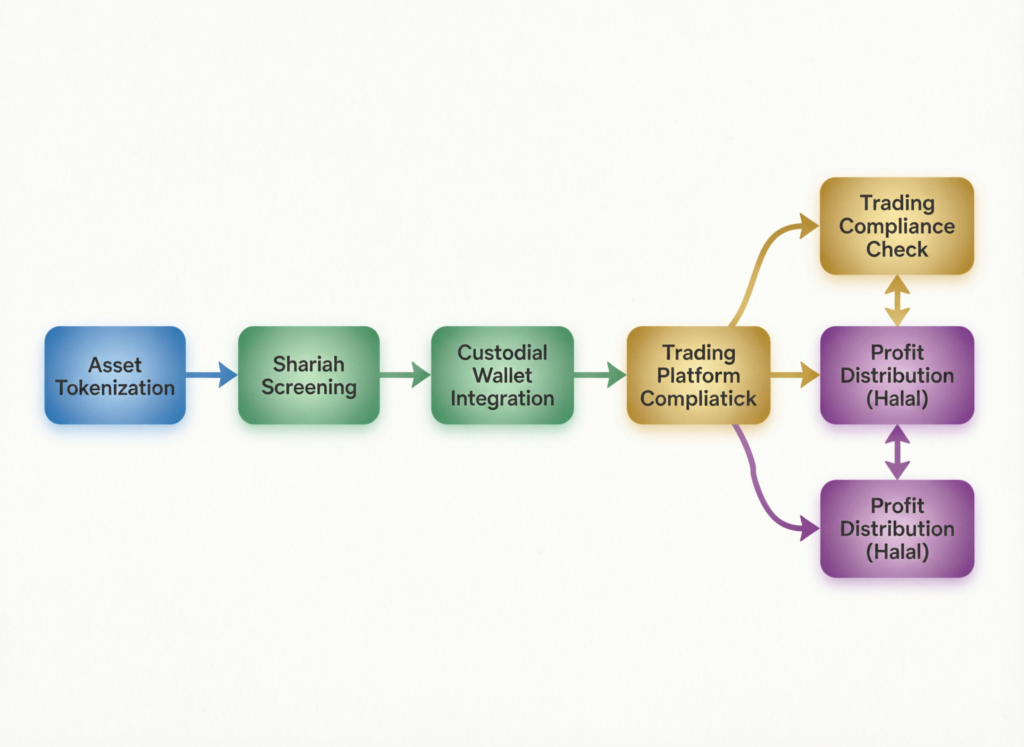
At asset level, a coin is more likely to be considered a Shariah-compliant digital asset when.
It represents a real, lawful use case (payments, infrastructure, utility, access to services)
The underlying project avoids haram sectors (e.g. adult content, conventional gambling, interest-based lending)
You can clearly understand how the protocol works and how value is created.
There is no built-in riba mechanism (e.g. protocol-level interest on debt positions)
Conversely, coins that primarily exist to power gambling platforms, high-interest lending, or clearly haram businesses will usually fail basic Shariah screening.
Trading rules: spot vs margin, futures, perps and day trading
For most scholars who allow crypto at all, spot buying and holding is usually the safest path. That means: you pay in full, you receive the asset into your own wallet or account, and there is no borrowing or leverage.
By contrast
Margin trading often involves borrowing money or coins with interest (riba).
Futures and perpetual contracts can be highly leveraged and may involve selling what you don’t yet own or purely speculative side bets.
Many day-trading strategies in crypto strongly resemble gambling (maysir), not informed investing.
So a simple rule-of-thumb answer to “spot vs leveraged crypto trading in Islam” is
Spot trading where you fully own the asset can be halal; margin, futures and perps are generally classed as haram or very doubtful due to riba and maysir.
Staking, yields, liquidity pools and DeFi.
This is where things get messy
Network-level staking (e.g. locking tokens to help secure a proof-of-stake chain and earn a share of protocol fees) is sometimes treated like earning fees for providing a service. Some scholars view this as potentially halal if the protocol is Shariah-compliant and the risks are clear.
Lending protocols and interest-bearing stablecoins are usually closer to riba: you’re lending for a fixed or algorithmic interest return.
Yield farming and complex DeFi strategies often combine leverage, derivatives and opaque counterparty risk – a cocktail of gharar and maysir.
Because these structures evolve fast, many Muslim investors rely on specialist screeners such as Halal Crypto Guide or Saraf Screening to understand whether a given yield or staking product passes Islamic crypto screening criteria.
A simple checklist Muslim investors can use before buying a coin
Before you buy any coin, run through a quick “AAOIFI-inspired” halal crypto checklist.
Purpose
Is the project’s main use case halal and socially beneficial?
Business model
How does the protocol make money and reward participants? Any riba or haram industries?
Leverage & derivatives
Do you need to use margin, options, or perps to benefit? If yes, that’s a red flag.
Guaranteed returns?
Be very wary of fixed, high, “risk-free” yields – this often signals riba or a Ponzi-like structure.
Documentation & transparency
Is the whitepaper clear? Is the team public and accountable?
Scholar opinion
Has a credible Shariah board or recognised scholar commented on this category of asset?
Jurisdiction & regulation
Is the platform under serious regulators (e.g. in the US, UK, Germany or EU), or operating in a legal grey zone?
KYC, AML & data protection
Does the platform follow proper KYC/AML and data protection standards (GDPR/UK-GDPR) or behave like an offshore casino?
You can turn this into a downloadable checklist or Notion template and use the same method across your entire crypto watchlist.
Choosing Halal-Friendly Platforms, Coins and Tools
What to look for in a halal-conscious exchange or broker
When Muslim investors in places like Dubai or Kuala Lumpur talk about “halal-friendly” platforms, they usually mean.
Regulated by credible authorities such as the Financial Conduct Authority or Federal Financial Supervisory Authority (BaFin), or equivalent in their jurisdiction. (FCA)
Segregated client assets and clear proof-of-reserves.
No forced leverage or default margin on retail accounts.
Transparent staking and yield products with clear risk and Shariah disclosure.
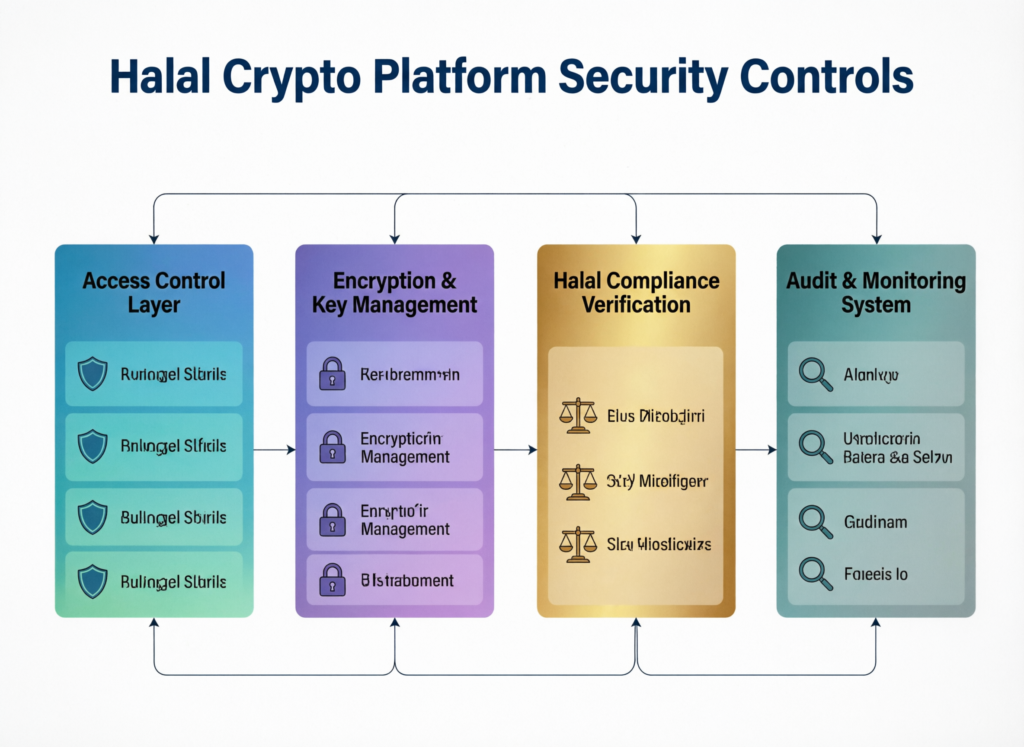
Strong security practices: hardware security modules, phishing-resistant MFA, good incident response. (Mak it Solutions)
Some large exchanges like Binance have launched Shariah-labelled products or engaged Shariah advisors for certain offerings, but you still need to read the fine print and ideally cross-check with independent Islamic finance experts.
Using halal crypto screening lists, Shariah boards and apps
Instead of analysing every project from scratch, many Western Muslims use:
Public halal crypto lists from researchers and educational sites
Formal Shariah boards attached to certain platforms
Third-party apps like Saraf Screening or dashboards produced by Halal Crypto Guide and others
These tools do not replace personal responsibility, but they can.
Filter out obviously haram sectors.
Flag coins where staking or yields rely on interest-based mechanisms.
Highlight projects where major scholars have issued clear fatwas.
Combined with your own checklist, this gives you a realistic workflow for Islamic crypto screening criteria without needing to be a full-time fiqh and blockchain expert.
Example halal-leaning portfolio setups for different risk levels
None of the examples below are investment advice they’re just illustrations of how some Muslim investors think about structure:
Conservative
Small allocation (e.g. 1–3% of liquid wealth) into one or two major coins only, bought in cash on a regulated exchange and held for the long term.
Moderate
Slightly larger allocation across a basket of blue-chip coins plus a limited number of carefully screened infrastructure or utility tokens.
Aggressive
A capped “high-risk” bucket (maybe 5–10% of your crypto allocation) for early-stage but screened projects, with strict exit rules and no leverage.
The key is written rules: position sizes, maximum total crypto exposure, and pre-agreed reasons to sell – not FOMO tweets.
If your organisation wants to build dashboards or risk views around these portfolios, services like Mak It Solutions can help with compliant data pipelines, analytics and reporting similar to what they already do in other regulated sectors. (Mak it Solutions)
Zakat, Tax and Regulation for Halal Crypto in US, UK, Germany and EU
How to calculate zakat on crypto holdings and trading profits
Most scholars who allow crypto treat it like other zakatable assets such as cash or trade goods. In practice, that means.
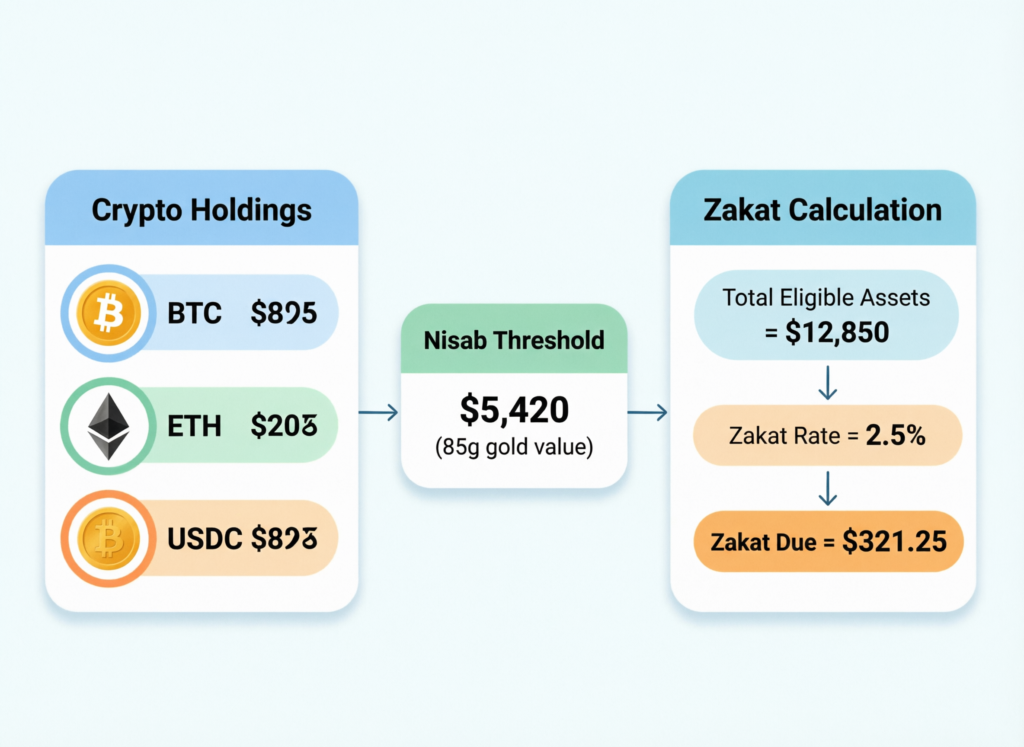
On your zakat date, calculate the current market value of all your halal crypto holdings, add other zakatable assets, subtract short-term debts, check if you meet nisab, then pay 2.5% on the net amount.
Simple example (illustrative only)
Crypto portfolio value on zakat date: $8,000
Other cash and halal investments: $4,000
Short-term debts due soon: $2,000
Net zakatable wealth: $10,000
Zakat due at 2.5%: $250
Trading profits are usually just part of your overall wealth you don’t pay 2.5% each time you make a gain, but on your net position at your annual zakat date. For complex cases (e.g. active trading, business accounts, or German-style tax rules on holding periods) speak to both a qualified scholar and a tax adviser.
How local tax rules interact with halal crypto strategies
Crypto is taxable in almost all Western jurisdictions, regardless of whether you see it as halal or not:
In the US, crypto is typically treated as property: selling, swapping or spending crypto can trigger capital gains tax.
In the UK, HMRC usually treats disposals of crypto as capital gains events; staking and some DeFi yields may be treated as income.
In Germany, capital gains on some crypto held more than 12 months may be tax-free, while frequent trading and staking rewards can be taxed as income.
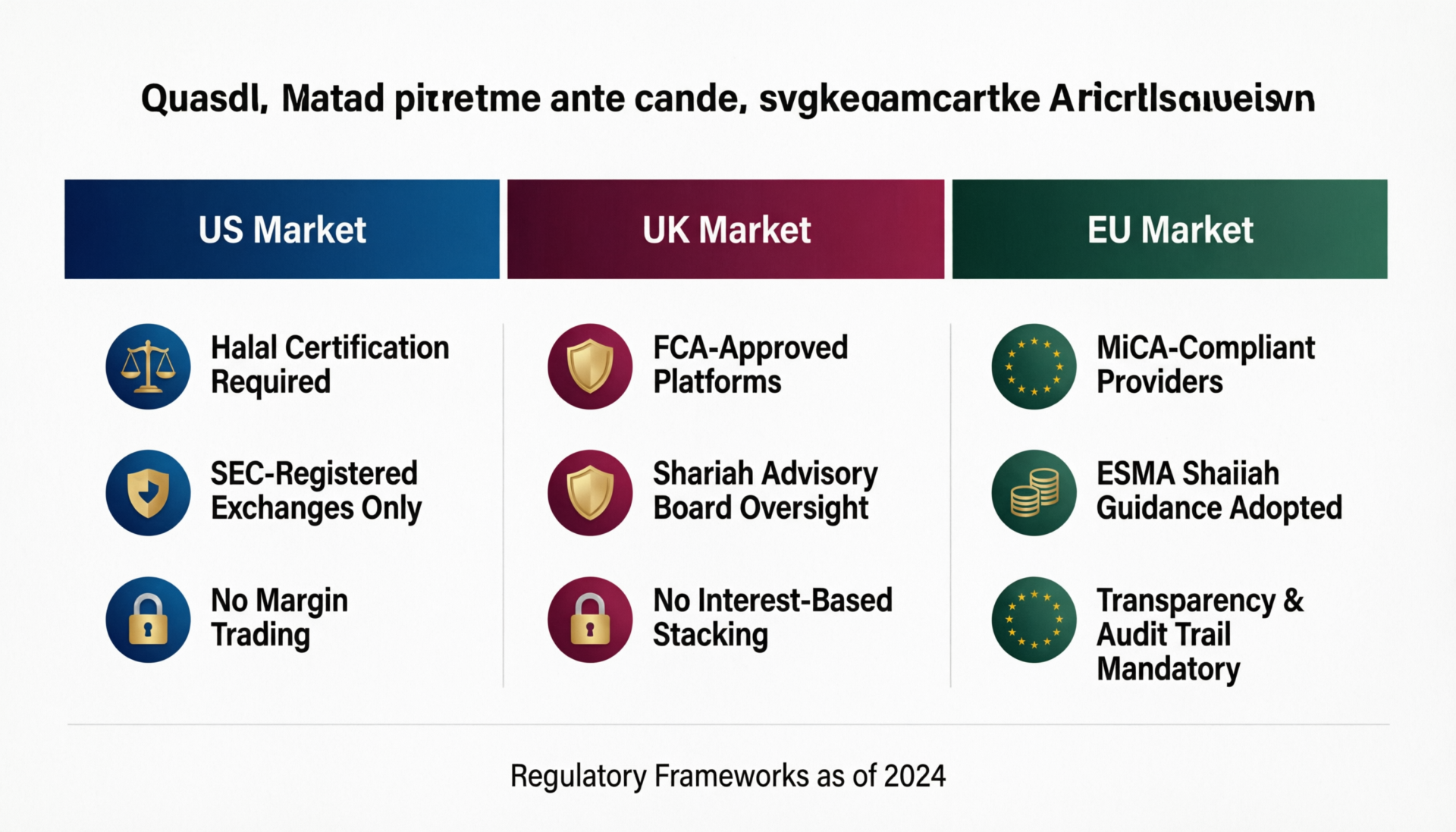
Across the European Union, the new MiCA framework is sitting alongside existing tax rules, but you still need to follow your local country’s guidance.
Because halal crypto investing often favours lower-frequency, spot-based strategies, you may already be nudging towards more tax-efficient behaviour but never assume “halal tax-free”.
Regulatory and data-protection issues Muslim investors should know
From a trust perspective, many Muslims in the West want their crypto platforms to feel as safe and predictable as interacting with a public health system portal – clear rules, strong privacy and robust complaints processes, not anonymous offshore entities.
Key things to look for.
Platforms operating under MiCA in the EU or equivalent frameworks.
Authorisation or supervision by regulators like the FCA (UK) or BaFin (Germany), which are tightening their crypto rules and consumer-duty expectations. (FCA)
Clear KYC/AML, sanctions checks and reporting obligations.
Strong data-protection policies aligned with GDPR/UK-GDPR requirements.
Many of the same secure-by-design practices discussed for other sectors like confidential computing, secure remote work policies and security awareness training apply directly to crypto platforms too. (Mak it Solutions)
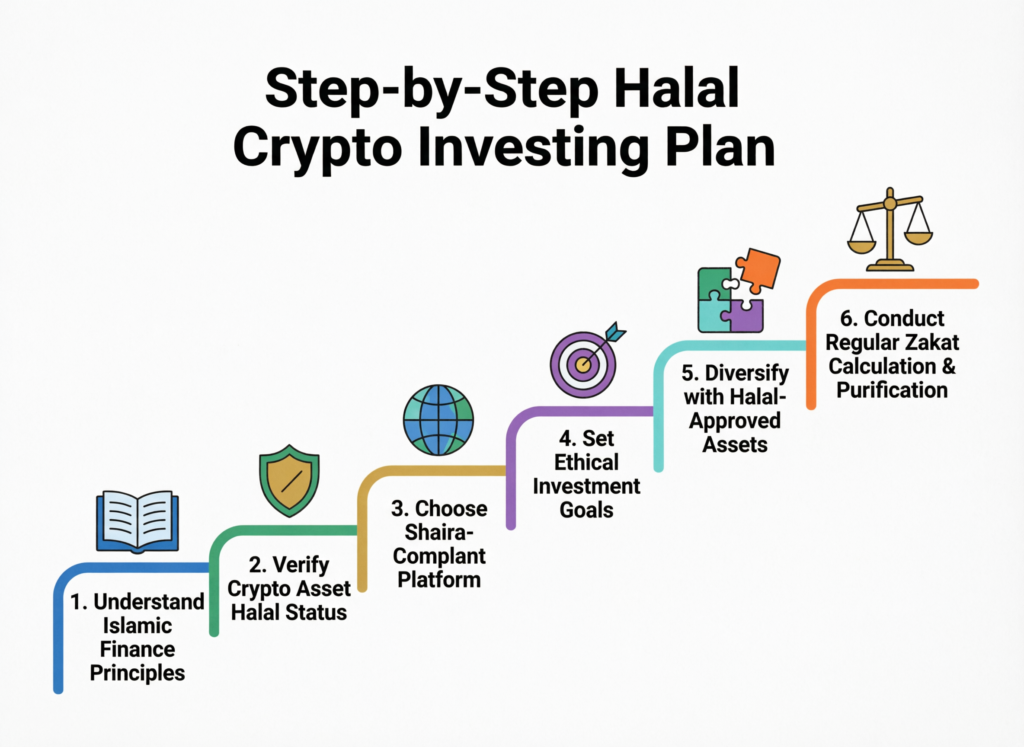
Step-by-Step Halal Crypto Investing Plan and Common Pitfalls
Define your Shariah stance, goals and budget
Clarify your Shariah stance
Decide which scholarly position you will follow (permissible with conditions vs avoid). Write this down in one paragraph so you can refer back when emotions run high.
Set your goals and time horizon
Are you seeking long-term diversification or gambling-style thrills? If it’s the latter, stop. For long-term goals, treat crypto (if allowed) as one small building block in a broader halal plan.
Fix your budget and emergency fund
Ensure you have a proper rainy-day fund and no high-interest debt. Then cap crypto as a small percentage of your halal net worth.
Screen projects, choose platforms and make your first halal-compliant purchase
Here’s a simple practical flow for beginners in the US, UK, Germany or wider EU:
Shortlist coins
Focus on a tiny list of major, useful projects.
Run your checklist
Apply the 6–8-point screening criteria from earlier.
Check external screeners
Cross-check with tools like Halal Crypto Guide, Saraf Screening or Islamic Finance Guru’s screening lists. (Halal Crypto Guide)
Pick a regulated platform
Choose an exchange or broker supervised in your country or EU, with strong security and simple spot products.
Start with a tiny test transaction
Move a small amount, test deposits/withdrawals and basic security features (MFA, withdrawal whitelists)
Over time, you can automate contributions (e.g. monthly DCA) if that fits both your fiqh position and your tax situation.
Automate, review and avoid common mistakes
Once you’re live.
Automate within reason
If DCA is halal in your view, small, automated contributions can reduce emotional decision-making.
Review annually
Once or twice a year, reassess: has your scholar’s view changed? Has regulation or your risk profile changed?
Avoid common traps Be especially careful about.
FOMO during bull runs and panic selling in crashes
Meme coins and celebrity-driven coins with no real utility
“Islamic” branding with weak or non-existent Shariah governance
Chasing triple-digit yields in DeFi without understanding the risks
Consider joining serious educational communities or newsletters that focus on halal investing and regulatory updates, not pump-and-dump schemes.
Key Takeaways
Halal crypto investing starts with Shariah principles: avoid riba, excessive gharar and maysir, then treat coins as real digital assets with lawful use cases.
Scholars genuinely disagree; many Western Muslims follow a “permissible with conditions” view that prioritises spot ownership, major coins and strict risk caps.
A repeatable screening workflow (purpose, business model, riba exposure, documentation, scholar input, regulation and KYC/data protection) is more important than picking the “perfect” coin.
Regulated platforms under MiCA, FCA or BaFin supervision with strong security and privacy protections are far safer than anonymous, offshore exchanges.
Zakat and tax obligations still apply: you must calculate zakat on your net crypto wealth and follow local tax rules in the US, UK, Germany or EU.
A clear step-by-step plan plus education and community support helps you avoid hype, scams and behaviour that can pull you outside both Shariah and good financial sense.
If you’re serious about exploring halal crypto investing, treat this as the starting map, not the final fatwa. Clarify your scholarly stance, write down a simple risk and screening policy, and then decide whether crypto deserves even a small role in your wider halal portfolio.
If your organisation needs help building compliant analytics, dashboards or secure cloud infrastructure around digital assets and other financial data, the team at Mak It Solutions can support with strategy, data, security and modernization across the US, UK, Germany and the wider EU.( Click Here’s )
FAQs
Q : Can I treat long-term Bitcoin holding like owning a foreign currency from a halal perspective?
A : Many scholars who permit crypto see Bitcoin as a type of digital asset that behaves somewhat like a foreign currency: you own a unit of value that can be exchanged for goods or other currencies. If your scholar accepts this analogy, then long-term, fully paid-up holding (no leverage, no interest) can be similar in principle to holding dollars or euros for savings or diversification. However, Bitcoin is far more volatile than most fiat currencies, so from both a Shariah and risk perspective it should usually remain a relatively small, carefully monitored part of your halal portfolio.
Q : Is it halal to dollar-cost average into crypto every month, even during bear markets?
A : If your scholar allows crypto and you stick to spot purchases in halal-screened assets, many see dollar-cost averaging (DCA) as simply a buying pattern not a separate Shariah issue. DCA can help reduce emotional timing mistakes by spreading purchases over months, including during bear markets when prices are lower. The key conditions are that you only invest surplus funds, you keep crypto as a capped slice of your overall halal plan, and you are prepared for the possibility of large drawdowns without compromising your zakat, family obligations or mental health.
Q : Are “Islamic” or “halal” branded crypto tokens automatically Shariah compliant?
A : No. An “Islamic” or “halal” label is just marketing until you verify the Shariah governance behind it. Some projects do engage credible scholars and publish detailed Shariah standards, but others simply add Islamic buzzwords to attract Muslim investors. Always ask: who is on the Shariah board, how are they paid, and how transparent are their rulings and conflicts of interest? If you can’t find clear, independent scholars and detailed documentation, treat that token as unverified at best. Use the same screening criteria you would apply to a conventional token, plus extra scrutiny for religious branding.
Q : How should I handle a coin that later turns out to be haram after I’ve already invested?
A : This is a common real-world issue. If trustworthy scholars or screeners later classify a coin as haram (for example, due to interest-based mechanics or haram underlying activity), the usual advice is to exit your position in an orderly way. Many scholars suggest you may keep your original capital and donate any clearly haram gains to charity without expecting reward, though details differ by madhhab and scenario. The sooner you act after learning of the issue, the better; delay because of greed or hope can make the ruling more complicated. Always confirm the exact clean-up method with a qualified scholar.
Q : What’s the safest way for a beginner to test a small halal crypto investment without risking too much money?
A : A cautious approach might look like this: first, confirm with your scholar that crypto is permissible for you with conditions. Next, choose one regulated, well-known exchange in your country and enable strong security (hardware key or phishing-resistant MFA). Then pick just one or two major, screened coins, and invest a small amount you could afford to see go to zero without impacting your life. Hold this for at least a full market cycle while you keep learning. If at any point you feel tempted to gamble, over-allocate or chase crazy yields, that’s a sign to stop and step back.