
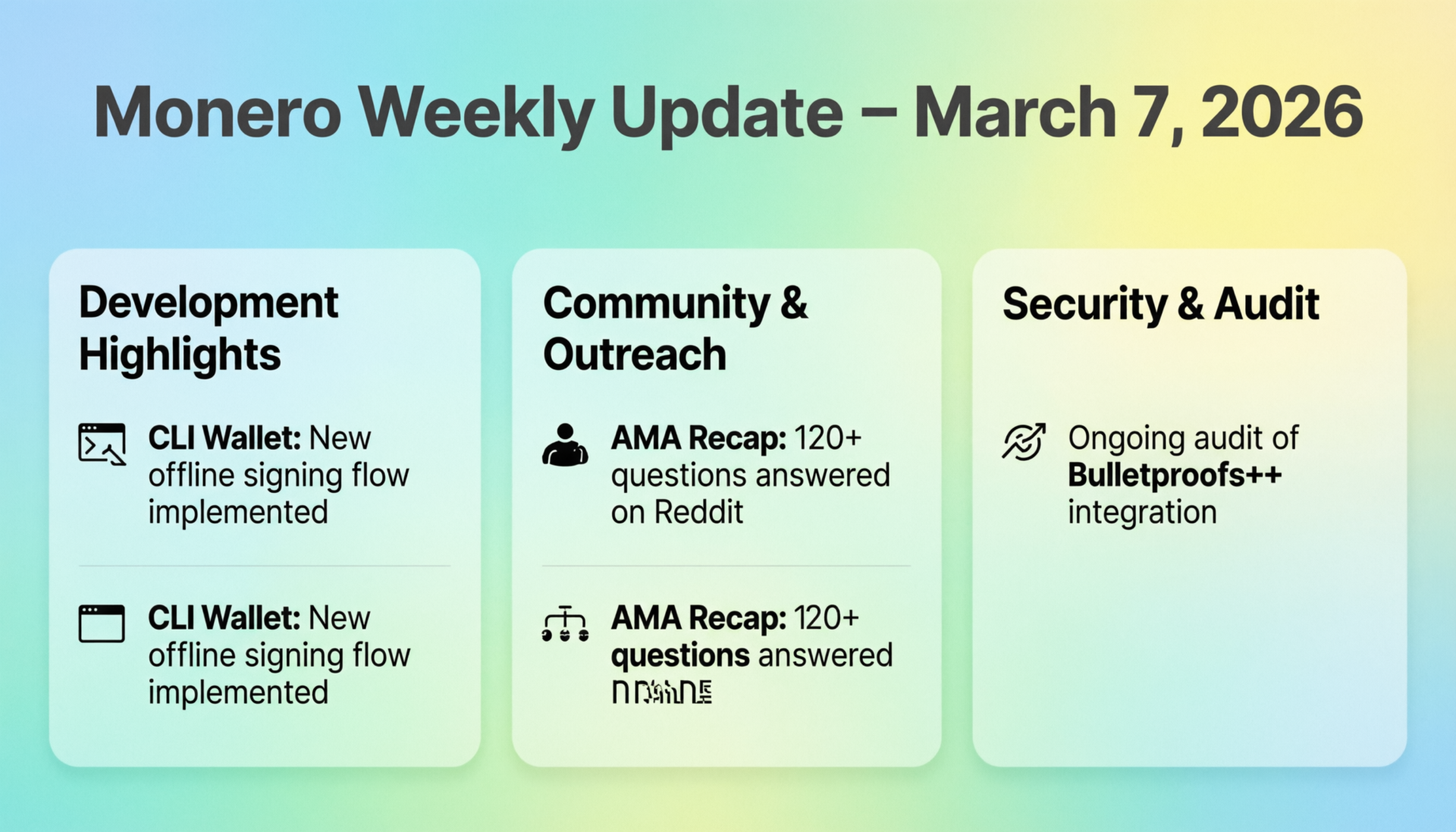

Monero (XMR) Weekly Update Privacy Coin Balances Regulatory Heat and Safe-Haven Demand (March 7, 2026)
Monero (XMR) spent the past week grinding higher in a tight range as privacy coins tried to balance safe-haven demand against rising regulatory heat. Over the last seven days, Monero has traded roughly between $325 and $375, finishing the week near $349, a gain of around 4% versus last week. The move reflects a tug-of-war between renewed demand for privacy coins amid geopolitical tensions and expanding regulatory restrictions and exchange delistings.
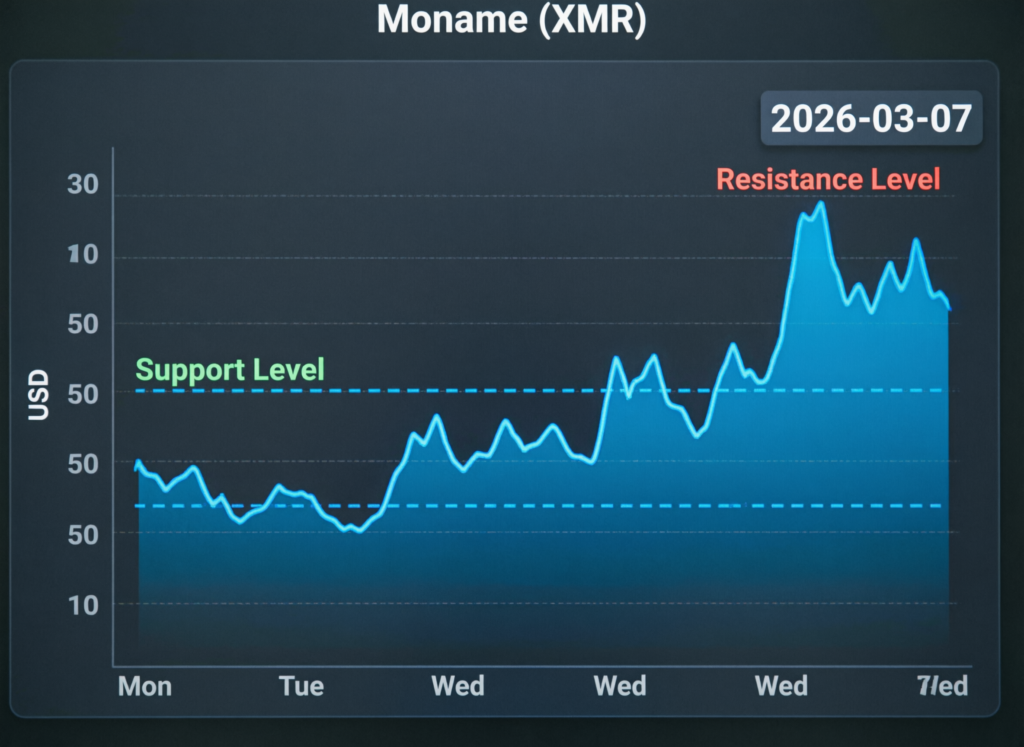
In the near term, key support sits around $340–$325, while resistance is clustered near $370–$380. A clean break above that band would reopen room toward the mid-$400s, while losing $320 would warn of a deeper correction.
Key Data Snapshot (as of 7 March 2026, 11:09 UTC)
Current price: ≈ $349 (XMR/USD)
24h change: around -2.1% to -2.3%
7d change: approximately +4.2%
7d high / low (est.): ≈ $375 / $325 (blended from daily OHLC and venue ranges; exact values vary by exchange)
Market cap: ≈ $6.4–$6.5B
24h volume: ≈ $80–90M
Main sources: CoinGecko, CoinMarketCap, Kraken, MEXC, CoinDesk, Yahoo Finance, CCN, FinanceFeeds.
This Week in Monero (XMR) Quick Summary
This Monero weekly update comes after a turbulent start to 2026 that saw an all-time high near $800 in mid-January, followed by a sharp drawdown.Over the past seven days, XMR has edged higher, roughly +4% week-on-week, as traders rotate back into privacy coins amid geopolitical conflict and safe-haven narratives.
At the same time, regulatory scrutiny continues to tighten. At least 10 countries now restrict or ban privacy coins on regulated exchanges, and many mainstream U.S. platforms no longer list XMR. The result is a market where price is rising modestly, but liquidity, on-ramps and off-ramps are clearly under pressure.
Monero Price Action & Key Levels
Weekly performance
According to major trackers, Monero is trading around $349, with a 7-day gain of roughly 4% and a 24-hour pullback of about 2% as of March 7, 2026. Blended data from multiple exchanges suggests XMR has ranged roughly between $325 (weekly low) and $375 (weekly high) over the past week.
This follows a strong late-February bounce discussed in recent daily analyses, where XMR rallied over 10% week-on-week before consolidating in the low-to-mid $300s. Price action now looks more like digestion of that move than a fresh breakout.
Short-term technical view
Short-term technical commentary from CoinMarketCap’s AI feed notes that the daily chart flipped bullish on March 5, with XMR reclaiming the $357 area as support and pointing at a potential technical target near $473 if momentum resumes. On spot charts, immediate support sits around $340–$325, where buyers have repeatedly stepped in since the post-ATH correction.
On the upside, $370–$380 is shaping up as near-term resistance; this zone lines up with recent daily highs and the underside of the prior breakdown area. Volatility remains elevated compared with blue-chip names like Bitcoin and Ethereum, but not at capitulation extremes consistent with a corrective phase inside a larger, still-uncertain trend.
News & Narratives That Moved Monero This Week
Privacy coins as war-time hedges
Coverage from MEXC highlights that Monero, Zcash and Dash have seen renewed interest as geopolitical tensions (including the US–Iran conflict) push some users toward censorship-resistant value transfer. This narrative has supported XMR even as regulators tighten the screws.
New wave of bans and restrictions
A detailed CCN report counts at least 10 jurisdictions now imposing bans or strict exchange rules on privacy coins, including Japan, South Korea, India and parts of Europe.These measures focus heavily on exchanges and AML requirements rather than directly criminalizing ownership, but they do limit regulated liquidity.
Exchange delistings and the Travel Rule
Bitget’s updated guidance on cashing out Monero in 2026 notes that many retail-facing U.S. exchanges have delisted XMR due to FATF Travel Rule compliance, forcing users toward international platforms or P2P routes.

From $800 peak to structural correction
Analyses from Binance Square, Phemex and others emphasize that XMR’s early-year drop of roughly 30–50% from its January ATH was driven largely by regulatory headlines and liquidity fears, not a collapse in usage.
Future tech roadmap – FCMP++
Recent research notes an upcoming FCMP++ upgrade (planned for August 2026), expected to significantly reduce transaction sizes and further harden privacy guarantees, although this is still months away.
On-Chain, Derivatives & Sentiment
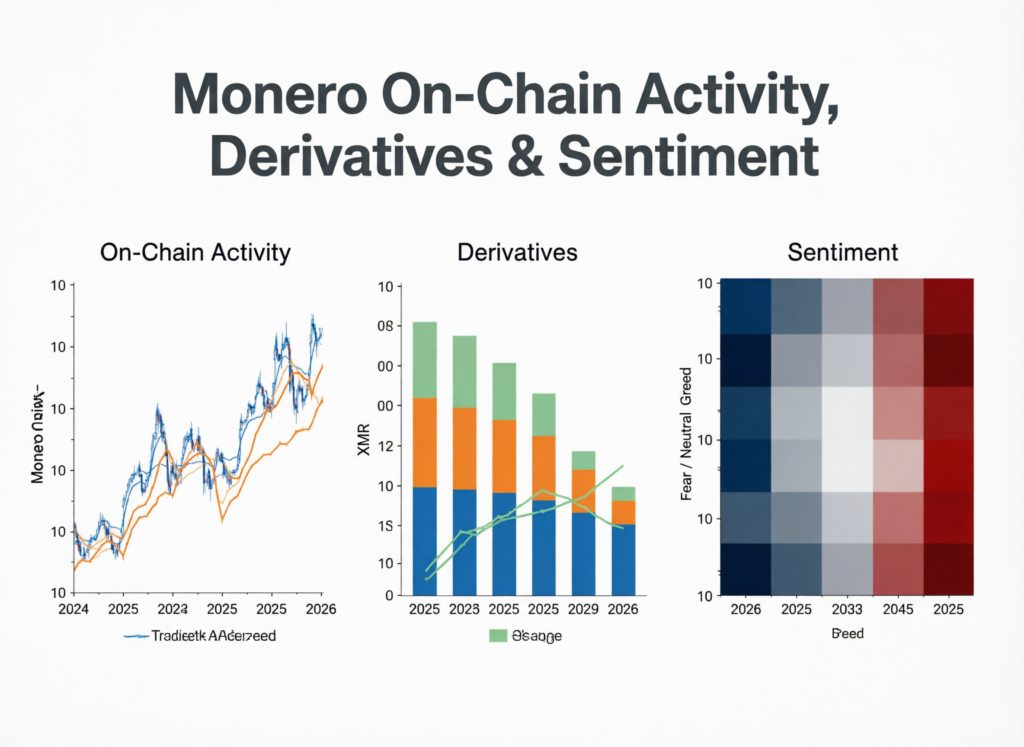
Despite the delistings, several on-chain and market-structure datapoints show remarkable resilience.
A Yahoo Finance analysis and multiple research pieces highlight that Monero network activity has stayed robust, with daily transactions and active addresses not collapsing despite being removed from many large exchanges.
CoinStats and MEXC reports note that around half of new darknet markets now prefer or exclusively support XMR, underlining its continued role where privacy is a primary feature, not a bug.
Derivatives data in recent daily market notes show balanced positioning with moderately bullish sentiment in futures funding rates are not at extremes, suggesting no crowded long or short.
Taken together, the on-chain and derivatives picture supports the view that XMR remains a high-conviction niche asset: fewer venues, but a committed user base and traders willing to hold through regulatory uncertainty.
Monero vs Bitcoin & the Wider Crypto Market
While Monero has gained about 4% over the last week, Bitcoin has been choppy to slightly weaker, sliding from above $70k earlier in the week to the mid-$60k to high-$60k region in recent data. Ethereum trades near $1,980 and continues to wrestle with a multi-month downtrend, with recent reports highlighting six straight red months into early March.
That means XMR modestly outperformed large caps this week, but it is still far below its January ATH around $800 and faces much harsher structural headwinds in terms of regulation, liquidity and institutional narratives.
What This Means for Traders & Long-Term Holders
For short-term traders
Expect elevated but not extreme volatility around the $325–$375 band.
Watch $340–$325 as key short-term support and $370–$380 as resistance; moves outside this range could accelerate momentum either way.
Liquidity is more fragmented than for majors; slippage can be higher, especially on smaller venues.
News flow on country-level bans, exchange delistings or enforcement actions can trigger outsized intraday swings.
For long-term holders
The core thesis still revolves around default, strong privacy, fungibility and censorship resistance, all of which remain intact technically.
However, regulatory and delisting risk is structural, not temporary; some jurisdictions explicitly want privacy coins off regulated platforms.
Upcoming upgrades (like FCMP++) and continued CPU-friendly mining (RandomX) are positives for decentralization and utility.
Access routes matter: holders increasingly rely on international exchanges, decentralized venues, or P2P markets, each with their own risk profile.
Risks, Scenarios
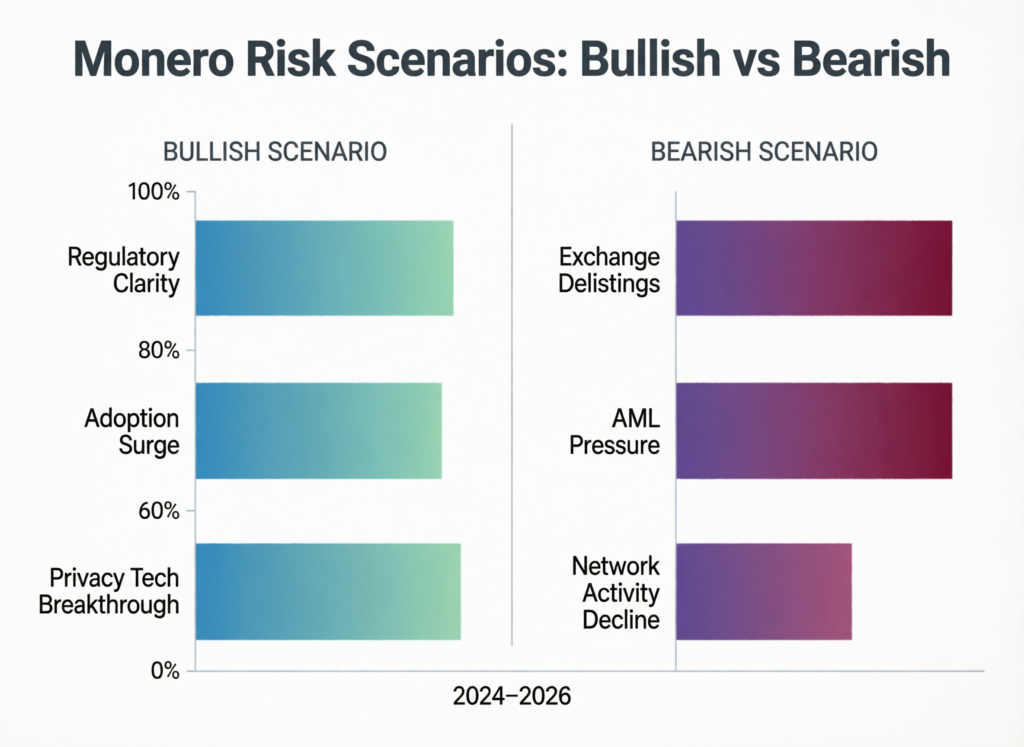
Bullish scenario
Privacy demand continues to rise amid geopolitical instability and surveillance concerns; XMR holds above the low-$300s, regulatory focus stays on exchanges rather than self-custody, and FCMP++ lands smoothly allowing price to rebuild toward prior resistance in the high-$400s and beyond over time.
Neutral scenario
Ongoing push-and-pull between regulatory headlines and grassroots demand keeps XMR range-bound between roughly $300 and $450, with periodic spikes around news but no clear long-term trend.
Bearish scenario
Additional G20-level rules or major exchange actions sharply limit fiat on-ramps, driving liquidity lower and pushing XMR back toward prior support zones in the low-$300s or below, even if on-chain activity remains stable.
Wrapping It Up
Monero’s 7 March 2026 weekly update shows a market that is bruised but far from broken. Price action around the mid-$300s, with support near $325–$340 and resistance at $370–$380, reflects traders carefully re-accumulating while watching regulation and liquidity risk.
For both short-term traders and long-term holders, Monero (XMR) remains a high-conviction but high-risk privacy asset. Geopolitical tension, new bans and exchange delistings can quickly change the picture, so sizing, venue choice and self-custody discipline matter. As always, treat this Monero analysis as information, not financial advice.
FAQs
Q : Why did Monero (XMR) move this week?
A : XMR gained around 4% over the last seven days as traders rotated into privacy coins on the back of renewed geopolitical tensions and a broader conversation about financial surveillance. At the same time, the market is still digesting earlier drawdowns from January’s $800 peak, so this week’s move looks more like a measured rebound than a fresh parabolic run.
Q : What are the key support and resistance levels for XMR right now?
A : Short-term, many analysts are watching the $340–$325 area as key support, reflecting recent weekly lows and the post-correction base. On the upside, $370–$380 is near-term resistance, with CoinMarketCap’s AI feed pointing to a broader technical target near $470–$480 if bulls regain control above the mid-$300s.
Q : How are new regulations affecting Monero this week?
A : Fresh coverage from CCN and other outlets underscores that at least 10 countries now explicitly restrict or ban privacy coins like Monero on regulated exchanges, including India’s directive for local platforms to drop XMR, ZEC and Dash. For everyday users this mainly impacts where they can buy or sell XMR, not whether they can hold it in self-custody.
Q : Is Monero usage actually falling because of delistings?
A : So far, the data suggests usage is holding up better than price: network activity metrics and several analyses indicate steady daily transactions and a growing share of darknet markets choosing XMR, even as major exchanges delist the coin. That said, liquidity has become more fragmented, which can increase trading costs and volatility.
Q : Is Monero too risky or volatile for new crypto investors right now?
A : Monero combines technical strength and strong privacy with very real regulatory and liquidity risks, making it higher-risk than blue-chip assets like BTC or ETH for many newcomers. The coin’s history of sharp rallies and deep drawdowns, plus evolving country-level rules, means anyone considering XMR should be comfortable with significant volatility and do thorough, independent research first.