

How to Buy Bitcoin in Egypt Without Bank (Safe Guide)
You can buy Bitcoin in Egypt without a local bank account by using reputable peer-to-peer (P2P) marketplaces that support cash, mobile wallets and prepaid options, then withdrawing your coins to a secure personal wallet. For family or expats in the US, UK, Germany or EU, a common route is to buy BTC or USDT on a regulated exchange abroad, send it to a P2P-compatible wallet, and let the recipient in Egypt convert or cash out locally only where this is legal and compliant.
Important
This guide is educational only and is not financial, legal or tax advice. Crypto rules in Egypt are restrictive and evolving always check the latest Central Bank and local laws, and never do anything that may be illegal where you live.
Introduction
Many people search “buy bitcoin in Egypt without bank” because normal routes like cards and local bank transfers often fail or are heavily restricted. Others don’t fully trust local banking, or they’re unbanked and need a cash-based crypto on-ramp instead of a traditional account.
In Egypt, the Central Bank has repeatedly warned against cryptocurrency trading and says issuing, promoting or trading crypto without its approval is prohibited, with potential fines and even imprisonment for some violations.At the same time, surveys such as the World Bank’s Global Findex suggest that only around two-thirds of adults have access to a bank or mobile-money account, leaving millions who may rely on cash or mobile wallets for everyday payments.
That mix of strict regulation, FX controls and limited banking access explains why people in Cairo, Alexandria or Giza look at peer-to-peer bitcoin trading, cash-based crypto on-ramps and mobile wallet payments instead of classic bank transfers. This guide walks through how these methods typically work in Egypt and abroad but you are responsible for confirming that any action you take is compliant where you live.
Bank blocks, FX limits and card declines in Egypt
If you try to buy BTC on a foreign exchange with an Egyptian card, you’ll often see a decline. Banks may block crypto-related merchant codes, cap FX usage, or simply reject international online payments to reduce capital flight and fraud risk. These limits can change quickly and are rarely explained clearly to end users.
On top of that, the Egyptian pound has faced significant volatility, and authorities use monetary and FX policy to manage pressure on the currency.When you combine volatile FX, card controls and a strict line on unlicensed crypto, it’s no surprise that users look for alternatives like P2P platforms, stablecoins and cash-based routes again, often in a legal grey area.
Who searches for “buy bitcoin in Egypt without bank”
This keyword usually maps to four groups:
Residents with blocked cards who still have bank accounts but can’t get payments through to exchanges.
Unbanked or under-banked users relying on cash, mobile wallets or telco products to move money.
Students, freelancers and gig-workers getting paid from clients in the United States, United Kingdom or Germany and wanting to hold or hedge in BTC or USDT.
Family abroad in New York, London, Berlin, Paris or Amsterdam who want to send value home without Egypt-side bank transfers.
Each group has different risk tolerance and legal exposure. For example, a freelancer receiving crypto income may need to think about both Egyptian tax rules and the rules in the client’s country, plus the platform’s KYC and reporting.
What this guide will and won’t cover
What we’ll do here
Explain common patterns Egyptians and expats use: P2P, cash, mobile wallet payments, stablecoins.
Compare privacy levels (no-KYC vs light KYC vs full KYC).
Show example routes from the US/UK/DE/EU to Egypt.
Highlight technical and personal-security risks.
What we won’t do
Encourage you to break any Central Bank, FX, tax or AML rules.
Recommend specific platforms as “the best” or help you hide funds.
Give investment advice on whether you should buy Bitcoin at all.
Always cross-check with a qualified local advisor before relying on any of this in practice.
Safest Ways to Buy Bitcoin in Egypt Without a Bank
The safest way most people in Egypt technically get Bitcoin without a local bank account is by using a reputable P2P marketplace with strong escrow, selecting high-rated traders who accept cash or mobile wallet, and immediately withdrawing BTC to a self-custody wallet once the trade is complete. Where local law allows, this keeps your coins off centralized exchanges and reduces counterparty risk.
For friends and family in the US, UK, Germany or wider European Union, the safer pattern is: buy BTC or USDT on a regulated exchange, send it to a P2P-compatible wallet, and let the Egyptian side handle any local conversions or cash-outs in line with their own legal obligations.
Safest path for residents inside Egypt
For residents who decide to proceed after checking the law, the typical “safest” path looks like this:
Choose a well-known P2P platform with escrow, public reputation scores and dispute resolution.
Filter offers for payment methods you can legally use (cash in person, mobile wallet, cash deposit, etc.).
Pick high-reputation traders with many completed trades, high completion rates and clear terms.
Pay only as agreed, keep proof (receipts, screenshots), and confirm the BTC is locked in escrow.
Release escrow only after you see BTC or USDT in your account, then withdraw to your own wallet.
In any face-to-face deal, meet in public, never carry more cash than you can afford to lose, and consider bringing a friend for safety.
Safest path for family and expats in USA/UK/Germany/EU
If you’re abroad in places like New York City, London or Berlin, you usually have a clearer legal route:
Open an account with a regulated exchange such as Coinbase, Kraken, Bitpanda or Bitvavo and complete full KYC.
Deposit via bank transfer (ACH, Faster Payments, SEPA) often cheaper than cards.
Buy BTC or USDT and send it to a self-custody wallet compatible with P2P platforms.
Share the wallet address or QR code securely with your contact in Egypt.
They then decide when and how to convert or cash out locally, based on what is allowed in Egypt at that time.
Methods to avoid or treat with caution
Approach these with extreme care (or avoid entirely)
Social media DMs promising cheap BTC in Cairo or Alexandria with no escrow.
Un-escrowed OTC trades, where you simply “trust” someone to send coins after cash.
Crazy premiums or discounts compared to global market prices.
Any offer that tells you to “bypass the platform” or “cancel after payment” both are classic scam patterns.
Methods to Buy Bitcoin in Egypt Without Bank: Cash, Mobile Wallets & Prepaid Cards
For people physically in Egypt, the main non-bank routes involve cash, mobile wallet payments and occasionally prepaid or gift cards. Remember: these methods may still fall under Central Bank rules even if you never touch a local bank account, so legal risk doesn’t magically disappear.
Buying bitcoin with cash from trusted local P2P traders
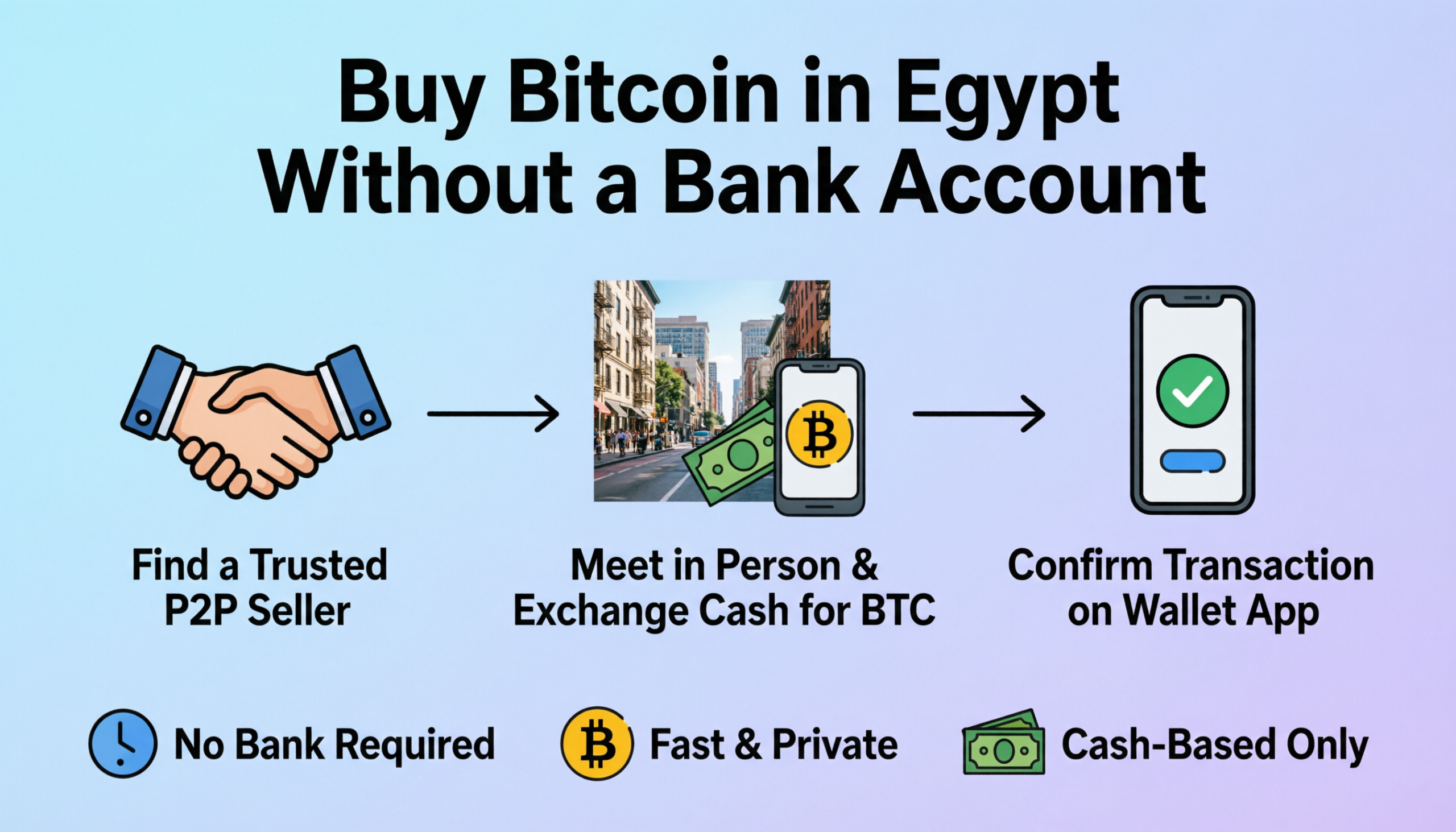
On most P2P platforms, you can filter for “cash in person” or “cash deposit” offers. The basic idea is that the seller locks BTC in platform escrow, you pay cash, and the platform releases coins when both sides confirm.
Key safety practices
Use escrow every time – never agree to move outside the platform chat.
Check trader stats: high trade count, high completion rate, verified ID where available.
Meet in a public place (mall, café, co-working space), ideally during daylight and with a friend.
Confirm on your phone that BTC arrived in your platform wallet before you leave.
Research from firms like Chainalysis has found that in many emerging economies, P2P trades make up a bigger share of total crypto activity after local currencies face shocks people use BTC and stablecoins as a parallel rail, even when rules are tight.
Using Egyptian mobile wallets and telco payments to fund P2P buys
Many P2P traders accept mobile wallet payments, airtime transfers or telco bill payments instead of bank transfers. This is attractive to users who have SIM-linked wallets but no traditional account.
Before trading
Check the exact wallet brand and type the seller accepts.
Confirm limits some telco wallets cap daily or monthly sends.
Double-check fees on both sides so you’re not surprised by spreads and charges.
For anyone building fintech or wallet products targeting markets like Egypt, secure integration with these flows is a classic use case for custom web and mobile development – something teams like Mak It Solutions cover in their mobile app development services and web development services.
Prepaid cards, vouchers and gift cards as last-resort options
Sometimes residents use international prepaid cards, vouchers or gift cards as a bridge: they buy the card in EGP, then sell its value on a P2P marketplace to someone who can redeem it abroad.
Trade-offs
Higher spreads: buyers will demand a discount vs face value.
More scams: fake codes, already-used vouchers, or chargebacks if cards are funded with stolen details.
Platform limits: some exchanges have banned gift-card trading because of fraud.
Treat this as a backup option when safer routes like cash-escrow trades or mobile wallets aren’t available.
Using P2P Platforms and Stablecoins (USDT) to Get Bitcoin into Egypt
Most non-bank flows into Egypt today rely on P2P platforms plus stablecoins like USDT, which are pegged to currencies such as the US dollar. Stablecoins have exploded in usage globally, with one analytics firm estimating that annual stablecoin transaction volume exceeded USD 4 trillion between January and July 2025 alone.
How P2P bitcoin Egypt marketplaces work step by step
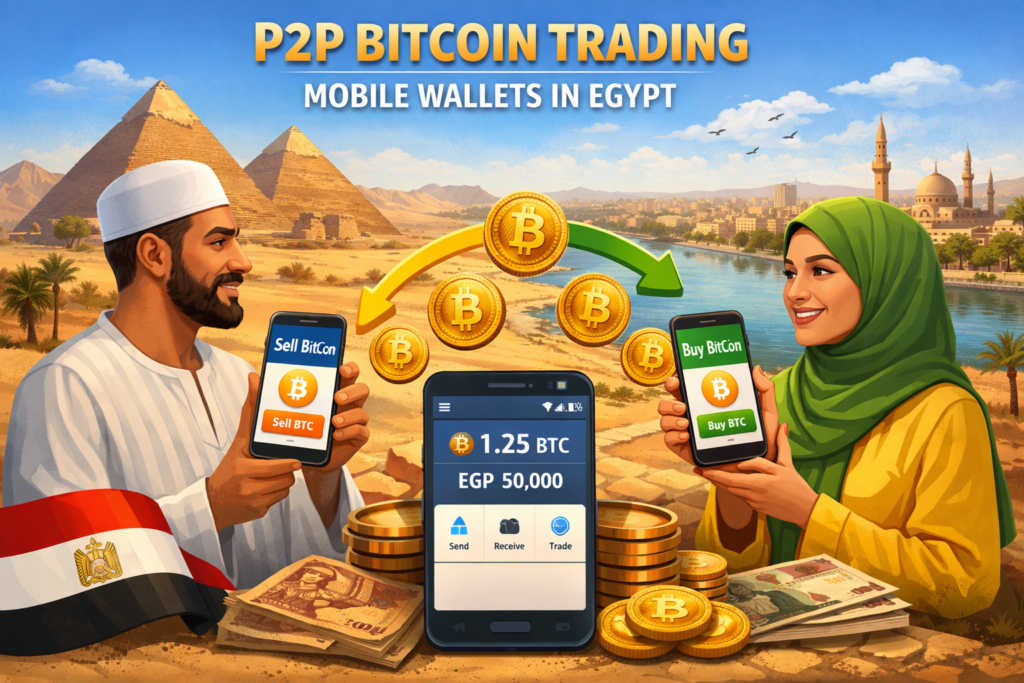
Here’s how P2P marketplaces generally work, whether you’re in Cairo or London:
Account & KYC
You register, secure your account, and complete whatever ID checks the platform requires for your region.
Browse offers
You filter for the crypto you want (USDT or BTC), your fiat (EGP, USD, EUR) and payment method (cash, wallet, SEPA, etc.)
Place an order
The platform locks the seller’s crypto in escrow so they can’t disappear with your money.
Off-platform payment
You send cash or mobile money using the agreed method and mark it as paid.
Release & rating
The seller confirms they’ve received funds, escrow releases the crypto, and you both leave ratings.
If something goes wrong for example, you paid but the seller refuses to release you can normally open a dispute and provide evidence. Escrow and dispute resolution are the reason you should choose a platform over informal Telegram or WhatsApp trades.
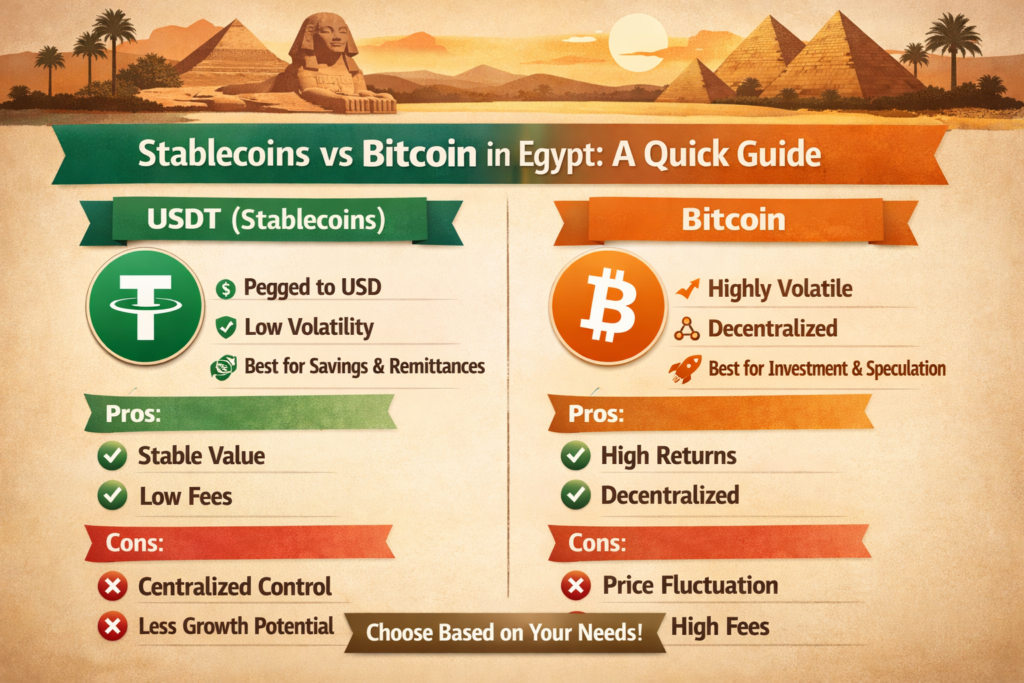
Why many users start with USDT in Egypt, then swap to BTC
In many EGP markets, USDT/EGP pairs are more liquid than BTC/EGP, meaning tighter spreads and more available offers. Users often:
Buy USDT against EGP via P2P.
Hold USDT as a short-term hedge vs local currency volatility.
Swap some USDT into BTC on a spot market or swap feature when they want longer-term exposure.
Reports on the Middle East & North Africa region suggest crypto volumes in MENA hit well over USD 300 billion in the year to mid-2024, with a big share involving stablecoins rather than BTC itself.
Comparing global exchanges that serve Egypt via P2P
Different platforms have very different rules for Egyptian users
KYC tiers
Some allow low-limit trading with “light KYC” (email + phone), while others require full ID and proof of address up front.
Payment methods
Check whether EGP, USD and EUR P2P markets exist, and if they support cash, wallets and SEPA.
Regulation
Platforms regulated in the UK by the Financial Conduct Authority or supervised in Germany by BaFin must comply with stricter data-protection and custody rules than offshore sites.
Where a platform is regulated (MiCA in the EU, future UK rules, US oversight by bodies like FinCEN/SEC/CFTC) can be a useful trust signal but it does not override Egyptian law if that law says certain activities are prohibited.
Privacy, KYC and Regulations When Buying Bitcoin in Egypt
Anonymous, low-KYC and fully verified options compared
On most exchanges and P2P platforms, you’ll see three broad privacy levels.
No-ID / very light KYC
Email and maybe phone verification only, with low limits and higher risk of bans or seized funds.
Light KYC
Basic ID verification, selfies, maybe address checks, but with moderate limits.
Full KYC
Full identity and address verification, income questions, and detailed monitoring for AML/CTF.
Generally, the more anonymous you try to be, the more you’ll pay in spreads and the higher your risk of frozen accounts or legal trouble especially in a country with tight crypto rules like Egypt.
What to know about Egyptian central bank guidance and legal risk
Key points from recent guidance.
Law No. 194 of 2020 prohibits issuing, promoting or trading cryptographic units without prior Central Bank approval.
The Central Bank has repeatedly warned the public against dealing with cryptocurrencies through any platforms, highlighting volatility, fraud and cybercrime risks. [cbe.org.eg]
Reports differ on whether private individuals trading on foreign platforms are directly criminalized, but penalties for violating the Central Bank law can include substantial fines and prison terms.
Because of these contradictions, many lawyers describe the situation as legally risky even if outright ownership isn’t clearly banned. Before you do anything, read recent summaries from reputable legal sources and consider getting country-specific advice.
How global rules (GDPR, FCA, BaFin, MiCA, etc.) affect the platforms you use
While Egyptian law affects whether you should trade at all, global rules affect how your data and assets are handled
In the EU, the GDPR sets strict standards for handling personal data and breaches.
The UK GDPR and the UK ICO’s guidance shape how exchanges market to and protect UK users.
Under MiCA, EU-regulated crypto-asset service providers must meet harmonized rules on custody, disclosures and complaint handling.
Using platforms under these regimes doesn’t remove price or legal risk, but it usually improves transparency, data protection and recourse compared to lightly regulated offshore sites.
Sending Bitcoin from USA, UK, Germany or EU to Someone in Egypt
Cheapest ways to buy in US/UK/DE/EU and send to Egypt
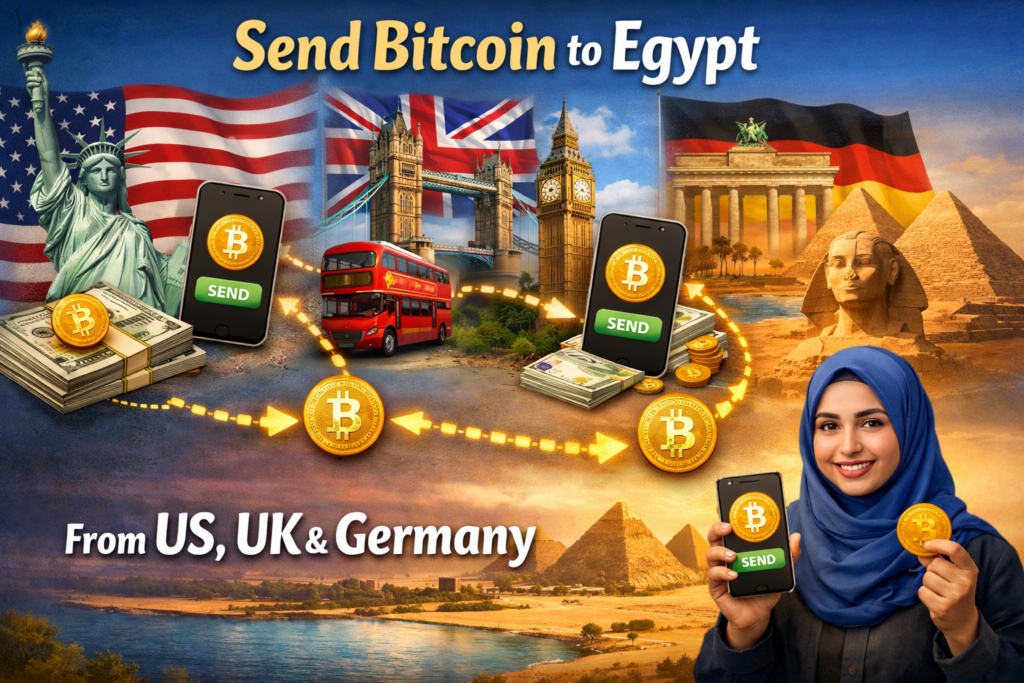
If you’re abroad and want to support family in Egypt, a typical route looks like:
Buy on a regulated exchange using local rails: ACH in the US, Faster Payments in the UK, SEPA in Germany or the EU.
Choose between BTC and USDT: USDT is often easier for the recipient to convert locally; BTC may be better if they want long-term exposure.
Send to their self-custody wallet or P2P account address.
Let them decide whether to keep it in crypto or cash out, taking full account of Egyptian law.
Global crypto market capitalization hovered around USD 2 trillion in late 2024, reminding us that these flows are now part of mainstream financial debates, not just a niche hobby.
Reducing FX, spread and network fees on remittances
Cost-cutting tips (where lawful)
Prefer low-fee rails
Bank transfers (ACH, SEPA) are usually cheaper than card purchases.
Use cheaper networks
Some exchanges support low-fee BTC or USDT networks; compare withdrawal fees before sending.
Avoid double spreads
Try not to convert from local currency → USD → BTC → USDT → EGP unless necessary; each hop adds a margin.
If you’re building a cross-border payment product, these optimizations map straight into data-driven dashboards and fee-routing logic a classic job for business intelligence services and SEO-driven growth work.
Example routes from New York, London and Berlin to Cairo or Alexandria
High-level examples only (always check both ends for compliance):
New York → Cairo
US sender uses ACH to fund a US-regulated exchange, buys USDT, sends to recipient’s wallet; recipient in Cairo decides whether to hold or, where legal, convert via P2P.
London → Alexandria
UK sender uses an FCA-supervised platform, pays via Faster Payments, buys BTC, sends on-chain; recipient treats BTC as savings and only converts small parts to cash as needed.
Berlin → Giza
DE sender uses a MiCA-aligned European platform and SEPA transfer, sends USDT to contact; contact converts only what they legally can and keeps the rest in crypto.
Storing, Securing and Cashing Out Bitcoin in Egypt Without Banks
Setting up secure wallets for Egyptian users
If you’re going to hold BTC or USDT at all, security is non-negotiable:
Use a reputable hot wallet app for small, everyday amounts.
Consider a hardware wallet for larger balances.
Write your seed phrase on paper (never in screenshots or cloud notes) and store it in a safe, offline location.
Keep your phone and laptop updated and protected with strong passwords and, ideally, a password manager.
Safe ways to sell or spend bitcoin in Egypt without local banks
Again, only where law allows:
P2P to cash or mobile wallet: Sell via escrow; accept only payment methods you can verify instantly.
Direct crypto payments: Some freelancers and merchants accept BTC or USDT directly, avoiding the need to cash out.
Informal OTC desks with escrow: In some regions, there are desk-style brokers who use platform escrow or smart contracts but do extra due diligence before trusting them.
To build secure checkout flows or merchant tools for these scenarios, brands often combine custom web development with targeted digital marketing and analytics exactly the kind of projects Mak It Solutions documents in its Middle East web trends guides and BI resources like The Complete Guide to Business Intelligence Services.
When to move into stablecoins or EGP and planning your exits
Many users treat USDT or similar stablecoins as a parking asset when they don’t want full BTC volatility:
They may hold USDT during periods of local currency stress and only convert to BTC when they’re comfortable with the risk.
Before any large expense in Egypt, they plan an exit strategy: which platform to use, what spreads to accept, and what legal/reporting obligations might apply.
Given how fast rules shift in Egypt, the UK, the EU and the US it’s wise to review your plan every few months and keep an eye on official guidance from regulators, not just social media.
Key Takeaways
Buying Bitcoin in Egypt without a bank usually means P2P marketplaces, cash, mobile wallets and sometimes prepaid cards – all within a tight and evolving regulatory environment.
The Central Bank of Egypt’s law and repeated warnings mean any crypto trading may carry legal risk, even if you avoid local bank rails, so compliance checks are essential.
For family in the US, UK, Germany or EU, the safer pattern is to buy BTC or USDT on regulated exchanges, then transfer to loved ones’ self-custody wallets rather than trying to route money into Egyptian banks.
Stablecoins like USDT play a central role as a liquid bridge between EGP and global crypto markets, especially in emerging economies.
Whatever route you choose to buy bitcoin in Egypt without bank channels, prioritize security (wallet hygiene, public meetups, escrow), understand P2P platform reputations, and be ready to adapt if your bank or regulator changes the rules.
If you’re exploring crypto-enabled products from P2P remittance tools to mobile wallets and analytics dashboards you don’t have to design the tech stack alone.The team at Mak It Solutions has deep experience in web, mobile and data-driven crypto/fintech solutions for clients across the USA, UK, Germany and wider Europe.
Share your idea and constraints via the contact page, and the team can help you scope a compliant, scalable architecture tailored to high-risk markets like Egypt no pushy sales, just a clear technical roadmap you can act on.
FAQs
Q : Is it legal to hold Bitcoin in Egypt if you bought it through a P2P platform?
A : Egypt’s Central Bank law focuses on issuing, promoting and trading cryptocurrencies without approval, and authorities have repeatedly warned against using regional or international platforms.Some legal analyses say simple ownership isn’t explicitly criminalized, but any trading, promotion or business activity involving crypto may be treated as a violation with significant fines or even jail time. Because interpretations differ and enforcement can be strict, you should treat all crypto activity in Egypt as high-risk and seek local legal advice before using P2P platforms.
Q : Can Egyptian students or freelancers buy small amounts of Bitcoin without a bank account?
A : In practice, some students and freelancers use P2P marketplaces, cash or mobile wallets to acquire small amounts of BTC or USDT without a local bank transfer. However, the Central Bank’s stance doesn’t change just because amounts are small unlicensed trading can still be considered illegal, and platforms may share data with regulators abroad. If you rely on crypto income from clients in the US, UK, Germany or EU, it’s vital to understand both your local obligations and any reporting or tax rules in those other countries before proceeding.
Q : Which mobile wallets and local payment methods in Egypt are most commonly used for P2P crypto trades?
A : P2P ads in Egypt often mention telco-linked mobile wallets, cash deposits and airtime or bill payments as alternatives to classic bank transfers. Traders like these methods because they’re fast to confirm and widely available, even for people without full bank accounts. The exact brands and wallet types allowed can change as providers tweak their risk policies, so always check current platform payment lists and make sure any wallet you use is properly registered in your real name to avoid AML and fraud flags.
Q : How can I check if a local Bitcoin trader in Egypt is trustworthy before meeting with cash?
A : Start by using P2P platforms with public reputations and escrow, not anonymous chat groups. Look for traders with a long track record, high completion percentages, clear terms and verified IDs where available. Avoid anyone who pushes you to move the deal off-platform or asks you to release escrow before you see the crypto. For in-person cash trades, meet in a public place, bring only the agreed amount, and consider having a friend or neutral third party present for extra safety.
Q : What is the difference between sending USDT and sending Bitcoin to someone in Egypt, and which is cheaper?
A : USDT is a stablecoin pegged to fiat, so its price is designed to track the US dollar, while BTC is highly volatile and mainly used as a long-term asset. In many P2P markets, USDT has better liquidity against EGP, tighter spreads and more payment options, which can make it cheaper and easier for the recipient to convert or hold. BTC, by contrast, can be more expensive to move during busy network periods and harder to price locally, but some users prefer it as a long-term store of value. The “cheapest” option depends on network fees, local spreads and what the person in Egypt plans to do with the funds.