

Bitcoin touches $70,000, then fades as ether and solana lead risk-on rebound
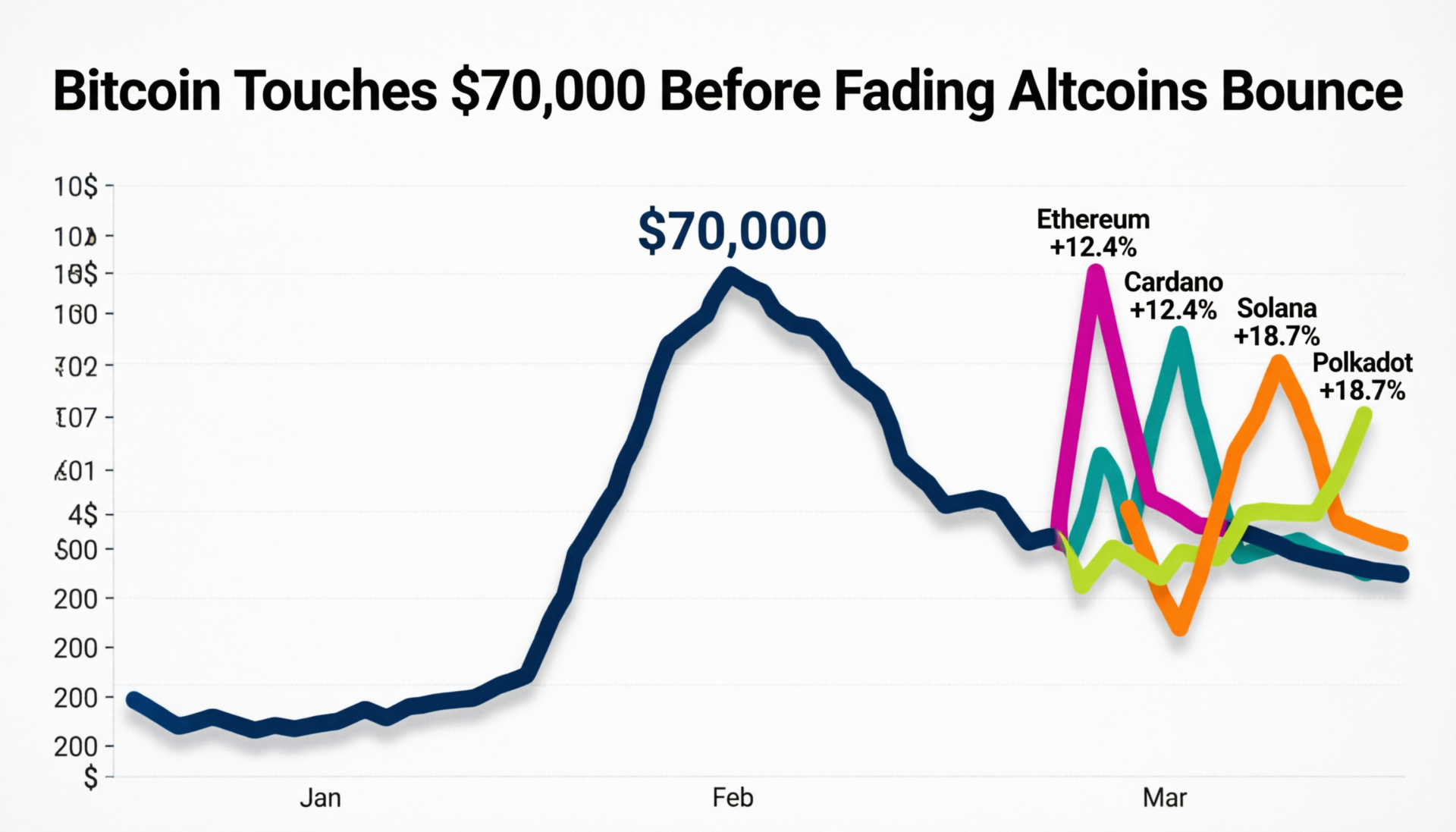
Bitcoin touches $70,000 before fading as altcoins lead the strongest bounce in weeks, with traders piling into higher-beta tokens as the market attempts to stabilize after the early-February selloff. Bitcoin briefly approached $70,000 before pulling back to around $68,300, a swing of nearly 5% from session highs to the overnight low near $67,700.
Bitcoin touches $70,000 before fading as altcoins lead the strongest bounce in weeks: what happened
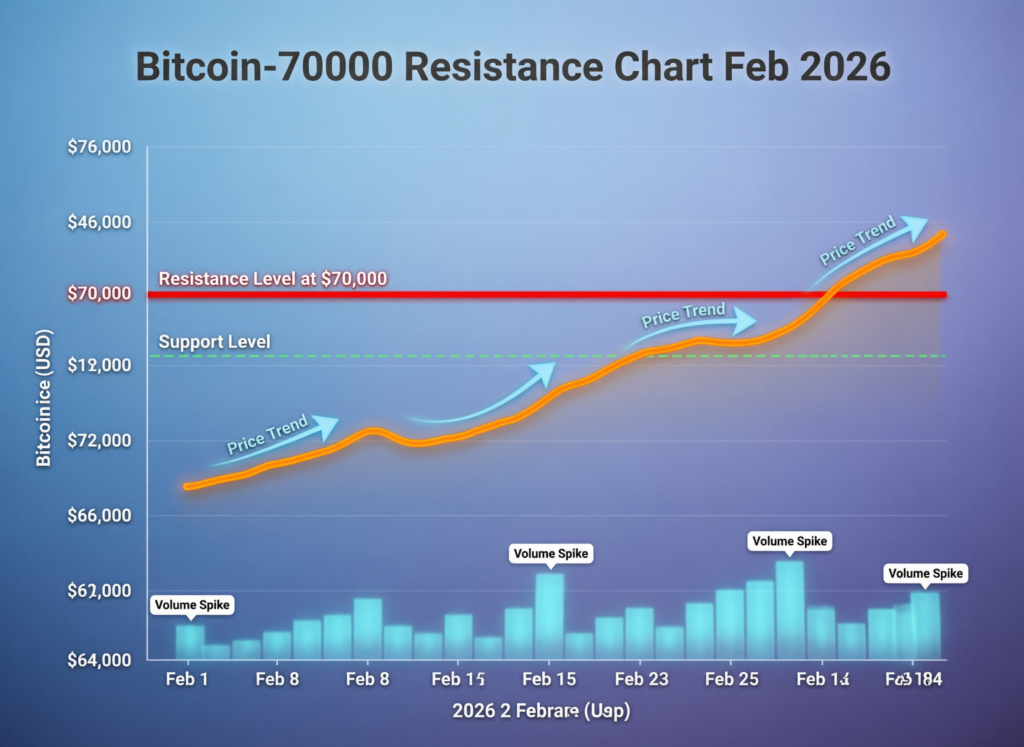
Bitcoin’s rally attempt marked its strongest move back toward the $70,000 level since the Feb. 5 crash, but it fell short of a clean breakout—an outcome that underscores $70,000 as a major technical resistance area for traders watching price structure and positioning.
Market participants framed the move as a relief bounce rather than a confirmed trend change, with attention shifting to whether spot demand and liquidity conditions can support follow-through.
Why Bitcoin touches $70,000 before fading as altcoins lead the strongest bounce in weeks is being watched as a “rotation” signal
While bitcoin gained roughly 4% on the day, several large-cap altcoins outperformed: ether rose about 8.5%, solana about 6.9%, cardano about 10.8%, and dogecoin about 8.3%, according to CoinDesk’s market recap.
That divergence is commonly interpreted as risk appetite expanding outward from bitcoin into higher-volatility assets often described as a “rotation” into higher-beta tokens when traders believe the heaviest selling has passed.
CoinDesk quoted Daniel Reis-Faria, CEO of ZeroStack, saying: “The wave of forced selling is starting to clear out… That tells me we’re seeing a rotation.”
Macro and liquidity headwinds remain in focus
The bounce arrived as equity markets processed Nvidia’s quarterly earnings, which beat expectations but did not sustain a rally; Nasdaq 100 futures dipped after the report, and Nvidia’s post-earnings move cooled.
Analysts cited in the report highlighted broader concerns.
Market maker Wintermute has argued crypto has been moving in tandem with tech, with capital rotating into more defensive or tangible assets.
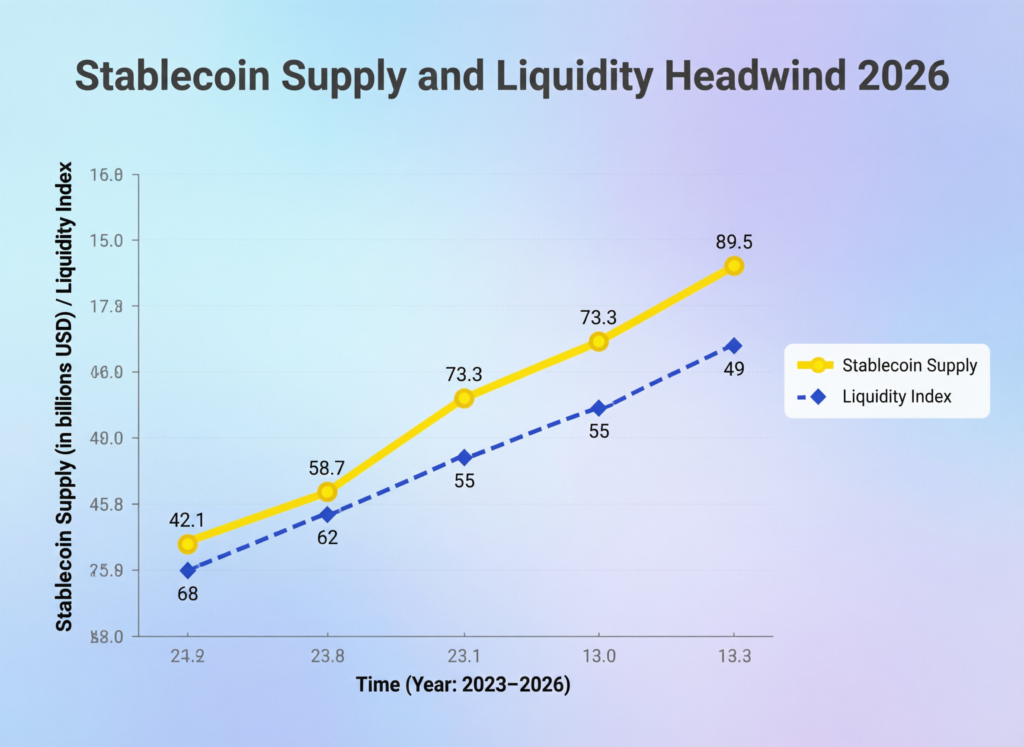
Matrixport has pointed to stagnation in stablecoin supply as a meaningful obstacle for bitcoin’s recovery, while other research expects liquidity improvement to take time.
Separately, analysis reported by Cointelegraph (via TradingView) noted total stablecoin supply had fallen year-to-date in 2026, a datapoint often used as a proxy for available “dry powder” in crypto markets.
Near-term levels and downside risks traders are citing
CoinDesk’s report flagged a straightforward near-term risk: if bitcoin breaks down below $60,000, some market commentary warns of potential cascading liquidations that could push price toward the $50,000–$55,000 range or lower in a disorderly selloff.
At the same time, the day’s price action suggests sellers may be losing momentum in the very short term creating space for rebounds while the medium-term outlook remains uncertain as long as liquidity and macro conditions are not clearly improving.
Concluding Remarks
Bitcoin’s rejection near $70,000 kept the market’s bigger question unresolved: is this bounce the start of a sustainable recovery, or a temporary relief rally fueled by rotation into higher-beta tokens? The next test is whether liquidity indicators improve and whether bitcoin can reclaim resistance without triggering another wave of liquidations on a downside break.
FAQs
Q : Why did Bitcoin pull back after nearing $70,000?
A : Because the move stalled at a widely watched resistance level, while broader macroeconomic and liquidity conditions remain uncertain.
Q : Which altcoins outperformed Bitcoin in this rebound?
A : Ether, Solana, Cardano, and Dogecoin posted larger percentage gains than Bitcoin on the day.
Q : What does “rotation into higher-beta tokens” mean?
A : It refers to traders shifting from Bitcoin into more volatile assets (often altcoins) when they believe selling pressure is easing and they want greater upside exposure.
Q : What’s the risk if Bitcoin falls below $60,000?
A : Some market commentary warns this could trigger cascading liquidations and extend losses toward lower price ranges if selling accelerates.
Q : How does stablecoin supply affect crypto prices?
A : Analysts often view stablecoin growth as a liquidity proxy; stagnant or declining supply can signal tighter liquidity for buying risk assets.
Q : How is the stock market tied to this move?
A : Market makers like Wintermute note that crypto has been moving alongside tech stocks, with macroeconomic shifts influencing both.
Q : What does “Bitcoin touches $70,000 before fading as altcoins lead the strongest bounce in weeks” suggest about sentiment?
A : It suggests short-term risk appetite may be returning especially in altcoins while the broader market trend still depends on liquidity conditions and macro follow-through.
Facts
Event
Bitcoin neared $70,000, then retreated as major altcoins outperformed in a broad bounce.Date/Time
2026-02-26 (article timestamps shown as “10:31 a.m.” and “10:41 a.m.”; timezone not specified in the provided text)Entities
Bitcoin (BTC), Ethereum (ETH), Solana (SOL), Cardano (ADA), Dogecoin (DOGE); Nvidia; Nasdaq 100; Wintermute; Matrixport; Glassnode; CryptoQuant; Bitrue; Binance; ZeroStackFigures
BTC near $70,000 then ~$68,300; ETH +8.5%, SOL +6.9%, ADA +10.8%, DOGE +8.3%, BTC +4.3%Quotes
“The wave of forced selling is starting to clear out…” Daniel Reis-Faria, CEO, ZeroStackSources
CoinDesk market report; Cointelegraph (via TradingView) on stablecoin-supply trend