

How to Buy Crypto in Saudi Arabia Safely (Guide)
The safest way to buy crypto in Saudi Arabia in 2026 is to use a well-regulated international exchange that still accepts Saudi users, complete full KYC, fund your account with a traceable method (bank transfer or card), then move your coins into a secure self-custody wallet. Because Saudi Arabia does not recognize crypto as legal tender and regulators warn that virtual currencies are high risk and outside local supervision, you should avoid unlicensed local schemes, keep clear records, and never invest more than you can afford to lose.
How to Buy Crypto in Saudi Arabia (2026 Guide for US, UK & EU Users)
Interest in buying bitcoin and stablecoins for use in Saudi Arabia is growing fast, even as the government keeps repeating that virtual currencies are high-risk and not approved as official money. This guide is for three main groups: people living in the Kingdom (citizens and expats), people visiting or working in hubs like Riyadh or Jeddah, and people in the United States, United Kingdom, Germany or wider EU who want to send crypto to wallets used inside the Kingdom.
You’ll get a legality-aware, step-by-step path: what documents you need, which payment methods are realistic, how cross-border flows usually work, and what risk controls to put in place. It’s not personal investment advice; it’s a map of the current landscape so you can have smarter conversations with your bank, tax adviser or compliance team.
How to Buy Crypto in Saudi Arabia Quick Answer
The most robust way to buy crypto tied to Saudi use-cases in 2026 is to use a reputable, well-regulated international exchange, complete strict KYC/AML checks, fund with traceable money, then withdraw to a wallet you control. Saudi authorities have repeatedly warned that virtual currencies are not approved as official currencies, are not licensed locally, and sit outside the traditional banking system so unregulated local schemes and “too good to be true” offers are especially risky.
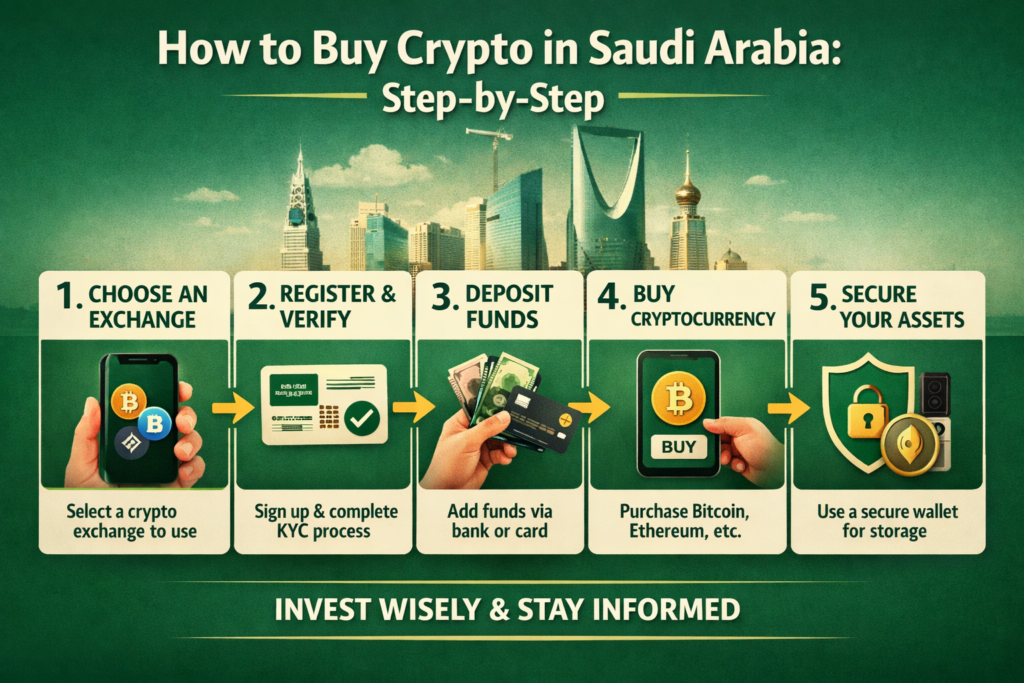
Step-by-step: how to buy crypto in Saudi Arabia (2026)
Here’s a typical 6-step flow many users follow (whether they’re in KSA, the US, UK or EU):
Choose a reputable exchange
Prioritise platforms regulated where you live (for example, FCA-registered in the UK, BaFin-supervised in Germany, or licensed in an EU jurisdiction).
Look for security certifications (such as PCI DSS for card payments and SOC 2 for cloud security), plus clear risk disclosures and transparent terms.
Create your account
Sign up with email, a strong unique password and app-based 2FA.
If you’re physically in KSA, some exchanges may geo-block your IP; others will allow sign-up but restrict certain features.
Complete KYC verification
Expect to upload a passport or national ID, a selfie, and proof of address (bank statement or utility bill).
If your residency or IP address is in KSA, the platform may apply extra scrutiny or simply decline the account because of the Kingdom’s stance on crypto.
Verification can be instant or take a few business days depending on volume and risk checks.
Deposit fiat (SAR / USD / EUR / GBP)
From inside KSA, bank transfers to crypto exchanges are often blocked; card payments may work on some platforms but fail on others.
From the US, UK or EU, you’ll usually deposit via ACH, domestic wire, SEPA or Faster Payments in your local currency.
Buy your crypto (BTC, ETH, USDT, etc.)
Place a market order (fast, but you accept the prevailing price) or limit order (you set the price and wait to be filled).
Expect trading fees roughly in the 0.1–0.5% range, plus any FX spread if you’re converting SAR ↔ USD/EUR/GBP.
Withdraw to your own wallet
Move coins off the exchange into a self-custody wallet (hardware or mobile) with a backup seed phrase.
For Saudi use, many people favour major stablecoins (like USDT or USDC) for remittances and short-term savings, given price volatility in other coins. Industry research suggests stablecoins already represent a large share of crypto transactions in MENA.
Signing up from the United States, the UK or EU is usually smoother because your bank and regulators have clearer rulebooks for licensed exchanges. Signing up inside KSA tends to be harder, with more chance of blocked deposits or geo-restrictions.
What You Need Before You Start (ID, Documents, Bank Account)
To buy bitcoin or other crypto in connection with Saudi Arabia, you usually need: a government-issued ID, proof of address, a compatible bank account or card, a verified email and mobile number, and if you plan to self-store a non-custodial wallet.
Most regulated exchanges in the US, UK and EU follow similar KYC/AML standards:
Passport or national ID (front and back)
Proof of address (bank statement, tax bill or utility bill, typically less than 3 months old)
Selfie or short liveness video
In some cases, proof of income or source of funds for larger deposits
For residents or IPs detected in Saudi Arabia, platforms may layer on further checks or outright decline the account, because crypto is not recognized as legal tender and sits in a legal grey zone.That doesn’t automatically mean you’re committing a crime by holding crypto, but it does mean service providers are cautious.
If you’re unbanked in KSA, you may still pass exchange KYC but struggle to fund the account; we’ll cover non-bank methods later.
Typical Fees, Limits and Timings for KSA-Focused Purchases
When your end-wallet is in Saudi Arabia, three cost layers usually matter:
Trading fees & spreads Maker/taker fees often fall around 0.1–0.5% plus a small spread on the order book.
Funding & withdrawal costs
Cards: commonly 1.5–4% deposit fee plus any FX mark-up your bank adds.
International wires: a flat bank fee plus a fee at some exchanges (for example, €/$25–40 per withdrawal).
P2P: platform fees can be low (sometimes 0–1%), but the spread between buyer and seller prices can be 2–5% or more.
FX conversion SAR is typically converted into USD or EUR before buying crypto, so you might pay both bank FX and exchange-side FX.
Card purchases are often instant; international wires can take 1–3 business days; P2P trades can be almost instant but depend heavily on counterparty reliability.
Is Crypto Legal in Saudi Arabia?
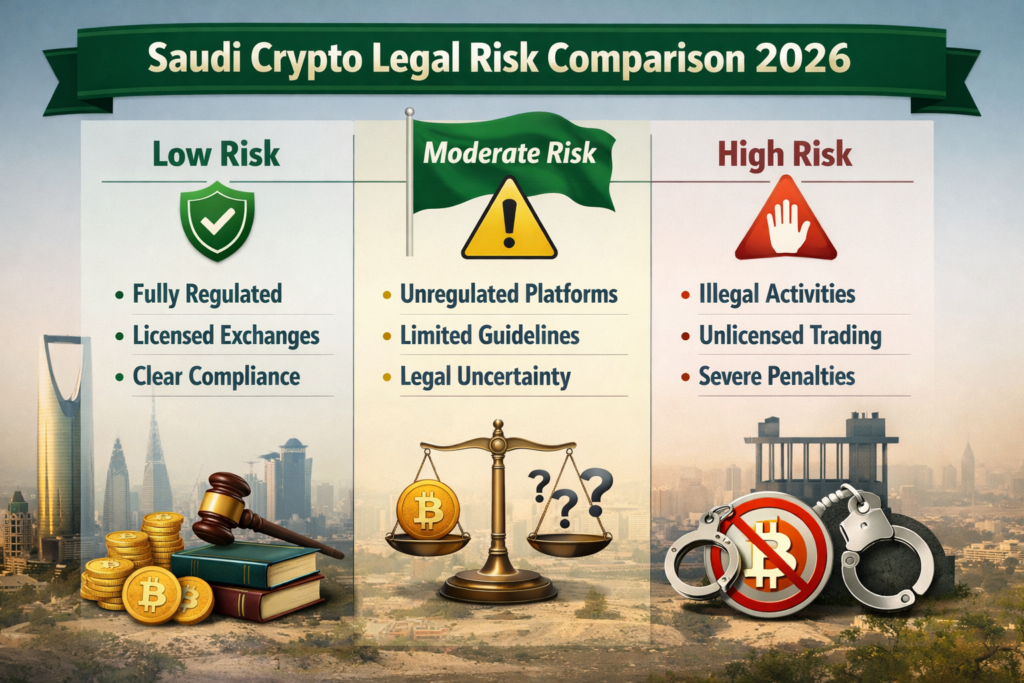
Saudi regulators take a cautious, sometimes confusing stance: crypto trading is strongly discouraged and often described as “illegal” or “not approved”, but there is still no dedicated retail-trading law or clear penalty schedule for individuals.
What SAMA, CMA and the Ministry of Finance Actually Say (2026 View)
The standing committee including the Saudi Central Bank (formerly SAMA), the Capital Market Authority and the Ministry of Interior has repeatedly warned that:
Virtual currencies, including bitcoin, are not approved as official currencies in the Kingdom.
No parties or individuals are licensed to provide crypto trading services domestically.
Trading such assets is high risk, outside government supervision and can lead to losses and fraud.
Recent legal research up to 2025 concludes that crypto is not recognized as legal tender and sits outside conventional banking and securities frameworks, though simple holding or trading by individuals is not always expressly criminalized.
In parallel, Saudi policy circles are exploring tokenization and digital assets for institutional use, but under strict supervision.
How These Rules Affect Banks, Cards and Local Platforms
Because of this stance, banks and payment institutions in KSA are generally expected not to facilitate retail crypto trading, even as they experiment with blockchain in pilots:
Banks may block transfers to known exchanges or decline card payments tagged with crypto merchant category codes.
There are no domestically licensed retail exchanges, so residents rely on foreign platforms or P2P networks.
Policy work is underway on centrally supervised stablecoins and tokenized instruments, especially as Saudi looks to keep pace with neighbouring hubs.
Commentary around stablecoin regulation notes Saudi Arabia has no specific stablecoin law yet, though there are plans to develop nationally regulated tokens under central-bank and market-authority oversight.
What This Means for US, UK, German and EU Users Dealing With KSA
If you’re in the US, UK, Germany or elsewhere in the EU:
Buying crypto at home on a regulated exchange is typically allowed, subject to your local rules and tax laws.
Sending that crypto to a wallet used in Saudi Arabia is technically just an on-chain transaction, but it still interacts with Saudi policy, especially if the recipient later touches KSA banks.
You also need to respect.
Home-country AML and sanctions rules, including Travel Rule thresholds on some exchanges.
Tax reporting (for example, capital gains filings in the US and UK, or BaFin-aligned guidance in Germany)
Think of Saudi policy as an extra risk layer on top of your domestic regulatory obligations, not a replacement for them.
Best Crypto Exchanges for Saudi Users
Some international exchanges accept users who live in Saudi Arabia; others restrict them to avoid regulatory friction and AML concerns. When platforms say they are not available in your country, they may block KSA IPs, refuse KSA IDs, or quietly fail SAR-linked payments, even if the same platform happily serves US, UK or EU customers.
Global Exchanges That Accept Saudi Users (KSA Residents & Expats)
When comparing platforms, focus less on brand names (which change policy frequently) and more on objective criteria.
Licences in strong jurisdictions (for example, supervision by the FCA, BaFin or EU regulators)
Transparent proof-of-reserves and regular security audits
Clear statements on whether Saudi residents are allowed
Support for common rails: international wires, cards and stablecoins
If you’re in the US, UK or EU but funding a Saudi-controlled wallet, you’ll usually sign up with your domestic details, complete KYC under home-country rules, and then withdraw on-chain to the Saudi wallet.
For readers building dashboards or tools around these flows, Mak It Solutions offers compliant web and app development services that already factor in cross-border fintech and GCC regulations. (Mak it Solutions)
P2P Marketplaces & OTC Options for Saudi Buyers
P2P marketplaces list hundreds of offers where individual buyers and sellers trade using payment methods like:
Local bank transfers and instant payments
Cash deposits at ATMs or branches
Gift cards, vouchers and local wallets
Pros
Access even when your bank blocks direct exchange transfers
Local pricing and SAR-denominated trades
Flexibility for users whose cards or accounts are flagged for crypto use
Cons
Counterparty and scam risk
Possibility of chargebacks or fake payment proofs
Need for strong escrow, reputation and dispute-resolution systems
Regional data suggests P2P and OTC volumes involving Saudi users already exceed roughly $1.5 billion annually in the mid-2020s.
Comparing Fees, Limits and Payment Methods (Cards, Bank, Wallets)
Roughly, you can expect:
Cards: highest convenience, medium–high fees; some exchanges allow Apple Pay or Google Pay overlays, but your underlying card issuer still decides whether to approve the transaction.
Bank transfers (US/UK/EU) often the lowest percentage fee, but slower and subject to compliance checks; SEPA and Faster Payments are particularly cost-effective when sending EUR/GBP into global exchanges.
P2P: usually no formal “deposit fee”, but the crypto price itself can be several percent above the mid-market rate.
Before committing, use each platform’s fee calculators and run a small test purchase (for example, $50–$100) to see the real effective rate.
Buying Crypto in Saudi Arabia With Card, Bank Transfer or Cash
Most users connected to Saudi Arabia end up using a mix of cards, international bank transfers and P2P workarounds. The best choice depends on where your bank account is, how strict your bank is about crypto, and how quickly you need the funds.
Using Local Saudi Debit and Credit Cards
To buy crypto with a Saudi-issued Visa or Mastercard:
Register with an international exchange or fiat on-ramp that explicitly lists KSA cards as supported.
Complete KYC and 3-D Secure setup.
Use the card-buy widget to purchase BTC, ETH or stablecoins in SAR or a major currency.
Common issues
Transactions failing because the bank has blocked crypto MCC codes.
Low daily card limits compared to your desired purchase size
Banks manually calling or messaging to confirm unusual overseas payments
Mobile wallets like Apple Pay work as a wrapper on top of your card; if the bank blocks crypto, using Apple Pay generally won’t bypass that block.
Buying via International Bank Transfer (US, UK, SEPA, GCC)
For many users, especially expats with foreign accounts, international wires are the backbone.
A US resident wires USD from a domestic bank to a US-regulated exchange, buys USDT, then sends it to a Saudi-controlled wallet.
A UK resident uses Faster Payments to fund a British exchange in GBP; a German resident uses SEPA in EUR to fund a BaFin-supervised platform.
Once the crypto is on-chain, the network doesn’t care whether the receiving wallet is in Riyadh, London or New York.
FX and compliance considerations:
Your bank’s FX spread between SAR and USD/EUR/GBP
Bank and exchange transfer fees
Automated AML screening, especially for transfers referencing Saudi Arabia or the Gulf Cooperation Council.
Cash, Vouchers and Gift-Card Workarounds
P2P platforms often list offers for.
Cash in person (meetups in malls or cafés)
Cash deposits at ATMs
Vouchers and gift cards for global merchants
These methods should be treated as high-risk:
Never meet in secluded locations; insist on public, well-lit venues and bring a friend for larger deals.
Always use platform escrow and refuse offers that push you into off-platform chat apps for “better rates”.
For bigger amounts, the risk of money-laundering exposure or even being used as a mule rises sharply.
If you’re avoiding banks entirely, stay comfortably below any thresholds that might trigger law-enforcement interest, and keep clear records in case you need to explain the transactions later.
How to Buy Crypto in Saudi Arabia Without a Bank Account
You can get crypto connected to Saudi use-cases without a local bank account, but each workaround increases risk and potential regulatory attention.
P2P and Cash-Based Methods for Unbanked Users in KSA
For students, gig workers or people with frozen accounts.
Choose a reputable P2P platform with strong escrow and identity-verified traders.
Verify your own identity anonymous accounts are often blocked quickly.
Filter offers for “cash”, “local wallet” or specific payment apps used in KSA.
Trade small at first, build a list of trusted counterparties, and avoid emotional decisions.
You pay for this flexibility with wider spreads and more counterparty risk. Check user ratings carefully and walk away from sellers who refuse escrow.
Prepaid, Virtual and Fintech Cards From the UK & EU
Some users bridge funds into crypto using prepaid or virtual cards from UK or EU fintech apps.
Load the card via SEPA or Faster Payments in Europe, or partner rails in the US.
Use the card on a global exchange that accepts non-Saudi issuers.
Withdraw the resulting crypto to a self-custody wallet accessible from Saudi Arabia.
Expect
Strict KYC from the fintech provider
Top-up limits (for example, €1,000–€2,500/month initially)
Extra checks when topping up from Saudi IPs or bank sources, as providers must comply with EU AML and GDPR/DSGVO rules.
Safety Checks to Avoid Fraud, Chargebacks and Account Closures
Basic rules
Red flags: offers significantly below market price, pressure to complete off-platform, screenshots instead of real payment confirmation.
Chargebacks: card buyers can sometimes reverse payments; if you are the seller on a P2P platform, stick to irreversible methods or accept the risk.
Account closures: banks and fintech apps can close accounts for “policy violations”, including unapproved crypto activity, even without alleging wrongdoing.
Treat your crypto records the way a hospital treats patient data under something like the National Health Service (NHS): carefully stored, well-organized and ready to explain to auditors if needed.
Cross-Border: US, UK & EU Residents Sending Crypto to Saudi Wallets
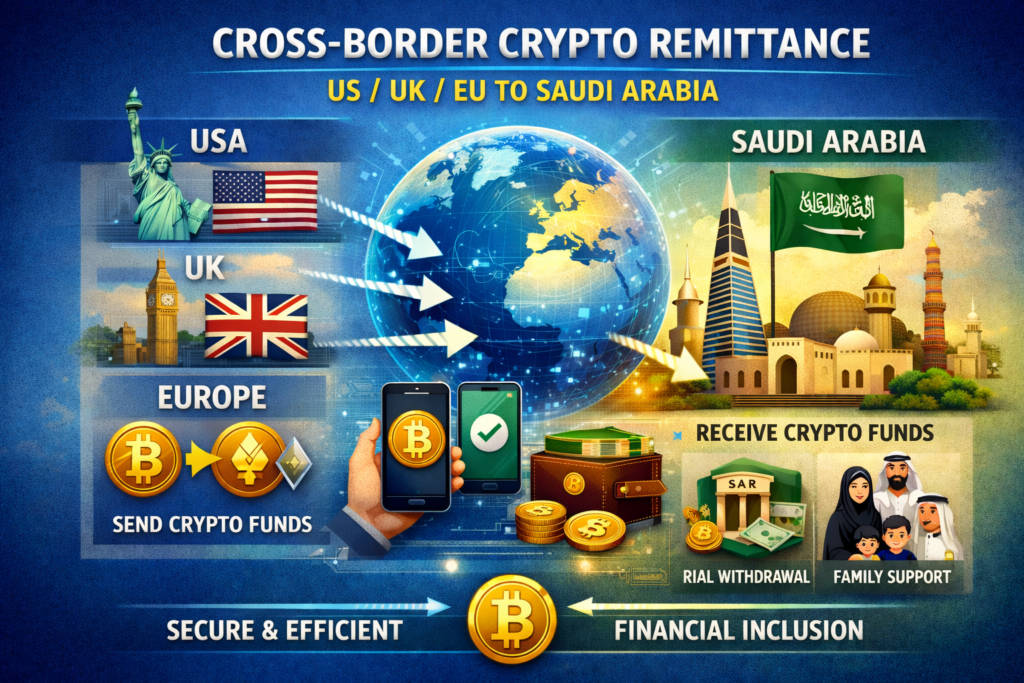
Many Saudi-linked crypto flows are actually cross-border: an expat in New York, London or Berlin buys crypto at home, then sends it on-chain to a wallet used in KSA.
The most robust approach is to buy on a regulated exchange in your home country using local payment rails, withdraw to a wallet you control, and then send only from that wallet to the Saudi-controlled address, keeping clean records for tax and AML purposes.
US Residents Using Regulated Exchanges to Fund Saudi Wallets
A typical US flow looks like this.
Open an account at a US-regulated exchange.
Fund via ACH or domestic wire.
Buy your chosen asset (often BTC or USDT)
Withdraw to your self-custody wallet, then send to the Saudi wallet.
US-specific considerations.
Capital gains tax on disposals, even if funds end up abroad.
FinCEN and IRS reporting thresholds; larger balances in offshore exchanges may trigger reports such as FBAR filings.
Scrutiny on flows that touch sanctioned entities or high-risk regions.
UK & European Buyers SEPA, Open Banking and Remittance Fees
In the UK and EU, you’ll likely use
Faster Payments or open-banking transfers from a UK account
SEPA or SEPA Instant from a Eurozone account
EU-regulated exchanges that must comply with MiCA and UK-GDPR / GDPR rules.
Fee stacking often looks like:
Fiat → exchange deposit fee (if any)
FX spread if you trade between EUR/GBP and USD pairs
Trading fee for buying crypto
Network fee for withdrawing to the Saudi wallet
Small optimizations (like using SEPA instead of card deposits) can make a big difference if you’re sending money regularly to family in Saudi Arabia.
Tax, Reporting and AML/KYC Considerations at Home
No matter where the wallet is used, your home-country rules still apply.
Capital gains or income tax on crypto trades and realized gains
Source-of-funds questions from exchanges and banks when you move larger amounts
Travel Rule requirements that may force exchanges to collect beneficiary details for cross-border transfers above certain thresholds. (Global Business Outlook)
In Germany, for example, BaFin-supervised platforms and tax rules may treat long-held crypto differently from short-term speculative trading. In the UK, FCA-regulated firms must follow strict financial-crime controls. Think of your KSA-related activity as multi-jurisdictional by default.
Checklist & Next Steps Before You Buy
Quick Due-Diligence Checklist (Platform, Compliance, Security)
Before moving serious money, ask
Is the platform licensed where I live?
Does it publish proof-of-reserves and use audited cloud providers like Amazon Web Services (AWS)?
Are card payments handled under PCI DSS and infrastructure audited to SOC 2 or similar standards? (PCI Security Standards Council)
Does it clearly explain whether Saudi residents are allowed?
Are reviews from users in places like Riyadh or Jeddah realistic, not just affiliate hype?
Do not proceed if
The platform hides its legal entity or licences
Support only answers in Telegram/WhatsApp
You are pressured to deposit quickly or promised unrealistically high returns
For teams building compliant crypto dashboards, Mak It Solutions’ web development services for secure fintech platforms and Webflow development for dashboards can help with KSA- and GCC-friendly UX, security and analytics.
How to Store Your Bitcoin or USDT Safely After Purchase
You have three broad options
Self-custody hardware wallet highest security if you protect your seed phrase; suitable for larger balances and long-term holding.
Self-custody mobile/desktop wallet convenient for frequent spending, but more exposed to device compromise.
Custodial wallet the provider controls the keys; easier for beginners but you carry counterparty risk.
Best practices:
Use strong unique passwords and app-based 2FA (not SMS)
Back up your seed phrase offline in at least two places
Avoid managing wallets over public Wi-Fi or shared devices
When to Get Professional Legal or Tax Advice
Consider speaking to a qualified adviser when:
You are planning six-figure-equivalent transfers to or from Saudi Arabia
You run a business treasury or remittance service involving crypto
You’re unsure about your tax residency or reporting duties
For cross-border fintech, data and compliance projects, Mak It Solutions can coordinate with your legal and tax advisers to translate policy requirements into concrete product and infrastructure decisions.
Key Takeaways
Saudi Arabia treats crypto as high-risk, outside official currencies and not licensed locally, so users rely on foreign exchanges and P2P markets at their own risk.
The safest route is typically: regulated exchange in your home jurisdiction → full KYC → traceable funding → withdrawal to a self-custody wallet used in or for KSA.
Payment choices (cards, wires, P2P) trade off speed, cost and risk; cross-border rails like SEPA, Faster Payments and US ACH are often cheaper than direct SAR card buys.
MENA is already one of the fastest-growing crypto markets, with Saudi adoption and volumes rising but scams, volatility and regulatory grey areas mean you should treat this as speculative capital.
Clean records, robust security (hardware wallets, 2FA, compliance-grade hosting) and early legal/tax advice are essential for anyone moving serious money into or out of Saudi-linked wallets.
Final Thoughts
Buying crypto connected to Saudi Arabia in 2026 is possible but only if you respect both the Kingdom’s warnings and your home-country rules. With the right mix of regulated exchanges, careful payment choices and strong security hygiene, you can reduce (not eliminate) the risks of cross-border crypto flows.
If you’re planning a KSA-facing crypto, fintech or remittance product, Mak It Solutions can help you map these complexities into a practical architecture: from compliant user journeys to secure cloud hosting. Explore our web development services, web development trends in the Middle East for KSA & UAE or platform comparison guides, or reach out for a short discovery call to scope your project.
If you’re serious about building or improving a Saudi-focused crypto, fintech or remittance product, you don’t have to decode all of this alone. The team at Mak It Solutions works with US, UK, German and GCC clients on compliant web platforms, data pipelines and cloud architectures that respect local rules without killing usability.
Share a short brief, and we’ll help you map out a realistic, regulator-aware roadmap whether that means a proof-of-concept MVP, a full production platform, or just a sanity check on your current architecture.( Click Here’s )
FAQs
Q : Is it legal for Americans to buy crypto on a US exchange and send it to a wallet used in Saudi Arabia?
A : In most cases, yes if you’re an American using a US-regulated exchange, buying crypto is governed by US law, not Saudi law, and sending funds on-chain to a Saudi-controlled wallet is just a blockchain transaction. You still need to respect US tax rules, sanctions and reporting obligations, and ensure the wallet is not linked to blacklisted entities. Saudi policy risk mainly affects what happens if the recipient later touches the local banking system with those funds, or if authorities decide to scrutinize large inflows connected to crypto.
Q : Which payment method has the lowest fees when buying crypto connected to Saudi Arabia card, bank transfer or P2P?
A : Generally, international bank transfers (ACH, SEPA, Faster Payments) to a regulated exchange have the lowest percentage fees, especially for larger amounts, although they are slower and require more paperwork. Card purchases are quick but tend to carry higher fees and FX spreads, and Saudi banks may block some crypto-related transactions altogether. P2P platforms may show “zero deposit fee,” but the price you pay for the coins often includes a sizeable spread over the mid-market rate, so always compare total effective cost.
Q : Can UK or EU residents keep using their existing exchanges after moving to work in Saudi Arabia?
A : Often yes, but with caveats. Many UK and EU exchanges allow you to keep your account when you move, as long as they still support customers whose residency is in Saudi Arabia and you keep your KYC details up to date. However, if the platform changes its country list or decides KSA is too high-risk, it may restrict new deposits or even request that you close the account. Before relocating, check whether your preferred exchange has published policies on residents in Saudi Arabia and have a backup option ready.
Q : How do Saudi crypto warnings compare with rules in other Gulf Cooperation Council countries like Bahrain or the UAE?
A : Saudi Arabia has issued strong warnings against virtual currencies and has no licensed retail exchanges, while hubs like Bahrain and the UAE have moved toward licensing “virtual asset service providers” and, in Bahrain’s case, even implementing a dedicated stablecoin law. This makes Bahrain and the UAE more welcoming to regulated exchanges and institutional crypto activity, whereas Saudi remains cautious and focused on supervised pilots. For users, that usually means Saudi-linked flows rely more on foreign exchanges and P2P markets.
Q : What’s the safest type of wallet for holding bitcoin that will be used or accessed in Saudi Arabia?
A : For significant holdings, a hardware wallet is typically considered the safest option because your private keys stay offline and are much harder to steal remotely. Combined with a strong passphrase, 2FA on any linked services, and careful offline backups of your seed phrase, this approach offers bank-grade security for long-term storage. Mobile or browser wallets are fine for everyday spending, but you should treat them like a pocket wallet: convenient, not a place to leave your life savings especially where local policy is still evolving and scams are common.