
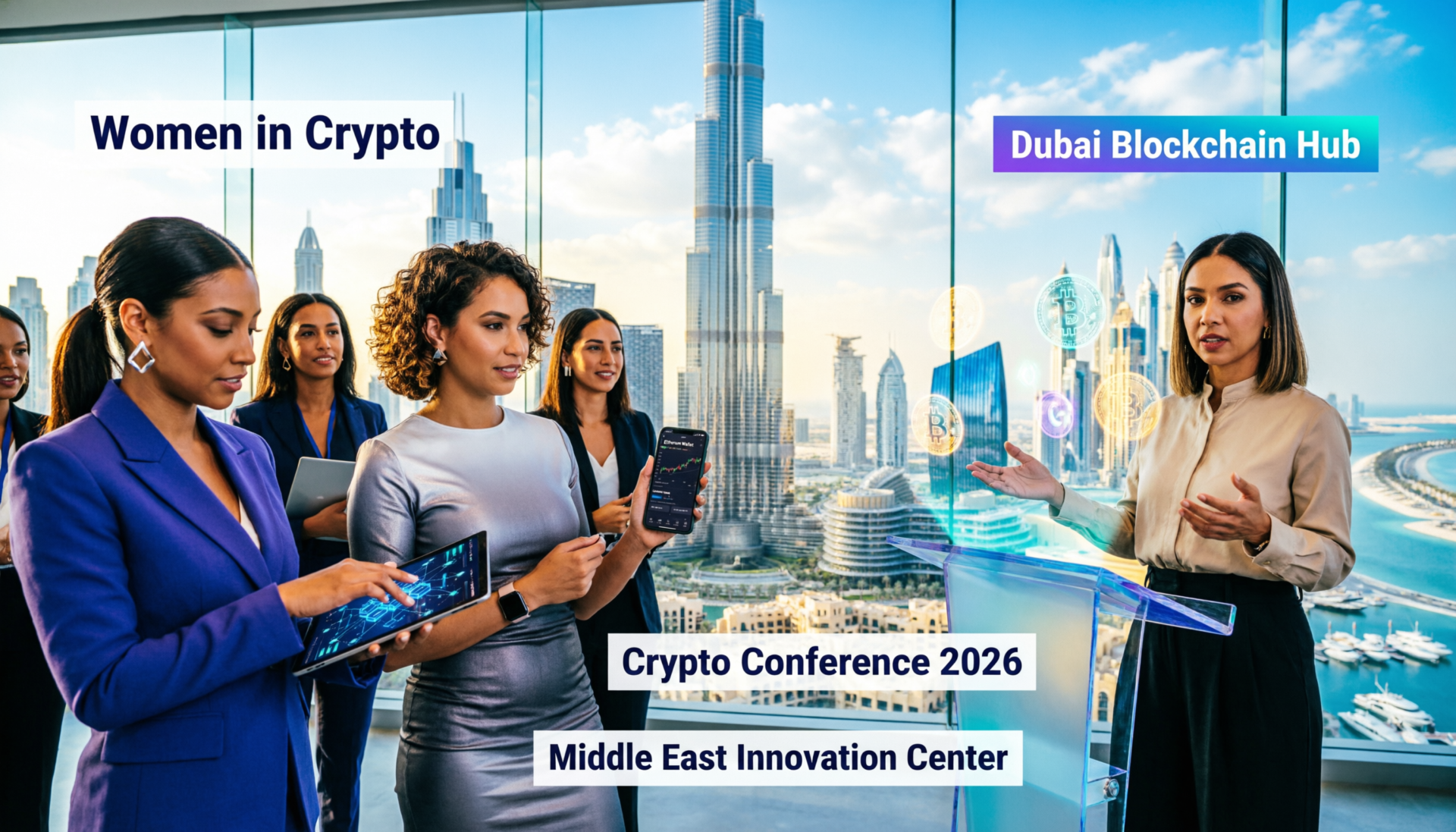

Women in Crypto Middle East: Data, Leaders & Next Steps
Women in crypto Middle East are still a minority but form a fast-growing segment of the region’s digital asset ecosystem, especially in hubs like Dubai and Abu Dhabi. As crypto adoption accelerates across MENA, a mix of better education, safer platforms and thoughtful global partnerships from the US, UK and EU can turn today’s gender gap into a long-term opportunity for women’s financial inclusion, careers and leadership.
Introduction
Women in crypto Middle East are standing at a crossroads. Adoption is climbing, regulation is maturing, and a new generation of founders and professionals is coming through STEM pipelines across the region. Yet many women still feel under-informed, under-served and under-represented when it comes to digital assets and web3 careers.
For partners in the US, UK, Germany and wider EU, this isn’t just a feel-good agenda item. More inclusive crypto ecosystems in GCC and MENA improve risk management, align with ESG and SDG5, and open new deal flow in one of the fastest-growing digital asset regions on earth.
In this guide we’ll combine data, role models, education programs and safety basics so that:
Middle Eastern women see clear, practical entry points; and
international allies in places like New York, London and Berlin know how to partner responsibly.
From Gender Gap to Global Opportunity
Across the Middle East, crypto and web3 adoption is rising, but women remain a minority of users, founders and employees. Some estimates suggest women make up under 10% of crypto users globally and an even smaller share of entrepreneurs, pointing to a clear inclusion gap.
At the same time, the region has one of the strongest female talent pipelines in the world: roughly 57% of STEM graduates in the Middle East are women, and around a third of tech-focused startups in some Arab markets are founded by women.
Crypto and web3 sit exactly at this intersection of finance, technology and entrepreneurship which is why women in crypto Middle East is less a niche topic and more a strategic economic lever.
Who This Guide Is For in the US, UK, Germany & EU
This article is written for two overlapping audiences.
Women in GCC, Levant and North Africa exploring crypto for the first time whether as small investors, career-switchers or founders.
Stakeholders in the US, UK, Germany and EU: investors, NGOs, universities, banks, fintechs and cloud platforms that want to support women in fintech MENA in a practical, compliant way.
If you’re sitting in Austin running an ESG-oriented venture fund, leading a web3 society at a university in Manchester, or building a compliance-heavy fintech in Munich, you’ll find concrete ways to plug into women’s digital asset education programs across the region.
How This Article Is Structured
To keep this usable (and AEO-friendly), we’ll move through.
The landscape today adoption, gender gaps and why the region is on global investors’ radar.
Role models and stories Arab women already leading in crypto and web3.
Education and communities where women can learn, connect and grow.
Safety and regulation how to invest and build in ways that are secure and compliant.
Partnership models for US/UK/EU partners to support women in crypto Middle East.
A 30-day roadmap for women (and allies) ready to get started.
Women in Crypto in the Middle East Today
Women in the Middle East currently make up a small but fast-growing share of crypto users. Adoption is rising across GCC states, yet most women still report low investment literacy and face structural barriers, making this an inflection point for education and inclusion. The opportunity is big but so is the work required to make it inclusive.
Crypto & Web3 Adoption Across MENA
The MENA region now accounts for around 7–8% of global on-chain transaction volume, with an estimated $300–350 billion in value received over a recent 12-month period.That makes it one of the fastest-growing crypto markets worldwide.
Within MENA, cities like Dubai and Abu Dhabi act as anchors for regulation, licensing and major conferences. The UAE’s dedicated virtual asset regime and initiatives like free-zone licensing have helped attract hundreds of crypto and web3 firms
Other GCC hubs Riyadh, Doha, Manama are investing in fintech, digital currencies and blockchain pilots, while Levant and North African markets show growing awareness but more uneven access to regulated platforms and education.
For women, this means the physical and regulatory landscape is there; the missing layer is targeted support, training and culturally aware products.
The Gender Gap: What the Numbers Say
Surveys suggest that 54% of women in the Middle East and North Africa describe their understanding of investments as “low”, even as their wealth and leadership roles grow.
At the same time
Around 57% of STEM graduates in the region are women, and
In some Arab markets, about 34% of tech-focused startups are founded by women.
This is a powerful female tech talent pipeline exactly the kind of gender diversity in blockchain and web3 that global employers say they want. Crypto and blockchain roles range from engineering and smart contract auditing to risk, compliance, UX, community and data analytics.
As more regulated exchanges and analytics firms expand into the region from global names like Bitpanda MENA to local startups demand grows for bilingual talent, compliance officers, product managers and educators who understand both local context and global standards.
Why the Middle East Is on Global Investors’ Radar
For US, UK and EU investors, MENA’s crypto growth is part of a bigger story: resilient transaction volumes, strong retail participation and proactive regulation. Chainalysis ranks MENA as a top emerging region, noting that transaction volumes hit record highs in late 2024 and stayed robust into 2025.
Gender-inclusive ecosystems are not just morally right; they also de-risk investments.
They align with SDG5 and EU equality frameworks.
They help meet LP expectations around ESG and DEI.
Mixed-gender leadership teams are associated with better governance and risk oversight in multiple studies.
When global investors back women in fintech MENA through women-led funds, accelerators and cap tables they combine commercial opportunity with measurable impact.
Arab Women Leading the Region’s Crypto & Web3 Scene
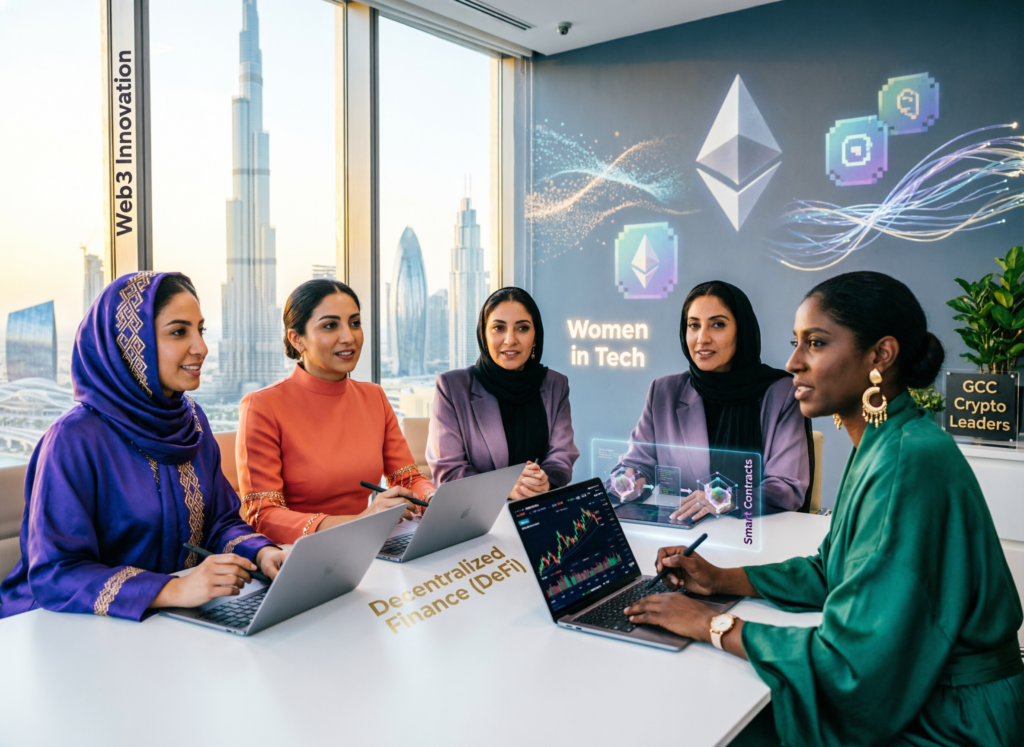
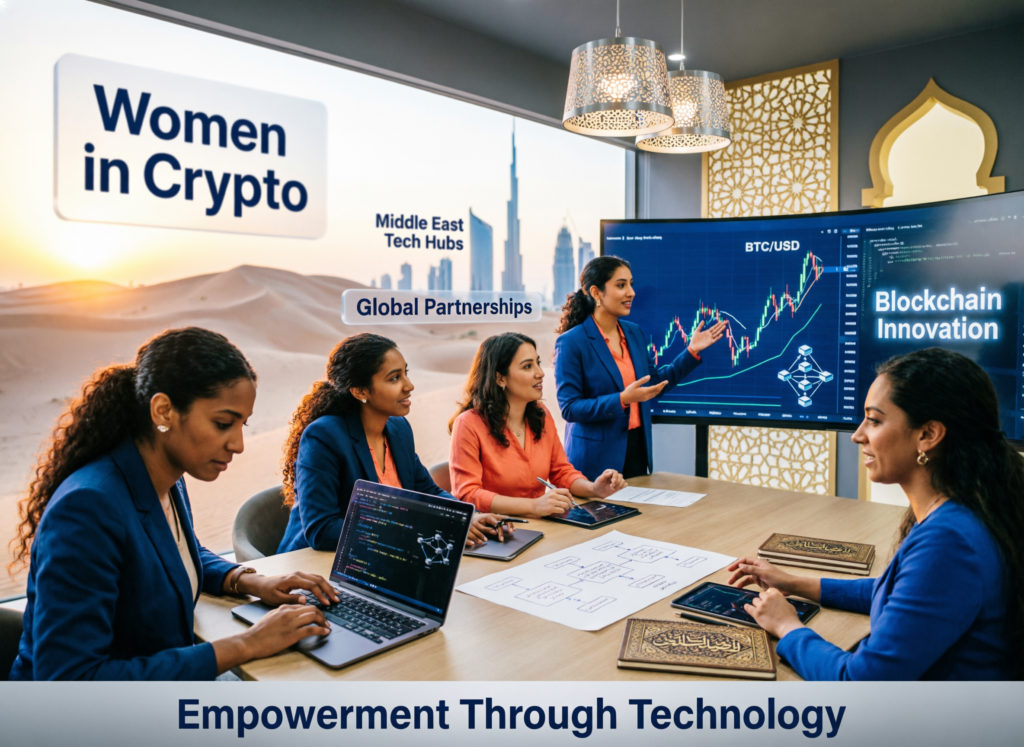
Across the Middle East, Arab women now lead exchanges, developer communities, content platforms and fintech startups, providing visible role models that challenge stereotypes and attract the next generation into crypto and web3.
Founders, Builders & Ecosystem Leaders
Regional media and exchanges such as Binance have profiled Arab women spearheading trading platforms, NFT marketplaces, DeFi tools and compliance practices across the UAE and wider GCC.
These leaders occupy diverse roles.
C-suite executives at exchanges and brokerages
Founders of web3 educational platforms and women in crypto training Middle East online
Policy advisors helping regulators design sandboxes and licensing regimes
Startup founders using blockchain for remittances, identity and financial inclusion for women in the Middle East
Their journeys nearly always feature three ingredients: access, mentorship and international partnerships often with investors or mentors based in San Francisco, London or Berlin.
Creators, Educators & Advocates
Not every leader ships code or runs a trading desk. Many of the most influential Arab women in crypto are creators and educators.
Journalists and content creators demystifying digital assets for women who feel shut out of “traditional finance speak.
Founders of women-only Telegram/WhatsApp cohorts that share explainers, security checklists and job leads.
Initiatives like Women Web3 Arabia, which sit at the intersection of AI, blockchain and culture to make web3 approachable for women creators from emerging markets.
These soft-power roles are critical. They normalise women’s participation, bring crypto into lifestyle and culture, and often form the top of the funnel for later technical and leadership careers.
Why Visible Role Models Change Behaviour
Behavioural research is clear: when people see “someone like them” in leadership positions, they are more likely to trust a sector, apply for roles and stay in the pipeline.
For students and early-career professionals in the US, UK, Germany and EU, visible Arab women at conferences in London and Berlin or speaking on global podcasts reshapes perceptions of the region. For women in GCC, Levant and North Africa, seeing regional role models on panels or in local media makes crypto feel less like a risky boys’ club and more like a viable, respectable path.
Education, Communities & Programs for Women in Crypto
Women in the Middle East can enter crypto through women-only meetups, online academies, university programs and targeted accelerators that provide safe, structured learning paths and direct connections to jobs and funding.
On-the-Ground Communities in GCC Hubs
Across Dubai, Abu Dhabi, Riyadh, Doha and Manama, women-focused or women-friendly communities are blossoming.
Women in Crypto Arabia brings together women across GCC for education, events and mentoring.(Middle East News 247)
Programs like Women in Crypto Arabia and Women Web3 Arabia collaborate with free zones, investment offices and conferences to run workshops and startup competitions.
For visitors from the US, UK or EU, major fintech and web3 conferences in Dubai and Abu Dhabi often bundle women in fintech MENA tracks and side events. Think of them as plug-and-play entry points to meet female crypto entrepreneurs in GCC, scout founders and co-host sessions.
Online Education & Remote-Friendly Programs
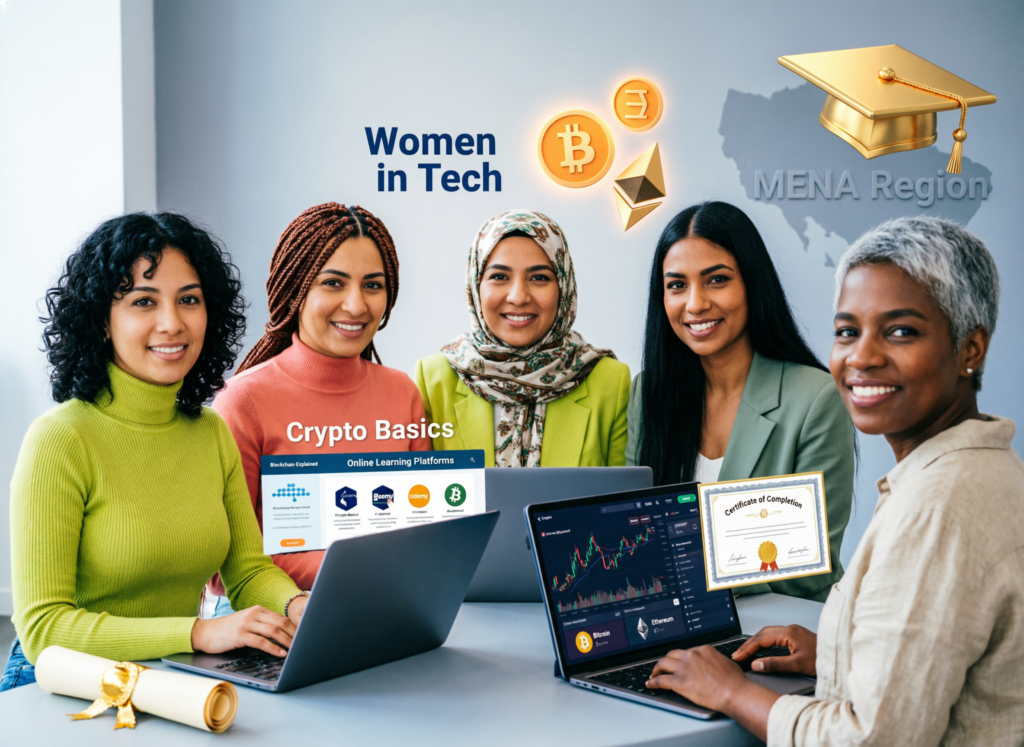
Remote-friendly learning is critical for women balancing work, family and cultural expectations. MOOCs, bootcamps and scholarships are increasingly aimed at women from MENA and the diaspora:
Online courses explaining basic concepts, wallet security and DeFi risk in Arabic and English.
University-run blockchain labs partnering with MENA hubs to offer virtual hackathons and mentorship.
Corporate academies launched by exchanges, cloud providers and analytics firms that build women’s digital asset education programs, often tied to real internships or hiring pipelines.
Content needs to be mobile-first, low-bandwidth-friendly and culturally aware more voice notes and visuals, fewer dense PDFs.
For Mak It Solutions, this is where services like data analytics, cloud-native platforms and mobile app development can underpin regional learning portals, from cohort dashboards to secure credentialing.(Mak it Solutions)
How Organisations Can Partner With MENA Communities
Banks, exchanges, NGOs and universities have several partnership options:
Co-branded workshops on basic investing, risk and compliance for women.
Mentorship programs pairing senior women in New York or London with early-career women in GCC.
Internships and junior roles earmarked for graduates of women-focused cohorts.
Joint research with groups like the Union for the Mediterranean on financial inclusion and women-led fintech in MENA.
Soft CTA: if you’re an organisation reading this, think about one pilot sponsoring a women-only cohort, offering guest speakers, or funding a scholarship for women in crypto training Middle East online.
Safe, Inclusive Investing for Women in the Middle East
Middle Eastern women can safely start investing in crypto by combining basic financial literacy with regulated platforms, clear KYC/AML processes, strong wallet security habits and an understanding of both local and international rules.
Important.
This article is for general information only and is not financial or legal advice. Always do your own research and, where needed, consult qualified professionals in your jurisdiction.
Regulatory Snapshot: GCC, EU & UK Cross-Walk
In Dubai, the Virtual Assets Regulatory Authority (VARA) oversees virtual asset service providers (VASPs) and maintains a public register of licensed firms a key tool for checking whether an exchange is properly authorised.
In Abu Dhabi, Abu Dhabi Global Market (ADGM) and its Financial Services Regulatory Authority run one of the region’s first comprehensive digital asset frameworks, setting standards for custody, trading and “accepted virtual assets.
For products touching EU or German users, firms must align with MiCAR and guidance from the Federal Financial Supervisory Authority (BaFin) on crypto-asset services. In the UK, the Financial Conduct Authority (FCA) is extending its Consumer Duty expectations to cryptoasset firms, focusing on fair value, disclosures and consumer protection.
For US-, UK- and EU-based firms serving women in MENA, this means.
Getting the right local licence (e.g., VARA, ADGM)
Ensuring data protection consistent with GDPR/UK-GDPR for cross-border users.
Building clear, multilingual KYC flows that explain why documents are needed and how data is stored.
Security Basics & Scam Prevention for New Women Investors
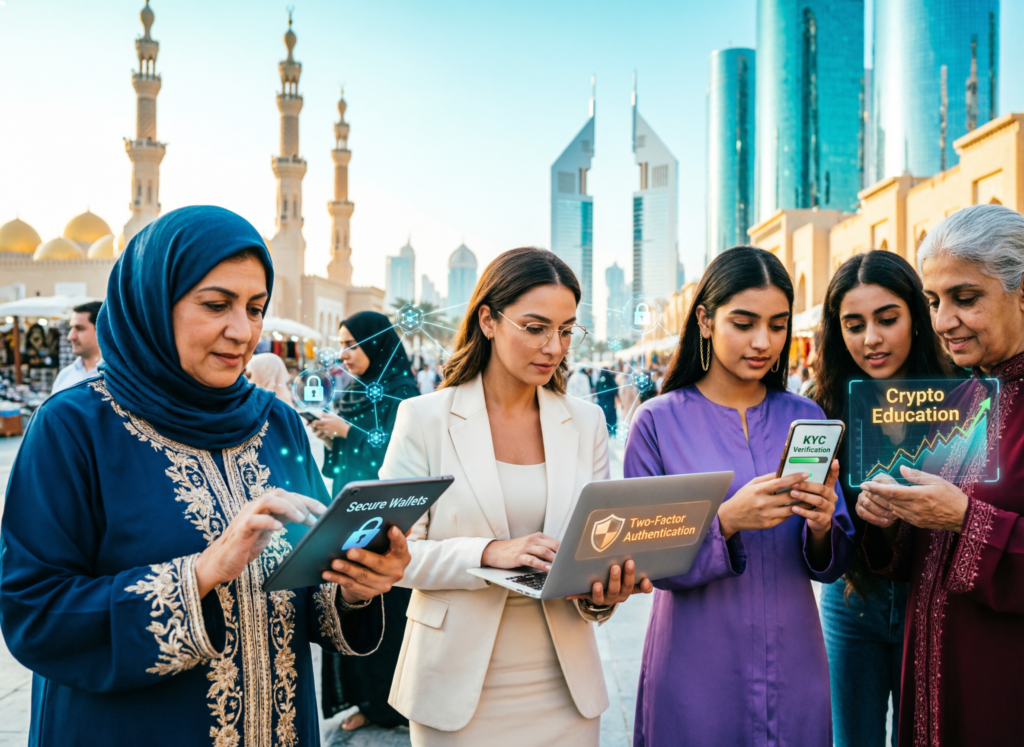
For new women investors, a few simple habits dramatically reduce risk.
Verify licences check VARA or ADGM registers and local Central Bank warnings before using an exchange.
Use strong passwords + 2FA ideally app-based, not SMS.
Start small treat first investments like tuition fees, not retirement savings.
Avoid “guaranteed returns” and pressure many scams in the region involve fake relationship-based or “VIP signal group” promises, often targeting women.
Women-only security workshops, checklists and “scam story” sessions can be powerful lead magnets for responsible platforms and a tangible way for partners to show they take safety seriously.
Designing for Cultural Realities & Financial Inclusion
Product teams need to account for cultural norms around women’s financial independence, guardianship and risk.
Some women prefer pseudonymous learning before revealing their identity.
Others may need products that explain how crypto fits with family financial planning or local rules.
Islamic finance considerations are key in GCC. Research on the impact of crypto markets on Islamic vs conventional stock indices in Gulf countries shows differing risk dynamics, reinforcing the need for Sharia-aware guidance and product screening.
Inclusive UX from language tone to KYC flows and support channels tends to drive higher retention and word-of-mouth among women users, especially when combined with clear education on risk rather than hype.
How US, UK & EU Stakeholders Can Support Women in Crypto Middle East
International investors, NGOs, universities and corporates can support women in crypto Middle East by co-funding education, backing women-led startups, sharing compliance know-how and amplifying regional role models through global platforms.
For Investors, Accelerators & Corporates
Impact-oriented funds and accelerators in New York, London and Berlin can:
Source women-led Middle East startups via regional competitions and hubs, then structure BaFin- and FCA-compliant investment vehicles for EU/UK LPs.
Launch co-investment models with regional funds and family offices where gender-diverse cap tables are an explicit KPI.
Partner with corporates like Mastercard that already run initiatives on women and digital assets, plugging Middle Eastern founders into global storytelling and mentoring platforms.
These actions directly link ESG and DEI commitments to tangible capital flows.
For NGOs, Development Agencies & Think Tanks
NGOs and multilaterals can design programs that connect crypto to real-world inclusion.
Financial literacy for women entrepreneurs and migrants using low-fee cross-border payments.
Blockchain pilots for social protection, cash transfers or identity in partnership with regional ministries and central banks.
Gender-smart financing programs backed by the Union for the Mediterranean and similar bodies, with robust monitoring and evaluation to track impact on women-led businesses.
For Universities & Research Labs
Universities in the US, UK, Germany and EU can.
Build on empirical research into cryptocurrency adoption among Arab users and women to run new surveys, experiments and policy pilots.
Offer visiting fellowships for women founders and researchers from GCC and North Africa.
Run joint hackathons focused on gender-inclusive web3 products and financial inclusion for women in the Middle East.
Academic partners can also work with delivery partners like Mak It Solutions to turn research into real platforms from analytics dashboards to mobile apps that serve women on the ground.(Mak it Solutions)
How Middle Eastern Women (and Allies Abroad) Can Get Started
The most effective way to enter crypto is gradually: learn core concepts, join a trusted women-focused community, practise with small, regulated transactions, and then layer on advanced topics like DeFi, NFTs or web3 careers as confidence grows.(CoinDesk)
30-Day Learning Roadmap for Women New to Crypto
Here’s a simple, realistic 30-day roadmap
Foundations
Learn what crypto is (and isn’t), how blockchains work, and basics like wallets and private keys. Use Arabic/English explainers from neutral sources and women-led educators.
Practise safely
Open an account with a regulated platform, complete KYC, and simulate trades using test environments or tiny amounts you can afford to lose.
Communities & careers
Join a women-friendly group (e.g., Women in Crypto Arabia, Women Web3 Arabia) and attend at least one local or online event. Ask about roles beyond trading marketing, UX, compliance.
Choose your track
Decide whether you want to focus on investing, working in web3, or founding something then pick one concrete next step (course, job application, accelerator, or MVP experiment)
Mak It Solutions can help organisations turn this roadmap into a structured, app-based program with progress tracking, content localisation and secure integrations to regulated platforms.(Mak it Solutions)
Choosing the Right Communities, Mentors & Platforms
When evaluating a platform or community, use this quick checklist.
Safety
Is the platform licensed? Are admins transparent? Are there clear scam warnings?
Diversity
Do you see women speaking, moderating and leading?
Transparency
Are risks explained in plain language? Are fees clear?
Regulation
Does the platform explain how it complies with VARA, ADGM, BaFin, FCA or other regimes for your country?
Global advocacy groups like Women in Crypto Arabia and international networks such as AWIC (All Women in Crypto) offer speaker directories, mentorship and resources that connect Middle Eastern women to allies abroad.
When to Move From Learning to Investing, Building or Working in Web3
There’s no perfect time but some signals that you’re ready to move beyond “curious” include.
You understand basic risk concepts and can explain them to a friend.
You’ve done several small, low-risk transactions without panic.
You’ve built relationships with at least a couple of trustworthy mentors.
From here, three paths open.
Investor
Increase your allocation gradually, diversify, and stay within regulated products.
Builder/Employee
Apply for roles at exchanges, analytics firms or fintechs (including remote roles serving MENA)
Founder/Creator
Join an accelerator, pitch for a women-focused grant, or co-create a pilot with a US/UK/EU partner.
Final CTA inside the article: subscribe to updates from trusted women in crypto Middle East communities, download a security checklist, or contact a technology partner like Mak It Solutions to co-create training and inclusion programs for women in your network.(Mak it Solutions)
Key Takeaways
Women in crypto Middle East are still under-represented but rapidly growing, especially in GCC hubs with strong female STEM pipelines.
Regulation is maturing fast in Dubai, Abu Dhabi, the EU and UK, making cross-border, compliant products for women far more feasible than a few years ago.
Education and community are the real unlocks women-only cohorts, blended online/on-ground programs and culturally aware UX matter more than yet another trading app.
Global partners in the US, UK and EU can add real value by funding cohorts, backing women-led startups and sharing compliance and risk expertise.
Mak It Solutions can provide the technical backbone from mobile apps to analytics and cloud-native platforms to deliver scalable women’s digital asset education programs across MENA.
If you’re a woman in the Middle East, your next step doesn’t have to be huge: pick one roadmap action join a community, try a tiny regulated transaction, or sign up for a women-focused workshop.
If you’re an organisation in the US, UK, Germany or EU, consider co-creating a women in crypto Middle East program with Mak It Solutions from curriculum design to mobile delivery and analytics. Request a scoped estimate or book a consultation via the Mak It Solutions website to explore what a pilot could look like for your ecosystem.( Click Here’s )
FAQs
Q : Are there beginner-friendly crypto platforms in the Middle East that are suitable for women just getting started?
A : Yes. Several regulated platforms in the UAE, Bahrain and other GCC markets now offer beginner-friendly interfaces, Arabic and English support, and clear risk disclosures. Check that any platform appears on VARA, ADGM or central-bank registers and avoid apps that promise guaranteed returns or VIP schemes. Many women start with small, recurring purchases of major assets and combine them with learning resources and women-only community groups for support.
Q : Do Middle Eastern women need prior finance or tech experience to work in crypto and web3 roles?
A : Not necessarily. While technical roles benefit from coding or quantitative skills, web3 companies also need people in marketing, community, operations, design, compliance and education. The region already has a strong base of female STEM graduates and entrepreneurs, and many skills from e-commerce, fintech, media and NGOs translate well. Short bootcamps and on-the-job learning can bridge specific crypto knowledge gaps over time.
Q : How can diaspora women in the US, UK or Europe support women in crypto communities back home in the Middle East?
A : Diaspora women can mentor younger women via online cohorts, share job leads at their companies, co-host virtual workshops and help local communities navigate global compliance and hiring expectations. They can also advocate for their employers or funds in New York, London or Berlin to allocate budget to women-led MENA pilots, sponsorships and scholarships. Even simple actions like speaking on a panel for a GCC-based event or reviewing pitch decks can have outsized impact.
Q : Are there Sharia-compliant or Islamic finance-aligned crypto options for women investors in GCC countries?
A : There is growing interest in Sharia-aligned digital asset products, though standards vary. Some funds screen assets against Islamic finance principles, while others focus on using blockchain for sukuk or Islamic indices rather than speculative trading. Research on crypto’s interaction with Islamic and conventional stock markets in GCC countries highlights specific risk patterns that scholars and regulators are still digesting, so women should seek guidance from trusted Islamic finance advisors and avoid products that use religious language purely as marketing.
Q : What are the best types of events (online or in-person) for networking with female crypto founders from the Middle East?
A : Look for events that explicitly highlight women in crypto or women in fintech MENA, such as Women in Crypto Arabia meetups, Women Web3 Arabia showcases, and female-founder tracks at Dubai and Abu Dhabi blockchain weeks. Many global conferences in London, Berlin and other EU hubs now include MENA-focused panels where Arab women founders speak. Online, curated webinars hosted by advocacy groups like AWIC or Union for the Mediterranean-linked programs can be equally valuable for building long-term relationships.