

Future of Crypto in the Middle East: MENA Investor Guide
The future of crypto in the Middle East points to regulated growth led by the United Arab Emirates, Saudi Arabia and Qatar, with adoption shifting from retail speculation to institutional trading, payments, remittances and tokenisation. Over the next 5 years, the region is likely to stay fragmented, with hubs like Dubai and Abu Dhabi offering clear rulebooks while others remain restrictive or ambiguous.
For US, UK and EU investors, the region is best approached as a selectively sized, regulation-first satellite allocation anchored in licensed hubs such as Dubai, Abu Dhabi and Qatar. Focus on partners that can evidence strong AML, custody, governance and data standards broadly comparable to MiCA, FCA, BaFin, SEC and CFTC expectations.
Introduction
The future of crypto in the Middle East is no longer a thought experiment for frontier tech funds. In the last three years, on-chain volumes across MENA have climbed into the hundreds of billions of dollars, even through market drawdowns, and new regulatory frameworks have come online in the UAE, Qatar and elsewhere.
For investors in the US, UK, Germany and wider EU, the question is no longer if the region matters, but how to gain exposure without tripping over regulatory, sanctions or operational risks. This guide focuses on the 5-year outlook to 2030, with a particular lens on compliant access routes rather than speculative hype.
None of this is legal, tax or investment advice. Think of it as a structured map to help your internal teams ask better questions about MENA digital assets and how they fit into your broader strategy.
MENA at a Turning Point: Future of Crypto in the Middle East
Over the next five years, the Middle East crypto market is likely to grow fastest in the UAE, Saudi Arabia and Qatar, driven by clearer regulation, institutional trading and demand for cross-border payments. At the same time, the region will remain highly heterogeneous: while Dubai releases detailed VARA rulebooks, other jurisdictions stay restrictive or ambiguous a critical nuance for risk-sensitive investors.
Where the Middle East Crypto Market Stands Today
Today’s MENA crypto market is big enough to matter, but still early in its institutionalisation. Chainalysis estimates that MENA received around $330–$390 billion in on-chain value between mid-2023 and mid-2024, roughly 7–8% of global volume.
Activity currently clusters around.
Trading and speculation in markets such as Türkiye, Egypt and Morocco
Wealth management and family offices in hubs like Dubai and Abu Dhabi
Payment and remittance use cases linking Gulf economies with Europe and South Asia
Cities like Dubai, Abu Dhabi, Riyadh, Doha and Istanbul are emerging as distinct sub-hubs, each with its own balance of trading, fintech, tokenised assets and state-backed pilots. For now, Dubai and Abu Dhabi have the most complete licensing environments; Saudi Arabia and Qatar are catching up through sandboxes and new digital-asset frameworks.
Adoption and Market Growth Scenarios to 2030
By 2030, three broad scenarios for the MENA digital-assets outlook stand out.
Bull case
Clear, interoperable regulation across the Gulf, MiCA fully bedded in across the EU, and mature stablecoin and tokenisation infrastructure. MENA could represent 10–12% of global on-chain value, with large tokenised real-estate and capital-markets niches in the Gulf.
Base case (most likely)
Continued regulatory leadership by the UAE and Qatar, gradual liberalisation in Saudi Arabia and cautious participation from others. On-chain volumes grow steadily, heavily skewed to regulated exchanges and stablecoins.
Bear case
Major enforcement actions or sanctions-related incidents tie certain markets to higher-risk buckets; volumes migrate back offshore or into grey channels.
Given the mix of reform and geopolitics, the base case is that MENA remains a growth market but one where the cost of compliance, not pure demand, will decide winners.
What This Means for US, UK and EU Investors
For the future of crypto in the Middle East for US investors, London-based funds and German or wider EU allocators, the region is best treated as a satellite allocation:
Focus on regulated hubs (UAE, Qatar, possibly Bahrain) rather than blanket region-wide exposure
Build positions on top of licensed VASPs and custodians, not lightly supervised platforms
Size exposure relative to your broader emerging-markets and digital-assets risk budget
For a New York or London manager already operating under SEC, CFTC or FCA expectations, Middle East exposure only makes sense if regulatory and operational standards feel comparable to home, or are at least clearly mapped to MiCA, FCA and BaFin expectations.
Mak It Solutions can help on the data and technology side building dashboards, pipelines and reporting that your risk, compliance and investment committees need to see across Gulf and European exposures, similar to how we support analytics programmes in GCC markets today.
Crypto Adoption Trends in the Middle East
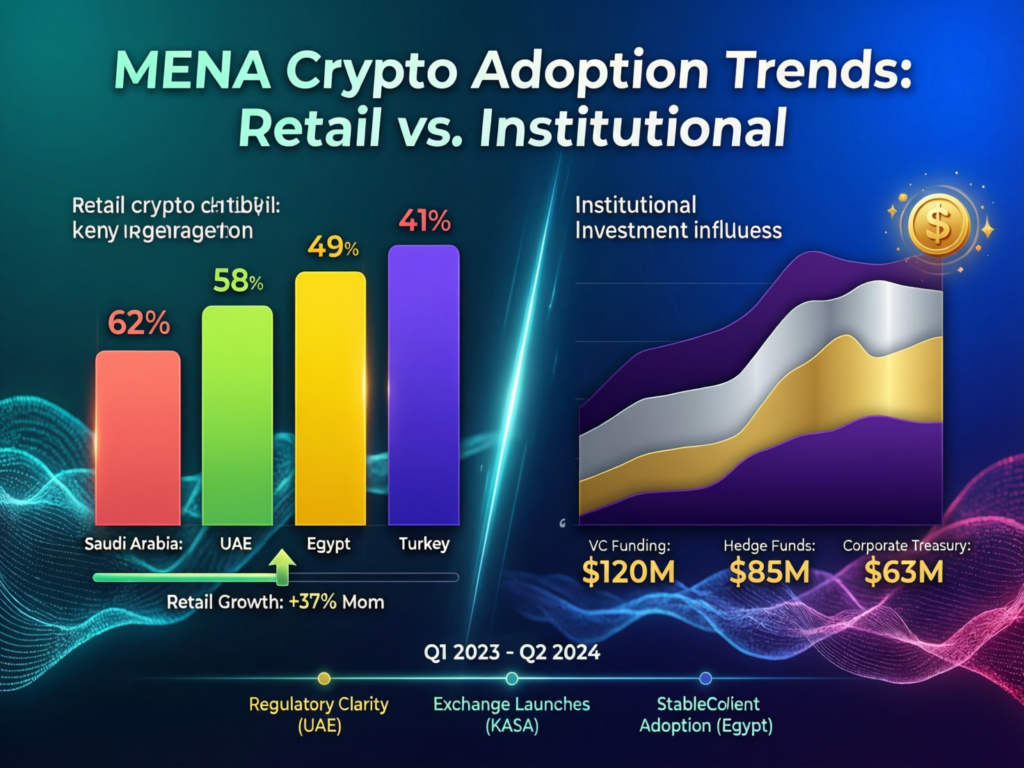
Adoption in the Middle East is shifting from early retail speculation towards institutional trading, real-world payments and remittances, with the UAE leading the region. Retail activity is still significant, particularly in Türkiye and North Africa, but licensing of exchanges and clearer guidance from central banks and securities regulators are steadily pulling volumes into more supervised channels.
Retail vs. Institutional.
Between 2021 and 2023, MENA users received an estimated $550–$600 billion in crypto value, at one point growing almost 50% year-on-year.
The pattern is evolving.
Retail and SME users in Egypt, Morocco and Jordan still rely on crypto as a hedge against inflation or FX controls.
High-net-worth individuals and family offices in the Gulf are allocating to Bitcoin, Ethereum, DeFi tokens and Sharia-compliant cryptocurrency products through licensed exchanges.
Banks and payment providers are piloting stablecoin and tokenised-deposit rails, especially in the UAE and Saudi Arabia.
Licensed players like BitOasis and Binance with VASP permissions under Dubai’s VARA and fresh approvals in Abu Dhabi’s ADGM illustrate how institutional-grade infrastructure is consolidating in a few core hubs.
Real-World Use Cases.
The most durable use cases look less like DeFi yield farming and more like infrastructure:
Remittances
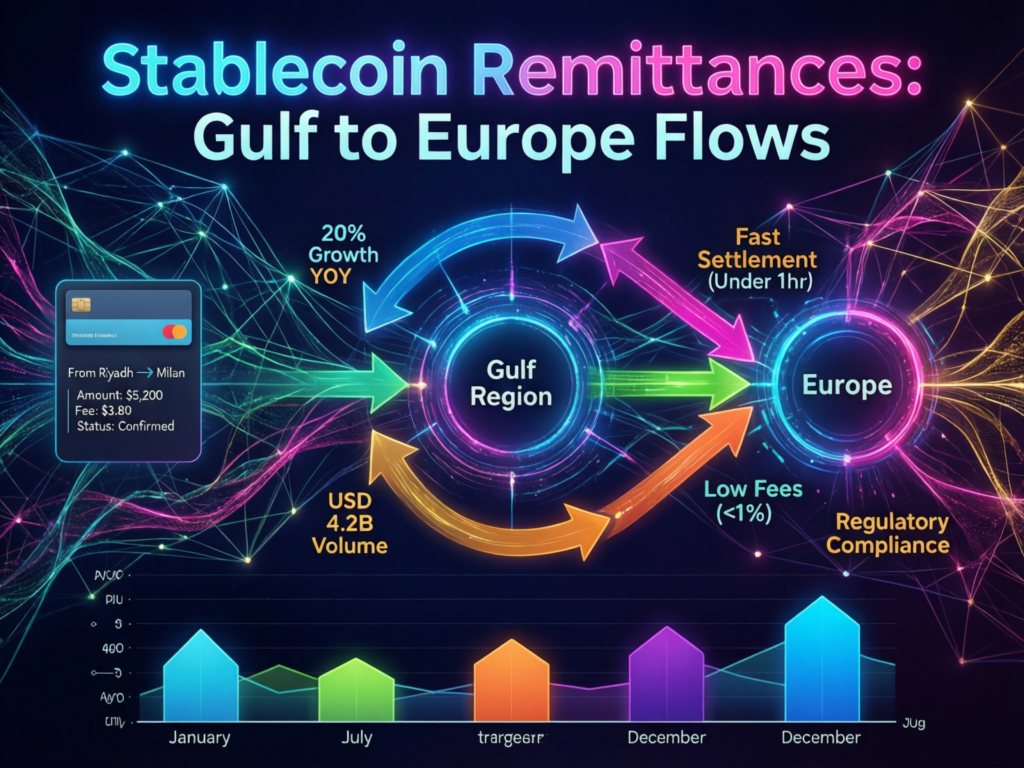
Gulf workers sending funds to families in Europe, North Africa and South Asia using stablecoins as an intermediate rail, with lower fees and faster settlement than some bank-to-bank routes.
Real estate
Tokenised real-estate pilots in Dubai and Abu Dhabi, enabling fractional ownership, programmable cashflows and faster secondary trading, often on permissioned chains.
Insurance and payments
Selected insurers and fintechs in Dubai and Doha exploring premium payments or B2B settlements in stablecoins or tokenised bank money, usually in sandbox environments.
For investors in Frankfurt, Berlin or Paris, these are not just headlines; they indicate which verticals in the region may support sustainable revenue and valuations versus hype cycles.
Sharia Considerations and Demographic Drivers in Gulf Markets
Gulf markets combine two powerful adoption drivers.
Demographics
Young, mobile-first populations with high smartphone and internet penetration, especially in Saudi Arabia, the UAE, Qatar and Bahrain.
Sharia compliance
Growing interest in Sharia-compliant crypto funds and structured products, overseen by local Sharia boards, particularly for wealth-management clients in Riyadh and Doha.
For zukunft von Kryptowährungen im Nahen Osten für EU-Anleger, it is important to understand that some Gulf products are designed to pass both regulatory and religious-ethical scrutiny something most EU products do not consider, but which can be a differentiator for regional allocators.
Regulation & Licensing.
The future of crypto in the Middle East will be shaped less by token prices and more by how regimes like VARA, ADGM and Qatar’s new framework align with FATF standards while remaining interoperable with SEC, FCA and MiCA rules. For cross-border investors, the key question is simple: can you evidence that local partners meet standards broadly comparable to those at home?
Patchwork to Playbook.
The regulatory picture is still a patchwork, but a clearer pattern is emerging:
UAE
Dubai’s Virtual Assets Regulatory Authority (VARA) and Abu Dhabi Global Market (ADGM) have comprehensive virtual-asset frameworks, detailed rulebooks and public VASP registers.
Saudi Arabia
The Saudi Central Bank (SAMA) runs fintech and digital-asset sandboxes; broader licensing remains cautious but is moving.
Qatar
The Qatar Financial Centre has launched a 2024 Digital Assets Framework, covering tokenisation, custody and smart-contract recognition.
Bahrain, Kuwait, Oman
Bahrain has an early crypto framework and licensed exchanges; Kuwait and Oman are more restrictive but experimenting with pilots.
Türkiye, Israel, Egypt, Jordan, Morocco
Each has its own mix of draft laws, FX restrictions and sandboxes critical if you are touching local users, not just booking trades in the Gulf.
All of this sits under the umbrella of FATF’s virtual-asset and Travel Rule guidance, which expects licensing, supervision and robust AML/KYC controls for VASPs.
MiCA, SEC, FCA vs. VARA, ADGM, DFSA.
From a “how Dubai’s crypto rules compare with FCA regulations” perspective, think in terms of alignment rather than identical text:
EU (MiCA)
Harmonised rules on issuance and services, passporting across the EU, and specific treatment of stablecoins (asset-referenced and e-money tokens). Fully applicable from December 2024.
UK (FCA)
Strong focus on financial promotions, consumer protection and AML. Crypto financial-promotion rules apply to all firms targeting UK consumers, including overseas platforms.
US (SEC/CFTC)
Case-by-case, enforcement-led approach, with ongoing debates over which tokens are securities or commodities.
Compared with this, VARA, ADGM and the Dubai Financial Services Authority (DFSA) explicitly position their regimes as MiCA- and FATF-aligned, with clear licensing categories, prudential requirements, Travel Rule compliance and detailed conduct rules.
For a BaFin-regulated German manager, that makes hubs like Dubai and Abu Dhabi much easier to map onto existing crypto-custody, securities and outsourcing frameworks.
Licensing Pathways for US, UK and EU Firms Entering MENA
Licensing pathways typically fall into three buckets.
Offshore-only access
Use existing EU/UK/US licences to serve professional clients outside restricted jurisdictions, with no local marketing. Lowest complexity, but limited growth.
Light-touch presence
Representative offices, partnerships with licensed VASPs and white-label services a common starting point for London or Frankfurt-based fintechs.
Full local VASP or financial licence
Apply for VARA or ADGM permissions, possibly combined with Qatar or Bahrain registrations, to operate locally regulated exchanges, brokers or custodians.
Dubai’s VARA rulebooks highlight a two-stage process (In-Principle Approval, then full VASP licence) with detailed AML, tech-risk and governance requirements closer to traditional capital-markets authorisations than some expect.
UAE, Saudi Arabia and Qatar as Crypto Hubs
By 2030, the UAE is likely to remain the primary Dubai virtual-asset hub for the region, with Saudi Arabia and Qatar catching up through Web3, tokenisation and state-backed digital-asset projects. For international investors, these hubs will not be interchangeable; each has a distinct mix of regulation, sector focus and political risk.

Dubai and Abu Dhabi as Virtual-Asset Powerhouses
The UAE’s proposition is simple: predictable rules plus global connectivity. VARA and ADGM offer:
Detailed licensing frameworks for exchanges, brokers, custodians and other VASPs
Public registers of licensed firms, helpful for due diligence
Integration with broader initiatives like CBDC pilots and cross-border payment corridors (e.g., mBridge)
Recent high-profile moves including Binance’s global authorisation under ADGM’s framework and significant UAE institutional investment into the exchange underscore how the country sees digital assets as part of its long-term diversification strategy.
For US or UK investors, Dubai and Abu Dhabi increasingly feel like “MiCA-adjacent” or “FCA-adjacent” environments: not identical, but structured enough that your lawyers and risk teams can map requirements.
From Cautious Stance to Strategic Web3 and Payments Plays
Saudi Arabia has taken a more cautious public stance on retail crypto trading but is moving decisively on Web3 infrastructure, CBDC and real-time payments under Vision 2030.
Key trends include.
Expansion of digital-asset and fintech sandboxes under SAMA and other bodies
Interest in tokenised real-world assets (RWAs) for infrastructure, energy and real estate
Collaboration with international banks and consultancies on pilot projects
For a London or New York investor, Saudi exposure may initially come via equity stakes in fintechs, infra providers or tokenised-asset platforms, rather than direct trading on local spot exchanges.
Qatar and Other Gulf Hubs.
Qatar’s Digital Assets Framework positions the country as a Web3 and tokenisation hub, especially for complex, institutional products rather than high-volume retail exchanges.
Bahrain, Manama and smaller hubs like Kuwait and Oman are likely to specialise in niches — for example, regional brokerage, custody or back-office operations — rather than trying to out-Dubai Dubai. For EU allocators, that can be attractive: a BaFin-supervised German custodian might partner with a Bahrain-licensed VASP to offer joint products that respect both MiCA and Gulf rules.
Cross-Border Use Cases.
From an infrastructure point of view, the most important theme is cross-border payments: how value moves between the Gulf and Europe, and where stablecoins, open banking and crypto on/off-ramps fit.
Stablecoins for Remittances Between the Gulf and Europe
Stablecoins already underpin many informal and semi-formal remittance routes between the Gulf and Europe. Conceptually, they sit in the middle of a three-step chain:
Local fiat (AED, SAR, QAR) → stablecoin (often USD-pegged)
On-chain transfer between wallets or platforms
Stablecoin → local fiat in the UK, Germany or another EU country
As UAE policies and infrastructure around stablecoins mature, the country aims to act as a payments hub linking Asia, Africa and Europe, which is directly relevant to banks and fintechs running EUR and GBP corridors into the Gulf.
Open Banking, Real-Time Payments and Crypto On/Off-Ramps
Interoperability with open-banking and instant-payments systems is increasing:
In Europe, PSD2/PSD3 and SEPA Instant provide fast EUR payments plus account-to-account APIs.
In the UK, Open Banking and Faster Payments underpin many crypto on/off-ramp products supervised by the FCA.
In the Gulf, new instant-payments rails in the UAE and Saudi Arabia are gradually being integrated with regulated exchanges and OTC desks.
If you are a US, UK or German fintech, the opportunity is often API-layer value: KYC/KYB services, sanctions screening, FX and treasury tools, or compliant on/off-ramps that plug into both EU and Gulf banks.
Opportunities for US, UK and German Fintechs to Plug into MENA Rails
Concrete models include.
Banking-as-a-Service platforms that expose local IBANs or virtual accounts tied to Gulf licences
Cross-border treasury tools for corporates with operations in Dubai, Riyadh and Berlin
Regtech tooling: FATF Travel Rule compliance, transaction-monitoring analytics and reporting across MiCA, FCA and VARA/ADGM requirements
Mak It Solutions frequently works with fintechs and enterprises who need to stitch together EU, UK and GCC data and payment flows, via custom APIs, reporting pipelines and dashboards. Our existing work on data architectures in the Middle East means we understand both the technical and compliance constraints.
Risk, Security and Illicit Finance in Middle East Crypto
The main risks in Middle East crypto are AML/sanctions exposure, regulatory fragmentation and operational security but these can be mitigated with robust KYC, transaction monitoring and trusted local partners. Global headlines about crypto-enabled money laundering and hacks are relevant here: regulators in Washington, London, Brussels and Berlin are watching Gulf markets closely.
AML, Sanctions and “De-Risking” Pressures
For risk and compliance teams, key questions include.
Sanctions exposure
Are any counterparties in, or routing through, high-risk jurisdictions? Are OFAC, EU and UK sanctions lists fully integrated into screening workflows?
FATF Travel Rule
Can your VASPs exchange originator/beneficiary data reliably, at scale, and are they supervised by credible regulators?
De-risking by correspondent banks
Could relationships with US or EU banks be at risk if Gulf crypto exposures look unclear?
A pragmatic approach is to insist on G20-standard AML controls at the VASP level and to favour partners in jurisdictions explicitly assessed and monitored by FATF, ESMA, the FCA and BaFin.
Custody, Cybersecurity and Data Protection for Cross-Border Investors
Institutional allocators should evaluate.
Custody standards
SOC 2, ISO 27001, segregation of client assets, cold-vs-warm-storage policies and insurance. Payment and card data: PCI DSS compliance for any card-based on/off-ramps.
Data protection
Alignment with GDPR and UK-GDPR for EU/UK customer data, especially when processed on Gulf-hosted infrastructure or cross-border analytics platforms.
This is where Mak It Solutions’ work on data analytics in the Middle East and edge computing for Saudi & UAE can support: designing architectures that respect data-residency, logging and access-control requirements across both sides of the corridor.
Practical Risk Mitigation.
minimal institutional-grade control stack should include:
Automated KYC/KYB onboarding with sanctions, PEP and adverse-media screening
Transaction monitoring with rule- and behaviour-based models tuned to MENA risk profiles
Regular wallet and protocol risk scoring via reputable blockchain-analytics providers
Clear governance and escalation paths when red flags appear
Prioritise partners that can evidence not just licences, but operational substance: local compliance teams, independent board oversight, third-party audits and transparent disclosures.
How International Investors Should Position for the Next 5 Years
International investors should treat the Middle East as a selectively attractive satellite allocation, prioritising regulated hubs like the UAE and partnering with compliant local platforms. The more your home framework resembles MiCA or the FCA regime, the easier it will be to justify exposure to boards and regulators.
Scenario Planning to 2030.
When building a thesis on the future of crypto in the Middle East, consider.
Bull
Broad regulatory convergence, strong macro tailwinds, and successful integration of tokenised RWAs into Gulf capital markets. Returns could outpace global crypto benchmarks but with concentrated jurisdictional risk.
Base
Steady growth led by the UAE and Qatar, selective liberalisation in Saudi Arabia, but ongoing geopolitical and sanctions noise. Risk-adjusted returns competitive with other emerging-markets crypto exposures.
Bear
One or more major enforcement or sanctions events ties certain hubs to enhanced-due-diligence categories, forcing rapid position trims.
Your internal risk committees should pre-plan how position sizing, hedging and exposure cuts work in each scenario.
Entry Models for US, UK and EU Firms: Direct, Partnered or Remote Access
Three main entry models.
Direct
Establish your own locally licensed entity or branch (e.g., VARA VASP licence or ADGM permissions). Highest control, highest cost.
Partnered
Work with a local exchange, custodian or infrastructure provider under white-label or JV structures. Mid-range control and cost.
Remote access
Provide services from your EU/UK/US base, targeting only professional clients and avoiding local marketing rules useful as a testbed.
For the future of crypto in the Middle East for US investors, partnered and remote models often make more sense initially, given SEC and CFTC scrutiny and US tax considerations.
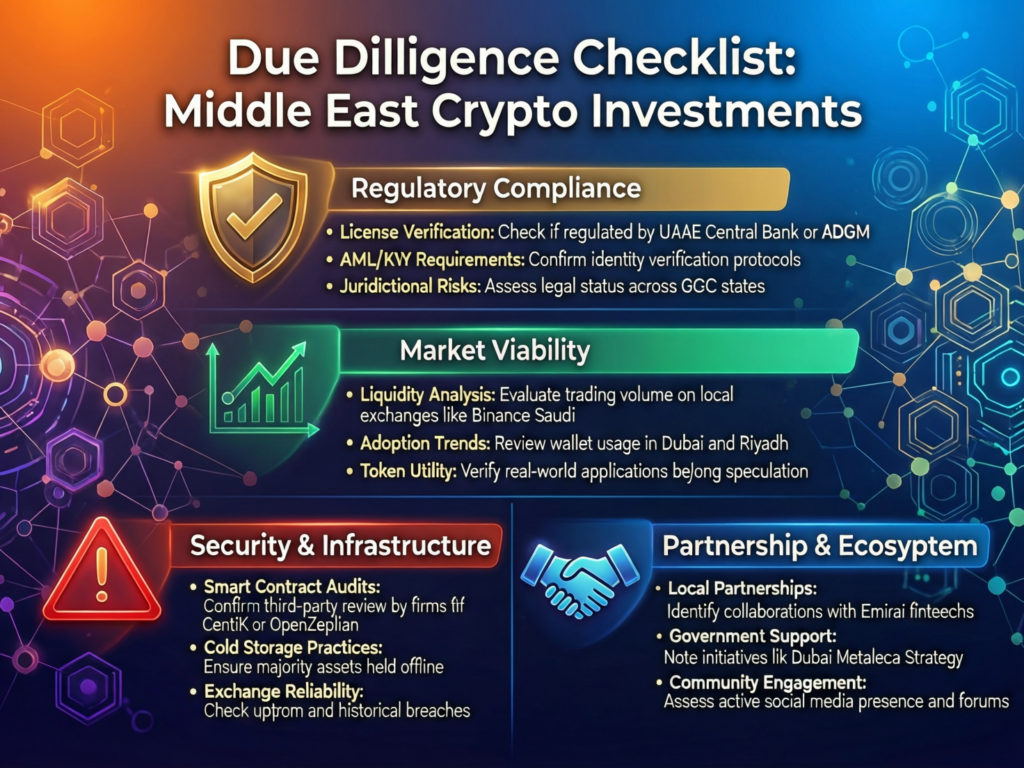
Due Diligence Checklist for Evaluating Middle East Crypto Opportunities
Before allocating, your teams should at minimum ask.
Licensing & regulation
Which regulator supervises the entity (VARA, ADGM, QFC, Bahrain Central Bank, etc.)?
Is the licence type and status visible on a public register?
Governance & ownership
Who ultimately owns and controls the business?
Is there independent board oversight and a named MLRO/CCO?
AML / sanctions / Travel Rule
How are customers screened and monitored?
Which tools and data sources support AML, sanctions and Travel Rule compliance?
Technology & security
What are the custody arrangements? Any SOC 2 / ISO certifications?
How are keys managed, and what is the incident-response plan?
Data & reporting
Can the partner provide data in formats your regulators expect (MiCA, FCA, BaFin, SEC)?
Are data-hosting locations and cross-border flows clearly documented?
Mak It Solutions can help your teams turn this checklist into concrete dashboards and workflow tools, integrating VASP data, sanctions feeds and internal exposure metrics into a single view for risk committees.
Concluding Remarks
The Middle East is unlikely to replace the US or EU as the core of global crypto markets, but it is already a critical growth engine, particularly for payments, remittances and tokenised real assets. The combination of young populations, reform-minded governments and new regulatory frameworks means that, by 2030, ignoring the region will be hard to justify for serious digital-asset investors.
Key Takeaways
MENA is a fast-growing but uneven crypto market: the UAE and Qatar are far ahead of many neighbours on regulation.
The most durable themes are stablecoins, tokenisation and institutional infrastructure, not meme-coin trading.
Regulatory alignment with MiCA, FCA and FATF standards is improving, particularly in Dubai and Abu Dhabi.
For EU-Anleger, the zukunft von Kryptowährungen im Nahen Osten is tightly linked to how well local rules plug into MiCA and BaFin expectations.
Risk can be managed with careful hub selection, strong partners and robust data/controls, but it cannot be eliminated.
When Middle East Exposure Does and Doesn’t Make Sense
Middle East exposure tends to make sense when you.
Already run a regulated digital-asset strategy in the US, UK or EU
Have internal AML, sanctions and operational-risk capabilities
Can articulate a clear thesis around payments, tokenised RWAs or infrastructure, not just beta
It probably does not make sense if you.
Are struggling to meet existing MiCA, FCA or SEC expectations
Lack resources to diligence and monitor multiple new jurisdictions
View MENA purely as a short-term yield play rather than a long-term structural bet
How Our Team Can Help You Navigate MENA Digital Assets
Mak It Solutions is not a law firm or fund manager but we are the kind of engineering and data partner you want beside your counsel and brokers. We help US, UK, German and wider EU clients build.
Data platforms that join up MiCA/FCA/BaFin reporting with Gulf VASP and payments data
Secure web and mobile frontends that respect GCC and EU data-protection rules
Analytics workflows that surface risk and opportunity across your Middle East digital-asset portfolio
If you are exploring a MENA crypto strategy, we can help you turn this conceptual map into a concrete technical and data roadmap.
If your team is debating Middle East crypto exposure or you are already piloting Gulf–EU payment or tokenisation projects you do not have to design the data and tech stack alone. Mak It Solutions can help you scope a 90-day discovery and architecture sprint focused on GCC-aware data pipelines, dashboards and integration with your existing compliance tooling.
Explore our recent Middle East-focused analytics and infrastructure guides on Mak It Solutions, or reach out to discuss a tailored roadmap for your US, UK or EU organisation.( Click Here’s )
FAQs
Q : Is crypto legal across all Middle Eastern countries, or only in places like the UAE and Bahrain?
A : No, crypto is not uniformly legal or regulated across all Middle Eastern countries. Jurisdictions such as the UAE and Bahrain have clear frameworks and licensed exchanges, while others remain restrictive or operate with limited guidance. Qatar, Saudi Arabia and Türkiye are moving forward with digital-asset frameworks and sandboxes, but rules vary widely by activity (trading, custody, payments) and customer type (retail vs. institutional). Always check the latest local regulations and work with qualified legal counsel before launching or allocating.
Q : Can US- or UK-regulated funds invest directly in Middle East crypto exchanges and tokens?
A : In principle, yes but only if both your home regulators and local Middle East regulators allow it and you respect cross-border marketing and AML rules. A UK FCA-regulated fund, for example, must comply with the UK’s crypto financial-promotion regime even when dealing with overseas platforms, while also ensuring that the chosen VASP is licensed (e.g., by VARA or ADGM) and meets FATF standards. US funds face additional SEC/CFTC and tax considerations. In practice, the safer route is usually to work through regulated custodians, structured notes or locally licensed partners rather than sending retail clients directly to foreign exchanges.
Q : How do Middle East crypto taxes typically work for foreigners relocating to Dubai or Riyadh?
A : Tax treatment depends on both your home country and your new residence. Some Gulf states, including the UAE and Saudi Arabia, do not levy personal income tax on most residents, but that does not automatically exempt you from obligations in the US, UK, Germany or elsewhere. Many expatriates still owe tax on worldwide income, gains or remittances under their home-country rules, and anti-avoidance provisions can apply. Crypto holdings, staking rewards and DeFi yields may all be taxable. Before relocating for “tax-friendly” crypto treatment, speak with cross-border tax specialists who understand both Gulf and home-country regimes.
Q : What sectors in the Middle East are seeing the strongest crypto traction right now?
A : The strongest traction is in payments and remittances, tokenised real estate and infrastructure, and institutional trading and liquidity infrastructure. Stablecoin-based remittances connect Gulf workers with families in Europe and beyond; tokenisation pilots are emerging around real estate and infrastructure projects in Dubai, Abu Dhabi and parts of Saudi Arabia; and licensed exchanges and brokers support growing institutional flows. Gaming, NFTs and DeFi exist, but from an institutional investor perspective they are secondary to payments, RWAs and core trading infrastructure.
Q : How can German and wider EU investors access Middle East crypto opportunities while staying MiCA and BaFin compliant?
A : German and EU investors should start from their MiCA and BaFin obligations and then map MENA exposures onto them. That usually means using EU-licensed custodians or investment firms that partner with VARA/ADGM/QFC-licensed entities, rather than going straight to unregulated offshore exchanges. Products might include tokenised-asset funds, structured notes linked to Gulf exchanges, or co-managed portfolios where an EU manager retains fiduciary responsibility. Robust AML/KYC, Travel Rule compliance and clear disclosures remain essential, and all marketing must follow MiCA, ESMA and local securities-law requirements.