
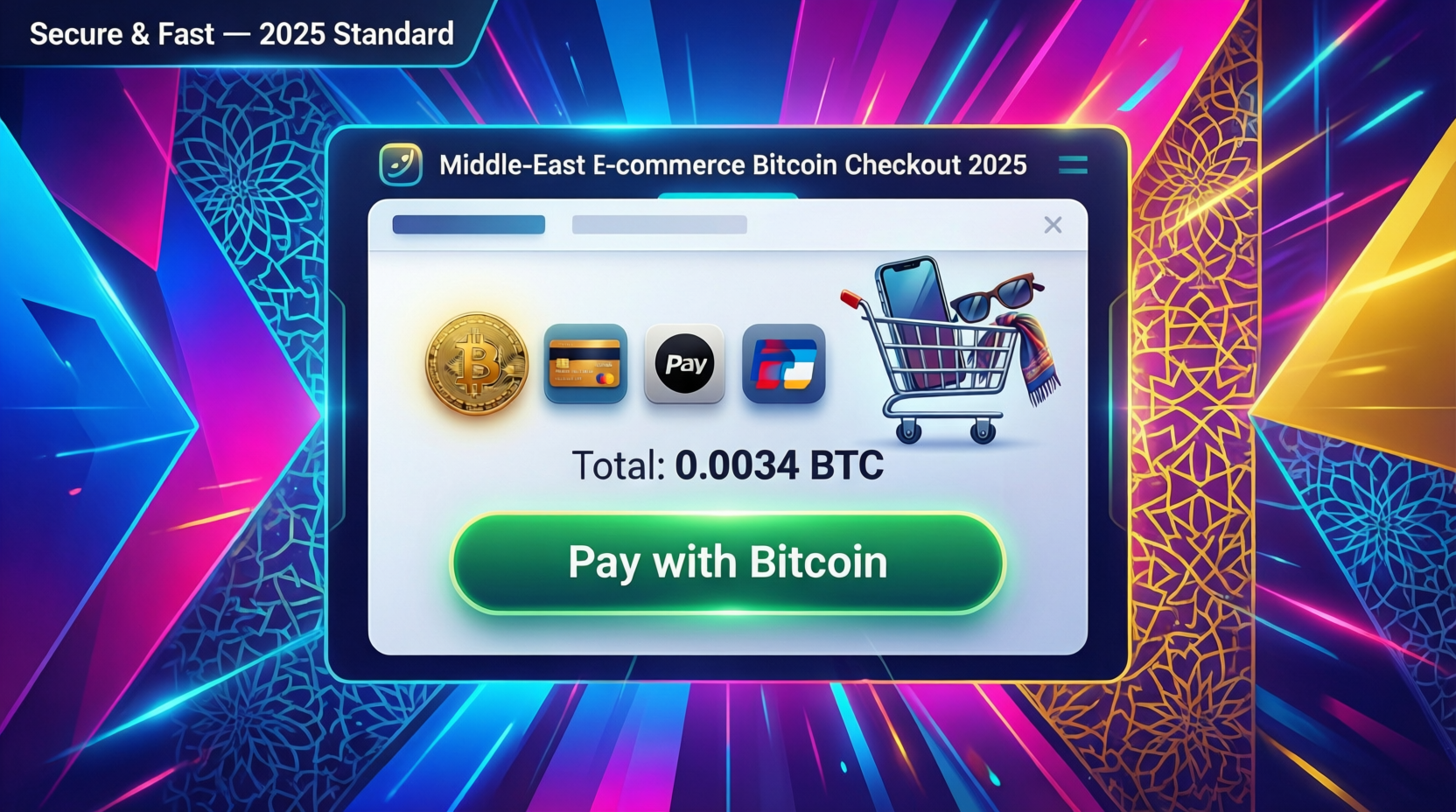

Middle East e-commerce bitcoin: where and how to pay
Middle East e-commerce bitcoin payments are still niche but growing, mainly via crypto payment gateways, gift card platforms and a small but visible set of online stores in hubs like Dubai and Riyadh. US, UK and EU merchants can plug into this demand by using regulated crypto gateways that price in BTC or stablecoins at checkout and settle in local currencies such as AED or SAR, while you keep your existing card and wallet stack intact.
Introduction
Middle East e-commerce bitcoin adoption is moving from hype to “early but real” — especially in Gulf markets like the United Arab Emirates and Saudi Arabia. For US, UK and EU merchants, bitcoin and stablecoin checkout is becoming the next payment rail into a region where ecommerce and digital payments are growing much faster than in many mature markets.
In this guide, we’ll zoom in on Middle East e-commerce bitcoin opportunities in 2025: how shoppers in Dubai, Riyadh and Doha are paying online, where BTC is already accepted, which crypto payment gateways support the region, and what you need to think about for regulation, KYC/AML and data protection. We’ll also walk through a practical integration path and readiness checklists for both regional merchants and cross-border sellers working with Mak It Solutions or similar partners.
Middle East e-commerce bitcoin.
E-commerce growth and digital payments in the Middle East
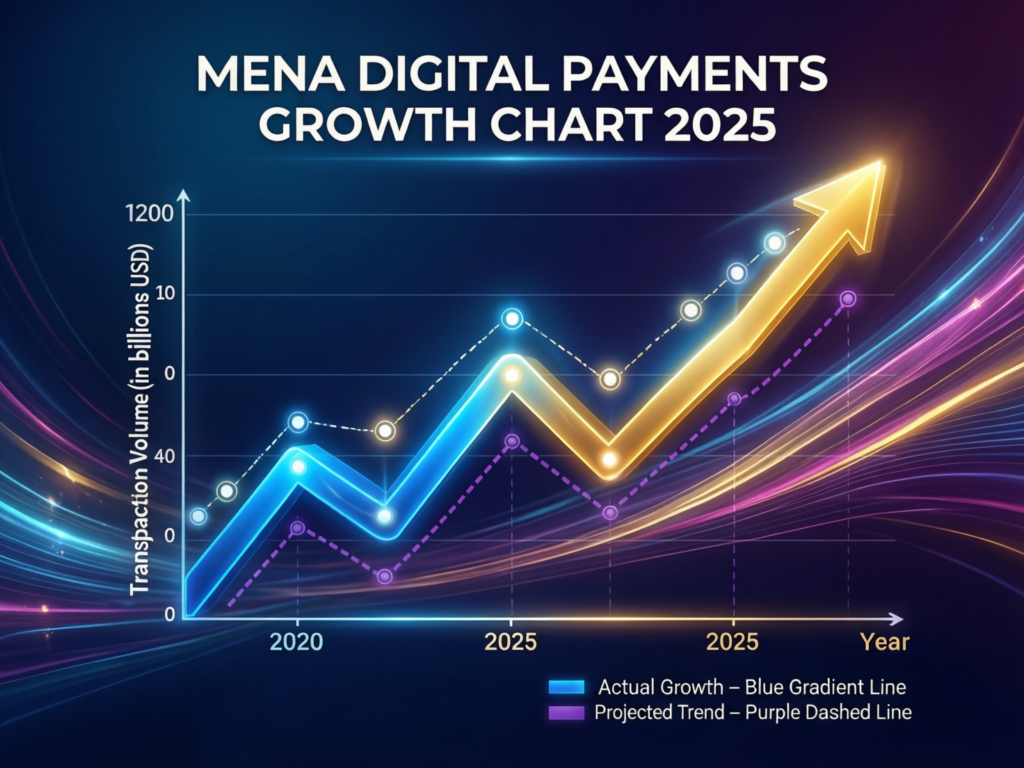
MENA ecommerce is no longer a sideshow: recent estimates put the region’s ecommerce GMV at roughly $34–35 billion in 2024, with forecasts that it could approach $55–60 billion by 2029.
On the payments side, digital rails have exploded. One major processor reports over 650% growth in MENA payment volume since 2020, alongside a 50%+ year-on-year jump in online spending intent for 2024.At the same time, the share of shoppers naming cash-on-delivery as their preferred online payment method has more than halved since 2020, signalling a decisive move toward cards, wallets and account-to-account payments.
Layer that on top of a MENA digital payments market valued at around $250 billion in 2025 and projected to grow at ~11% CAGR through 2031, and you get a clear story: the region is rapidly normalising digital payments, but still has room for alternative rails like bitcoin and stablecoins.
That shift is why adding bitcoin or stablecoin checkout is no longer just a “nice to have” for Middle East ecommerce merchants. It’s a way to stand out in a competitive payment landscape and tap into global crypto liquidity without replacing existing card and wallet options.
What is the current state of e-commerce in the Middle East and how widely is bitcoin accepted?
Middle East ecommerce is now reasonably mature in Gulf hubs like Dubai, Abu Dhabi, Riyadh and Doha, but bitcoin payments remain niche. Today, BTC is usually offered via crypto payment gateways, gift card platforms and a growing cluster of crypto-friendly online stores, and almost always alongside cards, local wallets and sometimes USDT/USDC stablecoins.
Typical verticals where BTC is starting to appear.
Electronics and gadget stores shipping across GCC
Travel, hotels and experiences for example, airlines experimenting with crypto-based payments and local booking platforms in the UAE
Luxury and fashion boutiques targeting high-spend tourists in Dubai and Doha
Global gift card platforms like Bitrefill and CryptoRefills that let users buy regional gift cards for marketplaces, food delivery and mobile top-ups in countries like Saudi Arabia and the UAE.
For most shoppers, especially in cities like Jeddah or Manama, bitcoin is still a secondary rail behind cards, account transfers and local wallets, but visibility is clearly increasing.
Bitcoin and crypto adoption in UAE, Saudi Arabia and wider GCC
The Gulf Cooperation Council (GCC) is not one uniform crypto market.
UAE
The UAE (especially Dubai) has positioned itself as a digital asset hub, with dedicated regulators such as the Virtual Assets Regulatory Authority (VARA) and clear licensing frameworks for virtual asset service providers.Dirham-backed stablecoins are now being formalised into the payments system, which makes stablecoin checkout particularly interesting for ecommerce.
Saudi Arabia
Official statements from the Ministry of Finance and the central bank warn that cryptocurrencies are not recognised as legal tender, and trading is outside the regulated framework, even as the country aggressively pushes digital payments like contactless cards and wallets.
Qatar
The Qatar Central Bank has previously prohibited most cryptocurrency activity, though newer digital asset frameworks in the Qatar Financial Centre focus on tokenisation under tight rules.
Bahrain
The Central Bank of Bahrain has one of the region’s clearest crypto-asset modules, licensing exchanges and service providers, and actively attracting crypto firms.
Egypt and Jordan
The Central Bank of Egypt has repeatedly warned against dealing in cryptocurrencies and treats unlicensed activity as illegal, while Jordan has also taken a cautious stance with restrictions on banks and payment providers.
For shoppers in the United States, United Kingdom and Germany, the first places they’re likely to see BTC and stablecoins accepted directly for Middle East ecommerce are UAE-based platforms, Bahrain-licensed businesses and cross-border services that route payments via regulated gateways rather than handling crypto custody themselves.

Why merchants are adding bitcoin and stablecoin checkout in Middle East e-commerce
Why are merchants in the Middle East starting to add bitcoin and stablecoin payments to their ecommerce sites?
Merchants across the GCC are adding bitcoin and stablecoin payments to reach global crypto spenders, capture higher basket sizes, reduce chargebacks and move money cross-border faster than with cards or wires. They also see marketing upside from positioning as crypto-friendly brands, especially in tourist hubs and digital-first sectors.
Key motivation clusters.
Local shoppers
In cities like Dubai and Kuwait City, younger buyers may already hold crypto on exchanges or in self-custody wallets and appreciate more payment choice.
Tourists and expats
International visitors, including US and EU residents, often hold BTC or USDT and want to pay directly without FX mark-ups or card declines.
Cross-border buyers
Crypto rails are attractive for SaaS, digital content and online education selling from or into GCC markets, because settlement can be faster and FX spreads can be lower than traditional bank rails.
In practice, many merchants see stablecoins such as USDT or USDC as “crypto cash” less volatile than BTC intraday, more intuitive for pricing in USD or EUR, and easier to reconcile against invoices.
Why do shoppers from the USA and Europe want to spend bitcoin on Middle East ecommerce platforms?
US, UK and EU shoppers want to spend bitcoin and stablecoins on Middle East ecommerce platforms because they already hold digital assets, want to avoid card fees or blocks, support crypto-friendly brands and sometimes send gifts or pay for services for friends and family in the region. For some, it’s also a way to “put their crypto to work” rather than converting back to fiat.
Different audience slices behave differently.
US investors
Crypto-native users in New York or Austin might book UAE travel, buy Dubai experiences or pay for remote courses hosted in Riyadh using BTC or stablecoins, especially where cards get flagged.
UK exporters
A UK seller in London might accept BTC from Gulf customers via a crypto gateway and settle in GBP while shipping goods to GCC. For them, stablecoins can be a hedge against FX friction and slow wires.
German/EU crypto users
Under EU rules like MiCAR, German users often access regulated euro stablecoins and may see paying a Bahrain- or UAE-licensed platform as more straightforward than going through multiple bank intermediaries.
Popular use cases from US/Europe into GCC include cross-border gifting via regional gift cards, luxury retail in Dubai malls, hotel and airline bookings, and digital products like coaching, SaaS or online education.
Business cases: from Dubai luxury stores to cross-border SaaS
Some representative business cases we see in Middle East e-commerce bitcoin projects:
Dubai luxury & fashion ecommerce
Luxury multi-brand stores in Dubai or Abu Dhabi can add BTC/USDT checkout for VIP customers, often seeing higher average order values and reduced chargebacks compared with cards.
Travel and experiences
Airlines and travel platforms exploring crypto payments align with the region’s push to be a digital asset hub, and can attract younger, tech-savvy travellers from the US and Europe.
Online education and SaaS into GCC
A SaaS vendor in Berlin or Manchester selling into GCC may accept stablecoin payments to reduce FX friction while still settling to EUR or GBP.
Gift card rails
Platforms using BTC and stablecoins to sell regional gift cards (for marketplaces, food delivery and mobile top-ups) effectively bridge international crypto holders and local fiat-only merchants.
Across these cases, metrics to track include incremental conversion, share of orders paid in crypto, reduction in chargebacks vs cards, settlement times into AED/SAR/EUR/USD and net impact on payment costs.
Crypto payment gateways and integrations for Middle East ecommerce
How can an online store in the Middle East start accepting bitcoin and crypto payments safely and compliantly?
The simplest way for a Middle East ecommerce site to accept bitcoin and crypto safely is to use a regulated crypto payment gateway: you complete onboarding and KYC, plug their plugin or API into your Shopify, WooCommerce or custom stack, enable BTC and stablecoins, and let the gateway auto-convert to fiat and pay out to your bank. You then update your T&Cs, privacy policy and checkout UX to reflect crypto payments.
For a practical rollout, merchants typically.
Choose a gateway
Compare global payment processors like Stripe or Checkout.com (for fiat plus any crypto/stablecoin products) and crypto-native gateways like PayAdmit or OxaPay for direct BTC/USDT processing.
Complete KYC/AML onboarding
Provide company docs, beneficial ownership details and business model explanations so the gateway can risk-rate you correctly.
Integrate via plugin or API
Use ready-made plugins for Shopify, WooCommerce or Magento, or a custom integration into your PHP, Laravel, Node.js or Java stack. Agencies like Mak It Solutions can help align this with your broader ecommerce and cloud architecture. (Mak it Solutions)
Configure currencies & settlement
Enable BTC plus one or two stablecoins, pick settlement currencies (AED, SAR, USD, EUR) and configure whether you hold any crypto on balance or always auto-convert.
Update legal & UX
Adjust T&Cs, refunds and privacy policies to cover crypto, and make sure checkout clearly shows rates, expiry windows and supported wallets.
Local merchants in GCC will typically settle to local-currency accounts. US/UK/DE merchants selling into GCC often choose USD or EUR settlement while pricing in local currencies on-site.
Crypto payment gateway options for MENA and cross-border merchants
The crypto payment gateway landscape changes quickly, but the main patterns for Middle East e-commerce bitcoin today are.
Fiat-first PSPs with crypto features
Global processors like Stripe and Checkout.com focus on cards, wallets and bank transfers, but increasingly experiment with stablecoin payouts, alternative payment methods and partnerships with digital asset players. Merchants already using them should watch product roadmaps and regional availability.
Crypto-native gateways
Providers such as PayAdmit and OxaPay offer BTC, ETH and stablecoin checkout, simple APIs, hosted invoices and some level of volatility management. OxaPay, for example, highlights low fees (around 0.4%) and broad coin support, while PayAdmit focuses on risk tools and accepting 300+ coins.
Exchange-linked tools
Major exchanges like Binance or Crypto.com sometimes provide merchant tools or cards that indirectly connect ecommerce flows to crypto balances, though support varies by region and regulation.
When comparing vendors, focus on.
Supported countries and KYC requirements (UAE-only vs multi-GCC vs global)
On- and off-ramp capabilities for AED, SAR and EUR
Stablecoin support (USDT, USDC, regional or euro-backed tokens)
Pricing and volatility handling (instant conversion vs partial hold)
Refund and dispute flows, which matter for consumer protection.
How do crypto payment gateways convert bitcoin into local currencies like AED or SAR for ecommerce merchants?
Crypto payment gateways typically lock the BTC price at checkout, accept the buyer’s bitcoin, and then instantly convert it via liquidity partners or exchanges before paying out to merchants in fiat currencies like AED, SAR, USD or EUR, minus a processing fee. Merchants see fiat amounts on settlement reports, often with transaction-level FX and fee data for reconciliation.
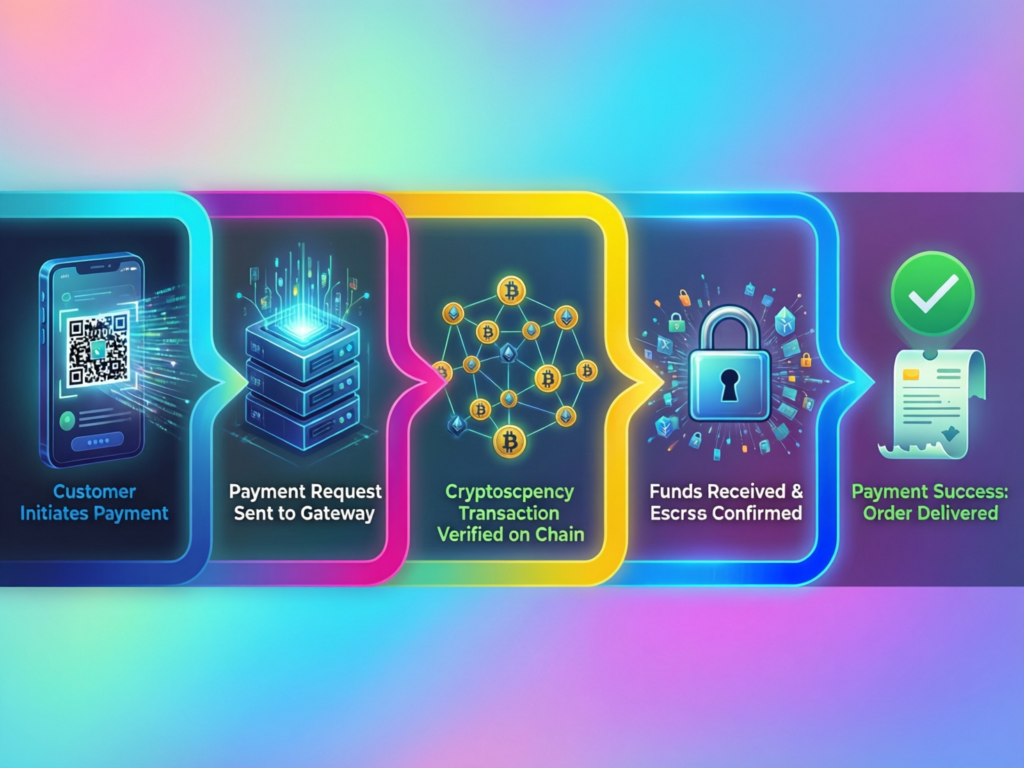
A simplified flow for Middle East e-commerce bitcoin payments.
Price quote
Cart total is converted from, say, AED into BTC or USDT using a live rate, plus a small buffer.
BTC payment
The shopper pays using their wallet within a time window; the gateway monitors the blockchain.
Confirmation
Once sufficient confirmations land, the payment is marked as complete and the order is released.
Auto-conversion
The gateway aggregates crypto receipts and sells them via exchanges/liquidity desks into AED, SAR, USD or EUR.
Payout & reconciliation
Funds are batched and sent to the merchant’s bank, and reports map each order to its payout amount for accounting.
This model minimises crypto balance sheet exposure and keeps accounting closer to traditional card payment flows.
Regulation, risk and compliance for bitcoin payments in Middle East ecommerce
Is bitcoin legal in key Middle East markets and what does that mean for ecommerce?
Bitcoin’s legal status in the Middle East is patchy and often distinguished between using BTC as legal tender, using it as a speculative asset and using it indirectly via licensed payment institutions.
UAE
The UAE has built detailed frameworks for virtual assets and payment tokens, allowing licensed firms in zones like Dubai’s DMCC to offer regulated crypto services, including payments and stablecoins.
Saudi Arabia
Official communications emphasise that virtual currencies are not approved as official currencies in the Kingdom and are outside the regulated framework, even as the government pushes a broader digital payments agenda.
Qatar and Egypt
Both have warned against or prohibited most unlicensed crypto activity, with Egypt’s 2020 law explicitly banning unlicensed issuance and trading.
Bahrain
The Central Bank of Bahrain has an explicit rulebook for crypto-asset services and licenses exchanges like BitOasis, positioning the country as a regional bridge for regulated digital asset activity.
For ecommerce merchants, the takeaway is: you generally shouldn’t try to operate as your own crypto exchange or custodian. Instead, work with licensed gateways or PSPs in jurisdictions where they are authorised, and follow your local central bank’s guidance on what’s permissible at the merchant level.
Cross-border rules for US, UK and EU merchants accepting bitcoin from Middle East customers
For merchants in the US, UK and EU, Middle East e-commerce bitcoin is not just a payment question it’s also tax and compliance:
US
The IRS treats digital assets as property, not currency, so accepting BTC for goods/services creates taxable income equal to the fair market value at receipt. Businesses must also report relevant digital asset transactions on their returns, and new broker reporting rules increase transparency and penalties for non-compliance.
UK
HMRC’s Cryptoassets Manual confirms that businesses accepting exchange tokens (like BTC) recognise trading profits on the value received; records must support tax treatment, and businesses must comply with UK-GDPR for data and FCA rules where regulated activities apply.
Germany/EU
Under MiCAR and national guidance from regulators such as BaFin, crypto-asset service providers face clear licensing and conduct requirements. Merchants using licensed gateways mainly need to ensure AML/CTF obligations are met and GDPR/DSGVO standards apply to customer and transaction data.
If you’re a Berlin-based ecommerce brand or a Manchester-based retailer selling into GCC, that usually means: get tax advice, understand how your PSP/gateway is licensed, and document how you meet KYC/AML expectations as transaction volumes grow. This article is for general information only and is not tax, legal or financial advice.
Operational risk management.
A robust risk playbook for Middle East e-commerce bitcoin should cover.
KYC tiers
Use your gateway’s tools plus your own checks to risk-rate customers, especially for high-value orders or B2B invoices.
AML & sanctions
Ensure your provider screens addresses and wallets for sanctions/blacklists and monitors suspicious activity. Expect this to tighten as Travel Rule standards become more widely enforced.
Data protection
Treat crypto checkout like any other payment flow under GDPR/DSGVO or UK-GDPR: lawful basis, data minimisation, strong privacy notices and processor agreements with gateways and analytics tools.
Security & certification
Look for vendors whose controls are comparable to traditional payment standards (e.g., PCI DSS) and cloud security frameworks such as SOC 2, especially if you store wallet addresses, transaction hashes or identity documents.
Health-related merchants selling into or within the region (for example, telehealth services referencing the NHS or dealing with US patients under HIPAA) need to consider sector-specific frameworks on top of payment and privacy rules.
Where and how shoppers can spend bitcoin on Middle East ecommerce sites
What types of Middle East online stores now accept bitcoin and other cryptocurrencies at checkout?
Today, shoppers can spend BTC and other cryptocurrencies on a mix of direct and indirect Middle East ecommerce channels. Typical categories include gift card platforms, electronics and gadget stores, travel and hotel booking sites, luxury and fashion boutiques, and some food delivery and digital services. Availability varies sharply by city (Dubai, Abu Dhabi, Riyadh, Doha) and by which gateway a merchant uses.
In practice, many consumers first experience Middle East e-commerce bitcoin by:
Buying gift cards that can be redeemed on local marketplaces or food apps
Paying for mobile top-ups, eSIMs or digital vouchers for Gulf retailers
Booking travel or experiences where crypto is explicitly promoted as a payment option.
How do US and European shoppers typically use bitcoin on Middle East ecommerce platforms?
Cross-border shoppers from the US, UK and EU use BTC and stablecoins on Middle East ecommerce sites to access unique products and experiences, support friends and family in the region, spend long-held crypto balances and sometimes save on FX and card fees. Building on their general motivations, they tend to favour:
Instant digital products
Gift cards, mobile data, eSIMs and online subscriptions that deliver immediately.
High-impact experiences
Hotels, attractions and activities in Dubai or Riyadh that make a trip feel “crypto-powered”.
Trusted, regulated brands
Platforms that highlight licences in the UAE or Bahrain, or clearly state that they work with regulated payment gateways.
Shipping, customs and VAT still matter: US and EU buyers should check duties for physical goods imported from GCC, and merchants should be transparent about who bears those costs.
Practical examples: from gift cards to Dubai luxury stores
A few concrete ways shoppers are already using bitcoin and stablecoins with Middle East ecommerce:
Gift cards for Saudi & GCC brands
Platforms like Bitrefill or CryptoRefills let users in New York, London or Berlin buy gift cards for Saudi marketplaces, hypermarkets and food delivery, which can then be spent locally in SAR. (Bitrefill)
Crypto-linked payment cards and gateways in Dubai
Services like Pallapay offer crypto gift cards and cards that can be used online or in malls, acting as a bridge from BTC/USDT into AED spending.
Luxury, travel and attractions
From car insurance in Dubai that accepts bitcoin premiums to airlines piloting crypto payments, high-ticket services are often early adopters.
For a US, UK or German shopper, a typical flow might be:
Load BTC or a stablecoin into a self-custody wallet or exchange-linked wallet.
Choose a gift card, hotel, airline or ecommerce site that explicitly supports crypto or a crypto card.
Scan a QR code or copy a payment address at checkout, paying within the specified window.
Keep transaction hashes and confirmations in case of support or refund requests.
Is now the right time to add bitcoin to your Middle East e-commerce strategy?
Readiness checklist for Middle East-based ecommerce merchants
You’re probably ready to experiment with Middle East e-commerce bitcoin if:
Your customers skew mobile-first and digital-savvy, with tourists, expats or crypto-aware locals in the mix.
Average order values justify the extra implementation and support overhead.
Your existing stack (Shopify, WooCommerce, custom PHP/Laravel, headless stacks) already integrates other gateways cleanly. (Mak it Solutions)
You have basic compliance muscle: KYC policies, AML awareness, and someone who “owns” payments.
You may want to wait and watch if you operate in more restrictive jurisdictions (for example Egypt) or have highly regulated products with complex approvals. In those cases, consider using crypto primarily for B2B billing or via offshore entities where appropriate legal advice backs the structure.
Readiness checklist for US, UK and German/EU merchants selling into the Middle East
For cross-border sellers, ask.
Do we see meaningful traffic or demand from GCC countries already (UAE, Saudi Arabia, Qatar, Bahrain, Kuwait, Oman, Jordan)?
Are our logistics partners comfortable with shipping to Dubai, Riyadh, Doha or Manama including returns and customs handling?
Can our finance team handle crypto-denominated invoices and reconcile gateway payouts in USD, GBP or EUR?
Have we mapped our obligations under US tax rules, UK HMRC guidance or EU MiCAR/BaFin expectations? (IRS)
If the answer to most of these is “yes”, piloting BTC/stablecoin checkout via a regulated gateway is a realistic next step.
From pilot BTC/stablecoin checkout to full rollout
A pragmatic rollout path.
Pilot scope
Start with one or two markets (for example UAE plus Bahrain), a narrow set of products and BTC plus one stablecoin.
A/B testing
Show crypto options to a subset of eligible users and measure uplift in conversion, basket size and approval rates vs cards.
Operational playbooks
Document refund processes, customer support scripts and reconciliations early so finance and support aren’t surprised.
Scale & storytelling
If metrics look good, expand to more countries and payment methods, and build case studies to share internally and with partners.
This is where working with a specialist ecommerce and payments partner such as Mak It Solutions helps: they can integrate gateways into your Shopify, WooCommerce or custom stack, align with multi-cloud strategies in GCC (for data residency and resilience) and optimise Core Web Vitals so new payment options don’t slow your site. (Mak it Solutions)

Key takeaways
MENA ecommerce and digital payments are growing fast, with cash-on-delivery shrinking and space opening for blockchain-based payments in retail.
Bitcoin and, increasingly, stablecoin payments are emerging first in UAE and Bahrain via regulated crypto gateways, gift card platforms and travel/luxury merchants.
US, UK and EU shoppers use BTC and stablecoins for cross-border ecommerce payments to access GCC products, avoid card friction and support crypto-friendly businesses.
Merchants should route crypto via licensed gateways, not act as their own exchanges, and ensure that KYC/AML, GDPR/DSGVO or UK-GDPR and security controls match or exceed traditional payment standards.
A controlled pilot (limited products, BTC plus one stablecoin, clear KPIs) is usually the safest way to validate Middle East e-commerce bitcoin demand before a full rollout.
If you’re considering bitcoin or stablecoin checkout for customers in Dubai, Riyadh or beyond, this is a good time to test before the market gets crowded. Mak It Solutions can help you compare crypto gateways, design a compliant checkout flow, integrate with Shopify, WooCommerce or custom stacks, and align everything with your broader cloud and data strategy across the US, UK, Germany and GCC. Reach out to explore a scoped pilot, or bundle crypto payments into a wider ecommerce or multi-cloud project so you ship safely rather than rush. (Mak it Solutions)
FAQs
Q : Can Middle East ecommerce sites accept both bitcoin and stablecoins at the same checkout?
A : Yes. Most crypto payment gateways that serve GCC merchants allow you to offer BTC alongside stablecoins like USDT or USDC in a single checkout widget. The shopper picks their preferred asset, the gateway locks the exchange rate for a short window, and then auto-converts everything into AED, SAR, USD or EUR for settlement. The key is to configure which coins you want to support, how much volatility you’re willing to tolerate and what currencies your bank accounts use.
Q : Are bitcoin payments in Middle East ecommerce considered halal, and does this vary by country?
A : Sharia opinions on bitcoin vary by scholar and jurisdiction, and regulators focus more on financial stability, investor protection and AML than on halal status. In some GCC markets, authorities have cautioned against crypto speculation or banned unlicensed crypto activity, while others license regulated providers under strict rules. Merchants should seek local legal and Sharia advice, especially if they market to observant Muslim customers, and may find stablecoins or tokenised fiat funds more acceptable in some contexts than highly volatile assets.
Q : What fees should online stores expect when accepting bitcoin from US, UK or EU customers?
A : Fees typically include a percentage charged by the crypto payment gateway (often somewhere between 0.4% and 1%), plus standard blockchain network fees, which are usually passed to the buyer or factored into exchange rates. Cross-border card fees, chargebacks and FX spreads may actually be higher than crypto fees for some transactions. However, costs vary widely between providers, so it’s worth benchmarking crypto fees against your existing card, PayPal or BNPL costs and factoring in settlement currency and volatility management.
Q : Do Middle East crypto payment gateways support refunds and chargeback-like dispute processes?
A : Most reputable gateways offer refund tools, but they don’t mirror card chargebacks. Instead, merchants generally process refunds by sending crypto back to a customer wallet, issuing store credit or, where the gateway supports it, refunding in fiat via bank transfer. Disputes are handled under your T&Cs and the gateway’s policies rather than card-scheme rules. When designing your crypto checkout, make sure your refund windows, KYC levels and support processes are clear so you can resolve issues without exposing yourself to fraud or regulatory risk.
Q : Which crypto wallets work best for paying Middle East ecommerce sites with bitcoin and stablecoins?
A : Most Middle East-focused gateways support mainstream self-custody wallets (mobile apps and browser extensions) and transactions from major exchanges, as long as the network and asset match the checkout options. For shoppers, the main priorities are: using a well-maintained wallet, double-checking the correct chain (for example, USDT on Tron vs Ethereum), and paying within the time window so the price lock doesn’t expire. Merchants don’t need to recommend specific wallet brands, but they should publish clear instructions, network requirements and support contact details to reduce payment errors.