

Crypto Zakat Donations: A Safe Guide for US & Europe
Crypto zakat donations let you take a slice of your Bitcoin, Ethereum and stablecoins and turn it into real-world impact for zakat-eligible causes even if you live in the US, UK, Germany or elsewhere in Europe. The key is knowing how to calculate zakat on your digital assets, which rulings to follow, and how to use safe, compliant platforms.
This guide is for general information only and doesn’t replace a fatwa or professional tax advice. Always double-check your situation with qualified scholars and advisers in your country.
What are crypto zakat donations?
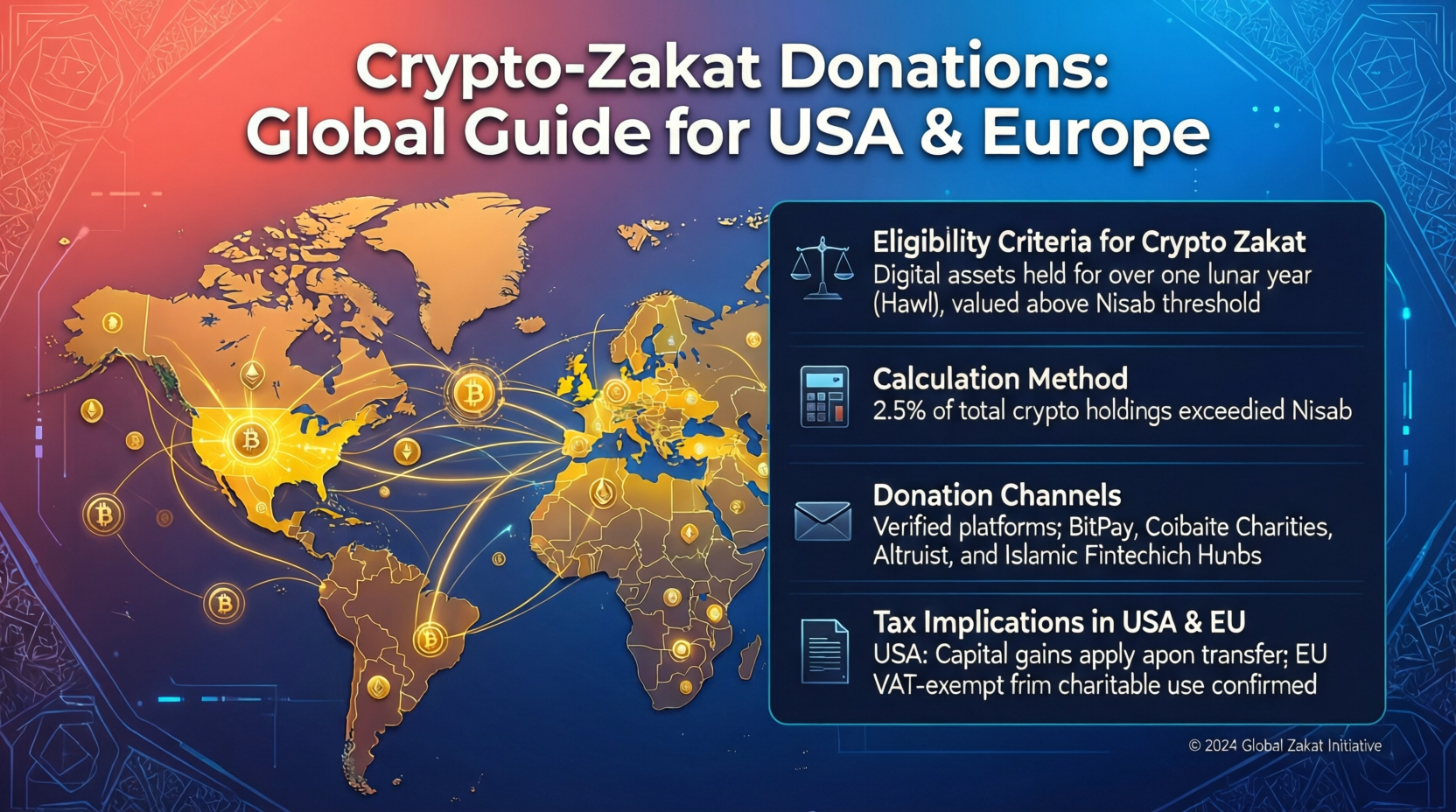
Crypto zakat donations are zakat payments made from Bitcoin, Ethereum, stablecoins or other digital assets to eligible recipients via compliant platforms and Islamic charities. Muslim donors in the US, UK, Germany and across Europe calculate zakat on their crypto at 2.5% above the nisab, then donate either directly in crypto or as converted fiat through Shariah-aligned, regulated channels.
Introduction
Crypto zakat donations simply treat your digital assets as zakatable wealth. You calculate zakat on your coins and tokens like you would for cash or trade goods, then give 2.5% (or your local equivalent ruling) to eligible causes either in crypto itself or in converted fiat.
They’re especially relevant for.
Muslim founders, tech professionals and investors whose savings are partly or mostly in crypto
Traders and long-term HODLers whose portfolios sit above the nisab
NGOs and Islamic fintech teams designing donation rails, zakat calculators and crypto gateways
With global crypto ownership estimated in the hundreds of millions in 2024, a growing share of Muslim wealth now lives on-chain, making crypto zakat more than a niche question it’s a mainstream fiqh and fintech issue.
Zakat Basics and How Digital Wealth Fits In
Zakat is an obligatory alms on certain types of wealth that have.
Reached the nisab (minimum threshold), and
Been held for one lunar year (hawl)
For most asset classes, the rate is fixed at 2.5%. Mainstream guidance from global zakat organisations is simple: total your zakatable wealth on your zakat date, confirm it’s above the nisab, then pay 2.5% without unnecessary delay.
Contemporary scholars increasingly classify cryptocurrencies as “mal” (property/wealth), similar to fiat currency or trade goods. Academic reviews of fatwas on cryptocurrency generally conclude:
If your combined crypto holdings meet the nisab
And a lunar year has passed
…then zakat is due, just like with other halal assets.
Which Crypto Assets Are Zakatable?
As a practical rule of thumb: if you hold a coin or token for investment, trading or as a store of value, it’s usually zakatable. That typically covers:
Major coins like BTC and ETH
Stablecoins such as USDT, USDC and EUR-pegged stablecoins
Most altcoins that you hold for price appreciation
Tokenised money-market funds or RWAs, subject to detailed scholar guidance
Institutions such as the National Zakat Foundation consider Bitcoin zakatable and advise paying 2.5% on its value, either directly in BTC or in your local currency equivalent.
Grey areas include.
Pure utility tokens
Governance tokens with limited real-world liquidity
Illiquid tokens you can’t realistically sell
Here, many scholars look at intention (investment vs pure utility) and liquidity (can you convert into money within a reasonable time?). When in doubt, you can ask a scholar whether a given token is closer to “wealth” or “pure access rights”.
Who Is Using Crypto Zakat Today?
Early adopters tend to be Muslim professionals working in Web3, fintech and tech hubs like New York City, London, Berlin and other major European cities. Their net worth often skews heavily towards digital assets, so excluding crypto from zakat calculations no longer feels realistic or spiritually comfortable.
On the NGO side, zakat funds and Islamic charities including global names such as Islamic Relief offices and NZF chapters now partner with platforms like The Giving Block and Crypto for Charity to accept crypto donations, including zakat. For these organisations, accepting crypto is a way to.
Reach younger, high-value donors
Tap into appreciated assets (rather than only cash)
Experiment with on-chain transparency and faster cross-border flows
Some crypto donation platforms have reported triple-digit year-on-year growth and five-figure average donation sizes, underlining that this is an important donor segment, not a side experiment.
Islamic Rulings on Zakat for Cryptocurrency
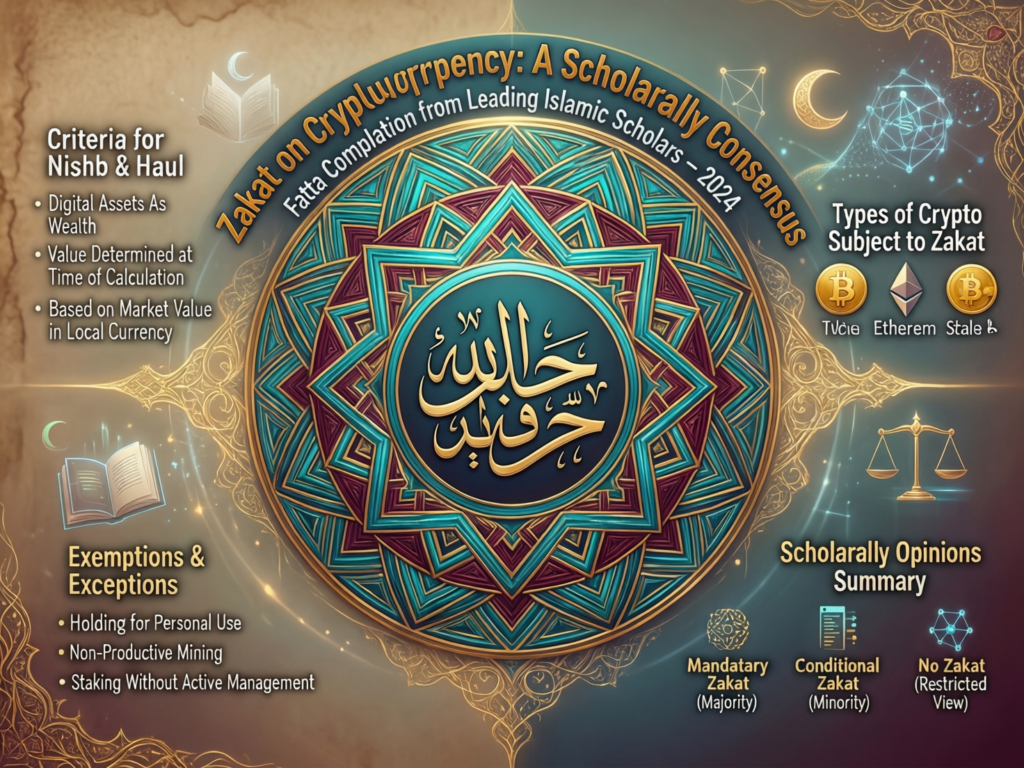
Most contemporary scholars treat cryptocurrencies as zakatable assets similar to money or trade goods, requiring 2.5% zakat above the nisab after a lunar year.
A minority debate whether particular tokens resemble commodities, currencies or equities more closely, but the practical outcome for retail donors is usually the same: treat your liquid crypto holdings as part of your zakatable wealth.
Key Scholarly Views on Zakat on Cryptocurrency
Reviews of fatwas and academic research on crypto zakat commonly highlight that:
Crypto you buy to trade or hold as an investment is zakatable at 2.5% of its market value once it exceeds nisab and one lunar year has passed
You may pay zakat from the crypto itself or by converting an equivalent amount to fiat
Zakat is based on overall value, not the specific coin, so rebalancing between assets doesn’t reset the hawl on your trading capital as a whole
Institutions like Cambridge Muslim College and various national fatwa councils also remind Muslims in the US and Europe that local context matters especially where classification and taxation of crypto differ by jurisdiction.
Is It Halal to Pay Zakat With Bitcoin Instead of Cash?
Where scholars deem a given cryptocurrency itself halal, they generally consider it permissible to discharge zakat using that asset, provided that:
The value you give equals or exceeds the zakat you owe in your local currency
The recipient (or charity) can practically use the crypto or convert it to cash at reasonable cost
In practice.
Tech-savvy charities and crypto-enabled Islamic NGOs: paying in BTC, ETH or stablecoins is often ideal, because they avoid forced selling on your side and may benefit from appreciated assets
Individual recipients who are unbanked or unfamiliar with crypto: converting to cash first may serve them better, even if the initial wealth was in digital assets
From a fiqh perspective, there is no requirement to pay zakat in the exact asset you’re being taxed on, as long as you pay from wealth that is halal and of equivalent value.
Rulings Common in the USA, UK, Germany and Wider Europe
Across the US and UK, many imams and zakat experts now align with the approach of organisations like NZF:
Include crypto at fair market value on your zakat date
Pay 2.5% if your net zakatable wealth sits above the nisab
In the EU (for example, in Germany and France), Muslims face an additional regulatory layer:
Crypto service providers are supervised by regulators such as BaFin and subject to frameworks like MiCA, even though the underlying zakat rulings remain broadly similar
No matter where you live, it’s worth confirming your approach with a local scholar who understands both Islamic law and your country’s crypto rules and tax treatment.
How to Calculate Zakat on Cryptocurrency.
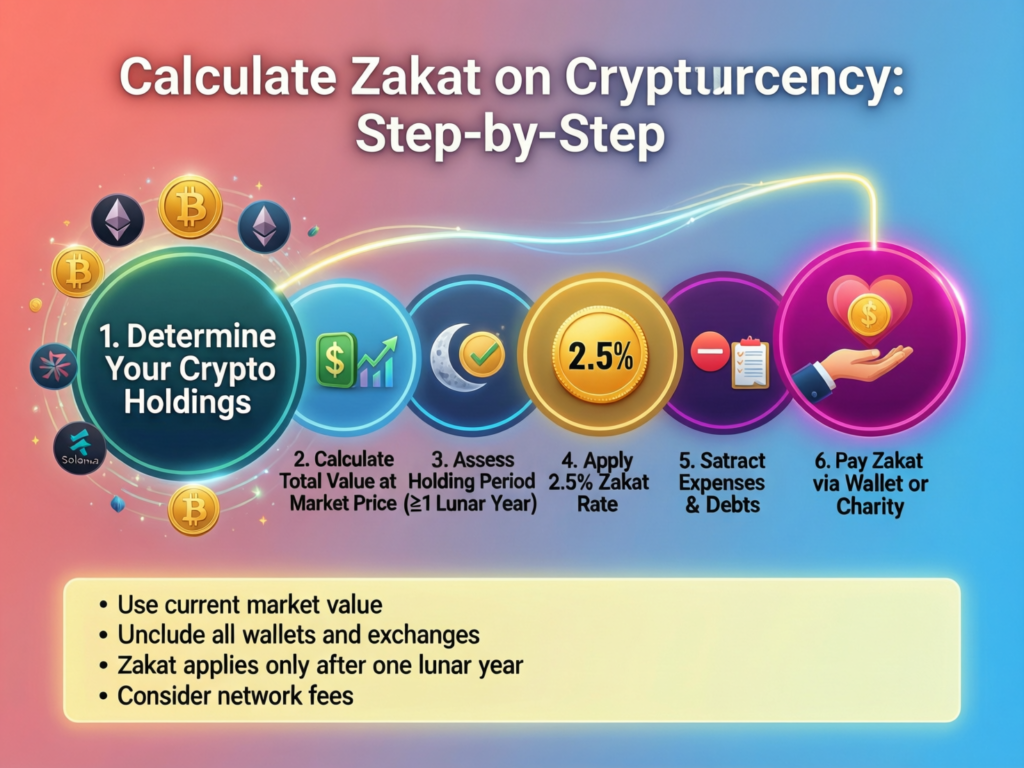
To calculate zakat on crypto, you.
Total the market value of all zakatable coins on your zakat date
Add that to your other zakatable assets
Subtract allowable short-term debts
Confirm you’re above the nisab
Pay 2.5% of the resulting figure
Many people pick a fixed “zakat anniversary” date each lunar year (often in Ramadan) to keep things simple.
Zakat on Cryptocurrency Calculator Method
A practical framework.
Set your zakat date
For example, the 1st of Ramadan every year
List all zakatable crypto
Trading and investment coins or tokens
Stablecoins
Yield-bearing positions where you still effectively own the underlying
Get the market value of each asset on that date
Use your base currency (USD, GBP, EUR, etc.)
Add other zakatable wealth
Cash, gold, trade inventory, some investments
Subtract short-term debts
Debts due within the next 12 months that you are actually repaying
Check the nisab
Using current gold or silver value, as published by many charities and scholars
If you are above the nisab, pay 2.5% of the net total as zakat
Many crypto zakat calculators offered by charities and donation platforms already use this logic. Still, it’s wise to check:
Which nisab basis they use (gold vs silver), and
The price date and source for their crypto valuations
Pricing Your Crypto.
Because crypto prices are volatile, don’t obsess over the “perfect” price — focus on being consistent and fair.
Use a reputable source such as:
Your main exchange, or
A recognised price index
Pick a single snapshot time on your zakat date
Convert everything into one base currency
Avoid chasing intraday swings; using a consistent end-of-day price source every year keeps your zakat fair and auditable
If your organisation is building internal zakat tools (for example, with a partner like Mak It Solutions), you can integrate exchange APIs and historical price feeds so calculations and audit trails are automated across your web and mobile apps.
DeFi, Staking Rewards, NFTs and Long-Term HODL
Some common crypto scenarios:
Staking / yield farming
Rewards are usually treated as growth in capital or income
Include the current total value (principal + rewards) once the underlying has been held for a lunar year
Locked DeFi positions
If you can realistically unwind or claim your share, they are typically zakatable
Genuinely illiquid or frozen funds may be excluded until they become accessible
NFTs
If bought as investments or for flipping, include their fair market value
If created or held purely for personal enjoyment with no real market, treatment may differ check with a scholar
Long-term HODL
Planning to hold BTC or ETH for ten years does not exempt them
If they are wealth above nisab, zakat remains due each year
Because DeFi structures change quickly, crypto-native Muslims should be prepared to revisit these classifications regularly with scholars who understand protocol design and tokenomics.
Worked Examples for US, UK and Germany/EU Donors
To keep the maths clear, assume the nisab is already met in all three examples and the zakat rate is 2.5% (1/40).
Example 1 US donor in New York
$10,000 in BTC
$5,000 in ETH
$5,000 in USDC
Total zakatable wealth = $20,000
Zakat = $20,000 ÷ 40 = $500
A Muslim in New York City might donate this $500 equivalent in BTC or stablecoins directly to a 501(c)(3) charity that accepts crypto. In some cases, donating appreciated crypto rather than selling it first can be tax-efficient always confirm with a qualified US tax adviser or the IRS’s latest guidance.
Example 2 UK donor in Birmingham
£8,000 in a mixed crypto portfolio
£4,000 in cash savings
Total zakatable wealth = £12,000
Zakat = £12,000 ÷ 40 = £300
A donor in Birmingham can send this £300 as crypto to a UK-registered Islamic charity, or sell enough crypto to pay in GBP. Gift Aid usually applies to voluntary donations rather than zakat itself, but many Muslims in the UK add extra sadaqah that can be Gift-Aided.
Example 3 German investor in Berlin
€15,000 in crypto on a regulated EU exchange
Total zakatable wealth = €15,000
Zakat = €15,000 ÷ 40 = €375
A donor in Berlin can pay that €375 in EUR or in crypto via an EU-registered NGO, while keeping separate records for German tax and any relevant reporting obligations under German or EU law.
Why Crypto Zakat Donations Are Powerful for Humanitarian Aid
Crypto zakat combines spiritual obligation with modern rails:
Faster cross-border transfers
Potentially lower intermediary fees
Transparent, auditable flows from donor to beneficiary
For humanitarian NGOs especially those serving refugees and unbanked communities — stablecoin-based cash assistance can be cheaper, faster and easier to audit than many legacy systems.
On-Chain Transparency: From Wallet to Beneficiary
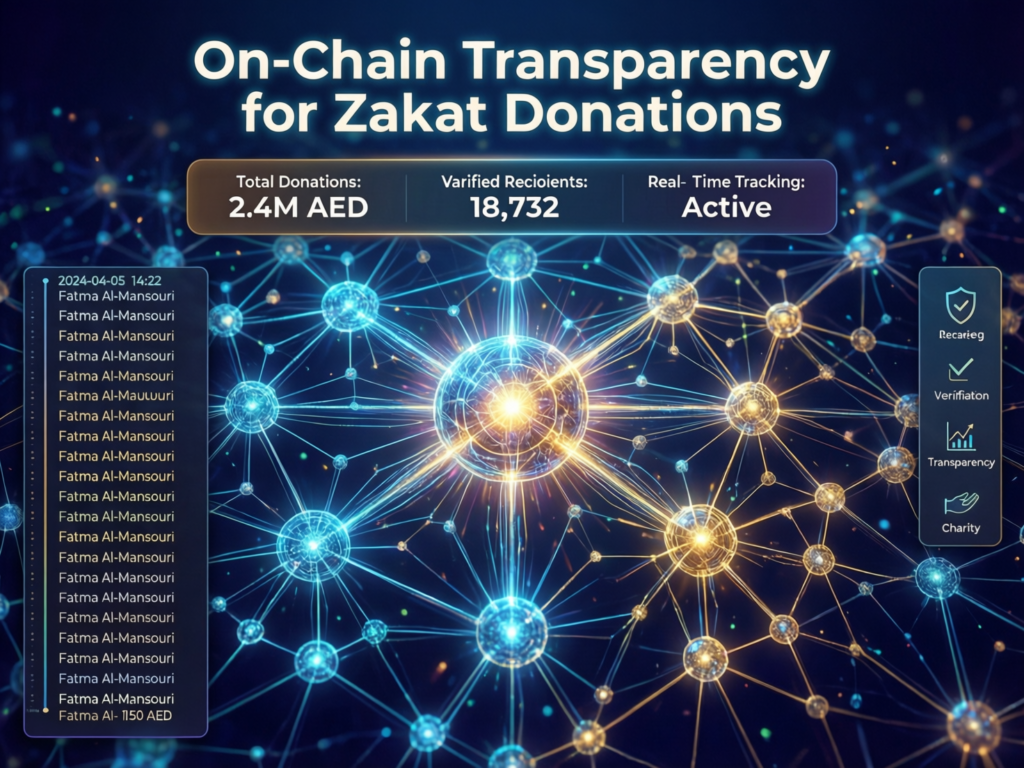
On-chain zakat makes transparency more tangible.
Donors can see funds leave their wallet, hit a charity’s wallet, and then move to project or field wallets
NGOs can publish read-only dashboards showing disbursement flows
Auditors can cross-check internal ledgers with public blockchain records
Projects like Oxfam’s UnBlocked Cash in Vanuatu used blockchain-based vouchers to reduce transaction times and improve transparency in cash and voucher assistance. Similar approaches are now being explored in other fragile and climate-vulnerable contexts.
Speed, Fees and Access: Why Stablecoins Matter
For refugees and people in fragile states, receiving aid as a stablecoin (such as a USD-linked token) can mean.
Near-instant settlement to a smartphone wallet
Lower fees compared to traditional remittance or card rails
Easier local spending through partner merchants or cash-out partners
UNHCR, for example, has piloted delivering assistance in stablecoins via the Stellar network, enabling quick, traceable support to displaced people. The World Food Programme’s “Building Blocks” platform has also processed hundreds of millions of dollars in blockchain-enabled cash transfers, saving significant bank fees while serving over a million refugees in camps such as those in Jordan and Bangladesh.
Real-World Case Studies
A few headline examples.
Oxfam’s UnBlocked Cash used stablecoin vouchers and NFC cards to deliver faster, more transparent cash support in Vanuatu and the wider Pacific
UNHCR & USA for UNHCR received a US$2.5 million stablecoin donation from Binance Charity in 2022 to support families fleeing the war in Ukraine
WFP Building Blocks has handled over US$500 million in aid with millions of blockchain-recorded transactions and notable fee savings
For your crypto zakat, these pilots show that on-chain systems are already powering real food, cash and health programmes, sometimes even linked to health systems like the NHS or EU health partners.
Choosing a Shariah-Compliant Crypto Zakat Platform
A good crypto zakat experience depends heavily on the platform you use. Look for:
Shariah oversight and a published zakat policy
Partnerships with regulated charities and NGOs
Support for major coins and stablecoins
Clear compliance with KYC/AML and data protection rules in your jurisdiction
Shariah Oversight and Zakat Policy
Key trust signals include.
A written zakat policy reviewed by recognised scholars or a Shariah board
Clear statements about which funds are zakat-eligible and how beneficiaries are verified
Transparent admin fees, including how much of your crypto zakat reaches programmes
Regular financial audits and impact reports
Many well-known Islamic charities publish their Shariah policies and advisory boards; crypto-native platforms offering “Shariah-compliant” donations should meet similar standards.
Platform Features That Matter
From a user and compliance perspective, pay attention to:
Supported assets
BTC, ETH and major stablecoins (USDC, USDT, EUR-stablecoins) as a baseline
Fees and spreads
Network gas fees
Conversion spreads
Any platform fee, especially on larger amounts
Automation
Recurring donations
Portfolio syncing
Built-in crypto zakat calculators
Receipts and reporting
Downloadable receipts for.
US 501(c)(3) tax records
UK Self Assessment
German or other EU income tax filings
CSV exports of donations and transaction hashes
If your organisation is building its own crypto zakat gateway, a partner like Amazon Web Services or other cloud providers combined with an engineering team such as Mak It Solutions can help you design secure, scalable infrastructure that plugs straight into your existing web and mobile apps.
Comparing Islamic Charity Crypto Donation Options
You’ll usually encounter three main models:
Direct charity integrations
Islamic NGOs (for example, Islamic Relief or NZF branches) that plug into processors like The Giving Block or Crypto for Charity
Crypto-native giving platforms
Multi-charity portals routing zakat and other gifts to thousands of NGOs worldwide
Custom NGO/fintech platforms
Built in-house or with vendors, tailored to specific zakat, sadaqah and waqf use cases
When comparing, prioritise.
Strong Shariah governance
Solid regulatory compliance
The quality of humanitarian partners (e.g., UN agencies and well-established NGOs)
Donating Crypto Zakat Safely in the USA, UK, Germany and Europe
Crypto Zakat to 501(c)(3)s and Tax Considerations
In the US, many large nonprofits now accept crypto via regulated processors. For Muslim donors.
Prefer charities with 501(c)(3) status and clear zakat policies
Check whether donations are handled directly or via an intermediary, and how quickly they’re converted
Keep strong records (including cost basis) and speak to a tax adviser, as donating appreciated crypto can sometimes reduce capital gains exposure
US-based organisations like USA for UNHCR already route on-chain donations into refugee programmes worldwide through specialist crypto partners.
Gift Aid, UK-Registered Charities and UK-GDPR
In the UK, focus on
Charities registered with the Charity Commission, ideally with published zakat policies
Compliance with UK-GDPR and clear privacy notices
Proper Gift Aid processes for any voluntary donations you give beyond zakat
A donor in London might send zakat in ETH to a UK Islamic charity, then add a small GBP sadaqah contribution that can be Gift-Aided to stretch support further.
BaFin, GDPR/DSGVO and Compliant NGOs
In Germany and across the EU.
Crypto service providers fall under regulators such as BaFin and EU rules like MiCA
Data protection is governed by GDPR/DSGVO
For donors in cities like Frankfurt, Paris, Brussels or Geneva:
Choose EU-based platforms and NGOs with clear statements on GDPR, AML and MiCA compliance
Check where your donation is processed (inside the EEA or via third-country processors) and how cross-border data transfers are handled
For larger gifts or if you work in a regulated sector, your accountant or compliance team may want transaction hashes, fiat equivalents and confirmations for their files
Compliance, Data Protection and AML for Crypto Zakat Platforms
KYC/AML and FATF Travel Rule Basics
Serious zakat and humanitarian platforms must meet KYC/AML requirements and, above certain thresholds, comply with the FATF “travel rule”. In practice this means:
Collecting minimum identity data for larger transactions
Screening donors and recipients against sanctions and watchlists
Sharing sender/recipient details between virtual asset service providers where required
As concerns about illicit crypto flows grow, regulators in the US, UK and EU are tightening expectations on monitoring and reporting, including for nonprofit-linked wallets.
Handling Donor and Beneficiary Data Under GDPR, UK-GDPR and DSGVO
For NGOs and platforms serving Muslims in the EU and UK, data protection is non-negotiable. Under GDPR/DSGVO and UK-GDPR, you must:
Have a lawful basis for processing data (often “legal obligation” and “legitimate interests” for compliance and fundraising)
Publish clear privacy notices explaining how wallet addresses, on-chain activity and KYC data are used
Implement appropriate security controls (encryption, access management)
Respect data subject rights, such as access and deletion requests where applicable
PCI DSS, SOC 2 and Open Banking Alongside Crypto
Most real-world crypto zakat flows are hybrid:
Donors may give in crypto, but NGOs still need.
Card processing
SEPA/ACH transfers
Open banking rails
Payment gateways and internal systems often need to meet PCI DSS standards
Larger platforms may seek SOC 2 reports to reassure institutional donors and partners
If you’re architecting these systems, cloud choices (for example, between AWS, Microsoft Azure and Google Cloud in specific regions) need to align with data residency, encryption and key-management requirements the sort of multi-cloud trade-offs explored in Mak It Solutions’ cloud comparison guidance.
How to Make Your First Crypto Zakat Donation
Once your calculation is done, actually sending crypto zakat is straightforward.
Confirm Your Zakat Amount and Pick a Coin
Calculate your total zakat (crypto plus other assets) on your chosen zakat date
Decide what portion you’ll pay in crypto vs cash
Choose the coin you’ll send, typically a widely supported asset such as BTC, ETH or a major stablecoin
Choose a Suitable Islamic Charity or Humanitarian Project.
Shortlist charities or platforms that clearly label zakat-eligible funds (for example, “zakat fund” or “emergency zakat for refugees”)
Check their Shariah oversight, compliance statements and core project areas (e.g., Gaza, Yemen, local hardship funds, health projects linked to the NHS or EU systems)
Review whether your gift will be held temporarily in crypto or converted immediately into stablecoins or local fiat
Connect, Send and Save Your Records
Connect your wallet (such as MetaMask, a hardware wallet or a CEX account) or generate a deposit address/QR code from the charity
Double-check.
The network (ETH mainnet vs L2, BTC onchain, etc.)
The amount and destination address
Estimated gas or network fees
Send the transaction and wait for sufficient confirmations
Download your donation receipt and export any relevant transaction details (hash, timestamp, fiat value) for your zakat records and tax filings
For NGOs and platforms, this is precisely the flow you can streamline with better UX, APIs and observability areas where Mak It Solutions regularly supports clients for other donation and subscription journeys.
The Future of Islamic Fintech, Crypto Zakat and Blockchain Humanitarian Aid
Trends in Crypto Philanthropy in the US, UK and Europe
Crypto philanthropy is moving from novelty to infrastructure.
Industry reports forecast cumulative crypto donations to nonprofits reaching roughly US$10 billion within the decade if current growth continues
Average crypto gift sizes on leading platforms already sit in the five-figure range for many campaigns
For Muslims in the US, UK, Germany and the wider EU, this means crypto zakat donations are steadily becoming mainstream especially as Islamic fintech products (zakat calculators, wallets, donation apps) become easier to use and better regulated.
Why Aid Agencies Prefer Stablecoins for Cash-Based Assistance
Agencies delivering cash-based aid typically prefer regulated stablecoins over volatile assets for operational use, because they offer:
Predictable value
Lower fees
Faster settlement
UN-linked pilots have shown that using stablecoins and digital treasury infrastructure can reduce programme and delivery costs across humanitarian flows worth around US$38 billion annually, while improving traceability.
For zakat, a common pattern is.
Donors send BTC or ETH
Platforms convert to USDC or fiat
NGOs disburse stablecoins or local currency to beneficiaries
Building Long-Term Trust With Muslim Donors
To build long-term trust with Muslim donors in cities like Washington, D.C., London, Paris or Brussels, crypto zakat platforms will need:
Independent Shariah and compliance oversight
Public transparency dashboards (with privacy-preserving aggregation)
Impact reports that clearly connect wallet flows to real projects food assistance, healthcare, education and beyond
Done well, crypto zakat can merge the rigor regulators expect from fintechs with the amanah (trust) that Muslims expect from zakat institutions.
Wrapping It Up
Most scholars treat cryptocurrencies as zakatable assets similar to money or trade goods, with 2.5% due above the nisab after one lunar year
You calculate zakat on crypto by valuing coins on a fixed zakat date, adding other wealth, subtracting eligible debts and applying 2.5%
Crypto zakat can move quickly and transparently into humanitarian programmes led by agencies such as UNHCR, Oxfam and WFP, especially when using stablecoins
Safe giving routes involve Shariah-reviewed, regulated platforms that respect KYC/AML, GDPR/UK-GDPR and security standards such as PCI DSS and SOC 2
Start Your Crypto Zakat Donations for Global Impact
If Allah has blessed you with digital wealth, your crypto can feed families, support hospitals and fund refugee programmes just as effectively as cash sometimes faster.
Before your next zakat date.
Set aside an evening to calculate your zakat, including crypto
Choose a trusted, crypto-enabled charity or platform that aligns with your values
Try sending part of your zakat directly from your wallet
If you’re part of an NGO or Islamic fintech team, now is also the time to explore how on-chain transparency and stablecoin rails could make your zakat operations faster, more auditable and more impactful for communities in need.
Key Takeaways
Crypto zakat donations treat Bitcoin, Ethereum, stablecoins and other digital assets as zakatable wealth, with 2.5% due above nisab after one lunar year
Mainstream scholarly opinion supports zakat on cryptocurrency and allows payment either in crypto itself or in fiat equivalent, subject to local guidance
On-chain transparency, stablecoin transfers and blockchain-enabled humanitarian platforms are already moving hundreds of millions of dollars in aid
Donors in the US, UK, Germany and EU should prioritise Shariah-reviewed platforms with strong KYC/AML, GDPR/UK-GDPR compliance and clear zakat policies
NGOs and Islamic fintechs can integrate crypto rails with existing card, bank and open banking systems while meeting PCI DSS, SOC 2 and data-protection standards
Technology partners like Mak It Solutions can help design secure, compliant crypto zakat flows across web, mobile and cloud architectures for faith-aligned giving
Ready to turn your crypto portfolio into real-world zakat impact?
Whether you’re a Muslim investor, a mosque trustee or part of an NGO leadership team, Mak It Solutions can help you. ( Click Here )
Design secure donation flows and dashboards
Integrate crypto rails with your existing systems
Respect both Shariah and modern regulatory standards
Reach out to explore a scoped, no-nonsense consultation on crypto-enabled zakat, or to discuss building your own Islamic fintech giving platform for donors across the US, UK, Germany and Europe.
FAQs
Q : Can I split my crypto zakat across several charities and still fulfil my obligation?
A : Yes. You can divide your zakat across multiple charities and projects as long as the total amount you distribute equals or exceeds the zakat you owe and it all goes to eligible recipients (e.g., the poor, refugees, those in debt). Many donors spread their crypto zakat across emergency appeals, local hardship funds and longer-term development projects. Keeping a simple log of where each portion went makes it easier to review your calculation and intention later.
Q : Do I need to pay zakat on crypto that I lost access to or that is locked in a smart contract?
A : If you have permanently lost access to a wallet (for example, you truly lost the seed phrase and there is no recovery option), many scholars consider that wealth no longer under your effective ownership, so zakat is not due on it going forward. For crypto temporarily locked in a smart contract or staking product where you still have a realistic claim, it is usually treated as part of your zakatable wealth. Because DeFi products vary a lot, seek case-by-case guidance from a knowledgeable scholar.
Q : How often should I recalculate zakat on volatile crypto prices during the lunar year?
A : You typically only need one full calculation on your chosen zakat date each lunar year, even if crypto prices swing wildly during the year. The key is consistency: pick a date (for example, the 1st of Ramadan), value your holdings as of that day, check that you’re above nisab and apply 2.5%. Some people keep quarterly or monthly snapshots for peace of mind, but from a zakat perspective, an annual calculation on a fixed date is normally sufficient.
Q : Are fees and gas costs included when calculating zakat on cryptocurrency transfers?
A : Gas fees and platform charges don’t usually reduce your zakat obligation itself — you calculate zakat on the gross value of your wealth at your zakat date. When you actually send crypto zakat, you’ll want to factor in gas and network fees so the net amount reaching the charity still matches what you intend to pay. For large payments, using lower-fee networks or stablecoins can help minimise friction while keeping your zakat amount intact.
Q : What’s the difference between giving sadaqah and zakat in cryptocurrency?
A : Zakat is an obligatory form of charity that becomes due when your wealth crosses the nisab and a lunar year has passed; sadaqah is voluntary and can be given any time, in any amount. You can use crypto for both, but zakat requires proper calculation, clear intention and delivery to eligible categories, while sadaqah is more flexible and can support a wider range of causes. Many donors use separate wallets or labels in their portfolio trackers to distinguish between crypto zakat and ongoing crypto sadaqah.