


Dubai Metaverse Strategy 2030: Guide for US, UK and EU
The Dubai Metaverse Strategy is a 2030 roadmap launched in 2022 to make Dubai one of the world’s top 10 metaverse economies, adding around $4 billion to GDP, supporting 40,000 virtual jobs and attracting 1,000+ blockchain and metaverse companies.
For founders and teams in the US, UK and EU, the Dubai metaverse strategy offers a regulated “virtual worlds” testbed with VARA for virtual assets, strong cloud infrastructure and clear free-zone paths to build Web3, digital-twin and immersive services for Dubai and global markets.)
Introduction
Dubai’s Metaverse Strategy is not a slogan; it’s a 2030 economic plan to build a $4bn “virtual worlds” layer on top of the city’s physical economy.The strategy positions Dubai as a metaverse-enabled smart city where Web3 apps, digital twins and immersive services sit alongside skyscrapers, free zones and cloud regions.
Announced in 2022, the Dubai Metaverse Strategy targets roughly $4 billion in additional GDP, more than 40,000 virtual jobs and at least 1,000 companies working across blockchain, Web3 and virtual worlds by 2030.For US, UK and German/EU founders and investors, this matters because Dubai is emerging as a Web3 and metaverse hub that sits closer (in time zone, regulations and culture) to both European and Asian markets than New York, London or Berlin.
Here’s how the Dubai metaverse strategy actually works in practice: how it fits into UAE-wide digital policy, what VARA means for compliance, and how US, UK and EU companies can set up metaverse ventures, secure licenses and ship their first virtual-world pilots in and from Dubai.
What Is the Dubai Metaverse Strategy?
The Dubai Metaverse Strategy is a government program launched in mid-2022 to make Dubai a leading global hub for metaverse innovation and Web3-enabled digital economy services by 2030. It’s part of Dubai’s broader digital economy vision and aims to integrate virtual worlds into tourism, real estate, government, finance and education not treat them as a side experiment.
Official Definition and 2030 Vision
Officially, the Dubai Metaverse Strategy seeks to add about $4bn to Dubai’s GDP, support more than 40,000 virtual jobs, attract over 1,000 blockchain and metaverse companies and place Dubai among the world’s top 10 metaverse economies by 2030.It also reinforces the city’s positioning as a metaverse-enabled smart city, where immersive services run on top of strong telecoms and cloud infrastructure.
In official communications, you’ll see it referred to as the “Dubai Metaverse Strategy” or “Dubai virtual worlds strategy”. Practically, you can treat it as Dubai’s master plan to use virtual worlds as a core layer of its digital economy on par with earlier pushes into smart government, fintech and free-zone innovation.
How Dubai’s Strategy Fits Within the UAE Metaverse Strategy
Dubai’s metaverse strategy sits inside a wider UAE digital and Web3 policy stack. In simple terms.
UAE level (federal) “UAE metaverse / digital economy strategy”
Sets national AI, blockchain and digital economy priorities, including the UAE AI Strategy 2031.
Coordinates between emirates and ministries (economy, finance, telecoms, etc.).
Dubai level (emirate) “Dubai Metaverse Strategy”
Focused specifically on Dubai’s economy and smart-city vision.
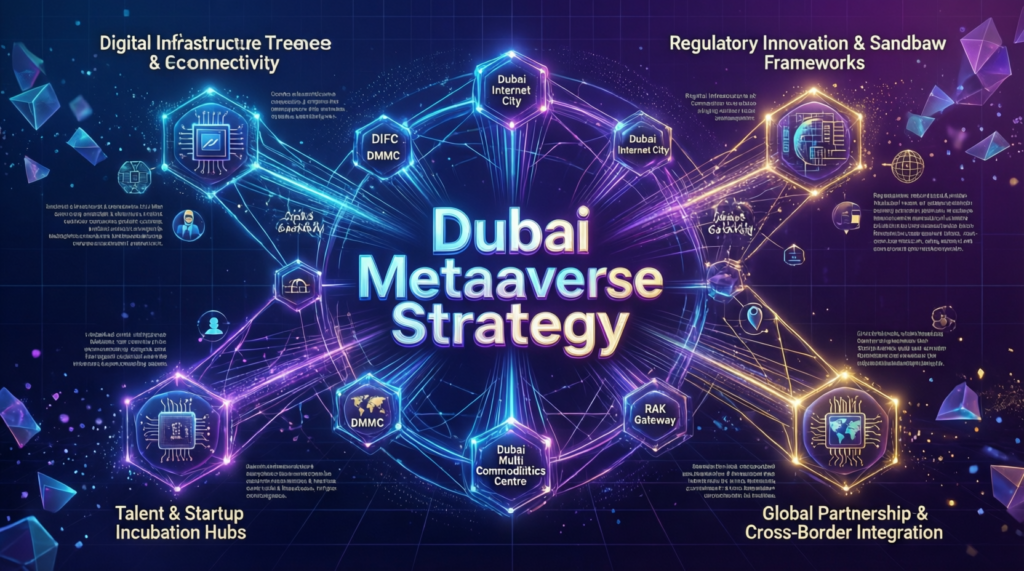
Implements concrete measures via Dubai Future Foundation, Dubai Digital Economy efforts and free zones like DIFC, DMCC and Dtec.
Abu Dhabi and other emirates are also building Web3 and virtual-asset ecosystems, but Dubai’s policy is the most explicitly branded around metaverse and virtual worlds. For US, UK and EU companies, that usually makes Dubai the starting point for metaverse pilots, while federal rules and other emirates provide additional regulatory and market options.
Virtual Worlds, Web3 and Digital Economy
Dubai’s virtual-worlds policy clusters around a few recurring pillars.
Infrastructure & Platforms
5G, fiber, large cloud regions (AWS, Azure, Google Cloud) and GPU capacity (NVIDIA-powered stacks) to run real-time 3D, AI and digital twins.
Virtual Worlds & Web3 Policy
Rules for virtual assets (via VARA), sandbox use cases, and standards alignment with bodies like the ITU Focus Group on metaverse.
Talent & Jobs
Attracting XR, gaming, Web3, AI, data and cloud skills from London, Berlin, New York, Austin and beyond.
Ecosystem Building
Dubai Future Foundation, Dubai Metaverse Assembly and Dubai Chamber of Digital Economy help convene big tech, startups and regulators around new use cases.
Goals and Metrics.
The headline question for investors is simple: what does this strategy actually deliver by 2030? Dubai’s answer is: measurable GDP, tens of thousands of jobs and sector-specific transformation in tourism, real estate, retail, healthcare and education.
$4bn GDP Impact and “Gross Metaverse Product” Concept
Dubai’s Metaverse Strategy targets around $4 billion in additional GDP contribution from metaverse-related activities by 2030, on top of the estimated $500m the local metaverse and blockchain sector already adds today.You can think of this as the beginnings of a “Gross Metaverse Product” value created in Dubai’s virtual worlds that ultimately shows up as revenue, jobs and investment in the physical city.
Revenue will come from
Virtual tourism immersive visits to Dubai landmarks, city-scale digital twins and virtual city tours.
Real estate virtual property tours, tokenised ownership and metaverse showrooms.
Retail & entertainment virtual malls, gaming, esports and “phygital” commerce that connects online and offline journeys.
Education and training VR classrooms and industrial training simulations for aviation, energy, logistics and more.
Globally, the metaverse could generate around $5 trillion in value by 2030 according to McKinsey roughly the size of Japan’s economy.The worldwide metaverse market generated about $105 billion in revenue in 2024 and is forecast to exceed $900 billion by 2030. Dubai’s $4bn target is its local slice of that global opportunity.
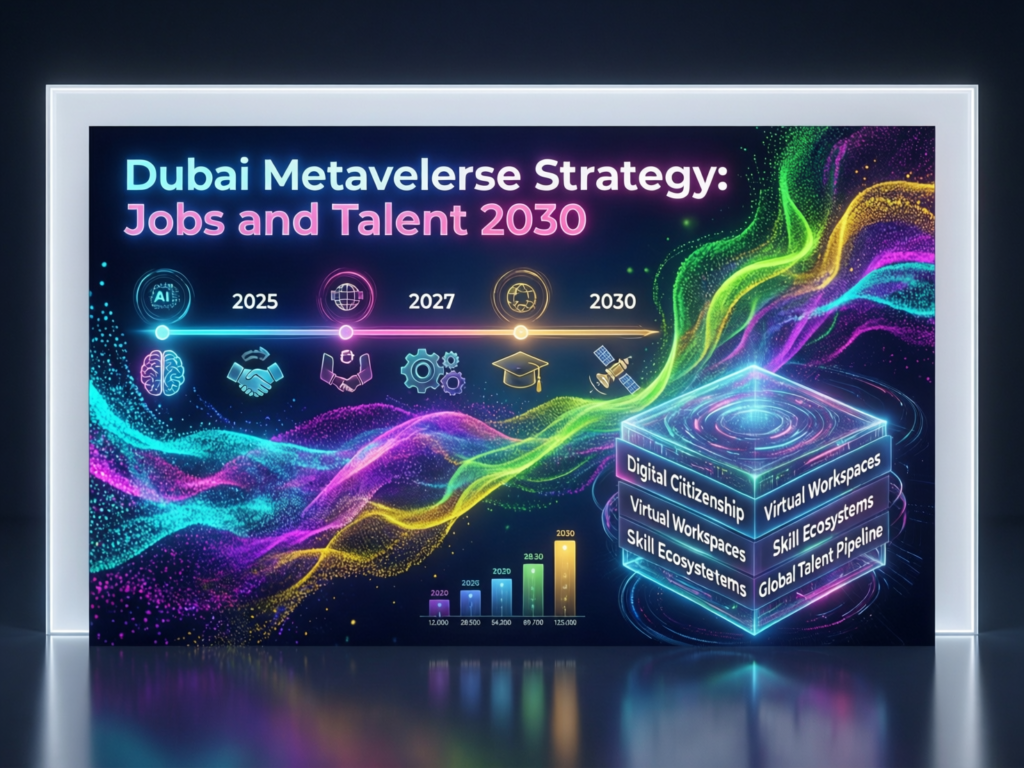
40,000 Dubai Metaverse Jobs by 2030
The strategy’s most concrete promise is supporting more than 40,000 virtual jobs by 2030, on top of existing XR and Web3 roles. These “Dubai metaverse jobs 2030” span.
XR & game engineering Unity/Unreal developers, 3D environment artists, technical artists, real-time rendering engineers.
Virtual-events & community virtual events producers and community managers for metaverse venues, conferences and festivals.
Governance & compliance trust & safety leads, AML/KYC analysts and virtual-asset compliance officers working with VARA and financial regulators.
Product, growth & data product managers, data scientists and growth marketers optimising virtual experiences for conversion and retention.
Some roles will be located in Dubai; others will be remote or hybrid, especially for US, UK and EU specialists plugged into Dubai-based companies, DAOs and agencies.
Tourism, Real Estate, Retail, Healthcare and Education
Dubai has named tourism, real estate, education, retail and government services as the key pillars for metaverse use cases.
Tourism metaverse tourism campaigns that let visitors explore virtual Burj Khalifa or Dubai Creek Harbour months before flying in, often using Apple Vision Pro or Meta Quest headsets.
Real estate fully interactive property tours, digital twins of entire districts and metaverse-only property developments marketed via platforms built on AWS, Azure or Google Cloud.
Retail & entertainment virtual malls, concerts and branded game worlds that connect payments back into open-banking and embedded-finance rails.
Healthcare virtual clinics, rehabilitation and medical training simulations (with HIPAA and GDPR-aware architectures for US and EU patients)
Education immersive classrooms and vocational training twins of factories and ports; here Dubai looks at models from London, Berlin and Munich universities and adapts them to GCC needs.
Regulation and Governance.
For US, UK and German executives, the question is rarely “can we build this?” but “are we allowed to?” Dubai’s answer is a dedicated virtual-assets regulator, bridges to global data-protection frameworks and a seat at the table in global metaverse standards work.
Dubai’s Metaverse Regulation and VARA
The Virtual Assets Regulatory Authority (VARA) is Dubai’s specialist regulator for virtual assets and related activities (outside the DIFC financial free zone). It issues licenses, writes rulebooks and supervises virtual-asset service providers, including many Web3 and metaverse platforms.
For most companies, “metaverse regulation UAE and VARA” means.
Determining whether your virtual-world business is a virtual-asset service (tokens, NFTs, wallets, exchanges, staking, etc.).
Applying for the relevant VARA license category if you touch virtual assets.
Coordinating with other regulators (for example, the DIFC for financial services) when your use case mixes finance and virtual worlds.
You don’t need a law degree, but you do need early conversations with Dubai-based law firms and corporate-services providers to understand how far your current product fits under existing VARA rulebooks.
Data Protection Bridges.
Dubai is not in the EU or UK, but any metaverse platform serving German, wider EU or UK users still has to respect GDPR/DSGVO and UK-GDPR obligations around consent, profiling and data transfers.
Practically, that means.
GDPR / DSGVO
Data-processing agreements, data minimisation, DPIAs for highly immersive tracking and lawful mechanisms for cross-border transfers from, say, Frankfurt or Amsterdam to Dubai cloud regions.
UK-GDPR
Largely similar obligations, enforced by the ICO; UK firms in London or Manchester must treat Dubai as a “third country” destination and use appropriate safeguards.
US frameworks
SOC 2, PCI DSS for payments and HIPAA where metaverse experiences touch healthcare or wellness data (for example, a US hospital using a Dubai-hosted VR training twin)
German and EU companies in particular should ask vendors specific questions about data residency, logging and cross-border transfers and may choose multi-cloud or sovereign-cloud architectures similar to those used for sensitive analytics workloads in the Middle East.
Governance of Virtual Worlds.
Dubai’s virtual-worlds policy doesn’t sit in a vacuum. Globally, bodies like the ITU Focus Group on metaverse are working on standards for interoperability, accessibility and safety in virtual worlds.
In that context, Dubai emphasises.
Safety & content moderation KYC/AML aligned with regulators such as BaFin (Germany), FCA (UK) and the SEC/CFTC (US), plus AI-powered content moderation for abuse, scams and extremism.
Inclusion & accessibility ensuring immersive services work for users with different abilities, languages and bandwidth levels a big focus for ITU’s accessibility work and for the EU’s digital-inclusion agenda.
Financial and consumer protection virtual-asset licensing, risk disclosures and clear processes for dispute resolution when things go wrong.
If your product touches user-generated content or payments, you will likely combine AI content moderation and human review to meet both Dubai’s expectations and those of regulators back home.
Business and Investment Opportunities in Dubai’s Metaverse Economy
Dubai is treating the metaverse as a cross-sector growth engine, not a fashionable toy. For agencies, SaaS and Web3 platforms in the US, UK and EU, business opportunities in the Dubai metaverse cut across digital twins, fintech, media, gaming and government services.
Business Opportunities Across Sectors
Some of the most accessible plays.
Agencies & studios build immersive campaigns and digital twins for tourism boards, airlines and retail brands; Dubai already hosts events like the Dubai Metaverse Assembly that bring these buyers together.
SaaS & platform players analytics, identity, NFT and Web3 tooling, compliance dashboards and customer-data platforms adapted to virtual-world telemetry.
Digital-twin providers simulating ports, logistics corridors and airports to optimise flows and support climate-aware city planning.
Fintech and payments embedded wallets, open-banking rails and tokenised loyalty for metaverse commerce.
Gaming & esports tournaments, metaverse arenas and creator marketplaces, connecting Dubai’s youth, expat and tourist population with global players.
If you already work in Saudi Vision 2030, GCC super apps or regional data analytics, your existing knowledge transfers well into Dubai’s metaverse economy.
How to Start a Metaverse Company in Dubai, UAE
Here’s a simple path for how to start a metaverse company in Dubai, UAE (high-level guidance, not legal advice)
Choose your free zone and structure
Shortlist hubs like DIFC, DMCC, Dubai Internet City or Dtec depending on whether you’re fintech, virtual-asset-heavy or more general tech.
Define your business activities
Decide if you’re a content studio, SaaS platform, virtual-asset platform or hybrid – this will drive license categories.
Apply for a metaverse / tech services license
Work with the chosen free-zone authority and, if needed, VARA to align on virtual-assets permissions and compliance.
Open banking and payments
Set up a UAE bank account and payment stack; if you’re touching cards, design around PCI DSS controls from day one.
Hire and sponsor talent
Combine in-Dubai staff with remote US, UK and EU talent for specialised XR, Web3 and AI roles.
Many founders treat this as a 60–90 day process with specialist corporate-services firms handling filings while they focus on product and early customers.
Metaverse Services License and Virtual Assets Permissions
If your business issues, trades or custodies tokens, NFTs or other digital assets, you’ll likely need a metaverse services license UAE / Dubai from a free zone, plus a VARA virtual-asset license or approval where applicable.
High-level considerations.
Map your activities to VARA categories (exchange, broker-dealer, custody, advisory, etc.)
Implement robust KYC/AML, security and governance controls before applying experience from BaFin, FCA or SEC-regulated environments is a plus.
Engage specialist law firms or corporate-services providers early especially if you’re a US Delaware C-Corp or UK Ltd entity expanding into Dubai.
Jobs, Talent and Real-World Use Cases
Dubai’s metaverse push isn’t just about companies and regulators; it’s a talent story. Professionals in New York, London, Manchester, Berlin, Frankfurt or Munich increasingly see Dubai as both an XR/Web3 career accelerator and a launchpad into the wider GCC.
Dubai Metaverse Jobs for US, UK and German Talent
Yes, US, UK and EU residents can secure Dubai metaverse jobs, including fully remote, hybrid and relocation roles. Companies based in Dubai’s free zones routinely hire engineers, designers and product leaders who remain in the US or Europe while visiting Dubai for sprints and events.
Searches like “remote metaverse jobs in Dubai for US talent”, “Dubai metaverse jobs for UK software engineers” or “Metaverse Jobs Dubai für deutsche Entwickler” already map to roles ranging from Unity devs and Web3 engineers to data scientists and growth marketers. German-speaking talent is in particular demand for EU-facing virtual-world projects with GDPR and BaFin exposure.
Virtual Worlds in Tourism, Real Estate, Retail and Government
The easiest way to understand Dubai’s metaverse ambition is to look at real use cases emerging in the city and wider UAE.
Virtual tourism 3D explorations of downtown Dubai, desert experiences and museum exhibits, used in campaigns aimed at London, New York, Paris and Hamburg audiences.
Real estate & digital twins immersive tours of apartments, villas and office towers, plus digital twins of new districts used by planners and investors.
Retail & entertainment pop-up virtual malls and branded experiences linked to loyalty programs and NFTs.
Government & public services “virtual HQs” and digital-twin sandboxes where ministries simulate policies before implementation echoing ITU’s work on metaverse for smart cities.
Skills, Salaries and Career Paths in the Dubai Metaverse Economy
In-demand skills include.
Technical Unity/Unreal, WebGL, React/React Native, Solidity and other Web3 stacks, 3D content pipelines, cloud and Kubernetes.
Data & AI analytics, real-time event processing and unstructured data analytics to make sense of in-world behaviour.
Security & compliance cloud security, privacy engineering, financial-crimes and T&S operations.
Salary bands often compete well with London or Berlin once you factor in Dubai’s tax regime, but packages vary widely by employer and sector. Compared to San Francisco, Dubai can offer faster visa routes, lower personal tax and direct exposure to GCC megaprojects in Saudi Arabia and Qatar.
How US, UK and German/EU Companies Can Plug In
If you’re running a team in San Francisco, New York, London, Manchester, Berlin or Munich, plugging into the Dubai metaverse strategy is less about moving your HQ and more about choosing the right entry path.
For US Tech and Web3 Companies
For US firms asking how to invest in the Dubai metaverse strategy from the USA, the most common playbooks are:
Incorporate a Dubai free-zone entity for regional operations while keeping your US parent (Delaware C-Corp, for example).
Use Dubai for MENA go-to-market Arabic-first user research, GCC-compliant hosting and VARA-aligned token models.
Keep sensitive US healthcare or financial data in US regions while using Dubai as a front-end and rendering hub, aligned with HIPAA and SOC 2.
Tax structuring (CFC rules, permanent establishment, etc.) should be handled by cross-border tax advisors; most US founders combine US and UAE counsel for this.
For UK Startups and Fintechs
Many UK fintechs and Web3 startups use Dubai as their MENA HQ, leveraging their FCA and PRA experience when dealing with VARA and UAE regulators. For queries like “Dubai metaverse for UK fintech” or “setting up a metaverse company in Dubai from the UK”, practical steps include:
Starting with a regulatory gap analysis between your FCA-regulated products and VARA / UAE expectations.
Building virtual-world layers on top of existing payments, lending or wealth products – for example, immersive investor education or virtual wealth-management lounges.
Using Dubai as a bridge to GCC markets while keeping engineering partly in London, Manchester or Edinburgh.
For German and EU Mittelstand and Scale-Ups
For German and EU Mittelstand, searches like “Dubai Metaverse Strategy Chancen für deutsche Unternehmen” or “wie deutsche Web3 Startups in Dubai Metaverse expandieren können” translate into a compliance-first expansion.
Aligning with DSGVO, BaFin expectations and the EU AI Act, then mapping where VARA and UAE digital-economy rules differ.
Designing data-minimised architectures that keep European PHI/PII in EU or German clouds while using Dubai for rendering and regional distribution.
Partnering with local systems integrators and analytics firms here, Mak It Solutions’ experience with GCC data and AI projects can shorten the learning curve
At some point, slides and strategy memos must turn into an actual virtual-world pilot. A simple way to derisk this is to run a 90-day pilot with a clear business case and limited regulatory exposure.
Choosing the Right Use Case and Partner
Start with a 2×2 grid: business impact vs complexity/regulatory risk. Good first pilots often include:
Virtual showrooms for high-value products or real estate.
Digital twins of a store, branch or logistics hub with limited PII.
Metaverse-based customer communities tied to existing loyalty programs rather than speculative tokens.
When choosing delivery partners, look for Dubai-based teams who understand cloud, mobile, analytics and compliance for example, agencies that already build apps, Web3 experiences and data platforms for GCC clients.
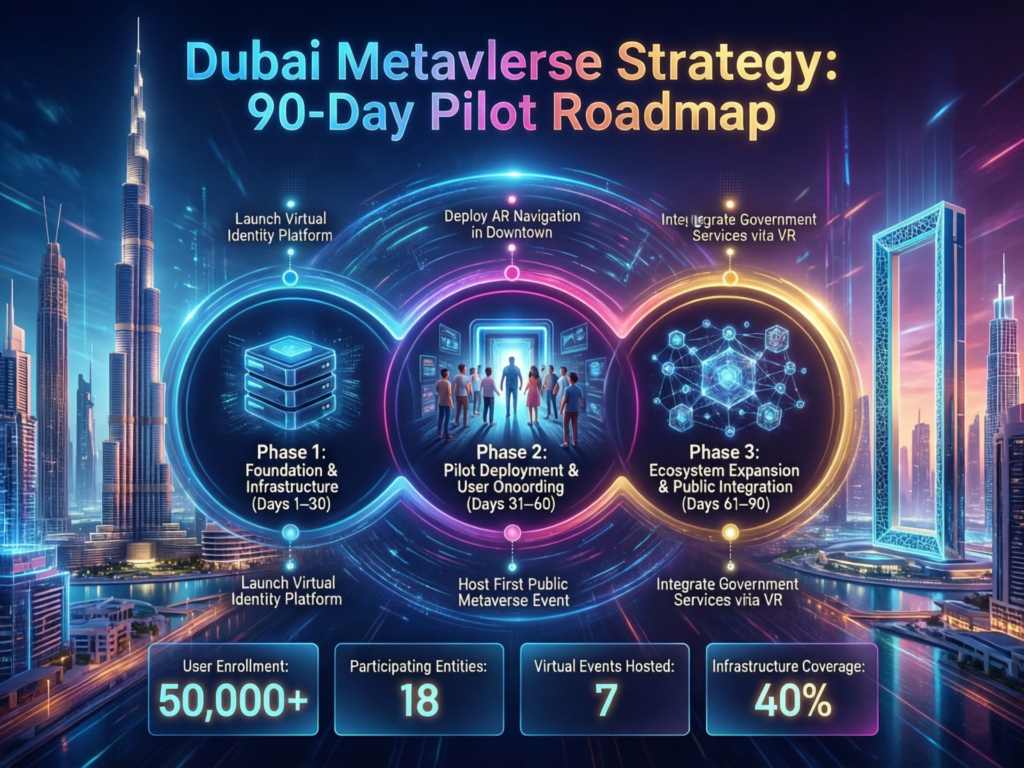
Implementation Roadmap: 90-Day Pilot Plan
A typical 90-day roadmap.
Discovery & design (weeks 1–3)
Clarify goals, KPIs and regulatory constraints (GDPR, VARA, sector rules)
Compliance & architecture review (weeks 2–4)
Map data flows, decide on cloud regions (Dubai vs EU vs US) and document controls.
Build & integrate (weeks 4–9)
Develop the metaverse experience and integrate identity, payments and analytics using proven web/mobile stacks.
Test & soft launch (weeks 9–11)
Run security, UX and regulatory checks; launch a closed beta with Dubai-based users plus a sample from US/UK/EU.
Go-live & measure (weeks 11–13)
Open to a wider audience, track KPIs, document lessons and plan for the next iteration.
Measuring ROI and Preparing for Scale
Key metrics typically include
Engagement session length, repeat visits and dwell time in virtual spaces.
Conversion bookings, leads or sales from virtual touchpoints vs classic web.
New revenue & cost savings incremental revenue from virtual products, reduced physical showroom or travel costs.
Talent & brand impact on recruiting and retention for hard-to-hire XR, AI and data roles.
Once the pilot works, Mak It Solutions can help you industrialise it hardening infrastructure, optimising cloud spend, connecting analytics and rolling out to new regions while keeping GDPR/DSGVO, UK-GDPR and US sector rules in mind.
Last Words
Global “metaverse” hype has clearly cooled, especially in the US and Europe as attention shifted to generative AI.But in Dubai, the policy and infrastructure pieces VARA regulations, government assemblies, cloud regions and free-zone ecosystems continue to move forward.
Is every vision slide going to materialise? No. But if you view the Dubai metaverse strategy as a long-term virtual-worlds and Web3 infrastructure bet, grounded in jobs, GDP and sectoral use cases, it’s clearly more than a passing fad.
Key Takeaways
Dubai’s metaverse strategy aims for about $4bn GDP impact, 40,000 virtual jobs and 1,000+ companies by 2030, making it a top-10 global metaverse economy.
VARA provides a bespoke virtual-assets regulatory regime, giving US, UK and EU firms clearer rules for metaverse tokens, wallets and exchanges than in many jurisdictions.
Priority sectors include tourism, real estate, retail, healthcare and education, with digital twins and immersive services already emerging across Dubai and the wider GCC.
US, UK and German/EU companies can enter via free-zone entities (DIFC, DMCC, Dtec, Dubai Internet City) and 90-day pilots that respect GDPR/DSGVO, UK-GDPR, SOC 2, PCI DSS and HIPAA where relevant.
Mak It Solutions brings web, mobile, cloud, AI and analytics experience in GCC and Western markets, making it a natural partner to design, build and operate Dubai-linked virtual-world projects.
If you’re considering Dubai as your metaverse or virtual-world hub, your next move doesn’t have to be a giant leap. Share a brief about your sector, target markets (US/UK/EU/GCC) and current tech stack, and the Mak It Solutions team can help you scope a 60–90 day pilot with clear KPIs and compliance guardrails.
From virtual showrooms to city-scale digital twins, we’ll work with your legal, finance and product teams to turn the Dubai Metaverse Strategy from a headline into a concrete roadmap.( Click Here’s )
FAQs
Q : Is Dubai’s metaverse strategy only relevant for crypto and NFT startups, or also for traditional businesses?
A : It’s absolutely relevant for traditional businesses. While VARA and virtual-asset rules are important for crypto and NFT platforms, most of Dubai’s metaverse use cases sit in tourism, real estate, retail, education and government services. Physical-world companies can use virtual worlds for marketing, training, sales and service delivery without issuing tokens at all. The key is to treat the metaverse as an additional channel like mobile or web that integrates with your existing apps, CRMs and payment systems.
Q : Do companies need a separate metaverse services license in Dubai if they already hold a tech or media license?
A : Often, yes. A generic tech or media license from a free zone covers software and content creation, but if you issue, trade or custodian virtual assets in your metaverse experience, you may also require a VARA-aligned virtual-assets permission or license. Many firms keep their core software under an existing license and spin up a dedicated virtual-asset entity once tokenisation or DeFi-style features come into scope. Specialist law firms and corporate-services providers can help design the right structure.
Q : How does Dubai’s metaverse strategy compare with similar initiatives in Saudi Arabia, the UK or EU smart-city projects?
A : Dubai is currently the most explicit about a named Metaverse Strategy with GDP and jobs targets, plus a standalone virtual-assets regulator (VARA). Saudi Vision 2030 is broader but includes mega-projects like NEOM that lean heavily on digital twins and immersive services. The UK and EU tend to focus on underlying regulations GDPR/DSGVO, AI and digital-services rules and on smart-city pilots rather than “metaverse” branding, though ITU’s global virtual-world work influences all of them.
Q : What are the main risks and challenges of building metaverse experiences in Dubai (regulation, talent, infrastructure)?
A : Key risks include regulatory misalignment, especially if you launch tokenised products without fully mapping VARA rules; data-protection gaps when handling EU/UK/US user data; and talent competition for senior XR, AI and security roles. On the infrastructure side, the UAE has strong cloud and connectivity, but GPU and specialist hardware capacity can still become bottlenecks for very large-scale deployments. Most of these risks can be reduced through careful architecture, multi-cloud strategies and early engagement with regulators.
Q : Can small startups or solo creators realistically benefit from Dubai’s metaverse strategy, or is it only for big enterprises?
A : Small teams and solo creators can absolutely benefit. Free zones increasingly offer startup-friendly license packages, coworking and accelerator programs aimed at Web3 and metaverse founders. Creators can land service work for Dubai brands, build white-label virtual-world solutions or launch niche experiences targeting GCC users from abroad. The main challenge is prioritisation: instead of trying to “own the whole metaverse”, focus on one sharp use case for example, virtual events for MENA conferences or digital twins for a specific industry and partner with larger agencies or systems integrators to reach enterprise clients