
Top Middle East Crypto Influencers for 2026
The most trusted Middle East crypto influencers in 2026 are Dubai- and Saudi-based traders, on-chain analysts and educators who publish consistent, transparent research in English and Arabic, with clear risk warnings and no guaranteed-return claims. Serious US, UK and EU investors should treat them as one research input, verify disclosures, and ensure any action stays within local rules like MiCA, BaFin guidance and FCA/SEC expectations.
Not investment advice
Use every influencer as one data point, not a trading signal, and always follow your local laws.
Introduction
Dubai, Riyadh and the wider MENA region no longer just react to global crypto cycles — they help set the tone for liquidity, token launches and Web3 narratives that traders in New York, London or Berlin wake up to each morning. Middle East crypto influencers sit in the middle of that flow, translating GCC news, exchange activity and regulatory moves into bite-sized content for global audiences.
When we talk about Middle East crypto influencers, we mean a broad mix of MENA KOLs: short-term traders posting BTC/ETH setups, DeFi and altcoin analysts, NFT and GameFi builders, founders sharing progress, and long-form educators explaining VARA, ADGM or MiCA to international investors. For US, UK, German and wider EU readers, this guide gives you a curated pan-MENA list of accounts to explore, a breakdown by country and platform, and a practical safety checklist so you can benefit from MENA insights without stepping outside your own regulatory perimeter.
Why Middle East Crypto Influencers Matter in 2026
Middle East crypto influencers matter because Dubai, Saudi Arabia and wider MENA now drive 24/7 liquidity, early token listings and on-the-ground regulatory news that US, UK and EU investors often can’t see from Western channels alone. The region has become one of the largest crypto markets globally, with MENA receiving roughly $330–390B in on-chain value in recent years around 7–8% of global volume.
The rise of MENA as a crypto & Web3 hub
Across the UAE (Dubai, Abu Dhabi), Saudi Arabia (Riyadh, Jeddah), Qatar (Doha) and Bahrain (Manama), crypto and Web3 now sit alongside AI and data centers as strategic industries. Regulators like Dubai’s Virtual Assets Regulatory Authority (VARA) and Abu Dhabi’s ADGM/FSRA have rolled out dedicated virtual asset frameworks, including specific marketing regulations for any crypto promotion targeting the UAE.
Hubs such as DIFC, ADGM, Qatar Financial Centre and Bahrain Fintech Bay are competing to attract exchanges, market makers, token issuers and Web3 studios. Bahrain alone is working with over 50 financial providers, nearly half of which are crypto firms or investment managers, while major exchanges such as Binance and Crypto.com have secured licenses there.
For investors in Zurich, Paris or Frankfurt, this translates into early liquidity, early listings and a dense cluster of professionals shaping the region’s crypto agenda many of whom build personal brands as influencers.
Why US, UK and German investors follow Dubai & KSA traders
US, UK and German investors follow Dubai and KSA traders because GCC time zones sit between Asia and Europe, catching overnight moves from both sides and translating them into English before Wall Street fully opens. Many MENA KOLs now label content explicitly “for US investors”, “for UK traders” or “für europäische Investoren”, making it easier for New York hedge funds or London fintech teams to plug MENA insights into their own dashboards.
Middle East creators often spotlight.
GCC narratives and token launches coming from Dubai and Abu Dhabi exchanges.
Regulatory updates from VARA, ADGM/FSRA, the Saudi central bank and, for EU-facing products, MiCA/MiCAR and local supervisors like BaFin.
Cross-border moves such as Abu Dhabi funds investing billions into global exchanges or token projects.
If you’re trading from London, Berlin or San Francisco, following these voices effectively extends your research team into the Gulf.
How Middle East KOLs differ from global crypto influencers
Middle East crypto KOLs tilt more heavily toward GCC-focused projects, centralized exchanges active in Dubai, Riyadh or Doha, and local DeFi and GameFi ecosystems. Their feeds often mix.
Trading-signal-style content (setups, entries, exits)
Deep-dive education on tokenomics, on-chain analysis and macro
Builder and founder updates from live projects in the UAE, Saudi, Qatar or Egypt
The key is learning to separate pure “signals” accounts from educators, builders and research channels that explain risk, regulation and technology in more depth — especially if you’re a compliance-conscious investor in the EU, UK or US.
How to Evaluate Middle East Crypto Influencers Safely
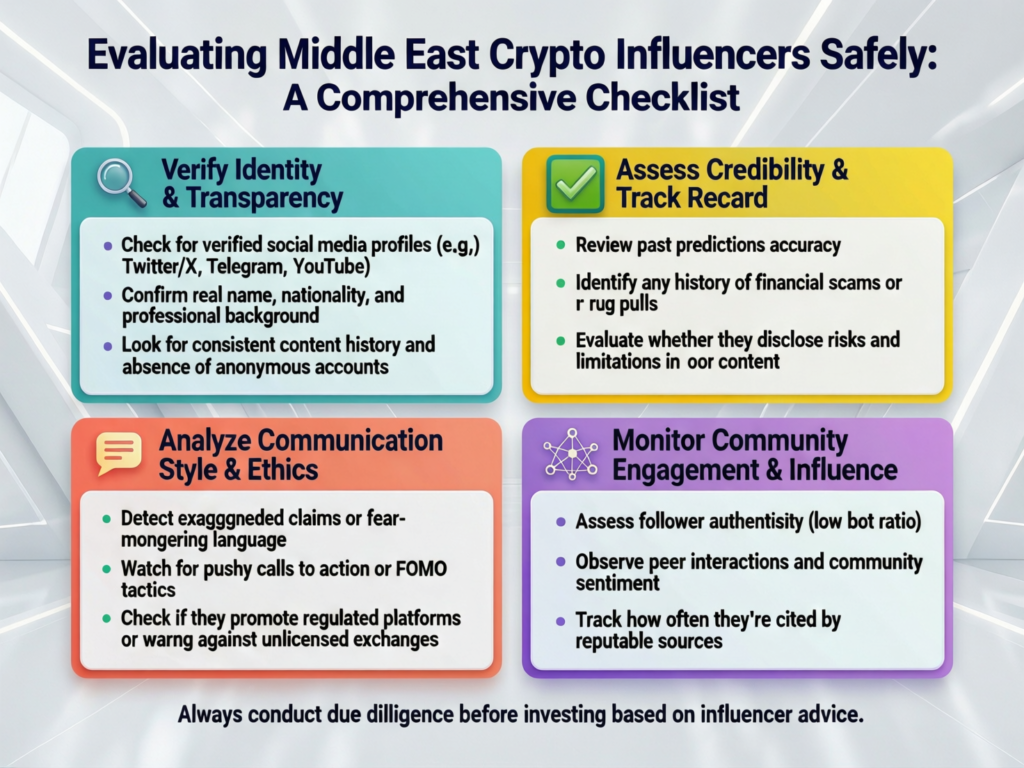
A trustworthy Middle East crypto influencer is transparent about paid promos, shares clear risk warnings, avoids guaranteed returns and broadly aligns with rules from VARA, MiCA and local regulators like BaFin for EU-facing content. Think of them as media channels that should follow basic advertising and financial promotion standards, even if they’re not fully licensed advisors.
Red flags and scam patterns to avoid
Certain patterns should trigger instant skepticism, whether the account is in Dubai, Jeddah or Beirut.
Unrealistic ROI promises (“100x guaranteed”, “no-loss strategy”)
Undisclosed pre-sale or seed allocations, especially when combined with heavy shilling.
Pressure to join copy-trading schemes or high-leverage derivatives with no risk disclaimers.
Fake screenshots of PnL or balances, often recycled across multiple accounts.
Obvious bot-inflated follower counts and low real engagement relative to audience size.
BaFin and other European regulators have specifically warned about crypto tips on social media and messenger apps, including from “financial influencers” who overstate returns or understate risk. l)
Transparency, disclosures and paid promotions
For US, UK and EU readers, treat crypto content like any other financial promotion:
Look for #ad, “sponsored”, or clear affiliate disclosures on X, YouTube and Instagram.
Check if the influencer clearly distinguishes between organic opinions and paid campaigns.
In Dubai, VARA’s Marketing Regulations apply to any virtual asset promotion targeting the UAE domestic or foreign and set expectations for fair, not-misleading messaging.
That aligns with EU standards under MiCA (transparency, disclosure, supervision) and UK guidance from the FCA on crypto financial promotions.
If you never see disclosures but the feed is full of low-cap tokens, assume conflicts of interest.
Compliance signals for US, UK, Germany & EU readers
When you join newsletters, Discord servers or gated Telegram groups, you’re also sharing data. For EU or UK residents that means GDPR/DSGVO and UK-GDPR should apply; look for privacy policies, unsubscribe controls and limited tracking. (Mak it Solutions)
For platforms and products an influencer promotes, check.
Are they preparing for MiCA/MiCAR if they onboard EU users?
In Germany, do they mention BaFin or MiCA-aligned licensing where relevant?
For exchanges/wallets, do they claim PCI DSS and SOC 2 compliance and hosting on reputable clouds like AWS, Azure or Google Cloud? (Mak it Solutions)
None of these prove safety, but together they tell you whether the ecosystem around an influencer respects basic governance something Mak it Solutions often emphasises in its work on Middle East data centers, cloud providers and DevSecOps for GCC leaders. (Mak it Solutions)
Top Middle East Crypto Influencers to Follow in 2026
The most trusted Middle East crypto influencers in 2026 are a mix of Dubai- and Saudi-based traders, on-chain analysts and educators who post consistent, bilingual research, make their conflicts clear and never promise guaranteed profits. Use this list as a discovery map, not a ranking of “best traders” and always verify whether their approach matches your risk profile and local rules.
Investor-grade Middle East & MENA list (English & Arabic)
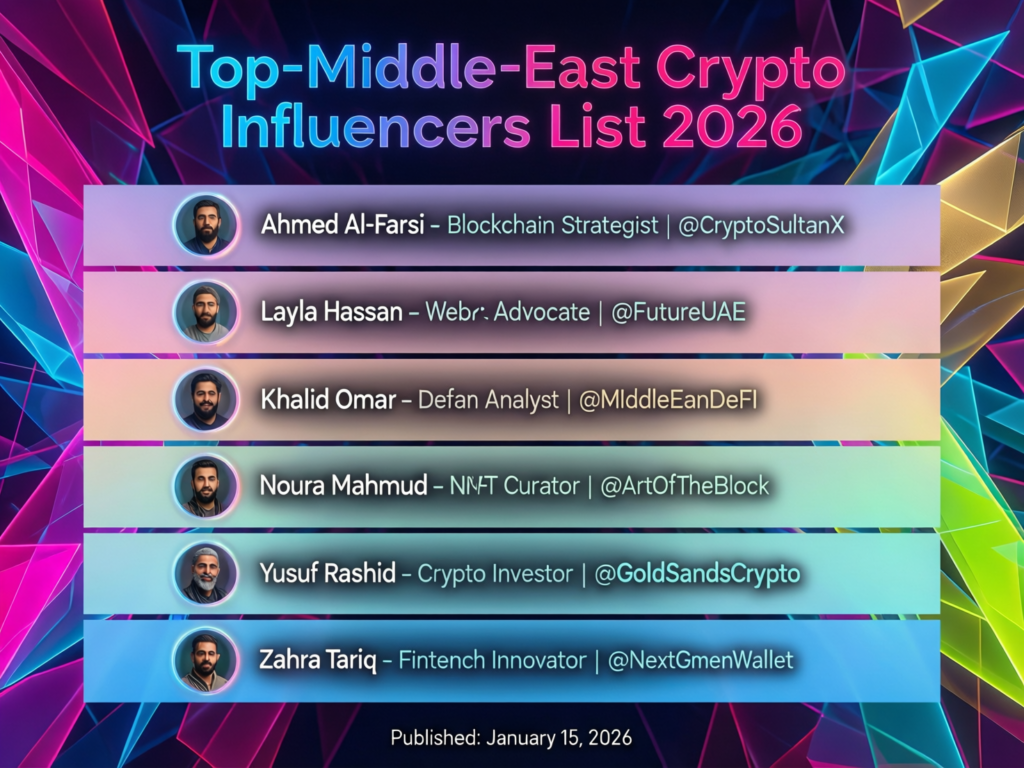
Based on follower quality (not just volume), engagement, content depth and language mix (English/Arabic, sometimes German), here are 12 Middle East crypto and Web3 creators to explore in 2026. Inclusion is not endorsement or financial advice:
Luiz Claudio (Dubai, UAE)
Instagram-first macro and altcoin commentary with more than ~1M followers, focused on education and mentorship. Best for high-level trend awareness.
Mohammad Galadari (Dubai, UAE)
Long-time Web3 and blockchain voice with a pan-MENA audience; relevant for US investors tracking Dubai’s deal flow and regional sentiment.
Mohammed Alsaadi (Dubai, UAE)
GCC-facing trader who mixes Arabic and English, useful for UK traders and EU desks wanting local flavour and early reactions to Dubai news.
Crypto Rover / Daan de Rover (Dubai, UAE)
Popular English-language macro trader with a Dubai base; good for BTC/ETH cycle narratives from a MENA hub, especially for London and Amsterdam desks.
Moe Valerian (Dubai & New York)
Bridges Dubai and US markets; commentary often framed for US investors evaluating GCC exchanges and liquidity.
Mery Way (Dubai, UAE)
Often described as “Dubai’s leading female voice in crypto”, focused on brand and community building; useful for Web3 SaaS and fintech marketers designing GCC campaigns.
VYSE CRYPTO (Saudi Arabia)
YouTube channel covering trading, projects and education in Arabic; a strong candidate “für europäische Investoren” seeking Arabic-first views with English concepts.
Crypto King Arab (Saudi Arabia)
Large Arabic YouTube channel with over 1M subscribers, sharing news and project breakdowns with explicit non-advisor disclaimers. Good for sentiment, not for blind copying.
Grazly Geek (Saudi Arabia)
Tech and crypto creator with a six-figure following; helpful for younger EU and UK retail audiences exploring KSA narratives.
Regional Web3 policy and event accounts (Abu Dhabi, Doha, Manama)
Official or semi-official channels around major Gulf events and accelerators often highlight builders and MENA Web3 thought leaders worth following.
Women in Tech / Women in Web3 MENA lists
“Women in blockchain MENA” award lists surface founders and policy leads in Dubai, Riyadh, Cairo and Beirut who share nuanced insights in English and Arabic. (Mak it Solutions)
Local DeFi and NFT community leaders in Cairo, Amman and Beirut
Smaller, high-signal accounts often found via Telegram or Twitter lists, especially valuable für deutsche Investoren and other EU readers targeting specific Arabic-speaking markets.
Again: do not copy trades from any list. Use these names to build a watchlist and then narrow down which voices fit your strategy, time horizon and compliance posture.
DeFi, NFTs, Web3 builders & on-chain analysts
Within the broader pool, many creators specialise.
DeFi yield and on-chain analysis
Accounts that walk through Dune dashboards, on-chain flows and protocol risk (often hosted on AWS or other clouds).
NFT, GameFi and metaverse
Influencers in Dubai, Riyadh and Doha who bridge gaming, esports and digital collectibles overlapping with trends in the region’s gaming and data-center buildout. (Mak it Solutions)
Regulation explainers
Lawyers, consultants and policy analysts who translate VARA guidance, ADGM rules and MiCA/ESMA updates into threads and YouTube breakdowns, including BaFin-specific notes for German users.
If you care about compliance, prioritise influencers who cite original rulebooks (VARA, ADGM, MiCA) rather than vague “Dubai is 100% crypto-friendly” claims.
Methodology, data sources and disclaimers
This list leans on.
Public rankings (Feedspot, Grynow-style lists, Heepsy and similar discovery tools)
Engagement metrics and audience quality where available.
Visible transparency: disclaimers, #ad usage, risk warnings.
However.
Popularity ≠ safety.
Education ≠ regulatory license.
Nothing here is a guarantee of future conduct.
Treat every influencer as one input to your research stack alongside data analytics, BI dashboards and regulated research similar to how institutional teams using Mak it Solutions’ business intelligence services would approach multi-source data.
Country & City Hotspots: Dubai, UAE, Saudi Arabia & Beyond
If you care about GCC markets, start with Dubai and Abu Dhabi in the UAE, then add Riyadh and Jeddah in Saudi Arabia, with emerging scenes in Doha, Manama, Kuwait City, Muscat, Cairo and Beirut. Each cluster has its own mix of traders, educators and Web3 builders.
UAE & Dubai/Abu Dhabi crypto influencers
Searches like “Dubai crypto influencers” and “UAE crypto influencers” now return dozens of lists from platforms such as Feedspot, Grynow and local agencies ranking Instagram, TikTok and YouTube creators.
For US crypto funds in New York or San Francisco, Dubai-based KOLs are particularly useful for.
Reading VARA’s marketing rules “through practitioner eyes”.
Understanding how ADGM/FSRA-regulated entities structure custody and token offerings.
Tracking cross-listings between Dubai venues and EU or UK exchanges.
UK fintechs and EU exchanges in Berlin or Amsterdam often collaborate with UAE influencers who can communicate nuanced VARA and ADGM rules without promising returns, aligning with MiCA’s focus on transparent, non-misleading disclosure.
Saudi Arabia, Riyadh & Jeddah influencers
“Saudi Arabia crypto influencers” and “KSA crypto influencers” mostly surface TikTok and YouTube traders based in Riyadh and Jeddah, many of whom cross-post to X/Twitter for English-speaking audiences. Heepsy and similar platforms show popular channels such as VYSE CRYPTO, TARIK CRYPTO, ASSIKI TECH and Crypto King Arab.
These creators are powerful for GCC-wide sentiment: a short in Arabic on Friday night can echo into Monday trading in London or Frankfurt. But the same safety rules apply check disclaimers, avoid leverage FOMO, and ensure any actions respect your local BaFin or FCA guidance.
Qatar, Bahrain, Kuwait, Oman, Egypt & Levant
Outside UAE and KSA.
Qatar (Doha)
Influencers often focus on institutional adoption and fintech, reflecting Qatar’s work on crypto-friendly financial centers and digital economy.
Bahrain (Manama)
Many local KOLs focus on regulated exchange activity and digital banking, mirroring the country’s push to attract global investment managers.
Kuwait City & Muscat
Smaller but growing creator bases, often mixing stock and crypto commentary.
Cairo, Amman, Beirut
High-energy scenes for developer-focused and Arabic-first education, often overlapping with AI, gaming and broader tech. (Mak it Solutions)
For brands targeting specific markets say a Berlin-based exchange expanding into Egypt partnering with local-language influencers in Cairo or Alexandria can outperform generic GCC-wide campaigns.
X, YouTube, Instagram, TikTok & Telegram in MENA
For real-time sentiment, start with X/Twitter; for deep dives, use YouTube; for brand-style collabs, pick Instagram/TikTok; and for high-risk alpha, tread carefully in Telegram groups.
X / Twitter real-time sentiment and macro calls
Most serious MENA traders and analysts treat X/Twitter as their main broadcast channel:
Threads for BTC/ETH macro, altcoin rotations and chain flows.
Spaces featuring guests from New York, London, Dubai and Riyadh.
Public lists that group “GCC crypto traders”, “MENA Web3 thought leaders” and “regulation watchers”.
If you’re based in New York, London or Berlin, configure lists and mobile alerts around your own timezone so GCC updates feed into your morning prep rather than becoming 3am noise.
YouTube long-form education & GCC regulation explainers
YouTube hosts many “MENA crypto YouTubers” who:
Break down project fundamentals, tokenomics and security.
Explain how VARA, ADGM/FSRA and MiCA apply to exchanges or tokens.
Walk through chain analysis dashboards and portfolio construction.
Creators like VYSE CRYPTO and other Saudi or UAE-based channels often attract viewers from Germany, the Netherlands and Switzerland looking for deeper regional insight without reading full legal texts.
Instagram, TikTok & Telegram reach vs. risk
“Dubai crypto influencers on TikTok” and UAE/Saudi IG creators are great for reach, aesthetics and brand collaborations especially if you’re promoting mobile apps on iOS or Android, or building lifestyle-heavy campaigns.
Telegram, by contrast, is where risk spikes.
Anonymous admins and fast-moving “alpha” groups.
Heavy leverage shilling and unverified pre-sales.
Front-running and pump-and-dump risk, especially for small caps.
Join to observe sentiment, not to YOLO trades. And never wire funds or share KYC documents based purely on a Telegram pitch.
Working With Middle East Crypto Influencers as a Brand
US, UK and EU brands should start with clear goals, shortlist compliant Middle East KOLs with transparent disclosures, then structure deals that respect VARA, MiCA and local ad rules. Think of it as regulated cross-border marketing, not casual endorsement.
Defining goals for US, UK, German & wider EU brands
Before DM’ing anyone in Dubai or Riyadh, decide whether you’re optimising for:
Awareness impressions in GCC markets or among Arab diaspora in London, Paris, Berlin.
Sign-ups or volume exchanges, brokers, wallets, DeFi apps.
B2B lead gen Web3 SaaS, data platforms, infrastructure or consulting.
A New York crypto fund might want macro-focused Spaces hosts in Dubai. A London fintech may prioritise bilingual UAE influencers who can explain PSD2/Open Banking tie-ins. A Berlin-based exchange regulated under BaFin and MiCA might choose German-speaking KOLs in Dubai familiar with EU capital-market culture.
Structuring compliant collaborations & contracts
Your contracts should cover.
Format (sponsored threads, YouTube integrations, AMAs, X Spaces, conference appearances).
Clear disclosure obligations (#ad, “sponsored by…”, pinned disclaimers).
Prohibition on “guaranteed returns” or unapproved product claims.
Alignment with VARA Marketing Regulations, MiCA and local financial promotion rules in the UK and EU.
Work with legal and compliance teams early the same way Mak it Solutions’ clients coordinate cloud, security and data-residency decisions when they launch new products in GCC and Europe. (Mak it Solutions)
Tools, platforms and measurement
Discovery platforms such as Heepsy, Grynow, HiveInfluence, Modash and Feedspot help you filter influencers by geography, audience quality and niche.
For measurement.
Use UTM-tagged links and first-party analytics (web + in-app).
Align tracking and cookie banners with GDPR/DSGVO and UK-GDPR. (Mak it Solutions)
Host dashboards securely (for example on AWS, Azure or Google Cloud) with strong access controls, similar to other BI or SaaS workloads. (Mak it Solutions)
Women & Emerging Voices in MENA Web3 & Crypto
A growing group of women and emerging MENA Web3 voices provide high-quality education, policy insight and community building, and are often less over-exposed than headline KOLs.
Highlighting women in MENA Web3 & crypto
Recent “women in fintech/blockchain MENA” lists and awards highlight founders, product leaders and researchers across Dubai, Riyadh, Doha, Cairo and Beirut. (Mak it Solutions)
These women often.
Run education-first channels.
Lead policy discussions around digital assets, data privacy and AI.
Speak at GCC tech events and accelerator programs.
They’re especially relevant for brands that care about diversity, corporate governance and long-term trust, not just short-term clicks.
Local-language and niche-community influencers
Don’t overlook.
Arabic-first channels serving specific cities (Jeddah, Amman, Muscat) or professions (Sharia-compliant finance, healthcare, logistics).
Bilingual English/Arabic or English/German creators who translate GCC developments for EU investors.
Faith-aware or value-aligned communities that blend Islamic finance principles with digital-asset education.
For a Zurich or Frankfurt asset manager wanting very specific audiences, these smaller, niche MENA Web3 thought leaders can be far more effective than mega-KOLs.
Key Risks, Disclaimers & Best Practices for US/UK/EU Readers
Treat every Middle East crypto influencer as one input into your research, never a sole decision-maker; cross-check claims, use regulated venues, and follow your local rules before acting. Your regulator (SEC, FCA, BaFin, AMF, etc.) ultimately cares about your decisions, not who you followed.
Why it’s risky to rely only on influencer tips
Relying solely on influencer tips is risky because:
Crypto markets remain highly volatile and easily manipulated.
Influencers may have undisclosed positions or seed allocations.
As BaFin, ESMA and other regulators repeatedly warn, social-media promotions can hide conflicts and exaggerate potential returns. (PwC Legal)
Echo chambers also form quickly: if the same bullish thread circulates from Dubai to London to New York, it can feel like “consensus” even when based on weak research.
Balancing influencer insight with independent research
Professional investors including big tech ecosystems that deploy billions in crypto-adjacent infrastructure on AWS or in Gulf data centers never rely on single voices. They combine:
Influencer sentiment and narratives.
On-chain data and analytics.
Research from regulated firms.
Project documentation and open-source code.
Mak it Solutions regularly helps clients build self-service BI and analytics stacks that fuse these inputs into dashboards for New York, London and Berlin teams; you should think in the same multi-source way, even as a serious retail trader.
Practical checklist before you act on any influencer content
Before acting on any tip from a Middle East crypto influencer:
Verify the project official site, docs, team, audits, on-chain activity.
Check disclosures is this sponsored, affiliated or part of a private round?
Cross-check sources look for independent analyses, not just one KOL.
Size positions modestly never invest money you can’t afford to lose.
Use stop-losses and risk limits where appropriate.
Trade on regulated or reputable venues that aim to comply with MiCA, BaFin, FCA or your local rules.
Re-read your local guidance (e.g., EU/ESMA or UK FCA warnings) before committing capital. (esma.europa.eu)


Final Thoughts
Middle East crypto influencers give you an invaluable window into a region that has become one of the world’s most dynamic crypto and Web3 hubs. From Dubai and Abu Dhabi to Riyadh, Doha and Manama, MENA voices now help shape global liquidity, narratives and regulation but they’re still just one input in a much bigger decision stack.
Bookmark a small, curated list of trusted KOLs, combine their insights with data and regulated research, and revisit your roster at least once a year as the market and rules evolve. If you’re a fund, exchange or Web3 SaaS team in the US, UK, Germany or wider EU, the next step is building a structured approach to influencer discovery, vetting and measurement not just following whichever account trended this week.
If you’re planning campaigns or research that depend on Middle East crypto influencers, you don’t have to build the framework alone. Mak it Solutions can help you design compliant, data-driven workflows from discovery and vetting dashboards to GCC-ready landing pages and analytics hosted on AWS or regional cloud providers.
Explore Mak it Solutions’ insights on web development trends in the Middle East, blockchain applications in MENA, Middle East cloud providers, data analytics and BI in the region, and DevSecOps in GCC to see how the team already supports Saudi, UAE and Qatar leaders then reach out for a tailored roadmap to your next GCC-ready Web3 campaign.( Click Here’s )
Key Takeaways
MENA is now a top-tier crypto market, accounting for roughly 7–8% of global transaction volume and hosting major hubs in UAE, Saudi Arabia, Qatar and Bahrain.
Middle East crypto influencers offer unique early signals on GCC projects, listings and regulations but must be treated as one research input, not trade-oracles.
Safety hinges on transparency and compliance, including clear ad disclosures, risk warnings and alignment with VARA, MiCA and local regulators like BaFin.
Brands should define GEO-specific goals and structure contracts that respect UAE, EU and UK marketing rules while using discovery platforms like Heepsy, Modash or Feedspot to filter for quality.
Women and emerging voices in MENA Web3 are increasingly important, especially for nuanced education, policy insight and diversity-focused campaigns. (Mak it Solutions)
Serious investors in New York, London or Berlin should mirror institutional practice: cross-check influencer content with on-chain data, BI dashboards and regulated research before acting. (Mak it Solutions)
FAQs
Q : Are Middle East crypto influencers regulated by VARA, MiCA or BaFin when they post for EU and UK audiences?
A : Not usually as individuals — but the content they publish can still fall under marketing and financial-promotion rules. In Dubai, VARA’s Marketing Regulations apply to any virtual asset promotion targeting the UAE, whether the promoter is domestic or foreign. In the EU, MiCA sets harmonised rules for crypto-asset offerings, and national regulators like BaFin can intervene if marketing to German consumers is misleading or unsafe. For UK or EU audiences, it’s safer to assume regulators will treat some influencer posts as promotions, even if the creator isn’t licensed.
Q : Do most Dubai and Saudi crypto influencers post in English, Arabic or both for international traders?
A : Many leading UAE and KSA influencers are bilingual, mixing Arabic with English captions or videos to reach both local and global audiences. Dubai-based creators often lean heavily on English to attract investors from the US, UK, Germany and wider EU, while Saudi YouTubers and TikTokers may prioritise Arabic with English subtitles or summaries. When building a watchlist, aim for a mix: Arabic-first channels for local nuance, and English-heavy accounts for smoother integration into your existing US/UK research stack.
Q : Can US or UK investors legally act on trading calls from Dubai-based crypto influencers?
A : In most cases, US and UK investors can act on publicly available information, but they still must follow their own country’s laws including tax rules, KYC/AML expectations and, in some cases, restrictions on certain derivatives or tokens. Regulators like the SEC, FCA and ESMA focus on whether products are sold appropriately and whether promotions are fair, clear and not misleading, regardless of where the influencer sits. If in doubt, treat overseas influencer content as general information and get professional advice before making large or leveraged bets.
Q : How much does it typically cost to hire a top Dubai or UAE crypto influencer for a campaign?
A : Rates vary widely based on follower count, engagement, niche and deliverables. A mid-tier Dubai Instagram or TikTok creator in crypto might charge anywhere from a few hundred to several thousand US dollars per sponsored post, while top-tier KOLs with strong UAE and GCC audiences can command five-figure campaign packages that bundle posts, Stories, AMAs and event appearances. Discovery platforms like Heepsy, Grynow, HiveInfluence and Modash, plus local agencies in Dubai, can give you current CPM benchmarks and help negotiate packages.
Q : Which Middle East crypto influencers are best for learning about EU rules like MiCA and German BaFin guidance?
A : Look for lawyers, compliance officers and policy-focused KOLs in Dubai, Abu Dhabi, Riyadh or Bahrain who regularly cite primary sources such as MiCA texts, ESMA updates and BaFin warnings in their posts or YouTube videos. They may not always appear in “top follower” lists but often show up on LinkedIn, in conference speaker rosters or in specialist newsletters. Combine their content with official sources ESMA’s MiCA hub, BaFin’s crypto warnings and EU-wide risk statements for a grounded view of how GCC activity interacts with EU regulation.